
A method to leverage legacy
Oracle Forms applications in an SOA
Master thesis J. Versteeg Bsc
A method to leverage legacy
Oracle Forms applications in an SOA
N
AMEJeroen Versteeg
S
TUDENTNUMBER0015768
P
LACE ANDDATEUtrecht, June 17, 2008
I
NSTITUTEUniversity of Twente, Enschede, The Netherlands
F
ACULTYSchool of Management and Governance (SMG)
P
ROGRAMMEBusiness Information Technology (MBI)
C
OMPANYOracle Nederland B.V., De Meern
C
OMMITTEEdr. M.L. Ponisio
1st university supervisor
Electrical Engineering, Mathematics and Computer Science (EEMCS)
dr. M.E. Iacob
2nd university supervisorSchool of Management and Governance (SMG)
J.W. Sieben MBA
1st company supervisorSummary
In the last couple of years, Service Orientated Architecture (SOA) has gained a lot of momentum as a promising concept for IT systems. Vendors and organizations are adopting this technology in hope of creating more flexible and maintainable IT systems. While SOA looks like a very desirable architecture, most organizations do not start with a clean slate, but instead have made large investments in older technology, which usually does not integrate well with SOA. Many of these organizations face a dilemma with respect to the choice between keeping these outdated systems or replacing them with something new.
According to market research, thousands of organizations are facing this problem with respect to applications that have been developed using the Oracle Forms application development framework. Now that Oracle is adopting SOA for new products (and newer version of existing products), customers feel pressure to adopt SOA, and need to decide what to do with existing Forms applications.
While a lot of research has been done on replacing or re-engineering legacy systems, these approaches are often infeasible because of the costs and risks involved. Because these approaches have been developed using a technical viewpoint and hence do not take into account the particular business problems that need to be solved, they often cannot predict the actual business benefits the approach will deliver.
The decision support method presented in this thesis takes a business-oriented viewpoint and helps organizations find a solution which solves the business problems it is actually facing because of the system. To this end, the method directs participants to analyze why exactly the system does not fulfill a particular business requirement, and to find a solution that solves this problem. Since this research acknowledges that legacy applications should be abandoned in the medium to long term, the emphasis lies on finding solutions that either require little investments in the legacy system, or enable a gradual transition towards a more modern application.
Acknowledgments
It is safe to say that this research would not have reached its goal without the help and support of a number people. First and foremost, I would like to thank my supervisors Maria Laura Ponisio and Maria Iacob for their feedback and their patience. I very much enjoyed discussing the direction of my thesis with them during our meetings in Enschede as well as via email. Maria Laura especially gave me guidance on which steps to take next, and perhaps most importantly, the encouragement to carry on when I needed it most.
Secondly, I would like to thank Remco Rosbergen and Jan-Willem Sieben, my supervisors at Oracle, for facilitating my project and introducing me to the right experts. In particular I would like to thank Jan Kettenis for taking the time to familiarize me with the OUM and to help develop my method, which is the primary contribution of this research.
Apart from the people who helped me directly with the research project and the thesis, there are number people who supported me personally during the project. A big thanks goes out to my family and friends, who supported me throughout the project and helped me cope with the personal issues I was facing at the time.
I would also like to acknowledge Gerben's patience with me during the time that I could contribute little to our company Asystance. It is because of his dedication and hard work that the company we started six years ago now provides us both with full-time employment and rewarding work.
Last but certainly not least I want to express my gratitude to all the friends I have made in Enschede, for making the six years I have spent there an enjoyable and unforgettable episode of my life.
Table of Contents
Chapter 1: Introduction...7
1.1 About this research...8
1.2 Thesis structure...11
Chapter 2: Introduction to Oracle Forms and SOA...13
2.1 Legacy systems in general...13
2.2 Oracle Forms...14
2.3 Service Oriented Architecture...15
2.4 Comparison...15
Chapter 3: Business Drivers for SOA Adoption...19
3.1 Introduction...19
3.2 Current business drivers and trends...20
3.3 Advantages inherent in SOA...26
3.4 Advantages compared to Oracle Forms...28
3.5 Summary of advantages...29
Chapter 4: Leveraging Approaches...31
4.1 Introduction...31
4.2 Classification of modernization approaches...32
4.3 Decisional framework...35
4.4 Leveraging Oracle Forms...36
4.5 Replacing Oracle Forms...40
4.6 Existing methodologies...42
Chapter 5: Requirements...47
5.1 Legacy system quality...47
5.2 SOA maturity...51
Chapter 6: Method...53
6.1 Oracle Unified Method...53
6.2 Method description...55
Chapter 7: Validation...68
7.1 Scenario...68
7.2 Evaluation...74
Chapter 8: Conclusions and Recommendations...77
8.1 Answers to research questions...77
8.2 Open questions / future research...80
8.3 Recommendations...81
Appendix A: Introduction to Oracle Forms...i
Appendix B: Introduction to SOA...iv
Appendix C: Oracle SOA Maturity Model...vii
Appendix D: Oracle SOA Maturity Assessment Questionnaire...x
Introduction
C
HAPTER
1: I
NTRODUCTION
In recent years, academia and commercial IT vendors have both described Service Oriented Architecture (SOA) as a desirable architecture for enterprise information systems (EIS) (see [Kontogiannis 2007], [Papazoglou 2005]). Promises of automatically configuring Business to Businesses (B2B) applications, lower maintenance costs, higher business agility and other radical improvements are widely spread, creating a sense of hype around the concept. Like many other technologies before it, SOA has raised great expectations about how it will revolutionize the enterprise IT landscape.
Academics and IT vendors agree that SOA is the best architecture to support current business drivers (see [Kontogiannis 2007]). If an organization would decide to set up its enterprise architecture from scratch, it could surely be wise to invest in SOA technology. The same holds true for investments in new applications, which should be “SOA ready”, even if the organization's underlying enterprise IT architecture is not yet.
If we can learn a lesson from previous hypes surrounding IT technology, we see that once the dust that was stirred up by the hype settles, expectations start to become more realistic, and pioneers report the real benefits of that technology.
The SOA movement is just in this phase at the moment of writing. While the various (and numerous) standards are still evolving, and research on the topic is continuing, vendors are already selling mature products, and some early adopters are already starting to reap the benefits of the new technology, while others face disappointing results [InfoWorld 2007].
Organizations want to have the best of both worlds: reaping the benefits of an SOA, while keeping long-term investments in legacy systems (which are mostly “well tested and tuned, and encapsulate
considerable business expertise“ [Cormella-Dorda 2000] because of these investments).
Unfortunately, there is a true generation gap between not only the architectures, but also between the technologies used in legacy and state-of-the-art applications. So is it possible to bridge the gap somehow?
1.1
About this research
1.1.1 Problem statement
One of the companies facing this challenge is Oracle Corporation, which has recently made the strategic decision to adopt SOA standards for its entire product suite. The company already offers a comprehensive suite of SOA middleware products and is committed to making all of its applications SOA compatible in the near future.
Oracle Forms and SOA are distinct technologies (see chapter 2), and no clear migration path is available to automatically move from Forms to SOA and Oracle's new development frameworks
(such as the Java-based Application Development Framework1).
According to a recent report by Gartner ([Gartner 2007]), the move away from Forms can be delayed but not avoided entirely. Organizations should already start migrating towards modern application development technologies like Java or .NET, because Forms is “ill-positioned for next generation AD [application development] challenges”. In conclusion, the “thousands" of applications built on Oracle Forms have to be migrated sooner or later.
But how can organizations “migrate” legacy systems to newer technology? According to Bisbal et al., “given the bewildering array of LISs [Legacy Information Systems] in operation and the problems they pose, it seems unlikely that a single generic migration method would be suitable for all systems” [Bisbal 1999].
Papazoglou et al. elaborate on their definition of “legacy” (quoted above) by stating: “Although there is strong corporate desire to replace legacy systems with modern technologies, the desire to replace these legacy systems is offset by real world constraints, such as massive long-term accumulated investments in the legacy systems and a significant loss of knowledge about the inner
1 See http://www.oracle.com/technology/products/adf/index.html
About this research
workings of these systems. The value of business logic in the legacy systems combined with the huge investments companies have already made in the development of their existing systems, are a powerful incentive to leverage these systems into modern business initiatives rather than replace them or recreate them with modern technologies.” [Papazoglou 2006, p. 468]
1.1.2 Goal of this research
This thesis is based on a prescriptive design research. The goal of this research is to develop a method that helps in leveraging legacy applications built on Forms in an SOA. In this context, “leveraging” means any approach that delivers one or more of the benefits of SOA while not completely abandoning the investments that have been made in the legacy application(s). This is not to be confused with “maintenance”, which is usually concerned with keeping a system running or correcting faults, without enhancing it to add value (see the definition on maintenance in section 4.1.1).
There are two reasons why SOA is the target architecture in the context of this research. The first is Oracle's choice to adopt SOA, which means that customers who wish to keep using Oracle's applications and middleware products also need to adopt SOA. The second reason is that a lot of organizations today wish to adopt SOA anyway. This research does not concern itself with the rationale behind this choice but instead accepts SOA as part of its context.
1.1.3 Research questions
The main research question is:
How can existing legacy IT applications be leveraged in a Service-Oriented Architecture, and which factors influence the choice between possible alternatives?
The first part of the question is vague and abstract because there are many fundamentally different ways to leverage legacy IT applications. Additionally, we have to find out exactly which alternatives are possible.
The second part acknowledges that some factors will guide or even dictate the choice between possible alternatives. Brooke and Ramage ([Brooke 2001]) state that business strategy must lead the evaluation of legacy systems. This project recognizes the need to take the business driver for change into account, and investigates the following factors:
● the organization's business driver to leverage the legacy application in an SOA
● the quality of the legacy application, and
● the organization's maturity with respect to the service-oriented businesses model and SOA
technology
In order to be able to answer the main research question, it has to be split into sub questions. The answers to these questions will be compiled into a method (see [Hevner 2004]), which is the main contribution of this thesis (see section 1.1.5).
● Which business drivers are better supported by SOA than by legacy applications, and why?
● Which requirements do leveraging approaches pose on an organization's SOA maturity and
the legacy system's quality?
● How can an organization's SOA maturity be measured?
● Which quality attributes of legacy systems are relevant with respect to this thesis?
○ How can these quality attributes be measured?
1.1.4 Scope
This research focuses on a particular kind of legacy, namely monolithic applications built around Oracle Forms, a framework for building enterprise applications based on proprietary Oracle technology. This focus will also increase the utility of the research, since generic approaches have already been covered in the literature (e.g. [Lewis 2006], [Cormella-Dorda 2000], [Bergey 2001], [Lewis 2005], [Brooke 2001]), whereas the application of these general concepts in detail is lacking.
1.1.5 Contribution
The primary goal of the research project is to create a method that helps decision makers deal with the challenge mentioned above. The method takes an organization's business driver as a starting point and provides a recommendation on how to leverage the legacy application to meet business requirements.
Since Oracle Forms applications should be abandoned eventually ([Gartner 2007]), the alternatives for leveraging a legacy application considered in this thesis are short to medium term solutions aimed at fulfilling one particular business requirement.
1.1.6 Research approach
To answer the first research question, SOA and “legacy” (in particular Forms) need to be compared first. The next step is to identify which business drivers organizations currently face. With this knowledge in place, an answer to the first research question can be given.
To answer the second question, a literature study will be conducted to study and integrate knowledge on the topics of legacy system modernization and migration. The gathered knowledge will be extended and / or specialized by conducting interviews with Oracle experts in the Netherlands to integrate specialized knowledge on modernizing Oracle Forms applications.
After investigating which options are available to leverage Forms applications, interviews with Oracle experts will be conducted to identify the requirements they pose and research how these can be specified and measured.
About this research
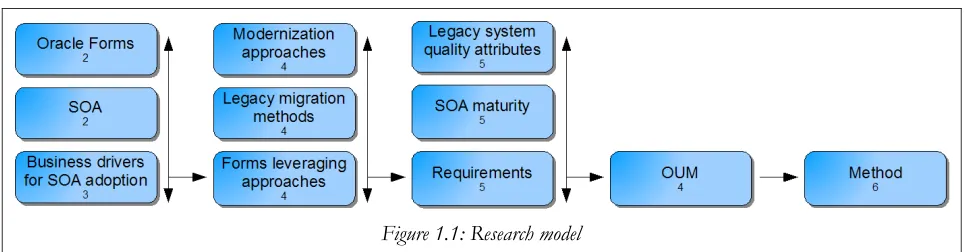
Figure 1.1 presents the research model for this approach.
1.1.7 Acceptance criteria and validation
The goal of this research is “to develop a method that helps in leveraging legacy applications built on Forms in an SOA”. The method also has to take into account the “business driver for change”. Together with the general guidelines for design science described in [Hevner 2004], these requirements form the basis of the validation criteria:
● Innovativeness: The method “must be innovative, solving a heretofore unsolved problem or
solving a known problem in a more effective or efficient manner.” [Hevner 2004]
● Applicability: The method needs to be applicable and complete. No steps or considerations
relevant to applying the method should be ambiguous or missing.
● Utility: The method must be useful to Oracle and its customers. This criterion can be split
into two sub-criteria.
○ The method has to fit both Oracle's existing methodologies and business strategy.
○ The method has to help the subject organization reach a decision about its short to
medium term strategy regarding the legacy application.
1.2
Thesis structure
The remainder of the thesis is structured as follows:
Chapter 2 provides a detailed discourse of both service oriented and legacy architectures and compares the two in order to identify the key features that enable SOA to better support current business drivers as discussed in the third chapter.
Chapter 3 presents the business benefits to adopt SOA, based on a literature study. First, a list of common business drivers will be presented, followed by a discussion on how SOA is better equipped to support these drivers than legacy architectures.
Chapter 4 presents an overview of the literature about approaches and techniques that can be used to leverage or migrate legacy applications. The list of approaches is extended with those described and employed by Oracle specialists.
Chapter 5 discusses which requirements the approaches place on the legacy application and the organization, and which measurements can be made to evaluate which approaches are feasible.
Chapter 6 first presents related work on decision support methods found in the literature. The second section presents the method, which forms the main contribution of this thesis.
Chapter 7 contains the validation of the method based on a scenario.
Chapter 8 presents the conclusions and recommendations for Oracle and provides pointers for further research.
Appendix A described the Oracle Forms application development framework in detail.
Appendix B provides a primer for the technologies and terminology behind the “Service Oriented Architecture” (SOA) concept, and compares SOA architecture to (common) legacy architectures.
Introduction to Oracle Forms and SOA
C
HAPTER
2: I
NTRODUCTION
TO
O
RACLE
F
ORMS
AND
SOA
This chapter compares Oracle Forms to SOA technology and identifies key differences that make SOA the more desirable architecture.
2.1
Legacy systems in general
2.1.1 Definition
The term “legacy system” can be used for systems that are no longer supported (e.g. because the hardware they run on is no longer manufactured, or because it is very difficult to find skilled developers because the technology has become outdated), but this definition does not consider any implications (e.g. maintenance costs are high, or the system is resistant to change). In this thesis, Papazoglou's description of legacy is used, which was introduced in the first chapter and is reproduced here for convenience.
Papazoglou goes on to state that “[t]he value of business logic in the legacy systems combined with the huge investments companies have already made in the development of their existing systems, are a powerful incentive to leverage these systems into modern business initiatives rather than replace them or recreate them with modern technologies.”
This is exactly the situation that organizations with large systems built on Oracle Forms face. While the technology is still supported (and will be for some time, according to Oracle2), the characteristics of the framework make these systems difficult to change.
2.1.2 Architectures
Architectures of legacy systems often follow a single- or two-tier approach. A tier is a logical layer of a system. The idea behind this is that these layers operate independently of another and expose services to upper layers and consume services offered by lower layers (similar to the layers of the OSI networking model). Dividing applications into multiple tiers is considered a good practice, since it reduces coupling, thereby making it easier to change or replace one part of a system with little or no effect to the other parts (see appendix A for more). The notion of “tiered architectures” also helps to compare different architectures.
A two-tiered architecture usually consists of one tier that includes the presentation logic (which creates user interfaces) as well as the data processing logic, and a separate tier that houses the database, which is accessible through the network. A single-tier architecture combines these two and usually runs on mainframes. The main characteristic of these architectures is the low cohesion of the application's code. This makes them very time-consuming and difficult to maintain, since local changes can have global effects, requiring extensive analysis of the code before making changes and extensive testing after the changes have been made.
The client applications in two-tiered architectures are often called “fat clients” because they provide rich functionality by handling input validation and data processing locally, in contrast to “thin clients” which require servers to perform these tasks for them.
2.1.3 Problems
Most legacy architectures have several major drawbacks, as has been thoroughly discussed in the literature ([Britton 2004], [Papazoglou 2006], [Alonso 2004]). The most important problems are monolithic development and tight coupling, which both make maintenance complex and time-consuming, and use of proprietary standards, which hinders system integration and requires specialized development skills.
2.2
Oracle Forms
Oracle Forms is an application development framework for enterprise applications. It allows developers to quickly create applications using the developer suite. Applications built on Oracle
Forms technology3 vary greatly in size, from applications with only a few dozen “screens” to
enormous systems consisting of several hundreds. Please refer to appendix A for a more detailed introduction to Oracle Forms.
Oracle Forms applications fit the general description of legacy systems quite well. They also fit the definition, since their architecture and other technical characteristics often make them difficult to
Oracle Forms
modify. However, this is not necessarily true for every application. The maturity of the framework and the development tools do make experienced developers very productive.
2.3
Service Oriented Architecture
The Open Group defines SOA as “an architectural style that supports service orientation. Service orientation is a way of thinking in terms of services and service-based development and the outcomes of services. A service:
● Is a logical representation of a repeatable business activity that has a specified outcome
(e.g., check customer credit; provide weather data, consolidate drilling reports)
● Is self-contained
● May be composed of other services
● Is a 'black box' to consumers of the service” [OPENGROUP 2006]
The term SOA is also used to refer to a set of standards, including SOAP, WSDL, UDDI, BPEL and others, which describe how services can be described, invoked, published and integrated.
Appendix B contains a detailed description of SOA.
2.4
Comparison
To understand the key differences between Oracle Forms and SOA, we will compare different aspects of each. We will compare commonly used technology, the division of the application among tiers and integration technology.
2.4.1 Standardization
For the last decade, the programming language of choice for enterprise application development is Java. The use of the language is so widespread that one could call it an industry standard. Sun, the creator of the language, has also recently opened the specifications and source code for the language, a move which will further increase compatibility between Java platforms.
However, in an SOA, which programming language is used to implement services shouldn't matter, since services can be considered black boxes that only have to expose an API using standards. So although the standardization of Java is good for lowering maintenance costs and other reasons, from an architecture point of view, it doesn't matter in which languages the services are implemented, and developers are free to chose different languages and even platforms (hardware, operating systems) as long as the APIs of the services use standards.
The situation is completely different in legacy applications. Each application can use different technologies, and integration and maintenance efforts have to consider these differences. The problem is even worse when the technology is proprietary, such as Oracle's PL/SQL.
time-consuming, since products from different vendors (should) work together and developers need no knowledge of proprietary standards and technology.
2.4.2 Separation of concerns
A good practice in software engineering and systems architecture is separation of concerns, which means that pieces of code that deal with closely related aspects should be isolated (or separated) from code that deals with other aspects. This separation is important because it helps to keep cohesion high and coupling low, which in turn makes modifications easier to carry out (see also section 2.1.2).
While separation of concerns has always been a best practice, the technology, architecture and standards used in many legacy applications do not enforce or even encourage strong separation of concerns.
Separation of concerns is an important aspect in SOA. Multi-tier architectures, object and service orientation, and modern development practices all advocate and encourage separation of concerns (although they do not force it). This makes it difficult to migrate legacy systems to SOA, since the architectures usually are fundamentally different.
This section discusses how separation of concerns is generally implemented and advocated in legacy applications and SOA.
Difference between application and business logic
Application and business logic are two similar concepts. In this thesis, application logic will refer to logic that is technical in nature and deals with processing information, while business logic is abstract and is concerned with codifying business policies and rules.
Examples of application logic include code that deals with converting one currency to another, or code that formats a machine-readable message to a human-readable form. Code that decides whether a purchase order needs management approval based on the total price reflects a business rule and hence is considered business logic.
However, due to the vague definitions, the coverage of both types of logic does overlap. The distinction is an important one to make though, since each type of logic is (usually) dealt with in different parts of an application in an SOA, where in most legacy systems, the distinction is not made, and both types of logic reside in the same places.
Application logic
In an SOA, application logic should be implemented in a separate “middle tier” (which lies between the data tier and the presentation tier) and decomposed into and exposed as services.
Comparison
pieces of code. This makes it even harder to reuse or change parts of these applications, since they are not isolated from the rest of the application.
To make functionality reusable, legacy application developers often make use of stored procedures, which are pieces of logic exposed through a function and embedded in the database. The advantage of using stored procedures is that logic can be reused and exposed using a strict API. Stored procedures can be wrapped and exposed as web services, which makes it easy to make the logic reusable in an SOA.
Businesses logic
In legacy applications, business rules are usually embedded in the code (and possibly stored procedures), together with the application and presentation logic. Depending of the definition of business logic, even database constraints (like foreign key constraints) might be considered business logic.
Just like application logic, business logic should be handled as a separate concern in an SOA. One of the obvious locations for business logic is a BPEL model, but there are alternatives, like (proprietary) rules engines (that expose their functionality as services) and database constraints.
The main point is that while businesses logic can be found in every layer of both architectures, it is usually considered a best-practice to manage it as a separate concern. This is usually the case in SOA applications, while in legacy systems, it is usually embedded in the application code and interwoven with the rest of the logic (e.g. presentation logic). Additionally, business logic is modeled explicitly in SOAs (see section 3.3.5), whereas legacy systems often contain business logic distributed among the application or depend on users knowing which actions to take and in which order.
Presentation logic
Legacy applications often use proprietary and platform-dependent interfacing technology, and, again, the logic is integrated with the rest of the logic, as described above. The technology is also usually designed for one particular client, for example desktop computers running Microsoft Windows or “dumb terminals” connected to mainframe systems.
In an SOA, the presentation tier is separated from the other tiers and able to create different interfaces for different clients. Platform-independent technologies like XHTML, CSS and XSLT are employed to improve portability. Of course, platform-specific and proprietary technology can still be used, but since the presentation tier is independent of the others, a new channel can be added quickly.
As should be clear from the above discussion, separation of concerns is often lacking in legacy applications (which in turn might be one of the reason an application becomes legacy in the first place). SOA, on the other hand, enables and encourages separation of concerns.
2.4.3 Integration technology
Legacy system integration (for EAI or B2B efforts) can be achieved using different techniques, depending on the systems' (common) technology. One of the most common approaches for interfacing legacy systems is to directly access that system's database by running SQL queries on it. Another is to statically link systems' machine code at compile-time, which makes it impossible to change any aspect of the integration at runtime. Both techniques create tightly coupled systems and dependencies, which are considered bad practices because they make systems resistant to change.
A lot of alternatives have been developed (e.g. RPC, COM, CORBA - see [Britton 2004] and [Alonso 2004]) in the form of middleware solutions to solve these problems, but none has gained enough momentum to be widely deployed and used.
This is where web services promise fundamental improvements by providing interfacing technology that is based on mature and platform-independent technologies and open standards (see appendix B).
2.4.4 Summary
One of the design principles of SOA is clear separation of concerns. Applications are divided among multiple tiers, each of which are independent of one another. This makes the resulting architecture loosely coupled, and thus more flexible and easy to change when compared to most legacy systems, which often have almost the exact opposite properties. This means it would be beneficial if the method developed in this thesis helped in enforcing separation of concerns.
Legacy applications also mostly rely on proprietary and platform-dependent technologies, which creates a highly heterogeneous ecosystem that makes integration efforts difficult and costly. Most legacy systems also degenerate over time because the use of bad practices accumulates. This also negatively affects maintainability.
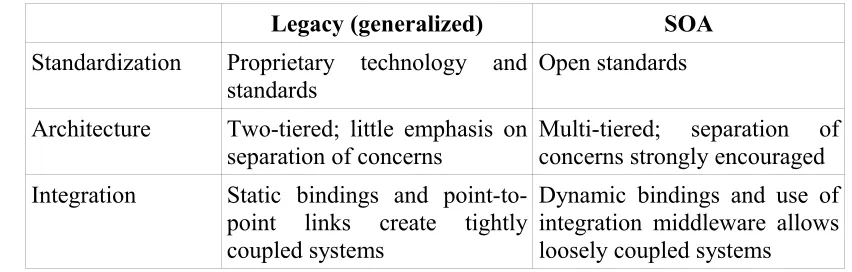
Table 2.1 provides a summary of the key differences between legacy and SOA based systems. It should be clear that the large differences make migrating legacy systems to SOA a difficult (and expensive) undertaking.
Legacy (generalized) SOA
Standardization Proprietary technology and
standards
Open standards
Architecture Two-tiered; little emphasis on
separation of concerns Multi-tiered; separation of concerns strongly encouraged
Integration Static bindings and
point-to-point links create tightly coupled systems
Dynamic bindings and use of integration middleware allows loosely coupled systems
Business Drivers for SOA Adoption
C
HAPTER
3: B
USINESS
D
RIVERS
FOR
SOA A
DOPTION
If we want to understand why SOA is considered the optimal IT architecture for today's enterprises ([Kontogiannis 2007]), we have to take a look at the business drivers it supports, and why it supports these better than previous architectures. This chapter will answer both these questions. The first part of this chapter provides an overview of current business drivers and opportunities organizations face. Subsequently, the reasons why SOA supports these better are discussed, based on high-level advantages of SOA over previous architectures.
3.1
Introduction
As described in the introduction (see section 1.1.3), the business driver is considered the starting point or primary input for the method developed for this thesis. However, interviews with Oracle experts have shown that, while one or more particular business drivers are the starting point for most organizations to consider SOA adoption, it is only indirectly relevant to the choice between leveraging alternatives for the legacy system. What is directly relevant for this choice is the way in which the current system does not sufficiently support the business driver(s).
If we look at it this way, we see that particular business drivers pose different requirements on organizations' IT systems. It is not the driver itself that directly influences the choice between leveraging alternatives, but rather the requirement(s) this driver poses on the information systems. To make this distinction explicit, we can differentiate between business drivers and IT drivers.
This change in perspective with regard to the method's input has been taken into account in the method as presented in chapter 6.
research. Consequently, the purpose of this discussion is not to promote SOA adoption or to make the case for SOA, but rather to describe part of the context for this research.
Sections 3.3 and 3.4 evaluate how the requirements on IT systems identified in section 3.2 are supported by SOA. This leads to a set of advantages of SOA over legacy systems in general and Oracle Forms applications in particular, which is presented in section 3.5. It is this set that is used as input for the method as described in chapter 6.
Since the set of SOA advantages is derived from a non-comprehensive list of businesses drivers, we cannot be sure whether the set of advantages is comprehensive. However, by covering the most common business drivers and by validating the set of advantages in interviews with Oracle's expert business consultants, the general applicability of the method can be guaranteed. By ensuring the method's extendability, its usefulness can be further improved. Please refer to section 8.2 for a discussion of the final method's applicability and shortcomings.
3.2
Current business drivers and trends
As stated in the introduction (chapter 1), SOA is considered the de-facto standard for enterprise applications [Kontogiannis 2007]. Unfortunately, the academic literature is not as verbose about
why this is so. It does list numerous technical advantages over previous (legacy) architectures (like reusability of code, separation of concerns, etc) [Alonso 2004], but it does not describe the necessity for these features from a business point-of-view, nor does it present solid empirical evidence to prove any of the claimed advantages are actually achieved. To paraphrase using the terminology of “Solution Selling” ([Bosworth 1994]), the literature does delve into the features and advantages of SOAs, but the discussion and proof of their benefits is lacking.
The industry literature does discuss benefits of adopting SOA. However, we have to be skeptical
when investigating the claims, since the majority of the literature is made up of vendors' marketing messages wrapped in commercial white papers and industry magazines, both of which lack a neutral stance.
3.2.1 Frameworks
To take inventory of aspects that are important to organizations, this section investigates two frameworks to compile a list of the most common business drivers. This list is used in sections 3.3 and 3.4 to show how SOA supposedly supports these drivers better than other architectures.
Strategic alignment
Current business drivers and trends
On of the areas of the strategic alignment model that can be directly supported by IT architecture is systemic competencies, found in the I/T strategy quadrant of the model. Systemic competencies are “those attributes of I/T strategy (for example, system reliability, cost-performance levels, interconnectivity, flexibility) that could contribute positively to the creation of new business strategies or better support of existing business strategy”.
Generic business strategies: Cost Leadership and Differentiation
To remain competitive in an increasingly globalized and fast-changing market, Ward and Peppard ([Ward 2003]) propose organizations have to adopt one of two generic business strategies (or both): the low-cost strategy and the differentiation strategy. However, “the majority of organizations have to follow a differentiation strategy, since, theoretically at least, only one company can have cost leadership of a product or service at any one time.” [Ward 2003] The authors admit that these two options do not cover all available options and leave questions as to how these goals can be achieved.
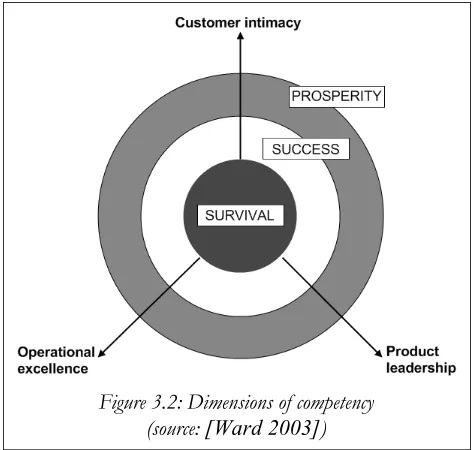
They cite Treacy and Wiersma, who suggest that a significant range of the possibilities to achieve market leadership (using differentiation) can be represented by three paths (see figure 3.2):
1. “Operational Excellence—enabling products and services to be obtained reliably, easily and cost-effectively by customers. This implies a focus on business processes to outperform others and can deliver both low costs and consistent quality of customer satisfaction.
2. Customer Intimacy—targeting markets very precisely and tailoring products and services to the needs of particular customer groups. The purpose here is not just to 'satisfy' but to 'please' customers by understanding their needs and meeting them on every occasion.
3. Product Leadership—continuing product innovation meeting customers' needs. This implies not only creativity in developing new products and enhancing existing ones, but also astute market knowledge to ensure that they sell. The strategy involves delivering a continuous stream of new products and/or services, where what is new is valued by the customers.” [Ward 2003]
Regardless of an organization's businesses strategy, financial drivers are always important and should be considered alongside any of the particular differentiation strategies mentioned above.
This section discusses which requirements these generic business strategies (including financial drivers) place on information systems. The focus lies on Operational Excellence and Financial drivers, since these two can be best supported by well-aligned IT.
3.2.2 Operational Excellence
From functional divisions to process orientation
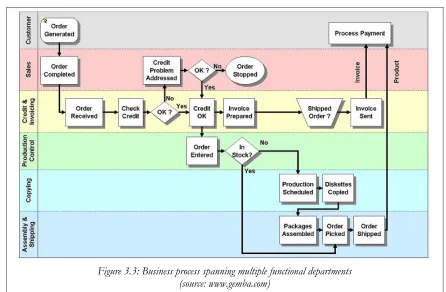
For a long time now, organizations have been structured along functional lines, resulting in departments which group related tasks and the required expertise in order to gain efficiency. This view is challenged by the business process re-engineering movement, which seeks to focus on horizontal business processes as the basis for organizational design. “In short, processes are becoming the building blocks of organizations and seek to capture natural workflows.” [Ward 2003] See figure 3.3 for a conceptual example.
Historically, departments have created information systems (often called “silos”) that strictly follow the departments' boundaries and which often duplicate information required by different departments [Britton 2004].
Current business drivers and trends
Process orientation requires workflows that span different departments to be supported by different information systems. Hence, integration between each of these systems' data and functionality (termed Enterprise Application Integration or EAI) becomes a prerequisite. In light of the strategic alignment model, this relates to operational integration, “the link between organizational infrastructure and processes and I/S infrastructure and processes.” [Henderson 1993]
In terms of Teacy and Wiersma's 'paths to market leadership', process orientation mostly supports Operational Excellence, but it can also support the other two paths.
Business Process Re-engineering and Business Process Management
To create efficient and effective business processes, organizations employ business process re-engineering (BPR) and business process management (BPM). BPR is defined by Hammer and
Champy as “the fundamental rethinking and radical redesign of business processes to achieve
dramatic improvements in critical contemporary measures of performance, such as cost, quality, service, and speed.” [Hammer 1993] BPM is often seen as the successor to BPR and focuses more on continuous evolution of processes instead of one-time radical changes and information technology support for processes.
Ward and Peppard state that it is not clear whether the role of information technology in BPR is the driver, an enabler or one of the means of implementation. They suggest that to answer this question, one first has to ask these two questions:
● How can business processes be transformed using IT (based on a full understanding of the
capabilities of IT)?
● How can IT support business processes?
Without answering these questions in detail, we can say that, ideally, IT should suit BPR and BPM by supporting both aspects.
Business agility through componentization and service orientation
The environment businesses operate in is constantly changing. “Mergers, acquisitions, and the introduction of new technologies are examples of drivers for change in business environments. Business agility refers to the ability of an enterprise to thrive in a continuously changing and unpredictable environment.” [Elfatatry 2007] As environments change, businesses must reevaluate their core competences and create new competitive advantages.
Henderson and Venkatraman state that an organizations strategic fit is dynamic “The choices made by one business enterprise, or firm (if fundamentally strategic), will over time evoke imitative actions, which necessitate subsequent responses.” [Henderson 1993] The systemic competencies are an important aspect of I/T strategy when dealing with change and flexibility.
In order to be able to change fast, organizations need to be agile. Cherbakov et al. have recognized that “corporations are naturally becoming componentized.” [Cherbakov 2005] This means that instead of dividing business into business units and departments, they are divided into finer grained parts, called business components. Each one corresponds to one business function. This enables businesses to rapidly deconstruct and reconstruct to create new value nets on-demand. “In the on demand environment, the component-based firm links its components efficiently and seamlessly both internally and across the firm’s boundaries with best-of-breed components provided by external partners.” [Cherbakov 2005]
This seamless integration is achieved through service orientation. Business components provide on ore more unique services for consumption by other components. Interactions between components are governed by contracts that specify costs, service levels and other agreements.
According to Cherbakov et al., this creates on-demand businesses that can adapt to changing needs quickly. This is necessary to decrease the time-to-market for new products or services, which serves the Operational Excellence and Product Leadership paths.
Componentization businesses are ideally supported by componentized information systems which can be flexibly and easily integrated.
e-Business
Papazoglou and Ribbers define e-Business as “the application of information and communication technologies to conducting business” [Papazoglou 2006]. According to the authors, e-Business can lead to performance increases and cost reductions in various core business processes, among others:
● collaborative product development
● collaborative planning, forecasting and replenishment
● procurement order management
Current business drivers and trends
Papazoglou and Ribbers list eight requirements for e-Business, six of which are organizational requirements and two involve IT. These latter two are “align business organizations with a flexible IT architecture” and “establish ubiquity within standards”, both of which are well supported by SOA.
3.2.3 Customer Intimacy
Providing above-average service to customers requires efficient business processes (see above) and integration of information systems that store different data.
Another way of improving customer intimacy is to provide self-service applications to customers. These can be used around the clock and from anywhere in the world, offering flexibility and freedom. This enables customers to quickly file common requests or view personalized information, for example. Not only does this increase customer satisfaction, it also helps to relieve the organization's back-office workload, thereby cutting costs.
Self-service applications are ideally web-enabled and provide user-friendly interfaces.
3.2.4 Product Leadership
One way information systems can help to achieve Product Leadership is to support a low time-to-market for products or services. This does not just mean being the first to introduce a new product, but especially catching up with competitors (who enjoy the luxury of a head start). Likewise, short time-to-market is not only important for new products or services, but also for implementing changes to existing ones.
Intuitively, information systems that enable fast implementations of new functionality or modifications to existing functionality can best support a low time-to-market strategy.
3.2.5 Financial performance
Whatever the environment or corporate strategy, reducing costs is always a top priority, especially for commercial organizations. This is not only true for organizations that adopt a 'Cost Leadership' strategy and so require lowest possible cost levels across the organization. All other organizations benefit from lowering costs to increase profit and shareholder value, regardless of their business strategies.
Studies report 60 - 90% of corporate IT budgets are spent on maintaining legacy applications [Bennett 1999], so more efficient maintenance is a prime opportunity for cost reduction in IT budgets. Other opportunities are lower costs for development of new systems and user training. Of course, organizations can not only decrease costs on the IT budget itself, but the right IT can also help to cut costs in other areas, for example through automation.
As first mentioned in section 3.2.1, Henderson and Venkatraman state that strategic fit is critical for financial performance.
3.3
Advantages inherent in SOA
This section discusses which features inherent in SOA make it a very desirable architecture for modern organizations by showing how it supports the requirements discussed in the previous section.
3.3.1 Strategic alignment
The strategic alignment model introduced in section 3.2.1 acknowledges systemic competencies as an important area of IT strategy. As example competencies, Henderson and Venkatraman list “system reliability, cost-performance levels, interconnectivity [and] flexibility”, each of which is promised to be well supported by SOA. The next sections describe in more detail how these attributes are supported by SOA.
3.3.2 Integration and standardization
As discussed in the previous section, integration between applications is important for nearly every business strategy. Most organizations have to deal with a collection of various information systems, which can reside inside or outside of the organization. Reliable and flexible integration between these systems is indispensable to create competitive advantages, high levels of process automation and high levels of customer service, among other advantages.
The heterogeneity of these systems has historically made integration complex and expensive. SOA is built on a wide range of open standards have been designed with flexibility in mind. IT vendors acknowledge that integration has been a major problem with previous products because of the lack of flexibility and standardization, and now are widely supporting and developing these new standards.
Whether true out-of-the-box interoperability will be achieved remains to be seen, as vendors have historically deviated from standards to differentiate themselves from competitors. On the other hand, customers are now demanding standards compliance because of the problems that arise from heterogeneity in information systems.
3.3.3 Flexible architecture
Flexibility of information systems is another desired attribute that serves a number of business strategies. The most important one is business agility, the ability to change fast in order to meet changing demands. According to Gartner analysts Roy Schulte, IT systems have historically been “built to last” instead of being “built to change”.
de-Advantages inherent in SOA
facto approach to bridging the gap between business models and software infrastructure and flexibly supporting changing business needs” [Kontogiannis 2007]
3.3.4 Low costs
Cost reduction is one of the key selling points for SOA technology. Not surprisingly, market research by has shown cost reduction is currently the number one business driver for SOA adoption [West 2006]. SOA promises to simplify legacy system maintenance, which currently drains large parts of organizations' IT budgets (see section 3.2.5). According to an industry white paper by webMethods, “reduced skills and effort to support business change [and] price/performance optimization based on freedom to select platform, technology, and location independently” [webMethods 2005] are two more ways SOA can reduce costs directly.
Vendors also claim that SOA can increase developers' productivity by stimulating reuse of code and simplifying integration.
3.3.5 Business process support
As discussed in section 3.2.2, Ward and Peppard state that, to determine which role IT can play in BPR and BPM, one first has to answer two questions first. This section explores the answers to both of these questions.
Support for business process transformation
The first question is “how can business processes be transformed using IT (based on a full understanding of the capabilities of IT)?” [Ward 2003].
Business processes can be modeled using specialized software tools to design, document and even benchmark these processes. These tools are usually used by business users and focus on the business process, with little or no regard for IT support. One common notation (or language) for these models is the Business Process Modeling Notation (BPMN, see [OMG 2006]) (see figure 3.4 for an example model).
One of the technologies usually employed in SOAs are BPEL engines (BPEL stands for Business Process Execution Language). These allow detailed models of business processes to be directly and
automatically executed. Since BPEL and BPMN are similar, BPEL models can be based on BPMN (or other) models of business processes. By extending the BPEL models to specify in detail which software services to invoke, the abstract business model can now be executed.
The advantage to this approach is that business users who design processes and IT developers can now work together to design, implement and maintain business processes and the supporting IT systems. A secondary, but nonetheless very important, effect of using BPEL is that IT systems' behavior and workflows are now modeled explicitly and centrally, instead of being embedded in and distributed over the applications' code or even implicit in users' memories (or both). This means processes and applications are transparent and far easier to change.
BPEL engines can also support implementing changes to processes on-the-fly. This means that running instances will keep running according to the old version, while new instances use the newer version. This allows for processes to be changed without halting the system and the resulting down-time.
Another instrument which is supported by SOA is Business Activity Monitoring, or BAM. It is defined as “provid[ing] real-time access to critical business performance indicators to improve the speed and effectiveness of business operations.” [Gartner 2002] BAM can be used as an analytical tool or benchmark for business processes to find bottlenecks or other opportunities for improvement. BAM and its “relative” Business Intelligence (BI) are not exclusive to SOA, but typical SOA architectures and middleware (such as BPEL engines) make it possible to use BAM with little or no required modifications to applications, since their activities can be monitored “from the outside” by tracking BPEL instances and other means, without requiring the application to report its activities “by itself”.
Support for business processes
The second question posed by Ward and Peppard is “how can IT support business processes?”. Next to the possibilities almost every IT system can offer in support of business processes – some of which have already been explored in this chapter – only those that are unique to SOA are discussed here.
Apart from the advantages described above, BPEL engines also allow users to monitor the progress of running process instances and view information about closed or aborted instances. This information can be used to reveal the status of particular instances and help when investigating problems. Together with the information provided by BAM tools, SOA offer more control on and more information about business processes, both of which can help organizations improve said processes. One additional advantage is that this information also can also help organizations monitor service level agreements (SLAs), both those of external services as well as those provided by the organization itself.
3.4
Advantages compared to Oracle Forms
Advantages compared to Oracle Forms
discussed in detail in the next chapter. These differences provide additional reasons for customers to switch to an SOA.
3.4.1 Application user interface usability
User interfaces for Oracle Forms are designed primarily for “power users” who often perform the same activities. The usability is geared towards efficiency, not user-friendliness, and requires users to be trained before they can use interfaces at all. This is especially problematic for applications intended for users with little or no experience with Oracle Forms, like external business partners or end customers.
User-friendly interfaces can be developed using a large number of technologies that are not tied to SOA, or any enterprise IT architecture for that matter. Customers that wish to adopt Oracle's modern application development framework (based on Java) need not automatically adopt SOA as enterprise architecture.
Likewise, SOA does not restrict the choice of user interface technology. In fact, its architecture even promotes the use of different presentation techniques for the same business logic by separating the presentation from the business logic (see the previous chapter for more details). This means that while SOA adoption is not required for organizations that wish to migrate to modern development frameworks, it does offer some advantages. For example, SOA can be used to “connect” a modern user interface developed in a new technology (Java) to existing businesses logic developed using older technology (Forms). This enables a gradual migration between old and new development frameworks and technologies. More examples for the usefulness of SOA with regard to “old” user interfaces are discussed in chapter 2.
3.4.2 Integration
Oracle Forms applications offer no interface to other applications. The only means for integration is to access the database directly. Apart from the implicit standardization issues (as discussed in section 2.4.3), this approach makes it problematic or downright infeasible to integrate external systems, since direct access to the database is undesirable from both technical and organizational perspectives.
As has been discussed in section 3.3.2, SOA provides an ideal environment for application integration, based on open standards and a focus on integration problems.
3.5
Summary of advantages
The primary goal of this chapter is to compile a list of features that enable SOA to better support business drivers than legacy systems, and especially those built on Oracle Forms technology. This list is used as input for the method described in chapter 6, and is based on the major advantages of SOA presented in the previous sections. To make the list usable and comprehensive, a high level of abstraction has been chosen.
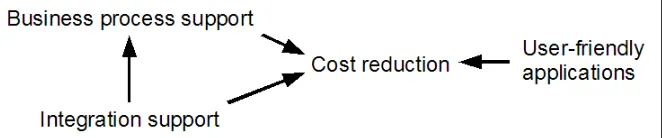
● Cost reduction. As has been shown in section 3.3.4, SOA adoption can result in improved
financial performance. Market research shows that cost reduction is currently the main driver for SOA adoption.
● Integration support. One of the cornerstones of SOA is the focus on information system
integration aspects. The use of open interfacing standards and technologies aimed specifically at supporting integration (like UDDI and BPEL) make SOA the ideal platform for Enterprise Application Integration (EAI) and integration with external entities (e-Business, especially B2B).
● Business process support. Section 3.3.5 discussed how SOA supports an organization's
BPM and BPR activities and offers a flexible IT architecture that can change along with business processes. This flexibility creates business agility, which is required to gain and maintain competitive advantages. Furthermore, BPEL and BAM software provide valuable (real-time) information about running business processes which organizations can use to monitor and benchmark these processes.
● User-friendly applications. User-friendly applications are not a property inherent to SOA.
More user-friendly interfaces can be developed using any one of a large set of technologies and frameworks currently available. However, by providing a platform that enables gradual migration and reuse of existing logic, SOA is an suitable enterprise architecture for organization that wish to leave the Oracle Forms framework in favor of a more modern framework.
It is important to note that these four high-level features of SOA are not entirely independent of another. For example, SOA's focus on integration can lead to a decrease in maintenance effort for applications that need to be integrated. This leads to increased business agility (because IT can adapt faster) as well as to cost reductions (since developers need less time for maintenance). Figure 3.5 shows the dependencies.
Leveraging Approaches
C
HAPTER
4: L
EVERAGING
A
PPROACHES
The third chapter has shown how SOA is better suited to support current business drivers like business agility and improved financial performance. The discussion of the differences between legacy architectures and SOA in chapter 2 should make clear that it is not possible to simply transform or “migrate” legacy applications in order to get a system based on SOA. By definition (see section 2.1.1), legacy applications cannot be abandoned or redesigned from scratch because of the huge investments that have been made over the years.
But is it really necessary to make every application completely SOA-based? Sure, SOA offers a number of advantages over legacy architectures. (One of these, cost reductions, is always beneficial, regardless of business strategy or environment). However, since complete transformation is generally infeasible, is it perhaps possible to partially transform legacy applications in a way that makes them fulfill business requirements? This chapter investigates these possibilities.
The first three sections provide a theoretical background based on the literature on the subject. The last three sections discuss actual approaches to leverage or replace legacy applications.
4.1
Introduction
The first chapter introduced the notion of “leveraging” legacy applications. This section will discuss in detail what is meant by that.
4.1.1 Definitions
In this thesis, a important distinction is made between the terms “maintenance” (as defined below) and “leverage”. The difference is that the latter aims to add value to a system, for example by adding new functionality or improving its flexibility or reducing maintenance cost.
4.2
Classification of modernization approaches
[Papazoglou 2006] presents an overview of legacy modernization strategies, which can be divided into invasive and non-invasive approaches. The discussion is presented in the context of e-Business integration.
The authors begin by stating that applications consist of two conceptual parts: their environmental part and their business part. The first manages the application's environment such as hardware, operating system, communication infrastructure and database. The second “deals with its perceived business functionality [and] contains the application's businesses rules and businesses process flows.” In the context of this research, the environmental part does not need to be considered, since legacy applications run on the same environment as SOA solutions.
Non-invasive approaches
Non-invasive approaches keep the existing application flow intact and result in new presentation interfaces for the legacy system by employing screen-scraping or using the systems APIs or new
Software maintenance “is the modification of a software product after delivery to correct faults, to improve performance or other attributes, or to adapt the product to a changed environment” (according to ANSI/IEEE Std. 729-1983)
Reverse engineering is the process of analyzing a subject system to
● identify the system's components and their interrelationships and
● create representations of the system in another form or at a higher
level of abstraction
Reverse engineering does not involve changing the subject system or creating a new system based on the reverse-engineered subject system. It is a process of examination, not a process of change or replication.
Restructuring is the transformation from one representation form to another
at the same relative abstraction level, while preserving the subject system's external behavior (functionality and semantics).
Classification of modernization approaches
wrappers to access existing business functionality. Papazoglou et al. present three alternatives for this approach: “refacing“, “repurposing“ and “presentation tier modernization techniques“.
Unfortunately, Papazoglou et al. do not provide detailed definitions or descriptions, making it hard to tell the exact differences between the categories. What the approaches have in common is that they do not change the legacy system, but only substitute or modernize the user interface in order to make them fit into modern desktop environments or make them more user-friendly.
Invasive approaches
Invasive approaches actually modify the legacy system, which makes these approaches inherently more powerful and flexible than non-invasive approaches. However, it also makes them costlier and riskier, since production systems are modified, which can introduce errors. Papazoglou et al. discern three alternatives:
● Maintenance, which is characterized by iterative and incremental changes to correct small
deficiencies or add minor enhancements.
● Replacement of the whole or parts of the legacy system by an an off-the-shelf product or a
newly developed custom system. This alternative is usually chosen when the legacy system can not longer be maintained efficiently or when business needs change so much that the costs of making the required changes are higher than the economic value of the system.
● Re-engineering and transformation (also called modernization). This entails analyzing the
legacy system to understand what it does and how it works, in order to modify some parts of even redevelop them using newer technologies. The first step is very important since the legacy system already partially satisfies business requirements.
The authors state that the use of the first two techniques is on the decline. Maintenance of large legacy systems does not significantly improve their value, nor does it create maintainable assets. Replacement is often infeasible because it means abandoning the large investments that have been made (see the introduction to chapter 1 for more details). This leaves the last option as the most viable alternative.
Modernization approaches
According to Papazoglou et al., re-engineering can be divided into two types: white-box and black-box re-engineering.
● “White-box re-engineering concentrates on reverse engineering techniques to gain an
understand of the internal structure and operations of an application.” [Papazoglou 2006] After the original program is sufficiently understood, it can be restructured at the application and code level to decompose the system into self-contained pieces of code, or components.
● Black-box re-engineering aims to re-interface existing code (often based on wrapping) by
2005]) argue that black box wrapping techniques are impractical because they usually require white box techniques to be applied in order to sufficiently understand the legacy system, so one might just as well go for white box approaches in conjunction with reverse engineering.
By definition, re-engineering implies restructuring an existing asset, which can cost considerable effort. Another modernization approach is legacy componentization, which aims at breaking up a legacy system into isolated parts (called components) with well-defined interfaces.
“[L]egacy componentization involves surrounding the legacy system with a layer of component software that hides the unwanted complexity of the old generation system and reveals a modern interface to give it a new and improved functionality.” [Papazoglou 2006] This abstraction makes it possible to use components using modern technology and programming environments. It also allows for the legacy component to be replaced by a modern component without changing the the rest of the system. This makes it possible to gradually replace legacy technology with modern technology.
4.2.1 Evaluation of approaches
Non-invasive
Non-invasive approaches all apply mainly to modernizing interfaces based on mainframes and terminals. This does not apply to Oracle Forms interfaces, which are already graphical in nature and run on most modern desktop environments (and even on the web). However, since user-friendliness is one of the requirements where Forms applications (may) need improvement, presentation tier modernization techniques must be considered.
Papazoglou et al. also mostly use mainframe systems with terminal screen interfaces running on legacy hardware as typical examples of legacy systems. This assumption does not hold for Oracle Forms applications. As section 2.1.1 makes clear, by the definition used in this thesis, “legacy” systems are not only those that run on unsupported hard- and software, but any systems that resist change. Of course, the former type of system usually resists change automatically, for example because skilled developers are scarce and hence expensive.
Oracle Forms applications are not legacy because the technology is outdated or unsupported (it isn't). They are considered legacy because their architecture and technology resist change. This implies that these applications do not necessarily need to be “migrated” to newer development frameworks or newer hardware environments, but instead might be improved through non-invasive techniques. This is another reason to consider non-invasive techniques.
Invasive
Classification of modernization approaches
approaches, elaborate on this conclusion by stating that interface modernization techniques like screen scraping (which, according to the authors, are derogatorily called 'whipped cream on road kill') do not improve the system's value, since, “from the IT department's perspective, the new system is as inflexible and difficult to maintain as the legacy system.” [Cormella-Dorda 2000]
Papazoglou et al.'s conclusion about re-engineering and transformation as the most appropriate options is drawn in the context of modernizing legacy systems for the purpose of e-Business integration. We have to be careful not to generalize this conclusion to the context of leveraging legacy systems in SOAs. Since integration is but one way to achieve this, we cannot disregard non-invasive approaches, especially since they are often easier and cheaper to apply than non-invasive approaches.
4.3
Decisional framework
De Lucia, Fasolino and Pompella [de Lucia 2001] present a decision framework, which distinguishes several alternatives for the management of IT assets (based on [Verdugo 1988]), being “ordinary maintenance, reverse engineering, restructuring, re-engineering, migration, wrapping, replacement with COTS [common off-the-shelf system], and dis
![Figure 3.1: Strategic Alignment Model (source: [Henderson 1993])](https://thumb-us.123doks.com/thumbv2/123dok_us/1030268.1128174/21.595.98.527.66.415/figure-strategic-alignment-model-source-henderson.webp)
![Figure 3.4: Example BPMN model (source: [WP 07a])](https://thumb-us.123doks.com/thumbv2/123dok_us/1030268.1128174/27.595.110.477.588.778/figure-example-bpmn-model-source-wp-a.webp)
![Figure 4.1: Quadrant map for portfolio analysis (adapted from [de Lucia 2001])](https://thumb-us.123doks.com/thumbv2/123dok_us/1030268.1128174/35.595.145.472.430.592/figure-quadrant-map-portfolio-analysis-adapted-from-lucia.webp)
![Figure 4.2: Overview of OAR activities (source: [Bergey 2001])](https://thumb-us.123doks.com/thumbv2/123dok_us/1030268.1128174/43.595.88.543.573.777/figure-overview-oar-activities-source-bergey.webp)
![Figure 4.3: The activities of the SMART (source: [Lewis 2005])](https://thumb-us.123doks.com/thumbv2/123dok_us/1030268.1128174/44.595.100.482.64.244/figure-activities-smart-source-lewis.webp)