An Annotated Dataset for Extracting Definitions and Hypernyms from the Web
Roberto Navigli, Paola Velardi
Juana Maria Ruiz-Mart´ınez
Dipartimento di Informatica Facultad de Inform`atica Sapienza Universit`a di Roma, Italy Campus de Espinardo, Murcia, Spain navigli,[email protected] [email protected]
Abstract
This paper presents and analyzes an annotated corpus of definitions, created to train an algorithm for the automatic extraction of defini-tions and hypernyms from Web documents. As an additional resource, we also include a corpus of non-definidefini-tions with syntactic patterns similar to those of definition sentences, e.g.: “An android is a robot” vs. “Snowcap is unmistakable”. Domain and style independence is obtained thanks to the annotation of a sample of the Wikipedia corpus and to a novel pattern generalization algorithm based on word-class lattices (WCL). A lattice is a directed acyclic graph (DAG), a subword-class of nondeterministic finite state automata (NFA). The lattice structure has the purpose of preserving the salient differences among distinct sequences, while eliminating redundant information. The WCL algorithm will be integrated into an improved version of the GlossExtractor Web application (Velardi et al., 2008). This paper is mostly concerned with a description of the corpus, the annotation strategy, and a linguistic analysis of the data. A summary of the WCL algorithm is also provided for the sake of completeness.
1
Introduction
This paper presents and analyzes an annotated corpus of definitions, created to train an algorithm for the automatic extraction of definitions and hypernyms from web docu-ments. Domain and style independence is obtained thanks to the annotation of a large and domain-balanced corpus and to a novel pattern generalization algorithm based on word-class lattices (WCL). The WCL algorithm will be integrated into an improved version of the GlossExtractor (Velardi et al., 2008) web application1. This paper is mostly
concerned with a description of the corpus, the annotation strategy, and a linguistic analysis of the data. The WCL al-gorithm is described in (Navigli and Velardi, forthcoming) and is summarized here for the sake of clarity.
A great deal of work is concerned with definition extrac-tion in several languages (Gaudio and Branco, 2007; Iftene et al., 2007; Deg´orski et al., 2008; Przepi´orkowski et al., 2007; Storrer and Wellinghoff, 2006; Westerhout and Monachesi, 2007). The majority of these approaches use symbolic methods that depend on lexico-syntactic patterns, which are manually crafted or semi-automatically learned (Zhang and Jiang, 2009; Hovy et al., 2003; Fahmi and Bouma, 2006; Westerhout, 2009). Patterns are either very simple sequences of words (e.g. “refers to”, “is defined as”, “is a”) or more complex sequences of words, parts of speech and chunks. A fully automated method is instead proposed by Borg et al. (2009): they use genetic program-ming to learn simple features to distinguish between defi-nitions and non-defidefi-nitions, and they then apply a genetic algorithm to learn individual weights of features. However, rules are learned for only one category of patterns, namely “is” patterns.
Most methods suffer from both low recall and precision, because definitional sentences occur in highly variable and potentially noisy syntactic structures. Higher performance (around 60-70% F1-measure) is obtained only for specific domains (e.g. an ICT corpus) and patterns (Borg et al.,
1Already freely available in its beta-version at http://
lcl.uniroma1.it/glossextractor.
2009).
Only few papers try to cope with the generality of patterns and domains in real-world corpora (like the web). In the GlossExtractor web-based system (Velardi et al., 2008), to improve precision while keeping pattern generality, candi-dates are pruned using more refined stylistic patterns and lexical filters. However in its beta-version GlossExtractor relies on a large set of machine-learned, but “fixed” lexico-syntactic patterns. Cui et al. (2007) propose the use of probabilistic patterns, calledsoft patterns, for definitional question answering in the TREC contest2. Soft patterns
generalize over lexico-syntactic “hard” (fixed) patterns in that they allow a partial matching by calculating a genera-tive degree of match probability between the test instance and the set of training instances. Because of its generaliza-tion power, this method is the most closely related with our word-class lattices.
The literature on hypernym extraction offers a higher vari-ability of methods, from simple lexical patterns (Hearst, 1992; Oakes, 2005) to statistical and machine learning tech-niques (Agirre et al., 2000; Caraballo, 1999; Dolan et al., 1993; Sanfilippo and Pozna´nski, 1992; Ritter et al., 2009). One of the highest-coverage methods is proposed in (Snow et al., 2004). They first search sentences that contain two terms with hyponymous relations (term pairs are taken from WordNet (Miller et al., 1990)); then they parse the sen-tences, and automatically extract patterns from the parse trees. Finally, they train a hypernym classifer based on these features. Lexico-syntactic patterns are generated for each sentence relating a term to its hypernym, and a depen-dency parser is used to represent them.
Except for (Snow et al., 2004; Velardi et al., 2008; Cui et al., 2007), all machine-learning methods for definition and hypernym extraction are trained and tested on rela-tively small domain-specific datasets, in which the vari-ability of patterns is not so high. Annotation of data used for learning is limited to manual classification of positive versus negative examples, with the exception of (Storrer
2
and Wellinghoff, 2006). In this paper, a German corpus of 174 definitions on hypertext research is annotated by marking three fields: the DEFINIENDUM (the term to be defined), the DEFINIENS(meaning postulates for the term) and the DEFINITOR (the verb which relates the definiens component to the definiendum component). In our work, we adopted a similar, but more refined, annotation strat-egy on a much wider corpus of about 1,700 definitions. The annotated definitions are used to learn a generalized form of word lattices, named Word-Class Lattices (WCL), as an alternative to lexico-syntactic pattern learning. A lat-tice is a directed acyclic graph (DAG), a subclass of non-deterministic finite state automata (NFA). The lattice struc-ture has the purpose of preserving the salient differences among distinct sequences, while eliminating redundant in-formation.
In computational linguistics, lattices have been used to model in a compact way many sequences of symbols, each representing an alternative hypothesis. In speech process-ing, phoneme or word lattices (Campbell et al., 2007; Math-ias and Byrne, 2006; Collins et al., 2004) are used as an interface between speech recognition and understand-ing. Lattices are adopted also in Chinese word segmenta-tion (Jiang et al., 2008), decompounding in German (Dyer, 2009), morphologic analysis in Arabic, and to represent classes of translation models in machine translation (Dyer et al., 2008; Schroeder et al., 2009). In more complex text processing tasks, such as information retrieval, information extraction and summarization, the use of word lattices has been postulated but is considered unrealistic because of the dimension of the hypothesis space, which makes it very dif-ficult to cluster in a lattice structure the different patterns. In definition extraction, the variability of patterns is higher than for “traditional” applications of lattices, such as trans-lation and speech, however not as high as in unconstrained sentences. The methodology that we propose to cluster pat-terns is based on the use of star (wildcard *) characters to facilitate pattern clustering. The * are then removed and re-placed by the original words or by word categories during lattice generation from clusters.
A key feature of our approach is its ability to both identify definitions and extract hypernyms. The method is tested on an annotated corpus and on a large Web corpus, in or-der to demonstrate the independence of the method from the annotated dataset. WCLs are shown to generalize over lexico-syntactic patterns, and outperform well-known ap-proaches to definition and hypernym extraction from Web documents.
The paper is organized as follows: Section 2 illustrates the corpus annotation strategy, the WCL algorithm is sum-marised in Section 3 where we also describe the experi-ments. Finally, a detailed linguistic analysis is performed in Section 4. We conclude the paper in Section 5.
2
Corpus annotation
In our work, we rely on a formal notion of textual defini-tion. Specifically, we assume a definition contains the fol-lowing fields (Storrer and Wellinghoff, 2006):
• The DEFINIENDUMfield (DF): this part of the defini-tion includes thedefiniendum(that is, the word being
defined) and its modifiers (e.g., “In computer science, a graph”);
• The DEFINITORfield (VF): it includes the verb phrase used to introduce the definition (e.g., “is”);
• The DEFINIENS field (GF): it includes the genus phrase (usually including the hypernym, e.g., “a dot”);
• The REST field (RF): it includes additional clauses that further specify thedifferentiaof the definiendum with respect to its genus (e.g., “that is part of a com-puter image”).
For example, given the sentence:
In the history of science, Alchemy (from the Arabic al-kemia) refers to an early form of the investigation of nature combining elements of chemistry, metallurgy, physics, medicine, astrology, semiotics, mysticism, spir-itualism, and art all as parts of one greater force
the following fields are marked:
DF: In the history of science, [Alchemy] (from the Arabic al-kemia)
VF: refers
GF: to an early form of the [investigation] of nature RF: combining elements of chemistry, metallurgy,
physics, medicine, astrology, semiotics, mysticism, spiritualism, and art all as parts of one greater force.
Furthermore, the words alchemy and investigation are marked, respectively, as “target” and “hypernym”. Fi-nally, the part-of-speech analysis of each sentence is also reported, as generated by the TreeTagger system3.
In annotating our corpus (and in evaluating system’s per-formance on test sets) we followed rather strictly the above notion of definition. For example, a sentence like: “ Etch-ing are made on zinc plates” is not annotated as a defini-tion, since, while it provides useful information about the term etching, it does not include a genus phrase. On the other side, “noise pollution is a [problem]”, though unin-formative, is considered a definition for the opposite rea-son. Only an analysis of the descriptive power of a detected hypernym could determine the rejection of uninformative definitions: however, one such analysis is mostly context-dependent, since for example “rucksack is a [problem] in combinatorial optimization” is indeed an informative defi-nition (and hypernym) for “rucksack” in applied mathemat-ics.
Overall, 1,717 definitions have been annotated like in the above example. Terms belong to different Wikipedia cat-egories (en.wikipedia.org/wiki/Wikipedia:Catcat-egories) and on-line glossary domains, in order to capture a represen-tative and domain-independent sample of lexical and syn-tactic patterns for definitions. The associated corpus of neg-ative examples (“syntactically plausible” false definitions) was obtained by automatically extracting sentences from Wikipedia and by manually selecting only false definitions (2,847). An example of false definition in this corpus is:
3
A Pacific Northwest tribe’s saga refers to a young woman who put all the self-hatred she felt for her own secretions.
The corpus was annotated by one of the authors, based on a previously agreed annotation policy, and reviewed by the other two authors. When about a 40% of the corpus was annotated, sentences in the remaining 60%, with the same part-of-speech sequence as in the annotated set, were au-tomatically annotated and then reviewed. Finally, survived inconsistencies in annotations have been automatically de-tected and manually corrected in a third pass. The corpus is available athttp://lcl.uniroma1.it/deco.
3
Summary of Lattice Learning Algorithm
The annotated corpus was used to learn a variety of def-inition patterns and compact them into word-class lattices (WCL). The classifier was then tested on a fragment of the annotated corpus and on a subset of the ukWaC Web Cor-pus (Ferraresi et al., 2008). In this section, we summarize the lattice learning algorithm and analyze its performance.3.1 Algorithm
The algorithm consists of three steps, described in the next subsections.
3.1.1 Star Patterns
The first step consists of associating a star pattern with each sentence in the training set. Letsbe a sentence such that
s = t1, t2, . . . , tn, whereti is its i-th token. Given the
setF of most frequent words in the training set, the star patternσ(s)associated withsis obtained by replacing with * all the tokensti 6∈ F, that is all the tokens that are
non-frequent words. For instance, given the sentence “In arts, a chiaroscuro is a monochrome picture”, the corresponding star pattern is “In *, ahTARGETiis a *”, wherehTARGETi is the defined term.
3.1.2 Sentence Clustering
In the second step, we cluster the sentences in our train-ing set T based on their star pattern. Formally, let Σ = (σ1, . . . , σm) be the set of star patterns associated with
the sentences in the training set. We create a clustering C= (C1, . . . , Cm)such thatCi ={s:σ(s) =σi}, that is
Cicontains all the sentences whose star pattern isσi. We
note that each clusterCi contains sentences whose degree
of variability is generally much lower than for any pair of sentences in the training set belonging to two different clus-ters.
3.1.3 Word-Class Lattice Construction
Finally, the third step consists of the construction of a Word-Class Lattice for each sentence cluster. Given such a cluster Ci ∈ C, we apply a greedy algorithm that
itera-tively constructs the WCL.
Let Ci ={s1, s2, . . . , s|Ci|} and consider its first
sen-tence s1=t1, t2, . . . , tn. Initially, we create a
di-rected graph G= (V, E) such that V ={t1, . . . , tn} and
E = {(t1, t2),(t2, t3), . . . ,(tn−1, tn)}. We consider the
subsequent sentences inCione by one and iteratively add
them to the graph. To do so, we determine the best align-ment between sentencesjand each sentencesk ∈Cisuch
thatk < j. The alignment is calculated based the pairwise similarity of the tokens and parts of speech of the respective sentences. We repeat this calculation for each sentencesk
(k = 1, . . . , j−1) and choose the one that maximizes its alignment score withsj. We then use the best alignment to
addsj to the graphG: we add to the set of verticesV the
tokens ofsjfor which there is no alignment tosk and we
add toEthe edges(t1, t2), . . . ,(t|sj|−1, t|sj|).
3.1.4 Variants of the WCL Model
So far, we have assumed that our WCL model learns lat-tices from the training sentences in their entirety (we call this model WCL-1). Note that our model does not take into account the RESTfield, so this fragment of the train-ing sentences is discarded. We now propose a second model that learns separate WCLs for each field of the def-inition, namely: DEFINIENDUM (DF), DEFINITOR (VF) and DEFINIENS(GF, cf. Section 2). We refer to this latter model as WCL-3. Rather than applying the WCL algorithm to the entire sentence, the very same method is applied to the sentence fragments tagged with one of the three defini-tion fields. The reason for introducing the WCL-3 model is that, while definitional patterns are highly variable, DF, VF and GF individually exhibit a lower variability, thus WCL-3 should improve the generalization power.
3.1.5 Classification
Once the learning process is over, a set of WCLs is pro-duced. Given a test sentences, the classification phase for the WCL-1 model consists of determining whether it ex-ists a lattice that matches s. In the case of WCL-3, we consider any combination of DEFINIENDUM, DEFINITOR and DEFINIENSlattices. Given that different combinations might match, for each combination of three WCLs we cal-culate a confidence score as follows:
score(s, lDF, lVF, lGF) =coverage·log(support)
wheresis the candidate sentence,lDF,lVFandlGFare three
lattices one for each definition field,coverageis the fraction of tokens of the input sentence covered by the three lattices, andsupportis the sum of the number of sentences in the star patterns corresponding to the three lattices.
While WCL-1 is applied as a yes-no classifier as there is a single WCL that can possibly match the input sentence, WCL-3 selects, if any, the combination of the three WCLs that best fits the sentence in terms of coverage and support from the training set.
3.2 Performance evaluation
We conducted experiments on two different datasets:
• Our corpus of 4,564 Wikipedia sentences, that con-tains 1,717 definitional and 2,847 non-definitional sentences (see Section 2).
Algorithm P R F1 A
WCL-1 99.88 41.82 58.99 75.95
WCL-3 99.30 59.85 74.69 83.24
Star patterns 94.23 65.15 77.04 83.96
Bigrams 66.12 78.77 71.89 74.56
Random BL 50.00 50.00 50.00 50.00
Table 1: Performance on the Wikipedia dataset.
any of 239 terms randomly selected from the terminol-ogy of four different domains (COMPUTER SCIENCE, ASTRONOMY,CARDIOLOGY,AVIATION).
The reason for using the ukWaC corpus is that, unlike the “clean” Wikipedia dataset, in which relatively simple pat-terns can achieve good results, ukWaC represents a real-world test, with many complex cases (discussed in Section 4).
We experimented with the following systems:
• WCL-1andWCL-3: these two classifiers are based on our Word-Class Lattice model. WCL-1 learns from the training set a lattice for each cluster of sentences, whereas WCL-3 identifies clusters (and lattices) sepa-rately for each sentence field (DEFINIENDUM,DEFIN -ITOR and DEFINIENS) and classifies a sentence as a definition if any combination from the three sets of lat-tices matches (cf. Section 3.1.4).
• Star patterns: a simple classifier based on the pat-terns learned as a result of step 1 of our WCL learning algorithm (cf. Section 3.1.1): a sentence is classified as a definition if it matches any of the star patterns in the model.
• Bigrams: an implementation of the bigram classi-fier for soft pattern matching proposed by Cui et al. (2007). The classifier selects as definitions all the sen-tences whose probability is above a specific threshold. The probability is calculated as a mixture of bigram and unigram probabilities, with Laplace smoothing on the latter. We use the very same settings of Cui et al. (2007), including threshold values. While the authors propose a second soft-pattern approach based on Pro-file HMM, their results do not show significant im-provements over the bigram language model.
We calculated precision (the number of definitional sen-tences correctly retrieved by the system over the number of sentences marked by the system as definitional), recall (the number of definitional sentences correctly retrieved by the system over the number of definitional sentences in the dataset), the F1-measure (a harmonic mean of precision (P) and recall (R) given byP2P R+R) and accuracy (the number of correctly classified sentences over the total number of sen-tences in the dataset).
3.3 Results
In Table 1 we report the results of definition extraction sys-tems on the Wikipedia dataset. Given this dataset is also
DF VF GF
AhTARGETi is a *
hTARGETi was of *
ThehTARGETi are an *
AhTARGETi(from * ) were the *
hTARGETi(also known as *) refers a * of * In * , ahTARGETi is a type the * of *
Table 2: Most frequent patterns for DF, VF and GF.
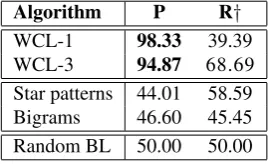
Algorithm P R†
WCL-1 98.33 39.39
WCL-3 94.87 68.69
Star patterns 44.01 58.59
Bigrams 46.60 45.45
Random BL 50.00 50.00
Table 3: Performance on the ukWaC dataset (†Recall is estimated).
used for training, experiments are performed with 10-fold cross validation. The results show very high precision for WCL-1, WCL-3 (above 99%) and star patterns (94%). As expected, star patterns exhibit a higher recall (65%). The lower recall of WCL-1 is due to its limited ability to gener-alize compared to WCL-3 and the other methods. In terms of F1-measure, star patterns achieve 77.04%, and are thus the best system, with WCL-3 ranking second (74.69%). However, if we also account for negative sentences – that is we calculate accuracy – the two systems perform the same (the difference is not statistically significant atp < 0.01). The Bigram method achieves the best recall, but precision and F-measure are lower. All the systems perform signifi-cantly better than the random baseline.
From our Wikipedia corpus, we learned 981 lattices (and star patterns). Using WCL-3, we learned 353 DF, 230 VF and 363 GF lattices, that then we used to extract definitions from the ukWaC dataset. Table 2 shows the most frequent patterns for the three fields: DF, VF and GF. An example of combination of different DF, VF and GF lattices is shown in Figure 1.
4
Linguistic Analysis
This section is dedicated to the linguistic analysis of frequent and relevant phenomena emerging from the Wikipedia and ukWaC datasets. This analysis has ben facil-itated by the learned lattices, that allow an identification of recurrent as well as idiosyncratic patterns. In previous work on definition analysis, definition classification was mostly manual and led to the identification of few recurrent struc-tures (e.g. 5 types in (Westerhout and Monachesi, 2007)). In the following of this section we report relevant phenom-ena observed as a result of the analysis of sample definitions and non-definitions.
Ambiguity. In large domains, such as the Web, the level of term ambiguity is larger than what one could imagine. Consider for example the following definitions of “mosaic” and “renaissance”, most of which are (commonsensically) unexpected:
Mosaic is a ten week online [course].
Mosaic was the first example of a [web browser].
Mosaic is a representation of medieval [bedford].
Mosaic is the third annual [film festival] sponsored by...
Mosaic is a community [organisation] of black families.
Mosaic is the fourth biggest [retailer] in the uk.
Renaissance is the first central [government investment programme].
Renaissance is an animated cyberpunk/science fiction detective [film].
Renaissance was a humanistic [revival] of classical art.
Renaissance is a very impressive [hotel].
Notice that the method described in section 3 is aimed at extracting definition patterns, not at solving ambiguity4, a
problem known as Word Sense Disambiguation (Navigli, 2009).
Multiple hypernyms. By grouping definitions belonging to the same sense, another phenomenon emerges, which is critical when considering the application of hypernym ex-traction to taxonomy building: the multiplicity of hyper-nyms. Consider the following examples:
Renaissance is doubtless the most popular [historical era] portrayed theatrically today.
Renaissance was a humanistic [revival] of classical art, architecture, literature, and learning...
Renaissance was a [period] in European history during which...
The term Renaissance also refers to a [group of artists] who work together...
4
In the GlossExtractor system, we describe a domain heuristics (Velardi et al., 2008) to prune non-domain definitions, when given an initial terminology T for which a glossary must be contructed.
While the first three hypernyms could be recognized as re-ferring to the notion of period of time, it is not easy for an automated system to handle multiple hypernyms in a correct way. This problem has never been discussed in recent literature on taxonomy building based on automat-ically extracted hypernyms, e.g. (Snow et al., 2006; Yang and Callan, 2009), though we found that it is a very com-mon case.
Uninformative definitions. As we already remarked, there are many sentences which, syntactically, are to be considered definitions (according to the notion of definition stated in Section 2), but are uninformative, e.g.
Artificial Intelligence is a killer [application]...
The mosaic is the main [feature] of the halls large out-side patio...
Lithography is an ideal [process] for artists who...
Dada is the [world soul], Dada is the [pawnshop].
A black hole is the ultimate [triumph] of gravity over matter.
This is indeed another frequent problem that is not dealt with by state-of-the-art taxonomy building methods.
Informative non-definitions. Symmetrically, there are sentences correctly rejected on the basis of our notion of definition, which are however informative, though they ex-press other types of relations, e.g.:
(author) Mosaic was developed at the National Center for Supercomputing...
(made of) Mosaics are made of broken tiles.
(characteristics) Mosaics are multi-coloured or poly-chrome...
(characteristics) A black hole is absolutely invisible.
(made of) The black holes are formed in the death-throes of a star which...
Concerning the treatment of these cases, there are differ-ent attitudes in the literature, since some of the papers on definition extraction accept as definitions sentences of the above type, e.g. “eLearning comprises resources and appli-cation...” in (Westerhout and Monachesi, 2007).
Complex structures. Finally, both during annotation and experiments we identified some particularly complex struc-ture for which the evidence was not strong enough to learn patterns, e.g.:
1. Structures where the information is contained in a relative clause that modifies a noun:
A diuretic is something [that makes you urinate more often] e. g. alcohol.
Artificial Intelligence is a fascinating subject [in which you build intelligent machines and study the nature of mind].
Adial telephone is a special kind of [telephone]...
Amonomial or mononomial is a particular kind of [polynomial].
Abahuvrihi or bahuvrihi compound is a kind of compound [word].
a hTARGETi or NN
NN
is a JJ kind of JJ NN
Figure 1: An example of combined lattice and matching sentences.
Dada is best understood not as a single entity but as a [collection of strands of literature and art] that occurred in zurich, and later paris and berlin, from approximately 1916 to 1924.
The big bang theory is widely considered to be a suc-cessful [theory of cosmology], but the theory is in-complete.
We did not add these patterns to the WCL lattices, since first, definitional patterns are open-ended, second, adding some rare pattern might improve recall but reduce preci-sion.
5
Conclusions
In this paper, we have presented a lattice-based approach to definition and hypernym extraction. The novelty of the WCL approach is in the use of a lattice structure to general-ize over lexico-syntactic definitional patterns and the abil-ity of the system to jointly identify definitions and extract hypernyms. WCLs achieve high performance as compared with the best-known methods for definition extraction, par-ticularly where the task is more complex, as in real-world documents (i.e. the ukWaC corpus)5.
The automated clustering of definition structures and the manual identification of the system’s hits and errors in the ukWaC corpus allowed a detailed analysis of frequent and relevant phenomena, especially for what concerns hyper-nym extraction, that have been so far ignored in current literature on automated taxonomy building. In the near fu-ture, we plan to apply the results of our methodology to the task of automated taxonomy building, and to test the WCL approach on other information extraction tasks, like hypernym extraction from generic sentence fragments, as in (Snow et al., 2004). We also aim to integrate Hearst’s pat-terns as well as other patpat-terns so as to increase the system’s recall in extracting hypernyms not only from definitions, but also from other sentences.
6
References
Eneko Agirre, Ansa Olatz, Xabier Arregi, Xabier Artola, Arantza Daz de Ilarraza Snchez, Mikel Lersundi, David Martnez, Kepa Sarasola, and Ruben Urizar. 2000. Ex-traction of semantic relations from a basque monolingual dictionary using constraint grammar. InProceedings of Euralex.
5For more details on comparative performance evaluation, see
(Navigli and Velardi, forthcoming).
Claudia Borg, Mike Rosner, and Gordon Pace. 2009. Evo-lutionary algorithms for definition extraction. In Pro-ceedings of the 1st Workshop on Definition Extraction 2009 (wDE’09).
William M. Campbell, M. F. Richardson, and D. A. Reynolds. 2007. Language recognition with word lat-tices and support vector machines. InProceedings of the IEEE International Conference on Acoustics, Speech and Signal Processing (ICASSP 2007), Honolulu, HI.
Sharon A. Caraballo. 1999. Automatic construction of a hypernym-labeled noun hierarchy from text. In Pro-ceedings of the37thAnnual Meeting of the Association for Computational Linguistics (ACL), pages 120–126, Maryland, USA.
Christopher Collins, Bob Carpenter, and Gerald Penn. 2004. Head-driven parsing for word lattices. In Pro-ceedings of the 42nd Meeting of the Association for Com-putational Linguistics (ACL’04), Main Volume, pages 231–238, Barcelona, Spain, July.
Hang Cui, Min-Yen Kan, and Tat-Seng Chua. 2007. Soft pattern matching models for definitional question an-swering. ACM Transactions on Information Systems, 25(2):8.
Łukasz Deg´orski, Michał Marcinczuk, and Adam Przepi´orkowski. 2008. Definition extraction using a sequential combination of baseline grammars and machine learning classifiers. InProceedings of the Sixth International Conference on Language Resources and Evaluation (LREC 2008), Marrakech, Morocco.
William Dolan, Lucy Vanderwende, and Stephen D. Richardson. 1993. Automatically deriving structured knowledge bases from on-line dictionaries. In Proceed-ings of the First Conference of the Pacific Association for Computational Linguistics, pages 5–14.
Christopher Dyer, Smaranda Muresan, and Philip Resnik. 2008. Generalizing word lattice translation. In Proceed-ings of the Annual Meeting of the Association for Com-putational Linguistics (ACL 2008), pages 1012–1020, Columbus, Ohio, USA.
Associa-tion for ComputaAssocia-tional Linguistics (HLT-NAACL 2009), pages 406–414, Boulder, Colorado, USA.
Ismail Fahmi and Gosse Bouma. 2006. Learning to iden-tify definitions using syntactic features. InProceedings of the EACL 2006 workshop on Learning Structured Information in Natural Language Applications, Trento, Italy.
Adriano Ferraresi, Eros Zanchetta, Marco Baroni, and Sil-via Bernardini. 2008. Introducing and evaluating ukwac, a very large web-derived corpus of english. In Proceed-ings of the 4th Web as Corpus Workshop (WAC-4), Mar-rakech, Morocco.
Rosa Del Gaudio and Ant´onio Branco. 2007. Automatic extraction of definitions in portuguese: A rule-based ap-proach. InProceedings of the TeMa Workshop.
Marti Hearst. 1992. Automatic acquisition of hyponyms from large text corpora. In Proceedings of the 14th International Conference on Computational Linguistics (COLING), pages 539–545, Nantes, France.
Eduard Hovy, Andrew Philpot, Judith Klavans, Ulrich Ger-mann, and Peter T. Davis. 2003. Extending metadata definitions by automatically extracting and organizing glossary definitions. InProceedings of the 2003 Annual National Conference on Digital Government Research, pages 1–6. Digital Government Society of North Amer-ica.
Adrian Iftene, Diana Trandab˘a, and Ionut Pistol. 2007. Natural language processing and knowledge representa-tion for elearning environments. InProc. of Applications for Romanian. Proceedings of RANLP workshop, pages 19–25.
Wenbin Jiang, Haitao Mi, and Qun Liu. 2008. Word lat-tice reranking for chineseword segmentation and part-of-speech tagging. InProceedings of the 22nd Interna-tional Conference on ComputaInterna-tional Linguistics (COL-ING 2008), pages 385–392, Manchester, UK.
Lambert Mathias and William Byrne. 2006. Statistical phrase-based speech translation. In Proceedings of the IEEE International Conference on Acoustics, Speech and Signal Processing (ICASSP 2006), Toulouse, France.
George A. Miller, R.T. Beckwith, Christiane D. Fellbaum, D. Gross, and K. Miller. 1990. Wordnet: an online lexical database.International Journal of Lexicography, 3(4):235–244.
Roberto Navigli and Paola Velardi. forthcoming. Learning word-class lattices for definition and hypernym extrac-tion.
Roberto Navigli. 2009. Word sense disambiguation: a sur-vey.ACM Computing Surveys, 41(2):1–69.
Michael P. Oakes. 2005. Using hearst’s rules for the auto-matic acquisition of hyponyms for mining a pharmaceu-tical corpus. InProceedings of the Workshop Text Min-ing Research.
Adam Przepi´orkowski, Lukasz Deg´orski, Beata
W´ojtowicz, Miroslav Spousta, Vladislav Kuboˇn, Kiril Simov, Petya Osenova, and Lothar Lemnitzer. 2007. Towards the automatic extraction of definitions in slavic. In Proceedings of the Workshop on Balto-Slavonic Natural Language Processing (in ACL ’07), pages 43–50, Prague, Czech Republic. Association for Computational Linguistics.
Alan Ritter, Stephen Soderland, and Oren Etzioni. 2009. What is this, anyway: Automatic hypernym discovery. InProceedings of the 2009 AAAI Spring Symposium on Learning by Reading and Learning to Read.
Antonio Sanfilippo and Victor Pozna´nski. 1992. The ac-quisition of lexical knowledge from combined machine-readable dictionary sources. InProceedings of the third Conference on Applied Natural Language Processing, pages 80–87.
Josh Schroeder, Trevor Cohn, and Philipp Koehn. 2009. Word lattices for multi-source translation. In Proceed-ings of the European Chapter of the Association for Computation Linguistics (EACL 2009), Athens, Greece.
Rion Snow, Dan Jurafsky, and Andrew Y. Ng. 2004. Learn-ing syntactic patterns for automatic hypernym discovery. InProceedings of Advances in Neural Information Pro-cessing Systems.
Rion Snow, Dan Jurafsky, and Andrew Y. Ng. 2006. Se-mantic taxonomy induction from heterogenous evidence. InProceedings of 44thAnnual Meeting of the Associa-tion for ComputaAssocia-tional Linguistics joint with21th Con-ference on Computational Linguistics (COLING-ACL), Sydney, Australia.
Angelika Storrer and Sandra Wellinghoff. 2006. Auto-mated detection and annotation of term definitions in ger-man text corpora. In Proceedings of the Fifth Interna-tional Conference on Language Resources and Evalua-tion (LREC 2006), Genova, Italy.
Paola Velardi, Roberto Navigli, and Pierluigi D’Amadio. 2008. Mining the web to create specialized glossaries. IEEE Intelligent Systems, 23(5):18–25.
Eline Westerhout and Paola Monachesi. 2007. Extraction of dutch definitory contexts for e-learning purposes. In Proceedings of CLIN.
Eline Westerhout. 2009. Definition extraction using lin-guistic and structural features. In Proceedings of the RANLP 2009 Workshop on Definition Extraction, pages 61–67.
H. Yang and J. Callan. 2009. A metric-based framework for automatic taxonomy induction. InProceedings of the Joint Conference of the 47th Annual Meeting of the As-sociation for Computational Linguistics and the 4th In-ternational Joint Conference on Natural Language Pro-cessing, pages 271–279, Singapore.