Exploring Knowledge Bases for Similarity
Eneko Agirre
†, Montse Cuadros
‡German Rigau
†, Aitor Soroa
††IXA NLP Group, University of the Basque Country, Donostia, Basque Country,
[email protected], [email protected], [email protected]
‡TALP center, Universitat Polit`ecnica de Catalunya, Barcelona, Catalonia,
Abstract
Graph-based similarity over WordNet has been previously shown to perform very well on word similarity. This paper presents a study of the performance of such a graph-based algorithm when using different relations and versions of Wordnet. The graph algorithm is based on Personalized PageRank, a random-walk based algorithm which computes the probability of a random-walk initiated in the target word to reach any synset following the relations in WordNet (Haveliwala, 2002). Similarity is computed as the cosine of the probability distributions for each word over WordNet. The best combination of relations includes all relations in WordNet 3.0, included disambiguated glosses, and automatically disambiguated topic signatures called KnowNets. All relations are part of the official release of WordNet, except KnowNets, which have been derived automatically. The results over the WordSim 353 dataset show that using the adequate relations the performance improves over previously published WordNet-based results on the WordSim353 dataset (Finkelstein et al., 2002). The similarity software and some graphs used in this paper are publicly available athttp://ixa2.si.ehu.es/ukb.
1.
Introduction
Measuring semantic similarity and relatedness between terms is an important problem in lexical semantics (Budan-itsky and Hirst, 2006). It has applications in many natu-ral language processing tasks, such as Textual Entailment, Word Sense Disambiguation or Information Extraction, and other related areas like Information Retrieval. Nev-ertheless, most of the proposed techniques are evaluated over manually curated word similarity datasets like Word-Sim353 (Finkelstein et al., 2002), in which the weights re-turned by the systems for word pairs are compared with human ratings.
The techniques used to solve this problem can be roughly classified into two main categories: those relying on pre-existing knowledge resources (thesauri, semantic networks, taxonomies or encyclopedias) (Alvarez and Lim, 2007; Yang and Powers, 2005; Hughes and Ramage, 2007; Agirre et al., 2009) and those inducing distributional properties of words from corpora (Sahami and Heilman, 2006; Chen et al., 2006; Bollegala et al., 2007; Agirre et al., 2009). (Hughes and Ramage, 2007) presented a random walk al-gorithm over WordNet, with good results on a similarity dataset. In (Agirre et al., 2009) we improved their results and provided the best results among WordNet-based algo-rithms on the Wordsim353 dataset. Those results are com-parable to a distributional method over four billion docu-ments, also presented in (Agirre et al., 2009).
In (Agirre et al., 2009) we already mentioned that differ-ent combinations of WordNet relations provide differdiffer-ent re-sults. This paper explores in detail a wider range of combi-nations of relations and improve previous WordNet-based results. The similarity software and graphs used are pub-licly available under the GPL license.
The paper is structured as follows. We first present the WordNet versions and relations used in this work. Section 3 presents the graph-based algorithm. Section 4 presents the results. Finally, Section 5 presents the conclusions and outlines future work.
2.
WordNet relations and versions
WordNet (Fellbaum, 1998b) is a lexical database of En-glish, which groups nouns, verbs, adjectives and adverbs into sets of synonyms (synsets), each expressing a distinct concept. Synsets are interlinked with conceptual-semantic and lexical relations, including hypernymy, meronymy, causality, etc.
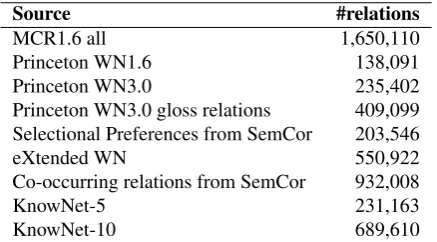
The WordNet versions that we use in this work are those integrated into the Multilingual Central Repository or MCR (Atserias et al., 2004) (which includes English Word-Net version 1.6 and wordnets for several other languages like Spanish, Italian, Catalan and Basque), and WordNet version 3.01.
The version of the MCR used in our experiments comprises relations from WordNet 1.6, WordNet 2.0 relations mapped to 1.6 synsets, eXtended WordNet relations (Mihalcea and Moldovan, 2001), selectional preference relations for sub-jects and obsub-jects of verbs (Agirre and Martinez, 2002) and semantic coocurrence relations. The latter two types of re-lations are extracted from SemCor, a semantically hand-tagged corpus (Miller et al., 1993). They are thus essen-tially different from the other relations of the MCR, as they are extracted from a hand-tagged corpus.
Selectional preferences were acquired for subjects and ob-jects from SemCor (Agirre and Martinez, 2002). Semantic co-occurrences were obtained using SemCor measuring the association between word-senses co-occurring in the same sentence (Cuadros et al., 2007).
We have tried three main versions of the MCR in our ex-periments, as follows:
mcr16.all: all relations in the MCR are used, including SemCor related relations.
mcr16.all wout sc: all relations except semantic cooccur-rence relations.
Method Spearman Known-words interval
mcr16.all 0.369690 0.395788 [ 0.275818, 0.456578 ] mcr16.all wout sc 0.449606 0.479641 [ 0.362092, 0.529263 ] mcr16.all wout semcor 0.525343 0.559497 [ 0.445263, 0.597086 ] mcr16.all wout semcor+k5 0.553766 0.589597 [ 0.476836, 0.622276 ] mcr16.all wout semcor+k10 0.565809 0.602374 [ 0.490275, 0.632907 ]
wn30 0.559087 0.588069 [ 0.482770, 0.626976 ] wn30g 0.658218 0.692505 [ 0.594597, 0.713647 ] wn30g+k5 0.685184 0.720859 [ 0.625450, 0.736934 ] wn30g+k10 0.638901 0.672213 [ 0.572612, 0.696891 ]
Table 2: Wordsim353 results for various wordnet versions and relations. Spearman report the correlation with the gold standard. Known-words reports the Spearman correlation for pairs where both words are in WordNet. The last column corresponds to the 95% confidence interval. Please check Section 2 for the meaning of the abbreviations used in this table.
The second term on Eq. (1) can also be seen as a smooth-ing factor that makes any graph fulfill the property of besmooth-ing aperiodic and irreducible, and thus guarantees that PageR-ank calculation converges to a unique stationary distribu-tion.
In the traditional PageRank formulation the vector v is a stochastic normalized vector whose element values are all
1
N, thus assigning equal probabilities to all nodes in the graph in case of random jumps. However, as pointed out by (Haveliwala, 2002), the vector v can be non-uniform and assign stronger probabilities to certain kinds of nodes, effectively biasing the resulting PageRank vector to prefer these nodes. For example, if we concentrate all the prob-ability mass on a unique nodei, all random jumps on the walk will return toiand thus its rank will be high; more-over, the high rank ofiwill make all the nodes in its vicin-ity also receive a high rank. Thus, the importance of nodei
given by the initial distribution ofvspreads along the graph on successive iterations of the algorithm. We call this vari-ant of PageRankPersonalized PageRank.
Given a target word, we compute the personalized PageR-ank over the WordNet graph for the word, that is, we initial-izevin Eq. (1) with equal probabilities for all synsets cor-responding to the target word, while the rest of the synsets are initialized to zero.
Regarding implementation details, Eq. (1) is solved apply-ing an iterative algorithm, computapply-ing Eq. (1) successively until convergence below a given threshold is achieved, or, more typically, until a fixed number of iterations are exe-cuted. We chose a damping value of0.85and finish the calculation after30iterations. These are default values, and we did not optimize them.
3.2. Computing similarity
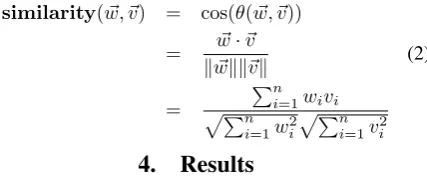
Once personalized PageRank is computed, it returns a prob-ability distribution over WordNet synsets. The similarity between two words can thus be implemented as the simi-larity between the probability distributions. Alternatively, we can interpret the probability distribution for a wordw
as a vectorw~ of weights wi where each dimensioni is a synset, and use the cosine to compute similarity, as in Eq 2.
similarity(w, ~~ v) = cos(θ(w, ~~ v))
= w~ ·~v
kw~kk~vk (2)
=
Pn
i=1wivi
pPn i=1w
2
i
pPn i=1v
2
i
4.
Results
We have tested the various sets of relations on the Word-Sim353 dataset (Finkelstein et al., 2002)5, which contains
353 word pairs, each associated with an average of 13 to 16 human judgements. Both similarity and relatedness are annotated without any distinction. Several studies indicate that the human scores consistently have very high correla-tions with each other (Miller and Charles, 1991; Resnik, 1995), thus validating the use of these kind of datasets for evaluating semantic similarity.
The results in Table 2 show the results as the Spearman correlation for several wordnet versions and relations. Not all words in the dataset are in WordNet6, meaning that we are not able to return a result in 9 pairs out of the 353. TheKnown-wordcolumn in Table 2 reports the Spearman value for the rest of pairs. Given the wide confidence inter-vals, most of the differences are not statistically significant. Note that the similarity literature rarely reports statistical significances, and limit themselves to report performance differences.
The main conclusions from the results are the following:
• The best combinations for MCR1.6 are obtained ig-noring selectional preferences and semantic occur-rences.
• The disambiguated glosses improve the results by a large margin on wn30.
• KnowNet improves results in both datasets. The largest gains are for MCR1.6 with KnowNet-10 (k10),
5
http://www.cs.technion.ac.il/˜gabr/ resources/data/wordsim353/wordsim353.html
6
As we assumed that all words are nouns in singular form, we missed the following words: media,live,children,eat,earning,
Method Source Spearman
(Hughes and Ramage, 2007) WordNet 0.55 (Finkelstein et al., 2002) LSA 0.56 (Finkelstein et al., 2002) Combination 0.56 (Gabrilovich and Markovitch, 2007) ODP 0.65 (Agirre et al., 2009) Web Corpus 0.65 (Agirre et al., 2009) WordNet 0.66
This work WordNet 0.69
(Gabrilovich and Markovitch, 2007) Wikipedia 0.75 (Agirre et al., 2009) Combination 0.78
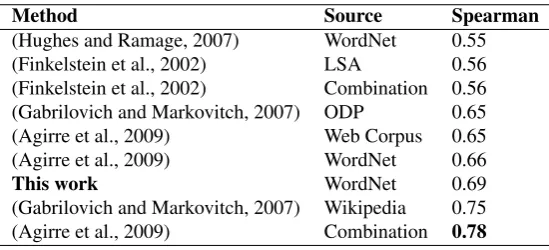
Table 3: Spearman correlation results for previous work for WordSim353.
but the best overall results are for Wordnet3.0 with dis-ambiguated glosses and KnowNet-5 (k5)
All relations sources added to WordNet seem to improve re-sults, with the exception of semantic cooccurrences and se-lectional preferences, which actually degrade performance. While adding relations was expected to improve the results, we were greatly surprised to see that the semantic cooccur-rences and selectional prefecooccur-rences were harmful. These re-lations come from a manually annotated corpus, and im-proved the results in an word sense disambiguation task (Agirre and Soroa, 2008). We are still investigating the cause of the poor performance of these relations.
5.
Related work
Table 3 shows the results of some noteworthy systems in the literature which use Spearman in their results. Compared to the systems in the literature, we outperform the best sys-tems that only use Wordnet. The algorithm is the same as in (Agirre et al., 2009), with the only change in the use of new relations, which in the case of KnowNet-5 improves perfor-mance in 3 points. Note that the results over the pairs with both words in Wordnet are very close to (Gabrilovich and Markovitch, 2007) (0.72 vs. 0.75), which is the best system using a single knowledge source (Wikipedia). The best re-sult overall is obtained using a supervised combination of distributional algorithms and our WordNet-based algorithm as reported in (Agirre et al., 2009).
6.
Conclusions and future work
The study presented in this paper shows that choosing the right version of WordNet and the right set of relations is im-portant to obtain good similarity results. The combination of all relations in WN3.0, the disambiguated glosses, and the automatically derived relations from KnowNets pro-duces the best results to date using WordNet on this dataset. The similarity algorithm and needed resources are publicly available under the GPL license athttp://ixa2.si.
ehu.es/ukb/.
For the future, we would like to perform a similar study on WSD using a related algorithm(Agirre and Soroa, 2009), and compare which is the best setting on these closely in-terrelated tasks.
Acknowledgments
This work has been supported by KNOW (TIN2006-15049-C03-01 / 03), KNOW-2 (TIN2009-14715-C04-01 / 04) and KYOTO (ICT-2007-211423). We want to thank the anony-mous reviewers for their comments.
7.
References
Agirre, E. and Lopez de Lacalle, O. (2004). Publicly avail-able topic signatures for all wordnet nominal senses. In
Proceedings of LREC.
Agirre, E. and Martinez, D. (2002). Integrating selectional preferences in wordnet. InProceedings of the First In-ternational WordNet Conference, Mysore, India. Agirre, E. and Soroa, A. (2008). Using the multilingual
central repository for graph-based word sense disam-biguation. InProceedings of LREC.
Agirre, E. and Soroa, A. (2009). Personalizing pagerank for word sense disambiguation. InProc. of EACL 2009, Athens, Greece.
Agirre, E., Soroa, A., Alfonseca, E., Hall, K., Kravalova, J., and Pasca, M. (2009). A study on similarity and relatedness using distributional and WordNet-based ap-proaches. InProceedings of annual meeting of the North American Chapter of the Association of Computational Linguistics (NAAC), Boulder, USA.
Alvarez, M. and Lim, S. (2007). A graph modeling of semantic similarity between words. Proceedings of the Conference on Semantic Computing, pages 355–362. Atserias, J., Villarejo, L., Rigau, G., Agirre, E., Carroll, J.,
Magnini, B., and Vossen, P. (2004). The meaning mul-tilingual central repository. InProc. of Global WordNet Conference, Brno, Czech Republic.
Bollegala, D., Y., M., and Ishizuka, M. (2007). Measur-ing semantic similarity between words usMeasur-ing web search engines. InProceedings of WWW’2007.
Budanitsky, A. and Hirst, G. (2006). Evaluating WordNet-based Measures of Lexical Semantic Relatedness. Com-putational Linguistics, 32(1):13–47.
Chen, H., Lin, M., and Wei, Y. (2006). Novel associa-tion measures using web search with double checking. InProceedings of COCLING/ACL 2006.
Cuadros, M., Rigau, G., and Castillo, M. (2007). Evalu-ating large-scale knowledge resources across languages. InProceedings of RANLP.
Daud´e, J., Padr´o, L., and Rigau, G. (2003). Making Word-net Mappings Robust. InProceedings of the 19th Con-greso de la Sociedad Espala para el Procesamiento del Lenguage Natural, SEPLN’03, Universidad Universidad de Alcala de Henares. Madrid, Spain.
Fellbaum, C. (1998a). WordNet. An Electronic Lexical Database. Language, Speech, and Communication. The MIT Press.
Fellbaum, C., editor (1998b). WordNet: An Electronic Lex-ical Database and Some of its Applications. MIT Press, Cambridge, Mass.
Finkelstein, L., Gabrilovich, E., Matias, Y., Rivlin, E., Solan, Z., Wolfman, G., and Ruppin, E. (2002). Placing Search in Context: The Concept Revisited. ACM Trans-actions on Information Systems, 20(1):116–131. Gabrilovich, E. and Markovitch, S. (2007). Computing
mantic Relatedness using Wikipedia-based Explicit Se-mantic Analysis. Proc of IJCAI, pages 6–12.
Haveliwala, T. H. (2002). Topic-sensitive pagerank. In
WWW ’02: Proceedings of the 11th international con-ference on World Wide Web, pages 517–526.
Hughes, T. and Ramage, D. (2007). Lexical semantic re-latedness with random graph walks. In Proceedings of EMNLP-CoNLL-2007, pages 581–589.
Laparra, E. and Rigau, G. (2009). Integrating wordnet and framenet using a knowledge-based word sense disam-biguation algorithm. InProceedings of Recent Advances in Natural Language Processing (RANLP09), Borovets, Bulgaria.
Mihalcea, R. and Moldovan, D. (2001). extended word-net: Progress report. InNAACL WorkshopWordNet and Other Lexical Resources: Applications, Extensions and Customizations (NAACL’2001)., pages 95–100, Pitts-burg, PA, USA.
Miller, G. and Charles, W. (1991). Contextual correlates of semantic similarity.Language and Cognitive Processes, 6(1):1–28.
Miller, G., Leacock, C., Tengi, R., and Bunker, R. (1993). A Semantic Concordance. InProceedings of the ARPA Workshop on Human Language Technology.
Page, L., Brin, S., Motwani, R., and Winograd, T. (1999). The pagerank citation ranking: Bringing order to the web. Technical Report 1999-66, Stanford InfoLab. Pre-vious number = SIDL-WP-1999-0120.
Resnik, P. (1995). Using Information Content to Evalu-ate Semantic Similarity in a Taxonomy. Proc. of IJCAI, 14:448–453.
Sahami, M. and Heilman, T. (2006). A web-based kernel function for measuring the similarity of short text snip-pets.Proc. of WWW, pages 377–386.