Constructing a Question Corpus for Textual Semantic Relations
Rui Wang
†and Shuguang Li
†‡†LT Lab, DFKI GmbH, Saarbruecken, Germany
†‡Greedy Intelligence Ltd., China
[email protected], [email protected]
Abstract
Findingusefulquestions is a challenging task in Community Question Answering (CQA). There are two key issues need to be resolved: 1) what is ausefulquestion to the given reference question; and furthermore 2) what kind of relations exist between a given pair of questions. In order to answer these two questions, in this paper, we propose a fine-grained inventory of textual semantic relations between questions and annotate a corpus constructed from the WikiAnswers website. We also extract large archives of question pairs with user-generated links and use them as labeled data for separating useful questions from neutral ones, achieving 72.2% of accuracy. We find such online CQA repositories valuable resources for related research.
Keywords:Community Question Answering, Question Usefulness, Textual Semantic Relations
1.
Introduction
Community Question Answering (CQA) is a recently es-tablished type of question answering (QA), which shifts the inherent complexity of constructing sophisticated open-domain QA systems to volunteer contributors. A user can post a query (reference) question and wait for the right con-tributors to answer it. The user can also search the large archives of data for similar questions, in order to minimize the time between the submission of a question by a user and the subsequent posting of answers by volunteer contribu-tors. CQA thus becomes similar to the traditional informa-tion retrieval (IR) task. The aim is to recommend a list of questions that can satisfy the user’s information need. However, retrieving questions from such large CQA repos-itories to satisfy the user’s information need is by no means an easy task. One reason is that the user’s information need is usually quite complex. The query questions are sometimes vague and ambiguous. Another reason is the lexical gap or word mismatch problem between questions; the same information need can be expressed by two ques-tions with few common words. Conventional word-based retrieval models for question search would fail to capture the similarity between two questions. Consider the follow-ing example of questions that are semantically similar to each other:
1. Where can I get cheap airplane tickets?
2. Any travel website for low airfares?
This problem in CQA was firstly studied as a question use-fulness ranking task in (Bunescu and Huang, 2010). The retrieved questions fell into three predefined classes rep-resenting different levels of “usefulness” for fulfilling the user’s information need. However, their definitions of use-fulnessand neutralwere too vague to be interpreted and the size of the manually labeled dataset was too small. Re-search on using CQA data to study the information needs of users is still in the early stages. A further study on the question usefulness ranking problem and how the question usefulness can benefit the question search is needed.
In another line of research, semantic relations between statements (compared to questions) have been popular top-ics in the recent years. For instance, Recognizing Textual Entailment (RTE) has attracted a lot of attention, from RTE-1 (Dagan et al., 2006) to RTE-5 (Bentivogli et al., 2009), as well as other textual semantic relations, paraphrase (Das and Smith, 2009), contradiction (de Marneffe et al., 2008), and some (Heilman and Smith, 2010) or all of them (Wang and Zhang, 2011). However, there is no detailed study on textual semantic relations betweenquestionsto our best knowledge.
Bernhard and Gurevych (2008) evaluate various string sim-ilarity measures and vector space based simsim-ilarity mea-sures on the task of retrieving question paraphrases from the WikiAnswers repository, which relies on the wiki tech-nology used in Wikipedia1. We find that most of the “Refor-mulation” questions are related but not paraphrasing. How-ever, the wealth of such questions available on the WikiAn-swers website can still be used in research for finding use-fulquestions. Furthermore, most “Useful” questions often have a textual entailment relation with the reference ques-tion. Therefore, CQA could benefit from the techniques used in the RTE community.
In this study, we make the first attempt to exploit the pos-sible textual semantic relations between questions from an online CQA repository. The motivation behind is that once we define such relations, many applications can benefit from it. For instance, we can raise a question in alternative ways, find similar questions (i.e., paraphrase), decompose complex questions (i.e., entailment/subset relation), find out contrast/contradictory questions (i.e., contradiction), or link the related questions (i.e., usefulness). In particular, we focus on the following issues: 1) a simple way to col-lect question pairs from the WikiAnswers repository
(Sec-1
tion 3.); 2) a finer-grained inventory of possible semantic relations between questions (Section 4.); and 3) an auto-matic approach to recognize such relations (Section 5.).
2.
Related Work
2.1. Question Usefulness Ranking
Bunescu and Huang (2010) present a machine learning ap-proach for the task of ranking previously answered ques-tions in a CQA resource, with respect to their relevance to a new, unanswered reference question. They manually la-bel 60 groups of questions. The relations between the ref-erence question and the ranked questions are divided into three categories:
1. Reformulation: paraphrasing questions which use al-ternative words or expressions;
2. Useful: useful questions;
3. Neutral: other not useful questions.
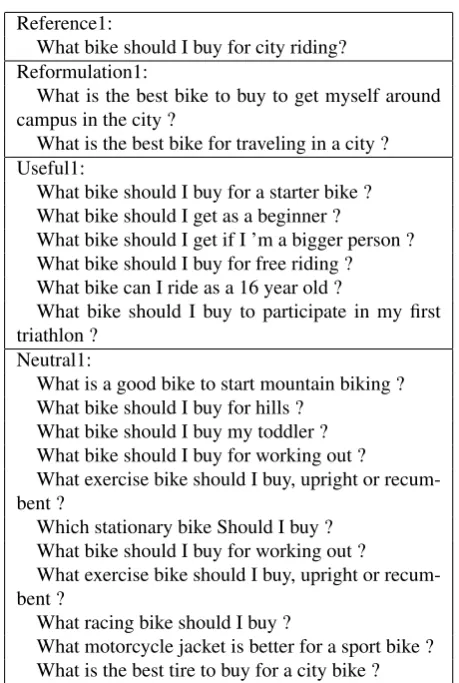
Table 1 shows an example from this dataset. However, we find this categorization to be too coarse-grained. The defi-nitions for “Usefulness” and “Neutral” are too vague to be interpreted. We also find that most of the “Useful” ques-tions had a textual entailment relation with the reference question in this dataset.
Reference1:
What bike should I buy for city riding? Reformulation1:
What is the best bike to buy to get myself around campus in the city ?
What is the best bike for traveling in a city ? Useful1:
What bike should I buy for a starter bike ? What bike should I get as a beginner ?
What bike should I get if I ’m a bigger person ? What bike should I buy for free riding ? What bike can I ride as a 16 year old ?
What bike should I buy to participate in my first triathlon ?
Neutral1:
What is a good bike to start mountain biking ? What bike should I buy for hills ?
What bike should I buy my toddler ? What bike should I buy for working out ?
What exercise bike should I buy, upright or recum-bent ?
Which stationary bike Should I buy ? What bike should I buy for working out ?
What exercise bike should I buy, upright or recum-bent ?
What racing bike should I buy ?
What motorcycle jacket is better for a sport bike ? What is the best tire to buy for a city bike ?
Table 1: Question usefulness ranking example
2.2. Question Paraphrasing
Question paraphrasing is critical in many natural language processing (NLP) applications, especially for question re-formulation in QA. Zhao et al. (2007) present a novel method for automatically extracting question paraphrases from a search engine’s logs and generating templates for question reformulation. A SVM model is trained, by mak-ing use of different features extracted from the questions and the most effective combination of features was identi-fied. However, this method requires access to Microsoft’s search engine logs. Sacaleanu et al. (2008) summarize a set of question templates. When there is an input question, the system compares it with each of the template in the set and finds the best match. Therefore, the corresponding ex-pected answer type can be found as well. Bernhard and Gurevych (2008) evaluate various string similarity mea-sures and vector space based similarity meamea-sures on the task of retrieving question paraphrases from the WikiAn-swers repository. As discussed in the previous section, most of the gold standard question pairs are not paraphrases. However, we will show that the wealth of this CQA data repository is still valuable for information need satisfaction research, after further annotation and processing.
2.3. Textual Entailment
Textual entailment is another important research field in Natural Language Processing. Recognizing Textual Entail-ment (RTE) (Dagan et al., 2006) detects whether a Hypoth-esis (H) can be inferred (or entailed) by a Text (T). It is shown to be helpful for QA by Harabagiu and Hickl (2006). Conventional methods for RTE tasks rely on similarity measures between texts. Androutsopoulos and Malakasi-otis (2010) nicely survey the field together with paraphrase acquisition. Here we just list a few of the previous works. Many approaches make use of the bag-of-words similarity, assisted by lexical resources like WordNet, for instance, (Corley et al., 2005). Kouylekov and Magnini (2005) ex-ploit the use of syntactic features and proposed a syntactic tree editing distance measure to detect entailment relations. Wang and Neumann (2007) propose a subsequence ker-nel method approach, to incorporate structural features ex-tracted from syntactic dependency trees for this task. Wang and Zhang (2009) combine syntactic and semantic features to capture the key information shared between texts. As far as can be ascertained, no previous work has been done in Recognizing Textual Entailment from CQA ques-tion pairs. We will make the first attempt to exploit this direction using our annotated WikiAnswers dataset and the first fine-grained framework.
3.
WikiAnswers and Data Collection
Training→Testing ALL - TFIDF ALL
W ikis→QSimple 48.2% 61.5%
W ikis→QComplex 43.1% 52.2%
W ikiW →QSimple 65.5% (17.3%↑) 65.5% (4.0%↑)
W ikiW →QComplex 70.3% (27.2%↑) 72.2% (20.0%↑)
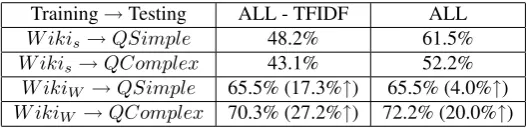
Table 5: Question usefulness classification results
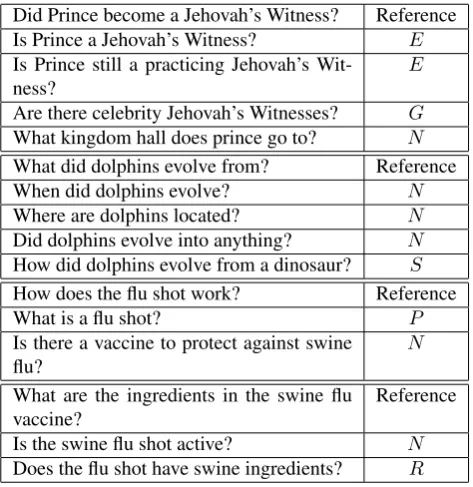
We manually relabeled the datasets using our inventory of relations (Section 4.). We found that most of the “Useful” questions have a textual entailment relation with the ref-erence question. In order to run the binary classification experiment, the questions in “Reformulation” and “Use-ful” are treated as positive instances, while the questions in “Neutral” are treated as negative ones. For the questions annotated in W ikis, the questions labeledN are treated as negative examples, while the other pairs are positive. The results of the classifiers with different feature sets are shown in the first two rows of Table 5.
One significant observation is that on these two datasets,
QSimpleandQComplex, TFIDF shows great importance
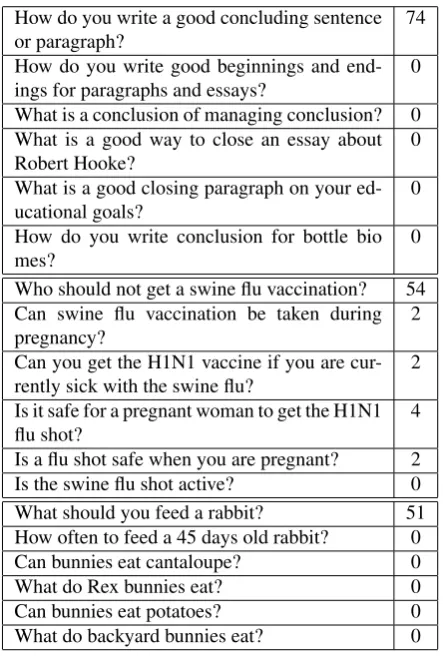
for the classification. However, the overall performance is not optimal. As inW ikis, about half of the question pairs are paraphrases or have a textual entailment relation, we think that WikiAnswers might be a good resource for learn-ing to retrieve useful questions. Therefore, we randomly select 6,574 question pairs from the WikiAnswers dataset, detailed in Section 3. as positive examples for training a two-class SVM classifier. We also randomly select 6,293 question pairs (W ikiW) which are not marked as “rephras-ing” questions on the WikiAnswers website as negative ex-amples. The results are shown in the last two rows of Ta-ble 5.
Along with the increase of the data size, the difference be-tween the feature models seems to have less impact on the final result. Although the data do not contain fine-grained manual annotations, the result we achieve is competitive with previous research (Bunescu and Huang, 2010)4. Com-paring the latter results with the previous ones (W ikis), we conclude thatW ikiW, which has been ‘user-annotated’, is a valuable resource for learning to retrieve useful questions. All the data with annotations are publicly available5by the time of this publication.
6.
Summary
In this paper, we presented our investigation on the textual semantic relations between questions. We collected large quantities of question pairs from WikiAnswers, which were shown to be a valuable resource for learning to retrieve useful questions. We formulated this problem as a fine-grained question pair classification task. The classification
4
Although we use the same data, the results are not directly comparable. Bunescu and Huang (2010) evaluated the pairwise accuracy of ranking a list of questions, while we cast it into a classification task and evaluate the classification accuracy. In ad-dition, we do not want to claim a better feature model or classifi-cation approach in this work.
5
http://www.coli.uni-saarland.de/˜rwang/ resources/LREC2012Data.zip
task was further decomposed into two binary classification subtasks, recognizing textual entailment between questions and recognizing useful questions. Furthermore, we com-pared the effectiveness of two feature models (in- or ex-cluding TFIDF) using a manually-annotated gold standard. Both the annotated and unannotated corpora are publicly available. For further improvements, we would like to con-sider more features of the questions, e.g., the categories, in- and out-coming link information, etc. In addition, we would also like to make a full cycle of bootstrapping by adding more links to the related questions in the existing CQA repositories.
Acknowledgements
The first author was partially supported by the EXCITE-MENT project (ICT-287923) funded by the European Com-munity under the Seventh Framework Programme (FP7) for Research and Technological Development.
7.
References
I. Androutsopoulos and P. Malakasiotis. 2010. A survey of paraphrasing and textual entailment methods.Journal of Artificial Intelligence Research, 38:135–187.
L. Bentivogli, B. Magnini, I. Dagan, H.T. Dang, and D. Gi-ampiccolo. 2009. The fifth pascal recognizing textual entailment challenge. InProceedings of TAC Workshop. NIST.
Delphine Bernhard and Iryna Gurevych. 2008. Answering learners’ questions by retrieving question paraphrases from social q&a sites. InProceedings of the Third Work-shop on Innovative Use of NLP for Building Educational Applications.
Razvan Bunescu and Yunfeng Huang. 2010. Learning the relative usefulness of questions in community qa. In Proceedings of EMNLP.
C. Corley, A. Csomai, and R. Mihalcea. 2005. Text se-mantic similarity, with applications. InProceedings of Recent Advances in Natural Language Processing. I. Dagan, O. Glickman, and B. Magnini. 2006. The pascal
recognising textual entailment challenge. Lecture Notes in Computer Science: Machine Learning Challenges. D. Das and N.A. Smith. 2009. Paraphrase identification
as probabilistic quasi-synchronous recognition. In Pro-ceedings of ACL-IJCNLP.
M.C. de Marneffe, A.N. Rafferty, and C.D. Manning. 2008. Finding contradictions in text. In Proceedings of ACL-08: HLT.
Meeting of the Association for Computational Linguis-tics, pages 905–912, Sydney, Australia, July. Association for Computational Linguistics.
M. Heilman and N.A. Smith. 2010. Tree edit models for recognizing textual entailments, paraphrases, and an-swers to questions. InProceedings of NAACL-HLT. Milen Kouylekov and Bernardo Magnini. 2005.
Recogniz-ing textual entailment with tree edit distance algorithms. InProceedings of the PASCAL Challenges on RTE, pages 17–20.
Bogdan Sacaleanu, Constantin Orasan, Christian Spurk, Shiyan Ou, ´Oscar Ferr´andezandez, Milen Kouylekov, and Matteo Negri. 2008. Entailment-based question an-swering for structured data. InIn Proceedings of COL-ING 2008 (Posters and Demonstrations).
Rui Wang and G¨unter Neumann. 2007. Recognizing tex-tual entailment using a subsequence kernel method. In Proceedings of AAAI.
Rui Wang and Caroline Sporleder. 2010. Constructing a textual semantic relation corpus using a discourse tree-bank. InProceedings of LREC.
Rui Wang and Yi Zhang. 2009. Recognizing textual relat-edness with predicate-argument structures. In Proceed-ings of EMNLP.
Rui Wang and Yi Zhang. 2011. A multi-dimensional classification approach towards textual semantic relation recognition. InProceedings of CICLing.