An Iterative Approach for Mining Parallel Sentences in a Comparable Corpus
Lise Rebout, Philippe Langlais
DIROUniversit´e de Montr´eal CP 6128 Succursale Centre-Ville H3C3J7 Montreal, Qu´ebec, Canada [email protected], [email protected]
Abstract
We describe an approach for mining parallel sentences in a collection of documents in two languages. While several approaches have been proposed for doing so, our proposal differs in several respects. First, we use a document level classifier in order to focus on potentially fruitful document pairs, an understudied approach. We show that mining less, but more parallel documents can lead to better gains in machine translation. Second, we compare different strategies for post-processing the output of a classifier trained to recognize parallel sentences. Last, we report a simple bootstrapping experiment which shows that promising sentence pairs extracted in a first stage can help to mine new sentence pairs in a second stage. We applied our approach on the English-FrenchWikipedia. Gains of a statistical machine translation (SMT) engine are analyzed along different test sets.
Keywords:comparable corpora, nearly-parallel document mining, machine translation
1.
Introduction
This work is concerned with mining parallel sentences from a comparable corpus. A typical two-stage approach for tackling the problem consists in identifying a set of po-tentially comparable documents, then to mine parallel sen-tences among those document pairs. The first stage is of-ten done heuristically. In the news domain, many authors have for instance proposed to rule out news written at too different times; e.g. (Munteanu and Marcu, 2005). Other constraints, such as length ratio can further restrain the doc-ument pairs considered. Others, working with Wikipedia avoid document pairing and rely instead on the inter-lingual links present in this resource (Adafre and de Rijke, 2006; Smith et al., 2010).
There are notable exceptions to this trend of work. In (Till-mann, 2009) the author avoids document pairing by directly harvesting the cartesian product of sentences in the source and target collections. This represents an enormous space trough which he manages to search thanks to a smart orga-nization of the operations involved in computing the proba-bility given by an IBM Model 1 to any sentence pair. Thus, the approach is specific to this feature only. On the contrary, the work of (Ture et al., 2011) tackles the computationally challenging task of pairwise document comparison thanks to a map-reduce approach which — provided enough com-puters (they used 96 cores) — was shown to be efficient for pairing all the German-English articles in Wikipedia. In (Ture and Lin, 2012) the authors describe the pending experiment, where pairwise sentence comparison is con-ducted over the huge set of comparable documents they identified (over 64 million document pairs), again making efficient use of map-reduce and a reasonable sized cluster. Although the last three studies we discussed are impressive engineering success stories, we take a rather opposite direc-tion, guided by the intuition that mining parallel sentences from a set ofnearly-paralleldocument pairs (a notion we define later on) will likely yield to better parallel sentence pairs than mining all (or many) document pairs, as done in (Ture and Lin, 2012). We see several reasons why it is
sen-sible to focus of nearly-parallel documents in the first place. From a computational point of view, it is obviously interest-ing to limit the number of documents among which pairs of sentences will be searched for; regardless of the fact that the heavy computations can be smartly parallelized. Another argument in favour of measuring the parallelness of a doc-ument pair is that it might help in adapting the technology with which to extract parallel sentences. For instance, we might prefer to extract parallel sentences of very parallel documents thanks to a standard sentence alignment tech-nique (Gale and Church, 1993) instead of using a classifier, as typically done.
We present our approach to mine parallel sentences in a comparable corpus in section 2. We describe the resources we used for training our classifiers, and those we used for conducting our SMT experiments in section 3. We report a number of experiments we conducted in section 4. We discuss our work and present future avenues in section 5.
2.
Approach
Our approach has two main components. The first one se-lects fruitful pairs of documents in a large set of document pairs, that is, pairs of documents that are likely parallel. The second component is taking care of the pairwise sen-tence comparison conducted for each identified pair of doc-uments. A block diagram of the system with references to the sections that discuss each component is provided in Fig-ure 1.
2.1.
Parallel Document Mining
We compare two approaches for identifying useful pairs of documents. The first one relies on a classifier trained in a supervised way. The second one is a cross-lingual informa-tion retrieval (IR) system similar to (Utiyama and Isahara, 2003). Both methods are detailed in the following sections.
2.1.1. Classifier
Figure 1: Block diagram of the approach
recast it into a binary classification problem, where the task is to define nearly-parallel document pairs from others. We measure the degree of parallelness of a sentence-aligned document pair ofnsrcsource andntrgtarget sentences with the ratio:
rpara=
2×npara nsrc+ntrg
wherenpara designates the number of parallel sentences. Based on it, we arbitrarily define the class of nearly-parallel document pairs as those which ratio rpara is greater or equal to 2/3.
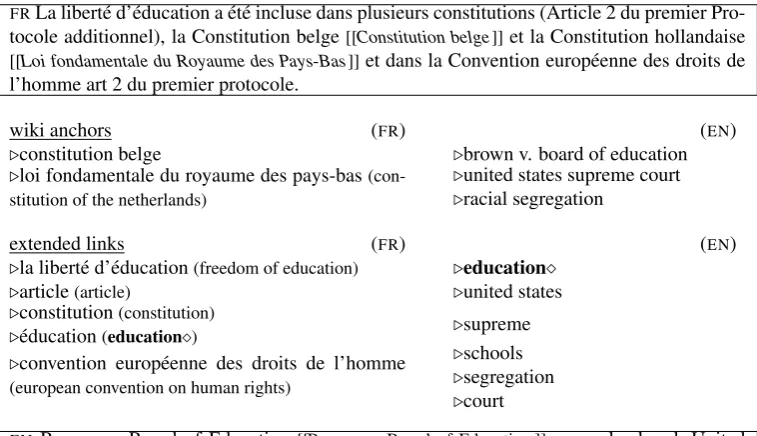
We trained in a supervised way a classifier to recognize this class, thanks to an annotated corpus described in sec-tion 3.2. In order to do so, we compute a handful of lightweight features, making use of a dictionary extracted from the titles of the article pairs linked inWikipedia, and mainly following the work of (Adafre and de Rijke, 2006). In particular, the following features are computed for each pair of documents, and are illustrated in Figure 2:
• the number of sentences in the French and the English articles,
• the Levenshtein distance between the phrases col-lected from the wiki links present in the En-glish articles (wiki anchors), and those collected in the French articles, then translated (when-ever possible) thanks to the WIKITITLE cor-pus. For instance, in Figure 2 the French phrase loi fondamentale du royaume des pays bas is translated into the English one
constitution of the netherlands,
• the number of phrases in each article that match an entry in WIKITITLE, but that are not anchored in wiki links (extended links); the size of the intersection of those two sets of phrases, after the French phrases got translated thanks to WIKITITLE.
Those features are definitely Wikipedia-centric, therefore our parallel document classifier is currently specific to this collection of documents. To us, WIKITITLEis playing the role of a dedicated bilingual lexicon. It remains to investi-gate whether a general bilingual lexicon would be as ade-quate or even better.
2.1.2. Cross-lingual IR System
We implemented a cross-lingual information retrieval ap-proach very similar to the one described in (Utiyama and Isahara, 2003). The idea is to index each English document thanks to a vector space model built on the English words present in the collection. At retrieval time, we “translate” a French document, so that it can be represented in the same vector space. We used an in-house bilingual dictionary for performing the translation which contains a total of 29 861 different forms1 and used the LUCENEAPI2 in its default setting for the indexing and retrieval steps.
In our implementation, English documents with a similar-ity score over 0.5 were considered nearly-parallel to the queried French document, provided they defined a pair be-longing to the set of interlingually linked pairs of articles. The value of 0.5 was chosen empirically so that the quan-tity of mined document pairs with LUCENE was directly comparable to the number of pairs mined by the classifier.
2.2.
Parallel Sentence Mining
Once the nearly-parallel documents are identified, we har-vest all possible sentence pairs and select those that are par-allel according to a classifier trained in a supervised way (see section 4.2.1.). This is a very imbalanced classification task where the number of negative examples is quadratic in the number of sentences, while the number of parallel sen-tences is at best linear. Lexical overlap filtering strategies, as in (Munteanu and Marcu, 2005) could be used for reduc-ing computation time.
We computed over 20 features of various nature includ-ing most of those described in (Smith et al., 2010), some we adapted from (Adafre and de Rijke, 2006), and others we specifically engineered. Some features are characteriz-ing a sentence by itself (e.g. number of words or charac-ters), a sentence within a document (e.g. the presence of hapax word, which has been shown to be useful for align-ing documents (Enright and Kondrak, 2007)), a pair of sen-tences (such as the number of links or numbers they share, Jaccard coefficients comparing different representations of those sentences, etc.).
1
FRLa libert´e d’´education a ´et´e incluse dans plusieurs constitutions (Article 2 du premier Pro-tocole additionnel), la Constitution belge[[Constitution belge]]et la Constitution hollandaise [[Loi fondamentale du Royaume des Pays-Bas]]et dans la Convention europ´eenne des droits de l’homme art 2 du premier protocole.
wiki anchors (FR) (EN)
.constitution belge .brown v. board of education
.loi fondamentale du royaume des pays-bas (con-stitution of the netherlands)
.united states supreme court .racial segregation
extended links (FR) (EN)
.la libert´e d’´education(freedom of education) .education
.article(article) .united states
.constitution(constitution)
.´education(education) .supreme
.convention europ´eenne des droits de l’homme (european convention on human rights)
.schools .segregation .court
EN Brown v. Board of Education[[Brown v. Board of Education]] was a landmark United States Supreme Court[[United States Supreme Court]]case that overturned segregation[[Racial segregation]]in US schools based on one’s race.
Figure 2: Illustration of the representation of twoWikipediadocuments, according to the text anchored in wiki links, or the phrases that correspond to article titles inWikipedia. When present, the translation of each French phrase in WIKITITLEis reported in parenthesis. The only match in both representations is marked by a diamond symbol.
2.2.1. Post-treatment
t As we will show, the identification of parallel sentence pairs is error prone. This is why we investigated a num-ber of post-treatment strategies. The simplest one imposes that a pair of sentences receives a classification score higher than a given threshold ρ in order to get elected parallel. Still, the main reason for the noise we observe is that the decisions made by the classifier are done independently for each sentence pair. This may lead to situations where, for instance, a given French sentence is paired to several target sentences.3
The set of pairings made at given thresholdρcan be orga-nized into a bipartite graph where nodes represent French and English sentences, and edges represent French to En-glish sentence pairings and are labeled with the cost of the pairing as returned by the classifier. Refining the decisions made can then be casted into finding the matching (that is, a set of edges that do not share vertices) with the maximum cost, where the cost of a match is the sum of the cost of all the pairs (edges) involved. We implemented two well known solutions to this problem, a greedy maximum first approach (hereafter namedgreedy) and the so-called Hun-garian algorithm (hereafter namedhung). The former picks the candidate edge e with the maximum score, removes candidate edges that share a vertice withe, and iterates until no edge remains.
Last, none of the post-processing methods aforementioned guaranty the sequentiality of the pairs we typically observe in a document. Therefore, we implemented a last heuristic, hereafter namedextend, which adds the edge(s+ 1, t+ 1)
whenever it does not share a vertices with existing edges,
3Note that this might indicate a legitimate 1-to-many
align-ment, a situation we do not consider in this work.
its score by the classifier is at least positive (but possibly lower thanρ) and edges(s, t)and(s+ 2, t+ 2)are already selected. This heuristic which admittedly is rather specific proved to be useful, as shown in section 4.
2.3.
Bootstrapping
None of the features we described so far are exploiting a general bilingual dictionary. The main motivation for this was that generic dictionaries might be of little use in min-ing domain specific comparable corpora, an assumption we still need to assess.4 It also makes our approach more appli-cable to language pairs for which covering dictionaries are not available. Still, using a dictionary has been reported to be useful (Munteanu and Marcu, 2005; Smith et al., 2010; Ture and Lin, 2012). This motivates an iterative approach, where a first pass extracts good sentence pairs, from which a bilingual dictionary is inferred. This dictionary can then be used in successive passes of pairing. This is similar in spirit to the 2-stage approach proposed in (Ture and Lin, 2012) where a fast classifier is first applied, producing a large set of sentence pairs which is refined by a more ac-curate but slower classifier. One difference is that in our case, the second classifier is bootstrapped by the knowl-edge acquired from the first stage. We investigate one such iteration in section 4.
3.
Resources
3.1.
Comparable Corpus
We downloaded the May 2011 dumps of the English and the French parts ofWikipedia. The English part contains 3.7
4See the ACCURAT project on this matterhttp://www.
millions of articles, the French part contains 1.1 millions of articles. A total of 551 388 pairs of articles are marked by an interlingual (English-French) link. This quantity of data is a mid-ground between very large data collections such as theGigaWord corpus (which English version con-tains roughly 26 gigabytes of texts) and more modest cor-pora such as the TDT3 corpus used in (Fung and Cheung, 2004), and which English part contains 290 000 sentences. We parsed the XML format of the dumps thanks to the SAX API for Java. We removed the specific wiki markup, keep-ing the record of useful information such as wiki hyper-links. The resulting text was then segmented and tokenized. We removed all articles containing less than 10 sentences, which is motivated by computation time considerations, as well as by the fact that short documents typically contain sentences specific toWikipedia(such asReferencesor
External links) as well as very repetitive construc-tions. In the end, we collected 367 797 pairs of articles linked by an interlanguage link. See Table 1 for details.
EN FR
sentences 33 028k 24 331k
words 70 393k 304 445k
avg. #sent. per article 59.9 43.1 avg. #words per sentence 14.3 12.5
#pairs of linked articles 551k #pairs of articles considered 367 797
Table 1: Main characteristics of the inter-lingually linked articles in the English-French Wikipedia downloaded in May 2011.
3.2.
Manually Annotated Corpus
For the sake of training our classifiers, we manually anno-tated a (random) subset of 80 article pairs. Naturally, this set is disjoint from theWikipediamaterial described in the previous section. For each French sentence, we marked its English translation in the corresponding English document, if any. Following (Smith et al., 2010), we consider as trans-lation, literally translated sentences. A total of 2 057 par-allel sentence pairs where manually identified. Out of the 80 pairs of articles we annotated, we found that 17 (21.3%) were nearly-parallel, as defined in section 2.1.1.
As far as the of May 2011Wikipediadump is concerned, the English articleNangchen horseis for instance con-sidered to be in translation relation with its French coun-terpart, while the biography of Albin Egger-Lienz
is not. The annotation, although simple in nature, turned out to be particularly time consuming and is available for download.
3.3.
SMT data sets
The in-domain training material we used in this study is made of the Europarl and the news commentary training sets available from the WMT 2011 evaluation campaign. It gathers a total of 1 940 639 sentence pairs and is named EUROPARLhereafter.
We built a development corpus of 2 489 sentence pairs from the news dev set available from WMT 2011, plus 813 sen-tence pairs we extracted fromWikipediaand which paral-lelness was verified manually.
We gathered three different test sets. One, named NEW -STEST, is the news test set of WMT 2011 and contains 3003 test sentences. The EUROTESTcorpus is composed of 2 000 sentence pairs from the European parliament cor-pus that we took from the WMT 2008 test set. Last, we also gathered 800 parallel sentence pairs we collected from Wikipedia. As for the development set, we paid attention to verify that those sentences were absent from the compa-rable corpus we mined sentences from.
3.4.
Bitexts Extracted
Out of theWikipediamaterial we describe in Section 3.1., we automatically extracted three bitexts:
WIKITITLE we gathered the titles ofWikipedia articles that are interlingually linked
WIKICLASS the bitext collected by first running our (best) document-level classifier (see section 4.1.1.), then by applying the same (best) parallel-sentence classifier we devised (see section 4.2.1.)
WIKILUCENE was obtained by first running our IR
sys-tem (see section 4.1.2.), then applying the same (best) sentence-pair classifier as previously (see sec-tion 4.2.1.)
The main characteristics of those bitexts are reported in Ta-ble 2. It is interesting to note that although WIKICLASSand WIKILUCENEhave been extracted roughly from the same number of document pairs (see section 4.1.), the number of pairs of sentences extracted varies greatly among the two corpora: the documents retrieved by LUCENEare typically longer than the ones returned by our classifier.
WIKITITLE WIKICLASS WIKILUCENE
FR EN FR EN FR EN
sent. 580k 561k 1 454k
words 1.5m 1.5m 11.1m 10.7m 29.4m 27.3m types 346k 337k 399k 382k 665k 612k
Table 2: Main characteristics of the bitexts extracted from Wikipedia.
4.
Experiments
we varied the number of hidden units (from 10 to 1000), the number of hidden layers (0 or 1), the number of iter-ations (up to 10 000), as well as the learning rate and the momentum. For the decision trees, we varied the learning algorithms (RandomTree or J48). This exploration was fa-cilitated by the WEKAtoolkit (Hall et al., 2009).
We evaluate the classifiers by their ability to correctly de-tect the positive instances, in our case, the parallel (docu-ment or sentence) pairs. Therefore precision is computed as the percentage of identified parallel pairs that are truly parallel, and recall measures the percentage of truly paral-lel pairs that are correctly identified. We also report the F1 combination of these two scores. The evaluation is con-ducted on the manually annotated ressource described in section 3.2., using a cross-validation procedure.
4.1.
Parallel Document Mining
4.1.1. Classification
Table 3 reports the best results we obtained for each clas-sifier family, as measured by F1 after a 3-fold cross-validation procedure. Neural networks achieved the best performance and the best performing one was trained over 500 epochs with a learning rate of 0.9 and a momentum of 0.3. Somehow at a surprise, we found that using no hidden layer leads to better results. For the decision tree, the best variant was trained using the J48 algorithm.
Recall Precision F1-score neural network 82.4% 87.5% 84.8% decision tree 70.6% 75.0% 72.7%
Table 3: Performance of the two best configurations of document-based classifiers.
The best neural network configuration we observed was retrained on the full annotated material, and the resulting classifier was applied to the 367 797 pairs of Wikipedia articles we considered in this study. This resulted into 38 829 pairs of documents identified as nearly-parallel, that is, 10.5% of the pairs of documents. This is consistent with the observation made by (Patry and Langlais, 2011) who es-timate that over 44 000 pairs ofWikipediaEnglish-French pages of a 2009Wikipediadump are indeed parallel; a non negligible quantity.
4.1.2. Cross-lingual IR
We applied our cross-lingual IR system on the same Wikipediacorpus and retrieved 43 564 article pairs, a larger set than the one retrieved by our best classifier. The doc-uments returned by LUCENE in each language contain roughly twice the number of sentences of the documents retrieved by the best classifier. This shows a bias of the IR approach toward larger documents, which might be due to a lack of coverage of our bilingual dictionary. It is also worth mentioning that only 12 490 article pairs have been returned by both approaches, which indicates that either the approaches are complementary, or one is suspiciously noisy. This will be analyzed in the section 4.2.2.
4.2.
Parallel Sentence Mining
4.2.1. Classification
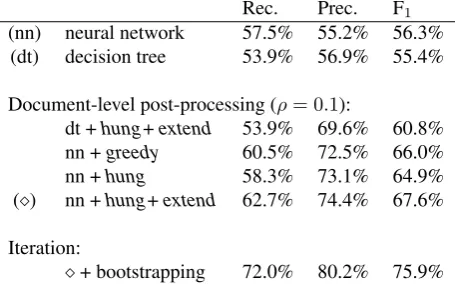
We used the 17 document pairs that were manually found nearly-parallel in the manually annotated corpus described in section 3.2. The results reported are averaged over a 17-fold cross-validation procedure (the test set being formed by one document at a time). The winning configuration is a neural network trained over 1 000 epochs with a learning rate of 0.2, a momentum set to 0.3 and a hidden layer of 16 neurones. The best decision tree configuration was ob-tained with the J48 training algorithm. The performance of those two configurations are reported in the two first lines of Table 4. Note that identifying parallel sentences is a more difficult task than identifying parallel documents and that the performance of the two winning configurations only differ by one absolute F1point.
We tested a number of refinement techniques presented in section 2.2.1. For both the decision tree and the multi-layer perceptron output, applying refinements helps increasing the performance significantly. This shows that taking into account previous decisions, as done in (Smith et al., 2010) is a good idea, as far as performance is concerned (on the bad stand, it incurs a computational cost). The winner con-figuration is marked by asign in Table 4 and corresponds to a neural network which decisions are post-processed by the hungarian algorithm, and the extension heuristic de-scribed in section 2.2.1. This configuration improves the neural network alone by more than 11 absolute F1 points (from 56.3 to 67.6). The last line of the table is discussed in section 4.4.
Rec. Prec. F1 (nn) neural network 57.5% 55.2% 56.3% (dt) decision tree 53.9% 56.9% 55.4%
Document-level post-processing (ρ= 0.1):
dt +hung+extend 53.9% 69.6% 60.8%
nn +greedy 60.5% 72.5% 66.0%
nn +hung 58.3% 73.1% 64.9%
() nn +hung+extend 62.7% 74.4% 67.6%
Iteration:
+ bootstrapping 72.0% 80.2% 75.9%
Table 4: Performance of different configurations of sentence-based classifiers.
The best configuration () was retrained on the full set of manually annotated sentence pairs (the 17 documents) before being applied to the documents pairs collected by the classifier (section 4.1.1.) or by LUCENE (sec-tion 4.1.2.). The main characteristics of the resulting bitexts (WIKICLASS and WIKILUCENE respectively) have been discussed in section 3.4. and are summarized in Table 2.
4.2.2. Manual Evaluation
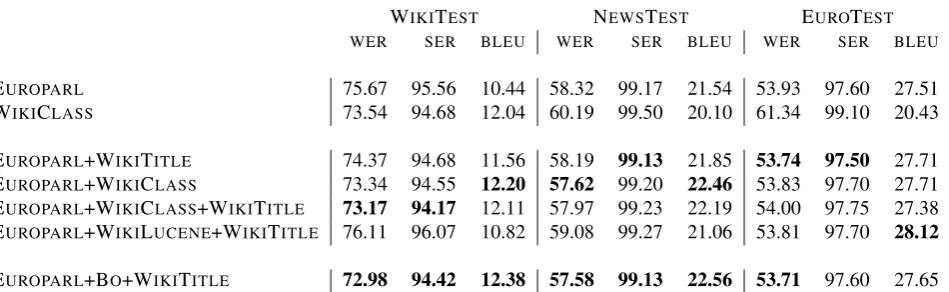
WIKITEST NEWSTEST EUROTEST WER SER BLEU WER SER BLEU WER SER BLEU
EUROPARL 75.67 95.56 10.44 58.32 99.17 21.54 53.93 97.60 27.51
WIKICLASS 73.54 94.68 12.04 60.19 99.50 20.10 61.34 99.10 20.43
EUROPARL+WIKITITLE 74.37 94.68 11.56 58.19 99.13 21.85 53.74 97.50 27.71 EUROPARL+WIKICLASS 73.34 94.55 12.20 57.62 99.20 22.46 53.83 97.70 27.71 EUROPARL+WIKICLASS+WIKITITLE 73.17 94.17 12.11 57.97 99.23 22.19 54.00 97.75 27.38 EUROPARL+WIKILUCENE+WIKITITLE 76.11 96.07 10.82 59.08 99.27 21.06 53.81 97.70 28.12
EUROPARL+BO+WIKITITLE 72.98 94.42 12.38 57.58 99.13 22.56 53.71 97.60 27.65
Table 6: Machine translation performance on two different test sets, as a function of the training set (first column).
EUROPARL+WIKICLASS+WIKITITLE. This indicates that bootstrapping is a fruitful strategy that deserves further in-vestigations, which is left as future work.
5.
Conclusion and Perspectives
We have described a simple implementation of an iterative two-stage approach for mining parallel sentences in a com-parable corpus. This approach has the interesting property of being endogenous in the sense that it does not assume the existence of a large external bilingual dictionary,5as most existing approaches do. We provide some evidence that fil-tering the set of pairs of documents among which to extract parallel sentences has several potential advantages, among which better parallel material collected as measured man-ually and on two machine translation test sets. We devel-oped a classifier for recognizing nearly-parallel document pairs, that is, documents in which at least two thirds of the sentence pairs are parallel. We show that it outperforms the standard cross-lingual information retrieval approach of (Utiyama and Isahara, 2003) which makes uses of a general bilingual dictionary. This in turn leads to better sentence pair extraction, as reflected by the SMT experiments we conducted. We also implemented a first iteration of boot-strapping which leads to systematic improvements in sen-tence pair classification, as well as in SMT.
This work opens up a number of avenues. First, the paral-lel document classifier we investigated here makes use of features tailored to Wikipedia. It remains to see whether this could be deployed on other collections of documents, possibly exploiting a general bilingual dictionary. Sec-ond, we must investigate the portability of our approach to other pairs of languages. One interesting point to look at is wether the document- and sentence-level classifiers we trained for the English-French language pair could be reused for other language pairs, as done in (Smith et al., 2010). Also, we accomplished a very simple bootstrapping iteration in this study. We need to investigate this further, notably by verifying whether the document-level classifier can benefit this iteration as well, especially since the num-ber of training examples given to it in this study is very
5It does rely on a dictionary built up from the titles of the
inter-lingually linked article inWikipedia.
low. Measuring the number of iterations that can be accom-plished successfully is another aspect we want to analyze. In this study, we considered the classification of document pairs as a binary decision process (parallel or not). We plan to investigate if a finer level of granularity can be learned. Another trend of work we would like to pursue is to measure the effectiveness of our approach for tackling domain specific comparable corpora (possibly simulated by theWikipediacategories). This is a useful setting for adapt-ing an SMT engine to a new domain where general bilin-gual dictionaries might not be very useful.
The material we gathered in this study is available for download at http://rali.iro.umontreal. ca/rali/?q=fr/node/1293.
Acknowledgments
This work has been partly founded by Natural Sciences and Engineering Research Council of Canada.
6.
References
Adafre, S. and de Rijke, M. (2006). Finding similar sen-tences across multiple languages in wikipedia. In Pro-ceedings of the 11th Conference of the European Chapter of the Association for Computational Linguistics, page 62–69.
Enright, J. and Kondrak, G. (2007). A Fast Method for Parallel Document Identification. InNAACL HLT 2007, Companion Volume, pages 29–32, Rochester, NY. Fung, P. and Cheung, P. (2004). Multi-level
bootstrap-ping for extracting parallel sentences from a quasi-comparable corpus. InProceedings of the 20th interna-tional conference on Computainterna-tional Linguistics. Gale, W. A. and Church, K. W. (1993). A program for
aligning sentences in bilingual corpora. Computational Linguistics, 19(1):75–102.
Gao, Q. and Vogel, S. (2008). Parallel implementations of word alignment tool. InSoftware Engineering, Testing, and Quality Assurance for Natural Language Process-ing, pages 49–57.
(a) source Il´etait frappant de constatercombienla question de lapartie continentaleelle-mˆeme ´etait ab-sente.
reference It was striking how the issue of the mainland itself was absent. EUROPARL Itisstrikingthatthe issue of thecontinentitself was absent. EU+WC+WT Itwasstrikinghowthe issue of themainlanditself was absent.
(b) source C’est le serveur de la BBCqui a transmiscette information. reference The case was reported by BBC.
EUROPARL This is the BBC serverwhich has receivedthis information. EU+WC+WT This is the BBC serverwhich reportedthis information.
(c) source Zapatero et laligne rougeallemande reference Zapatero and the German red line EUROPARL Zapatero and the GermanRed
EU+WC+WT Zapatero and the Germanred line
(d) source Myst´erieuxtravaux de terrassement
reference Mysteriousearthworks
EUROPARL Mysteriousworkings of terrassement
EU+WC+WT Mysteriousearthworks
(e) source Elle a ´ecrit lesc´enarioelle-mˆeme: c’est unehistoire d’amourentre une femme originaire de la Bosnie et un homme d’origineserbe.
reference She wrote the script herself - a love story between a woman from Bosnia and a Serbian man. EUROPARL She wrote thescenarioitself: It is ahistory of lovebetween a woman from Bosnia and a man of
Serborigin.
EU+WC+WT She wrote thescreenplayitself: It is alove storybetween a woman from Bosnia and a man of
Serbianorigin.
Figure 3: Selected translation examples produced on the NEWSTESTdata set. Sentences have been detokenized manually for the sake of readability.EU+WC+WTis a shortcut for the bitext obtained by concatenating EUROPARL, WIKICLASSand WIKITITLE.
Koehn, P., Hoang, H., Birch, A., Callison-Burch, C., Fed-erico, M., Bertoldi, N., Cowan, B., Shen, W., Moran, C., Zens, R., Dyer, C., Bojar, O., Constantin, A., and Herbst, E. (2007). Moses: Open source toolkit for statistical ma-chine translation. InProceedings of ACL, demo session, Prague, Czech Republic.
Morin, E., Daille, B., Takeuchi, K., and Kageura, K. (2007). Bilingual terminology mining - using brain, not brawn comparable corpora. In 45th ACL, pages 664– 671, Prague, Czech Republic, June.
Munteanu, D. and Marcu, D. (2005). Improving machine translation performance by exploiting non-parallel cor-pora. Computational Linguistics, 31(4):477–504. Patry, A. and Langlais, P. (2011). Identifying parallel
doc-uments from a large bilingual collection of texts: ap-plication to parallel article extraction in wikipedia. In Proceedings of the 4th Workshop on Building and Us-ing Comparable Corpora: Comparable Corpora and the Web, pages 87–95.
Smith, J., Quirk, C., and Toutanova, K. (2010). Extracting parallel sentences from comparable corpora using doc-ument level alignment. InHuman Language Technolo-gies: The 2010 Annual Conference of the North Ameri-can Chapter of the Association for Computational Lin-guistics, page 403–411.
Stolcke, A. (2002). SRILM - an extensible language
mod-eling toolkit. In Proceedings of ICSLP, Denver, Col-orado, Sept.
Tillmann, C. (2009). A Beam-Search extraction algorithm for comparable data. InProceedings of the ACL-IJCNLP 2009 Conference Short Papers, page 225–228.
Ture, F. and Lin, J. (2012). Why not grab a free lunch? mining large corpora for parallel sentences to improve translation modeling. In Proceedings of the 2012 Con-ference of the North American Chapter of the Associa-tion for ComputaAssocia-tional Linguistics: Human Language Technologies, pages 626–630, Montr´eal, Canada, June. Ture, F., Elsayed, T., and Lin, J. (2011). No free
lunch: brute force vs. locality-sensitive hashing for cross-lingual pairwise similarity. InProceedings of the 34th international ACM SIGIR conference on Research and development in Information Retrieval, pages 943– 952.