Named Entity Tagging a Very Large Unbalanced Corpus:
Training and Evaluating NE Classifiers
Joachim Bingel, Thomas Haider Institute for the German Language (IDS)
R5 6–13, 68161 Mannheim, Germany
{bingel|haider}@ids-mannheim.de
Abstract
We describe a systematic and application-oriented approach to training and evaluating named entity recognition and classification (NERC) systems, the purpose of which is to identify an optimal system and to train an optimal model for named entity tagging DEREKO, a very large general-purpose corpus of contemporary German (Kupietz et al., 2010). DEREKO’s strong dispersion wrt. genre, register and time forces us to base our decision for a specific NERC system on an evaluation performed on a representative sample of DEREKOinstead of performance figures that have been reported for the individual NERC systems when evaluated on more uniform and less diverse data. We create and manually annotate such a representative sample as evaluation data for three different NERC systems, for each of which various models are learnt on multiple training data. The proposed sampling method can be viewed as a generally applicable method for sampling evaluation data from an unbalanced target corpus for any sort of natural language processing.
Keywords:Named entity recognition, Evaluation, Very large corpora
1.
Introduction
The German Reference Corpus DEREKO, a very large general-purpose corpus of contemporary German texts, serves as a “primordial sample from which virtual corpora can be drawn for the specific purposes of individual stu-dies” (Kupietz et al., 2010). The corpus is accessible via the COSMAS II corpus analysis system, which currently has more than 30,000 registered users. DEREKO’s impor-tance in German linguistics makes it desirable to provide researchers with access to named entity annotations in the corpus, which is the outset for this study. While the texts in DEREKOare (partly) tagged for morphological informa-tion, the absence of named entity annotations calls for a processing of the corpus with a NE tagger.
DEREKO’s constant and rapid growth1as well as its strong dispersion wrt. genre, register and time force us to base our decision for a specific NERC system on an evaluation per-formed on a representative sample of DEREKOinstead of performance figures that have been reported for the individ-ual NERC systems when evaluated on more uniform and less diverse data. To tackle this issue, we create and ma-nually annotate such a representative sample as evaluation data for three different NERC systems, for each of which various models are learnt on multiple training data.
Note that this study is not so much an exhaustive evalua-tion of a broad array of NERC systems, nor is its central purpose to judge which of the systems performs best in a general setting. Instead, we want to describe the process of selecting an optimal system for the purpose of tagging a very large multi-domain corpus and to outline all necessary steps that are involved in this process.
1
The corpus grew from five billion to six billion between 2012 and 2013. For 2014, a growth by factor four is estimated (Kupietz and L¨ungen, 2014).
2.
Named entities
2.1.
NE tagging of D
ER
EK
OThe identification and classification of names and named entities plays a central role in many different linguistic and text-processing applications such as question answer-ing (Moll´a et al., 2006), machine translation (Babych and Hartley, 2003), text classification (Gui et al., 2012) or even in the life sciences, for instance bioinformatics (Humphreys et al., 2000). Beyond this, quantitative linguistic research such as discourse analysis may profit from named entity information (van Vliet, 2008) or may be interested in ex-ploring the syntactic behaviour of named entities or their frequency in specific genres and domains. Hence, enrich-ing DEREKO, the largest systematic collection of German texts, is an obvious benefit.
Most NERC systems expect a single text genre and domain as training and processing input. In the case of older sys-tems using handcrafted rules, genre is usually limited to newswire text (Poibeau and Kosseim, 2001), typically in the domain of politics, business or sports. In fact, the im-pact of genre and domain has not been thoroughly studied in the NERC literature (Nadeau and Sekine, 2007). The dispersion over text genre2 is a crucial bottleneck for our enterprise of NE tagging DEREKO, for as Poibeau and Kos-seim (2001) are able to show, performance may drop dras-tically when a system trained on newswire text is ported to a different domain.
Later systems, which are usually based on machine learn-ing techniques, view named entity recognition similar to more straightforward NLP tasks such as PoS tagging. They employ n-grams, chunking information and orthographic information (e.g. capitalisation). As Tjong Kim Sang and de Meulder (2003), note, none of the features works well for named entity recognition when used in isolation. Zhang and Tong (2004) study the impact of certain features on
2Although the largest portion of the texts in D
(Baden)</GPE>and<ORG>Universit¨ atsklini-kum Ulm</ORG>, respectively.
Place names used as adjectives
Entities (organisations or persons) that are modified with place names in an adjectival manner in German are evi-dent in the following examples: Mannheimer Stadtver-waltung(Mannheim city council),schleswig-holsteinischer Hotel- und Gastst¨attenverband(Hotel and Restaurant As-sociation of Schleswig-Holstein) or die Partenkirchnerin Maria Riesch (Maria Riesch, a skiing professional from Partenkirchen). In these cases, we do not annotate place names in the evaluation data in order to ensure consistency with the training data, in which this problem is treated like-wise.
Coordination of composed proper names
In the evaluation sample, we observe inLani- und Gelin-genbach one example of ‘N- and N+N’ coordination of proper names (which are originally noun compounds). This case is problematic because it is unclear whether and how the first coordinated name (Lani-[bach]) can be annotated. As we consider this case highly difficult for any NERC sys-tem to solve and also to be extremely exceptional6, we re-move the containing sentence from the data.
3.3.
Distribution of named entities in the
evaluation data
The evaluation sample comprises a total of 1,454 annotated named entities that distribute across the classes as listed in table 2.
Class PER ORG LOC GPE OTH Total
Instances 652 401 130 230 41 1,454
Table 2: Distribution of named entities across classes
4.
Experiments
4.1.
Systems and training data
We train different models for the Stanford NERC (coreNLP) system v3.2.0 (Finkel et al., 2005), the JULIE Named Entity Tagger [JNET] (Hahn et al., 2008), as well as Apache OpenNLP7. The former two systems are based on Conditional Random Fields, while the latter is a max-imum entropy classifier. As training data, we use T¨uba-D/Z, a newspaper corpus comprising 75k sentences (1.3M tokens) that are manually annotated for named entities, parts-of-speech, coreference relations and various syntac-tic information. In addition to T¨uba-D/Z, we evaluate two models developed for the Stanford system by Faruqui and Pad´o (2010), trained on the Huge German Corpus [HGC] (Schmid, 1994; Schiller et al., 1999) and on the deWaC corpus (Baroni et al., 2009), respectively. In another ex-periment on the impact of domain differences (see section
6
We do not expect a significant number of other occurrences of such cases in the corpus, as would beSwitzer- and Finlandor Liver- and Blackpool.
7
http://opennlp.apache.org
5.2.3.), we use the Europarl corpus (Koehn, 2005) as testing data.
We first gauge the performance of a system by evaluating it against the DEREKOsample, and in a second series of experiments unify the locality classesLOCandGPEin order to determine the difficulty of the systems in distinguishing the two.
4.2.
Gazetteers
In order to back up the systems with pre-compiled lists of named entities, we extract names of persons, organisa-tions and places from DBpedia (Bizer et al., 2009), and further place names from the GeoNames database (GeoN-ames, nd), distinguishing betweenGPEandLOCaccording to the feature codes used in GeoNames.8 We extract about 75k proper names for every class from DBpedia and 200k German place names from GeoNames.
5.
Evaluation of systems
5.1.
Evaluation metrics
A common metric for the evaluation of NERC systems is the MUC score, which distinguishes between so-called TEXT predictions and TYPE predictions (Nadeau and Sekine, 2007), where the former relates to the correct iden-tification of a text span as a named entity (recognition task) and the latter to the correct assignment of a class label to identified named entities (classification task). Standard evaluation metrics such as recall, precision and f-measure can then be applied individually to TEXT and TYPE pre-dictions. This method has a clear advantage compared to an exact matching of TEXT and TYPE in that a system that correctly identifies many named entities but assigns wrong class labels is valued higher than a system that does not find these named entities at all.
We test differences in evaluation results for statistical sig-nificance using approximate randomisation tests (Noreen, 1989; Yeh, 2000). We compute the test statistics using the sigf package (Pad´o, 2006).
5.2.
Experimental results
Table 3 shows the TEXT- and TYPE-based F1-scores for the systems trained on the T¨uba-D/Z. We observe an equal performance of the Stanford and JNET systems wrt. the TEXT statistics and for the TYPE statistics a slight but not highly significant superiority of the Stanford system (p = 0.064). The OpenNLP system lags behind in both statistics.
System FTYPE FTEXT Stanford .689 .790
JNET .673 .790
OpenNLP .446 .579
Table 3: F1-scores for TYPE and TEXT for NERC systems trained on T¨uba-D/Z
8We utilise the top- level feature codes, e.g. Afor country,
Class Precision Recall F1
PER .829 .738 .780
ORG .630 .355 .454
GPE .729 .715 .722
LOC .477 .287 .358
OTH .143 .024 .041
Total .728 .563 .689
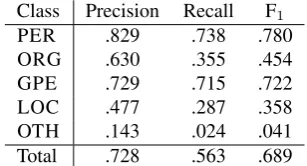
Table 4: Stanford Tagger performance by NE class
Table 4 displays the Stanford system’s performance as re-call, precision and F1 by NE class. We observe particular difficulties in identifying ORGs and LOCs, which may be partly due to an interference of the classes as outlined in the case of organisations with places in their names (cf. section 5.3. on error analysis). Additionally, only one of the 41 NEs labelledOTHis recognised. The results reflect the general observation (which also holds for the other systems and set-tings) that precision is considerably higher than recall.
5.2.1. Simplified classification task
We train and test further models for 4 instead of 5 classes, unifying LOCs and GPEs in order to avoid the systematic difficulties in distinguishing these classes and also in order to allow for a comparison with the HGC and deWaC mo-dels, which only comprise the 4 remaining classes. Table 5.2.1. shows the results for a reduced class set. Again, we observe a superiority of the Stanford system and in parti-cular of the T¨uba-D/Z model towards the other models. The evaluation statistics is significantly higher for the winning system (p <0.01).
System FTYPE FTEXT
StanfordT¨uba-D/Z .721∗ .800∗ JNETT¨uba-D/Z .691 .783 OpenNLPT¨uba-D/Z .446 .579 StanforddeWaC .612 .761 StanfordHGC .624 .756
Table 5: F1-scores for 4 NE classes (PER,ORG,LOC+GPE andOTH). Subscripts indicate training data.
∗=Statistically significant withp <0.01.
5.2.2. Gazetteers
We further examine the influence of gazetteers on the Stanford system. Table 5.2.2. shows an improved perfor-mance using DBpedia and another small increase using GeoNames, although none of the two leads to a statistically significant improvement (p≈0.45, respectively).
System FTYPE FTEXT
Stanford .689 .790
+DBpedia .693 .792
+DBpedia+GeoNames .693 .800
Table 6: F1-scores using gazetteers, 5 NE classes
5.2.3. Robustness across domains
Finally, we are interested in the potential of the systems given equal and very different training and testing domains. This experiment is intended to shed some light on the question how dependent the individual systems are on do-main consistency in training and testing. Table 7 shows the TYPE- and TEXT-based F1-scores for the Stanford and JNET systems trained and evaluated on a 90/10 split of the T¨uba-D/Z. We observe a clear and significant im-provement (p <0.01) compared to the DEREKOstatistics and a significant superiority (p < 0.01) of JNET towards Stanford. For very different training and testing domains, we evaluated the T¨uba-D/Z-trained models against the NE-annotated German section of the Europarl corpus (Koehn, 2005; Faruqui and Pad´o, 2010), yielding the results pre-sented in table 8. Here, we observe that Stanford is clearly superior to JNET. These results lead us to say that the Stan-ford systems seems to be less sensitive to training/testing domain.
System FTYPE FTEXT Stanford .818 .888 JNET .844∗ .976∗
Table 7: Performance evaluation with equal train/test do-main (T¨uba-D/Z90%and T¨uba-D/Z10%).
∗=Statistically significant withp <0.01.
System FTYPE FTEXT Stanford .458∗ .544∗
JNET .300 .515
Table 8: Performance evaluation with different train/test domains (T¨uba-D/Z and Europarl).
∗=Statistically significant withp <0.01.
Class PER ORG LOC GPE OTH ¬NE
PER 535 7 - 3 - 107
ORG 16 141 10 13 1 220
LOC 11 6 33 15 - 65
GPE 10 13 12 157 - 38
OTH 2 2 1 1 1 34
¬NE 21 19 2 8 5 15041
Table 9: Confusion over classes (Stanford system trained on T¨uba-D/Z, without gazetteers). Rows indicate gold an-notation, columns indicate system output. ¬NE stands for tokens that are not (parts of) named entities.
5.3.
Error analysis
Table 9 displays the confusion over NE classes for the ba-sic Stanford system (trained on T¨uba-D/Z, no gazetteers). We observe general difficulties for the system indetecting named entities, with gold NEs not identified as such by the system regardless of the correct class. In the cases ofORG,
79–86.
Kupietz, M. and L¨ungen, H. (2014). Recent developments in DeReKo. Inthis volume.
Kupietz, M., Belica, C., Keibel, H., and Witt, A. (2010). The German Reference Corpus DeReKo: A Primor-dial Sample for Linguistic Research. InProceedings of the Seventh International Conference on Language Re-sources and Evaluation (LREC’10).
Moll´a, D., Van Zaanen, M., and Smith, D. (2006). Named entity recognition for question answering. Proceedings of ALTW, pages 51–58.
Nadeau, D. and Sekine, S. (2007). A survey of named en-tity recognition and classification. Lingvisticae Investi-gationes, 30(1):3–26.
Noreen, E. W. (1989). Computer Intensive Methods for Testing Hypotheses. An Introduction. John Wiley & Sons, 2(5):33.
Pad´o, S. (2006). User’s guide to sigf: Significance testing by approximate randomisation.
Poibeau, T. and Kosseim, L. (2001). Proper Name Extrac-tion from Non-Journalistic Texts. InComputational Lin-guistics in the Netherlands, pages 144–157.
Schiller, A., Teufel, S., St¨ockert, C., and Thielen, C. (1999). Guidelines f¨ur das Tagging deutscher Textcor-pora mit STTS. Technical report, IMS Stuttgart. Schmid, H. (1994). Probabilistic Part-of-Speech Tagging
Using Decision Trees. InProceedings of International Conference on New Methods in Language Processing, Manchester, UK.
Telljohann, H., Hinrichs, E., and K¨ubler, S. (2004). The T¨uBa-D/Z treebank: Annotating German with a context-free backbone. In Proceedings of the Fourth Interna-tional Conference on Language Resources and Evalua-tion (LREC’04).
Tjong Kim Sang, E. F. and de Meulder, F. (2003). In-troduction to the CoNLL-2003 shared task: Language-independent named entity recognition. InProceedings of the Seventh Conference on Natural Language Learning at HLT-NAACL 2003-Volume 4, pages 142–147. Associ-ation for ComputAssoci-ational Linguistics.
van Vliet, S. M. K. (2008). Proper nouns and pronouns. The production of referential expressions in narrative discourse.Ph.D. thesis, Tilburg University, Tilburg. Yeh, A. (2000). More accurate tests for the statistical
sig-nificance of result differences. In Proceedings of the 18th conference on Computational linguistics-Volume 2, pages 947–953. Association for Computational Linguis-tics.