“Export of jute products
from
Bangladesh to Europe”
Analysis of market potential
and development of interventions
“Export of jute products from Bangladesh to
Europe”
Analysis of market potential and development of
interventions for GTZ-PROGRESS
Faculty of Business, Public Administration, and Technology
Business Administration – International Management
April 2007
Graduation committee
Johan
de
Vries
Ir.
S.J.
Maathuis
S0109274
Prof.
Dr.
E.J.
de
Bruijn
Principal
P. Weijers
GTZ-PROGRESS
University of Twente
House 10/C, Road 90, Gulshan-2
Postbus 217
Dhaka-1212,
Bangladesh
500
AE
Enschede
Preface
This research is the result of cooperation between the University of Twente and GTZ. The research is partly conducted in Bangladesh and partly in the Netherlands.
Bangladesh is one of the poorest countries in the world, and conducting a research in this environment is very challenging. The adjustment to a complete other culture and religion requires a lot of effort. All together it was a very interesting and great experience which was very useful for me.
As in every research, there were things that went very smooth, and also times in which parts did not work out the way I wanted and planned them to. But as a part of learning, it was sometimes a great challenge to gather the information that was needed and talk to the right people.
Through several visits and interviews I obtained a good impression of the jute industry, as well as living conditions in Bangladesh. For me, this research in Bangladesh was an opportunity to visit a country that I otherwise probably never would visit. All together it was an interesting and great learning experience that I will not forget.
A lot of people were helpful with the execution of this research. At PROGRESS, everybody was very helpful and always ready to do their best to make everything work. Special thanks go out to Munira Rahman and Mamun Yusuf from PROGRESS for their help with appointments and translations during the interviews. Furthermore I would like to thank Karim Munna from Creation Private Limited for all the conversations about the jute industry, visits to factories and production sites, and his patience with me.
Also I would like to thank Stephan Maathuis from the University of Twente and last but not least Paul Weijers for the possibility to execute this research and offering me a chance for a great learning experience.
Enschede, the Netherlands,
Executive summary
Bangladesh is one of the poorest countries in the world, and as with almost all developing countries, agriculture and related industries are very important. One of the largest industries in Bangladesh is the jute industry, in which almost 1.5 million people are active.
Historically, jute was the main foreign exchange earner and its contribution to the national economy is still significant. In the 1950s and 60s, almost 80% of the world’s jute was produced in Bangladesh. Due to several setbacks and the introduction of, often cheaper, substitutes the market declined and jute started to lose its dominant position. In 2000, 5% of all exports from Bangladesh consisted of jute. This figure decreased to 3% in 2004, while the world market for jute products is slowly increasing again. This gives reason for PROGRESS, which focuses on the development of Small and Medium Sized Enterprises (SME’s) in Bangladesh, to look into the jute market.
The last years the diversified jute products (JDPs) is an increasing market and offers potential, also for Bangladesh. For PROGRESS, this is an interesting market and therefore it wants to look into this market to see where possible interventions can help develop this market further.
Based on this, the problem formulation for this research is: What are the market
opportunities in Europe for the Bangladeshi Jute Diversified Products (JDP) industry and how should PROGRESS support this industry to take advantage of these opportunities?
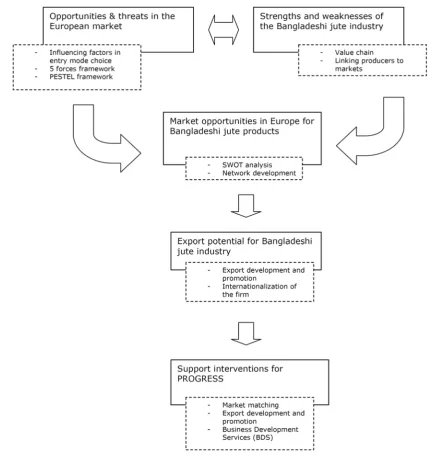
To answer this question, the research is divided into five sub questions that each answers a part of the problem formulation.
The first area of interest is the assessment of the target market. In this research the European market and especially Western Europe is analyzed, based on secondary data. Second area is the strengths and weaknesses analysis of the Bangladeshi JDP industry, followed by the formulation of market opportunities based on the analysis of the Bangladeshi JDP industry and the European market. Fourth, the export potential of Bangladeshi JDPs is determined, and finally interventions were defined that are useful to PROGRESS with regard to this market. All of these sub questions are supported by models and theories.
From the primary data from interviews with JDP producers and secondary data, market opportunities and improvement areas are formulated. These opportunities and improvement areas together result in support interventions for PROGRESS that they can use with the objective to improve the exports of JDPs to the European market. Table I shows the interventions that are developed for PROGRESS.
The interventions that are developed each have been connected to one of the five components of PROGRESS and thus translated into clear objectives that suit the goal of PROGRESS:
• Enabling Business Environment
• Design and Product Development Services
• Enterprise Information Services
• Skills Development Services
Constraint Support activities Interventions PROGRESS
Lack of market information and because of that a lack of knowledge about exporting
1. Training and education Organize customized training on ‘international
marketing’ for (potential) exporters of
JDPs Lack of support and policies
from government bodies 1. Improve cooperation between SMEs and government 2. Improve the functioning of government bodies
and R&D 1. Training and education 2. Cooperation with foreign parties
3. Improvement of research facilities
Facilitate development of product design as per global market trend
Competition from other LDCs
and mainly India 1. Improve quality 2. Improve competitiveness 3. Improve export knowledge
Lack of knowledge of the domestic market for diversified jute products
1. Promotion of the home
market Organizing a specialized trade show to display the entire range of jute products and try to
2. Improve working conditions A training needs assessment to find the actual skill deficiencies
Table I: Overview of interventions
Table of contents
PREFACE... 2
EXECUTIVE SUMMARY... 3
TABLE OF CONTENTS... 5
LIST OF FIGURES AND TABLES... 7
LIST OF ACRONYMS... 8
1. INTRODUCTION... 9
2. RESEARCH DESIGN... 10
2.1GTZPROFILE... 10
2.2BACKGROUND AND OBJECTIVE... 11
2.3PROBLEM FORMULATION... 11
2.4RESEARCH QUESTIONS... 12
2.5RESEARCH APPROACH... 13
2.6RESEARCH STRUCTURE... 15
3. MODELS AND THEORIES... 16
3.1INTRODUCTION... 16
3.2OPPORTUNITIES AND THREATS IN THE EUROPEAN MARKET FOR DIVERSIFIED JUTE PRODUCTS... 16
3.2.1 Factors influencing the choice of entry... 16
3.2.2 Porter’s five forces framework... 18
3.2.3 PESTEL framework... 19
3.3STRENGTHS AND WEAKNESSES OF THE BANGLADESHI JDP INDUSTRY... 21
3.3.1 The value chain... 21
3.3.2 Linking national producers to international markets... 21
3.4THE MOST PROMISING MARKET OPPORTUNITIES IN EUROPE FOR THE BANGLADESHI JDP INDUSTRY ... 23
3.4.1 SWOT analysis... 23
3.4.2 Using networks to solve export marketing problems of SMEs from developing countries... 24
3.5EXPORT POTENTIAL AND NEEDS OF THE BANGLADESHI JDP INDUSTRY WITH RESPECT TO THE MARKET OPPORTUNITIES IDENTIFIED... 25
3.5.1 Export development and promotion... 25
3.6INTERVENTIONS FOR PROGRESS IN ORDER TO SUPPORT THE BANGLADESHI JDP INDUSTRY... 28
3.6.1 Market matching... 28
3.6.2 Export development and promotion... 29
3.6.3 Business Development Services... 29
3.7SUMMARY... 29
4. MARKET FOR DIVERSIFIED JUTE PRODUCTS IN EUROPE... 31
4.1INTRODUCTION... 31
4.2TARGET COUNTRY MARKET FACTORS... 31
4.2.1 The world jute market... 31
4.2.2 Porter’s five forces framework... 32
4.4TARGET COUNTRY ENVIRONMENTAL FACTORS... 35
4.5CONCLUSION... 37
5. ANALYSIS OF THE BANGLADESHI JUTE DIVERSIFIED PRODUCTS (JDP) INDUSTRY... 39
5.1INTRODUCTION... 39
5.3THE JUTE SECTOR VALUE CHAIN... 40
5.4STRENGTHS AND WEAKNESSES ANALYSES OF THE JDP SECTOR... 42
5.4.1 Research and development... 43
5.4.2 Production... 43
5.4.3 Export... 45
5.4.3 Marketing... 47
5.4.4 Competition... 48
5.4.5 Weaknesses in the JDP sector according to PROGRESS... 50
5.5CONCLUSION... 51
6. MARKET OPPORTUNITIES FOR THE BANGLADESHI JDP INDUSTRY IN EUROPE ... 52
6.1INTRODUCTION... 52
6.2SWOT MATRIX... 52
6.3MARKET OPPORTUNITIES AND IMPROVEMENT AREAS... 53
6.3.1 Focus on environmental friendly products... 53
6.3.2 Development of new products and designs... 54
6.3.3 Improve cooperation of JDP producers... 54
6.3.4 Improve policies and support from government bodies... 55
6.3.5 Increase the number of JDP producers in Bangladesh... 55
6.4CONCLUSION... 56
7. EXPORT POTENTIALS FOR THE BANGLADESHI JUTE INDUSTRY AND POSSIBLE INTERVENTIONS FOR PROGRESS... 57
7.1INTRODUCTION... 57
7.2EXPORT CAPABILITIES... 57
7.3EXPORT CONSTRAINTS... 58
7.4INTERVENTIONS... 59
7.5SUPPORT INTERVENTIONS FOR PROGRESS... 61
8. CONCLUSIONS, RECOMMENDATIONS AND REFLECTION... 64
8.1CONCLUSIONS... 64
8.2RECOMMENDATIONS... 65
8.3REFLECTION... 66
REFERENCES... 67
APPENDICES... 69
APPENDIX I... 71
APPENDIX II... 81
APPENDIX III... 82
APPENDIX IV... 84
List of figures and tables
Figure 2.1: Research structure
Figure 3.1: Factors in the entry mode decision Figure 3.2: Porter’s five forces framework Figure 3.3: The value chain
Figure 3.4: SWOT confrontation matrix
Figure 3.5: Relation of three stages of network evolution Figure 3.6: Network evolution in developing countries Figure 3.7: Matching markets
Figure 3.8: Research questions and models & theories
Figure 4.1: World production of Jute in major producing countries Figure 4.2: World export of jute
Figure 4.3: Imports in EU from Bangladesh Figure 4.4: Export and local sales value of JDPs Figure 4.5: Bangladesh trade with the EU
Figure 5.1: Value chain of the jute industry in Bangladesh Figure 5.2: Partitioning of market expansion
Figure 5.3: Direct and indirect export
Figure 5.4: Production of jute, kenaf, and allied fibres Figure 6.1: Network evolution in developing countries Table 3.1: Examples of external and internal factors Table 3.2: PESTEL framework
Table 3.3: Factors and elements
Table 3.4: Stages of export involvement
Table 3.5: Instruments of action from the international marketing plan Table 4.1: Value of export in Bangladesh
Table 4.2: Exports to EU
Table 4.3: Opportunities and threats of the European market Table 5.1: List of Jute Diversified Products
Table 5.2: Total number of people employed in the jute industry in Bangladesh Table 5.3: Distribution of value addition across different stages of the value chain Table 5.4: Size of factories
Table 5.5: List of Jute Diversified Products
Table 5.6: Export countries of Bangladeshi jute goods in Europe Table 5.7: Constraints in the JDP sector
Table 5.8: Strengths and weaknesses of the Bangladeshi jute industry Table 6.1: SWOT matrix
Table 6.2: SWOT confrontation matrix
Table 6.3: Market opportunities and improvement areas Table 7.1: Export involvement and promotion focus Table 7.2: Overview of difficulties with exporting
Table 7.3: Combination from difficulties and constraints Table 7.4: Constraints and support activities
List of acronyms
BCSIR Bangladesh Council of Scientific and Industrial Research BDS Business Development Services
BJA Bangladesh Jute Association BJC Bangladesh Jute Corporation
BJEA Bangladesh Jute Exporters Association BJGA Bangladesh Jute Goods Association BJMA Bangladesh Jute Mills Association BJMC Bangladesh Jute Mills Corporation BJRI Bangladesh Jute Research Institute BJSA Bangladesh Jute Spinners Association
BKMEA Bangladesh Knitwear Manufacturers and Exporters Association BSTI Bangladesh Standards and Testing Institution
CBC Carpet Backing Cloth
CBI Centre for the Promotion of Import from Developing Countries CCCI Chittagong Chamber of Commerce and Industry
EFTF ECOTA Fair Trade Forum
EIS Enterprise Information Services EPB Export Promotion Bureau
EPIDC East Pakistan Industrial Development Corporation EVD Economische Voorlichtingsdienst
FAO Food and Agricultural Organisation of the United Nations FDI Foreign Direct Investment
FJF Finer Jute Fabrics GDP Gross Domestic Product GNI Gross National Income GNP Gross National Product
GTZ German Agency for Technical Cooperation ICB International Commodity Body
IFIH International Forum for India’s Heritage IJO International Jute Organisation
IJRIA Indian Jute Research Industry Association IJSG International Jute Study Group
JAF Jute and Allied Fibre
JDP Jute Diversified Products
JDPC Jute Diversification Promotion Centre JIBC Jute Intermediate Bulk Container
JTPDC Jute Textile Product Development Centre LDC Less Developed Country
MFA Multi Fibre Arrangement
NGO Non-Government Organisation
NORAD Norwegian Agency for Development Cooperation PROGRESS Promotion of Private Sector SMEs in the Post MFA era R&D Research and Development
RMG Ready Made Garments
1. Introduction
As the final assignment for the master programme in Business Administration with specialization ‘International Management’ at the University of Twente, students carry out a research and write a master thesis. The research for this assignment is conducted for the German Technical Coorporation (GTZ) in Dhaka, Bangladesh.
Bangladesh is situated in Asia and surrounded by India for 95%. The only other country that has a border with Bangladesh is Myanmar, and on the south end it lies at the Gulf of Bengal. Bangladesh is one of the poorest countries in the world. In 2005, the Gross National Income (GNI) per capita was $ 470.-, compared to $ 36,620.- in the Netherlands.
One of the largest and most important industry sectors in Bangladesh is the jute sector, in which almost 1.5 million people are working. For the last decades, the worldwide use of traditional jute goods like sacks is declining, and companies are trying to find more diverse uses for jute, resulting in new, diversified goods.
The world market for these new diversified goods is growing and in order to participate in this market, it is important to inform and persuade jute producers to expand into these diversified jute goods market.
The PROGRESS division of GTZ functions as the principal of this graduation assignment. PROGRESS tries to improve the position of the Small and Medium sized Enterprises (SMEs) in Bangladesh. Its main objective is to improve the competitiveness of the SMEs in Bangladesh.
The goal of this research is to assess the possibilities of the jute products, and especially the diversified products, from Bangladesh in the European market. By looking and analyzing both the Bangladeshi jute industry as well as the European market, possibilities for the diversified jute products are defined and translated into interventions that are suitable for PROGRESS.
The report starts in chapter 2 with the research design. In the next chapter, the models and theories are given that support the research and give it its scientific background. In chapter 4, the European market for jute products is outlined. Opportunities, threats and developments are identified and analyzed. Next, in chapter 5, the Bangladeshi jute industry is described. The jute sector is outlined, and the results from the interviews that were held with the producers are presented in terms of strengths and weaknesses of the industry.
2. Research design
In this chapter, the research design is outlined. First, GTZ and PROGRESS are introduced, followed by the background and objective for the research. Next, the problem formulation will be identified, followed by the research questions, which will lead to an answer to the problem formulation. Finally, the research approach and research structure are presented.
2.1 GTZ Profile
GTZ in general
GTZ is an international operating technical cooperation enterprise for sustainable development that operates worldwide. GTZ was established in 1975 and is organised as a private company owned by the German Federal Government. GTZ works on a public benefit basis, using all funds generated as profits exclusively for projects in international cooperation [GTZ, 2006].
The organization wants to provide viable, forward-looking solutions for political, economic, ecological and social development in a globalised world, and its objective is to improve people’s living conditions on a sustainable basis. GTZ works mainly for the German Federal Government. GTZ implements about 2,300 development projects and programs in over 130 countries around the world, with offices in 66 of these countries, focusing on Africa, Asia, Latin America and Eastern Europe.
The main focus in international cooperation is on so-called Technical Cooperation. Far from being only centred on transferring technical knowledge, this primarily involves communicating knowledge that enables people to shape their present and future on their own. For this, GTZ strengthens individual initiatives and the capabilities of people and organisations, and lays the basis for stable development, for future generations as well.
PROGRESS
In Bangladesh, a part of the GTZ activitities is focused on the development of Small and Medium sized Enterprises (SME’s), and this project is called PROGRESS. For PROGRESS, the main objective is reducing poverty, and the main focus is on increasing social and environmental compliance.
PROGRESS tries to promote the Small and Medium sized Enterprises (SMEs). Its main goal is to improve the competitiveness of the SMEs in Bangladesh. PROGRESS interventions include technical advice, human- and institutional networking, and supportive research. The program of PROGRESS in Bangladesh consists of five different components [PROGRESS 2006];
• Enabling Business Environment
• Design and Product Development Services
• Enterprise Information Services
• Skills Development Services
• Social- and Environmental Standards
2.2 Background and objective
The jute industry in Bangladesh is one of the most important industries in the country. Jute was the main foreign exchange earner and its contribution to the national economy is still significant. In the 1950s and 60s, almost 80% of the world’s jute was produced in Bangladesh. The share of jute sector in foreign exchange earnings started to decline due to various synthetic substitutes and artificial fibres entering the market and because of bulk handling techniques introduced during the 1980s. Eventually the importance of jute in international markets declined and jute started losing its predominant position. Between 1980/81 and 1999/00, export of both raw jute and jute products declined in absolute terms and their total share came down to only 6% in 1999/00 [PROGRESS 2006].
Furthermore, the Bangladeshi export market of jute products decreased in 2000. In 2000 5% of all the exports from Bangladesh consisted of jute, and in 2004 this decreased to 3% [Rabobank, 2006]. Since the world jute market increased the last few years, PROGRESS wants to develop program interventions in order to support the export of Bangladeshi jute products to Europe. By developing interventions, PROGRESS hopes to increase the export of jute products, and especially diversified jute products, once again. Europe and the US are the two most important export destinations for Bangladesh. In order to stimulate the exports, PROGRESS tries to find new opportunities for jute products in Europe.
This brings us to the following objective for our research:
• The objective of this research is to develop interventions for PROGRESS in order to improve the export of Bangladeshi jute products to Europe.
2.3 Problem formulation
Based on the background of the research and the objective formulated, the problem formulation is defined.
Next, some aspects are considered in order to reach a well defined problem formulation.
• The objective of the study is to find opportunities for Bangladeshi jute products in the European market. Both markets will be assessed in terms of supply and demand. In this way the gaps can be identified between the European market and the Bangladeshi jute industry. Objective is to find and formulate opportunities that solve these gaps. The focus of the research is on the Jute Diversified Products (JDP) segment.
• The world market for jute products is increasing, which is not the case for the Bangladeshi jute industry. This means that there are opportunities for the Bangladeshi industry that are not yet explored. Goal is to find opportunities in the European market for the Bangladeshi JDP industry and to expand the exports of this sector. In this way, the jute industry in Bangladesh should increase again and create opportunities for new developments.
Based on the above statements, the problem formulation is defined as follows:
What are the market opportunities for the Bangladeshi Jute Diversified Products (JDP) industry in Europe and how should PROGRESS support this industry to take advantage of these opportunities?
The goal is to improve the export of Bangladeshi jute products to Europe and give insights into the European and Bangladeshi jute market. Objective of PROGRESS is to support the SMEs in Bangladesh.
2.4 Research questions
The problem formulation is split into several components. The components form the basis for the research questions, which will deal with these components. The goal here is to construct the questions in such a way that they together provide a satisfying answer to the problem formulation of the research.
Next the questions and sub questions will be outlined:
1. What are the opportunities and threats in the European market for diversified jute products?
• This part of the research will include secondary data research. The goal is to find data on parameters that are relevant to the industry, such as market characteristics, relevant stakeholders, geographic areas in Europe, and marketing elements. Opportunities and threats are identified and further explored to gain more knowledge about the target market.
2. What are the strengths and weaknesses of the Bangladeshi diversified jute products industry?
• Recently a value chain assessment has been conducted in Bangladesh by PROGRESS, which is the basis for the assessment of the jute production situation in Bangladesh. Further, field visits to enterprises engaged in the jute value-chain and interviews with JDP producers will give insights into the dynamics of the industry. In this way the current situation in Bangladesh is mapped resulting in the strengths, weaknesses, and organization of the Bangladeshi JDP industry.
3. What are the most promising market opportunities in Europe for the Bangladeshi diversified jute products industry?
• The findings from the research conducted in the Netherlands will be compared to the factual production and export situation in Bangladesh. From here on, the market opportunities and improvement areas will be determined and formulated.
Goal for this part of the assignment is to indicate which will be the most promising market opportunities for the jute industry in Europe.
4. What is the export potential of the Bangladeshi diversified jute products industry with respect to the market opportunities identified?
5. What interventions can PROGRESS develop to support the Bangladeshi diversified jute products industry?
• In the final part of the assignment, support interventions are formulated to give the market opportunities that are identified a practical form. These interventions are then specified for PROGRESS in order to support the industry. PROGRESS applies a BDS market development methodology, which means that support mechanisms for SMEs are developed with assistance of PROGRESS, but the actual provision of such services is by local organizations.
2.5 Research approach
In this part of the research plan, the research approach is outlined. It specifies how the answers to the research questions are obtained, and which tools and analysis instruments are used to reach these answers. The research questions of the previous section will act as the main point for the elaboration of the data that is needed.
There are two major reasons for reviewing the literature; first, it is a preliminary search that helps to generate and refine the research ideas, and second, it is part of the research project proper. By critically reviewing the literature, the awareness and knowledge of the subject is enhanced and it will help to further clarify the research questions [Saunders et al., 2003].
Next, literature will be sought on the subject of export promotion and internationalization, to retrieve theories and models that can support the research and give it a scientific basis to work from. Also, it could be useful to look at internationalization and export programs from developing countries that have already been conducted, because looking at similar research can reveal relevant information that can be useful to the current research.
Research question 1: What are the opportunities and threats of the European market for diversified jute products?
The literature in this part will focus on the characteristics of the sector. Root (1994) developed a framework with factors that influence the choice of the entry mode. This theory is supported by Porter’s five forces framework [Johnson & Scholes 2002] and the PESTEL framework [Johnson & Scholes 2002].
Through secondary data, knowledge is obtained about the market and its opportunities and threats. Institutions like the Dutch Foreign Trade Agency (EVD), and the Dutch Centre for the Promotion of Imports form Developing Countries (CBI) are consulted to gather secondary data.
Research question 2: What are the strengths and weaknesses of the Bangladeshi diversified jute products industry?
Together with the literature that deals with the value chain, a list of measurable parameters and fields of interest are determined. These parameters are the basis for a questionnaire. Interviews are held, based on the questionnaire, with producers of Jute Diversified Products (JDPs). The objective was to get insights into the products, problems and difficulties of exporters, marketing and competition in the Bangladeshi JDP industry. This primary data is important to obtain knowledge of the market and its stakeholders. Another aspect here is to look at the competitiveness of the Bangladeshi JDP industry. What is the competitiveness of the Bangladeshi jute industry compared to, for example, the Indian jute industry?
Research question 3: What are the most promising market opportunities in Europe for the Bangladeshi diversified jute products industry?
Research question 4: What is the export potential of the Bangladeshi JDP industry with respect to the market opportunities identified?
Seringhaus and Rosson (1991) developed a framework that outlines company needs within export development and promotion. Theories of export promotion and internationalization of the firm are supporting theories within this part of the research. Goal is to determine what is present in the market, which capabilities are there, which capabilities are needed, and what is lacking in the market to take advantage of the opportunities that are identified. From this assessment it becomes clear what the export potential is, and how the different markets of Bangladesh and Europe could be linked.
Research question 5: What interventions can PROGRESS develop to support the Bangladeshi diversified jute products industry?
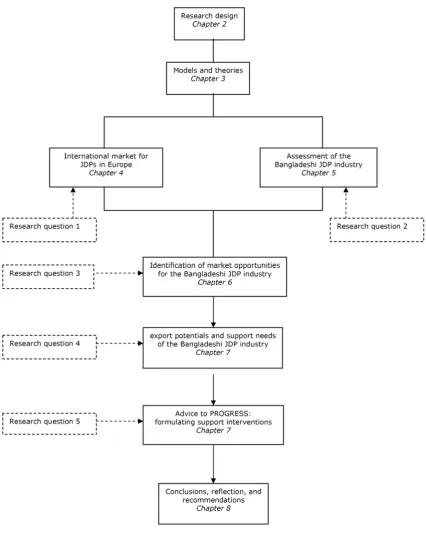
2.6 Research structure
The structure of the research is presented in figure 2.1.
3. Models and theories
3.1 Introduction
In this part of the report models and theories are introduced to support and clarify the research questions. The theories are helpful to gain knowledge on several aspects. Applicable theories are outlined per research question.
In section 3.2 the attention is on opportunities and threats in the European market for JDP products. Root (1994) has developed a model that is supported by Porter’s five forces [Johnson & Scholes 2002] and the PESTEL framework as used by Johnson and Scholes (2002).
The next section gives theories that are useful in outlining the Bangladeshi jute industry. The value chain is the theoretical focus of this section, and some general theory on this subject is discussed as well as an article by Humphrey (2002) in which the coordination aspects along the value chain is outlined.
Section 3.4 treats the theories that support the market opportunities for the Bangladeshi diversified jute products industry in Europe. The SWOT analysis, which combines the outcomes from both the European and the Bangladeshi analysis, is a useful tool. A second theory that is used here is one of network development.
In section 3.5 the export potential of the Bangladeshi diversified jute products industry are supported by the theories of Seringhaus and Rosson (1991), export promotion and internationalization of the firm.
Section 3.6 focuses on the support interventions that will be developed for PROGRESS. Supporting theories here are those of market matching, and a model by Seringhaus and Rosson.
Finally, section 3.7 gives a complete overview of the theories that are used per research question.
3.2 Opportunities and threats in the European market for
diversified jute products
The opportunities and threats in the European market for JDP products can be assessed using data from several sources. To support these findings, Root (1994) outlines several factors that influence choices in a foreign market, with support of Porter’s five forces model and the PESTEL framework.
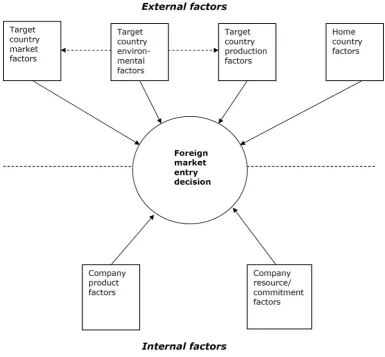
3.2.1 Factors influencing the choice of entry
Figure 3.1: Factors in the entry mode decision
Source: Root (1994)
External factors
Market, production, and environmental factors in both the target and home country can seldom be affected by management decisions. They are external to the company and may be regarded as parameters of the entry mode decision. Because no single external factor is likely to have a decisive influence on the entry mode for companies in general, we can only say that such factors encourage or discourage a particular entry mode [Root 1994].
Internal factors
The internal factors concentrate on the way a company responds to the external factors in choosing an entry mode. To clarify the model above, table 3.1 shows examples of both the external and internal factors from figure 3.1.
Factor Examples External factors
Target country market factors - present and projected size of the target country market
- competitive structure of the target market - availability and quality of the local marketing
infrastructure Target country production
factors - quality, quantity, and cost of raw materials, labour, energy in the target country - quality and cost of the economic infrastructure Target country environmental
factors - government policies and regulations with regard to international business - geographical distance
- economical characteristics like size of the economy and level of performance
- sociocultural factors like cultural distance Home country factors - the competitive structure of the home market
- High production costs relative to the foreign target country
- Policy of the home government towards exporting and foreign investment by domestic firms
Internal factors
Company product factors - differentiation of the products - pre- and post-purchase services - technology of the products Company resource/commitment
factors - a company’s resources in management, capital, technology, production skills, and marketing skills
Table 3.1: Examples of external and internal factors
Source: Based on Root (1994)
To give the external factors support, Porter’s five forces framework and the PESTEL framework are used. Porter’s five forces help to identify the different sources of competition in the market, which supports the target country market factors of Roots’ model. The PESTEL framework deals with relevant aspects that comply with the theory above.
The internal factors return to the attention in section 3.3, which deals with the characteristics of the Bangladeshi market for JDP products.
3.2.2 Porter’s five forces framework
Within the European market, an important aspect is to look at the competitiveness of it. The five forces framework of Michael Porter helps to identify the different sources of competition that exist in the market or sector [Johnson & Scholes 2002].
Threat of substitutes
Substitute products can provide a higher perceived benefit or value. This means that substitutes reduce the demand for a particular range of products, which has consequences for the demand of that range of products. It can even go that far that the switch to alternatives makes the original range of products obsolete.
Figure 3.2: Porter’s five forces framework
Source: Johnson & Scholes (2002)
Power of buyers and suppliers
This part is a combination of two forces, the power of suppliers and that of buyers. Both forces can have similar effects in constraining the strategic freedom of an organization and in influencing the margins of it. There are several factors that influence the power of buyers and suppliers, like the concentration of buyers and suppliers. Another example of an influencing factor is the switching costs from one buyer or supplier to another.
Competitive rivalry
Within this force, the focus is on the organization and its immediate competitors. Competitive rivals refer to organizations with similar products and services aimed at the same customer group. Also here, several factors influence the force, like the market growth rate and the extent to which the competitors are in balance.
3.2.3 PESTEL framework
The PESTEL framework consists of the following parts:
• Political influences
• Economic factors
• Sociocultural factors
• Technological influences
• Environmental influences
• Legal influences
This framework, shown in table 3.2, categorises environmental influences into six main types. It provides a summary of questions to ask about key forces at work in the macro environment.
environmental forces which will be especially important for one organisation may not be so important for another [Johnson & Scholes 2002]. The items listed in table 3.2 are of limited value if they are merely seen as a listing of influences. It is, therefore, important that the implications of the PESTEL factors are understood. It may be possible to identify a number of structural drivers of change, which are forces likely to affect the structure of an industry, sector or market. It will be the combined effect of some of these separate factors that will be important, rather than the factors separately.
Macro-environmental influences: The PESTEL framework Political
- Attitudes to work and leisure - Consumerism
- Levels of education
Technological
- Government spending on research - Government and industry focus on
technological effort
- New discoveries/development - Speed of technology transfer - Rates of obsolescence
Source: Johnson & Scholes 2002
Table 3.3 shows the factors that are relevant for the external analysis in this research. The elements that are relevant for the external factor are given in the right section of the table.
Factor Elements
External factors
Target country market factors - Threat of entry - Threat of substitutes - Power of buyers - Power of suppliers - Competitive rivalry Target country environmental
factors -- Political Economic factors - Sociocultural factors - Technological
3.3 Strengths and weaknesses of the Bangladeshi JDP industry
3.3.1 The value chain
A value chain includes a full range of activities that are required to bring a product from its conception, through different phases of production to its final customer. The value-chain helps to improve the overall productivity of a sector, which means all individual actors can benefit from it. In general, a value chain takes the form of figure 3.3.
Figure 3.3: The value chain Source: Kaplinsky,and Morris (2000)
The figure shows that production is only a part of the complete chain. Every part is linked and the linkages between the parts are of a two-way nature. This is a simplified value chain, and often they are more complex, with more participants and linkages. The main goal of the value chain is to give an overview of the actors within a certain chain and what their relations and value addition are.
PROGRESS selects value-chains, which have relevance to the different components of PROGRESS (see section 2.1), and which can create opportunities for additional jobs and scopes for diversifying the export portfolio of Bangladesh. More information about the components of PROGRESS can be found in appendix 1. GTZ-PROGRESS considers the Jute Diversified Products (JDPs) within the jute sector as one of the potential value chains for extending its support [PROGRESS 2006].
Next to the value chain assessment of the Bangladeshi jute industry, more knowledge about the JDP industry in Bangladesh is necessary to assess its strengths and weaknesses. Relevant aspects are products, export, marketing, and competition. For this research, a questionnaire was developed and interviews held with JDP producers to get information about these aspects (see appendix 4).
The subjects of products (design and product development), production, and marketing relate back to elements of the value chain (see figure 3.3). Export is supported by the theory of export promotion and development, outlined in section 3.5, and competition by Porter’s five forces framework (section 3.2.2.), which looks at competition from various points of view.
The value chain assessment gives a complete overview of the actors in the jute industry, while the interviews give more specific information about the JDP industry in Bangladesh. The combination of the value chain assessment that has been conducted by PROGRESS and the interviews with Jute Diversified Products (JDP) producers results in strengths and weaknesses.
3.3.2 Linking national producers to international markets
Humphrey (2002) distinguishes 2 forms of coordination, the firm and the market. The firm coordination deals with coordinating a whole range of activities and bring them within the control of a single firm, and to coordinate them through management.
The market coordination focuses on activities along the value chain.
Humphrey states that global markets are becoming more complex. Global buyers want to have much more information about both their immediate suppliers and about what is happening further back along the supply chain. The article gives four reasons for the information demand;
1. Product differentiation and innovation have become increasingly important sources of competitive advantage;
2. The elimination of stocks and the pressure to reduce ‘time to market’ favours greater integration of supply chains;
3. Final product markets in developing countries are characterized by an increasing emphasis on safety, labour, and environmental standards;
4. In the pursuit of low-cost inputs in labour-intensive sectors such as garments, global buyers are frequently looking to develop new sources of supply.
The four points that were just mentioned support the theory of the value chain in section 3.3.1 (see also figure 3.3).
1. Product differentiation and innovation have become increasingly important sources of competitive advantage Æ this point can be linked to the design and product development stage of the value chain;
2. The elimination of stocks and the pressure to reduce ‘time to market’ favours greater integration of supply chains Æ this point can be linked to the production stage of the value chain, especially the inward logistics and transforming stage; 3. Final product markets in developing countries are characterized by an increasing
emphasis on safety, labour, and environmental standards Æ this point can be linked to both the design and product development and the production stage; 4. In the pursuit of low-cost inputs in labour-intensive sector such as garments,
global buyers are frequently looking to develop new sources of supply Æ this last point can be linked to the production stage of the value chain.
These four points also are part of the questionnaire (see appendix 4), in which a section relates to production and production methods. Objective is to get insights into the capabilities of the producers, the current range of products, and the level of R&D.
So, in order to gain more understanding of the JDP industry a questionnaire was developed and interviews held with existing JDP producers in Bangladesh. The questionnaire was developed as a semi-structured interview. The interviews were recorded by note-taking.
The questionnaire can be found in Appendix 4 and is divided into five different areas with different subjects:
• A quick overview of the organisation
• Products
• Export
• Marketing
• Competition
3.4 The most promising market opportunities in Europe for the
Bangladeshi JDP industry
In order to be able to promote the Bangladeshi JDP products into Europe, market opportunities and improvement areas for those products have to be determined and formulated. This means comparing the results from the both the European (opportunities and threats) and the Bangladeshi (strengths and weaknesses) analysis.
In today’s world, the growing integration of world markets provides opportunities for substantial economic growth, like for example gaining higher incomes and increasing the quality of the differentiated final products [Kaplinsky, 2000]. Globalization has also opened up possibilities for developing countries. For the developing world globalization contains a potentially increasing scope of industrial growth and an upgrading of their manufacturing and service activities. Without sustained economic growth the chances of reducing poverty and inequality is difficult to achieve.
3.4.1 SWOT analysis
The SWOT (Strengths, Weaknesses, Opportunities, and Threats) analysis provides a good framework for reviewing strategy, position, and direction of a company or business proposition, or any other idea.
The SWOT analysis is a subjective assessment of data which is organized into a logical order that helps understanding, presentation, discussion, and decision making. The four dimensions are a useful extension of a basic two heading list of pro’s and con’s1.
The SWOT analysis summarizes the key issues from the business environment and the strategic capability of an organization that are most likely to impact on strategy development. This can also be useful as a basis against which to judge future courses of action [Johnson & Scholes 2002].
The SWOT analysis template is normally presented as a grid, comprising four sections, one for each of the heading.
Figure 3.4: SWOT confrontation matrix
Figure 3.4 combines the forces into a confrontation matrix. In this matrix, four cells emerge. Each of these cells has different strategies that could be applied:
• S+O are opportunities that are a good fit to the industry’s strengths
• S+T identifies ways in which the company can use it’s strengths to reduce it’s vulnerability to external threats
• W+O identifies weaknesses that should be overcome to pursue opportunities
• W+T calls for a defensive plan to prevent the weaknesses from making it highly susceptible to external threats
By using this theory, the opportunities and threats of the European market for JDP products are compared and combined with the strengths and weaknesses of the
1 Source: www.quickmba.com
SWOT confrontation matrix
Opportunities Threats
Strenghts S+O S+T
Bangladeshi JDP industry. By combining all of the four areas into a confrontation matrix, an overview is created that shows were opportunities lie and improvements are needed. From this, market opportunities and improvement areas emerge. The market opportunities will act as the basis for the export potential for the Bangladeshi jute industry, and eventually result in interventions for PROGRESS.
3.4.2 Using networks to solve export marketing problems of SMEs
from developing countries
Networks play an important role for exporting organizations around the world.
In their article, Ghauri et al. (2001) suggest that export problems are time, industry, state, and even country specific. Export marketing problems are often classified as internal and external, where internal export problems are related to the firm and are usually associated with insufficient organizational resources for export marketing, and external export problems are related to the industry, the export market and the macro environment.
They developed and identified three stages in the evolution of a network: 1. the emergence of the network;
2. the network development process; 3. the achievement of the network.
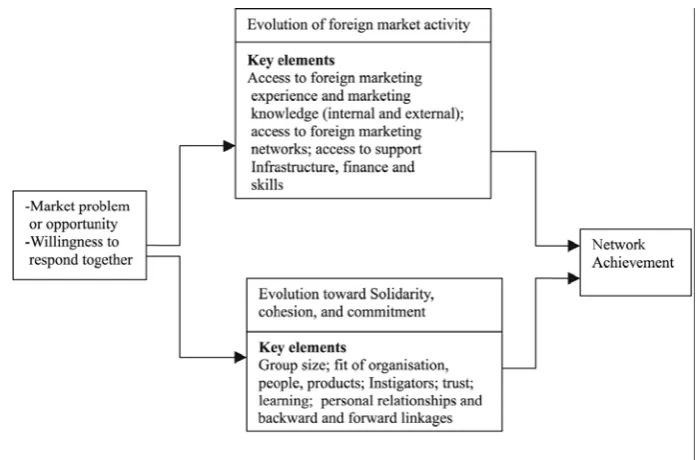
The relationship between these three stages is depicted in more detail in figure 3.5.
Figure 3.5: Relation of three stages of network evolution
Source: Ghauri, Lutz & Tesfom (2001)
From experiences discussed in the article, it can be concluded that the above presented model is in line with the experiences. The successful networks are characterized by the existence of a concrete market opportunity (threat), a willingness to cooperate, some form of early market penetration together with a process creating solidarity, cohesion and commitment among group members.
Figure 3.6: Network evolution in developing countries
Source: Ghauri, Lutz & Tesfom (2001)
Figure 3.6 outlines the network evolution of firms in developing countries. It addresses the variables related to the emergence, the development process, and the achievement of networks. Network development is highly influenced by two key factors:
• the evolution of the foreign marketing activity
• the evolution toward solidarity, cohesion and commitment
Network development should be demand oriented. The model makes this explicit as it stresses the importance of a market problem or market opportunity. This means that a network must be based on a thorough analysis of the problems or market opportunities. For companies in developing countries, and thus also in Bangladesh, networking should be an important aspect of doing business. Once the market opportunities and improvement areas are identified, this theory can be useful to give direction to the opportunities and improvement areas.
3.5 Export potential and needs of the Bangladeshi JDP industry
with respect to the market opportunities identified
3.5.1 Export development and promotion
Firms develop themselves gradually. Both Bell & Young (1996), Root (1994), and Seringhaus and Rosson (1991) developed a framework for the internationalization and export development of companies.
There has been a lot of research into the field of internationalization and much of it has been influenced by the conceptualizations which comes from the ‘Uppsala school’ in the mid- to late 1970’s. Several models emerged and most of these propose an incremental stages approach. Less emphasis is placed on the development of alternative market entry modes. From being unwilling to export, firms proceed through various stages to become experienced, highly committed exporters [Bell & Young, 1996]. These stages are:
1. No regular export activities 2. Export via overseas agents
The structure of these stages is confirmed by Root (1994). In addition, Root also makes a distinction between kinds of export.
Based on their experiences, Bell & Young (1996) reveal some common assumptions. First, firms develop in their domestic market before initiating exports. This comes from the fact that initially, the need to go outside the domestic market is not present, and often derives from the satisfaction of the domestic market and the expansion of the organization.
Second, there is some initial resistance to become involved in export activities, for a large part in developing countries because of lack of knowledge.
Third, firms begin by exporting to psychologically close countries and thereafter move to more distant countries.
Fourth, there is a logical, linear sequence whereby firms begin by exporting before considering alternative market entry modes, where overseas production/manufacturing is the ultimate stage.
Lastly, internationalization can be seen as possible in both directions and to some extent inevitable once the first steps have been taken.
Bell & Young have a view that too much attention has been given to the merits of competing theories and models and too little attention is paid to their potential complementarities. They designed an integrative framework for internationalization of the firm on the basis of three assumptions; (1) both behavioural and transaction cost theories may be appropriate in different circumstances, (2) the nature and pace of internationalization is conditioned by product, industry and other external environmental variables, as well as by firm-specific factors, and (3) the firm’s international marketing decisions are made in a more central way, incorporating products, markets and entry modes.
Seringhaus and Rosson (1991) share the view from Bell & Young that exports develop gradually. They distinguish four factors that help explain why companies seek export promotion support and why this is provided by public organizations:
1. The growing importance of international trade 2. The increasing intensity of international competition
3. The necessity of participating in the global expansion of trade in goods and service
4. The need to strengthen domestic industrial sectors
In the context of exporting, most public organization activity is undertaken by departments of government (like US Department of Commerce, quasi-government organizations (like Swedish Trade Council), and non-governmental organizations (like Chamber of Commerce).
Table 3.4: Stages of export involvement
Source: Seringhaus & Rosson (1991)
Seringhaus and Rosson state that the crucial barriers to increased involvement by companies in foreign markets are managerial motivation, knowledge and resources. Non-exporters often view exporting as more risky, costly and time-consuming than domestic business. This perception, although partly true, is incomplete. Exporters find that entry to foreign markets frequently generates good returns, spreads market risks, and provides opportunities for growth and expansion. Thus, many firms need motivation before they are likely to start exporting. This is the first barrier to be overcome. Advertising, testimonials and seminars are frequently employed to achieve this goal. Information barriers are the second hurdle. Many companies do not know where to begin; they lack both an appreciation of the information that should be collected, where it might be found and, in the event that these problems are dealt with, how it should be analyzed. Again, public organizations play a role in this area, providing standardized economic data on markets around the world, more specific data by product or country, and assistance in interpreting data collected.
Operational or resource barriers mean that companies suffer from a shortage of the time and/or money that must be invested if export markets are to be seriously developed. As argued above, although critical to success, managerial knowledge of foreign markets and marketing is typically lacking in the not experienced exporter. Again, public organizations frequently help companies to deal with these barriers through, for example, such vehicles as cost-shared market visits, trade missions, and trade fairs.
For the research, this method is chosen to classify the producers of jute products from Bangladesh. It gives categories of exporting and guidelines to each of these categories with regard to needs and possible interventions. By applying this method, it should become clear what the export potential and need of the Bangladeshi JDP industry is. Also the theory by Humphrey (2002)2 is appropriate here. Humphrey states that global markets are becoming more complex. The four reasons that were given in section 3.3.2 are also useful to attain in this part of the research. By looking at the four points, important issues concerning the development of exports and international business are brought to the attention.
3.6 Interventions for PROGRESS in order to support the
Bangladeshi JDP industry
3.6.1 Market matching
The markets of Europe and Bangladesh have a lot of differences, among others both economically as well as culturally. Ghauri developed a useful model to deal with differences between markets and link markets that are different on several levels and factors.
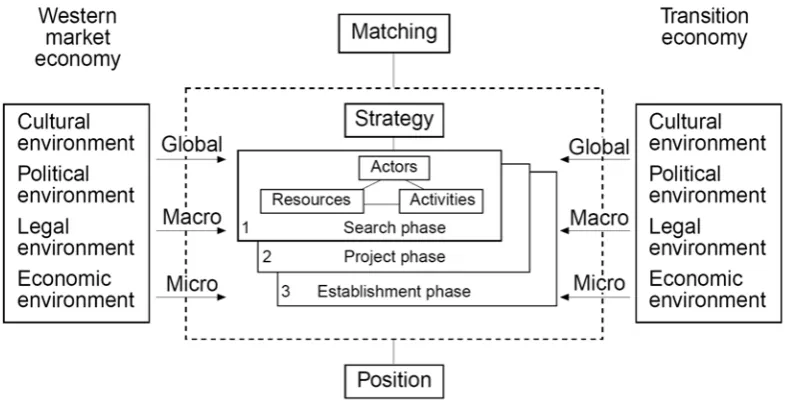
The model for a foreign entry process consists of an establishment process and a resulting position of an organization in the network [Ghauri & Holstius, 1996]. The establishment part consists of three phases; (1) the search phase, (2) the project phase, and (3) the establishment phase. In each of these phases, the network variables actors, activities and resources are present.
Matching is used as a key concept how the development of successful business relationships can be facilitated between two countries which are culturally, politically, legally, and economically dissimilar. The matching concept comprises everything from facilitating systems provided by governments and international organizations to company-specific measures. Steps can be taken at three levels; (1) global level, (2) macro level, and (3) micro level.
The establishment process with its three different phases constitutes the core of the foreign market entry model. It shows how companies develop relationships and build up a market position. As companies in a network produce or consume complementary or competing products, the network always includes elements of both conflict and co-operation. Since matching takes place at three levels, there are three levels of matching actors, too. Particularly at the macro and micro levels, matching helps a company to establish contacts with different counterparts, with companies as well as authorities. The foreign market entry model and the matching model are combined in Figure 3.7.
Figure 3.7: Matching markets
3.6.2 Export development and promotion
In section 3.5.1. the theory of export development and promotion was outlined, and is also suitable for this part of the research. Table 3.4 provides a summary of the stages of export involvement, corresponding company needs, and export promotion program responses. In this part of the research, where the focus is on developing interventions for PROGRESS, the part of the company needs can be very useful here. It provides guidelines to where the focus of the needs lie.
3.6.3 Business Development Services
All of the above theories should lead to the development of interventions for PROGRESS. In the research, these will be compared to the possibilities within the range of PROGRESS. BDS market development is a methodology that is widely applied within PROGRESS. Business Development Services (BDS) are any non-financial services provided tot SMEs on either formal or informal basis. As such, BDS refers to a wide range of services used by entrepreneurs to help them operate and grow their businesses.
PROGRESS bears in mind that the development of the BDS market is one of its main objectives. The approaches in developing business services for the actors should be characterised by the following:
• Providing basic, rather than sophisticated or strategic services at the outset
• Ensuring informal but effective delivery mechanisms rather than formal mechanisms
• Service delivery through different forms of public-private partnerships
• Services embedded within social and business transactions and relationships The business and market development services should center around and be guided towards:
• Developing a shared market concept for a sector
• Organising institutional training to develop entrepreneurial and managerial skills of the key players of the selected sectors
• Business development services should equip the enterprises with the knowledge on how to solve issues at their own level as well as at an institutional level.
3.7 Summary
4. Market for diversified jute products in Europe
4.1 Introduction
The objective of the assessment of the European market is to see where the opportunities and threats lie in the European (EU) market. The EU market consists of 27 member states. The most important markets are in West Europe, and therefore the focus for this research is on the West European countries.
Section 4.2 looks at the target country market factors, and is followed by the target country production factors in section 4.3. Then, in section 4.4 the target country environmental factors are handled, followed by the conclusions of this chapter.
4.2 Target country market factors
The first part in the model of Root (1994) (see figure 3.1) consists of target country market factors. The target market of the research is the EU market, and especially the West European countries. To gain some more understanding of jute and its markets, first general information is given about the total world market for jute. Next, the chapter will specify more into the target market of the research.
4.2.1 The world jute market
Bangladesh, India, Myanmar, Vietnam and Thailand account for over 95% of the world production in jute [Ministry of Jute of Bangladesh3, 2006]. For Bangladesh, it once accounted more than 80% of the country’s total foreign exchange. But times have changed and Bangladesh now faces a decline in the profits, and many of the government-owned mills are shut down. The decline of the jute items is shown in table 4.1. A main explanation for this decline is the use of various synthetic substitutes and artificial fibres [PROGRESS 2006]. The table shows that the share of jute items, after a decline, is increasing again and this could increase more with the development of JDPs and more JDP producers.
Nowadays the jute industry is still the third most important source of foreign exchange for the country, and almost one-seventh of the total population is involved in jute production, transportation, processing and marketing, either directly or indirectly. This means that the jute sector provides about 10% of the total employment in the economy [Ministry of Jute and Textiles Bangladesh 2006].
(value in million dollar)
Jute items Non-jute items
Fiscal year Total export Value % Share of total export Value % Share of total export
1984-85 934.43 540.61 57.85 393.83 42.15 1994-95 3472.56 398.25 11.47 3074.31 88.53 2002-03 6548.44 339.64 5.19 6208.8 94.81 2003-04 7602.99 326.15 4.29 7276.84 95.71 2004-05 8654.52 403.67 4.66 8250.85 95.34
Table 4.1 Value of export in Bangladesh
Source: Export Promotion Bureau of Bangladesh
Table 4.1 shows the decline from the jute items compared to the non-jute items. Compared to the year 2003-2004, the share of jute items rose in the year 2004-2005. The target for the jute goods in 2004-2005 was USD 370 million, and the actual export
was USD 403.67 million, which means the actual exports have exceeded the target by almost 14%. In comparance, the total exports only rose 1.04% to USD 8,654.52 million [Export Promotion Bureau of Bangladesh, 2006]. From this amount, USD 4,621.22 million is exported to the EU, which means that 53.40% is exported to this region. The EU destination countries are; Austria, Belgium, Denmark, France, Finland, Germany, Italy, Greece, Ireland, Luxembourg, the Netherlands, Portugal, Spain, Sweden, and the UK. The development of the export to the export is shown in table 4.2. 3.55% of the total exports are jute goods, where the Ready Made Garments (RMG) sector is the largest with 74.16% [Export Promotion Bureau of Bangladesh 2006].
(value in million dollar)
Total export
2000-01 2,960.44 2001-02 2,852.99 2002-03 3,282.33 2003-04 4,279.51 2004-05 4,621.22
Table 4.2: Exports to EU
Source: Export Promotion Bureau of Bangladesh
4.2.2 Porter’s five forces framework
Threat of entry
Bangladesh is one of the few countries that grows jute and produces jute goods (India is the only other large producer), and therefore the threat of entry is not so high. Figure 4.1 outlines the world production in jute from the largest jute producing countries. Other producing countries are Thailand, Nepal, Vietnam, Myanmar and some small parts in Latin America.
There are several reasons that the threat of entry is not so high. First, labour costs in Bangladesh are amongst the lowest in the world, and economies of scale are an important aspect with regard to production costs of JDPs. Second, producers from jute growing areas have far more experience with producing jute and jute products than European countries. Producers who market their products in Europe gain experience in, for example, marketing and can further try to expand their position on the European market. Another point here is, in combination with the low wages, that it is impossible for European countries to import the jute and produce jute products that can compete in price with those that are made in Asian countries.
0
Figure 4.1: World production of Jute in major producing countries
Source: Food and Agricultural Organisation of the UN
Threat of substitutes
With regard to the traditional jute products like sacks, the threat of substitutes concentrates to synthetic fibres. These synthetic products have an advantage in use compared to their cost. This is called product-for-product substitution.
For this research, the JDP market is more relevant. The JDP market deals more with a generic substitution, where products compete for disposable income. It is expected that the JDP market will further open up new possibilities for revival of the jute sector in Bangladesh. It creates additional employment opportunities, improves the economic conditions of farmers and workers, and hence assists in poverty reduction [PROGRESS 2006]. Looking at, for example, the geotextiles made from jute, these compete with traditional geotextiles. Other JDPs compete with substitute products like gift items from other third world countries. By differentiating the products, competitive advantage can be gained compared to other gift items.
Power of buyers
The power of buyers is not so high. The market, West Europe, does not contain a few large buyers.
The export market for JDPs is currently developing and therefore buyers could be sought in all parts and layers of the market. Because these products (JDPs from Bangladesh) are relatively new to both the foreign as well as the domestic market, there is not much information about the customers of these products. Important for exporters and new exporters in the market is to get insights into the buying habits of the customers and learn from other similar products that already have experience in the (West European) market. This importance also comes from the interviews that were held with JDP producers. The producers all mentioned the competition that is coming from areas with more experience like India (see chapter 5).
Although the world production and consumption of jute and traditional jute products is decreasing, the market for JDPs is increasing, which means the potential for JDPs is rising [PROGRESS 2006]. Next to the competition from India, there is still a huge potential in the home market, where the familiarity with the diversified products leaves room for improvement.
Power of suppliers
consequences for the total quality of the products and their price, and has consequences for the selling of a standard (high) quality. In order to improve the standard quality of the jute delivered by the jute mills, the bargaining position of the JDP producers must be improved.
The European market is not relevant with regard to power of suppliers. All of the JDPs are produced in countries where the jute is grown as well. Main reason for this is that the production typically takes place in developing countries. Second it is not feasible for European companies to start producing these products competitively. Raw jute, production costs, and labour costs are lower in developing countries (which also produce the jute).
Competitive rivalry
Competitive rivals are organisations with similar products and services aimed at the same customer group. In the international JDP market, India is considered to be the market with the most fierce competition and competitors. Next to Bangladesh, India has the largest market and producers of JDPs. Because India started earlier with the production of JDPs, it has the advantage of more experience. Although India has more experience with JDPs, Bangladesh is the largest exporter of jute and jute products in the world. Figure 4.2 shows the world exports of jute products from India, Bangladesh, and the other jute producing countries. The largest difference between the Indian and Bangladeshi jute market is that 90% of the Indian market is used domestically and 90% of the Bangladeshi jute is exported [Ministry of Jute of Bangladesh, 2006].
0 100 200 300 400 500
2004 2003 2002 2001 2000 1999
In '000 tonnes
Other India Bangladesh
Figure 4.2: World export of jute
Source: Food and Agricultural Organisation of the UN
One way to cope with this fierce competition, mainly from India, is for producers from Bangladesh to differentiate their products (for example focus on the trend of environmental friendly products). When a lot of products in a market are undifferentiated, there is little to stop customers switching between competitors or other third world gifts. This also comes back in the fact that a lot of producers are of roughly the same size and relatively new to the market.
Most competition in the market for JDPs comes from India, but especially in the area of jute quality, Bangladesh can differentiate itself from these competitors.
4.4 Target country environmental factors
The PESTEL framework is a suitable tool to observe a market through several environmental factors (See section 3.2.3 and table 3.2). Each of the six factors will be shortly discussed.
Political
In West Europe, each member state has its own political climate. This means each state can decide its own political direction and regulations. Not every regulation is important or relevant for the JDP industry. As with every development with target country environmental factors, companies have to determine which regulations are relevant enough to focus on. There are collective agreements with regard to the EU and imports, but often the end decision lies with the country itself.
Since the target market in West Europe are developed countries, the government often is politically stable and products from developing countries often are welcome, because most countries have poverty reduction programs that encourage trade and products from developing countries.
Bangladesh’s exports to the European market have benefited from a preferential market access like duty and quota-free access. However, the trade capacity of Bangladesh presently relies on a very limited number of export products. There is, therefore, a need for a profound diversification of the country’s export range. Figure 4.5 gives an overview of the total exports from Bangladesh to the EU the last few years. There is clearly an upward tendency in the figure. Next to that, more than half of all the exports from Bangladesh go to the EU (53%) [Delegation of the European Commission to Bangladesh, 2004].
Figure 4.3 Imports in EU from Bangladesh
Source: Delegation of the European Commission to Bangladesh
Economical factors
The world market for jute is positively influenced by the market expansion of diversified jute products [Food and Agricultural Organisation of the UN, FAO]. The diversified products are a small proportion of the total consumption, however their share in the value of total exports in rising. With effective research and development strategies and intensified marketing efforts there is real potential growth.
India are increasingly diversifying the products made of jute and exporting these to developed countries. Their ability to produce and market a wide range of JDPs shows the scope for expanding demand for such products. Bangladesh too has the potential to capture certain market segments, provided that the JDP producers improve the quality and designs, increase the product range, establish effective market linkages and uphold the image of Bangladeshi products in foreign markets [PROGRESS, 2006].
In 2002, the government of Bangladesh set up the Jute Diversification Promotion Centre (JDPC)4 to inspire both new and old entrepreneurs to set up factories in this promising sector by offering technical and financial supports. Goal is to increase both the foreign as well as the domestic market of JDPs. The task of the JDPC is to provide support and information to entrepreneurs in the JDP market, and those who want to enter the market. Support is provided in terms of loans to entrepreneurs and (free) technical support [Ministry of Jute of Bangladesh, 2006].
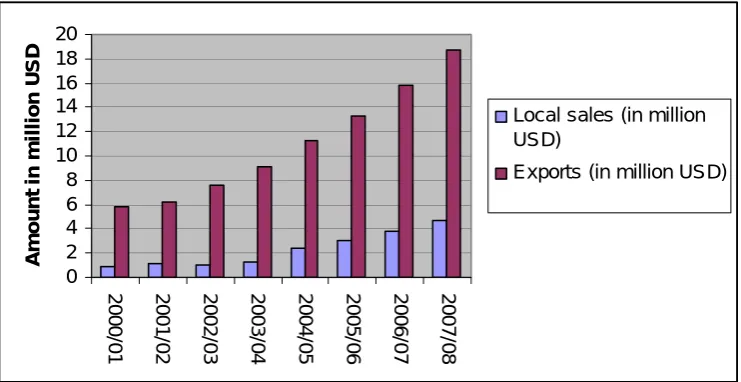
Next to the increasing international market for diversified products, the domestic consumption pattern in Bangladesh is gradually changing, as more and more people are recognizing the aesthetic and ecological values of jute products [PROGRESS 2006]. According to statistics complied by the JDPC and the Ministry of Textile and Jute, the local sales of JDPs will increase the coming years. This is also presented in figure 4.4, which indicates the trend of the past few years and the predictions for the coming years.
0
Figure 4.4: Export and local sales value of JDPs
Sourc