International Journal of Scientific Research in Computer Science, Engineering and Information Technology © 2017 IJSRCSEIT | Volume 2 | Issue 5 | ISSN : 2456-3307
5G Heterogeneous Networks Future Assessment on Network
Channel Allocation and Particle Swarm Optimization (PSO)
Dr. Srihari Chintha
Assoc Professor, CSE Department, AIET, Hyderabad, Telangana, India
ABSTRACT
The demand for spectrum resources has augmented dramatically with the appearance of recent wireless applications. Spectrum sharing, thought of as an essential mechanism for 5G networks, is visualized to deal with spectrum deficiency issue and accomplish high data rate access and secure the quality of service (QoS). From the licensed network's perspective, the interference caused by all secondary users (SUs) ought to be decreased. From secondary networks purpose of reading, there's a requirement to assign networks to Sus in such how that overall interference is reduced, enabling the accommodation of a growing variety of Sus. This paper presents a network choice and channel allocation mechanism so as to extend revenue by accommodating a lot of Sus and line of work to their preferences, whereas at an equivalent time, respecting the first network operator's policies. An optimization drawback is developed so as to reduce accumulated interference incurred by licensed users and also the quantity that Sus have to get hold of exploitation the first network. The aim is to produce Sus with a particular QoS at a lower cost, subject to the interference constraints of every available network with idle channels. Particle swarm optimization and a changed version of the genetic algorithmic rule square measure accustomed solve the optimization problem. Finally, this paper is supported by intensive simulation results that illustrate the effectiveness of the proposed ways in finding a near-optimal resolution.
Keywords: Channel Allocation, Network Selection, 5G Heterogeneous Networks, Optimization
I.
INTRODUCTION
5th generation mobile networks or 5th generation wireless systems, abbreviated 5G, are the proposed next telecommunications standards beyond the current 4G/IMT-Advanced standards,[1] operating in the millimeter wave bands (28, 38, and 60 GHz).
5G planning aims at higher capacity than current 4G, allowing a higher density of mobile broadband users, and supporting device-to-device, more reliable, and massive machine communications.[2] 5G research and development also aims at lower latency than 4G equipment and lower battery consumption, for better implementation of the Internet of things.[3] There is currently no standard for 5G deployments.[1]
The Next Generation Mobile Networks defines the following requirements that a 5G standard should
fulfill:[2]Data rates of tens of megabits per second for tens of thousands of users. Data rates of 100 megabits per second for metropolitan areas,1 Gb per second simultaneously to many workers on the same office floor,Several hundreds of thousands of simultaneous connections for wireless sensors Spectral efficiency significantly enhanced compared to 4G,Coverage improved ,Signaling efficiency enhanced Latency reduced significantly compared to LTE.[3][4]
systems and base stations will require new and faster application processors, basebands and RF devices.[6]
Although updated standards that define capabilities beyond those defined in the current 4G standards are under consideration, those new capabilities have been grouped under the current ITU-T 4G standards. The U.S. Federal Communications Commission (FCC) approved the spectrum for 5G, including the 28 GHz, 37 GHz and 39 GHz bands, on 14 July 2016.[7][8].
The last decade has seen the dramatic increase in the demand of mobile data due to the increase in mobile devices and versatile applications. It is forecast that the data traf c will increase 10-fold between 2014 and 2019 [1]. This explosive demand of mobile data results in several chal-lenges which shifted the research directions to fth gen-eration (5G) networks [2]. 5G networks are intended to provide signi cantly high data rate access and guaranteed quality-of-service (QoS). Thus, the demand of spectrum resources is expected to increase signi cantly in 5G net-works. This requires wireless system designers to propose ef cient spectrum management schemes. Different views on 5G architecture are presented in [3] [5] with key technologies such as massive MIMO, energy ef cient communications, cognitive radios, visible light communication, small cells, etc. In nutshell, 5G is visualized as heterogeneous networks which can provide access to a range of wireless networks and access technologies [6]. The 5G heterogeneous networks will mainly consist of network densi cation, i.e., densi cation over space and frequency. The dense deployment of small cells is called the densi cation over space whereas utilizing radio spectrum in diverse bands is called densi cation over frequency. Network densi cation can meet the demand of high capacity in 5G networks [7]. However, opportunistic spectrum sharing is important in order to achieve stringent goals of 5G in heterogeneous environment.
Spectrum sharing ensures the coverage of 5G heteroge-neous networks everywhere and all the time. It can support a large number of connected devices and diverse appli-cations [8]. In addition, it is spectrum ef cient as it can use all non-contiguous spectrum, can achieve better sys-tem capacity, reduce energy consumption, and increase cell throughput. Dynamic spectrum access (DSA) has emerged as key for spectrum sharing in an opportunistic way [9], [10]. A
radio network employing DSA to coexist with a licensed network (primary network) is known as a cognitive radio network (CRN) [11]. The users who subscribe to any of these primary networks are known as primary users (PUs). On the other hand, users who do not belong to any of these primary networks and contend for the unused portion of the spec-trum in these networks are known as secondary users (SUs). SUs may face a problem in choosing which primary network to join because a 5G heterogeneous network incorporates multiple primary networks with different characteristics in terms of bandwidth, price, and capacity; this is known as the network selection problem [12], [13].
Price is a key factor while leasing/selecting the network of a speci c operator for spectrum access. In [14], a joint price-based spectrum sharing and power allocation scheme is pro-posed for interference management. Author in [15], presented a price based spectrum sharing algorithm. The optimization problem is formulated to minimize the price incurred by the SUs and solved using the particle swarm optimization (PSO). However, the algorithm is based on assumption that there exists an interaction between PU and SUs which is practically not a feasible option. A price-based spectrum sharing and rate allocation scheme is proposed to address the problem of sub-carrier sharing with discrete rate allocation in [16]. In [17], the PSO approach is used to solve the problem of network selection. However, due to the intractable nature of the network selection problem in 5G heterogeneous net-works, it is desirable to explore other avenues to develop better algorithms for solving the network selection problem. Therefore, it is required to study network selection problem in order to enhance the previous work.
II.
RELATED WORK
parameter which considers various metrics associated with users, system, base station transmitted power, traf c load, and spectral ef ciency. In [13], authors considered realistic approaches based on network-centric and user-network-centric for intelligent network selection. However, none of them con-sidered price based network selection approach.
A uniform framework to investigate and evaluate network selection strategies is presented in [20]. Authors proposed a gradient-based optimal network selection strategy and dis-cuss several existing strategies. In [12], authors studied a single network selection scheme to maximize the mutual information over all secondary networks while satisfying the constraint of availability of the primary service. Spectrum band selection scheme is presented in [21] while satisfying the constraint on delay. The aim is to select a band with highest secondary channel power gain and lowest inter-ference channel power gain to PUs. Authors formulated a problem to maximize effective capacity by optimizing transmit power allocation with both band selection criteria. A game-theoretic framework for network selection is pro-posed in [22]. The network selection problem is formulated as a non-cooperative game (ordinal potential game) with SUs as players. To solve this problem, a decentralized stochas-tic learning-based algorithm was proposed in which Nash equilibrium is achieved without cooperation with other SUs. A cross-layer framework is designed in [23] while jointly considering spectrum sensing, access decision, physical-layer adaptive modulation and coding scheme, and frame size. The throughput of SUs is maximized for which problem is formulated as Markov decision process.
The genetic algorithm (GA) and the PSO are derived from natural phenomena and are commonly used for solving the optimization problem. They belong to the class of evolution-ary algorithms. The GA is inspired from the concepts in evo-lutionary biology, such as inheritance, mutation, selection, and crossover. Whereas the PSO relies on the social behavior of the particles. In every generation, each particle adjusts its trajectory based on its own best position and the position of the best particle in the entire population. More speci cally, regarding evolutionary computing in CRNs, a number of efforts have been reported so far, such as spectrum sensing using the PSO [24], [25], resource allocation using the PSO and the GA [26],
[27], dynamic parameter adaptation using the GA [28], the GA aided transmit power control [29], energy ef cient scheduling based on the PSO [30].
III. PROBLEM FORMULATION
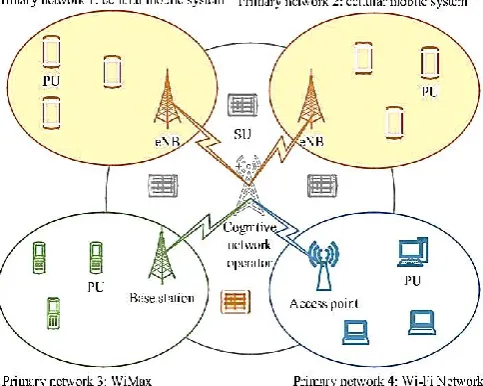
We consider a 5G heterogeneous network which is composed of N primary networks, where each primary network can have any number of subscribed users (PUs). Each primary network has maximum number of channels denoted by pm, however, the number of
channels available for SU communication depends on the PU behavior. For each particular primary network, the PU behavior is modeled using Poisson process with two states, i.e., ON-OFF state model. Most publications in this Field modeled PU traffic as independent and identifiably distributed ON-OFF process [31] [33]. For example, in [31], authors proposed a Super Wi-Fi using an ON-OFF model based PU activity. A Super WiFi uses spectrum holes and is operated by a wireless service provider which leases a licensed spectrum band.
Figure 1. An illustration of cognitive network operator-based 5G heterogeneous network.
The maximum possible rate of transmission on ith
channel of mth network is C
immax . The value of Cim
depends on the ithchannel condition in network m. It is
mechanism. When jth SU enters the system, it speci es
its minimum data rate requirement j and the maximum
price pj that it is willing to pay to the CNO. Let U =u1;
u2; : : : ; uM } denote the set of M SUs contending for
access. When jth SU is allocated a particular channel i
in a network m, it is assumed that SU creates a unit interference denoted by hjm with the PUs. The amount
of interference depends on the channel condition. It is desired to limit the maximum interference to the PUs of
mth network below a specific threshold
m. Assume that
a cost fm is associated with every mth network; this
means if a jth SU joins an mth primary network the cost
fjm will be charged. The objective is to minimize the
overall cost and the interference caused by assigning SUs to different networks, subject to the constraints of each network. Thus, the objective function for the optimization is expressed as:
where Q(X ) is the objective function that accumulates the interference incurred to PUs in the system and the amount that SUs have to pay for using primary networks. The FIrst constraint states that each SU can be assigned only one channel among all the channels in networks at a given instant. If the binary decision variable xjm is 1, the user is assigned to the mth network and vice versa. Second, third and fourth con-straints depend on the primary network resources available for SUs as well as the policy of the network. Second con-straint ensures that the total interference caused by all SUs assigned to a particular network m will not exceed the max-imum tolerable interference m. Third and fourth constraints show that the assigned channel must be suitable for the SU in terms of bandwidth and cost requirements, respectively.
IV. PARTICLE SWARM OPTIMIZATION (PSO)
FOR NETWORK SELECTION IN 5G
HETEROGENEOUS NETWORKS.
PSO consists of a swarm of particles in which each particle resides at a position in the search space [34]. The position of each particle is represented by a vector that presents a solution. The algorithmic of PSO technique starts with an initial population of n random particles. Each particle is initialized with a random position and velocity in the search space. PSO is an evolutionary algorithm, so the position and velocity of each particle is updated in every iteration. After the update, the tness value of each particle is computed using a tness function. The tness of each particle represents the quality of its position. The velocity of each particle is in uenced by its own best previous position (pbest) found by itself and the best previous position (nbest) found by its neighbors. If all the particles in a swarm are de ned as neighbors of a particle, nbest is called global best (gbest), whereas if only some of the particles are declared neighbors of a particle, nbest is called local best (lbest).
Algorithm 1 Generale Description of PSO
1. Randomly initialize the position xk and velocity vk of each kth particle
2. Calculate the tness of kth particle
3. Calculate pbestk for kth particle
4. Calculate nbestk for the swarm
5. Update the velocity vk of kth particle using (2)
6. Update the position xk of kth particle using (3)
7. Calculate tness of kth particle
8. Update pbestk of kth particle
9. Update gbestk of the swarm
10. Terminate the algorithm if the stopping condition is reached, otherwise go to step 5
Let vk and xk denote the velocity and position of the kth particle, respectively. In [35], the author mentioned that they are updated as
vknewD w vkC c1r1(pbestk xk)
C c2r2(nbestk xk ); 8 k D 1; 2; : : : n (2)
xknewD xkC vknew; (3)
experience. The general description of PSO is given in Algorithm .Now we discuss the PSO algorithm for network selection in 5G heterogeneous networks. The algorithm includes several features, such as associating a particle position into the dif-ferent primary networks and channels (encoding of particles), computing tness value of a particle, updating the particles position and velocity and employing a repair process for all infeasible allocations.
A. ENCODING OF PARTICLES
One of the key problems in applying PSO is the de nition of an encoding scheme that describes one-to-one mapping between the solution and the particle. Each particle should consist of a complete solution for SUs, primary networks, and channels. This paper considers the kth particle position in a search space of a vector for the problem of M SUs and N primary networks, each with pm channels. To clarify, consider an example with parameters N D 5 and M D 5 which means that there are ve primary networks with ve SUs in a 5G heterogeneous network. It is assumed that each mth network has the same channel denoted by p, i.e., pm D p D 7. In this case, each group of 35 slots (M p) represents the network and channel allocation for one SU, as shown in Fig. 2. Slots 1-35 represent both the channel and network allocated for the rst SU, slots 36-70 for the second SU and so on.
Figure 2. Network selection to PSO particle mapping
The position of a particle can be represented by multi-dimensional vectors whose entries belong to a set of f1; 2; ::; M pN g. The M-dimensional position of the kth particle is de ned as xk D (xk1; xk2; ::; xkM ), where xkj represents the jth dimension of the kth particle, which indirectly provides the assigned network and channel for the jth SU.
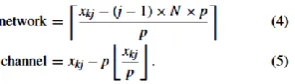
The above-mentioned encoding of the particles can be easily extended to a problem with mth network having the different number of channels denoted by pm. In this case, the value of p will be maximum of pm, i.e., p D max pm. This means that it is supposed that each network has the same p channels. For any network m having the number of channels pm < p, a value 1 is inserted in all the slots other than pm, which indicates that p pm slots of network m are already occupied. Mathematically, the network and channel corresponding to an element of a particle can be computed as follows:
Figure 2. shows an example of a mapping between a net-work/channel selection and particle position. In this example, xkjis (xk1; xk2; xk3; xk4; xk5)D(5; 52; 87; 124; 161). Out of 1-35 available slots, the rst SU occupies slot number 5 (xk1 D 5), which means that the rst SU is
assigned to the
B. FITNESS FUNCTION
The overall interference incurred by SUs and the overall cost SUs have to pay (Q(x)) as described in Section II are used to evaluate the performance of the algorithm. In our case, the tness function is the inverse of Q(X), which means a solution with higher accumulative interference and subscription charges will have a lower tness value. The tness value of each solution can be estimated using
fitness[k] D (Q(X )) 1: (6)
C. UPDATE OF VELOCITY AND POSITION
The PSO algorithm uses the new velocity obtained from (2) to update the particle position to a new position according to (3). In this paper, we de_ne the velocity vector of particle k as vk D (vk1; vk2; : : : ;
vkM ), vkj 2 R where vkj is the real number pointing toward the movement of the SU for the kth particle from the current slot to the next one. For example,the velocity vector vk D (1:2;�1:5; 2:3;�1:68; 1:87) in the next generation is added to the position vector xk
rounded. Thus, the particle position (6; 51; 89; 122; 163) is obtained in the next generation.
Generally, the value of each component in v can be clamped to the range [�vmax;Cvmax] to prevent excessive roaming of particles outside the search area. If vkj is smaller than �vmax, then set vkj D �vmax; if
vkj is greater than Cvmax, then set vkj D vmax. We set
vmax D 7, which limits the forward or
backward movements of each SU to a maximum position of 7 slots. For example, if an SU is currently associated with network 3, in the next generation it can join network 2,network 4, or remain in network 3.
D. REPAIR PROCESS
The algorithm starts to randomly generate as many potential solutions for the problem as the size of the initial population of the PSO. Each dimension in the particle vector represents a channel as well as a network assigned to a SU. The allocation of a network and a channel to SUs is performed sequentially until all SUs are assigned to a network and channels.
Each particle represents a complete solution that ensures that each allocation must satisfy the constraints mentioned in Section II.
V.
GENETIC ALGORITHM (GA) FOR
NETWORK SELECTION IN 5G
HETEROGENEOUS NETWORKS
Normally GA starts by creating an initial population of chro-mosomes denoted by Npop. Each chromosome
encodes a solution of the problem, and its tness value is related to the value of the objective function for that solution. Generic oper-ations, such as crossover, mutation, and natural selection are applied during each iteration in order to search for potentially better solutions. The crossover operation combines two chro-mosomes to generate the next generation of chromosomes while preserving their characteristics. The mutation operation reorganizes the structure of genes in a chromosome randomly so that a new combination of genes may appear in the next generation. It serves the purpose of the search by jumping out of the local optimum solutions. Reproduction involves copying a chromosome to the next generation directly so that chromosomes from various generations can cooperate in the evolution. The
quality of the population may be improved after each generation [36].
A. ENCODING OF CHROMOSOMES
Chromosomes are the basic building blocks of the GA. Each chromosome should be represented in such a way that it provides complete information about the solution of problem. A chromosome consists of genes that can be represented in the form of a binary or integer string. For the prob-lem of N SUs and M primary networks, we represent each kth chromosome (potential solution)
as a binary string. Let us consider an example where there are 5 primary networks and 5 SUs (N D 5 and M
D 5) and each primary network has 7 channels available for SUs. As there are 5 SUs, there are 5 genes in kth chromosome. Once we have decided on the
number of genes for the chromosome, the next step is the encoding of the chromosome. Each gene represents one SU, and each SU should be assigned to a network and a channel. Because there are 5 primary networks and 7 channels in each network, we need 3 bits for representing the network and 3 bits for representing the channel, i.e., each gene will have 6 bits. As a result, each chromosome will have 30 bits with 5 genes, as shown in Figure 4.
C. SELECTION OF CHROMOSOMES
The process following the tness measure is the construction of the next generation selection. The selection process is dependent on the tness measure of the chromosomes. In the selection process, the population is rst sorted by a compar-ison of tness values. The top NpopRselect chromosomes are included in
the selected/mating pool, where Npop is the population
size (total number of chromosomes) and Rselect is the
selection rate (which is chosen as 0:5 in this paper). A pair of parent chromosomes is selected from this pool and mated using the crossover procedure discussed in the next section.
D. CROSSOVER PROCESS
ran-domly selected chromosomes. Crossover is a process in which the characteristics of a pair of parent chromosomes are exchanged with each other to form a pair of child chromo-somes. The crossover rate is taken as 0:5. There are several mechanisms for the crossover process, such as single point, 2-point, multi-point, and uniform crossovers. We have chosen the 2-point crossover process. As described in Section IV-A, a binary encoding is used for the chromosome struc-ture, so we have to develop some crossover speci cations. Two cross-points are set at the multiple of 3 bits, which means either the border between genes or the mid-point of a gene. Once two cross-points are chosen, every bit between the two cross-points is swapped between the parent chromo-somes, rendering two child chromosomes. For example, as shown in Fig. 5, two parent chromosomes p1 and p2 crossover and produce two child chromosomes c1 and c2.
The allocated network and channel for an SU are repre-sented by the allocation bits of each gene in the chromosome. The rst three bits represent the network id and last three bits are the channel id. For example, if the rst gene representing the rst SU has a value of 010110 as allocation bits, this means that the rst SU is assigned to the second network and the sixth channel.
B. FITNESS MEASURE
The next step after construction of the chromosomes and generation of the initial population is to evaluate each chro-mosome by measuring its tness. The tness measure is also known as the survival measure that determines how well an individual (i.e., the chromosome) from a population solves the given problem. The tness is generally a real number, the higher the value of its value, the closer the chromosome is to the optimal solution. We use the same tness function as in (6) for the GA, as discussed in Section III-B
Figure 5. 2-point crossover procedure for generating child chromosomes.
Each crossover generates two child chromosomes that replace two chromosomes from the bottom of the population that are not in the mating pool. This replacement process continues until all the
chromosomes that are not in the mating pool are replaced. In this manner, the chromosomes that have high tness, i.e., the ones in the mating pool, survive in the subsequent generations. In contrast, the chromosomes that have low tness, i.e., the ones that are not in the mating pool, do not survive and are replaced by the children of the chromosomes of the mating pool, which potentially have higher tness.
Algorithm 2 Elitism Based Genetic Algorithm (GA) 1. Generate the initial population of chromosomes 2. Evaluate the tness of each chromosome
3. Check for Termination if the stopping condition is reached goto step 4 otherwise step 5
4. Select the best chromosome and Stop
5. Elitist population to preserve the best individual of each generation using sorting mechanism 6. Apply crossover on selected chromosomes 7. Apply mutation on selected chromosomes 8. Goto step 3
E. MUTATION
After producing the new generation using the crossover pro-cess, another process, called mutation is performed. Mutation is applied to the child chromosomes, altering a binary bit of 0 to 1 or vice versa. The number of chromosomes undergoing the mutation process out of 100 chromosomes is speci ed by the mutation rate. Here, the mutation rate is chosen to be 0:03, which means that every chromosome is considered for mutation with a probability of 3%.
F. ELITISM
We applied the concept of elitism in the GA. In this concept, unlike the standard GA, the excellent individual is reserved in each generation. As mentioned earlier in the selection pro-cess, the individuals are sorted according to their tness value and the best individuals are preserved. The child chromo-somes replace the parent chromosomes with lower tness val-ues. Together with the help of elitism, the best individual can be prevented from being lost during the process of selection, crossover, and mutation. This is clearly helpful in the global convergence property of the GA. The description of Elitism based GA for network selection is given in Algorithm 2.
VI. CONCLUSION
The emerging wireless applications with stringent QoS requirements continue to demand more spectrum resources. Spectrum sharing is the key solution to deal with the prob-lem of spectrum scarcity. In this paper, we have studied the network selection problem in 5G heterogeneous networks. We have proposed a network selection mechanism and for-mulated an optimization problem for network selection to minimize the interference to primary networks and cost paid by SUs. We then solved the optimization problem with the PSO and modi ed GA in order to nd near-optimal solution. We have also designed two scenarios for performance evalu-ation with different system settings, SU data rate demands, and price preferences. Then the performance of proposed mechanism for network selection was evaluated under these scenarios. The simulation results showed that the modi ed GA outperforms the PSO and achieves a higher tness value with less iterations in terms of both interference reduction and SU price requirement.
VII.
REFERENCES
[1]. 'Cisco visual networking index: Global mobile data traf c forecast update 2014 2019,'White Paper c11-520862, May 2015. [Online]. Available: http://www.cisco.com/c/en/us/solutions/collateral/s
ervice-provider/visual-networking-index-vni/mobile-white-paper-c11-520862. html
[2]. S. Chen and J. Zhao, 'The requirements, challenges, and technologies for 5G of terrestrial mobile telecommunication,'IEEE Commun. Mag., vol. 52, no. 5, pp. 36 43, May 2014.
[3]. M. Iwamura, 'NGMN view on 5G architecture,'in Proc. IEEE 81st Veh. Technol. Conf. (VTC Spring), Glasgow, Scotland, May 2015, pp. 1 5. [4]. H. Droste et al., 'The METIS 5G architecture: A
summary of METIS work on 5G architectures,'in Proc. IEEE 81st Veh. Technol. Conf. (VTC Spring), Glasgow, Scotland, May 2015, pp. 1 5. [5]. P. K. Agyapong, M. Iwamura, D. Staehle, W.
Kiess, and A. Benjebbour, 'Design considerations for a 5G network architecture,'IEEE Commun. Mag., vol. 52, no. 11, pp. 65 75, Nov. 2014.
[6]. A. M. Akhtar, X. Wang, and L. Hanzo, 'Synergistic spectrum sharing in 5G HetNets: A harmonized SDN-enabled approach,'IEEE Commun. Mag., vol. 54, no. 1, pp. 40 47, Jan. 2016.
[7]. N. Bhushan et al., 'Network densi cation: The dominant theme for wire-less evolution into 5G,'IEEE Commun. Mag., vol. 52, no. 2, pp. 82 89, Feb. 2014.
[8]. W. Ejaz and M. Ibnkahla, 'Machine-to-machine communications in cognitive cellular systems,'in Proc. IEEE Int. Conf. Ubiquitous Wireless Broadband (ICUWB), Montreal, QC, Canada, Oct. 2015, pp.1 5.
[9]. C. Rattaro, L. Aspirot, and P. Belzarena, 'Analysis and characterization of dynamic spectrum sharing in cognitive radio networks,'in Proc. IEEE Int. Wireless Commun. Mobile Comput. Conf. (IWCMC), Dubrovnik, Croatia, Aug. 2015, pp. 166 171.
[10]. W. Ejaz, N. ul Hasan, S. Lee, and H. S. Kim, 'I3S: Intelligent spec-trum sensing scheme for cognitive radio networks,'EURASIP J. Wireless Commun. Netw., vol. 2013, no. 1, pp. 1 10, Dec. 2013. [11]. W. Ejaz, N. Ul Hasan, and H. S. Kim, 'Distributed
cooperative spectrum sensing in cognitive radio for ad hoc networks,'Comput. Commun., vol. 36, no. 12, pp. 1341 1349, Jul. 2013.
[12]. M. Ju and K. Kang, 'Cognitive radio networks with secondary net-work selection,'IEEE Trans. Veh. Technol., vol. 65, no. 2, pp. 966 972, Feb. 2016. [13]. S. Andreev et al., 'Intelligent access network
selection in converged multi-radio heterogeneous networks,'IEEE Wireless Commun., vol. 21, no. 6, pp.86 96, Dec. 2014.
[14]. I. Ahmad, S. Liu, Z. Feng, Q. Zhang, and P. Zhang, 'Price based spectrum sharing and power allocation in cognitive femtocell network,'in Proc. IEEE 78th Veh. Technol. Conf. (VTC Fall), Las Vegas, NV, USA, Sep. 2013,pp.1 5.
in cognitive radio networks,'EURASIP J. Wireless Commun. Netw., vol. 2013, p. 265, Nov. 2013. [16]. M. Fathi, 'Price-based spectrum sharing and rate
allocation in the down-link of multihop multicarrier wireless networks,'IET Netw., vol. 3, no. 4,pp.252 258, Nov. 2014.
[17]. N. Ul Hasan, W. Ejaz, H. S. Kim, and J. H. Kim, 'Particle swarm optimiza-tion based methodology for solving network selection problem in cognitive radio networks,'in Proc. IEEE Frontiers Inf. Technol. (FIT), Islamabad, Pakistan, Dec. 2011, pp. 230 234.
[18]. S. Hu, X. Wang, and M. Z. Shakir, 'A MIH and SDN-based framework for network selection in 5G HetNet: Backhaul requirement perspectives,'in Proc. IEEE Int. Conf. Commun. Workshop framework for net-work selection in cognitive radio networks,'in Proc. IEEE Int. Conf. Commun. (ICC), London, U.K., Jun. 2015, pp. 3708 3713.
[21]. Y. Yang, S. Aissa, and K. N. Salama, 'Spectrum band selection in delay-QoS constrained cognitive radio networks,'IEEE Trans. Veh. Technol., vol. 64, no. 7, pp. 2925 2937, Jul. 2015.
[22]. L.-C. Tseng, F.-T. Chien, D. Zhang, R. Y. Chang, W.-H. Chung, and C. Huang, 'Network selection in cognitive heterogeneous networks using stochastic learning,'IEEE Commun. Lett., vol. 17, no. 12, pp. 2304 2307, Dec. 2013.
[23]. T. LeAnh, M. Van Nguyen, C. T. Do, C. S. Hong, S. Lee, and J. P. Hong, 'Optimal network selection coordination in heterogeneous cognitive radio networks,'in Proc. IEEE Int. Conf. Inf. Netw. (ICOIN), Bangkok, Thailand, Jan. 2013, pp. 163 168.
[24]. R. A. Rashid et al., 'Ef cient in-band spectrum sensing using swarm intelligence for cognitive radio network,'Can. J. Elect. Comput. Eng., vol. 38, no. 2, pp. 106 115, May 2015.
[25]. T. M. Shami, A. A. El-Saleh, and A. M. Kareem, 'On the detection perfor-mance of cooperative spectrum sensing using particle swarm optimization algorithms,'in Proc. IEEE 2nd Int. Symp.
Telecommun. Technol. (ISTT), Langkawi,
Malaysia, Nov. 2014, pp. 110 114.
[26]. S. B. Behera and D. D. Seth, 'Resource allocation for cognitive radio network using particle swarm
optimization,'in Proc. IEEE 2nd Int. Conf. Electron. Commun. Syst. (ICECS), Coimbatore, India, Feb. 2015,pp.665 667.
[27]. Y. El Morabit, F. Mrabti, and E. H. Abarkan, 'Spectrum allocation using genetic algorithm in cognitive radio networks,'in Proc. IEEE 3rd Int. Workshop RFID Adapt. Wireless Sensor Netw. (RAWSN), Agadir, Morocco, May 2015, pp. 90 93. [28]. A. Sun, T. Liang, Y. Zhang, and W. Lu, 'An adaptive genetic based cogni-tive radio parameter adjustment algorithm,'in Proc. IEEE 7th Int. Symp. Comput. Intell. Design (ISCID), vol. 2. Hangzhou, China, Dec. 2014, pp.433 436.
[29]. R. B. Lopez, S. M. Sanchez, E. M. G. Fernandez, R. D. Souza, and H. Alves, 'Genetic algorithm aided transmit power control in cognitive radio networks,'in Proc. IEEE 9th Int. Conf. Cognit. Radio Oriented Wireless Netw. Commun. (CROWNCOM), Oulu, Finland, Jun. 2014, pp.61 66.
[30]. Y. Qu, M. Wang, and J. Hu, 'A new energy-ef cient scheduling algorithm based on particle swarm optimization for cognitive radio networks,'in Proc. IEEE Int. Conf. Signal Process., Commun. Comput. (ICSPCC), Guilin, China, Aug. 2014, pp. 467 472. [31]. H. Kim, J. Choi, and K. G. Shin, 'Hierarchical
market competition in a duopoly super Wi-Fi spectrum market,'IEEE J. Sel. Areas Commun., vol. 31, no. 11, pp. 2580 2591, Nov. 2013.
[32]. W. Ejaz, G. A. Shah, N. Ul Hasan, and H. S. Kim, 'Energy and throughput ef cient cooperative spectrum sensing in cognitive radio sensor networks,'Trans. Emerg. Telecommun. Technol., vol. 26, no. 7, pp. 1019 1030, Jul. 2015.
[33]. A. Kumar and K. G. Shin, 'DSASync: Managing end-to-end connections in dynamic spectrum access wireless LANs,'IEEE/ACM Trans. Netw., vol. 20, no. 4, pp. 1068 1081, Aug. 2012.
[34]. R. Poli, J. Kennedy, and T. Blackwell, 'Particle swarm optimization,'Swarm Intell., vol. 1, no. 1, pp. 33 57, Jun. 2007.
[35]. M. Çunka³ and M. Y. Özsaglam, 'A comparative study on particle swarm optimization and genetic
algorithms for traveling salesman
problems,'Cybern. Syst., Int. J., vol. 40, no. 6, pp. 490 507, Aug. 2009.