An Experimental Study of Subject Properties in Korean Multiple
Subject Constructions (MSCs)
Ji-Hye Kim Eunah Kim James Hye-Suk Yoon
Baird University College College English Program Department of Linguistics Soongsil University
Seoul, Korea
Seoul National University Seoul, Korea
University of Illinois, Urbana-Champaign
[email protected] [email protected] U.S.A.
Abstract
Yoon (2008, 2009) claimed that there are two distinct Subjects in Multiple Subject Constructions (MSCs) in Korean. The crux of his argument hangs on reinterpreting the traditionally proposed subject diagnostics as distinguishing between the Grammatical Subject (GS) and the Major Subject (MS) in MSCs. The claimed diagnostics for GS and MS were examined experimentally in MSCs and corresponding Single Subject Constructions (SSCs). We found that: (i) MS diagnostics and GS diagnostics were differentiated even in SSCs and (ii) there was no statistically significant difference between MS and GS diagnostics in MSCs. Implications of these findings are discussed.
1 Introduction: MSCs and Subjecthood in Korean
Sentences in Korean where more than one Subject-like NP carries nominative case are known as Multiple Nominative Constructions (MNCs) or Multiple Subject Constructions (MSCs) (cf. 1 below).
(1) a. Cheli-ka nwun-i khu-ta. Cheli-NOM eye-NOM big-DECL ‘Cheli’s eyes are big.’
Cheli-NOM father-NOM rich-DECL
b. Cheli-ka apeci-ka hoysa-ka Cheli-NOM father-NOM compnay-NOM pwuca-ta.
rich.DECL
‘It is Cheli whose father’s company is rich.’
A debate concerning MSCs is whether they possess more than one Subject, as the name MSC implies, or has a single Subject with multiple NPs carrying nominative case on the surface, as the name MNC implies. The latter position is defended in works such as Yoon 1986, Yoon 1989, Hong 1991, Park 1995, Schütze 2001, etc., while the former position finds advocacy in works such as Park 1973, Teng 1974, Youn 1990, Cho 2000, Lee 1997, Heycock 1993, Kang 2002, Yoon 2004, 2007, 2008, 2009, 2015, etc.
To make headway on this debate we need to first establish the properties that diagnose subjecthood. The following are some of the subjecthood diagnostics proposed in the literature (Yoon 1986, Hong 1991, 1994, Youn 1990, etc.)
(2) Subject Diagnostics in Korean1
a. Controller of optional plural-marking (i.e., Plural Copying)
b. Controller of subject honorification (i.e., Honorific Agreement) c. Controller of PRO in complement (obligatory) control
We thank Yong-hun Lee for statistical consultation.
1 There are additional subject diagnostics proposed in the
previous studies. However, we mention only 6 diagnostics tested in this study. For more discussion of comprehensive subject diagnostics, see Kim et al (2015)’s experimental study or Yoon (1986), Hong (1991, 1994) or Youn (1990).
In sentences with a single Subject, or SSCs, the subject properties shown in (2) will be controlled by the unique Subject nominal. If MSCs are characterized by multiple Subjects, we expect the situation to be different.
Under Yoon’s (2008, 2009) proposal, MSCs have two different types of Subjects. The nom-marked NP immediately preceding the predicate (e.g., nwun-i in 1a) is the Grammatical Subject, while the initial NP that carries nom-marking (e.g., Cheli-ka in 1a) is the Major Subject. Yoon hypothesized that the subject properties controlled by the unique Subject NP in an SSC will be distributed between the Major Subject and the Grammatical Subject in MSCs.
Specifically, Yoon proposes that among the list of subject properties in (2), (2a), (2b), (2c) and (2d) are properties controlled by the GS, whereas (2e) and (2f) are controlled by the MS in MSCs. The reason for this particular split is that the Major Subject is a Subject-qua-Pivot, while the Grammatical Subject is a Subject-qua-Prominent Argument, in the sense of Falk 2006.
A significant shortcoming of previous studies on MSCs, including the studies by Yoon, is that the key claims are based on the intuition of researchers. Since MSCs are not common and require particular contexts to be felicitous, it is important to test these theoretical claims on a large scale with naïve speakers. However, we know of only a few experimental studies on MSCs. In addition, the previous experimental studies based on Yoon’s approach (Kim et al. 2015, Lee et al. 2015, and Kim et al., in progress) focused on testing the validity of one or two chosen subject diagnostics, but not that of the entire set of GS vs. MS diagnostics. This is what we propose to do in this paper.
2 This diagnostic was referred as Coordinated Null Subject
Deletion (CD) in this study, following Kim et al (2015), to avoid confusion with what it refers to in the previous study.
The research question of the current study is the following: Do native Korean speakers distinguish between GS and MS in MSCs in terms of subject properties as proposed in Yoon (2008, 2009)?
Assuming Yoon’s proposals, we hypothesize the following:
Hypothesis 1: In SSCs, all 6 diagnostics in (2) should be controlled by the unique Subject nominal.
Hypothesis 2: In MSCs, the subject properties will be distributed between the GS (2a-d) and MS (2e,f).
2.2 Participants
Forty Korean native speakers (age range: 23~38) residing in and near Seoul, South Korea, who are either current university students or graduates, participated in the experiment.
2.3 Task, Materials, and Procedure
The main task was an acceptability judgment using Magnitude Estimation (ME), in which the participants were asked to draw different lengths of lines (range:0 to 150mm) to indicate the perceived degree of naturalness (acceptability) of a given sentence.3
The test materials consisted of 40 sentences: 20 target sentences (4 conditions u 5 tokens) and 20 filler sentences. Since we have six diagnostics, 240 sentences were used in the experiments.
The target sentence types had a 2u2 design, crossing sentence type (SSC vs. MSC) with the NP that is intended as the controller of a given subjecthood diagnostic (NP1 vs. NP2). In MSCs, NP1 is the Major Subject while NP2 is the Grammatical Subject. In SSCs that match MSCs, NP1 is the Possessor of NP2 which we take to be the unique Subject NP.
The 4 conditions are illustrated below in (3) with relevant examples, with respect to diagnostic of Honorific Agreement, a GS diagnostic.
3 See Kim et al (2015) for the rationale of using ME for
(3) Target Sentences
a. Type 1: [NP1]poss [NP2]nom Subj.Diag[controlled by NP2] (SSC+NP2)
a’. Cheli-uy(NP1) apenim-i(NP2) C-GEN father-NOM
pwuca-i-si-ta
rich-cop-HON-DECL
b. Type 2: [NP1]poss [NP2]nom Subj.Diag[controlled by NP1] (SSC+NP1)
b’. Apenim-uy(NP1) ankyengthey-ka(NP2) father-GEN glass.frame-NOM
kwuksan-i-si-ta
Korean.made-cop-HON-DECL
c. Type 3: [NP1]nom [NP2]nom Subj.Diag[controlled by NP2(GS)] (MSC+NP2)
c’. Cheli-ka(NP1) apenim-i(NP2) C-NOM father-NOM
pwuca-i-si-ta
rich-cop-HON-DECL
d. Type 4: [NP1]nom [NP2]nom Subj.Diag[controlled by NP1(MS)] (MSC+NP1)
d’. Apenim-i(NP1) ankyengthey-ka(NP2) father-NOM glass.frame-NOM
kwuksan-i-si-ta
Korean.made-cop-HON-DECL
Specific predictions of our experiment are as follows:
Prediction 1) Type 1 sentences should be acceptable while Type 2 sentences should be unacceptable for all subject diagnostics, because NP1 in SSCs is not a Subject.
Prediction 2) Type 3 sentences should be acceptable and Type 4 should be unacceptable for GS diagnostics (i.e., 2a-2d).
Prediction 3) Type 3 sentences should be unacceptable and Type 4 should be acceptable for MS diagnostics (i.e, 2e or 2f).
2.4 Statistical Analysis
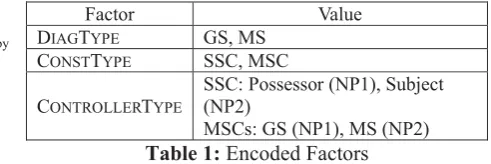
After the experiment was conducted, all the scores were extracted for the target sentences. Then, three factors were encoded as follows for statistical analysis.
Factor Value
DIAGTYPE GS, MS
CONSTTYPE SSC, MSC
CONTROLLERTYPE
SSC: Possessor (NP1), Subject (NP2)
MSCs: GS (NP1), MS (NP2) Table 1: Encoded Factors
Since the data did not follow normal distribution with the normality tests, a non-parametric GLM analysis was adopted in order to examine how each factor affected the acceptability scores.4
For each combination of two factors in Table 1, a GLM was performed with Gaussian distributions. Also, a statistical analysis was performed to determine how CONTROLLERTYPE distinctions played a role in the acceptability scores in SSCs and MSCs.
3 Results
3.1 SSC: GS Diagnostics
While analyzing the results, we found that GS vs. MS diagnostics behave differently not just in MSCs, but also in SSCs. Therefore, we will separate the diagnostics for both construction types.
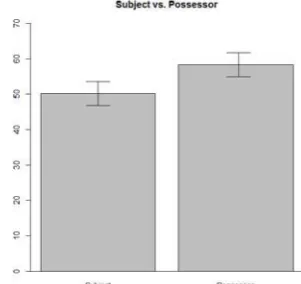
Figure 1 illustrates the distributions of acceptability scores in SSCs with 4 GS diagnostics. Here ‘Possessor’ is NP1, while ‘Subject’ is NP2. The y-axis represents the length of the lines (in mm) that participants drew for the target sentences (range: 0~150mm).
4 If the collected data follow the normal distribution,
parametric tests such as t-test, ANOVA, or ordinary regression analysis can be applied; otherwise, non-parametric tests such as Mann-Whitney tests, Wilcoxon tests, Friedman tests, and/or Generalized Linear Model (GLM) should be applied (Gries 2013, Lee 2016).
Figure 1: Bar Plots for ‘GS diagnostics in SSC’
As you can see, the average acceptability score for ‘Subject’ was slightly higher than that of ‘Possessor.’ Though the differences between the two groups were not clear in Figure 1, which is descriptive statistics, the results of the GLM analysis in Table 2 below show that they were statistically significant (p<.001). 5
Estimate Standard
Error
T P
(Intercept) 48.2889 0.5341 90.413 .000 ***
AGREETYPE -2.1456 0.5341 -4.017 .000 ***
Table 2: Regression Analysis Results
Similarly, the interaction plot in Figure 2 below shows that the acceptability score for ‘Subject’ was higher than those of ‘Possessor.’ The non-overlapping 95% CIs as indicated in the interaction plot in Figure 2 shows that the difference is significant. The significantly higher acceptability scores for ‘Subject’ than those of ‘Possessor’ is consistent with Prediction 1.
Figure 2: Interaction Plot
5 While the bar plots indicate the results of descriptive
statistics, the GLM and the interaction effect plot provide results from inferential statistics.
Figure 3: Bar Plots for ‘MS diagnostics in SSC’
The acceptability scores for ‘Possessor’ were higher than those of ‘Subject.’ The GLM analysis in Table 3 shows that the differences were statistically significant (p<.001).
Estimate Standard Error
t p
(Intercept) 54.3246 0.6938 78.299 .000 ***
CONTROLLERTYPE 4.0989 0.6938 5.908 .000 ***
Table 3: Regression Analysis Results
Similarly, the interaction plot in Figure 4 below shows that the 95% CIs of the ‘Possessor’ and the ‘Subject’ did not overlap.
3.3 MSC: GS Diagnostics
The acceptability scores for MSCs were lower overall compared to that for SSCs.6 Perhaps because
of the overall lower degree of acceptability, the difference between NP1 (Major Subject) and NP2 (Grammatical Subject) was less pronounced than in SSCs.
Figure 5 shows the acceptability scores for GS and MS with GS diagnostics. While the acceptability score for ‘GS’ (NP2) was slightly higher than those of ‘MS’ (NP1), the 95% CIs clearly overlapped.
Figure 5: Bar Plots for ‘GS diagnostics in MSC’
The inferential statistics (the GLM analysis in Table 4 and the interaction plot in Figure 6) indeed suggest that there was no significant difference between the acceptability score for ‘GS’ and that for ‘MS’.
Estimat e
Standard Error
t p
(Intercept) 32.0058 0.4162 76.897 .000 *** CONTROLLERTYPE -0.3842 0.4162 -0.923 .356
Table 4: Regression Analysis Results
6 While the mean score for grammatical SSCs was generally
higher than 50 on a 0-145 scale, MSCs were mostly rated below 50 in the scale. This could reflect many factors, one being that MSCs are felicitous in particular contexts, unlike SSCs but no context was given in the task. Another is that MSCs are marked constructions that are not commonly used. We do not think that the lower ratings mean that MSCs are ungrammatical but only that they may not sound as natural out of context to untrained subjects. Given the decades of attention paid to them in both traditional and contemporary linguistic research, they clearly inhabit the grammatical landscape of Korean.
Figure 6: Interaction Plot
3.4 MSC: MS Diagnostics
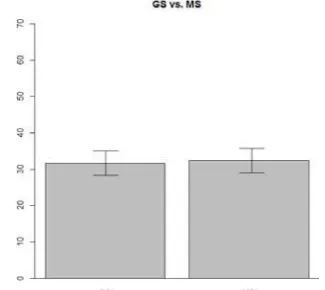
Figure 7 shows the acceptability scores for GS and MS with MS diagnostics. As can be seen in the Figure, the acceptability scores for ‘MS’ (NP1) and those for ‘GS’ (NP2) were not very different.
Figure 7: Bar Plots for ‘MS diagnostics in MSC’
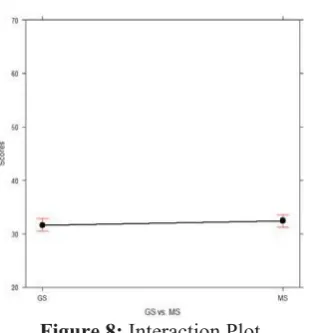
The results of GLM analysis (Table 5) and the interaction plot (Figure 8) show that the difference between the two conditions was not statistically significant.
Estimate Standard
Error
t p
(Intercept) 35.2086 0.6205 56.746 .000 ***
Fator1 0.4886 0.6205 0.787 .431
Figure 8: Interaction Plot
4 Discussion
We hypothesized that in SSCs, sentences where the Subject (NP2) controls the subject diagnostics would be acceptable while those where the Possessor (NP1) does should be unacceptable, regardless of the type of subject diagnostic (Prediction 1). However, the results diverged from the prediction in two ways. First, SSCs where the Possessor (NP1) controls subject diagnostics were not judged unacceptable. The overall acceptability rating of such sentences was even higher than MSCs, for example. Secondly, SSCs where the Possessor controls a given diagnostic were judged to be better than those where the Subject (NP2) does so for certain subject
diagnostics (i.e., Plural Copying (PC) and Adjunct Control (AC)). Thus, Prediction 1 was not fully supported by the results.
For MSCs, Prediction 2 (that sentences where GS diagnostics are controlled by NP2 but not NP1 would be acceptable) was not supported
statistically. Likewise, Prediction 3 (that sentences where MS diagnostics are controlled by NP1 but not NP2 would be acceptable) was not supported statistically either. However, the overall numerical results were in the direction of the two predictions. Since the SSC condition constitutes the baseline against which the results of the MSC condition can be evaluated, we turn to SSCs first. We predicted that the Possessor (NP1) should not control any subject property, but it came close to the Subject (NP2) with respect to the GS subject properties and actually surpassed the latter with the MS subject properties. How could we understand these results?
properties (as a group) are even less likely than the GS properties to be subject properties, since the Possessor, a non-Subject, outperformed the Subject in a statistically significant manner with these diagnostics. And while the Subject outperformed the Possessor (in a statistically significant manner, to boot) for GS properties, SSCs where the Possessor ‘wrongly’ controlled these properties were judged to be fairly well-formed. So, even the GS properties as a group may not be valid to diagnose all and only Subjects in Korean. We need to examine the validity of each diagnostic separately. Doing so may reveal that the set of true subject diagnostics is a much smaller subset of the GS diagnostics.7
A different way to understand the results is to try to make sense of them in light of the fact that the non-subject nominal in SSCs that was able to usurp some subject properties is the Possessor of the Subject. The reason this is important is the following.
While we have been writing about Subjects as if they were theoretical primitives, in many syntactic traditions subjecthood is a derived notion. Subjects are defined in terms of structural prominence (i.e., Subject is the highest nominal in an A-position that asymmetrically c-commands other nominals). Understood this way, a surface Subject controls Subject Agreement in a language because the nominal is in the right configuration to be the minimal controller (via relations such as Agree) of the category that bears Subject Agreement.
Now, it is well-known that the Possessor of a Subject can scope or bind out of the Subject in certain circumstances in certain languages, perhaps because Specifiers can optionally c-command out of the constituent they are in (Kayne 1994).
What this means is that the behavior of the Possessor-of-Subject may not be representative of how non-Subject nominals behave in general because the Possessor-of-Subject can usurp certain properties of the Subject by virtue of being able to
7 Previous studies (Kim et al, 2015; Lee et al, 2015; Kim et al,
progress. Honorific Agreement and Plural Copying as Subject Diagnostics in Korean: An Experimental Approach.
Ik-Hwan Lee. 1987. Double Subject Constructions in GPSG. Harvard Studies in Korean Linguistics II:287-296.
James Hye-Suk Yoon. 1986. Some Queries Concerning the Syntax of Multiple Subject Constructions in Korean. Studies in the Linguistic Sciences 16: 215-236, Department of Linguistics, University of Illinois, Urbana-Champaign.
James Hye-Suk Yoon. 2004. Non-nominative (Major) Subjects and Case-stacking in Korean. In Peri Bhaskararao and Karumuri VenkataSubbarao (eds.), Non-nominative Subjects, volume 2:265-314. Mouton de Gruyter, Berlin.
James Hye-Suk Yoon. 2008. Subjecthood and Subject Properties in Multiple Subject Constructions. Talk presented at the East Asian Linguistics Seminar, Oxford University, Oxford.
James Hye-Suk Yoon. 2009. The Distribution of Subject Properties in Multiple Subject Constructions. Proceedings of Japanese/Korean Linguistics, 64-83. CSLI, Stanford, CA.
James Hye-Suk Yoon. 2015. Double Nominative and Double Accusative Constructions. In Lucien Brown and Jaehoon Yeon (eds.), The Handbook of Korean Linguistics, First Edition. 79-97. John Wiley & Sons, Inc., New York.
James Hye-Suk Yoon. 2007. Raising of Major Arguments in Korean and Japanese. Natural Language and Linguistic Theory, 25:615-653.
Ji-Hye Kim, Yong-hun Lee and Eunah Kim. 2015. Obligatory Control and Coordinated Deletion as Korean Subject Diagnostics: An Experimental Approach. Language and Information, 19(1):75-101.
Jong-Yurl Yoon. 1989. On the Multiple –ka and –lul
Constructions in Korean. Harvard Studies in Korean Linguistics III:383-394. Hanshin Publishing Company, Seoul.
Kayne, Richard. 1994. The Antisymmetry of Syntax. Cambridge: MIT Press.
Ki-Sun Hong. 1991. Argument Selection and Case-Marking in Korean. Doctoral dissertation, Stanford University.
Stefan Th. Gries. 2013. Statistics for Linguistics. 2nd Edition. Mouton de Gruyter, Berlin.
Yong-hun Lee, Eunah Kim, and Ji-Hye Kim. 2015. Reflexive Binding and Adjunct Control as Subject Diagnostics in Korean: An Experimental Approach. Studies in Language 31.2: 427-449.