Encoding Generalized Quantifiers in
Dependency-based Compositional Semantics
Yubing Dong⇤
Department of Computer Science University of Southern California
Ran Tian
Graduate School of Information Sciences Tohoku University
Yusuke Miyao
National Institute of Informatics, Japan [email protected]
Abstract
For textual entailment recognition systems, it is often important to correctly handle Gen-eralized quantifiers (GQ). In this paper, we explore ways of encoding GQs in a recent framework of Dependency-based Composi-tional Semantics, especially aiming to cor-rectly handle linguistic knowledge like hy-ponymy when GQs are involved. We use both theselection operator mechanism and a new relationextension to implement some major properties of GQs, reducing 69% errors of a previous system, and a further error analy-sis suggests extensions towards more power-ful logical systems.
1 Introduction
Dependency-based Compositional Semantics (DCS) provides a formal yet intuitive way to model nat-ural language semantics. It was initially proposed in Liang et al. (2011) as a relational database query-ing protocol, and later used for logical inference in Tian et al. (2014a). Although the DCS inference framework provided decent support for both quanti-fiersall(universal quantifier) andno (negated exis-tential quantifier), attention is required for an RTE system to cope with generalized quantifiers (GQ), including “at most n”, “at least n”, “most”, etc.,
which can affect the direction or even the existence of an entailment relation, as demonstrated in Exam-ples 1 to 3.
⇤This work was conducted during an internship at the Na-tional Institute of Informatics, Japan.
Example 1. P )HbutH ;P, where P At most 5 students like noodles.
H At most 5 Japanese students like udon noodles. Example 2. P )HbutH ;P, where
P At least 5 Japanese students like udon noodles. H At least 5 students like noodles.
Example 3. P ;HandH ;P, where
P Most Japanese students like udon noodles. H Most students like noodles.
In this paper, we explore ways of encoding GQs in a recent framework of Dependency-based Com-positional Semantics (DCS) (Liang et al., 2013; Tian et al., 2014a), especially aiming to correctly handle linguistic knowledge like hyponymy when GQs are involved. We useselection operators, an extension mechanism described in Tian et al. (2014a), to im-plement a sub-type of GQs (Section 3.1). To deal with downward monotonicity of the predicate ar-gument, we also propose a simple extension called “relation” to the framework (Section 3.2). This ap-proach does not encode the exact semantics of ev-ery specific GQ, but instead captures some major properties that are both easily implementable with the current technology and useful in many cases.
hyponymy a more effective resource for textual en-tailment tasks, and also shed some light on the han-dling of more complicated natural language infer-ence phenomena. The extended system is publicly released athttps://github.com/tomtung/ tifmo.
2 Background
2.1 Properties of Generalized Quantifiers In this paper, “generalized quantifiers” refers to quantity-denoting determiners such as “few”,
“most”, “at least 5”, etc. They can bind with a property-denoting common noun phrase (e.g. “stu-dents”) to form a quantified noun phrase (e.g. “few students”), which can then bind with a predicate (e.g. “like noodles”) to form a sentence (e.g. “few
students like noodles”). We regard the meanings
of both the common noun phrase and the predi-cate as their denotations, i.e. let W be the uni-verse containing all entities (a.k.a. the “world” set), then the meaning of “students” is regarded as a set student✓W containing all entities being students, and the meaning of “(someone) likes noodles” is re-garded as a subset ofW which contains all entities who like noodles. Thus, if we denote the power set ofW as2W, then a GQ can be seen as a binary rela-tion over2W, or in other words, a function F from (A, B) 22W ⇥2W toF(A)(B) 2 2 ={0,1}, in which the sets A and B are called noun argument andpredicate argument, respectively.
Usually, the relation imposed by a GQ is based on the notion |·| of set cardinalities; for example, AtM ost[30%](A)(B) represents the relation that
|A\B|/|A| 30%. However, in practice it often requires a large amount of effort to introduce cardi-nalities into logical inference. Hence, in this paper we make a compromise by encoding properties of GQs that are most relevant to semantic relations like hyponymy and are useful for solving RTE problems. We mainly focus on three major properties, namely
interaction with universal and existential quantifica-tions,conservativity, andmonotonicity.
Given a GQ, say F, one most basic semantic property is its interaction with universal and ex-istential quantifications—whether F(A)(B) is en-tailed by the noun argument being a subset of the predicate argument (for short, “entailed by8”), i.e.
A ✓ B ) F(A)(B), or whether it entails the two arguments having a non-empty intersection (for short, “entails9”), i.e. F(A)(B) ) A\B 6= ;. There are three cases:
A✓B )F(A)(B))A\B6=;
as“most”in Example 4,
A✓B 6)F(A)(B))A\B6=;
as“a lot of”in Example 5, and
A✓B 6)F(A)(B)6)A\B6=;
as“at most5”in Example 6.1 Example 4. A)B )C, where A All students like noodles. B Most students like noodles.
C There are students who like noodles. Example 5. A6)B )C, where A All students like noodles. B A lot of students like noodles. C There are students who like noodles. Example 6. A6)B 6)C, where A All students like noodles. B At most 5 students like noodles. C There are students who like noodles.
The conservativityproperty of GQs results from the “domain restraining” role of the noun argument, which effectively eliminates objects that do not have the noun property, so that we only need to consider which of the rest has the predicate property. For ex-ample:
Example 7. Few apples are toxic. ()Few apples are toxic apples.
The intuition here is that to know whetherfew ap-plesaretoxic, it is sufficient to know whichapples
are toxic; those non-apple toxicants are irrelevant. We formally define the conservativity property as follows.
Definition 1(Conservativity). A GQF is
conserva-tiveif for anyA, B ✓W,
F(A)(B)()F(A)(A\B).
1We have made a convenient and practical assumption here:
for an English GQ denoted asF(·)(·),F(A)(B)presupposes
in a relational database but abstract sets (treated as symbols) representing denotations of the words, and “\” is a relational algebra operator representing “in-tersection”.
Similarly, the abstract denotation of “like udon
noodles”is formulated by:
D2 =like\(WSBJ⇥(D1)OBJ),
where W is the “world set” as mentioned in Sec-tion 2.1, and “⇥” denotes the Cartesian product. SubscriptsSBJandOBJare used to denote different dimensions.
Finally, the abstract denotation of “subjects who
like udon noodles”is:
D3 =⇡SBJ(D2),
where⇡ is the projection operator. Here we use⇡r
to denote a projection into dimensionr, whereas⇡r
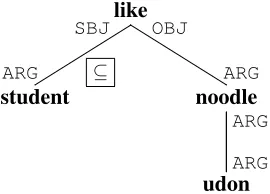
denotes a projection to all dimensions other thanr. The adapted DCS tree in Figure 2 uses syntac-tic/semantic labels (SBJ,OBJ, etc.) instead of num-bers in the original DCS tree to denote different di-mensions (i.e. different columns in the tables of the relational database), because they provide database-independent explanations for these dimensions. In addition, the involved “mark-execute” mechanism for representing quantifier “all” (as illustrated by theQ,E andX12markers in Figure 1) is simplified to a quantification marker “✓” on the student-like edge (Figure 2), and explained as the division oper-atorq✓in relational algebra2:
q✓r(R, C) ={x|; 6=R\({x}⇥Wr)✓{x}⇥Cr}
Therefore, the abstract denotations
D4 =qSBJ✓ ⇡OBJ(D2),student =qSBJ✓ (D3,student) and
D5 =⇡OBJ qSBJ✓ (D2,student) ,
correspond to the final results calculated by the orig-inal DCS tree according to the wide reading and nar-row reading of“all”, respectively. For logical infer-ence, instead of the database-dependent evaluations
2WhenRandChave the same dimension,qr
✓(R, C)is
ei-ther the 0-dimension point set{⇤}(ifR ✓ C) or (otherwise)
;.
of such denotations, we mainly consider their
satisfi-ability, i.e. whetherD4(orD5)6=;. Here, by
defini-tion of the division operator,D4 6=; ,student✓ D3 and D5 6= ; , q✓SBJ(D2,student) 6= ; , 9x;studentSBJ⇥{x}OBJ✓D2.
As we can see from the previous description, many intermediate or related denotations are pro-duced during the processing of DCS trees. In Tian et al. (2014a), a special kind of auxiliary denota-tions is considered, which integrates the context in-formation of an entire DCS tree, and is naturally linked to a single pairing of a syntactic/semantic la-bel and a node in the DCS tree. Such a pair is called a germ, denoted by (like,SBJ)T, (like,OBJ)T, (noodle,ARG)T, etc., where the subscriptT is used to denote the whole DCS tree and emphasize the context awareness of the germ object. Abstract denotations linked to germs are closely related to the concept of feasible values defined in Liang et al. (2013). For example, if we consider the DCS treeT in Figure 2 and assume the wide reading of
“all”, then the denotations linked to (like,OBJ)T
and (noodle,ARG)T both equal to ⇡OBJ(D2) =
⇡OBJ(like)\D1, “udon noodles that are liked by
somebody”; the denotation linked to (like,SBJ)T
is D3, “subjects who like udon noodles”; and the
denotation linked to (student,ARG)T is student. The final resultD4 can then be seen as been calcu-lated from the abstract denotations linked to germs (like,SBJ)T and (student,ARG)T. Abstract de-notations linked to germs are useful for encoding GQs in the DCS framework, as we describe in Sec-tion 3.2.
Another useful mechanism for implementing GQs is theselection operatorsf introduced in Tian et al.
(2014a), which are marked on a DCS tree node and wrap an abstract denotation D to form a new ab-stract denotationsf(D) during the calculation
abstract denotation D to a new denotation sf(D).
In Section 3.1 we will use this mechanism to encode GQs.
2.3 Related Work
GQs have been a topic of interest in study of logic since ancient time: Aristotle’s syllogism could be seen as concerning the meanings and properties of four basic quantifiers, namely“all”,“no”,“some”, and“not all”. Gottlob Frege (Zalta, 2014), one of the founders of modern logic, in 1870s introduced8
and9, and formulated the notion of a quantifier as a second order relation. The idea ofgeneralized quan-tifiers was introduced by Mostowski (1957) and gen-eralized in Lindstr¨om (1966), forming the standard definition we use nowadays. Later, Barwise and Cooper (1981), following Montague (1973), showed the importance of GQs in the formal analysis of lin-guistic phenomena. By and large, these works cover the logical and linguistic background involved in this paper.
Although it has been recognized that it is impor-tant to encode GQs for solving textual entailment problems, this remains a big challenge. MacCart-ney et al. (2006), for example, tried to capture the use of GQs in feature vectors, but the capabilities of which are greatly limited without an inference en-gine. Even for systems that are backed by inference engines like in this paper, the focus still needs to be put on practical NLP rather than logic, linguistics, or semantic theory, and model complexity may need to be purposely traded for computation efficiency. For example, Lewis and Steedman (2013) used first-order logic for semantic representation, which is the-oretically very expressive, but still unable to define GQs without some extensions (Barwise and Cooper, 1981) that are nontrivial especially for practical in-ference.
Some works made the compromise similar to ours: only encode the important properties of GQs rather than their perfect semantics. A notable re-cent work that focused on monotonicity is MacCart-ney and Manning (2008), in which the notion of monotonicity was generalized to support recursive determination of entailments of a compound expres-sion from its constituents. To a large extent, this approach handled the interaction between multiple GQs in a single sentence. However, inference was
based on a chain of shallow syntactic edit operations linking premise to hypothesis, which not only failed to include various inference patterns, but also was unreliable when there are multiple sentences in the premise, or when the premise is relatively long. The DCS inference framework, on the other hand, grace-fully handles such cases in a uniform way, thanks to the more sophisticated inference engine. An empiri-cal comparison is shown in Section 4.
The logical inference engine described in Tian et al. (2014a) treats abstract denotations as terms and represent meanings by atomic sentences, which is shown to be very efficient compared to first order logic provers (Tian et al., 2014b). The idea be-hind this is actually very similar to description logics (DL) (Baader et al., 2003); indeed, theDLR
gener-alization of DLs towardsn-ary relations (Calvanese
et al., 1998) was proposed to deal with inference problems on database schemata expressed in rela-tional models, which shares the same setting with the logical system proposed in Tian et al. (2014a). The DLR system includes intersections, Cartesian
products of1-dimensional sets and projections into 1-dimensional sets, as well as constructors not pre-sented in Tian et al. (2014a)’s system such as com-plement, union, and qualified number restrictions.
DLR is also shown to be reducible to the tradi-tional DL (with binary relations)ALCQI, for which
many complete DL inference engines are available3.
In comparison, Tian et al. (2014a)’s inference en-gine is not complete and lacks a thorough explo-ration from the theoretical side, e.g. on the decid-ability and complexity of the logical system, but it has a working natural language interface inher-ited from the DCS framework, and supports spe-cific constructors tailored for textual inference, e.g. the division operator, which seems not easily en-coded in DLR. Description logics have been ap-plied to natural language processing since the early days, but were used mostly for semantic interpre-tation (Brachman, 1985; Sowa, 1991; Knight and Luk, 1994), in which knowledge on syntactic, se-mantic, and pragmatic elements of natural language are encoded in DL to drive the process of converting utterances into deep and context-dependent logical
3http://www.cs.man.ac.uk/˜sattler/
like
SBJ
ARG ✓
OBJ
ARG sAtLeast[5](student) noodle
ARG
ARG
udon
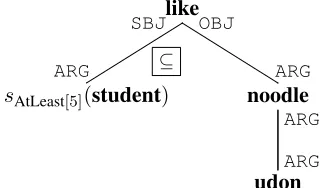
Figure 3: Encoding“at least 5”as selection
forms. Tian et al. (2014a)’s work on the other hand directly uses a DL-like logical system to represent semantics and perform textual inference, benefiting from the efficiency of DL logical inference. We ex-plore ways of extending Tian et al. (2014a)’s system to deal with more advanced linguistic phenomena in this work, while trying to preserve its algebraic fashion to ensure efficiency, because we believe it is important to investigate to what extent the “natu-ral” textual inference requires from a logical system. Some limitations of Tian et al. (2014a)’s framework has actually been revealed; for which we will discuss in Section 4.
3 Encoding Generalized Quantifiers 3.1 Encoding as Selections
Selections are used to encode GQs in the form of
F(A)(B)⌘sF(A)✓B,
where sF is the specific selection operator defined
for the GQ F—that is, a selection operator sF is
always used together with a quantification marker “✓”, as exemplified in Figure 3. Note that sF(A)
can be defined as any set related toA, not necessar-ily being its subset.
The basic requirement for encoding a GQ F in this way is thatF should be upward-entailing in its predicate argument, because the form sF(A) ✓ B
implies such monotonicity. Entailment from univer-sal quantification (Example 4)
A✓B)sF(A)✓B
and conservativity
sF(A)✓(A\B),sF(A)✓B
both hold if we add axiom:
sF(A)✓A
On the other hand, entailment to existential quantifi-cation (Example 5)
sF(A)✓B )A\B 6=;
can be implied from the custom axiom:
sF(A)\A6=;
The monotonicity in the noun argument can be implemented as well. If F is upward-entailing in the noun argument, we should add the axiom
A0◆A)sF(A0)✓sF(A).
Note that the direction of ✓ is reversed because
sF(A)serves as thesubsetin the formF(A)(B)⌘
sF(A)✓B. Similarly, downward-entailment in the
noun argument can be achieved by the axiom
A0✓A)sF(A0)✓sF(A).
A proof tree for Example 2 is shown in Figure 4, where D3 is the denotation for “subjects who like udon noodles”, as defined in Section 2.2, and sim-ilarlyD30 = ⇡SBJ(like\(WSBJ⇥noodleOBJ))for “subjects who like noodles”.
3.2 Encoding as Relations
As mentioned in Section 2.1, a GQ can be seen a binary relation over 2W. From this point of view,
we introduce a new extension called relation as a new type of statement into the framework. A rela-tionrf can be used to represent an arbitrary relation
Algebraic Property student◆Japanese\student
Upward-entailment forsAtLeast[5]
A0◆A)sAtLeast[5](A0)✓sAtLeast[5](A)
sAtLeast[5](student)✓sAtLeast[5](student\Japanese)
Premise
sAtLeast[5](student\Japanese)✓D3
sAtLeast[5](student)✓D3
Algebraic Property D3✓D30
sAtLeast[5](student)✓D30
Figure 4: An example of proof with generalized quantifiers encoded as selections.
like
student noodle
udon SBJ
ARG
OBJ
ARG
ARG
ARG 𝑟
𝒯
𝒯
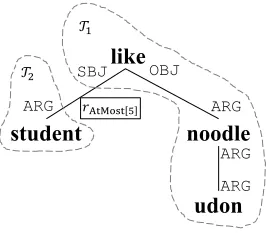
Figure 5: Encoding“at most 5”as relation
Intuitively, a GQF can be represented by a
rela-tionrF:
F(A)(B)⌘rF(A, B)
To enable the entailment from universal or to ex-istential quantification, we simply add the axiom A ✓ B ) rF(A, B)orrF(A, B) ) A\B 6= ;, respectively.
The axioms for monotonicity are also very intu-itive. For GQs that are downward-entailing in both
arguments (e.g. “at most 5” in Example 1), we put
rf(A, B)^A◆A0^B ◆B0 )rf(A0, B0).
Other kinds of monotonicity can be achieved in a similar way.
As for conservativity, we can simply implement
rF(A, B))rF(A, A\B),
but the reverse
rF(A, A\B))rF(A, B)
is a little tricky. This is because Tian et al. (2014a)’s inference engine is based on forward-chaining: it
al-ways tries to deduceall possible implications from
given premises. This strategy is employed not
only because of its efficiency, but also because it opens the possibility of adapting DCS for entail-ment generation (Androutsopoulos and Malakasio-tis, 2010), in which case without any given hypothe-ses the system needs to actively explore what the
premises entail. For example, from “few dinosaurs are pterosaurs”, with the knowledge of GQ conser-vativity the system should figure out “few dinosaurs can fly” without being explicitly instructed to prove
so. However, to implement rF(A, A \ B) )
rF(A, B), the forward-chaining strategy would
re-quire the engine to find allBs that satisfyX=A\B
whenever a relationrF(A, X)is claimed, in order to
claim the relationrF(A, B). Though it is quite easy
to check ifX=A\B for a given triple(X, A, B),
issues arise whenBis not given and we need to find
all possibilities. It is generally impractical to
enu-merate all possible forms that a setXcan be written
as intersections; the number of possibilities easily
explodes even for small-size problems4. Hence, we
implement the rulerF(A, A\B) ) rF(A, B)as
the following: if rF(A, X), and if X ✓ A, then
we take everyB ◆ X and check if X = A\B.
The necessary conditionsX ✓AandB ◆Xlimit
the search space at first. We would like to empha-size this detailed implementation issue here because formal semantics researchers are often not aware of such difficulties.
A shortcoming of the relation implementation is that, when processing DCS trees with relations, our extended system simply discards the edges marked as relations, then calculate the abstract denotations of germs in the resulting DCS forest, and finally use the denotations of corresponding germs as ar-guments of the relations to form statements. For example, in Figure 5, we calculate the
denota-tions of germs(student,ARG)T2 and(like,SBJ)T1,
which are student and D3 (as defined in
Sec-tion 2.2), respectively; then we form the statement rAtMost[5](student, D3) as the meaning of this
scope and hence we cannot deal with multiple re-lations in a single sentence. It causes errors when there are multiple GQs encoded as relations appear in the same sentence; we analyze this case in detail in Section 4.
4 Evaluation and Analysis
The FraCaS corpus (The Fracas Consortium et al.,
1996)5 was built in the mid 1990s by the FraCaS
Consortium, which contains a set of hand-crafted entailment problems covering a wide range of se-mantic phenomena, organized in nine sections. The first section is titled “Generalized Quantifiers”, and can serve as a good empirical test suite for RTE sys-tems that handle general properties of GQs. This
section contains 74 problems6; 44 of them have one
premise sentence while the other 30 have multiple premises. The involved GQs and their properties
are listed in Table 1.7 Our implementation extends
the TIFMO system publicly released with Tian et
al. (2014a)8. Since we mainly focus on the
perfor-mance of the DCS framework as formal semantics, on-the-fly knowledge and WordNet are not used. Major GQ properties can be implemented as
com-posable and reusable units9, so that each GQ can be
created by simply composing the units that corre-sponds to the properties it has. This makes imple-menting new GQs very easy.
TIFMO uses the Stanford Parser10to obtain
Stan-ford dependencies (de Marneffe et al., 2006) and POS tags, which are used to construct DCS trees based on a set of pre-defined rules. We extend those rules in order to recognize GQs in this step, and encode them under one of four settings, namely “Baseline”, “Selection”, “Relation”, and
“Selec-5We used the version converted to XML format by
MacCart-ney and Manning (2007).
66 problems that do not have a defined solution are excluded.
7FraCaS dubiously interpreted “many” as denoting “a large
proportion” rather than “a large absolute number”, whereas “few” as denoting “a small absolute number” rather than “a small proportion”. We also treat “a lot of” as a synonym of “many”.
8http://kmcs.nii.ac.jp/tifmo/
9We implement GQ properties as stackable traits in
Scala (Odersky et al., 2011), each consists of no more than a few dozen lines of code.
10http://nlp.stanford.edu/software/
lex-parser.shtml
GQ Entailed by8 Entails9 Monotonicity
Noun Arg. Predicate Arg.
many 3 3 7 "
a lot of 3 3 7 "
few 7 3 # #
a few 3 3 " "
most 3 3 7 "
at mostn 7 7 # #
at leastn 7 3 " "
Table 1: Properties of GQs appear in FraCaS corpus, including the interaction with universal and existential quantifications, and the monotonicity in noun and predi-cate arguments, where “"”, “#”, and “7” denote
upward-entailing, downward-upward-entailing, and non-monotone, re-spectively.
System Accuracy
Single Multi Overall
NatLog MacCartney07 84.1% N/A
MacCartney08 97.7%
CCG-Dist Parser SyntaxGold Syntax 70.5% 50.0% 62.2%88.6% 80.0% 85.1%
TIFMO
Baseline 79.5% 86.7% 82.4%
Selection 90.9% 93.3% 91.9%
Relation 88.6% 93.3% 90.5%
Selection+Relation 93.2% 96.7% 94.6%
Table 2: Accuracies achieved on the first section of Fra-CaS corpus using different systems.
tion+Relation”. GQs are simply dropped in the “Baseline” setting. The “Selection” and “Relation” settings use the same DCS trees as in “Baseline”, except for selection or relation markers on DCS trees to represent GQs. The “Selection” approach implements all GQs as selections (even for those are downward-entailing in the predicate argument), whereas “Relation” approach implements all GQs as relations. In the “Selection+Relation” setting, we use relations only for the GQs that are downward-entailing in the predicate argument (i.e. “few” and
“at mostn”), and implement the rest of the GQs as
selections. We evaluate the system under each set-ting; the test results are shown in Table 2.
in Table 2. CCG-Dist uses rule-based conversion from CCG parses to first order logic formulas, and results are given using both parser syntax and gold syntax. The resulting accuracies are not very high, even for gold syntax, showing that implementing GQs is not an easily accomplishable task although first order logic is theoretically very expressive. Nat-Log is a system based on natural logic, which has almost perfect performance on single premise prob-lems but faces difficulties dealing with premises of multiple sentences. In contrast, our extension of the TIFMO system achieves the best overall accuracy.
In each setting of our extension, almost all of the errors are related to the handling of GQs. The “Se-lection” approach cannot encode downward entail-ment in the predicate arguentail-ment, as shown in Exam-ple 8; whereas the “Relation” approach fails to han-dle multiple GQs in a single sentence, as shown in Example 9.
Example 8. P1^P2^P3)H, where
P1 Few committee members are from southern
Eu-rope.
P2 All committee members are people.
P3 All people who are from Portugal are from
southern Europe.
H There are few committee members from Portu-gal.
Example 9. P 6)H, where
P At most ten commissioners spend a lot of time at home.
H At most ten commissioners spend time at home. In Example 9, when both “at most ten” and“a lot of”are encoded as relations, both of them take the widest scope and the meaning ofP is calculated as the conjunction of Pa “at most ten
commission-ers spend (something) at home”, and Pb
“(some-body) spend a lot of time at home”. Then, Pa im-pliesH since“at most ten” is downward-entailing in the predicate argument; the system produces a wrong answer. On the other hand, in the “Selec-tion+Relation” setting, “a lot of” is encoded as selection and accompanied with the quantification marker “✓”, which can take a narrow scope and is
explained as a division operator. Hence the calcu-lated meaning ofP becomes
rAtMost[10](comm’r, qOBJ✓ (D, sALotOf(time)))
where D is the abstract denotation for “spend at
home”
D=spend\(WSBJ⇥WOBJ⇥homeMOD)
which is correct and solves this case. However, in general we need to further extend the notion of “re-lation” to handle different scopes, or at least we need something similar to the division operator but can be used to implement downward entailment in the pred-icate argument.
If we recall the definition of division operatorq✓, it is natural to consider a similar operator as
qr◆(R, C) ={x|R\({x}⇥Wr)◆{x}⇥Cr}.
Fortunately,q◆can be defined algebraically as
qr◆(R, C) =⇡r(R)\⇡r( ¯R\(Wr⇥Cr)),
where Wr denotes the Cartesian product of Ws on all dimensions other than r. This is imple-mentable if we introduce complementX¯ into Tian
et al. (2014a)’s logical system. Operator “q◆” can be combined with selection operators to encode GQs that are downward-entailing in predicate argument, e.g. “at most ten”. We may also be tempted to introduce free variables or higher order opera-tors, especially when we begin to consider donkey anaphora (Heim, 1982) and other advanced infer-ence phenomena. Such decisions should be made with caution because unguarded free variables easily lead to undecidability, as suggested by the research on description logics. However, further exploration on this topic should be a future direction but out of the scope of this work.
5 Conclusion
References
Ion Androutsopoulos and Prodromos Malakasiotis. 2010. A survey of paraphrasing and textual entailment methods. J. Artif. Int. Res., 38(1):135–187, May. Franz Baader, Diego Calvanese, Deborah L.
McGuin-ness, Daniele Nardi, and Peter F. Patel-Schneider, edi-tors. 2003. The Description Logic Handbook: Theory, Implementation, and Applications. Cambridge Uni-versity Press, New York, NY, USA.
Jon Barwise and Robin Cooper. 1981. Generalized quan-tifiers and natural language. Linguistics and Philoso-phy, 4(2):159–219.
Ronald J. Brachman. 1985. On the epistemological sta-tus of semantic networks. In Ronald J. Brachman and Hector J. Levesque, editors, Readings in Knowledge Representation. Morgan Kaufmann.
Diego Calvanese, Giuseppe De Giacomo, and Maurizio Lenzerini. 1998. On the decidability of query con-tainment under constraints. InProceedings of the 17th ACM SIGACT SIGMOD SIGART Symposium on Prin-ciples of Database Systems (PODS98).
Edgar F Codd. 1970. A relational model of data for large shared data banks. Commun. ACM, 13(6):377–387, June.
Marie-Catherine de Marneffe, Bill MacCartney, and Christopher D. Manning. 2006. Generating typed de-pendency parses from phrase structure parses. In Pro-ceedings of the 5th Language Resources and Evalua-tion Conference (LREC 2006), pages 449–454. Irene Heim. 1982. The semantics of definite and
indefi-nite noun phrases. Ph.D. thesis.
Kevin Knight and Steve K. Luk. 1994. Building a large-scale knowledge base for machine translation. In Pro-ceedings of AAAI ’94.
Mike Lewis and Mark Steedman. 2013. Combined distributional and logical semantics. Transactions of the Association for Computational Linguistics, 1:179– 192.
Percy Liang, Michael Jordan, and Dan Klein. 2011. Learning Dependency-based Compositional Seman-tics. In Proceedings of the 49th Annual Meeting of the Association for Computational Linguistics: Hu-man Language Technologies, pages 590–599, Strouds-burg, PA, USA. Association for Computational Lin-guistics.
Percy Liang, Michael I. Jordan, and Dan Klein. 2013. Learning dependency-based compositional semantics. Computational Linguistics, 39(2).
Per Lindstr¨om. 1966. First order predicate logic with generalized quantifiers. Theoria, 32(3):186–195. Bill MacCartney and Christopher D. Manning. 2007.
Natural logic for textual inference. In Proceedings of the ACL-PASCAL Workshop on Textual Entailment
and Paraphrasing, pages 193–200. Association for Computational Linguistics.
Bill MacCartney and Christopher D. Manning. 2008. Modeling semantic containment and exclusion in natu-ral language inference. InProceedings of the 22Nd In-ternational Conference on Computational Linguistics - Volume 1, COLING ’08, pages 521–528, Strouds-burg, PA, USA. Association for Computational Lin-guistics.
Bill MacCartney, Trond Grenager, Marie-Catherine de Marneffe, Daniel Cer, and Christopher D Manning. 2006. Learning to recognize features of valid textual entailments. InProceedings of the main conference on Human Language Technology Conference of the North American Chapter of the Association of Com-putational Linguistics, pages 41–48. Association for Computational Linguistics.
Richard Montague. 1973. The proper treatment of quan-tification in ordinary english. In Patrick Suppes, Julius Moravcsik, and Jaakko Hintikka, editors,Approaches to Natural Language, volume 49, pages 221–242. Dor-drecht.
Andrzej Mostowski. 1957. On a generalization of quan-tifiers.Fundamenta mathematicae, 44:12–36. Martin Odersky, Lex Spoon, and Bill Venners. 2011.
Traits as stackable modifications. InProgramming in Scala: A Comprehensive Step-by-Step Guide, chapter 12.5, pages 267–271. Artima Inc, 2nd edition. John F. Sowa, editor. 1991. Principles of Semantic
Net-works: Explorations in the Representation of Knowl-edge. Morgan Kaufmann.
The Fracas Consortium, Robin Cooper, Dick Crouch, Jan Van Eijck, Chris Fox, Josef Van Genabith, Jan Jaspars, Hans Kamp, David Milward, Manfred Pinkal, Massimo Poesio, Steve Pulman, Ted Briscoe, Holger Maier, and Karsten Konrad. 1996. Using the frame-work. Fracas project LRE 62, 51.
Ran Tian, Yusuke Miyao, and Takuya Matsuzaki. 2014a. Logical inference on dependency-based compositional semantics. InProceedings of Association for Compu-tational Linguistics (ACL) 2014.
Ran Tian, Yusuke Miyao, and Takuya Matsuzaki. 2014b. Efficient logical inference for semantic processing. In Proceedings of the ACL 2014 Workshop on Semantic Parsing.