Available Online atwww.ijcsmc.com
International Journal of Computer Science and Mobile Computing
A Monthly Journal of Computer Science and Information Technology
ISSN 2320–088X
IJCSMC, Vol. 4, Issue. 3, March 2015, pg.328 – 332
RESEARCH ARTICLE
A Copyright Tagging on Android Platform
to Prevent Piratical Behavior of Images
Priyanka Wagh
1, Mayuri Bandgar
2, Ashiwini Mandlik
3, Prashant Jawalkar*
Department of Computer Engineering, Bhivarabai Sawant Institute of Technology and Research, Pune
[email protected], [email protected], [email protected]
Abstract__ Camera Smartphone in recent years has become a very popular consumption electronic product. Young people like to share their images and information with each other’smoreover, they also like to record their day by day lives. However, the photos may be used without approve after they are uploaded to internet. To avoid this problem, one can do the watermarks into the images with embedded visible and invisible watermarks. Before the image is uploaded, the additional process for embedding watermark should be performed. If the photos are large in number, the process of embedding watermark will irritate the user. Thus in this paper, we propose a copyright embedding system for android platform. Using this system already specified copyright information is automatically embedded into photos with digital watermark technology when these photos are taken. In addition to this, images without watermarks can be retain selectively. It has some following features:(1) complexity is possibly reduced for handheld mobile system of watermark embedding process;(2) the watermark can be origined without the use of the original image;(3) the watermark embedded into an image would not be detached by commonly used image processing operations; (4) embedding copyright information, relocate the images, and uploading images to internet are automatically performed without manual interference.Therefore, the protection of the photographs taken by Android phones is to prevent piratical behaviors.
I. INTRODUCTION
A smart phone is basically similar to a mobile phone with some advanced features included. Earlier the smart phones had features
like digital camera, media player, GPS etc. but recently the smart phones which are being developed consist of new features like Touch
screen, Wi-Fi. Nowadays the smartphones which are developed are in big use and has gained a high market price value.
Currently developed smartphones are largely run on Android platform. It is an open source platform that means any user having
using these smartphones as they (smart phones) have various new features included, by which it becomes easier to communicate with the
rest of the world through social networking sites. one person can share data with other person. Uploading of data or photos on social
networking sites or any website without any security can be very dangerous. Thus it necessary to watermark the data or the image for
higher level of protection. A numeric representation of a 2-dimensional image represents a digital image. Watermark is a pattern in paper
which can be visible only when viewed by transmitted light produced by wideness in the paper. Hiding digital data into a signal is called
watermarking. Digital watermarking can be used to provide protection for the digital images when they are been exposed to the rest of the
world to prevent image piracy. Digital watermarking is a method of inserting data into image records. The image which is watermarked can
still be demonstrated and the embedded information is used for the authentication of owner. For various right management applications
digital watermarking is widely considered all over. In case if a copy of any work is found then the watermark embedded will be regained
and the original source will be identified. In order to prevent copy prevention, digital watermarking can be used to insert information or
data which can be easily detected by hardware or software devices to avoid illegal use of the data. Numbers of other applications make use
of watermarking concepts which include authentication, transaction tracking, device control etc. there are two types of watermarks one is
visible watermark and the other is invisible watermark. A visible watermark is the one in which the watermark embedded is visible to the
human eye and invisible watermark is not easily seen with naked eyes.
We can also use the concept of Steganography here. Steganography is a technique in which one image or data can be masked or concealed
inside another image or file or data. The masked image can then be watermarked with any licensed information to prevent its piracy. In this
paper we propose a new copyright embedding system. By using this system the copyright data is now been embedded into images with the
help of digital watermarking technique when the images are captured. We can hide one data or image into other data or image without
affecting the quality of the original image. Embedding of information into the pictures then uploading the picture on internet after resizing
it as required is a process which is habitually accomplished. Thus the system we are proposing is a suitable system for the security of the
snapshots or pictures captured by the android smartphones to avert piratical actions.
II. LITERATURE SURVEY
On smart phone platform, Androidhas populated among hardware manufacturers in recent years. Its open market model allows
software developers to buildapplications for Android mobile devices in Java and listed in Android Market without taking any review and
waiting for approval. Users can download from a particular store of smart-phone applications at Google Market,in this many of which
connect with existing Google services. Android is developed on Linux version 2.6 to operate core system services like security,memory
and process management.Twomain working principles of android system is that,An app do not killed by android, i.e. apps keep running
even after you switch to other apps and An apps killed by android when the memory use goes too high, but it saves app state for quick
restart later on. Android provides a set of libraries, Android runtime and a various application framework. For application developers, the
Android SDK serves the tools and APIs necessary to develop applications on the Android platform using JDK environment. Media codecs
for Android is that it can play video and audio and play backrecords in a various formats according to AAC, VLC, AVC, MP3,
andMPEG-4 files players. Android Operating System was made available from the 22nd of October 2008 to the user market.l March 2009 2,000
applications, March 2010 40,000 applications.Flexible, adaptable&reliable, Android’s facility in supporting screen-based interfaces has
also made it the OS of choice for many IT industrial, consumerelectronics, including navigation devices, set-top boxes, medical
equipment, netbooks, tablets, and e-readers.
while doing this security is the main issue to avoid misuse of our images. So, there is very important to provide protection to images to
avoid loss of information like as ownership information. Prevent images from those people which do not have any access authentications or
rights of authority. This can be achieved byapplying digital watermark embedding the information into image. This technique is mostly use
to identify the patent of the copyright of such image. Watermarking means hide digital data in a images. Digital watermark is use to verify
the authentication of image or to show the identity of its Author or Owner.
One of the applications of digital watermarking is tracking the source. Later if any work copy found, then we can
retrieveinformation (watermark) from copy and source of the distribution is known. Likewise we can also find the source of illegally
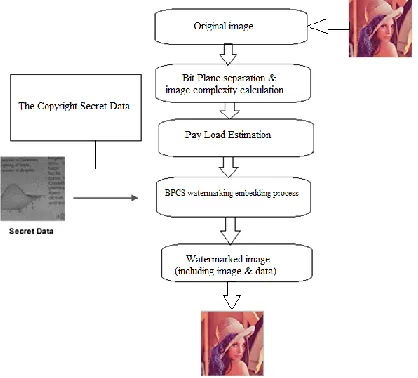
copied images.Bit-Plane Complexity Segmentation (BPCS)watermarking is newstenographic technique, which has large capacity of
information hiding. This algorithm replaces the complex bits of bit plane of color image which cannot recognize by human eyes or any
statistical analysis.
Fig 1.Flow diagram for BPCS watermarking
Working of BPCS Watermarking algorithm is as follows:
1) The source image is divided into 8 different Bit-Planes. All the bit-planes are divided into small pieces of the same size, which is called
bit-plane blocks, such as 8 ×8. (Shown in Fig 2.)
2) Calculate the complexity of every block. The Complexity is defined as the amount of all the adjacent Pixels that get different values
(one pixel is 0 and the other is 1). The maximum possible value of the complexity is denoted as max C.
3) Setting the complexity threshold of the bit-plane Block is C_max, here α is a parameter. The bit-plane block whosecomplexity is larger
than C_max is used to embed Secret information. The smaller the value of c, the more Secret data can be embedded.
4) This secret data is formed into bit-plane blocks. After checking the complexity, if the complexity of each plane is Greater than threshold
value (i .e. max_α). Then replace those bits using our secrete data bits. This will not effect on our source image.
5) This process is done for all bit planes. After embedding information into our image then wrap all the bit planes. This will gives us new
embedded image. (Shown in Fig 3.)
6) Extraction of watermarking is same as embedding process up to splitting of planes, and then we will check the complexity of each bit
Fig 2.Bit Plane Separation
Fig 3.Image before & after BPCS watermarking
IV. CONCLUSION
We propose this paper to develop an android application for android OS(2.2 or later) that reads input image and affect it with
watermarking (visible or invisible)Supported file format are: .jpg,bmp etc…Using this system, pre-specified copyright information
isautomatically embedded into pictures with digital watermark technology when these pictures are taken on the cellphone. In addition,
original images (i.e., images without modification) can be sealed selectively. This system has following features: (1) this approach of
watermarking is based on BPCS algorithm and the watermark embedding process;(2) the watermark can be taken out without harming the
source image; (3) the watermark put into an image would not be removed by commonly used image processing operations;(4) embedding
copyright information, resizing the images, and uploading the images to Internet are automatically performed without instruction manual
interfering. This system is appropriate for the protection of the photographs taken by Android phones to prevent piratical behaviors.
REFERENCES
[1] I. J. Cox, M. L. Miller, J. A. Bloom, J. Fridrich, and T. Kalker,‖Digital Watermarking and Steganography‖ London: Elsevier Science& Technology, November 2007.
[6] Eiji Kawaguchi and Richard O. Eason, ”Principle and applications of BPCS-Steganography‖, University of Maine, Orono, Maine 04469-5708
[7] S. Katzenbeisser and F. Petitcolas, ―Information HidingTechniques for Steganography and Digital Watermarking‖. London: Artech House, 2000.
[8] M. M. I. Cox and J. Bloom, ―Digital Watermarking‖SanFrancisco: Morgan Kaufmann Publishers, 2001.