An Efficient Facial Recognition Based Access Control of Door and Home
Security system
Kommu Renuka
& Shekar Boddupally
1M. Tech (Embedded Systems), Dept of Electronics & Communication Engineering, E-mail: [email protected] 2M.Tech VLSI System Design, Dept of Electronics & Communication Engineering,E-mail:[email protected]
ABSTRACT:This paper deals with the idea of secure locking automationutilizing IOT for door unlocking system to provide essentialsecurity to our homes, bank lockers and related controloperations and security caution through the GSM module. This paper alsopresents a computer vision system for visually impaired. This system understands face around the subject up to 1 feet in front, left and right direction using a camera module.This proposed system uses Raspberry Pi board to process real timedata collected by camera module. The module contains a secured facerecognizer for automatic door unlocking. The camera catchesthe facial picture and compares it with the image which isstored in the database. If the picture is found in the databasethen the door lock opens otherwise it relevant recorded speechmessage stored in memory is invoked. This pre-recorded speech messages are invoked using easy text to speechsoftware which is installed in the raspberry pi board. Such speech messages are conveyed to the visually impaired using earphone or speaker.
KEYWORDS:Facial Recognition; Image matching; Sensor
System; Digital camera; Raspberry Pi 3;Person Identifications
I. INTRODUCTION
A facial acknowledgment framework is a framework whichgets facial pictures and confirms the character of a man usinga propelled camera . It is an application fit for distinguishingor checking a man from a computerized picture. One approachto do this is by looking at chose facial components from thepicture and a face database.As stood out from other diverse biometrics frameworksutilizing unique mark/palm print and iris, confrontacknowledgment has unmistakable favorable circumstancesdue to its non-contact handle. Face pictures can be caughtfrom a separation without touching the individual beingrecognized, and the ID does not require participating with theindividual.
It is normally utilized as a part of security frameworks andcan be contrasted with different biometrics. It has
additionallyturned out to be main stream as a commercial recognizableproof and advertisinginstrument.
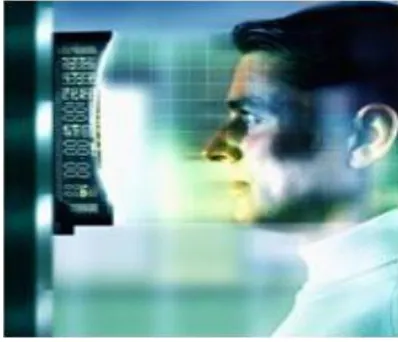
Fig 1: Facial Recognition
In the late time, cloud computing has advanced as a netdriven, benefit arranged processing model. As characterizedby National Foundation of Measures and Innovation (NIST),cloud computing is show which empowers the advantageous,on-request organize access to a common pool of configurableregistering assets (e.g., servers , administrations, applications,systems, stockpiling, and systems,).In a facial recognition security system the Raspberry pi iscombined with Cloud Computing to provide thecommunication between the person and the security system.
worldview inso far as it permits the use of a figuring framework at leastone levels of deliberation, as an on-request benefit madeaccessible over the Web or other PC organize. It is sold onrequest, normally incrementally or the hour; it is versatile – aclient can have to such an extent or as meagre of anadministration as they need at any given time and theadministration is completely overseen by the supplier. Due toits elements of more prominent adaptability and accessibilityat lower cost, Cloud computing is a subject that has beengetting a decent arrangement of consideration.
II. RELATED WORK
People always remain busy in their day to day work also wants to ensure their safety of their beloved things. Sometimes they forget to look after their necessary things like keys, wallet, credit cards etc. Without these, they are unable to access their home or any place they want. Douglas A. Reynolds [7] discussed voice recognition of a user is done in many methods. The mostsuccessful methods are through Gaussian Mixture Model and Score Normalization. These methods are used toverify the user's tone and process the system for the further level. But these methods have a drawback that they can’tverify the user in a noisy environment. Some systems use the Viterbi beam search decoder for the recognizingpurpose. When a speaker utters the sequence of words this decoder uses the conditional probability involved inthe Hidden Markov Model during the training process and compares with the originally stored voice. This is abit lengthy process so it requires a great amount of time which leads to the degradation of the efficiency of thesystem.
IztokKramberger [1] discussed the doorway telephone mechanism with collective vice feedback
and speech technology is not completely reliable the focus was on components which have more significantimpact on efficiency. Utilizing embedded microphone array raises voice detection performance in quite noisylocations. To maximize speech detection functionality, a null syntax with assurance measure assistance wasapplied. The speaker conformation segment was also maximized for noisy conditions. It offers an individualidentification and confirmation process depending on a VoIP doorway telephone embedded system and server-based speaker authentication system. Voice is transported using the
widely accepted VoIP technology, whichhelps to ensure that this system may function in numerous application places with various security stages. There
are numerous active doorway telephone devices that assist a variety of networking systems as well as assist toresolve personal mobility issues. This offers an expansion to a VoIP-based doorway telephone system setup withspeaker authentication for doorway security [8].
Biometric devices gain incomparable superior individual identification and authentication, performing ahuge task in private, national and universal security. Anyway, these devices may be baited and apart from theinnovative improvements in spoofing detection, latest alternatives frequently depend on domain information,particular biometric reading techniques, and also attack types [2].
We take into account an extremely limitedunderstanding of biometric spoofing at the sensing unit to attain remarkable spoofing detecting devices for irisand fingerprint modalities depending on a pair of strong understandable methods. The initial method includesschooling of perfect convolutional network architectures for every domain, while the subsequent method is targeted on data of the reliable network by means of backpropagation [4]. We analyze nine biometric spoofingconditions consisting of real and imitation examples of a particular biometric modality and assault type andunderstand strong representations for every benchmark by merging and differing both understanding methods.This layout not just include the much better idea of how these methods interplay, but additionally develop devicesthat go over the widely known results in eight of the nine conditions. The outcomes highly show that spoofingidentification devices depending on convolutional networks may be difficult to assaults that are previously notedand likely modified [10][11].
III. PROPOSED SYSTEM
identification and authentication process. The details ofthe components used in this system and the methods they follow for accessing are discussed in the below.Most important input device is the wireless camera.
Fig.1Block diagram
It is used to see videostream and also whenever a person comes it takes a snapshot ofthat person and transmit it to raspberry pi. Raspberry pi processthese inputs like whenever it gets a calling bell as input it transmits a signal to wireless camera to capture an image of the visitor.
A. HARDWARE IMPLEMENTATION:
Raspberry Pi 3: The Raspberry Pi 3 Model B is the third generation Raspberry Pi. This powerful credit-card sized single board computer can be used for many applications and supersedes the original Raspberry Pi Model B+ and Raspberry Pi 2 Model B. Whilst maintaining the popular board format the Raspberry Pi 3 Model B brings you a more powerful processer, 10x faster than the first generation Raspberry Pi. Additionally it adds wireless LAN & Bluetooth connectivity making it the ideal solution for powerful connected designs.The main features of Raspberry pi 3 are[4]
Processor: Broadcom BCM2387 chipset.1.2GHzQuad-Core ARM Cortex-A53 802.11 b/g/n Wireless LAN and Bluetooth 4.1 (Bluetooth Classic and LE)
GPU: Dual Core VideoCore IV® Multimedia
CoProcessor. Provides Open GL ES 2.0,
hardwareacceleratedOpenVG, and 1080p30 H.264 highprofile decode.
Operating System: Boots from Micro SD card, running a version of the Linux operating system or Windows 10 IoT.
GPIO Connector: 40-pin 2.54 mm (100 mil) expansion header: 2x20 strip Providing 27 GPIO pins as well as +3.3 V, +5 V and GND supply lines
LCD Interfacing to Microcontroller: A liquid crystal display (LCD) is a thin, flat panelused for electronically displaying information such astext and integers. Its major features are its lightweightconstruction, and portability. Date and time arecontinuously displayed on LCD when the sensor valuesare being stored in EEPROM. Four data lines are usedto send data on to the LCD. When RS=0 and EN pin ismade high to low command is sent to LCD. WhenRS=1 and EN pin is made high to low data is sent toLCD. VEE is used to adjust contrast.
Fig.2. LCD connection
APR9600 board:This shortens the total length of sound recording to 32 seconds.Total sound recording time can be varied from 32 seconds to 60 seconds by changing the value of asingle resistor. The IC can operate in one of two modes: serial mode and parallel mode.In serial access mode, sound can be recorded in 256 sections. In parallel access mode, sound can berecorded in 2, 4 or 8 sections. The IC can be controlled simply using push button keys. It is alsopossible to control the IC using external digital circuitry such as micro-controllers and computers.The APR9600 has a 28 pin DIP package. Supply voltage is between 4.5V to 6.5V. Duringrecording and replaying,
Web camera
Door
LCD display
Ear-Phones
Power supply
ARM11-Raspberry
PI-3
Speaker
Voice recording
current consumption is 25 mA. In idle mode, the current drops to 1 mA.The APR9600 experimental board is an assembled PCB board consisting of an APR9600 IC, anelectret microphone, support components and necessary switches to allow users to explore allfunctions of the APR9600 chip. The oscillation resistor is chosen so that the total recording periodis 60 seconds with a sampling rate of 4.2 kHz. The board measures 80mm by 55mm.
Camera:Web camera is a video camera that feeds or streams its image in real time, Webcams are known for their low manufacturing costand their high flexibility, making them the lowest-cost form of video telephony.
B. RESULT AND DISCUSSION
Here is the flow of the system. At first the system detects human and automatically raspberry pi take a snapshot which means the image acquisition part. After that image is processedand checked for authentication. Now theimage matches with database, door lock or open according to users command the magnetic lock gets open or close.The result in the creation of real time database are recorded. The real time database is created by using python. While executing itproduces 30 images of each subject. . Likewise, databases should be created for at least 10 individuals and it creates each image size ofabout 100*130 pixels of height and width.
Fig.3Creation of Real Time database
Fig.4Hardware of the designed System
IV. CONCLUSION
The system can be used in several places like banks, hospitals,labs and other sophisticated automated systems, whichdramatically reduce the hazard of unauthorized entry.Evidence can be given to the security department if anyrobbery issue occurs. But the system needs to be monitoralways that the internet bills are paid in due time to keepconnected with own home.
REFERENCES
[1] Jae Hoon Lee ; Yong-Shik Kim ; Bong KeunKim ; Ohba,K. ;Kawata,H. ; Ohya,A. ; Yuta,S. “Security Door SystemUsing Human Tracking Method with Laser Range Finders” , IEEE-International Conference on Mechatronics and Automation 2007. ICMA2007.
[2] YanboZhao ; ZhaohuiYe “A low cost GSM/GPRS based wireless homesecurity system” IEEE Transactions on Consumer Electronics, (Volume:54 , Issue: 2 )
[3] Priyanka Rani and Pinki Sharma. “A Review Paper on Fingerprint Identification System”. International Journal of AdvancedResearch in Computer Science & Technology (IJARCST 2014) Vol. 2, Issue 3 (July - Sept. 2014).
[4] Riddhi Patel and Shruti B. Yagnik. “A Literature Survey on Face Recognition Techniques”. International Journal of ComputerTrends and Technology (IJCTT) – volume 5 number 4 –Nov 2013.
[6] Khalil Challita. “Biometric Authentication for Intrusion Detection Systems”. 2010 First International Conference onIntegrated Intelligent Computing, 08/2010
[7] Douglas A. Reynolds, Thomas F. Quatieri, and Robert B. Dunn. “Speaker Verification Using Adapted Gaussian MixtureModels”. Digital Signal Processing 10, 19–41 (2000). doi:10.1006/dspr.1999.0361.
[8] Y. J. Oh, E. H. Paik, and K. R. Park, “Design of a SIP-based real-time visitor communication and door control architectureusing a home gateway”, IEEE Trans. Consumer Electron., Vol. 52, No. 4, pp. 1256-1260, Nov. 2006.
[9] Smita S. Mudholkar, Pradnya M. Shende, Milind V. Sarode. “Biometrics Authentication Technique for Intrusion DetectionSystems Using Fingerprint Recognition”. International Journal of Computer Science, Engineering and InformationTechnology (IJCSEIT), Vol.2, No.1, February 2012.
[10] Ravi Subban and Dattatreya P. Mankame. “A Study of Biometric Approach Using Fingerprint Recognition”. Lecture Noteson Software Engineering, Vol. 1, No. 2, May 2013.
[11] Arun Ross and Anil Jain. “Biometric Sensor Interoperability: A Case Study In Fingerprints”. International ECCV Workshopon Biometric Authentication (BioAW), (Prague, Czech Republic), LNCS Vol. 3087, pp. 134-145, Springer Publishers,May 2004.
BIODATA
Kommu Renuka completed M.Tech (Embedded Systems).