A NEW APPROACH TO EVALUATE THE SURFACE WAVES TERM FOR THE NONSYMMETRICAL COMPONENTS OF GREEN’S FUNCTIONS IN MULTILAYERED MEDIA
A. K. Abdelmageed †
Engineering Mathematics and Physics Department Faculty of Engineering
Cairo University Giza 12211,Egypt
Abstract—The discrete complex image method is one of the most prominent techniques that handle the Sommerfeld integrals encountered in the integral equation formulations of multilayered media. The extraction of surface waves extends the validity of the method to the far field. These surface waves are expressed in terms of Hankel functions that suffers a singularity problem at the origin which contaminates the results in the near field. In this work,we use a formulation developed recently by the author to derive a new expression for the surface waves. The new expression is shown to obviate the singularity of the Hankel functions at the origin,and hence leads to accurate results in the near field.
1. INTRODUCTION
The analysis of electromagnetic waves interaction with multilayered structures is one of the most widely studied topics in applied electromagnetics due to its vast applications in the geophysical prospecting, wave propagation,microstrip antennas and monolithic microwave integrated circuits. The mixed-potential integral equation (MPIE) is the most preferable integral equation used to formulate this problem [1,2]. The MPIE requires the computation of the scalar and magnetic vector potential Green’s functions. These functions are expressed in terms of infinite integrals,commonly known as
Sommerfeld integrals (SI). These integrals are highly oscillatory and slowly decaying. The numerical integration is very time consuming. Many techniques have been designed to accelerate the computation time of these integrals. One of the most efficient and prominent methods is the discrete complex image method (DCIM) [3,4]. In this method,the quasi-static contribution is extracted first from the spectral Green’s function. The next step is to approximate the remaining spectral function in terms of a short series of complex exponentials using the generalized pencil-of-function method (GPOF) [5]. By invoking standard integral identities [6],a closed-form solution is obtained. There are two approaches to extract the quasi-static part for the nonsymmetrical components of the magnetic vector potential Green’s functions. In the first approach (recognized here as the conventional approach),the two-level DCIM [7] is employed to approximate the slowly-decaying spectral tail of Green’s function in terms of a set of complex images. This approach yields an approximate expression for the quasi-static part. In the second approach [8],an exact expression for the quasi-static is developed and a one-level DCIM is applied to approximate the remaining spectral function.
Extracting only the contribution of the quasi-static part prior to the application of the DCIM yields accurate results in the near- and intermediate-field regions. In order to extend the validity of the DCIM to the far-field region,the contribution of surface-wave poles is also extracted before applying the GPOF procedure. The surface-wave term dominates the behavior of Green’s function in the far field. It is expressed in terms of Hankel functions. Unfortunately,these functions have a singularity problem at the origin when ρ = 0. This is a well-known phenomenon which contaminates the results in the near-field region [9–12]. This technique has been applied for the symmetrical components and also for the nonsymmetrical components using the conventional approach.
In this article,we extend the work of [8] to extract the contribution of surface waves. As it will be clarified in Section 2,the developed expression of these surface waves is shown to comprise two parts. The first part is due to the surface-wave poles and is expressed in terms of Hankel functions. This part is similar to that developed previously for the symmetrical and nonsymmetrical components. The second part is due to the Hankel functions singularity at kρ = 0 in the spectral
domain. This pole has a contribution in the near field. Its effect is to mask the singularity of the Hankel functions in the first part when ρ= 0 which leads to accurate results in the near-field region.
components of magnetic vector potential Green’s function is presented in Section 2. The advantage attained by this expression in removing the singularity of Hankel functions when ρ = 0 is emphasized. Results of the proposed method are provided in Section 3. A comparison is made with the direct numerical integration technique. Concluding remarks are given in Section 4.
h(N 2)
h1
x z
J
L ayer-(N 1)
L ayer-(N 2)
L ayer-(N 3)
L ayer-2
L ayer-1
L ayer-0
−
−
−
−
. . . . . .
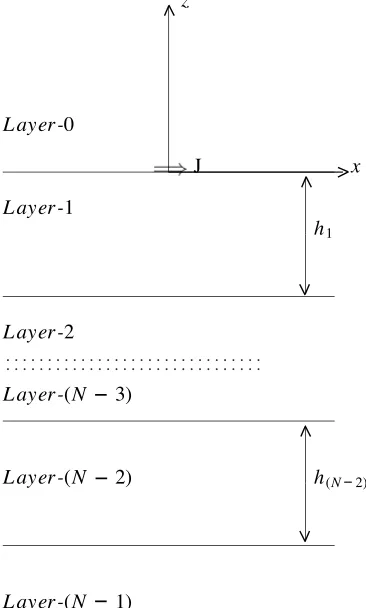
Figure 1. A current source in a multilayered medium.
2. FORMULATION
A general planar multilayered medium is shown in Fig. 1 where a current source is located in the top layer. Each layer has a relative permittivity ri,a relative permeability µri,and thickness hi. The
the computation of the scalar and magnetic vector potential Green’s functions. The nonsymmetrical components of the magnetic vector potential have a sinφ or cosφ dependency and the typical integral form can be expressed as [13]
G(ρ;z|z) =T1
˜
G(kρ;z|z)
(1)
where ˜G(kρ;z|z) is the spectral-domain counterpart of G(ρ;z|z),
and
Tn{·}=
1 4π
∞
−∞dkρk
n+1
ρ {·}Hn2(kρρ), n= 0,1 (2)
H2
n is the nth-order Hankel function of the second kind. To
demonstrate clearly our approach,we will consider the case where the source and field points belong to the same layer (top layer). For such case,(1) can be written as [8]
G(ρ;z|z) =T1
˜ F(kρ)
2k2 ρ
e−jkzo(z+z)
(3)
where ˜F(kρ) is a spectral function which depends on the physical
parameters of the multilayered medium, kzo =
k2
o−k2ρ,and ko is
the wavenumber of the top layer. In order to evaluate (3) using the DCIM [7],it is conventionally rewritten in the following form
G(ρ;z|z) =−j ∂
∂ρT0
1
j2kzo
˜
Fc(kρ)e−jkzo(z+z )
(4)
where
˜
Fc(kρ) =kzo
˜ F(kρ)
k2 ρ
(5)
Before proceeding to evaluate (4) using the DCIM,we follow the usual procedure and extract the quasi-static and surface-wave contributions first. As pointed out in [8],the conventional formulation of the nonsymmetrical components,as given by (4),does not allow an explicit extraction of a quasi-static term. Instead,an approximate quasi-static term can be obtained using the two-level DCIM [7]. In this technique, the slowly-decaying spectral tail of ˜Fc(kρ) is approximated in terms of
a number of complex exponentials using the GPOF. Then subtracting and adding these exponentials to the original spectral function ˜Fc(kρ)
accounts for the slowly-decaying behavior of the spectral function. It dominates in the near-field region; while the second set contributes mainly in the intermediate-field region.
Alternatively,Abdelmageed [8] reformulated (3) in such a way that allows the extraction of an explicit closed-form quasi-static term. Using the approach of [8],we can write (3) as
G(ρ;z|z) =S
1 2
˜
F(kρ)e−jkzo(z+z )
(6)
where
S{·}= 1 4π
∞
−∞dkρ{·}H
2
1(kρρ) (7)
Extracting the quasi-static contribution of the spectral function ˜F(kρ),
we get
G(ρ;z|z) = FqsS
1 2e
−jkzo(z+z)
+S
1
2
˜
F(kρ)−Fqs
e−jkzo(z+z) (8)
whereFqs= lim kρ→∞
˜
F(kρ). Making use of the identity [14],
S
1 2e
−jkzz = 1
4πρ
e−jkz−z
re
−jkr
(9)
then (8) can be expressed as
G(ρ;z|z) =Gqs+S
1
2
˜
F(kρ)−Fqs
e−jkzo(z+z) (10)
where
Gqs =
Fqs
4πρ
e−jko(z+z)−(z+z)
r e
−jkor
(11)
and r = ρ2+ (z+z)2. In [8],the DCIM is used to evaluate the
integral in (10). However,the results are valid in the near- and intermediate field regions. In this work,we extend the validity of the DCIM to the far field by extracting the contribution of surface waves.
G(ρ;z|z) =Gqs+Gsw+S
1 2
˜
F(kρ)−Fqs−F˜sw
whereGsw and ˜Fsw are the spatial- and spectral-domain contributions
due to surface-wave poles. They are given as
Gsw = S
1
2 F˜sw(kρ)e
−jkzo(z+z) (13)
˜
Fsw(kρ) =
N p
p=1
2kρpResp
k2 ρ−k2ρp
ejkzo(z+z) (14)
Resp = lim kρ→kρp
(kρ−kρp)
e−jkzo(z+z)F˜(k
ρ)
(15)
Np is the number of poles, kρp’s are the surface-wave poles located
in the complex kρ-plane,and Resp’s are their corresponding residues.
Two types of poles are observed in the integral (13):
Surface-wave poles: which are located at kρ = kρp in the complex
kρ-plane in the range{ko, kmax}wherekmaxis the maximum value
of the wavenumber present in the multilayered medium.
Hankel function singularity at the origin: where H12(kρρ) has a
singularity of type 1/kρwhich has a non-vanishing contribution as
kρ →0. This can be viewed by taking the limit of the integrand
in (13)
lim
kρ→0
kρ
2kρpResp
k2
ρ−k2ρp H
2 1(kρρ)
,and noting thatH12(x)→ πx2j as x→0 [15]. Therefore,the integral (13) has a pole at kρ= 0.
To seek the contribution of both types of poles,we either apply directly Cauchy’s residue theorem or equivalently split ˜Fsw(kρ) into
two parts:
˜
Fsw(kρ) =
N p
p=1
2Resp
kρp
kρ2 k2
ρ−kρ2p
−1
ejkzo(z+z) (16)
Hence,Gsw can be decomposed into two parts as follows
Gsw=Gsw1+Gsw2 (17)
where
Gsw1 =
N p
p=1
2Resp
kρp
S 1 2 k2 ρ k2 ρ−kρ2p
(18)
Gsw2 = −
N p
p=1
2Resp
kρp
S
1
Gsw1 has the same contribution due to surface-wave poles as the
integral (13). However,the singularity of the Hankel function atkρ= 0
in (18) has a vanishing contribution:
lim
kρ→0
kρ
kρ2 k2
ρ−kρ2p
H12(kρρ)→0 (20)
Using Cauchy’s residue theorem,Gsw1 can be evaluated as
Gsw1 = (−2πj)
1 8π N p p=1 lim
kρ→kρp
(kρ−kρp)
2Resp
kρp
k2ρ k2
ρ−k2ρp
H12(kρρ) (21)
which reduces to
Gsw1 =−
j 4
N p
p=1
RespH12(kρpρ) (22)
Gsw2 has the same contribution as the integral (13) has due to the
singularity of the Hankel function atkρ= 0. It can be evaluated using
the identity (9) forz= 0.
Gsw2 =−
N p
p=1
2Resp
kρp
1 4πρ =−
N p
p=1
Resp
2πkρpρ
(23)
On substituting forGsw1 and Gsw2 from (22) and (23),we get
Gsw =−
j 4 N p p=1 Resp
H12(kρpρ)−
j2
πkρpρ
(24)
Now,the one-level DCIM can be used to evaluate the integral in (12). The remainder functionF˜(kρ)−Fqs−F˜sw
is approximated as a set of complex exponentials using the GPOF. By employing the identity (9),we obtain
G(ρ;z|z) =Gqs+Gsw+
M
l=1
alGl(bl) (25)
where
Gl(bl) =
1 4πρ
e−jko(z+z+bl)−(z+z
+b
l)
rl
e−jkorl
rl=
(z+z+bl)2+ρ2 (27)
al’s and bl’s are the coefficients and exponents of the complex images
determined by the GPOF. On combining (11),(24) and (25),we get
G(ρ;z|z) = Fqs
4πρ
e−jko(z+z)−(z+z
)
r e
−jkor
−j
4
N p
p=1
Resp
H12(kρpρ)−
j2
πkρpρ
+
M
l=1
AlGl(bl) (28)
The first term in (28) dominates in the near field,the second term dominates in the far field and the last term contributes mainly in the intermediate field region.
To investigate the effect of Gsw2 on the behavior of the
surface-wave term Gsw in the near- and far-field regions,we take the limit
for ρ → 0 and ρ → ∞; respectively. Using the small-argument approximation for H12(x) → πx2j as x→ 0,it is evident that Gsw → 0
asρ→0. Thus,the surface-wave term is nonsingular at the origin. It has a negligible influence on the results in the near field as ρ → 0. This means that it does not suffer the singularity problem which is encountered in previous works when ρ → 0 in the application of the DCIM with surface-wave extraction [9,10]. To conclude, the new proposed surface-wave term has the advantage of masking the singularity of the Hankel functions in the near field. In the far field, the functional behavior of Gsw1 and Gsw2 are different. For large ρ,
Gsw1 behaves as e −jkρp ρ
√
kρpρ; whileGsw2 behaves as 1
kρpρ. This makesGsw1
constitutes the main part of the surface-wave term in the far field.
3. NUMERICAL RESULTS
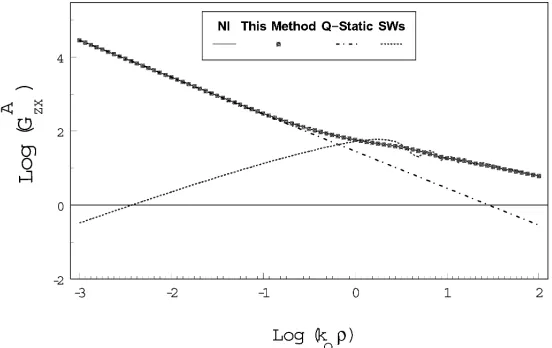
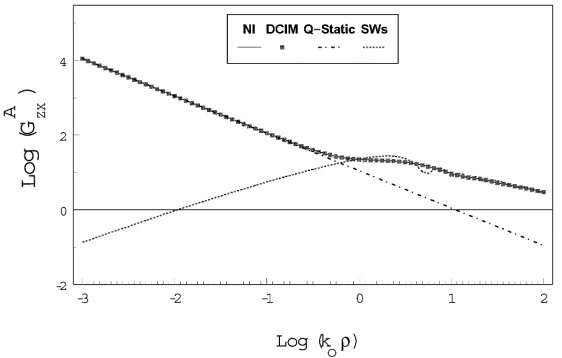
To validate the results of the proposed method,two structures of the configuration shown in Fig. 1 are examined. For both structures,the top layer is air and the bottom layer is PEC. The first structure is a three-layered medium with: h1 = 1.0 mm, r1 = 12.6,and the
second structure is a four-layered medium with: h1= 1.5 mm,r1= 2,
h2 = 0.75 mm,r2 = 10. Both the source and field points are assumed
to be located at the interface between air and first layer,i.e.,z =z= 0. Plots of the magnitude of the nonsymmetrical component GA
zx are
Figure 2. Magnitude of GAzx in a three-layered medium: Layer 0: air,layer 1: h1 = 1.0 mm, r1 = 12.6,layer 2: PEC. z = z = 0.
f = 15 GHz.
Figure 3. Magnitude of GAzx in a three-layered medium: Layer 0: air,layer 1: h1 = 1.0 mm, r1 = 12.6,layer 2: PEC. z = z = 0.
Figure 4. Magnitude of GA
zx in a four-layered medium: Layer 0: air,
layer 1: h1 = 1.5 mm,r1 = 2,layer 2: h2 = 0.75 mm, r2 = 10,layer
3: PEC.z =z= 0. f = 15 GHz.
Figure 5. Magnitude of GAzx in a four-layered medium: Layer 0: air, layer 1: h1 = 1.5 mm,r1 = 2,layer 2: h2 = 0.75 mm, r2 = 10,layer
the numerical integration technique for all field regions. The quasi-static term dominates in the near-field region; while the surface-wave term dominates in the far-field region. As explained in Section 2 and clearly validated in the figures,the surface-wave term has a negligible influence on the results in the near-field region.
4. CONCLUSION
A new method based on the application of the DCIM has been proposed for evaluating the contribution of surface waves for the nonsymmetrical components of the magnetic vector potential Green’s function. In all previous works,the surface-wave term is expressed in terms of Hankel functions. Unfortunately,it has a singularity problem of Hankel functions at the origin which is known to corrupt the results of the DCIM in the near field. In our proposed method,the waves term comprises two parts. The first part is related to the surface-wave poles and is expressed in terms of Hankel functions. The second part is related to the Hankel function singularity when kρ = 0 in
the spectral domain. The merit of the second part is to obviate the singularity of the Hankel functions of first part when ρ = 0. Thus, the new expression of surface-wave term does not suffer the singularity problem of Hankel functions at the origin. The results shows that the surface-wave term has a negligible effect on the calculation of the near field which is dominated by the quasi-static term. The results also demonstrates an excellent agreement with the direct numerical integration technique for all field regions.
REFERENCES
1. Michalski,K. A.,“Formulation of mixed-potential integral equations for arbitrarily shaped microstrip structures with uniaxial substrates,” Journal of Electromagnetic and Waves and Applications,Vol. 7,799–817,1993.
2. Michalski,K. A. and J. R. Mosig,“Multilayered media Green’s functions in integral equation formulations,”IEEE Trans. Antennas Propagat.,Vol. 45,508–519,1997.
3. Fang,D. G.,J. J. Yang,and G. Y. Delisle,“Discrete image theory for horizontal electric dipoles in a multilayered medium,” IEE Proc.,Pt. H,Vol. 135,297–303,1988.
5. Hua,Y. and T. K. Sarkar,“Generalized pencil-of-function method for extracting poles of an EM system from its transient response,” IEEE Trans. Antennas Propagat.,Vol. 37,229–234,1989.
6. Chow,Y. L.,J. J. Yang,D. G. Fang,and G. E. Howard,“A closed-form spatial Green’s function for the thick microstrip substrate,” IEEE Trans. Microwave Theory Tech.,Vol. 39,588–592,1991. 7. Aksun,A. K.,“A robust approach for the derivation of closed-form
Green’s functions,” IEEE Trans. Antennas Propagat.,Vol. 44, 651–658,1996.
8. Abdelmageed,A. K.,“A closed-form expression of the nonsym-metrical components of Green’s function for multilayered media,” Electromagn.,Vol. 22,59–70,2002.
9. Hojjat,N.,S. Safavi-Naeini,and Y. L. Chow,“Numerical computation of complex image Green’s functions for multilayer dielectric media: Near-field zone and the interface region,” IEE Proc. Microwaves, Antennas and Propagat.,Vol. 145,449–454, 1998.
10. Ling,F. and J. M. Jin,“Discrete complex image method for Green’s functions of general multilayer media,” IEEE Microw. Guided Wave Lett.,Vol. 10,400–402,2000.
11. Abdelmageed,A. K. and A. Mohsen,“An accurate computation of Green’s functions for multilayered media in the near-field region,” Microwave &Opt. Technol. Lett.,Vol. 29,130–131,2001.
12. Abdelmageed,A. K. and M. S. Ibrahim,“On enhancing the accuracy of evaluating Green’s functions for multilayered media in the near-field region,”Prog. in Electromag. Res. M,Vol. 2,1– 14,2008.
13. Michalski,K. A. and D. Zheng,“Electromagnetic scattering and radiation by surfaces of arbitrary shape in layered media,Part I: Theory,” IEEE Trans. Antennas Propagat.,Vol. 38,335–344, 1990.
14. King,R. W. P.,M. Owens,and T. T. Wu,Lateral Electromagnetic Waves,653–659,Harper & Row,New York,1992.