AN EFFICIENT TECHNIQUE FOR REDUCING PAPR OF OFDM SYSTEM IN THE PRESENCE OF
NONLINEAR HIGH POWER AMPLIFIER
H. Y. Sakran, M. Shokair, and A. A. Elazm
Faculty of Electronic Engineering El-Menoufia University
Egypt
Abstract—Peak to Average Power Ratio (PAPR) is one of the serious problems in any wireless communication system using multi carrier modulation technique like OFDM, which reduces the efficiency of the transmit high power amplifier. In this paper, proposed scheme will be introduced that combine interleaving method with peak windowing. Simulation results show that our technique simultaneously decrease Bit Error Rate (BER), reduce the PAPR by 3.5 dB and improve out-of-band radiation, in presence of nonlinear power amplifier model.
1. INTRODUCTION
OFDM [1, 2] is a multicarrier modulation where it is split a high-rate datastream into a number of lower rate stream that are transmitted
simultaneously over a number of subcarriers. Because the symbol
duration increases for the lower rate parallel subcarriers, the relative amount of dispersion in time caused by multipathdelay spread
is decreased. Intersymbol interference (ISI) is eliminated almost
completely by introducing a guard time in every OFDM symbol. International standards making used for OFDM in high-speed wireless communications are already established or being established by IEEE 802.11, IEEE 802.16, IEEE 802.20, and European Telecommunications Standards Institute (ETSI) Broadcast Radio Access Network (BRAN) committees [3, 4].
The basic concept of OFDM is to divide the total bandwidth into several narrow band sub-channels, which are transmitted in parallel. Because, the symbol duration of each sub channel is made relatively larger than the delay spread it would minimize the ISI effect. Moreover, it is spectrally more efficient technique than a conventional single carrier modulation technique.
OFDM has several properties, which make it an attractive modulation scheme for high speed transmission links. However, one major difficulty is its PAPR.
High PAPR has been recognized as one of the major practical problem involving OFDM modulation. This problem results from the nature of the modulation itself, where multiple subcarriers/sinusoids are added together to form the signal to be transmitted. Usually, the systems are constrained to a limited peak power due to the limitation of the dynamic range over which the transmitter amplifier operates linearly.
Several researchers have proposed schemes for reducing peak amplitude, suchas clipping [7], coding [8], interleaving [9], Active Constellation Extension (ACE) [10], partial transmit sequences [11], Turbo Coded OFDM [12].
In this paper, an efficient technique will be suggested to reduce the PAPR by making combination between the interleaving and peak windowing methods in presence of nonlinear power amplifier model.
The paper is organized as follows: In Section 2, the PAPR in OFDM is introduced, and the principles of interleaving and windowing
method are investigated. Section 3 proposed technique will be
introduced. Section 4, simulation results will be made. Section 5, conclusions will be done.
2. PAPR IN OFDM SYSTEM
If we consider N modulated data symbols from a particular signalling
constellation, Xk = (X0, X1, . . . , XN−1), over a time interval [0, T], the OFDM symbol can be written as
x(t) = N−1
k=0
Xkej2πkf0t (1)
where: f0= 1/T.
Replacing t = nTb, where Tb = T /N, we arrive at the discrete time version given by:
xn= N−1
k=0
The PAPR of the signal, x(t), is then given as the ratio of the peak instantaneous power to the average power, written as:
P AP R= maxo≤t≤T |
x(t)|2
E|x(t)|2 (3)
whereE[·] is the expectation operator.
If N is large enough, based on the central limit theorem, the
real and imaginary parts of x(t) have Gaussian distribution and its
envelope will follow a Rayleighdistribution. This implies a large
PAPR. Equivalently, we can think of this as N sinusoids adding
constructively to give a PAPR as large asN.
2.1. Peak Windowing
The basic idea of peak windowing is to multiply the envelop of OFDM signal witha window function. Therefore,
˜
xE(t) =xE(t)·f(t) (4)
where
xE(t) =|x(t)|.
f(t) = 1−α·w(t−t). w(t): is the window function.
t: denotes the position of a local maximum of the envelopxE(t).
α: attenuation constant.
When the amplitude of envelop amplitude of the OFDM signal exceeds a threshold, a window function is applied to the envelop of the OFDM signal to eliminate the peak amplitude. windowing results in a smoothsignal. The peak window is given by:
w(t) = 0.5−0.5 cos(2πt/T) 0≤t≤T (5)
2.2. Interleaving
In this approach k interleavers are used at the transmitter. These
interleavers produce K permuted frames of the input data sequence.
These permutations can be done either before or after the modulation
(mapping). The minimum PAPR frame of all theK frames is selected
3. PROPOSED TECHNIQUE
In this paper we combine the interleaving and windowing methods as shown in Fig. 1.
First, the interleaving approach is used and the signal with lowest PAPR is then passed through windowing method. The intention to combine these two methods is to obtain signal with lower PAPR than in the case of interleaving method and with lower bit error rate in the case of windowing method.
. . . OFDM i l . . . . . . . Select th e sequenc e w ith Minimum P A PR . . . . . . . mapping IFFT . . . IFFT IFFT IFFT P ea k w in dow in g P /S Add cyclic prefix . . . mapping mapping mapping Interleaver 1 Interleaver 2 Interleaver K S/P S/P S/P S/P . . . Input data
Figure 1. OFDM system withproposed technique for PAPR reduction.
4. SIMULATION RESULTS
Computer simulations are used to clarify the peak power reduction capability and the BER performance with the proposed technique.
This simulated system employs an OFDM signal with N = 256, 512,
and 1024 subcarriers using QPSK, 16 QAM, and 64 QAM. The high power amplifier (HPA) is Rapp’s solid state power amplifier model (SSPA) [13, 14] with the characteristic
vout =
vin
1 +
|vin|
vsat
2p1/2p (6)
wherevin,vout are respectively the complex input and complex output signals andvsat is the output saturation level. The parameterp, often called “knee factor”, controls the smoothness of the characteristic.
is applied to a region there exist large peaks. The window function is multiplied with the signal in such a way that the signal peaks fall in the center of the window while the signal samples with lower amplitudes align themselves with the large amplitude segment of the window function. In this paper, the hanning window will be used as a window function.
In the Interleaving method, k = 8 is used where the number of
stages only influence on the Complementary Cumulative Distribution Function (CCDF) of the PAPR. In the following, BER and CCDF performances will be investigated.
4.1. CCDF Performance
PAPR statistics are given in terms of the CCDF. The CCDF shows the probability of an OFDM frame exceeding a given PAPR,
CCDF(P AP R(x)) =P r(P AP R(x)> P AP R0).
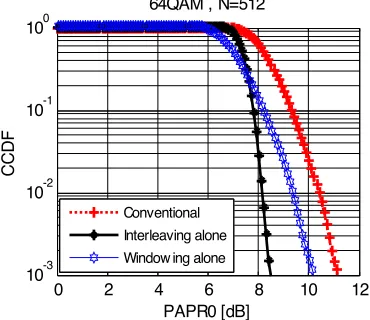
Figure 2 show the performance of interleaving and windowing method each alone.
The interleaving and windowing methods give improvement by 2.7 dB and 1 dB, respectively for the probability of 10−3.
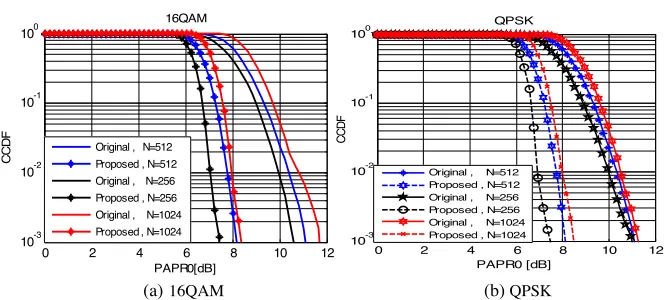
The proposed technique gives better result than each method alone.
Figures 3(a) and (b) demonstrate the performance improvement
over a conventional OFDM system of the proposed scheme. At
the probability of 10−3 the PAPR is almost 3.5 dB smaller than in
0 2 4 6 8 10 12
10-3 10-2 10-1 100
PAPR0 [dB]
CCDF
64QAM , N=512
Conventional
Interleaving alone
Window ing alone
0 2 4 6 8 10 12 10-3 10-2 10-1 100 PAPR0[dB] CCDF 16QAM
Original , N=512 Proposed , N=512
Original , N=256
Proposed , N=256 Original , N=1024 Proposed , N=1024
(a)16QAM
0 2 4 6 8 10 12
10-3 10-2 10-1 100 PAPR0 [dB] QPSK
Original , N=512 Proposed , N=512 Original , N=256 Proposed , N=256 Original , N=1024 Proposed , N=1024
(b)QPSK
CCDF
Figure 3. CCDF of PAPR with the proposed technique.
-10 -5 0 5 10
-5 0 5 10 15 20 25 30 representing frequency s p ec tr u m s ig nal s
Spectrum Effects without PAPR reduction
Befor Amplifier
After Amplifier
(a) Without PAPR reduction
-10 -5 0 5 10
-5 0 5 10 15 20 25 30 representing frequency s p ec tr um s ig nal s
Spectrum Effects with PAPR reduction
Befor Amplifier After Amplifier
(b) With PAPR
Figure 4. Spectrum of an OFDM signal after passing through an SSPA.
modulator without PAPR reduction, where the same number of frame will be sent for eachmodulation.
4.2. Spectrum Effect
Figures 4(a) and (b) show the signal spectrum before and after passing through SSPA model for conventional OFDM system and
OFDM system with PAPR reduction method. The spectrum with
0 5 10 15 20 25 30 10-4
10-3 10-2 10-1 100
SNR[dB]
BER
16QAM , N=256
Without Peak reduction With Proposed Technique
(a) N=256
0 5 10 15 20 25 30 10-4
10-3 10-2 10-1 100
SNR[dB]
BE
R
16QAM , N=512
Without Peak reduction
With Proposed Technique
(b) N=512
0 5 10 15 20 25 30
10-4
10-3
10-2
10-1
100
SNR[dB]
BER
16QAM , N=1024
Without Peak reduction
With Proposed Technique
(c) N=1024
Figure 5. Bit error performance in an AWGN channel.
4.3. BER Performance
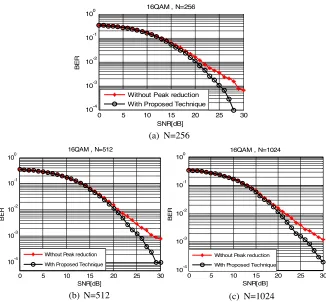
The error performances of OFDM systems over the AWGN channel are
given by the BER curves in Figs. 5(a), (b), and (c) where N = 256,
N = 512, andN = 1024 respectively. The results with 16 QAM show
that the required SNR for BER = 10−2 is almost the same. We see
that the SNR required for the BER = 10−3is improved by 3 dB, 3.5 dB,
and 5 dB, forN = 256, N = 512, and N = 1024, respectively.
5. CONCLUSIONS
In this paper, proposed technique for PAPR reduction of OFDM
signals had been suggested. This technique combines two basic
the BER over conventional techniques, and improve the spectrum efficiency, where the proposed technique is evaluated in presence of nonlinear power amplifier.
REFERENCES
1. Nee, R. V. and R. Prasad, OFDM for Wireless Multimedia
Communications, ArtechHouse Publishers, Norwood, MA,
January 2000.
2. Lee, Y.-D., D.-H. Park, and H.-K. Song, “Improved channel estimation and MAI-robust schemes for wireless OFDMA
system,” Progress In Electromagnetics Research, PIER 81, 213–
223, 2008.
3. Liu, P., “A new peak to average power ratio reduction schemes for OFDM system,” Master dissertation, 2004.
4. Min, K.-S., M.-S. Kim, C.-K. Park, and M. D. Vu, “Design for PCS
antenna based on WiBro-MIMO,” Progress In Electromagnetic
Research Letters, Vol. 1, 77–83, 2008.
5. Al-Kamali, F. S., M. I. Dessouky, B. M. Sallam, and F. E. Abd El-Samie, “Frequency domain interference cancellation for single
carrier cyclic prefix CDMA system,”Progress In Electromagnetics
Research B, Vol. 3, 255–269, 2008.
6. Min, K.-S., M.-S. Kim, C.-K. Park, and M. D. Vu, “Design for PCS
antenna based on WiBro-MIMO,” Progress In Electromagnetics
Research Letters, Vol. 1, 77–83, 2008.
7. Gross, R. and D. Veeneman, “Clipping distortion, in DMT ADSL systems,”IEEE Electron. Lett., Vol. 29, 2080–2081, Nov. 1993. 8. Davis, J. A. and J. Jedwab, “Peak-to-mean power control
in OFDM, Golay complementary sequences, and Reed-Muller
codes,” IEEE Trans. Inform. Theory, Vol. 45, 2397–2417, Nov.
1999.
9. Jayalath, A. D. S. and C. Tellambura, “Use of data permutation to reduce the peak-to-average power ratio of an OFDM signal,”
Wirel. Commun. Mob. Comput., Vol. 2, 187–203, 2002.
10. Krongold, B. S. and D. L. Jones, “PAR reduction in OFDM via active constellation extension,”IEEE Trans. on Broadcasting, Vol. 49, 258–268, Sept. 2003.
OFDM for reducing PAPR and error rates,” IEEE Transactions on Wireless for Communications, Vol. 7, No. 1, January 2008. 13. Ciochina, C., F. Buda, and H. Sari, “An analysis of OFDM
peak power reduction techniques for WiMAX systems,” IEEE
International Conference on Communications, 2006. ICC apos; 06, Vol. 10, 4676–4681, June 2006.