ABSTRACT
THOMAS, STEPHEN MICHAEL. Using Automated Fix Generation to Mitigate SQL Injection Vulnerabilities. (Under the direction of Dr Laurie Williams.)
Since 2002, over 10% of total cyber vulnerabilities were SQL injection vulnerabilities (SQLIVs). Since most developers are not experienced software security practitioners, a solution for correctly removing SQLIVs that does not require security expertise is desirable. In this paper, a prepared statement replacement algorithm for removing SQLIVs by replacing SQL statements with prepared SQL statements is described. Prepared SQL statements have a static structure and take type-specific input parameters, which prevents SQL injection attack input from changing the structure and logic of a statement. The prepared statement
replacement algorithm is evolved over the course of preparing for and analyzing the results of four formative and evaluative case studies. Each algorithm version was tested by
Using Automated Fix Generation to Mitigate SQL Injection Vulnerabilities
by
Stephen M. Thomas
A thesis submitted to the Graduate Faculty of North Carolina State University
In partial fulfillment of the Requirements for the degree of
Master of Science
Computer Science
Raleigh, NC 2007
Approved by:
Dr. Rada Chirkova Dr. Laurie Williams
Chair of Advisory Committee
BIOGRAPHY
Stephen Thomas is from Raleigh, North Carolina. He received his Bachelors of Science in Computer Science attending North Carolina State University from 2003 to 2006. In 2005 Stephen began taking graduate classes and in 2005 he enrolled in the Accelerated
ACKNOWLEDGMENTS
TABLE OF CONTENTS
LIST OF TABLES ... vi
LIST OF FIGURES ... vii
1 Introduction ... 1
2 Background ... 5
2.1 SQL Injection Vulnerabilities (SQLIVs) ... 5
2.2 SQL Injection Attacks (SQLIAs) ... 5
2.3 Prepared Statements ... 6
2.4 SQL Structure ... 8
2.5 Automated Fix Suggestion ... 9
3 Related Work ... 10
3.1 SQLIA Mitigation Solutions ... 10
4 Prepared Statement Replacement Algorithm ... 13
4.1 Algorithm Target Environment ... 13
4.2 Algorithm Evolution ... 13
4.2.1. SQLIVF-Algorithm v1... 14
4.2.2. SQLIVF-Algorithm v2... 15
4.3 SQLIVF-Algorithm v3 ... 20
4.3.1. Generated Code Structure ... 20
4.3.2. SQLIVF-Algorithm v3 Details ... 26
4.3.3. SQLIVF-Algorithm v3 Implementation ... 34
4.4 Assumptions and Limitations ... 36
5 Empirical Case Studies ... 38
5.1 Testing Frameworks ... 38
5.2 SQLIA Types ... 39
5.3 Study One: Initial Formative Case Study ... 42
5.3.1. Case Study Setup ... 43
5.3.2. Generated Code Analysis ... 43
5.4 Study Two: Formative Empirical Case Study ... 45
5.4.1. Case Study Setup ... 45
5.4.2. Equivalency and Security Unit Testing ... 46
5.5 Study Three: Evaluative Empirical Case Study ... 50
5.5.1. Case Study Setup ... 52
5.5.2. Equivalency and Security Unit Testing ... 52
5.5.3. SQL Statement Logical Equivalency ... 54
5.6 Study Four: Repeat Evaluative Empirical Case Study ... 54
5.6.1. Case Study Setup ... 56
5.6.2. Equivalency and Security Unit Testing ... 57
6 Conclusion ... 59
7 References ... 61
LIST OF TABLES
Table 1: Code Challenges for SQLIVF-Algorithm Versions ... 14
Table 2: SQLIVF-Algorithm v1 Category Breakdown of Toy Java Applications ... 43
Table 3: Summary of the Results of the Initial Formative Case Study ... 44
Table 4: SQLIVF-Algorithm v2 Category Breakdown of iTrust ... 45
Table 5: Summary of the Results of the Formative Empirical Case Study ... 50
Table 6: SQLIVF-Algorithm v3 Category Breakdown of Nettrust ... 51
Table 7: Summary of the Results of the Evaluative Empirical Case Study... 54
Table 8: SQLIVF-Algorithm v3 Category Breakdown of iTrust ... 56
LIST OF FIGURES
Figure 1: PS String and assistant vector creation and use example code ... 17
Figure 2: Creation and propagation of the PreparedStatement example code ... 19
Figure 3: Example Code of a PS String and Assistant Vector ... 21
Figure 4: Conditional Vector Trees ... 23
Figure 5: Recursive Method traverseInputTree Traverses Vector Trees at Runtime ... 24
Figure 6: Transversal of a Vector Tree ... 24
Figure 7: Initial source code analysis... 26
Figure 8: Initial steps of separateStrings ... 27
Figure 9: Initial analysis of a mixed string token ... 28
Figure 10: Separation of input variables and recursive separation of Strings ... 31
Figure 11: Finish of separateStrings and assignment of bind variables... 33
Figure 12: Insert traverseInputTree method and return converted Java file ... 34
Figure 13: Arguments to SQLIVF-Generator to convert Nettrust and iTrust ... 35
Figure 14: Conditional where injection vulnerability ... 40
Figure 15: Conditional Order Keyword Injection Vulnerability ... 42
Figure 16: SQLIVF-Algorithm v2 pseudo code ... 64
Figure 17: Example SQLIVF-Algorithm v3 vector tree ... 66
Figure 18: FindBugs™ iTrust Bugs ... 67
Figure 19: FindBugs Nettrust Bugs ... 69
Figure 20: Generated separateStrings Code Example ... 72
Using Automated Fix Generation to Mitigate SQL Injection Vulnerabilities
1 Introduction
SQL injection vulnerabilities (SQLIVs) have accounted for 20% of input validation vulnerabilities and 10% of total cyber vulnerabilities since 2002 [18]. Vulnerable SQL statements send statement structure and input in a combined request to the database, instead
of distinguishing statement structure from input in the request. In Java, Statement objects include input before the statement structure is determined and therefore are the major creators of SQLIVs. Developers can use PreparedStatement objects to prevent
SQLIVs since PreparedStatements allow the developer to distinguish between
statement structure and input. Using PreparedStatements is one technique of defending against SQL injection attacks (SQLIAs) [15]. However, malformed PreparedStatements can also contain SQLIVs, which is why good coding practices
need to be followed when creating PreparedStatements [12]. Since many developers are not experienced software security practitioners [3], many SQLIVs will not be fixed. Therefore, a solution that removes SQLIVs without requiring secure software development experience from the developer is desirable.
create a fix that is then suggested to a developer as replacement code. When a vulnerable SQL statement is discovered, either through code inspection and/or through a static analysis tool, an automated fix suggestion solution would suggest code that would replace the vulnerable code with functionally-equivalent secure code.
The objective of this research is to propose a prepared statement replacement algorithm
for removing SQL injection vulnerabilities from vulnerable SQL statements by replacing
them with secure prepared SQL statements. The prepared statement replacement algorithm, SQLIV Fix Algorithm (SQLIVF-Algorithm), can be used with automated fix suggestion to gather information from a source code file containing a vulnerable SQL statement, generates functionally-equivalent, secure, prepared SQL statement code, and suggest the replacement code to remove the SQLIV.
In this thesis, the SQLIVF-Algorithm and the SQLIV Fix Generator
In the first formative case study, the SQLIVF-Algorithm v1 was ran on five toy Java applications and the SQLIVF-Algorithm v1 replaced the seeded SQLIVs in each Java application with the source code generated by SQLIVF-Algorithm v1. The functional equivalency and security of the code generated by SQLIVF-Algorithm v1 was tested with unit tests.
SQLIVF-Algorithm v1 evolved into SQLIVF-Algorithm v2 to handle simple conditional code; to handle dynamically-constructed SQL statement structure; to treat different types of queries all the same; to differentiate between SQL statement structure and input; and to allow for an undetermined number and types of inputs to the prepared SQL statement. For the second formative empirical case study, SQLIVF-Algorithm v2 was ran on a role-based, web-based, open-source healthcare application, iTrust1, written in Java. The FindBugs™ [14] static analyzer was ran on iTrust and found 24 vulnerable SQL statements. SQLIVF-Algorithm v2 was run on the application and replaced the vulnerable SQL statements with the SQLIVF-Algorithm v2- generated PreparedStatements. The functional
equivalency and security of the code generated by SQLIVF-Algorithm v2 was tested with unit and system level tests.
management application called Nettrust2. The FindBugs™ static analyzer was ran on iTrust and found 31 vulnerable SQL statements. The SQLIVF-Generator, an automation tool that uses SQLIVF-Algorithm v3, was used on the application. The SQLIVF-Generator replaced the vulnerable SQL statements with the SQLIVF-Algorithm v3-generated
PreparedStatements. The functional equivalency, query execution equivalency, and
security of the code generated by SQLIVF-Algorithm v3 was tested with unit test suites. Additionally, the formative empirical case study on iTrust was re-run as an evaluative empirical case study using SQLIVF-Algorithm v3 and the SQLIVF-Generator. The functional equivalency and security of the code generated by SQLIVF-Algorithm v3 was tested with the same unit level tests used in the formative empirical case study.
The remainder of this thesis is organized as follows: Chapter 2 contains background information on SQLIVs and the proposed solution; Chapter 3 examines related work; Chapter 4 describes the evolution of the SQLIVF-Algorithms; Chapter 5 discusses the case studies and findings; and Chapter 6 presents the conclusions.
2 Background
In this chapter, background on SQL injection vulnerabilities, SQL injection attacks,
PreparedStatements, SQL structure, and automated fix suggestion is provided.
2.1 SQL Injection Vulnerabilities (SQLIVs)
A SQLIV is a vulnerability that is caused by not keeping SQL statement structure and input separate. A SQL statement is vulnerable to having the structure and logic of the statement changed by input at runtime when the structure of the statement is grouped together in the query that is sent to the database. A SQLIV is caused by dynamic SQL statement construction combined with inadequately-verified input, which allows the input to change the structure and logic of a SQL statement [10, 15]. For example, a vulnerable SQL statement looks like this:
SELECT password FROM users WHERE userName = ‘” + inputUserName + “’
In the above example, the vulnerable statement concatenates the input
inputUserName with the statement structure before sending the statement to the database,
which allows inputUserName to change the WHERE clause and the ending of the statement.
2.2 SQL Injection Attacks (SQLIAs)
A SQLIA is an attempt to input SQL characters and/or keywords into the input of a SQL
statement and modify the statement structure [10]. If inputUserName for the statement:
SELECT password FROM users WHERE userName = ‘” + inputUserName + “’
SELECT password FROM users WHERE userName = ‘111’ OR true#’.
When the database executes this query, the WHERE clause would always be true and the
structure of the statement would effectively be changed to: “SELECT password FROM
users”. The SQLIA is able to remove the where clause from the previous statement since the single quote SQL character ‘ escapes out of the variable inputUserName, the
keyword OR makes the where clause conditional, the keyword true makes the conditional
always true, and the character # comments out of the rest of the statement. The result of executing the modified SQL statement would be the entire password column from the users
table, regardless of inputUserName.
2.3 Prepared Statements
Prepared statements are SQL statements that separate statement structure from statement input. Prepared statements have a static structure when they are executed and take type-specific input parameters. When prepared statements are created and the statement structure is explicitly set before runtime, the statement structure cannot be changed by input variables and the statement is secured from SQLIVs. A prepared SQL statement is “prepared” by declaring the structure of the statement and putting bind variables in the places where input will go at a later time [15]. When a prepared SQL statement is “prepared”, the structure of the statement with the bind variables included is sent to the database, which compiles and saves the statement structure for future execution with input variables. For example, in Java PreparedStatements and Statements are the objects that contain prepared SQL
SELECT password FROM users WHERE userName = ?
where the question mark (?) is the bind variable. A bind variable is set by a setter method that does strong type checking and will nullify the effect of invalid characters, such as single quotes in the middle of a string. The setter method, setString(index, input), sets
the bind variable in the SQL structure indicated by the index to input. Additionally, the
setter method setObject(index, input)will call the appropriate setter method based on the object type of the input. After the SQL statement has been prepared, one setter method is used per bind variable to fill the bind variable with input. The static nature of a prepared SQL statement’s structure is the characteristic that prevents SQLIVs.
PreparedStatements were originally added to Java 1.1 for efficiency, not security,
purposes, since PreparedStatements allow for the execution of the same statement multiple times while only compiling and caching the statement structure once, a feature that plain text SQL statements do not have [5]. Additionally, since PreparedStatements
can be compiled once and executed multiple times, PreparedStatements are used for security and efficiency [8].
While the static structure characteristic of PreparedStatements enables
PreparedStatements to avoid SQLIVs, PreparedStatements can be created that
have SQLIVs if they are not developed carefully [17]. If a developer uses input literal strings as part of the structure of a prepared SQL statement, then the input literals change the
structure and nature of the statement before it is “prepared” and the PreparedStatement
statement structure is static and input cannot change the logic of the structure and can only be set to the bind variables.
2.4 SQL Structure
Throughout the discussion of SQLIVs and prepared statements, the difference between a statement’s structure and variables will continually be referred to. A SQL statement’s structure is the SQL code that contains the logical purpose of the statement. The statement’s structure can contain the following elements:
• clauses, such as SELECT, FROM, WHERE;
• identifiers, such as table and attribute names; and • comparators, such as equals (=), AND, OR, LIKE.
A SQL statement’s variables are the variables that are commonly used with attribute identifiers and comparators to create conditionals or are used as the values used to set the result set order. A SQL statement’s variables are not considered part of the structure of the statement. SQL variables are commonly used in:
• VALUES clause: The new inserted values in an INSERT clause; • SET clause: What an attribute is set to;
• WHERE clause: The values that the comparators are compared to; and
• ORDER BY clause: The attribute that the result set is ordered by.
For example, the SQL statement:
SELECT password FROM users WHERE userName = ‘user1’
2.5 Automated Fix Suggestion
Automated fix suggestion suggests replacement code, created by automated fix
generation, as a fix for code containing faults or vulnerabilities. Automated fix generation, a type of automated code generation, is explained by Davison et al. when they describe that "The basis for automatic code generation is to read in your project artifacts…and turn them into meaningful and correct source code" [6]. Expanding on Davison et al., the basis for automated fix generation is to read in project artifacts related to faults and generate fault free replacement code. The benefit of automated fix generation is that the generators “deliver a predictable, consistent and repeatable process” and “relieve humans from manually
performing tedious and error-prone actions” [2, 4].
Automated fix suggestion can be incorporated into development tools. For example, the Eclipse3 Integrated Development Environment (IDE) has “Quick Fixes” for several of the problem warnings that the Java compiler creates during compilation. The “Quick Fixes” in the Eclipse IDE include adding types to raw type data, removing unused local variables, and changing non-static access to static members to static references. A “Quick Fix” creates and suggests functionally-equivalent replacement code for code generating a problem warning and replaces the problematic code with the generated code [7]. The “Quick Fixes” allow the developer to remove the issue causing a warning without manually editing the problem code. FindBugs™ [14] also offers “Quick Fixes” for several of the FindBugs™ bug types.
3 Related Work
Other solutions to mitigate the effects of SQLIAs are reviewed in this chapter.
3.1 SQLIA Mitigation Solutions
Su and Wassermann [19] mitigate SQLIAs by doing static analysis of a SQL statement’s parse tree, generating custom input validation code, and wrapping the statement in the validation code. Su and Wassermann create a SQL parse tree by parsing a SQL statement into its grammatical parts and arranging it into a tree to reveal the structure of the statement. They use the revealed structure to determine how to filter input and generate the input
validation code. They conducted a study using five open-source Web application projects on GotoCode.com, the same five projects used by Haliford and Orso [10], and applied their SQLCHECK wrapper to each application. They found that their wrapper stopped all 18424 SQLIAs in their attack suite without generating any false positives. While their wrapper was effective in preventing their SQLIA attack suite, they noted that their attack suite was created by independent researchers, and it may not contain all possible attacks. The solution
proposed in this thesis shifts the focus from the structure of the attacks and to the preventative removal of the SQLIVs .
general input manipulation attacks through sanitizing input, removing the SQLIVs is a more efficient and secure solution to mitigating SQLIAs since it does not focus on white and black listing input and focuses on keeping the SQL structure and SQL input separate.
Buehrer et al. [5] secure vulnerable SQL statements by comparing the parse tree of a SQL statement at runtime with the parse tree of the original statement and only allow a SQL statements to execute if the parse trees match. They conducted a study using one student-created web application and applied their SQLGuard solution to the application. They found that their solution stopped the four SQLIA types they described in their paper without
generating any false positives. The computational overhead of dynamic statement validation are avoided in the solution outlined in this thesis by having the database keep the statement structure and input separate.
integrated with the existing runtime environment processes. Adding a process into the runtime environment is potentially dangerous since it relies on the developer to properly integrate the new process into the environment. If the developer does not integrate the process properly with the runtime environment, the application would remain vulnerable when it is assumed to be secure. Additionally, while their solution stopped current attacks, Anley claims that dynamically determining whether a statement is valid or not is a difficult problem since new attack techniques are created frequently [1]. The problem of dynamically determining statement validity can be avoided by separating the statement structure from input through separate compilation of the structure. Further, their solution uses exceptions to indicate potential attacks, which is a developer overhead the solution outlined in this thesis avoids by rendering the attacks harmless by keeping the SQL structure separate from the SQL input.
4 Prepared Statement Replacement Algorithm
The environment that SQLIVF-Algorithm v3 is assumed to work in, the evolution of the SQLIVF-Algorithms, and the insights that were gained between each version of the algorithm are outlined in this chapter. The SQLIVF-Algorithm v3, the process it goes through to remove SQLIVs, and the limitations of SQLIVF-Algorithm v3 in its current form are discussed in this chapter.
4.1 Algorithm Target Environment
SQLIVF-Algorithm v3 is targeted to the environment where there is existing source code that contains SQLIVs that need to be removed. SQLIVF-Algorithm v3 allows the
environment to be a repository of legacy code; a repository of code that is not fully
understood by the debugging developer; and/or a repository of code that is being debugged by a developer who does not know how to correctly remove SQLIVs.
4.2 Algorithm Evolution
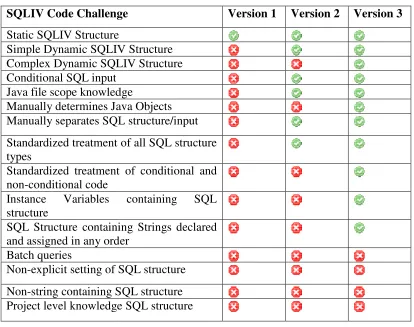
Table 1: Code Challenges for
SQLIV Code Challenge
Static SQLIV Structure
Simple Dynamic SQLIV Structure Complex Dynamic SQLIV Structure Conditional SQL input
Java file scope knowledge
Manually determines Java Objects Manually separates SQL structure/input Standardized treatment of all SQL structure types
Standardized treatment of conditional and non-conditional code
Instance Variables containing SQL structure
SQL Structure containing Strings declared and assigned in any order
Batch queries
Non-explicit setting of SQL structure Non-string containing SQL structure Project level knowledge SQL structure
4.2.1. SQLIVF-Algorithm v1
The SQLIVF-Algorithm v1 was formed during an initial formative five toy Java applications. SQLIVF
SQLIVs; to parse a vulnerable statement to gather the needed
PreparedStatement object.
the Statement or Connection
was assumed to provide the needed Java objects and needed to separate the SQL structure from the input.
: Code Challenges for SQLIVF-Algorithm Version
SQLIV Code Challenge Version 1 Version 2
Simple Dynamic SQLIV Structure Complex Dynamic SQLIV Structure
Java file scope knowledge
Manually determines Java Objects Manually separates SQL structure/input Standardized treatment of all SQL structure Standardized treatment of conditional and
Instance Variables containing SQL SQL Structure containing Strings declared and assigned in any order
explicit setting of SQL structure string containing SQL structure Project level knowledge SQL structure
Algorithm v1
Algorithm v1 was formed during an initial formative case study done on SQLIVF-Algorithm v1 initially started as a way to analyze simple parse a vulnerable statement; to separate that statement structure
Java objects to create and propagate
object. SQLIVF-Algorithm v1 first gathered the SQL statement,
Connection object, and the execution method call.
provide the needed Java objects and a SQL parse tree was assumed to be to separate the SQL structure from the input. SQLIVF-Algorithm v1
ersions
Version 3
case study done on initially started as a way to analyze simple separate that statement structure from input; and and propagate the equivalent first gathered the SQL statement,
this information to extract out the input from the statement and replace it with a bind variable while putting the input in order into setXXX methods, where XXX would be the input
object’s type, such as setString for String input types and setInt for Integer input types.
SQLIVF-Algorithm v1 only handled static SQLIV structure and assumed that all SQL statement structure data would be available at the line of execution. SQLIVF-Algorithm v1’s knowledge was limited to within the Java method containing the SQLIV execution.
Additionally, different types of queries (SELECT, INSERT, DELETE, etc.) were assumed to have to be handled differently. However, through further analysis SQLIVF-Algorithm v1 was able to be simplified and all types of queries treated the same in SQLIVF-Algorithm v2.
4.2.2. SQLIVF-Algorithm v2
The SQLIVF-Algorithm v2 evolved from SQLIVF-Algorithm v1 during a formative empirical case study done on a web based medical repository project iTrust. In preparation for the empirical case study on iTrust, SQLIVF-Algorithm v1 was evolved to handle simple dynamically-constructed SQL statement structure, handle conditional SQL input, treat different types of queries all the same, differentiate between SQL statement structure and input; and allow for an undetermined number and types of inputs to the prepared SQL statement. A simple dynamically-constructed SQL statement structure is a SQL structure that changes based on a single conditional. Additionally, conditional SQL input is SQL input that is either added or not added to the SQL statement based on a conditional. The logic behind SQLIVF-Algorithm v2 can be seen in the pseudo code of SQLIVF-Algorithm v2 in
Connection object, and the execution method call from the code. However, since
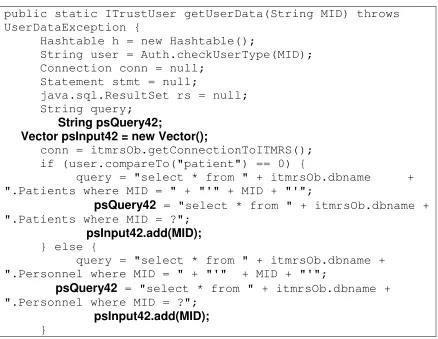
SQLIVF-Algorithm v2 accounted for dynamic statement construction, SQLIVF-Algorithm v2 determined the value of each variable used in the SQL statement to determine if the variable was input or was part of the statement’s structure. If a variable was determined to contain both statement structure and input variables, SQLIVF-Algorithm v2 declared a functionally-equivalent, prepared SQL statement String (PS String) at the declaration of the String variable and set the PS String to a prepared statement equivalent of what the String variable was set to at each instance the input variable was set. A PS String is an equivalent string to a SQL statement string that has only raw string data, other PS Strings, and bind variables.
Along with SQLIVF-Algorithm v2 declaring a PS String and assigning the PS String at each instance, SQLIVF-Algorithm v2 also declared a vector where SQLIVF-Algorithm v2 declared the String variable and added input variables to the vector at each instance SQLIVF-Algorithm v2 assigned the PS String. The vector is an assistant to the new PS String by holding the input variables that SQLIVF-Algorithm v2 removed from the prepared statement equivalent PS String at each assign. The vector keeps the elements in order and in the proper state until the execute method is reached.
vector to one per prepared SQL statement, which is an issue that is resolved in the next evolution of the algorithm, SQLIVF-Algorithm v3.
public static ITrustUser getUserData(String MID) throws UserDataException {
Hashtable h = new Hashtable();
String user = Auth.checkUserType(MID); Connection conn = null;
Statement stmt = null;
java.sql.ResultSet rs = null; String query;
String psQuery42;
Vector psInput42 = new Vector();
conn = itmrsOb.getConnectionToITMRS(); if (user.compareTo("patient") == 0) {
query = "select * from " + itmrsOb.dbname + ".Patients where MID = " + "'" + MID + "'";
psQuery42 = "select * from " + itmrsOb.dbname + ".Patients where MID = ?";
psInput42.add(MID); } else {
query = "select * from " + itmrsOb.dbname + ".Personnel where MID = " + "'" + MID + "'";
psQuery42 = "select * from " + itmrsOb.dbname + ".Personnel where MID = ?";
psInput42.add(MID); }
Figure 1: PS String and assistant vector creation and use example code
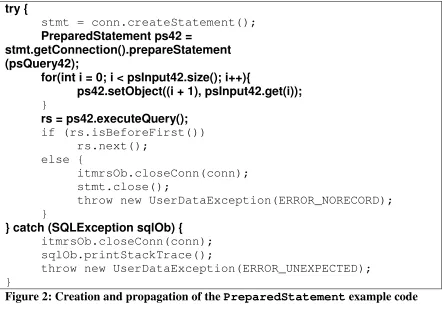
Once SQLIVF-Algorithm v2 created variables that made up a complete prepared SQL statement, SQLIVF-Algorithm v2 was able to create a PreparedStatement.
SQLIVF-Algorithm v2 created a PreparedStatement in the same scope as the execution of the
Statement using either the Statement or the executing Connection.
using the PS String as the prepared SQL statement. SQLIVF-Algorithm v2 then set each bind variable to the associated input variable in the assistant vector through the setObject
try {
stmt = conn.createStatement(); PreparedStatement ps42 = stmt.getConnection().prepareStatement (psQuery42);
for(int i = 0; i < psInput42.size(); i++){
ps42.setObject((i + 1), psInput42.get(i)); }
rs = ps42.executeQuery(); if (rs.isBeforeFirst())
rs.next(); else {
itmrsOb.closeConn(conn); stmt.close();
throw new UserDataException(ERROR_NORECORD); }
} catch (SQLException sqlOb) {
itmrsOb.closeConn(conn); sqlOb.printStackTrace();
throw new UserDataException(ERROR_UNEXPECTED); }
Figure 2: Creation and propagation of the PreparedStatement example code
Once SQLIVF-Algorithm v2 created the PreparedStatement, SQLIVF-Algorithm
v2 removed the execution of the Statement to remove the SQLIV and set the return value
of the PreparedStatement to the variable that the return value of the vulnerable
Statement was set to, if any. The execution call:
rs = stmt.executeQuery(query);
where rs is a ResultSet object and stmt is a Statement object was replaced by rs =
ps42.executeQuery(); by SQLIVF-Algorithm v2. If one Statement contained multiple vulnerable executions, then SQLIVF-Algorithm v2 had each subsequent execution
4.3 SQLIVF-Algorithm v3
The SQLIVF-Algorithm v3 evolved from SQLIVF-Algorithm v2 by analyzing the results of the formative empirical case study on iTrust. SQLIVF-Algorithm v3 was evaluated with one evaluative empirical case study done on the Java server code of a trust management project Nettrust, and one evaluative empirical case study repeated on iTrust. Based on the analysis of SQLIVF-Algorithm v2 and efforts to solidify SQLIVF-Algorithm v2 into a standardized way of converting SQLIVs into secure, prepared statement code, SQLIVF-Algorithm v2 was evolved to handle complex dynamic SQL statement structure and to treat code in a standardized manner, regardless of whether the code was conditional or not. Complex SQL statement structure is SQL structure that changes based on more than one conditional. Additionally, SQLIVF-Algorithm v2 was expanded out to the file level to allow for instance variables that contain SQL statement structure and are modified and set throughout methods within the Java file. Further, an assumption SQLIVF-Algorithm v2 relied on, which assumed that String variables would be declared and assigned in the same order that they appeared in the execute method for the SQL statement, was removed. The logic of the code generated by SQLIVF-Algorithm v3 and the logic of SQLIVF-Algorithm v3 will be explained by each part.
4.3.1. Generated Code Structure
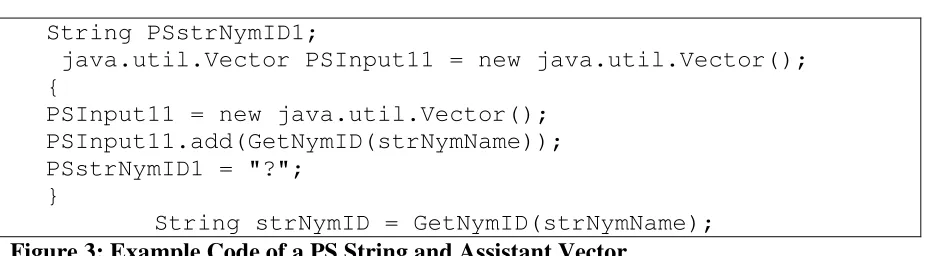
elements separated from the structure of the PS String contained in the SQL statement String. An example of SQLIVF-Algorithm v3 declaring a PS String and assistant vector can be found in Figure 3.
String PSstrNymID1;
java.util.Vector PSInput11 = new java.util.Vector(); {
PSInput11 = new java.util.Vector(); PSInput11.add(GetNymID(strNymName)); PSstrNymID1 = "?";
}
String strNymID = GetNymID(strNymName);
Figure 3: Example Code of a PS String and Assistant Vector
As seen in Figure 3, SQLIVF-Algorithm v3-generated the PS String PSstrNymID1
and the assistant vector PSInput11 for the String reference ID strNymID.
SQLIVF-Algorithm v3 also cleared PSInput11 and added GetNymID(strNymName) to the
has a series of Strings that contain other Strings and associated assistant vectors that contain other assistant vectors.
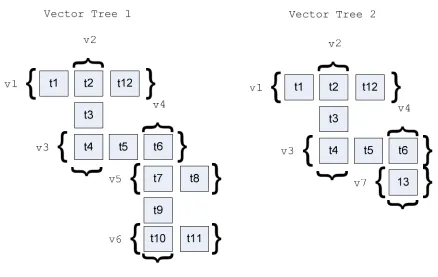
The associated assistant vectors create a vector tree that changes dynamically at runtime. If the conditional if(j == 0) in Figure 17in the Appendix is true, the vector tree contains
vectors v5 and v6 and looks like Vector Tree 1 in Figure 4, where vector v1 contains
vectors v2 through v6 and input variables t1 through t12. If the conditional if(j ==
0)is not true, then the vector tree looks like Vector Tree 2 in Figure 4 and vector v1 contains
vector v7 instead of vectors v5 and v6 and input variables t1 through t6 and t12 through
Figure 4: Conditional Vector Trees
private static java.util.Vector traverseInputTree (java.util.Vector vectorTree, java.util.Vector returnVector){ for(int i = 0; i < vectorTree.size(); i++){
if (vectorTree.get(i) instanceof java.util.Vector) {
java.util.Vector nextVectorNode = (java.util.Vector) vectorTree.get(i);
traverseInputTree(nextVectorNode, returnVector);
}
else {
returnVector.add(vectorTree.get(i)); }
}
return returnVector; }
Figure 5: Recursive Method traverseInputTree Traverses Vector Trees at Runtime
Figure 6: Transversal of a Vector Tree
4.3.2. SQLIVF-Algorithm v3 Details
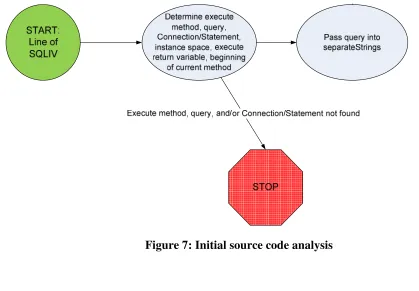
As seen in Figure 7, SQLIVF-Algorithm v3 initially collects the execution method, query
being executed, Connection or Statement object, and context in which the return of the execute is returned, such as a return variable or a conditional statement. Additionally, SQLIVF-Algorithm v3 collects the lines that are the instance space and the beginning of the method that the SQLIV resides in. If the execution method, query, and/or Connection or
Statement object is not found, SQLIVF-Algorithm v3 cannot continue and exits. Once
SQLIVF-Algorithm v3 finds all of the elements, SQLIVF-Algorithm v3 passes the query into seperateStrings, a recursive algorithm inside SQLIVF-Algorithm v3 which takes in a reference ID and a mixed string and makes the prepared statement equivalent. A mixed string is a string that composed of a mixture of raw string data and reference IDs.
As seen in Figure 8, the separateStrings algorithm initially takes the referenceID String and declares a PS String equivalent at the line the referenceID is declared. A unique PSInput assistant vector is also declared at the referenceID declaration line. The PSInput assistant vector is associated specifically with the PS String and will contain the input variables and/or other PSInput vectors that SQLIVF-Algorithm v3 separates from the PS String. It is important to note that separateStrings uses the modifiers of the referenceID for both the PS String and the PSInput, to ensure equivalent handling of PS String and PSInput as the original. An example of SQLIVF-Algorithm v3 declaring a PS String and assistant vector can be found in Figure 3. The use of the same modifiers is especially important for instance variables, which can have unique and restrictive modifiers, such as static and final.
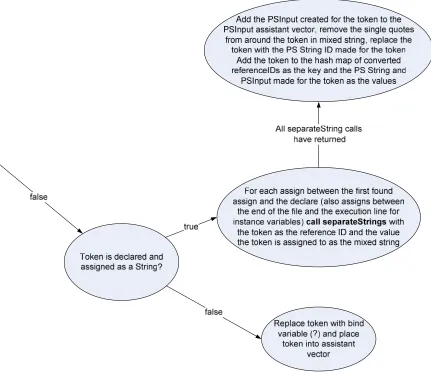
Once the PSInput is declared, separateStrings resets the vector to an empty vector at the line the referenceID is assigned, in order to ensure that the elements added to the vector are added without interference from unrelated elements. The separateStrings algorithm then parses the mixed string into raw string data and reference IDs. The separateStrings algorithm takes the tokens of mixed string and analyzes each token independently.
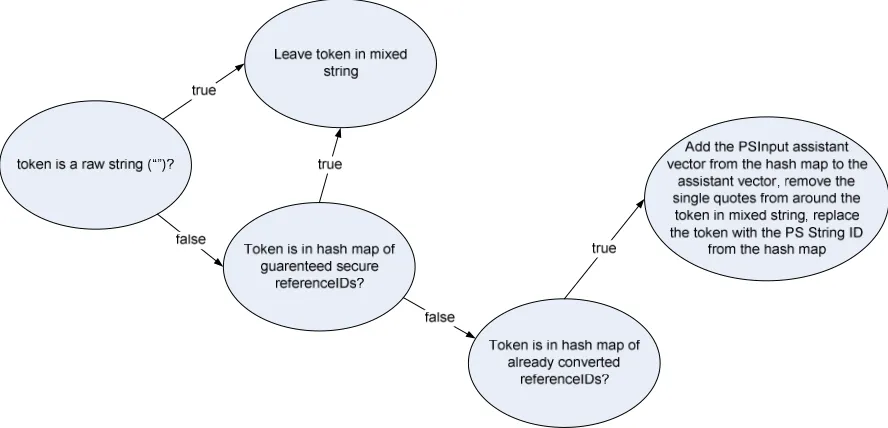
As seen inFigure 9, separateStrings first determines whether the token is a raw string or not for each mixed string token. If the token is a raw string, then separateStrings leaves the token unmodified in mixed string and separateStrings moves on to the next token. However, if the token is not a raw string, separateStrings considers whether the token is a String reference ID. First, separateStrings checks the hash map of guaranteed secure reference IDs to determine if separateStrings needs to handle the token. SQLIVF-Algorithm v3 is limited to the knowledge of a single source file, which limits the uses of SQLIVF-Algorithm v3. SQLIVF-Algorithm v3 allows a developer to use SQLIVF-Algorithm v3 where overall project knowledge is needed, such as when the database name is a static string from a separate Java file, SQLIVF-Algorithm v3 allows developers to note which reference ID are secure but are outside the Java file. If the reference ID is in the hash map of guaranteed secure reference IDs, since the developer specified the reference ID was secure, SQLIVF-Algorithm v3 skips over the reference ID.
If the reference ID is not in the guaranteed secure hash map, then separateStrings checks a hash map of already converted reference IDs to determine whether separateStrings has already converted the token into a PS String. If the token is in the hash map, then separateStrings gathers the reference IDs of the PS String and the PSInput vector for the token from the hash map. The separateStrings algorithm adds the PSInput vector for the token to the current PSInput vector, removes the single quotes from around the token in mixed string, and replaces the token in the mixed string with the PS String ID. The separateStrings algorithm adds the PSInput vector for the token to the current PSInput vector so that any input variables separateStrings separated from the PS String of the token are included along with the use of the PS String.
The separateStrings algorithm removes any single quotes surrounding the token from the mixed string in order to make sure that the strings combine correctly and do not cause SQL syntax exceptions, which occur with redundant single quotes. The PS String replaces the token since the PS String is the logical equivalent of the token with the SQL structure separated from the input variables. An example of separateStrings replacing a String with a PS String and keeping raw string data in a PS String can be found in Figure 20 in the Appendix. Figure 20 in the Appendix shows separateStrings setting the PS String
PSqueryUniqueID3 to raw string data as well as the PS String PShcpid3 instead of the
original String hcpid.
Figure 10: Separation of input variables and recursive separation of Strings
An example of separateStrings replacing tokens with bind variables and adding the tokens into the assistant vector can be found in Figure 20 in the Appendix. Figure 20 shows
separateStrings setting the PS String PSqueryUniqueID3 to raw string data, the PS String
PShcpid3, and bind variables and separateStrings putting the values notes.replace(
"'", "''" ), PSInput13, mid, and visitDate associated with each bind
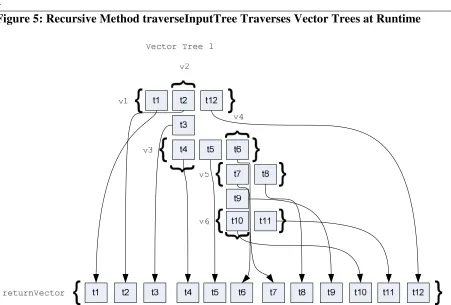
Now that separateStrings has analyzed and handled all of the tokens in mixed string, separateStrings has removed all of the input variables from mixed string. Mixed string now contains only raw string data, PS Strings, and/or bind variables. Therefore, as seen in Figure 11, separateStrings assigns PS String to mixed string at the line the reference ID is assigned. The separateStrings algorithm assigning PS String marks the end of separateStrings. When SQLIVF-Algorithm v3’s call to separateStrings returns, SQLIVF-Algorithm v3 knows that separateStrings has created an equivalent prepared SQL statement for the conditional and dynamic SQL statement. SQLIVF-Algorithm v3 also knows that it has all of the vector tree code finished and can start preparing for the prepared statement execute. SQLIVF-Algorithm v3 adds a call to traverseInputTree at the line of SQLIV execution, which does an in-order traversal of the SQLIVF-Algorithm v3-generated code vector tree and returns a singular vector with the elements in the traversed order. Additionally, SQLIVF-Algorithm v3 declares the PreparedStatement with the first PS String as the prepared
SQL statement. Once SQLIVF-Algorithm v3 declares the PreparedStatement, SQLIVF-Algorithm v3 inserts a loop that iterates through the singular vector and assigns each element to each bind variable in order. The SQLIVF-Algorithm v3-generated code
assigns each element to a bind variable using the setter method setObject(index,
input), which calls the appropriate setter method based on the object type of the input.
Once the SQLIVF-Algorithm v3-generated code fills all the bind variables in the PreparedStatement, SQLIVF-Algorithm v3 executes the PreparedStatement and
returned, such as a return variable or a conditional statement. SQLIVF-Algorithm v3 also removes the SQLIV execute call, thus removing the SQLIV.
Figure 11: Finish of separateStrings and assignment of bind variables
The SQLIVF-Algorithm v3 can remove the SQLIV execute since the equivalent PreparedStatement is executed in its place. An example of SQLIVF-Algorithm v3
preparing the PreparedStatement, setting the bind variables to the appropriate values,
and replacing the SQLIV with the PreparedStatement execute can be found in Figure
21 in the Appendix. Figure 21 in the Appendix shows the PreparedStatement ps0
created by stmt’s Connection, set to PSqueryUniqueID0, the bind variables set to
the proper inputs, and ps0’s execution inserted into the if statement that the SQLIV was in. As seen in Figure 12, SQLIVF-Algorithm v3 inserts the traverseInputTree method as one of the final steps of the conversion process. The SQLIVF-Algorithm v3
inserts the traverseInputTree method into the Java file under analysis since the vector tree grows dynamically at runtime and needs to be traversed at runtime. The traverseInputTree method is a recursive method that takes in a vector tree and returns
inserts the traverseInputTree method into the Java file, SQLIVF-Algorithm v3 successfully finishes and exits, leaving a converted Java file to use in place of the vulnerable Java file.
Figure 12: Insert traverseInputTree method and return converted Java file
4.3.3. SQLIVF-Algorithm v3 Implementation
SQLIVF-Algorithm v3 was implemented as an automated fix generator in Java called SQLIVF-Generator4. SQLIVF-Generator takes in a Java file and line numbers of SQLIV execution calls and outputs a Java source file with the SQLIVF-Algorithm v3-generated code structure included and the SQLIV execution calls removed. The process of securing
vulnerable source code with SQLIVF-Generator first starts with formatting the source code in preparation for the generator. The source code is imported into an Eclipse IDE project and use the Eclipse IDE Formatter, a feature of the Eclipse IDE, to make sure that the source code was organized in a standardized way that made analyzing the code a regular and repeatable process5.
After the Eclipse IDE Formatter formats the code, the code is analyzed to find all SQLIVs. The FindBugs™ static analyzer Eclipse IDE plugin is used to analyze the source
4
The SQLIVF-Generator source code can be found at: http://www4.ncsu.edu/~smthomas/SQLIVF-Generator.zip 5
code and find the line numbers of all SQLIVs in the source code. Once all of the SQLIV line numbers have been collected, the SQLIVF-Generator is run on each Java file that has
SQLIVs. For each vulnerable Java file, the generator is passed the path to one Java file, all of the SQLIV line numbers that FindBugs™ found in ascending order, and any secure reference IDs and SQLIVF-Generator creates one converted Java file with the SQLIV
execution calls removed. The arguments used to convert both Nettrust and iTrust can be seen in Figure 13 below.
C:\...\nettrust\JavaServletsCode\AddBroadCasterServlet.java 106 112 143 C:\...\nettrust\JavaServletsCode\AddFriendServlet.java 105 111 140 C:\...\nettrust\JavaServletsCode\BroadCasterServlet.java 130
C:\...\nettrust\JavaServletsCode\CheckNymServlet.java 87 91 C:\...\nettrust\JavaServletsCode\CreateNymServlet.java 83 84
C:\...\nettrust\JavaServletsCode\DeleteBroadCasterServlet.java 95 102 131 C:\...\nettrust\JavaServletsCode\DelFriendServlet.java 95 101 130
C:\...\nettrust\JavaServletsCode\ExplicitRatingServlet.java 104 118 127 154 C:\...\nettrust\JavaServletsCode\FriendsServlet.java 98 132
C:\...\nettrust\JavaServletsCode\NetTrustFinalServlet.java 225 236 240 400 438 453 981 1011
C:\...\itrust\Auth.java 229 258 422 458 itmrsOb.dbname
C:\...\itrust\Demographics.java 101 103 139 443 451 486 573 itmrsOb.dbname C:\...\itrust\Records.java 107 240 292 367 469 489 itmrsOb.dbname
C:\...\itrust\Transactions.java 196 228 230 234 itmrsOb.dbname
Figure 13: Arguments to SQLIVF-Generator to convert Nettrust and iTrust
As you can see in Figure 13, the arguments to SQLIVF-Generator for Nettrust contain the full path to the Java file and the SQLIV line numbers while the arguments to
4.4 Assumptions and Limitations
Several assumptions were made about the runtime environment that the
SQLIVF-Algorithm v3-generated code will run in and the state of the code that SQLIVF-SQLIVF-Algorithm v3 will analyze. The language, database connector, and database must all support
PreparedStatements. SQLIVF-Algorithm v3 assumes that all SQL structure is
contained within Java Strings as raw String data. Additionally, SQLIVF-Algorithm v3 assumes all setting of SQL structure Strings is done through explicit setting of the Strings in the Java file. If Strings are not set explicitly from within the Java file and are set by direct access to the String from outside the Java file, then the SQLIVF-Algorithm v3-generated code structure will not reflect the settings and may end up with the wrong statement. Also, if the SQL structure of the SQLIV statement is spread across multiple files and requires project level knowledge, SQLIVF-Algorithm v3 will not be able to generate the replacement
prepared statement code. The source code is assumed to have all comments removed from it before it is used by SQLIVF-Generator. An adequate Java comment remover was not found for SQLIVF-Generator, so SQLIVF-Generator manually removes all block comments from the code before SQLIVF-Generator uses SQLIVF-Algorithm v3 on the code.
not enough. Additionally SQLIVF-Generator only analyzes and creates Java source code. SQLIVF-Generator’s analysis of the source code relies solely on pattern matching and does not take into consideration call graphs, Abstract Syntax Trees, or other methods of code analysis. In addition to SQLIVF-Algorithm v3 and SQLIVF-Generator being limited to Java, the solution outlined in this thesis is further limited since Java currently does not have the
PreparedStatement equivalent of the Statement batch job functionality. While
PreparedStatements do have the ability to have multiple batches of input for a single
statement structure, PreparedStatements do not have the ability to specify multiple
5 Empirical Case Studies
The SQLIVF-Algorithms evolved over the course of preparing for and conducting four case studies. Study One was a formative case study using SQLIVF-Algorithm v1 on five toy Java applications written and seeded with SQLIVs by the author. Study Two was a formative empirical case study which used SQLIVF-Algorithm v2 on a web based medical repository project iTrust. Study Three was an evaluative empirical case study using SQLIVF-Algorithm v3 and SQLIVF-Generator on the Java server code of a trust management project Nettrust. Study Four was an evaluative empirical case study using SQLIVF-Algorithm v3 and the SQLIVF-Generator to repeat the Study three on iTrust. Each case study and the findings of each study will be reviewed in the following sections.
5.1 Testing Frameworks
To analyze the security of the SQLIVF-Algorithms, unit-level test suites were created for each case study. To make the tests repeatable, the JUnit6 testing framework was used. JUnit is a framework that allows developers to create and execute a repeatable test suite. Specific methods within the case study projects were tested for security and equivalency through the JUnit framework.
Since iTrust was developed with only certain access points for remote users while
test for different types of vulnerabilities. Therefore, HttpUnit7 and SecureUnit [9], were used in addition to JUnit, to create system level tests. HttpUnit is a framework which allows developers to test applications across the internet through the GUI, while SecureUnit is a framework which allows developers to deploy tests with an exploit library (EL), which is a collection of test strings that run on each test. SecureUnit executes each test with each test string until the entire EL has run through each test, increasing the usefulness of each test. HttpUnit also has the ability to input test strings into variables that are available in the GUI but do not have a field available for the input, commonly called the “Make the client invisible” attack pattern for software security testing [13].
5.2 SQLIA Types
Throughout each case study, a variety of different SQLIAs were used to exploit SQLIVs to analyze the effectiveness of the PreparedStatement based code. Each SQLIV in all four case studies were exploited through one of four types of SQLIAs, as will be explained: conditional where, additional column insert, additional row insert, and additional order keyword. For testing, we considered each of these types as an equivalence class and ensured we had adequate coverage of each of these types.
The conditional where exploit inserts an attack string into a method variable that is used
in a SQL statement WHERE cause that turns that part of the WHERE cause into an always true. An example of a SQL statement vulnerable to this attack is seen in Figure 14, where the return of loggedInUser.getMID() is put directly into a WHERE clause for the MID attribute. An example of a conditional where exploit is: Demographics.getUserData("3' or true#");
where the "3' or true#" turns the MID part of the WHERE clause of the SQL statement to be always true, which causes the statement to return the user data for all patients.
java.sql.ResultSet r =
stmt.executeQuery("SELECT HCPID FROM DeclaredHCP WHERE PatientID = '" + loggedInUser.getMID() + "'");
Figure 14: Conditional where injection vulnerability
The additional column insert exploit inserts an attack string into a method variable that is
used in a SQL statement VALUES clause that sets the value for the attribute as well as the following attribute(s). An example of a SQL statement vulnerable to this attack is seen in the following code:
stmt.execute("INSERT INTO TransactionFailureAttempts
(medicalID, failureCount) VALUES (" + id + ", 0);");
where the id method variable is put directly into a VALUES clause for the id attribute. An example of a additional column insert exploit is: a.getTransactions().logFailure("4, 800)#", 0); where the "4, 800)#" sets the medicalID to 4 and the failureCount to 800, as opposed to the intended 0, which falsifies the iTrust logs.
where the values notes, hcpid, mid, and visitDate are put directly into a VALUES
clause that sets the values for the attributes notes, HCPID, PatientID, and
visitDate respectively. An example of a an additional row insert exploit is:
a.getRecords().addOfficeVisit("notes", "1", "0000-00-00'), ('patient died', '2', '2', '0000-00-00')#"); where the value "0000-00-00'), ('patient died', '2', '2',
'0000-00-00')#" sets the visitDate to ‘0000-00-00’, exists out of the
visitDate, and adds the additional value set ('patient died', '2', '2',
'0000-00-00') and then exits out of the rest of the statement. The statement inserts both
value sets into the table.
The conditional order keyword exploit inserts an attack string into a method variable that
is used in a SQL statement ORDER BY clause that sets the value for the attribute and adds an order keyword to the statement. An example of a SQL statement vulnerable to this attack is
seen in Figure 15, where the value strCriteria is put directly into the ORDER BY clause which sets the attribute with which to order by in descending order. An example of a conditional order keyword exploit is: tmpABC.GetBroadcasterRating("name1",
"broadcastername asc#"); which sets the attribute to order by to
broadcastername and adds the order keyword asc, which changes the order in which to
getBroadCasterName.executeQuery("select BroadCasterName, broadcasters.BroadCasterID from broadcasters,broadcasternymmap
where broadcasternymmap.BroadCasterID =
broadcasters.BroadCasterID and NymID='" + strNymID + "' order by " + strCriteria + " desc");
Figure 15: Conditional Order Keyword Injection Vulnerability
5.3 Study One: Initial Formative Case Study
To formulate the source code analysis and PreparedStatement code generation the SQLIVF-Algorithms needed to do, SQLIVF-Algorithm v1 was created and tested on five vulnerable toy Java applications created by the author [20]. The author seeded the five vulnerable toy Java applications with SQLIVs and all of the information SQLIVF-Algorithm v1 collected was placed in the method containing the SQLIV execution [20].
SQLIVF-Algorithm v1 handles SQLIVs that have the Connection in scope of SQLIV, the
Connection out of scope of the SQLIV, the execute call is an executeUpdate, and the
Table 2: SQLIVF-Algorithm v1 Category Breakdown of Toy Java Applications
SQLIVF-Algorithm v1 Category Number of SQLIVs
Connection in scope of SQLIV 3
Connection out of scope of SQLIV 2
executeUpdate execute call 2
executeQuery execute call 3
Conditional where SQLIAs 4
Additional column 1
Additional row 0
Conditional order 0
5.3.1. Case Study Setup
All five vulnerable Java applications were setup in an Eclipse IDE project. Algorithm v1 is provided the location of the seeded SQLIVs for each application. SQLIVF-Algorithm v1 was ran by hand one each Java application, first analyzing an application and collecting the needed information. Once SQLIVF-Algorithm v1 collected all of the needed
information, SQLIVF-Algorithm v1 creating the PreparedStatement based code
structure and replaced the SQLIV execution with the PreparedStatement code execution.
5.3.2. Generated Code Analysis
created. Each toy Java application was tested before and after the conversion with normal input as well as with a SQLIA and compared the results. The converted toy Java applications returned the same values as the original toy Java applications for normal input. Additionally, the converted toy Java applications were not affected by the SQLIA tests while the original toy Java applications were exploited by the SQLIAs. A summary of the overall results of the case study is shown in Table 3.
Table 3: Summary of the Results of the Initial Formative Case Study
Test Suite Type of Test Original Toy Applications Converted Toy Applications
Equivalency Unit Passed Passed
Security Unit All attacks successful No attacks successful
5.4 Study Two: Formative Empirical Case Study
To test the security and equivalency aspects of Algorithm v2, SQLIVF-Algorithm v2 was tested on a role-based, web-based, open-source medical records application written in Java called iTrust. One purpose of iTrust is to catalogue sensitive medical information. Therefore, security is an important requirement of the system.
SQLIVF-Algorithm v2 handles SQLIVs that have conditional SQL statement structures and non-conditional SQL statement structures as two significantly different categories. The category breakdown of iTrust can be seen in
Table4.
Table 4: SQLIVF-Algorithm v2 Category Breakdown of iTrust
SQLIVF-Algorithm v2 Category Number of SQLIVs Conditional SQL Statement Structure 4
Non-Conditional SQL Statement Structure 17
Conditional where SQLIAs 19
Additional column 1
Additional row 4
Conditional order 0
5.4.1. Case Study Setup
in 18 classes. The iTrust application also includes a JUnit regression test suite, consisting of 66 tests and 1,493 lines of code, with 76% line coverage. The JUnit test suite was used to validate functional equivalency. Both the original iTrust and the converted iTrust versions can be found online8.
The input filter code was removed from iTrust to make security validation of iTrust more obvious. The input filter code would make sure that the input was in the proper format (e.g. between 8 and 20 characters) before it would enter the application. The input filter code would have restricted the SQLIAs to more complex and harder-to-understand attacks to bypass the restrictions to expose the SQLIVs. Since the goal of the testing was to expose the SQLIVs, regardless of whether they are latent or not, and compare the security of the pre- and post-algorithm versions of iTrust, the case study did not benefit from the input filter code existing in iTrust.
FindBugs™ [14] was run on iTrust to identify potentially vulnerable SQL statements. Each SQL statement identified as potentially containing a SQLIV was inspected and 24 SQLIVs within 21 SQL statements were identified, where each of the 21 SQL statements contained at least one SQLIV. The 24 FindBugs™ bugs found in iTrust are shown in Figure 18 in the Appendix. SQLIVF-Algorithm v2 was then run on each of the 24 vulnerable execution calls and SQLIVF-Algorithm v2 replaced each vulnerable execution call with a PreparedStatement execution call.
5.4.2. Equivalency and Security Unit Testing
created by analyzing each vulnerable SQL statement and determining how it could be exploited. The original JUnit regression test suite provided by the iTrust programmers was ran as well as the SQLIA test suite on both the original and converted versions of iTrust and functional equivalency, time, and security data was gathered. Both versions of iTrust were found to have the same results to all 66 regression tests, and therefore were functionally equivalent according to those tests. Additionally, the converted iTrust ran the regression test suite 0.14 seconds slower than the original on average over the course of 30 runs, which is an overhead of 0.002 seconds for each test, which is nominal.
The SQLIA test suite contained 18 conditional where, one additional column insert, four additional row insert, and zero conditional order exploits. Each vulnerable statement was analyzed to determine how a SQLIA could get to the SQLIV and whether code needed to be bypassed to test and validate the vulnerability of each SQLIV. The conditional state that the code must be in to execute each test as well as what result signifies a successful exploit was noted. When the SQLIA test suite was run on the original iTrust, all 24 SQLIVs were exploited while none of the SQLIAs were successful when ran on the converted version of iTrust. The results of the SQLIA test suite show that each of the 24 SQLIVs were
vulnerable. Nine of the 24 SQLIVs were within conditional code or had specific exception conditions that prevented the injection attacks from being exploited without code bypass, such as turning off a log to read the result set of a SQL statement, based on the attack types employed. The result that none of the SQLIAs were successful when the SQLIA test suite
SQLIA test suite can validate is that SQLIVF-Algorithm v2 removed 24 vulnerabilities that were in the system.
5.4.3. Secure System Testing
To show the direct security improvements of SQLIVF-Algorithm v2 on iTrust, each attack was analyzed in the SQLIA test suite and four of the attacks were extracted out to a system level and system level SQLIAs were generated for each attack. From the previous JUnit test results, the system-level responses for each exploit were derived. SecureUnit, an exploit library framework, was used to run two attack strings: “3’ or 1=1#” and “3’ or true#”, through two of the system level tests, HttpUnit was used to run the tests on a deployed
system over the Internet, and JUnit to make the test repeatable. The tests and the SQLIA EL are available online9. Each test is discussed in detail below.
The first system level test was a conditional where attack which used the SQLIA EL to
inject attack strings into the mid iTrust ID field when a patient tries to declare a HCP. The result of the attack extracted a user name from the database and displayed the name on the resulting Web page.
The second system level test was an additional row insert attack that used the attack
string: value’), (‘6666’, ‘badvalue’)#, to insert the additional row (‘6666’,
‘badvalue’) when managing diagnosis information. Due to the structure of the
vulnerable SQL statement, multiple attack strings were not able to be used on this one statement.
9
The third system level test was an additional row insert attack that required that the GUI be bypassed because the exploit could not be injected through normal means into a drop
down box. Using the newUnvalidatedRequest functionality provided by HttpUnit, the
exploit was injected into the visitDay parameter when documenting a patient visit. As with the second test, due to the structure of the vulnerable SQL statement, multiple attack strings could not be used on the statement. This attack was not only able to inject an additional row into for patient visits, but it was also able to inject a date value in the additional row that caused an exception within iTrust that prevented iTrust from reading that table entirely. The error causing row had to be removed manually through the database to repeat this test.
Similar to system level test 3, the fourth system level test required bypassing the GUI to inject a conditional where attack into a parameter whose input value was determined by the user choosing a value from a list box. The conditional was inserted into a variable that determined which diagnosis information got removed, allowing the removal of all diagnosis information with one command. The exploit library (EL) was used to attack iTrust for this vulnerability.
The system level tests verified that four of the unit test attacks could be extracted out and used remotely. Additionally, the system level tests showed that SQLIVF-Algorithm v2 was able to fix vulnerabilities in iTrust that were immediately exploitable by a remote attacker.
use more than one attack string and therefore could not make use of the EL. All four tests successfully exploited the original iTrust, but failed against the converted iTrust. A summary of the overall results of the case study is shown in Table 5.
Table 5: Summary of the Results of the Formative Empirical Case Study
iTrust: 2213 Lines of Code 18 Classes 24 SQLIVs
Test Suite Type of Test Test
Statistics
Original iTrust
Converted iTrust
Regression Unit 75% code
coverage
Passed Passed
Security Unit 100% SQLIV
coverage
All attacks successful
No attacks
successful
Security System 4 tests All attacks
successful
No attacks
successful
While SQLIVF-Algorithm v2 was successful in converting all 24 SQLIVs in iTrust, SQLIVF-Algorithm v2 only handled simple cases of conditional code and dynamic SQL structure. Additionally, SQLIVF-Algorithm v2 assumes Strings that are used as part of the SQL statement will declared and assigned in the order they appear in the SQL statement, which prevents SQLIVF-Algorithm v2 from converting a wide variety of SQLIVs.
Therefore, SQLIVF-Algorithm v2 needed to be evolved beyond solving simple conditional code and assuming the order of Strings used in the SQL statement.
5.5 Study Three: Evaluative Empirical Case Study
To test the security and equivalency aspects of Algorithm v3, SQLIVF-Algorithm v3 was tested on the Java server code of an open source, trust management application called Nettrust. One purpose of Nettrust is to use social trust between
running properly. The following corrections were made on Nettrust: a string was changed to String, a misspelled variable was corrected, and an Integer.parseInt that trying to
parse a float improperly was replaced with a Float.parseFloat. SQLIVF-Algorithm v3 has no significant category breakdown, but SQLIVF-Algorithm v3 handles SQLIVs that assign or execute SQL statements inside one line conditionals, SQLIVs that do not assign or execute SQL statements inside one line conditionals, SQLIVs that use instance variables Strings to hold SQL structure, and SQLIVs that do not use instance variables to hold SQL structure as four minimally different categories. The category breakdown of Nettrust can be seen in Table 6.
Table 6: SQLIVF-Algorithm v3 Category Breakdown of Nettrust
SQLIVF-Algorithm v3 Category Number of SQLIVs
Assigns or Executes SQL Statement Inside One Line Conditional 0
Does Not Assign or Execute SQL Statement Inside One Line Conditional
31
Uses Instance Variable to Hold SQL Structure 4 Does Not Use Instance Variable to Hold SQL Structure 27
Conditional where SQLIAs 14
Additional column 3
Additional row 2
5.5.1. Case Study Setup
The version of Nettrust used for the case study is the version of Nettrust Fortify Software used in the Java Open Review Project10. A similar analysis of Nettrust was done to see the SQLIVs found by Fortify Software could be removed. The Java server code of the
application consisted of 1,603 lines of code in 11 classes. Both the pre-conversion Nettrust and the post-conversion Nettrust versions can be found online11.
The SQLIVF-Generator was used to convert Nettrust. Therefore, the process of importing Nettrust into the Eclipse IDE and formatting Nettrust with the Eclipse IDE Formatter was done. The FindBugs™ [14] Eclipse IDE plugin was then ran on Nettrust to identify SQLIVs and the plugin found 31 potential SQLIVs. Each potential SQLIV identified as potentially containing a SQLIV was inspected and 31 potential SQLIVs were identified as SQLIVs. The 31 FindBugs™ bugs found in Nettrust are shown in Figure 19 in the Appendix. The SQLIVF-Generator was ran on each SQLIV in each of the 10 files containing SQLIVs.
5.5.2. Equivalency and Security Unit Testing
A unit test suite was created for the purpose of this research using JUnit to test the equivalency of the converted Nettrust to the original Nettrust. A unit test was created for each SQLIV that SQLIVF-Algorithm v3 converted to use prepared statements. The unit test suite had 44% line coverage and 69% branch coverage on the overall project but 100% coverage of the SQLIVs, which is the only code modified by SQLIVF-Algorithm v3. Additionally, a JUnit SQLIA test suite was created to test the security of the converted
10