
A Parallelizable Enciphering Mode
Shai Halevi∗ Phillip Rogaway†
July 28, 2003
Abstract
We describe a block-cipher mode of operation, EME, that turns ann-bit block cipher into a tweakable enciphering scheme that acts on strings ofmnbits, where m∈[1..n]. The mode is parallelizable, but as serial-efficient as the non-parallelizable mode CMC [6]. EME can be used to solve the disk-sector encryption problem. The algorithm entails two layers of ECB encryption and a “lightweight mixing” in between. We prove EME secure, in the reduction-based sense of modern cryptography. We motivate some of the design choices in EME by showing that a few simple modifications of this mode are insecure.
Key words: Block-cipher usage, cryptographic standards, disk encryption, modes of operation, provable security, sector-level encryption, symmetric encryption.
∗IBM T.J. Watson Research Center, P.O. Box 704, Yorktown Heights, NY 10598, USA,
[email protected] http://www.research.ibm.com/people/s/shaih/
Contents
1 Introduction 1
2 Preliminaries 2
3 Specification of EME 3
4 Security of EME 3
5 Proof Ideas 5
6 Some Insecure Modifications 6
6.1 The “extra” block-cipher call is needed . . . 6 6.2 Necessity of the Length Restriction . . . 7
References 8
A Extending EME to Longer Messages 9
B Proof of Theorem 1 — Security of EME 11
1 Introduction
Tweakable enciphering schemes and their use. Atweakable enciphering scheme is a func-tion E that maps a plaintext P into a ciphertext C = ETK(P) under the control of a key K and tweak T. The ciphertext must have the same length as the plaintext and there must be an in-verseDTK to ETK. We are interested in schemes that are secure in the sense of a tweakable, strong pseudorandom-permutation (±gprp): an oracle that maps (T, P) into ETK(P) and maps (T, C) into
DT
K(C) must be indistinguishable (when the key K is random and secret) from an oracle that
realizes a T-indexed family of random permutations and their inverses. A tweakable enciphering scheme that is secure in the±gprp-sense makes a desirable tool for solving the disk-sector encryption problem: one stores at disk-sector locationT the ciphertextC =ET
K(P) for plaintextP. The IEEE
Security in Storage Working Group [8] plans to standardize a±gprp-secure enciphering scheme.
Our contribution. This paper specifies EME, which is a simple and parallelizable tweakable enciphering scheme. The scheme is built from a block cipher, such as AES. By making EME par-allelizable we accommodate ultra-high-speed mass-storage devices to the maximal extent possible given our security goals. When based on a block cipher E:{0,1}k× {0,1}n → {0,1}n our mode uses ak-bit key and 2m+1 block-cipher calls to encipher anmn-bit plaintext in a way that depends on ann-bit tweak. We require that m∈[1..n].
The name EME is meant to suggest Mix-ECB, as enciphering under EME involves ECB-encrypting the plaintext, a lightweight mixing step, and another ECB-encryption. For a description of EME look ahead to Figures 1 and 2.
We prove that EME is secure, assuming that the underling block cipher is secure. The proof is in the standard, provable-security tradition: an attack on EME (as a ±prp with domaing M = {0,1}n∪ {0,1}2n∪ · · · ∪ {0,1}n2
) is shown to imply an attack on the underlying block cipher (as a strong PRP with domain{0,1}n).
We go on to motivate some of the choices made in EME by showing that other choices would result in insecure schemes. Finally, we suggest an extension to EME that operates on sectors that are longer than mnbits.
CMC mode. The EME algorithm is follow-on work to the CMC method of Halevi and Rogaway [6]. Both modes are tweakable enciphering schemes built from a block cipher E:{0,1}k× {0,1}n →
{0,1}n. But CMC is inherently sequential, as it is built around CBC encryption and decryption.
EME was designed to overcome this limitation, which was seen as potentially problematic for high-speed encryption devices. The change does not increase the serial complexity; both modes use 2m+ 1 block-cipher calls (and little additional overhead) to act on an mn-bit messages.
Further history. Naor and Reingold gave an elegant approach for making a strong PRP onN
bits from a block cipher on n < N bits [14, 15]. Their approach involves a hashing step, a layer of ECB encryption (say), and another hashing step. They do not give a fully-specified mode, but they do show how to carry out the hashing step given an xor-universal hash-function that mapsN
bits tonbits [14]. In practice, instantiating this object is problematic: to compare well with CMC or EME one should find a construction that is simple and has a collision bound of about 2−128 and is more efficient, in both hardware and software, than AES. No such construction is known.
Efforts to construct a block cipher with a large blocksize from one with a smaller blocksize go back to Luby and Rackoff [13], who also put forward the notion of a PRP and a strong PRP. The concrete-security treatment of PRPs that we use begins with Bellare, Kilian, and Rogaway [2]. The notion of a tweakable block-cipher is due to Liskov, Rivest, and Wagner [12]. The first attempt to directly construct an mn-bit block cipher from an n-bit one is due to Zheng, Matsumoto, and Imai [17]. A different approach is to build a wide-blocksize block-cipher from scratch, as with BEAR, LION, and Mercy [1, 4].
Discussion. EME has some advantages over CMC beyond its parallelizability. First, it uses a single key for the underlying block cipher, instead of two keys. All block-cipher calls are keyed by this one key. Second, enciphering under EME uses only the forward direction of the block cipher, while deciphering now uses only the reverse direction. This is convenient when using a cipher such as AES, where the two directions are substantially different, as a piece of hardware or code might need only to encipher or only to decipher. Finally, we prove EME secure as a variable-input-length (VIL) cipher and not just as a fixed-input-length (FIL) one. This means that, in an attack, the adversary may intermix plaintexts and ciphertexts of various lengths.
We comment that the parallelizability goal is arguably of less utility for a ±prp-secure enci-g
phering scheme than for some other cryptographic goals. This is because, parallelizable or not, a ±prp-secure encryption scheme cannot avoid having latency that grows with the length of theg
message being processed (to achieve the ±prp security notion one cannot output a single bit ofg
ciphertext until the entire plaintext has been seen). Still, parallelizability is useful even here, and the user community wants it [7]. More broadly, EME continues a tradition of trying to make modes of operation (like CTR mode, IAPM/OCB [10, 16], and PMAC [3]) that achieve parallelizability at near-zero added computational cost compared to their intrinsically serial counterparts.
2 Preliminaries
Basics. We use the same notions and notation as in [6]. A tweakable enciphering scheme is a function E:K × T × M → M where M=Si∈I{0,1}i is the message space (for some nonempty index setI ∈N) andK 6=∅is thekey spaceandT 6=∅is thetweak space. We require that for every
K ∈ KandT ∈ T we have that E(K, T,·) =ETK(·) is a length-preserving permutation onM. The inverse of an enciphering schemeE is the enciphering scheme D=E−1 whereX =DT
K(Y) if and
only ifET
K(X) =Y. Ablock cipher is the special case of a tweakable enciphering scheme where the
message space isM={0,1}n(for somen≥1) and the tweak space isT ={ε}(the empty string).
The numbernis called the blocksize.
An adversary Ais a (possibly probabilistic) algorithm with access to some oracles. Oracles are written as superscripts. By convention, the running time of an algorithm includes its description size. The notation A⇒1 describes the event that the adversaryA outputs the bit one.
Security measure. For a tweakable enciphering scheme E:K × T × M → Mwe consider the advantage that the adversary A has in distinguishing E and its inverse from a random tweakable permutation and its inverse:
Adv±Egprp(A) = PrhK← K$ : AEK(·,·)E− 1
K(·,·)⇒1
i
−Prhπ←$ PermT(M) : Aπ(·,·)π−1(·,·)⇒1i
permutation. By Perm(n) we mean all permutations on {0,1}n. In writing ±gprp the tilde serves
as a reminder that the PRP is tweakable and the±symbol is a reminder that this is the “strong” (chosen plaintext/ciphertext attack) notion of security. For a block cipher, we omit the tilde.
Without loss of generality we assume that an adversary never repeats an encipher query, never repeats a decipher query, never queries its deciphering oracle with (T, C) if it got C in response to some (T, M) encipher query, and never queries its enciphering oracle with (T, M) if it earlier gotM
in response to some (T, C) decipher query. We call such queries pointless because the adversary “knows” the answer that it should receive.
When R is a list of resources and AdvxxxΠ (A) has been defined, we write AdvxxxΠ (R) for the maximal value of AdvxxxΠ (A) over all adversaries A that use resources at most R. Resources of interest are the running time t and the number of oracle queries q and the query complexity σn
(wheren≥1 is a number). The query complexityσnis measured as follows. A stringXcontributes
max{|X|/n, 1} to the query complexity; a tuple of strings (X1, X2, . . .) contributes the sum of the contributions of each string; and the query complexity of an adversary is the sum of the contributions from all oracle queries plus the contribution from the adversary’s output. So, for example, an adversary that asks oracle queries (T1, P1) = (0n,02n) and then (T2, P2) = (0n, ε) and then outputs a bitb has query complexity 3 + 2 + 1 = 6. The name of an argument (e.g., torσn)
will be enough to make clear what resource it refers to.
Finite fields. We interchangeably view an n-bit string as: a string; a nonnegative integer less than 2n (msb first); a formal polynomial over GF(2) (with the coefficient ofxn−1 first and the free term last); and an abstract point in the finite filed GF(2n). To do addition on field points, one xors their string representations. To do multiplication on field points, one must fix a degree-nirreducible polynomial. We choose to use the lexicographically firstprimitive polynomial of minimum weight. Forn= 128 this is the polynomialx128+x7+x2+x+1. See [5] for a list of the indicated polynomials. We note that with this choice of field-point representations, the point x= 0n−210 = 2 will always have order 2n−1 in the multiplicative subgroup of GF(2n), meaning that 2,22,23, . . . ,22n−1 are all distinct. Finally, we note that given L = Ln−1· · ·L1L0 ∈ {0,1}n it is easy to compute 2L. We illustrate the procedure for n = 128, in which case 2L = L<<1 if firstbit(L) = 0, and 2L = (L<<1)⊕Const87 if firstbit(L) = 1. (Here Const87 = 012010413 and firstbit(L) means L
n−1 and
L<<1 means Ln−2Ln−3· · ·L1L00.)
3 Specification of EME
We construct from block cipher E:K × {0,1}n→ {0,1}n a tweakable enciphering scheme that we
denote by EME[E] or EME-E. The enciphering scheme has key spaceK, the same as the underlying cipher, and tweak space is T = {0,1}n. The message space M = {0,1}n∪ {0,1}2n∪ · · · {0,1}n2 contains any string having any number m of n-bit blocks, where m ∈ [1..n]. An illustration of EME mode is given in Figure 2. In the figures, all capitalized variables except forKaren-bit strings (key K is an element of the key-spaceK). Variable namesP and C are meant to suggestplaintext and ciphertext. When we write ETK(P1· · ·Pm) we mean that the incoming plaintext P =P1· · ·Pm
is silently partitioned into n-bit strings P1, . . . , Pm and when we write DTK(C1· · ·Cm) we mean
that the incoming ciphertext C =C1· · ·Cm is partitioned into n-bit strings C1, . . . , Cm. It is an
error to provide E with a plaintext that is not mn bits for somem ∈[1.. n], or to supply D with a ciphertext that is notmn bits for some m∈[1..n].
4 Security of EME
Algorithm ET
K(P1· · ·Pm)
100 L←2EK(0n)
101 fori∈[1.. m]do 102 PPi←2i−1L⊕Pi
103 PPPi←EK(PPi)
110 SP←PPP2⊕ · · · ⊕PPPm
111 MP←PPP1⊕SP⊕T
112 MC ←EK(MP)
113 M ←MP⊕MC
114 fori∈[2.. m]doCCCi←PPPi⊕2i−1M
115 SC←CCC2⊕ · · · ⊕CCCm
116 CCC1←MC ⊕SC ⊕T
120 fori∈[1.. m]do 121 CCi←EK(CCCi)
122 Ci←CCi⊕2i−1L
130 returnC1· · ·Cm
Algorithm DT
Kt(C1· · ·Cm)
200 L←2EK(0n)
201 fori∈[1.. m]do 202 CCi←2i−1L⊕Ci
203 CCCi←EK−1(CCi)
210 SC←CCC2⊕ · · · ⊕CCCm
211 MC←CCC1⊕SC⊕T
212 MP←E−1
K (MC)
213 M←MC ⊕MP
214 fori∈[2.. m]doPPPi←CCCi⊕2i−1M
215 SP←PPP2⊕ · · · ⊕PPPm
216 PPP1←MP⊕SP⊕T
220 fori∈[1.. m]do 221 PPi←EK−1(PPPi)
222 Pi←PPi⊕2i−1L
230 returnP1· · ·Pm
Figure 1: Enciphering (left) and deciphering (right) underE= EME[E], whereE:K × {0,1}n→ {0,1}n is a
block cipher. The tweak isT ∈ {0,1}n and the plaintext is P =P
1· · ·Pmand the ciphertext isC=C1· · ·Cm.
CCC4
8L
4L
2L L
4M 8M
2M
8L
4L
L 2L
MP
MC
SP⊕T
SC⊕T
CCC1
PPP1
CC3
PP3
PPP3
CCC3 P3
C3
CC1
PP1 P1
C1
CC2
PP2
CCC2
PPP2 P2
C2
PPP4
PP4
CC4 P4
C4
Figure 2: Enciphering a four-block messageP1P2P3P4underEME. The boxes representEKandL= 2EK(0n).
Theorem 1 [EME security] Fixn, t, σn∈Nand a block cipherE:K × {0,1}n→ {0,1}n. Then
Adv±EME[Perm(gprp n)](σn) ≤
7σ2n
2n and (1)
Adv±EME[gprpE](t, σn) ≤
7σ2n
2n + 2Adv
±prp
E (t
0, σ
n) (2)
wheret0 =t+O(σ
n). 2
The heart of Theorem 1 is Equation (1), which is given in Appendix B. Equation (2) embodies the standard way to pass from the information-theoretic setting to the complexity-theoretic one.
5 Proof Ideas
Since the proof in Appendix B is quite long we give a brief sketch here of some of its ideas. We consider an attack against EME as a game between the attacker and the mode itself, where the cipher is replaced by a truly random permutation and this permutation is chosen “on the fly” during this game. We give names to all of the internal blocks that occur in the game, where an internal block is any of the n-bit values PPi, PPPi,MP,MC,CCCi, CCi that arise as the game
is played. For example,PPPsi is the PPPi-block of thesth query of the attacker.
As usual with such modes, the core of the proof is to show that “accidental collisions” are unlikely. An accidental collision is an equality between two internal blocks which is not obviously guaranteed due to the structure of the mode. Specifically, an equality between the ith blocks in two different encipher queries Ps
i = Pit implies that we also have the equalities PPsi = PPti
and PPPsi = PPPti and so these do not count as collisions. (And likewise for decipher queries.) Most other collisions are considered accidental collisions and we show that those rarely happen.1 Showing that accidental collisions are rare is ultimately done by case analysis (but, as usual, it takes a non-trivial argument to get there). For example, in one case we show that with high probability PPsi 6=PPtj; in another case we show that with high probability PPPsi 6=MCt.
The analysis of most of the cases is standard. Below we illustrate one of the more interesting cases. We show that for an encipher query Ps the block MPs does not collide with any of the previousMPr blocks (cf. Claim 7 in Appendix B). This is easily seen if any of the plaintext blocks
Ps
i is a “new blocks” (i.e., different than Pir for all r < s). But we need to show it also for the
case where the plaintext Ps was obtained by “mix-and-matching” blocks from previous plaintext vectors. So let r < sbe the last plaintext that share some blocks with Ps, i.e., Pir =Pis for some index i. This means that all the blocks Ps
i appeared in queries no later than r If queries s and r
sport the same plaintext vectors,Pr =Ps, and differ only in the tweak values, Tr 6=Ts, then we clearly have MPr⊕MPs =Tr⊕Ts 6= 0. So assume that Pr 6= Ps, let Eq be the set of indexes where they are equal, and denoteDr ={1..mr} −Eq and Ds ={1..ms} −Eq, where ms and mr
are the lengths (in blocks) of queriesr ands. That is,Pir =Pisexactly for all i∈Eq, which means that all the blocksPis fori∈Dsappeared in queries before queryr. This, in turn, implies that the
value of PPPsi for any i∈Ds depends only on things that were determined before queryr.
Assume that query r was decipher (and that MCr did not already accidentally collide with anything), so MPr was chosen “almost at random” during the processing of query r. We show that the sum MPs⊕MPr can be expressed asaMPr+β, wherea6= 0 is a constant andβ is some
1
Actually, we only care about collisions between two values in the domain ofπor between two values in its range; collisions between a domain value and a range value, such asPPs
i =CC r
expression that only depends on things that were determined before the choice of MPr. Thus, the sum MPs⊕MPr is rarely zero. We can write this sum as
MPs⊕MPr = Ts⊕
ms
X
i=1
PPPsi ⊕Tr⊕
mr
X
i=1
PPPri = Tr⊕Ts⊕ X
i∈Ds
PPPsi ⊕ X
i∈Dr PPPri
= things-that-were-determined-before-query-r ⊕ X
i∈Dr PPPri
Assuming thatDris non-empty, it is sufficient to show that we can expressPi∈DrPPP
r
i =aMPr+β
wherea is non-zero and β only depends on things that were determined before the choice of MPr (cf. Claim 2 in Appendix B). There are two cases in this proof, depending on whether 1∈ Dr or
not, but they both boil down to the same point: since we use the value 2i−1(MCs⊕MPs) to mask
theCCCi block, the sum ofPPPri’s can be written as
X
i∈Dr
PPPri = some-expression-in-the-CCCri’s-and-MCr ⊕ X
i∈D0 2i−1
! MPr
whereD0 is also a non-empty set, D0 ⊆[1..mr], and so the coefficient ofMPr in this expression is
non-zero. The case where query r is encipher is a bit longer, but it uses similar observations. One last “trick” that is worth mentioning is the way we handle an adaptive adversary. To bound the probability of accidental collisions we analyze this probability in the presence of an augmented adversary, that can specify both the queries and their answers. That is, we let the adversary specify the entire transcript (with some minor restrictions) then choose some “permutation”π that maps the given queries to the given answers, and then consider the probability of accidental collisions. Clearly, this augmented adversary is no longer adaptive, hence the analysis becomes more tractable.
6 Some Insecure Modifications
In this section we justify two of our design choices by showing that changing them would result in insecure schemes. Specifically, we show that the block-cipher call that sits in between the two ECB layers is effectively unavoidable, and we show that that the length restrictionm < nalso is needed.
6.1 The “extra” block-cipher call is needed
The EME construction has three block-cipher invocations in its “critical path” (that is, the con-struction is depth-3 in block-cipher gates). We now show that, in some sense, this is the best that you can do for a constructions of this type. Specifically, we show that for a construction of the type ECB-Mix-ECB, implementing the intermediate mixing layer by any linear transformation always results in an insecure scheme. This remains true even for an untweakable scheme, even when one considers only fixed-input-length inputs, even when each block-cipher call in each ECB encryption layer uses an independent key, and even if the linear transformation in the middle is key-dependent. This result implies that, as opposed to the Hash-Encrypt-Hash approach that was proven secure by Naor and Reingold [15], the “dual” approach of Encrypt-Hash-Encrypt will not be secure under typical assumptions.2
Formally, fix m, n ∈N with m ≥2, and let E:K × {0,1}n → {0,1}n be a block cipher. The scheme E= BrokenEME is defined on message space{0,1}mnand key spaceK2m× K0 whereK0 is a set of invertible linear transformations on {0,1}mn. BrokenEME is keyed with 2m independent
keysK1, . . . , Km, K10, . . . , Km0 ∈ K, and with an invertible (possibly secret) linear transformation3
2
This may seem somewhat surprising, as one may think that Encrypt-Hash-Encrypt should be at least as secure since it uses “more cryptography”.
3
T:{0,1}mn→ {0,1}mn. To encipher a plaintextP =P
1· · ·Pm ∈ {0,1}mn we do the following:
SetPPPi =Eki(Pi) fori= 1. . . m. Let PPP =PPP1· · ·PPPm be the concatenation of the PPPi blocks (PPP ∈ {0,1}mn).
Apply the linear transformationT to obtain CCC =CCC1· · ·CCCm =T(PPP).
SetCi =Ek0
i(CCCi) fori= 1. . . m. The ciphertext is the concatenation of all the Ci blocks,
C=C1· · ·Cm∈ {0,1}mn.
Deciphering is done in the obvious way.
We now give an adversary A that attacks the mode, distinguishing it from a truly random permutation and its inverse using only four queries. Denote the adversary with it’s oracles as
AE D. The adversary A picks two mn-bit plaintexts that differ only in their first block, namely
P1=P
1P2· · ·Pm and P2 =P10P2· · ·Pm (withP16=P10). Then A queries its oracle as follows:
(1) LetC1 =C11· · ·Cm1 ← E(P1) and letC2 =C12· · ·Cm2 ← E(P2).
(2) Create two “complementing mixes” of the two ciphertexts, for exampleC3=C2
1C21· · ·Cm1 and C4=C11C22· · ·Cm2.
(3) LetP3 =P13· · ·Pm3 ← D(C3) and letP4 =P14· · ·Pm4 ← D(C4).
If the plaintext vectors P3 and P4 agree in all but their first block then A outputs 1 (“real”) while otherwise it outputs 0 (“random”). To see that this works, we denote the intermediate variables in the four queries by PPPij and CCCij (i= 1..4 andj = 1..m) and denote the “vector
of differences” between PPP1 and PPP2 by DP = DP1· · ·DPm def= PPP1⊕PPP2. Since P1
and P2 agree everywhere except in their first block, it follows that also the “vector of differences” DP is zero everywhere except in the first block. Similarly, we denote the “vector of differences” between CCC1 and CCC2 by DC = DC1· · ·DCm def= CCC1⊕CCC2 and since we computed
CCCi=T(PPPi) and T is a linear transformation, it follows that DC =T(PPP1)⊕T(PPP2) =
T(PPP1⊕PPP2) =T(DP). Recall now that for anyj∈[1..m] we have eitherCj3 =Cj1 and Cj4=
Cj2, orCj3 =Cj2 and Cj4 =Cj1. It follows that for allj,CCCj3⊕CCCj4=CCCj1⊕CCCj2 =DCj,
namely CCC3⊕CCC4 =DC. Putting this together we now compute PPP3⊕PPP4 as:
PPP3⊕PPP4 = T−1(CCC3)⊕T−1(CCC4)
= T−1(CCC3⊕CCC4) = T−1(DC) = T−1(T(DP)) = DP
This means thatPPP4j =PPP3j forj= 2..m, and therefore alsoP4
j =Pj3 for all but the first block.
6.2 Necessity of the Length Restriction
Recall that EME is defined on message space M = Sm∈[1..n]{0,1}mn. Here we show that the restriction m ≤ n is justified. In fact, we do not know whether allowing m = n+ 1 breaks the security of EME, but we can show that allowing m = n+ 2 permits easy distinguishing attacks. The details of the attack depend somewhat on the representation of the field GF(2n). Below we demonstrate it for n = 128, where the field GF(2128) is represented using the polynomial
P128(x) =x128+x7+x2+x+ 1.
Assume that m ≥ n+ 2 and let J be a nonempty proper subset of the indexes from 2 to m,
J ⊂ {2,3, . . . , m},J 6=∅, such that in the field GF(2n) we haveP
j∈J2j−1 = 0. For example, when
GF(2128) is represented using P128, we have
2129+ 28+ 23+ 22+ 21 = 2(2128+ 27+ 22+ 21+ 20) = 0
(1) Pick an arbitrary tweak T. All the queries in the attack will use the same tweak T. (In other words, the attack works also when EME is used as an untweakable scheme.) Pick two plaintext vectors that differ only in their first block, P1 =P1P2. . . Pm and P2 =P10P2· · ·Pm
(withP1 6=P10).
(2) Encipher both plaintext vectors to get C1=E(T, P1) and C2=E(T, P2).
(3) Create a ciphertext vector C3 such thatCj3=
(
Cj1 ifj ∈J Cj2 ifj /∈J .
(4) Decipher C3 to getP3 =D(T, C3).
Output 1 (“real”) if P3 and P2 agree in all the blocks j ∈([2..m]\J) and output 0 (“random”) otherwise. To see that this works we denote the intermediate variables in the three queries by PPPij and CCCij and MPi and MCi andMi (i= 1..3 andj= 1..m).
We note that PPP1j =P P Pj2 for all j∈[2..m], and in particular for allj ∈J. Also, from the construction ofC3 we get that CCCj3 =CCCj1 forj ∈J and CCCj3=CCCj2 forj /∈J. Thus
M C2⊕M C3 =
T ⊕
m
X
j=1
CCCj2
⊕
T ⊕
m
X
j=1
CCCj3
= X
j∈J
CCCj2⊕CCCj3 = X
j∈J
CCCj2⊕CCCj1
= X
j∈J
(P P Pj2⊕2j−1M2)⊕(P P Pj1⊕2j−1M1)
= X
j∈J
2j−1M2+ 2j−1M1 = (M2+M1)X
j∈J
2j−1 = 0
So we haveMC3 =MC2 and therefore alsoMP3 =MP2 andM3 =M2. Thus for anyj /∈J,j >1 we have PPP3j =CCC3j ⊕2j−1M3 = CCC2
j + 2j−1M2 =PPPj2 and therefore also Pj3=Pj2.
References
[1] R. Anderson and E. Biham. Two practical and provably secure block ciphers: BEAR and LION. In Fast Software Encryption, Third International Workshop, volume 1039 of Lecture Notes in Computer Science, pages 113–120, 1996. www.cs.technion.ac.il/∼biham/.
[2] M. Bellare, J. Kilian, and P. Rogaway. The security of the cipher block chaining mes-sage authentication code. Journal of Computer and System Sciences, 61(3):362–399, 2000. www.cs.ucdavis.edu/∼rogaway.
[3] J. Black and P. Rogaway. A block-cipher mode of operation for parallelizable message authen-tication. In L. Knudsen, editor,Advances in Cryptology – EUROCRYPT ’01, volume 2332 of Lecture Notes in Computer Science. Springer-Verlag, 2001.
[4] P. Crowley. Mercy: A fast large block cipher for disk sector encryption. In B. Schneier, editor, Fast Software Encryption: 7th International Workshop, volume 1978 of Lecture Notes in Computer Science, pages 49–63, New York, USA, Apr. 2000. Springer-Verlag. www.ciphergoth.org/crypto/mercy.
[6] S. Halevi and P. Rogaway. A tweakable enciphering mode. In D. Boneh, editor, Advances in Cryptology – CRYPTO ’03, volume 2729 ofLecture Notes in Computer Science. Springer-Verlag, 2003. Full version available on the ePrint archive, http://eprint.iacr.org, 2003.
[7] J. Hughes. Personal communication, 2002.
[8] IEEE. Security in Storage Working Group (SISWG). See www.siswg.org. Call for algorithms at www.mail-archive.com/[email protected]/msg02102.html, May 2002.
[9] A. Joux. Cryptanalysis of the EMD mode of operation. InAdvances in Cryptology – EURO-CRYPT ’03, volume 2656 ofLecture Notes in Computer Science. Springer-Verlag, 2003.
[10] C. Jutla. Encryption modes with almost free message integrity. In Advances in Cryptogra-phy – EUROCRYPT’01, volume 2999 of Lecture Notes in Computer Science, pages 529–544. Springer-Verlag, 2001.
[11] J. Kilian and P. Rogaway. How to protect DES against exhaustive key search. Journal of Cryptology, 14(1):17–35, 2001. Earlier version in CRYPTO ’96. www.cs.ucdavis.edu/∼rogaway.
[12] M. Liskov, R. Rivest, and D. Wagner. Tweakable block ciphers. In Advances in Cryptology – CRYPTO ’02, Lecture Notes in Computer Science. Springer-Verlag, 2002. www.cs.berkeley.edu/∼daw/.
[13] M. Luby and C. Rackoff. How to construct pseudorandom permutations from pseudorandom functions. SIAM J. of Computation, 17(2), April 1988.
[14] M. Naor and O. Reingold. A pseudo-random encryption mode. Manuscript, available from www.wisdom.weizmann.ac.il/∼naor/.
[15] M. Naor and O. Reingold. On the construction of pseudo-random permutations: Luby-Rackoff revisited. Journal of Cryptology, 12(1):29–66, 1999. (Earlier version in STOC ’97.) Available from www.wisdom.weizmann.ac.il/∼naor/.
[16] P. Rogaway, M. Bellare, J. Black, and T. Krovetz. OCB: A block-cipher mode of operation for efficient authenticated encryption. InEighth ACM Conference on Computer and Commu-nications Security (CCS-8). ACM Press, 2001.
[17] Y. Zheng, T. Matsumoto, and H. Imai. On the construction of block ciphers provably secure and not relying on any unproved hypotheses. In Advances in Cryptology – CRYPTO ’89, volume 435 of Lecture Notes in Computer Science, pages 461–480. Springer-Verlag, 1989.
A Extending EME to Longer Messages
The restriction on the message size of EME, m ≤ n, means, for example, that when using AES as the underlying cipher one cannot encrypt messages longer than 2KB. In some applications this restriction could be problematic. We now describe EME+, an extension of EME that can be used to handle message of practically any length (as long as it is an integral number of blocks).
Algorithm ET
K(P1· · ·Pm)
100 L←2EK(0n)
101 fori∈[1.. m] do
102 PPi←2i−1L⊕Pi, PPPi←EK(PPi)
110 MP1←PPP1⊕PPP2⊕ · · · ⊕PPPm⊕T
111 MC1←EK(MP1), M1←MP1⊕MC1
112 fori∈[2..n]doCCCi←PPPi⊕2i−1M1
113 forj ∈[2.. dm/ne]do 114 MPj←PPP(j−1)n+1⊕M1
115 MCj←EK(MPj), Mj←MPj⊕MCj
116 CCC1+(j−1)n←MCj⊕M1
117 fori∈[2 + (j−1)n .. jn]do 118 CCCi←PPPi⊕2i−1 modnMj
119 CCC1←MC1⊕CCC2⊕ · · · ⊕CCCm⊕T
120 fori∈[1.. m] do
121 CCi←EK(CCCi), Ci←CCi⊕2i−1L
130 returnC1· · ·Cm
Algorithm DT
Kt(C1· · ·Cm)
200 L←2EK(0n)
201 fori∈[1.. m]do
202 CCi←2i−1L⊕Ci, CCCi←EK−1(CCi)
210 MC1←CCC1⊕CCC2⊕ · · · ⊕CCCm⊕T
211 MP1←EK−1(MC1), M1←MC1⊕MP1
212 fori∈[2..n]doPPPi←CCCi⊕2i−1M1
213 forj∈[2.. dm/ne] do
214 MCj←CCC(j−1)n+1⊕M1
215 MPj←EK−1(MCj), Mj←MCj⊕MPj
216 PPP1+(j−1)n←MPj⊕M1 217 fori∈[2 + (j−1)n .. jn] do 218 PPPi←CCCi⊕2i−1 modnMj
219 PPP1←MP1⊕PPP2⊕ · · · ⊕PPPm⊕T
220 fori∈[1.. m]do
221 PPi←EK−1(PPPi), Pi←PPi⊕2i−1L
230 returnP1· · ·Pm
Figure 3: Enciphering (left) and deciphering (right) underE= EME+[E], whereE:K × {0,1}n→ {0,1}n is a
block cipher. The tweak isT ∈ {0,1}n and the plaintext is P =P
1· · ·Pmand the ciphertext isC=C1· · ·Cm.
. . .
. . .
Pn+2
Cn+2
CCn+2
CCCn+2
PPPn+2
PPn+2
PPn+1
PPPn+1
CCCn+1
CCn+1
Cn+1 Pn+1
C2 P2 CC2 CCC2 PPP2 PP2
2n+1L
2n+1L
2M2
M1 M1
2nL
2nL
2L
2L
2M1
MC2
MP2
2n−1L
2n−1L
Pn
Cn
2n−1M1
PPn PPPn CCCn CCn MP1 MC1
SC⊕T
L
SP⊕T P1 C1 PPP1 PP1 CCC1 CC1 L
Figure 4: Enciphering an (n+ 2)-block message under EME+. The boxes representEK andL = 2EK(0n).
We specify in Figure 3 both the forward direction of our construction, E= EME+[E], and its inverse D. An illustration of EME+ mode is given in Figure 4. One observes that EME+ is a “proper extension” of EME in that when we use it on a message of length m ≤n blocks, we get back the original EME mode.
Although we have not written a proof of security for EME+ we expect that such proof can be written. One would follow the arguments in the proof for the basic EME in Appendix B, except that one needs to analyze a few more cases in the case analysis (specifically in the proof of Claim 7).
B Proof of Theorem 1 — Security of EME
Our proof of security for EME is divided into two parts: in Section B.1 we carry out a game-substitution argument, reducing the analysis of EME to the analysis of a simpler probabilistic game. In Section B.2 we analyze that simpler game. Before we begin we first recall a little lemma, saying that a (tweakable) truly random permutation looks very much like an oracle that just returns random bits (as long as you never ask pointless queries). So instead of analyzing indistinguishability from a random permutation we can analyze indistinguishability from random bits.
Let E:K × T × M → M be a tweaked block-cipher and let D be its inverse. Define the advantage of distinguishingE from random bits,Adv±gErnd, by
Adv±gErnd(A) = Pr[K← K$ : AEK(·,·)DK(·,·)
⇒1 ]−Pr[A$(·,·) $(·,·)⇒1 ]
where $(T, M) returns a random string of length|M|. We insist that Amakes no pointless queries, regardless of oracle responses, and A asks no query (T, M) outside of T × M. We extend the definition above in the usual way to its resource-bounded versions. We have the following lemma, whose (standard) proof can be found, for example, in the full version of [6].
Lemma 2 [±prpg-security≈ ±rndg-security] LetE:K ×T ×M → Mbe a tweaked block-cipher and let q ≥ 1 be a number. Then |Adv±Egprp(q)−AdvE±grnd(q)| ≤ q(q−1)/2N+1 where N is the
length of a shortest string in M. 2
B.1 The game-substitution sequence
Fix n, σn, and q. Let A be an adversary that asks q oracle (none pointless) and has query
complexityσn. Our goal is to show thatAdv±gEME[Perm(rnd n)](A)≤2 Pr[ NON2 setsbad] +qσ2nn where NON2 is some probability space and “ NON2 sets bad” is an event defined there. Later we bound Pr[ NON2 sets bad], and, putting that together with Lemma 2, we get Equation (1) of Theorem 1. Game NON2 is obtained by a game-substitution argument, as carried out in works like [11]. The goal is to simplify the rather complicated setting ofA adaptively querying its oracles, and to arrive at a simpler setting where there is no adversary and no interaction—just a program that flips coins and a flag bad that does or does not get set.
Game EME1. We begin by describing the attack scenario of A against EME[Perm(n)] as a probabilistic game in which the permutation π is chosen “on the fly”, as needed to answer the queries ofA. Initially, the partial functionπ:{0,1}n→ {0,1}n is everywhere undefined. When we
Subroutine Choose-π(X):
010 Y ← {$ 0,1}n; ifY ∈Rangethenbad←true,Y $ ←Range
011 ifX ∈Domainthenbad←true, Y ←π(X)
012 π(X)←Y, Domain←Domain∪ {X}, Range←Range∪ {Y}; returnY
Subroutine Choose-π−1(Y):
020 X← {$ 0,1}n; ifX ∈Domainthenbad←true, X $
←Domain
021 ifY ∈Rangethenbad←true,X←π−1(Y)
022 π(X)←Y, Domain←Domain∪ {X}, Range←Range∪ {Y}; returnX
Initialization:
030 bad←false; forallX ∈ {0,1}n doπ(X)←undef
031 EZ ← {$ 0,1}n; L←2EZ
032 π(0n)←EZ; Domain← {0n}; Range← {EZ}
Respond to the s-th adversary query as follows: An encipher query, Enc(Ts;Ps
1· · ·Pmss):
110 fori←1to msdo
111 Letr=r[s, i] be the smallest index s.t.Pis=Pir
112 ifr < sthenPPsi ←PP r i, PPP
s
i←PPP
r i
113 else PPsi ←Pis⊕2i−1L; PPP s
i ← Choose-π(PP s i)
120 MPs←PPPs1⊕PPP s
2⊕ · · · ⊕PPP s ms⊕T
s
121 MCs← Choose-π(MPs)
122 fori∈[2.. m]do CCCsi ←PPP s
i ⊕2i−1(MP s⊕
MCs) 123 CCCs1←MCs⊕CCCs2⊕ · · · ⊕CCCsm⊕T
130 fori←1to msdo
131 CCsi ← Choose-π(CCC s i); C
s i ←CC
s i ⊕2
i−1L
140 returnC1· · ·Cms
A decipher query, Dec(Ts;Cs
1· · ·Cmss):
210 fori←1to msdo
211 Letr=r[s, i] be the smallest index s.t.Cs i =C
r i
212 ifr < sthenCCsi ←CCir, CCC s
i ←CCC
r i
213 else CCsi←Cis⊕2
i−1L; CCCs
i ← Choose-π−1(CC s i)
220 MCs←CCCs
1⊕CCCs2⊕ · · · ⊕CCCsms⊕T
s
221 MPs← Choose-π−1(MCs) 222 fori∈[2.. m]do PPPsi←CCC
s
i ⊕2i−1(MP s
⊕MCs) 223 PPPs1←MP
s⊕
PPPs2⊕ · · · ⊕PPP s m⊕T
230 fori←1to msdo
231 PPs
i← Choose-π−1(PPP s
i); Pis←PP s
i ⊕2i−1L
240 returnP1· · ·Pms
Initialization:
000 bad←false; EZ ← {$ 0,1}n; Domain←Range← {0n,EZ}; L←2EZ
Respond to thes-th adversary query as follows: An encipher query,Enc(Ts;Ps
1· · ·Pmss):
110 fori←1toms do
111 Letr=r[s, i] be the smallest index s.t.Ps i =Pir
112 ifr < sthenPPs i ←PP
r i, PPP
s
i ←PPP
r i
113 else PPs
i←Pis⊕2i−1L; ifPP s
i ∈Domain thenbad←true
115 PPPs
i
$
← {0,1}n; ifPPPs
i ∈Rangethenbad←true
116 Domain←Domain∪ {P Ps
i}, Range←Range∪ {PPP s i}
120 MPs←PPPs1⊕PPPs2⊕ · · · ⊕PPPsms⊕T
s; ifMPs∈Domain thenbad←true
121 MCs← {$ 0,1}n; ifMCs∈Rangethenbad←true
122 Domain←Domain∪ {MPs}, Range←Range∪ {MCs}
123 fori∈[2.. m]doCCCs
i←PPP
s
i ⊕2i−1(MP
s⊕MCs)
124 CCCs
1←MCs⊕CCCs2⊕ · · · ⊕CCCsm⊕Ts
130 fori←1toms do 131 Cis
$
← {0,1}n;
132 CCsi ←Cis⊕2i−1L; ifCC s
i ∈Rangethenbad←true
133 ifCCCs
i ∈Domainthenbad←true
134 Domain←Domain∪ {CCCs
i}, Range←Range∪ {CC s i}
140 returnC1· · ·Cms
A decipher query,Dec(Ts;Cs
1· · ·Cmss), is treated symmetrically
Figure 6: Game RND2 is indistinguishable from Game RND1 but chooses some of its variables in different order.
the complement of these sets relative to {0,1}n. The game, denoted EME1, is shown in Figure 5.
Since game EME1 accurately represent the attack scenario, we have that
Pr[AEπDπ ⇒
1 ] = Pr[AEME1 ⇒1 ] (3)
Game RND1. We next modify game EME1 by omitting the statements that immediately follow the setting ofbadtotrue. (This is the usual trick under the game-substitution approach.) Namely, before we were making some consistency checks after each random choice π(X) = Y ← {$ 0,1}n to see if this value ofY was already in use, or ifπ was already defined atX, and we reset out choice ofY as needed. Now we still make these checks and set the flagbad, but we do not reset the chosen value of Y. This means thatπ may end up not being a permutation, and moreover we may reset its value on previously chosen points.
Still, the games EME1 and RND1 are syntactically identical apart from what happens after the setting of the flag bad totrue. Once the flagbad is set totrue the subsequent behavior of the game does not impact the probability that an adversary A interacting with the game can set the flag bad totrue. This is exactly the setup used in the game-substitution method to conclude that
Pr[AEME1⇒1 ]−Pr[ARND1⇒1 ] ≤ Pr[ARND1 setsbad] (4)
the code. Next, instead of choosingCCsi ← {$ 0,1}n and then setting Cs
i ←CCsi ⊕2iL(in encipher
queries, line 131), we will now choose Cs i
$
← {0,1}n and then set CCs
i ←Cis⊕2iL. Clearly, this
change preserves the distribution of all these variables. The analogous comments apply to the choice of PPsi and Pis in decipher queries; we could just as well have chosen Pis at random and definedPPsi using it. The last change that we make is to artificially add 0n also to the Range set,
and the value EZ (which was meant to represent π(0n)) to the Domain set. This last change is meant to make the encipher and decipher directions completely symmetric, so that we can reduce the number of cases that we need to handle in the analysis to come. Note that this last change has no effect on the answers that are returned to the adversary. Its only effect is to slightly increase the probability that the flagbad is set.
The resulting game RND2 is described in Figure 6. (In that figure we did not bother describing the decipher queries, as they are completely symmetric to the encipher queries.) It is clear that the changes we made do has no effect on the probability thatA returns one (as they do not change anything in the interaction betweenA and its oracles), and they can only increase the probability of setting flagbad. Hence we conclude that
Pr[ARND1⇒1 ] = Pr[ARND2 ⇒1 ] and Pr[ARND1 setsbad]≤Pr[ARND2 setsbad] (5)
We note that in game RND2 we respond to anym-blockEnc-query by returningnm random bits,
C1· · ·Cm. Similarly, we respond to anym-blockDec-query by returningnmrandom bits,P1· · ·Pm.
Thus RND2 provides an adversary with an identical view to a pair of random-bit oracles,
Pr[ARND2⇒1 ] = Pr[A±grnd ⇒1 ] (6)
Combining Equations 3, 4, 5, and 6, we thus have that
Adv±gEME[Perm(rnd n)](A) = Pr[AEME1 ⇒1 ]−Pr[ARND2 ⇒1 ]
= Pr[AEME1 ⇒1 ]−Pr[ARND1 ⇒1 ] ≤ Pr[ARND1 setsbad]
≤ Pr[ARND2 setsbad] (7)
Our task is thus to bound Pr[ARND2 setsbad].
Game RND3. Next we reorganize game RND2 so as to separate out (i) choosing random values to return to the adversary, (ii) defining intermediate variables, and (iii) setting the flagbad.
We remarked that game RND2 returns mn random bits in response to any m-block query. Now, in game RND3, shown in Figure 7, we make that even more clear by choosing the necessary
Cs=Cs
1· · ·Cmss orPs=Ps
1 · · ·Pmss response just as soon as the sthquery is made. Nothing else is done at that point except for recording if the adversary made an Enc query or aDec query.
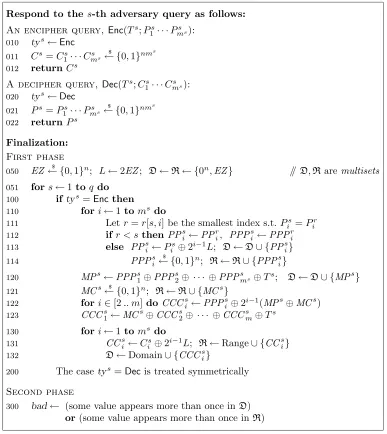
When the adversary finishes all of its oracle queries and halts, we execute the “finalization” step of game RND3. First, we go over all the variables of the game and determine their values, just as we do in game RND2. While doing so, we collect all the values in the sets Domain and Range, this time viewing them asmultisets Dand R, respectively. When we are done setting values to all the variables, we go back and look at Dand R. The flag bad is set if (and only if) any of these multisets contains some value more than once. This procedure is designed to setbad under exactly the same conditions as in game RND2. The following is thus clear:
Respond to the s-th adversary query as follows: An encipher query, Enc(Ts;Ps
1· · ·Pmss):
010 tys←Enc
011 Cs=Cs 1· · ·Cmss
$
← {0,1}nms
012 returnCs
A decipher query, Dec(Ts;Cs
1· · ·Cmss):
020 tys←Dec
021 Ps=Ps 1· · ·Pmss
$
← {0,1}nms
022 returnPs
Finalization: First phase
050 EZ ← {$ 0,1}n; L←2EZ; D←R← {0n,EZ} //D,R aremultisets
051 fors←1 toqdo 100 iftys=Encthen
110 fori←1 tomsdo
111 Letr=r[s, i] be the smallest index s.t.Ps i =Pir
112 ifr < sthenPPs
i ←PP r i, PPP
s
i ←PPP
r i
113 else PPs
i ←Pis⊕2i−1L; D←D∪ {PP s i}
114 PPPs
i
$
← {0,1}n; R←R∪ {PPPs i}
120 MPs←PPPs1⊕PPPs2⊕ · · · ⊕PPPsms⊕T
s; D←D∪ {MPs}
121 MCs← {$ 0,1}n; R←R∪ {MCs}
122 fori∈[2.. m] doCCCsi ←PPP s
i ⊕2i−1(MP
s⊕MCs)
123 CCCs
1←MCs⊕CCCs2⊕ · · · ⊕CCCsm⊕Ts
130 fori←1 tomsdo
131 CCsi ←Cis⊕2i−1L; R←Range∪ {CC s i}
132 D←Domain∪ {CCCs
i}
200 The casetys=Decis treated symmetrically
Second phase
300 bad← (some value appears more than once inD) or(some value appears more than once inR)
Figure 7: Game RND3 is adversarially indistinguishable from game RND2 but defers the setting ofbad.
Game NON1. So far we have not changed the structure of the games at all: it has remained an adversary askingq questions to an oracle, our answering those questions, and the internal variable
bad either ending up true or false. The next step, however, actually gets rid of the adversary, as well as all interaction in the game.
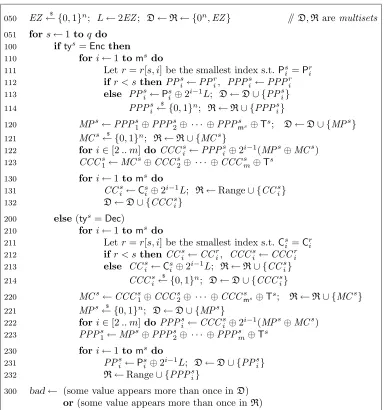
We want to bound the probability thatbadgets set totruein game RND3. We may assume that the adversary is deterministic, and so the probability is over the random choicesPs← {$ 0,1}nms
and
Cs← {$ 0,1}nms
that are made while answering the queries (in lines 011 and 021), and the random choicesEZ ← {$ 0,1}n,PPPsi ← {$ 0,1}n,MPs← {$ 0,1}n,MCs← {$ 0,1}n, andCCCsi ← {$ 0,1}n that are made in the first finalization phase (lines 050, 113, 120, 213, and 220). We will now eliminate the coins associated to lines 011 and 021. Recall that the adversary asks no pointless queries.
050 EZ ← {$ 0,1}n; L←2EZ; D←R← {0n,EZ} //D,R aremultisets
051 fors←1 toqdo 100 iftys=Encthen
110 fori←1 tomsdo
111 Letr=r[s, i] be the smallest index s.t.Ps i =Pri
112 ifr < sthenPPsi ←PP r i, PPP
s
i ←PPP
r i
113 else PPsi ←P
s i⊕2
i−1L; D←D∪ {PPs i}
114 PPPsi
$
← {0,1}n; R←R∪ {PPPs i}
120 MPs←PPPs
1⊕PPPs2⊕ · · · ⊕PPPsms⊕T
s; D←D∪ {MPs}
121 MCs $
← {0,1}n; R←R∪ {MCs}
122 fori∈[2.. m] doCCCs
i ←PPP
s
i ⊕2i−1(MP
s⊕MCs)
123 CCCs
1←MCs⊕CCCs2⊕ · · · ⊕CCCsm⊕Ts
130 fori←1 tomsdo
131 CCsi ←Csi ⊕2i−1L; R←Range∪ {CC s i}
132 D←D∪ {CCCs
i}
200 else(tys=Dec)
210 fori←1 tomsdo
211 Letr=r[s, i] be the smallest index s.t.Csi =Cri
212 ifr < sthenCCsi ←CC r i, CCC
s
i←CCC
r i
213 else CCsi ←Csi ⊕2i−1L; R←R∪ {CC s i}
214 CCCs
i
$
← {0,1}n; D←D∪ {CCCs i}
220 MCs←CCCs1⊕CCC s
2⊕ · · · ⊕CCC s ms⊕T
s; R←R∪ {MCs}
221 MPs← {$ 0,1}n; D←D∪ {MPs}
222 fori∈[2.. m] doPPPsi←CCC s
i ⊕2i−1(MP
s⊕MCs)
223 PPPs1←MPs⊕PPPs2⊕ · · · ⊕PPPsm⊕Ts
230 fori←1 tomsdo
231 PPsi←Psi ⊕2
i−1L; D←D∪ {PPs i}
232 R←Range∪ {PPPsi}
300 bad← (some value appears more than once inD) or(some value appears more than once inR)
Figure 8: Game NON1 is based on game RND3 but nowτ = (ty,T,P,C)is a fixed, allowed transcript.
For example, assume that r-th and s-th queries (r < s) are both encipher queries, and that the random choices in line 011 specify that the i’th ciphertext block in the two answers is the same,
Cir=Cis. Then the flagbadis sure to be set, since we will have a “collision” betweenCCri andCCsi. Formally, since in line 131 we set CCri = Cir⊕2i−1L =Cs
i ⊕2i−1L = CCs1, and since both CCri
and CCsi are added to R we would set bad when we examine their values in line 300. A similar example can be shown for decipher queries. We call such collisionsimmediate collisions. Formally, an immediate collision happens whenever we have Cir = Cis (r < s) and query s is an encipher query, and whenever we have Pr
i =Pis (r < s) and query sis a decipher query. The probability of
an immediate collision in game RND3 is at most
q
X
s=1
ms(s−1) 2n <
q
2n q
X
s=1
ms = qσn 2n
(T1,· · ·,Tq), and P = (P1,· · ·,Pq), and C = (C1,· · ·,Cq) where tys ∈ {Enc,Dec}, Ts ∈ {0,1}n,
and Ps =Ps1· · ·Psms and Cs =Cs1· · ·Csms for|Pr
i|=|Cri|=n. This fixed transcript may not specify
any immediate collisions or pointless queries; we call such a transcriptallowed. Thus saying thatτ is allowed means that for allr < s we have the following: if tys =Enc then (i) (Ts,Ps)6= (Tr,Pr)
and (ii)Csi 6=Cri for anyi∈[1..m]; while if tys =Dec then (i) (Ts,Cs)6= (Tr,Cr) and (ii)Psi 6=Pri for any i∈[1..m]. Now fix an allowed transcript τ that maximizes the probability of the flag bad being set. This one transcript τ is hardwired into game NON1. We have that
Pr[ARND3 setsbad] ≤ Pr[ NON1 setsbad] + qσn
2n (9)
This step can be viewed as conditioning on the presence or absence of an immediate collision, followed by the usual argument that an average of a collection of real numbers is at most the maximum of those numbers. One can also view the transition from game RND3 to game NON1 as augmenting the adversary, letting it specify not only the queries to the game, but also the answers to these queries (as long as it does not specify immediate collisions or pointless queries). In terms of game RND3, instead of having the oracle choose the answers to the queries at random in lines 011 and 021, we let the adversary supply both the queries and the answers. The oracle just records these queries and answers. When the adversary is done, we execute the finalization step as before to determine thebad flag. Clearly such an augmented adversary does not interact with the oracle at all, it just determines the entire transcript, giving it as input to the oracle. Now maximizing the probability of setting bad over all such augmented adversaries is the same as maximizing this probability over all allowed transcripts.
Game NON2. Before we move to analyze the non-interactive game, we make one last change, aimed at reducing the number of cases that we need to handle in the analysis. We observe that due to the complete symmetry betweenD andR, it is sufficient to analyze the collision probability in just one of them. Specifically, because of this symmetry we can assume w.l.o.g. that in game NON1
Pr[some value appears more than once inD]≥Pr[some value appears more than once inR]
and therefore Pr[ NON1 setsbad]≤2·Pr[some value appears more than once inD].
We therefore replace the game NON1 by game NON2, in which we only set the flagbad if there is a collision inD. We now can drop the code that handlesR, as well as anything else that doesn’t affect the multisetD. The resulting game is described in Figure 9, and we have
Pr[ NON1 setsbad] ≤ 2·Pr[ NON2 sets bad] (10)
B.2 Analysis of the non-interactive game
In the analysis we view the multisetDas a set of formal variables (rather than a multiset containing the values that these variables assume). Namely, whenever we setD←D∪{X}for some variableX
we think of it as setting D←D∪ {“X”} where “X” is the name of that formal variable. Viewed in this light, our goal now is to bound the probability that two formal variables in D assume the same value in the execution of NON2. We observe that the formal variables in D are uniquely determined byτ—they don’t depend on the random choices made in the game NON2; specifically,
D = {Zero,EZ} ∪ {MPs| s≤q}
∪ {PPsi | tys=Dec, i≤ms} ∪ {PPsi | tys=Enc, i≤ms, s=r[s, i]}
050 EZ ← {$ 0,1}n ; L←2EZ; D← {0n,EZ}
051 fors←1 toqdo 100 iftys=Encthen
110 fori←1 tomsdo
111 Letr=r[s, i] be the smallest index s.t.Ps i =Pri
112 ifr < sthenPPsi←PP r i, PPP
s
i ←PPP
r i
113 else PPsi ←Psi⊕2i−1L; D←D∪ {PP s i}
114 PPPsi
$ ← {0,1}n
120 MPs←PPPs1⊕PPPs2⊕ · · · ⊕PPPsms⊕T
s; D←D∪ {MPs}
121 MCs $
← {0,1}n
122 fori∈[2.. m]doCCCsi ←PPP s
i ⊕2i−1(MP s
⊕MCs) 123 CCCs1←MC
s
⊕CCCs2⊕ · · · ⊕CCC s m⊕Ts
130 fori←1 tomsdo D←D∪ {CCCs i}
200 else (tys=Dec)
210 fori←1 tomsdo
211 Letr=r[s, i] be the smallest index s.t.Cs i =C
r i
212 ifr < sthenCCCsi ←CCC r i
213 else CCCs
i
$
← {0,1}n; D←D∪ {CCCs i}
220 MCs←CCCs1⊕CCC s
2⊕ · · · ⊕CCC s ms⊕T
s
221 MPs $
← {0,1}n ; D←D∪ {MPs}
222 fori∈[2.. m]doPPPsi ←CCC s
i ⊕2i−1(MP s⊕
MCs) 223 PPPs1←MP
s⊕
PPPs2⊕ · · · ⊕PPP s m⊕Ts
230 fori←1 tomsdoPPs
i ←Psi⊕2
i−1L; D←D∪ {PPs i}
300 bad← (some value appears more than once inD)
Figure 9: Game NON2. Twice the probability that bad gets set in this game bounds the probability that bad
gets set in game NON1. We highlight random selection by shading, and statements that growD by boxing.
(where “Zero” is a formal constant that always assumes the value 0n). We view the formal variables inDasordered according to when they are assigned a value in the execution of game NON2. This ordering too is fixed, depending only on the fixed transcriptτ. Our goal is to show the following:
Throughout the remainder of this section, in all probability claims, the implicit experiment is that of game NON2. We adopt the convention that in an arithmetic or probability expression, a formal variable implicitly refers to its value. For example, Pr[X =X0] means the probability that the value assigned toX is the same as the value assigned to X0. (At times we may still write “X” to stress that we refer to the name of the formal variableX, or value(X) to stress that we refer to the value ofX.) The rest of this section is devoted to case analysis, proving the following claim:
Claim 1 For any two distinct variableX, X0∈Dwe have that Pr[X=X0]≤2−n.
Before proving Claim 1, we show how to use it to complete the proof of Theorem 1. Due to our conventions on how to measure the query complexity there are no more than 2σn+ 1 variables inD
so the union bound gives us that
Pr[ NON2 setsbad]≤
2σn+ 1
2
Combining Lemma 2 with Equations 7, 8, 9, 10 and 11 we are done:
Adv±EME[Perm(prpg n)](A) ≤ AdvEME[Perm(±grnd n)](A) +q(q−1)/2n+1
≤ 2·Pr[NON2 sets bad] +qσn/2n+q(q−1)/2n+1
≤ 2·
2σn+ 1
2
/2n+qσn/2n+q(q−1)/2n+1
≤ (2σn+ 1)(2σn) +σ 2
n+ 0.5σn2
2n
≤ 7σ 2
n
2n
Since Awas an arbitrary adversary with query complexity of σnwe are done.
The case analysis. We now need to prove Claim 1. We first prove a few claims (Claims 4 through 7 below), each covering some special cases of collisions, and then go through a systematic case analysis, showing that all possible cases are indeed covered by these claims.
Inspecting the code of game NON2 we see that the only random choices in the game are the selection EZ ← {$ 0,1}n in line 050, the selections PPPs
i $
← {0,1}n and MCs $
← {0,1}n on encipher
(lines 114, 121), and the selectionsCCCsi ← {$ 0,1}nandMPs $
← {0,1}non decipher (lines 213, 221).
Specifically, the variables that are directly chosen at random are EZ, the variables PPPsi from encipher queries such thats=r[s, i], the variablesCCCsi from decipher queries such thats=r[s, i], the variablesMPs from encipher queries, and the variables MCs from decipher queries. Hereafter we refer to these variables as the free variables of the game, and we letF denote the set of them:
F = {EZ} ∪ {MPs | tys=Dec} ∪ {MCs | tys=Enc} ∪ {PPPsi | tys=Enc, i≤ms, s=r[s, i]}
∪ {CCCsi | tys=Dec, i≤ms, s=r[s, i]}
The value of any other variable in the game can be expressed as a function in these free variables. In fact, the bulk of the argument below is to show that for any pair of variables in D, either their sum is some non-zero constant, or else it depends linearly on at least one free variable. We first prove a little helpful observation.
Claim 2 If r is an encipher query (tyr = Enc) and I ⊆[1..mr] is a non-empty set, then we have
P
i∈ICCCri = aMCr+β, where a 6= 0 is a constant (that depends on the set I) and β is an
expression involving only constants and free variables that are determined beforeMCr in the game NON2.
Likewise, if r is a decipher query (tyr = Dec) and I ⊆ [1..mr] is a non-empty set, then
P
i∈IPPPri =aMPr+β, where a6= 0 is a constant andβ is an expression involving only constants
and free variables that are determined beforeMPr in the game NON2.
Proof: We prove here only the first assertion. The proof of the other assertion is completely symmetric. Since r is an encipher query, then the values of all the CCCri’s except the first (i.e.,
i∈[2..mr]), are set in line 122,CCCr
i ←PPPri ⊕2i−1(MPr⊕MCr). If 1∈/ I then we have
X
i∈I
CCCri = X
i∈I
PPPri ⊕2i−1(MPr⊕MCr)
= things-that-were-determined-before-MCr ⊕ X
i∈I
2i−1
and the coefficient of MCr is non-zero since I is non-empty.4
For the case where 1∈I, since in line 123 we set CCCr1←MCr⊕ Pmi=2r CCCri, we get
X
i∈I
CCCri = CCCr1 ⊕ X
i∈I, i6=1 CCCri
= MCr⊕
mr
X
i=2 CCCri
!
⊕ X
i∈I, i6=1 CCCri
= MCr⊕ X
i /∈I,2≤i≤mr CCCri
= MCr⊕ X
i /∈I,2≤i≤mr
PPPri ⊕2i−1(MPr⊕MCr)
= things-that-were-determined-before-MCr ⊕
1⊕ X
i /∈I, 2≤i≤mr 2i−1
MCr
and again, the coefficient ofMCr is non-zero.
To simplify the case analysis to come, we consider, for each variable X ∈ D, the last free variable (in the ordering of the game NON2) thatXdepends on, denotedφ(X). Formally, we have a function φ:D→F∪ {none} that is defined as follows:
• As “Zero” is a constant, we denoteφ(Zero) =none.
• For the formal variables EZ,PPsi ∈D, this last free variable isEZ,φ(EZ) =φ(PPsi) =EZ.
• For a formal variable CCCsi ∈ D this last free variable φ(CCCsi) is either CCCsi itself (on decipher)5 orMCs (on encipher). (The last assertion is a corollary of Claim 2 for I ={i}.)
• The rules forMPs are a bit more involved. Clearly, on decipher we haveφ(MPs) =MPs. For encipher, recall that we set (in line 120) MPs←Ts⊕ Pmi=1PPPsi, so the last free variable thatMPs depends on, is the “last of the free variables that any PPPsi depends on”.
Each of thesePPPsi’s can either be a free variable itself (if this is a “new block”,s=r[s, i]), or it can be set equal to some priorPPPri (ifr=r[s, i]< s). In the latter case,PPPri is either a free variable (if queryr is encipher), or else it depends onMPr (if queryr is decipher). To defineφ(MPs), we therefore denote
rmax[s]def= max{r[s, i] | 1≤i≤m}, imax[s]def= max{ i | r[s, i] =rmax[s]}
and then, on encipher (tys =Enc) we have
φ(MPs) =
(
MPrmax[s] iftyrmax[s] =Dec PPPrmaximax[[ss]] ifty
rmax[s] =Enc
A summary of all these cases appears in Figure 10. We stress that just like the sets D and F, the function φ too depends only on the fixed transcript τ and not on the random choices in the game NON2. Justifying the name “last free variable” we observe the following, which follows from the preceding discussion:
4
Here we use the fact thatmr ≤n.
5
Note thatCCCsi ∈D, which means thatC s
φ(Zero) = none Z
φ(EZ) = EZ EZ
φ(PPsi) = EZ iftys=Dec ors=r[s, i] PP
φ(CCCsi) =
(
CCCsi iftys=Dec and s=r[s, i]
MCs iftys=Enc
CCC1
CCC2
φ(MPs) =
MPs iftys=Dec MPrmax[s]
iftys=Enc andtyrmax[s] =Dec PPPrmaximax[[ss]] ifty
s=Enc andtyrmax[s] =Enc
MM1
MM2
MM3
Figure 10: Defining the last free variable, φ(X), associated to formal variable X ∈ D. Transcript τ = (ty,T,P,C)has been fixed and it determines r[·,·], rmax[·]and imax[·].
Claim 3 Let X ∈ D be a formal variable, and let Y = φ(X). If Y 6= none then the value that X assumes in game NON2 can be expressed as value(X) = a·value(Y)⊕β where a6= 0 is a constant (that depends on the name of the formal variableX and the fixed transcript τ) and β is an expression involving only constants and free variables that are determined before Y in the
game NON2. 2
As an immediate corollary of Claim 3, we get the following.
Claim 4 LetX, X0 ∈Dbe formal variables such that φ(X)6=φ(X0). Then Pr[X =X0] = 2−n.
Proof: letY =φ(X) and letY0 =φ(X0), and assume thatY0occurs beforeY in NON2. By Claim 3 above, we haveX⊕X0 =a·Y ⊕β ⊕ a0·Y0⊕β0 wherea6= 0 is a constant, andβ⊕ a0·Y0 ⊕β0 is an expression involving only constants and free variables that are determined beforeY. As the value of Y is chosen at random from GF(2n), independently of the other free variables, it follows that Pr[X =X0] = 2−n.
Claim 4 leaves us with the task of analyzing collisions between variables that depend on the same last free variable. These are handled in the next three propositions.
Claim 5 Let X, X0 ∈ Dbe two distinct formal variables, such that φ(X) = φ(X0) = EZ. Then Pr[X=X0]≤2−n.
Proof: Recall thatL= 2EZ. The types of collisions that we need to analyze are eitherEZ vs. PPsi for some PPsi ∈D, orPPsi vs. PPsi00 forPPsi,PPs
0
i0 ∈D. We start with collisions of the type PPsi vs. PPsi00. If i6=i0 then we have
PPsi ⊕PPsi00 = (Pis⊕2i−1L)⊕(Ps 00
i⊕2i
0−1
L) =Psi ⊕Ps0i0 ⊕(2i⊕2i0)EZ
and as i6=i0, the coefficient of EZ is non-zero, and therefore Pr[PPsi ⊕PPis00 = 0n] = 2−n. Ifi=i0 ands0 < sthen necessarilyPs
i 6=Ps
0
and PPsi ∈/ D, or query s is encipher, which means that the transcript τ specifies an immediate collision.) Therefore, with probability one we havePPsi ⊕PPsi00 = (Psi ⊕2i−1L)⊕(Ps
0
i⊕2i−1L) =
Psi ⊕Ps0i 6= 0. For the other type of collisions,EZ vs. PPsi, we have
PPsi ⊕EZ = (Psi ⊕2i−1L)⊕EZ = (Pis⊕2iEZ)⊕EZ =Psi ⊕(1⊕2i)EZ
and again, sincei≥1 the coefficient of EZ is non-zero.
Claim 6 For any two distinct variablesCCCsi,CCCsi00 ∈Dwithφ(CCCsi) =φ(CCCs 0
i0), Pr[CCCsi = CCCsi00] = 2−n.
Proof: By inspecting Figure 10, we see that for two variable CCCsi,CCCsi00 ∈ D, the equality
φ(CCCsi) = φ(CCCis00) implies that s=s0, and that this is a encipher query, tys =Enc (in which case φ(CCCsi) =φ(CCCsi00) =MCs).
By Claim 2 (with I = {i, i0}), we can write CCCs
i ⊕CCCsi0 = aMCs+β where a is a non-zero constant andβ is an expression involving only constants and variables that were determined before MCs. Hence we have
Pr[CCCsi =CCCsi00] = Pr[aMCs+β = 0n] = Pr[MCs = a−1β] = 2−n
sinceMCs is a free variable.
The most involved case to analyze (indeed, the one that embodies the “real reason” that EME is secure) is collisions of the typeMPs=MPs0. These are analyzed in Claim 7 below.
Claim 7 For any two distinct variables MPs,MPt ∈ D with φ(MPs) = φ(MPt), it holds that Pr[MPs=MPt]≤2−n.
Proof: Fix some s < t such that φ(MPt) = φ(MPs). In Figure 10 we see that the equality
φ(MPs) = φ(MPt) implies that the later query t must be encipher (i.e., tyt = Enc), and either querys is decipher withrmax[t] =s, or query sis encipher withrmax[t] =rmax[s].
If the plaintext vectors in both queries are the same (i.e., they havePs=Pt) then it must be that the tweaks differ between them, Ts6=Tt (since the transcriptτ does not specify pointless queries). From Ps =Pt it follows that PPPs
i =PPPti for all i, and therefore with probability one we have
MPs⊕MPt=Ts⊕Tt6= 0.
So from now on we assume that Ps 6= Pt. Let E be the set of indexes where Ps,Pt are equal,
E def= {i≤min(ms,mt) | Ps
i =Pti}. We note that the sumMPs⊕MPt can be written as
MPs⊕MPt = Ts⊕
ms
X
i=1
PPPsi ⊕Tt⊕
mt
X
i=1 PPPti
= Ts⊕Ts0⊕ X
i≤ms
,i /∈E
PPPsi ⊕ X
i≤mt
,i /∈E
PPPti (12)
where the last equality is justified sincePsi =Pti impliesPPPsi =PPPti.
We first analyze the case where query sis decipher,tys =Dec, and furthermorePsis not a proper
![Figure 1: Enciphering (left) and deciphering (right) underblock cipher. The tweak is E = EME[E], where E: K × {0, 1}n → {0, 1}n is a T ∈ {0, 1}n and the plaintext is P = P1 · · · Pm and the ciphertext is C = C1 · · · Cm.](https://thumb-us.123doks.com/thumbv2/123dok_us/1840357.1238446/6.612.139.479.342.684/figure-enciphering-deciphering-underblock-cipher-tweak-plaintext-ciphertext.webp)
![Figure 3: Enciphering (left) and deciphering (right) underblock cipher. The tweak is E = EME+[E], where E: K × {0, 1}n → {0, 1}n is a T ∈ {0, 1}n and the plaintext is P = P1 · · · Pm and the ciphertext is C = C1 · · · Cm.](https://thumb-us.123doks.com/thumbv2/123dok_us/1840357.1238446/12.612.137.496.365.686/figure-enciphering-deciphering-underblock-cipher-tweak-plaintext-ciphertext.webp)
![Figure 5: Game EME1 describes the attack of A on EME[Perm(n)], where the permutation π is chosen “on thefly” as needed](https://thumb-us.123doks.com/thumbv2/123dok_us/1840357.1238446/14.612.127.487.118.648/figure-game-describes-attack-permutation-chosen-they-needed.webp)


![Figure 10:Defining the last free variable,( φ(X), associated to formal variablety, T, P, C) has been fixed and it determines r[·, ·], rmax[·] and imax[·].](https://thumb-us.123doks.com/thumbv2/123dok_us/1840357.1238446/23.612.121.491.69.286/figure-dening-variable-associated-formal-variablety-xed-determines.webp)