THE METASTABLE. NATURE OF PARAMUTABLE R ALLELES IN MAIZE. 111. HERITABLE CHANGES IN LEVEL OF R ACTION
IN HETEROZYGOTES CARRYING DIFFERENT PARAMUTABLE R ALLELES
E. D. STYLES'
Department of Genetics, Uniuersity of Wisconsin, Madison, Wisconsin 53706
Received August 22, 1966
ARAMUTABLE R alleles in maize are subject to a marked heritable repres- 'sion of aleurone pigmenting potential in heterozygotes with a n unmistakably paramutagenic allele such as stippled (review, BRINK 1964). They have been found to undergo less marked, but nevertheless measurable and heritable, changes in R I- and R R cultures also (STYLES and BRINK 1966; STYLES 1966). In general, the aleurone pigmenting potential of a paramutable R allele increases when maintained in highly inbred W22 stocks heterozygous with r (colorless aleurone) and decreases, or remains comparatively stable, when maintained homozygous R R on this background. Thus by following simple mating schemes, stocks may be bred which contain an allele of a given origin in different states of expression. Furthermore, R alleles which have been obtained from diverse geographic or varietal sources and which differ slightly in single dose aleurone expression when compared initially in TV22 background may be brought to similar states by these procedures, in separate cultures, so that they can no longer be distinguished from each other (STYLES, 1967).
The experiments reported here show that an additional characteristic of para- mutable R alleles is an inherent paramutagenic capacity which is expressed when
a given R allele is made heterozygous with another paramutable R allele origi- nally stronger in aleurone pigmenting potential than itself. The regularly occur- ring interaction between paramutable R alleles when paired with each other in heterozygotes is understandable as an expression of the metastability of such alleles with which this series of articles is concerned.
MATERIALS A N D METHODS
The R alleles used in this study have been described in previous articles of the series (STYLES and BRINK 1966; STYLES 1967). Alleles designated R7 condition colored aleurone, colored s e d lings, and colored anthers; Rg' alleles of the class used here give colored aleurone, green seedlings and anthers. The two groups are indistinguishable in paragenetic and aleurone pigmenting properties, but can be separated from each other definitively on the basis of seedling and anther color. Standard Rf' has been extensively used in earlier paramutation studies; the other alleles
' Paper No. 1098 from the Department of Genetics, College of Agriculture, University of Wisconsin. ' Present address: Department of Biology, University of Victoria, Victoria, British Columbia, Canada
412 E. D. STYLES
are designated according to geographic origin. All were incorporated, by repeated backcrossing, into a uniform strain of an inbred line of maize known as W22.
A number of different R,R, heterozygotes ( R , and R , distinguishable from each other in each instance by plant color characteristics, symbolized by RT and Rg) were produced by mating
R,rg and R,rg plants to yield sib progeny with Rlrg, R,R, and R2rg genotypes. In the main, the
R,R, combinations made were between alleles known at the start of the experiment to differ from each other in single dose ( R r r ) aleurone phenotype. R,R, lineages were maintained for several generations by self-fertilization. In some cases, the homozygous RIRl and R,R, plants obtained as segregates were selfed also to establish homozygous R I R , and R,R, lineages. The
R rg plants used for the initial crosses were either closely related to, or full sibs of, plants used for generation I of a previously reported experiment (STYLES 1967) designed to measure effects, on this same group of alleles, of homozygosity and of heterozygosity with r g . Thus information
on the effect of R R homozygosity per se is available for comparison with data from this experi- ment which concern expressly effects of heterozygosity between R alleles of different origin. The aleurone pigmenting potential of each allele was measured at each generation by crossing representative plants to W22 f l r g females, and scoring the resulting aleurone phenotypes by
matching them against a standard scale defining seven grades of aleurone mottling from color- less (class 1) to self-colored (class 7). (For further details see STYLES and BRINK 1966). R alleles
TABLE 1
Progressive change in level of R action in heterozygotes carrying paramutable R alleles with different single dose aleurone pigmenting potentials. R r r aleurone color scores
from the alleles: R, =India R g , R, =Argentina R'
Generation I R1r
Families 1
Plants 15
Mean score 7 . 0 0
15 6.14
Generation I1 R1r
(From Generation I R,r x R,r)
Families 3
Plants 5
Mean score 7.00
R J R ,
3 5 6.93 5.39
3 5 5.23
Generation I11 RlRl
(From selfed generation I1 plants)
Families 2
Plants 7
Mean score 6.39
R l / R ,
2 12 5.95 4.78
2 7 5.09
Generation IV RlRl R A R J R , R,R, R,R,
(From selfed generation I11 plants)
Families 4 6 6 6 4
Plants 11 17 21 15 12
Mean score 6.12 6.30 6.01 5.60 5.76 5.25
Generation V RlRl RlRl R J R , RZR, R,R*
(From selfed generation IV plants)
Families 3 4 4 4 3
Plants 12 11 12 9 12
CHANGE I N LEVEL O F GENE ACTION 41 3 in RlR2 heterozygous plants were evaluated by scoring 125 kernels per testcross ear and then germinating to determine seedling color. The value assigned to each allele was the mean for the first 50 kernels which germinated with the appropriate seedling color. Most of the kernels in this experiment scored as dark mottled or self-colored, i.e., they were in a range that approached or reached the limits of the scoring method. As a consequence, many important comparisons are between sets of data statistically without variance (7.00
+
0.00) and data which is highly vari- able. No attempt has been made to analyze the data statistically. Instead, emphasis is based on consistency in patterns of change rather than on absolute degree o r direction of change-an exception to this rule of emphasis being taken where the change has been from a self-colored to a mottled phenotype.RESULTS
R alleles with different levels of
R
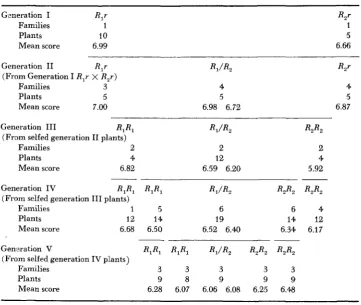
action: Tables 1 and 2 contain summarized data from the pairs of alleles ( 1 ) R , = India R g , R2 = Argentina R' and (2) R, = Kansas R', R, = Argentina Rg, respectively. The testcross scores are illus- trated in Figure 1 . Bothl?,
alleles conditioned near self-color or self-color in singleTABLE 2
Progressive change in lever' of R action in heterozygotes carrying paramutable R alleles with different single dose aleurone pigmenting potentials. R r r aleurone color scores
from the alleles: R , = Kansas R'; R , = Argentina Rg
Generation I R,r Rzr
Families 1 1
Plants 10 5
Mean score 6.99 6.66
Generation I1 R,r R J R , R2r
(From Generation I R,r x R , r )
Families 3 4 4
Plants 5 5 5
Mean score 7.00 6.98 6.72 6.87
Generation I11 RlRl
(Fram selfed generation I1 plants)
Families 2
Plants 4
Mean score 6.82
RZR2
2 4 5.92
RlRl RlR, R d R , RZR, RZR,
Generation IV
(From selfed generation I11 plants)
Families 1 5 6 6 4
Plants 12 14 19 14 12
Mean score 6.68 6.50 6.52 6.40 6.34 6.17
Generation V R,R, RlRl R d R 2 R2R2 R2R*
(From selfed generation IV pllants)
Families 3 3 3 3 3
Plants 9 8 9 9 9
414
E. D. STYLESO L N L I A T I O N
FIGURE 1 .-Progressive change in level of R action in heterozygotes carrying paramutable R alleles with different single dose aleurone pigmenting potentials. Heavy lines connect values obtained from alleles maintained in R,R, heterozygotes by self-fertilization of R,R, plants. Fine lines indicate mean scores of homozygous sib segregates and descendants.
dosecwhen tested in generation I R,r plants. The R, alleles gave dark, but distinctly mottled, aleurone when similarly tested. The generation V testcross scores show that both R, alleles underwent a distinct change in the R,R, heterozygotes. After four generations of heterozygosity, they were no longer distinguishable by aleurone phenotype from the R, alleles with which they were partnered. Only their differing plant colors allowed them to be separated. A previous experiment
(STYLES 1967) showed that some reduction in R action is to be expected when so-called “strong” paramutable R alleles (self-colored, or nearly so, in single dose) are maintained in homozygous ( R R ) condition. The reduction in the case of the India Rg and the Kansas R‘ alleles, however, was much less than that which occurred in the R,R2 heterozygotes. Three generations of homozygosity reduced the single dose aleurone score of India R g from 7.00 to 6.98 and that of Kansas R‘
from 6.99 to 6.94, whereas the scores from the same two alleles after three genera- tions of heterozygosity with a mottled R allele were 6.01 and 6.52, respectively (Tables 1 and 2). In contrast, there appears to have been little change in the
R, alleles that could not be attributed to the R R condition as such. The aleurone color score for the Argentina R‘ allele changed from 6.14 to 5.69 after three generations of homozygosity; after three generations of heterozygosity with India
C H A N G E I N L E V E L O F G E N E A C T I O N 41 5 tion in score from 6.66 to 6.54 after three generations of homozygosity and to 6.40 after three generations of heterozygosity with Kansas
R'.
Thus there is no marked alteration in the R, expressions as a result of the heterozygosity with the R, alleles. Most of the change in the stronger R, alleles, however, appears attrib- utable to heterozygosity with the weaker R, alleles.The data for the pail-s of alleles (1) R1 = India R9; R, = Turkey R* and (2)
R, = India R9; R, = staindard Rr for four generations are summarized in Table 3. Figure 2 illustrates the testcross scores obtained from the heterozygous plants and compares them with four generations of the testcross scores from India Rg/Argentina R' hetercizygotes (data from Table 1 )
.
The R , allele, India RO, is the same in all three cases. The R, alleles differ in origin and also slightly in initial single dose aleui-one score. The three sets of data may be compared for the degree of change which occurs in the expression of a particular strong R allele when paired with R alleles of different aleurone pigmenting potential. Although data from three generations of heterozygosity does not serve to assess completely the possible interactions between the alleles of each pair, there is clear indication of a correlation between the amount of reduction which accurs in the potential of the R, allele and the initial level of expression of the R, allele. The generation Isingle dose expressions of the R, alleles in Figures 2A, B, and C were 6.67, 6.36, and 6.14, respectively. The RI single dose expressions after three generations of
TABLE 3A
Progressive change in level of R action in heterozygotes carrying paramutable R alleles with different single dose aleurone pigmenting potentials. R r r aleurone mlor scores
from the alleles: R, = India R g ; R, = Turkey Rr
Generation I R1r R,r
Families 1 1
Plants 15 9
Mean score 7.00 6.67
Generation 11 R1r
(From Generation I R,r x h ! g )
Families 4
Plants 5
Mean score 7.00
4 5 6.98 6.42
Generation 111 RlR, R d R , R A
(From selfed Generation I1 plants)
Families 2 2 2
Plants 6 12 6
Mean score 6.80 6.80 6.51 6.51
3 5
6.84
Generation IV R,R, R , / R , R,R,
(From selfed Generation I11 plants)
Families 4 4 4
Plants 11 12 11
41 6 E. D. STYLES TABLE 3B
Progressive c h n g e in leuel of R action in heterozygotes carrying paramutable R alleles with
different single dose aleurone pigmenting potentials. R r r aleurone color scores from the alleles: R, = India R g ; R, = standard Rr
~~ ~~ ~~~~
Generation I R,r R2r
Families 1 1
Plants 15 10
Mean score 7.00 6.36
Generation I1 R1r
(From Generation I Rlr
x
R,r)Families 3
Plants 5
Mean score 7.00
3 5 6.92 6.02
Generation I11 RlR, W R , R2R2
(From selfed Generation I1 plants)
Families 1 1
Plants 3 10
Mean wore 6.81 6.58 5.75
3 5 6.73
Generation IV RlR, RJR2 R2R2
(From selfed Generation I11 plants)
Families 2 2 2
Plants 6 6 5
Mean score 6.98 6.49 6.00 6.02
heterozygosity with these R, alleles were, in the same order, 6.58 $49, and 6.01. Heterozygotes carrying two paramutable R alleles with strong R action: Both the R alleles from which the data in Table
4
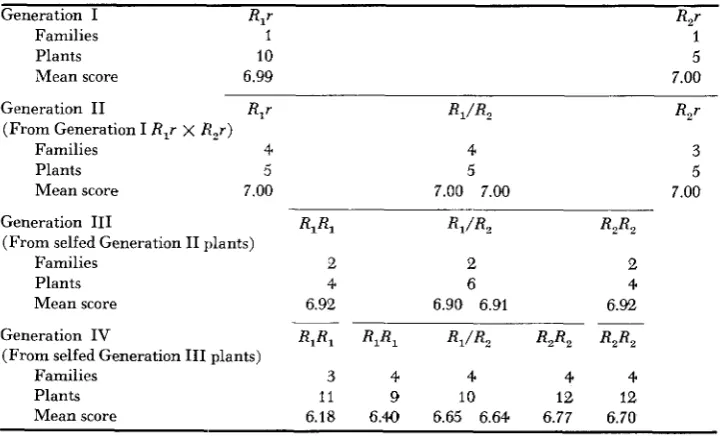
were obtained conditioned near self- colored R r r aleurone when generationI
R r plants were testcrossed. Only four of 500 kernels scored for the Kansas allele were mottled, and only one of 250 was scored as mottled for the Guatemala allele. No kernels in samples taken from the second testcross generation were mottled. The third and the fourth generations, however, produced, in increasing numbers, mottled kernels in all lineages tested, including homozygous lineages isolated as such after only one generation of heterozygosity with the allele of different origin. The two alleles in the RlR2C H A N G E I N L E V E L O F G E N E A C T I O N 41 7
. C . * E " * 7 1 0 *
FIGURE 2.-Change in level of R action when a paramutable R allele originally self-colored in R r r aleurone is maintained in heterozygotes with alleles weaker in pigmenting potential than itself.
TABLE 4
Progressive change in level o f R action in heterozygotes carrying paramutable R alleles w i t h w i t h near self-colored single dose aleurone pigmenting potential. R r r aleurone
color scores from the alleles: R, = Kansas Rr; R2 = Guatemala R g
Families 1 1
Plants 10 5
Mean score 6.99 7.00
Generation I R1r R2r
Generation I1 R1r RlIR2 R2r
(From Generation I R,r x B 2 r )
Families 4 4 3
Plants 5 5 5
Mean score 7.00 7.00 7.00 7.00
Generation 111 RlRl R J R , R2R2
(From selfed Generation I1 plants)
Families 2 2 2
Plants 4 6 4
Mean score 6.92 6.90 6.91 6.92
_ _ _ _ -
Generation IV RlRl R A R d R , R,R, R2R,
(From selfed Generation 111 plants)
Families 3 4 4 4 4
Plants 11 9 10 12 12
41 8 E. D. STYLES
zygous Kansas R’ lineages in this experiment are considerably lower than those derived from
R r
plants.DISCUSSION
The R alleles present in colored aleurone maize strains collected in most areas of the world are paramutable. When placed on a common background, these alleles often differ in pigmenting potential as expressed in single dose ( R r r )
in the triploid endosperm. They vary also in paramutagenicity as measured by the heritable changes they induce in other paramutable R alleles. The experi- mental data presented here show that the two phenomena, level of pigmenting action and paramutagenicity, are related in a characteristic way.
The properties in question in these R alleles are almost certainly inherent in the alleles themselves, and have not been acquired in response to passage through heterozygotes carrying overtly paramutagenic R factors such as stippled, marbled, or the self-colored alleles designated as group B by BRINK (1964). These strongly paramutagenic, non-paramutable alleles appear limited in distribution to the Andean region of South America, whereas the R factors under study here were derived from much more widely scattered sources.
The variations in pigmenting producing and paramutagenic potentials of these widely distributed R factors, based on tests with stock cultures, could have resulted from differences in genetic history with reference to heterozygosity for r (STYLES 1967) or heterozygosity with other paramutable R forms. The results presented in this article establish the importance of the latter source of variation.
The experimental results bring to light two sets of conditions in R,R, plants under which change in R potential occurs, namely, heterozygosity for alleles that initially differ measurably in potential, and heterozygosity f o r alleles both of which are “strong” at first and are therefore not directly distinguishable. The former condition leads to a progressive reduction in expression of the stronger allele toward the level of the weaker partner, whereas the latter condition results in a progressive reduction of both alleles to similar levels of action. The inter- action between alleles differing in potential will be discussed first.
The term paramutation was originally proposed to include the invariable occurrence of heritable R change in certain heterozygotes and the corresponding regular partial reversion in certain other combinations (BRINK 1958). BROWN
C H A N G E I N L E V E L O F G E N E A C T I O N 41 9 the scale is such that differences measured close to the limits appear smaller when compared with differences measured in the intermediate ranges.
As emphasized above, the R alleles used in this experiment have had no history of heterozygosity with stippled or similar overtly paramutagenic alleles. Never- theless such alleles apparently have properties similar, given the correct con- ditions for measurement, to the secondary paramutagenic properties of R’ alleles derived from R Rst heterozygotes. If the interaction between stock alleles of
different pigmenting potentials is similar to the secondary paramutation phe- nomenon, then an interpretation of secondary paramutation requiring direct involvement (transfer of a paramutagenic component, or the like) of stippled is not supported. Furthermore, all tests so far made for the involvement in para- mutation of a gene-dependent cytoplasmic particle have proved negative ( BRINK, KERMICLE, and BROWN 1964). Recently acquired evidence shows that paramut- able R alleles, as a class, are metastable (STYLES 1967) and that they respond in level of pigmenting action, in a heritable fashion, to different paramutagenic influences-the degree and direction of the response being determined by the conditioning influence. The action of stippled, therefore, could be visualized as a pronounced repressing influence on the level of action of R in R R S t plants which is heritable. Heterozygosity with r, on the other hand, is a condition which allows heritable enhancement of R expression. The significant fact from the standpoint of the subsequent action of a given paramutable R allele appears to be the state it has acquired by virtue of its genetic history and not its exposure as such in a heterozygote to one or another allele that has heritably altered its properties. On this view a paramutant R’ allele represses the action of its paramutable partner in an R R’ plant because of the state of the R’ allele rather than because R’ has previously been associated with stippled in a heterozygote.
The interaction between two strong R alleles is unlike the interaction between alleles differing in potential in that both strong alleles were apparently at the same initial level and that both suffered a reduction in ptential, and to similar levels. Although no completely satisfactory explanation can be offered at this time, there are observaiions from other experiments which are probably relevant: (1 ) There is a positive correlation between the single dose aleurone expression of a paramutable R alllele and the single dose expression of its R’ form derived from F , R Rst plants (STYLES and BRINK 1966; STYLES 1967). Thus a mottled allele yields a lighter R’ form than does an allele which is self-colored in single dose. It is also true, however, that alleles which are similar in that they give self- color in single dose can differ with respect to the mean scores of their R’ forms. Thus differences between paramutable R alleles self-colored in single dose may exist which are of a similar nature to the directly measurable differ- ences between, for exalmple, one allele that is self-colored and another that is mottled. (2) Paramutable R alleles with strong pigmenting action decrease in pigmenting potential i~n homozygous stocks obtained from self-fertilized R r
plants and thereafter maintained homozygous by selfing (STYLES 1967). More
420 E. D. STYLES
however, than expected from the R R state as such, and therefore some reduction must be attributed to heterozygosity with another and different strong allele. It
appears probable that strong alleles cannot maintain their high pigmenting po- tential in R
R
plants, and that when partnered with another paramutable allele will tend to revert to a mottled condition. The rate at which a given allele becomes mottled, however, appears to depend on the state of the allele with which it is partnered. In the homozygous state, i.e., the state at which the two R genes are most likely to be at similar levels of action, the rate of change is the slowest. When partnered with another strong allele, when the possibility of both alleles being at different (though not necessarily directly measurable as such) potentials is greater, the change is more rapid, in terms of plant generations, although not as rapid as when partnered with a mottled allele, in which case the rate becomes dependent to some extent on the pigmenting level of the mottled allele.Certain standard R' stocks have been maintained homozygous, by self-fertiliza- tion, for many generations in W22 background. Such standard Rr stocks will consistently give single dose mean scores of, say, 5.00 in a n arbitrary seven class color scale. Some variation around this norm exists among kernels on a single testcross ear, and among sib plants of a single family, but not an unusual amount of variation for the type of character (mottling) on which the score is based. Thus it appears that a certain stability of expression may be achieved when the potential of a paramutable allele is such that it produces a mottled phenotype in single dose. The mean score of standard R' from such stocks may be heritably altered by outcrossing to closely related W22 stocks carrying other R forms. For example, one generation of heterozygosity with
RSt
is sufficient to reduce the mean single dose aleurone score of standard R' two or three classes of the color scale (see e.g. STYLES and BRINK 1966). Several successive generations of hetero- zygosity with a n r allele can result in a n increase in single dose aleurone score of one or two classes (STYLES and BRINK 1966). Changes in either direction are accompanied by a characteristic instability expressed both i n the range of kernel phenotypes on a testcross ear and in the range of mean values obtained from sib plants. This instability is most clearly expressed in testcrosses of PI R R S t plants where the R' r r kernel phenotypes often span five or more classes of a seven class color scale. Only when there has been mosaicism for degree of change in a plant (see SASTRY, COOPER, and BRINK 1965), however, are individual kernel pheno- types likely to reflect, with any degree of certainty, the potential to be transmitted by a gamete. Nevertheless the range of phenotypes exhibited by one generation usually indicates the range of heritabilities to be expected in the following genera-tion. Thus, although immediate phenotypes are not necessarily heritable, they do indicate the degree of heritable variation that exists in a population of gametes from a single plant or in a population of kernels from a single ear.
C H A N G E IN LEVEL O F GENE ACTION 42 1 When a plant carrying an R allele that has undergone a paramutational change is self-fertilized, two gametes each carrying an R gene with a certain potential for aleurone pigmentation unite to form R R zygotes. Because of the intrinsic variability accompanying a paramutational change, the potential of each of the R genes will probably differ even though they have been produced by the same plant. An interaction might then be expected similar to that ‘which occurs in secondary paramutation phenoma, i.e., an interaction tending to equalize the potentials of the two R genes. Complete equality of potential is not brought about in one plant generation, however, as the results presented in this article show. The indication is that the differences decrease more rapidly when the differences between the potentials of the two genes are greater. This could also be interpreted to indicate that the number of plant generations required to bring two R alleles with different potentia 1s to an equilibrium is approximately the same regardless of the extent of the differences.
As discussed above, paramutable alleles respond to different paramutagenic influences in different ways. Frequently an R allele is subject to more than one influence at a time. Partial reversion of the expression of an R’ allele following repression of its potential by stippled can occur apparently independently if the R’ is partnered with r ‘or unparamutated R alleles (KERMICLE 1963). Reversion is retarded, however, in homozygous R’R‘ plants and completely prevented in R R8t plants (KERMICL~E 1963). Thus a potential for reversion can be modified or nullified by superposing a repressing influence. Paramutable
R
alleles can be obtained and maintained in a “strong” condition by maintaining them in stocks heterozygous with r. This condition is not stable in homozygotes, and in homo- zygous stocks the allele eventually reverts toward a mottled condition. The mottled condition will be reached sooner, however, if the enhanced allele is partnered with an allele that is already mottled. In this case the “secondary para- mutation” type of influence masks the natural tendency of the allele to become mottled in the R R condition, although without doubt the two phenomena are in some way related.This study was aided by grants from the Research Committee of the Graduate School, Uni- versity of Wisconsin, of funds supplied by the Wisconsin Alumni Research Foundation, by grants from the Public Health Service, the National Science Foundation, and by the Atomic Energy Commission under Contract No. AT( 11-1)-1300.
SUMMARY
422 E . D. STYLES
this type of interaction and the interaction previously described as secondary paramutation, occurring between a paramutable
R
allele and a paramutant R' derived from R R S t plants, is thought to be significant. The paramutagenicity of an R' factor may be regarded as the enhancement of a property normally present in the allele and not as an acquisition of some part of the paramutagenic proper- ties of stippled.LITERATURE CITED
BRINK, R. A., 1958 Paramutation at the R locus in maize. Cold Spring Harbor Symp. Quant.
Biol. 23: 379-391. - 1%4 Genetic repression of R action in maize. Symp. Soc. Study Develop. Growth 23: 183-230.
BRINK, R. A., J. L. KERMICLE, and D. F. BROWN, 1964 Test for a gene-dependent cytoplasmic particle associated with R paramutation in maize. Proc. Natl. Acad. Sci. U.S. 51: 1067-1074. BROWN, D. F., and R. A. BRINK, 1960 Paramutagenic action of paramutant Rr and Rg alleles
in maize. Genetics 45: 1313-1316.
KERMICLE, J. L., 1963 Metastability of paramutant forms of the R gene in maize. Ph.D. thesis.
SASTRY, G. R. K., H. B. COOPER, JR., and R. A. BRINK, 1965 Paramutation and somatic mosaicism
STYLES, E. D., 1967 The metastable nature of paramutable R alleles in maize. 11. Character-
STYLES, E. D., and R. A. BRINK, 1966 The metastable nature of paramutable R alleles in maize. University of Wisconsin Library, Madison.
in maize. Genetics 52 : 407424.
istics of alleles differing in geographic origin. Genetics 55: 399409.