THE STUDY OF CAUSES AND EFFECTS OF CHANGE ORDER TO ENGINEERING CONSULATANT PRACTITIONERS
AHMAD SAFUAN BIN AHMAD RADZI
A project report submitted in partial fulfillment of the requirements for the award of the degree of Master of Science in Construction Management
Faculty of Civil Engineering University Technology Malaysia
ACKNOWLEDGEMENTS
In preparing this thesis, I was in contact with many people, researches, academicians, and practitioners. They have contributed towards my understanding and thoughts. In particular, I wish to express my sincere appreciation to my thesis supervisor, Associate Professor Dr. Mohamad Ibrahim Mohamad, for encouragement, guidance, critics and friendship. I am also very thankful to my superior officer at work and colleague for their guidance, advice and motivation. Without their continued support and interest, this thesis would not have been the same as presented here.
ABSTRAK
ABSTRACT
TABLE OF CONTENTS
CHAPTER ITEM PAGE
TITLE i
DECLARATION ii
DEDICATION iii
ACKNOWLEDGEMENT iv
ABSTRAK v
ABSTRACT vi
TABLE OF CONTENTS vii
LIST OF FIGURES ix
LIST OF TABLES x
LIST OF APPENDICES xi
CHAPTER 1 INTRODUCTION 1
1.1 Introduction 1 1.2 Problem Statement 2 1.3 Objective of the Study 2 1.4 Scope and Limitation of the Study 3 1.5 Brief Research Methodology 3 1.6 Structure of Dissertation 5
CHAPTER 2 CHANGE ORDER IN CONSTRUCTION 6
PROJECTS
2.2 Causes of Change Order 9 2.2.1 Technical Changes 10 2.2.2 Administrative Changes 12
CHAPTER 3 CLAIM ISSUES REGARDING CHANGE 14
ORDER FOR ENGINEERING CONSULTANTS
3.1 Consulting Engineer 14 3.1.1 What is Consulting Engineer 14 3.1.2 Consulting Engineer’s Scope of Work 15 3.2 Scale of Professional Fees 17 3.2.1 Fees Depending on Cost of Work 18 3.2.2 Fees on the Basis of Salary Cost Times 19 Multiplier
3.3 Claims on Extra Works caused by 20
Change Order
CHAPTER 4 RESEARCH METHODOLOGY 22
4.1 Introduction 22 4.2 Research Approach 22 4.3 Approach of Data Collection 23 4.4 Models of Data Collection 23 4.5 Questionnaire Design 24
CHAPTER 5 DATA COLLECTION AND ANALYSIS 27
CHAPTER 6 DISCUSSION 42 6.1 Introduction 42 6.2 Factors Contributing to Change Order 43
6.2.1 Causes of Change Order 43 (Technical Dimension)
6.2.2 Causes of Change Order 45 (Administrative Dimension)
6.3 Resulting Effects of Change Order to Engineering 48 Consultants
6.4 Method to Improve Claim Procedures on 51 Extra Works Caused by Change Order
CHAPTER 7 CONCLUSION AND RECOMMENDATIONS 53
7.1 Conclusion 53 7.1.1 Causes of Change Order 53 7.1.2 Effects of Change order 54 7.1.3 Method to Improve Claim Procedures 54 7.2 Recommendations for Future Research 54
REFERENCES 55
LIST OF FIGURES
FIGURE NO. TITLE PAGE
1.1 Flowchart of brief research methodology 4
4.1 Five ordinal measures of agreement of Likert scale 25
4.2 Flowchart of research methodology 26
5.1 Composition of respondents 28
5.2 Distribution of respondents experience in construction 29 industry
5.3 Distribution of projects involved by the respondents 30
5.4 Remuneration mode preferred by C&S and M&E engineers 36
5.5 Degrees of claim basis made for extra works 37
LIST OF TABLES
TABLE NO. TITLE PAGE
3.1 Scale of fees (taken from part B of the Schedule Scale 18 of fees BEM)
3.2 Multiplying factor of time basis method 19
5.1 Distribution of respondents by organisation 28
5.2 Factors contributing to change order 30
5.3 Effects of change order 34
5.4 Remuneration mode preferred in rendering 35 professional services
5.5 Degrees of satisfaction with method recommended 36
by BEM
5.6 Basis of claims made for extra works 37
5.7 Problems in making claims 39
5.8 Measures to improve claims method 40
6.1 Ranking of factors contributing to change order 44 (technical dimension)
6.2 Ranking of factors contributing to change order 46 (administrative dimension)
6.3 Ranking of factors category for change order 48
6.4 Effects of change order 49
6.5 Problems in making claims 50
LIST OF APPENDIXES
APPENDIX TITLE PAGE
CHAPTER 1
INTRODUCTION
1.1 Introduction
Building construction is a complex process, which requires close cooperation
and coordination among the stakeholders. The process also consists of different
stages, which ultimately make it more complicated and difficult to manage. From the
view of an author Oberlander (1993), the different stages of construction projects are,
inception/conceptual stage, design development (sketch and detail design),
procurement, construction, testing and commissioning and operation. All the stages
are important and it caries significant impact to the project. However, according to
Smith (1995) design stage gives the greatest influence on the final capital cost of a
project. This shows how important the design stage is.
Studies by many researches have pointed out that design plays an important
role in improving the development of construction industry. A good design will
enhance value generation, reduce dispute and improve the workflow. As the
designing work being undertaken there are tendencies for changes in design to
happen. These changes can take place right from the drawing stage up till the
construction phase. The later the changes are made, the more of it will affect the
project.
In the actual design environment, changes inevitably and continuously affect
2
project. Such changes may occur due to the needs to satisfy the new or modified
requirements specified by the owner, to reduce project cost, or to rectify existing
design mistake (Wang and Soh, 2000). To make things worse most of the changes
were made during construction stage. These will generate change orders, contractual
disputes, cost overrun, time delay, compromising on quality and frustration. In
addition to that parties which are involved in the process of making the changes into
reality will need to submit fresh claims on the extra work done.
1.2 Problem Statement
Change order is known as one of the major setbacks for construction projects.
They are many factors that contribute to the changes and the effects of such are also
varied depending on its causes. As for designers, changes mean extra work and these
extra works are liable for them to claim. However, there are difficulties in doing so,
generally because of problems such as complexity in quantifying the value and lack
of guidelines on the matter.
1.3 Objective of the Study
The study is aimed to provide an understanding of what causes change order
and their relative effects to the engineering consulting firms. In addition it will also
look into the nature of claims made by the designers and suggest some improvement
on the current practice.
The main objectives of the study are:
1. To identify the main causes of change order in construction projects from
the engineering consultants point of view;
2. To identify the resulting effects of change order to the practitioners of
3
3. To provide suggestion on how to improve the claim procedure practiced
by engineering consultants on extra works caused by change order.
1.4 Scope and Limitation of the Study
The study was confined itself within the following scopes:
1. It is only focusing on the causes and effects of change order from engineering
consultant perspective.
2. The respondents involved were only the engineering consultants from Klang
Valley area.
3. The suggestion made is only focusing on method the to improve claim
procedures for the engineering consultant practitioners.
There are guidelines on the fees or claims that need to be paid to the
consultants in performing their duties as designers. Example of such is the schedule
of fees which was produced by the Board of Engineers Malaysia. However, this
guideline is lacking in the area of claims that related to rework or extra work caused
by change order. Thus, it is the aim of this study to look at the normal practice that
used by Malaysian consulting engineering firms in the mentioned task.
1.5 Brief Research Methodology
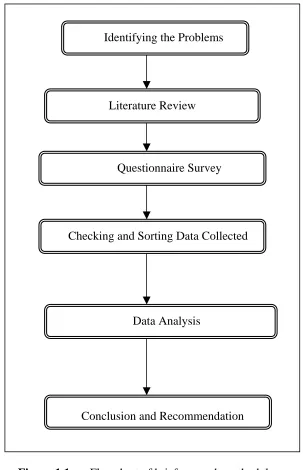
This research started off with problem identification which done through
unstructured interview and brief literature reading. Upon obtaining the identified
problem thorough literature review were conducted to provide in depth
understanding on the issues of change order, focusing on the causes and effects to
engineering consultants practitioners. The literature includes books, dissertations,
magazines, journals, newspapers readings and seminar notes. Apart from the
4
sent out to respective engineering consultant organisations. The objective of the
survey is to obtain more extensive coverage of the Malaysian scenario on the issue of
change order and claims made by engineering consultants on extra works caused by
change order. Upon obtaining the data desired, checking and sorting of data were
done and followed by data analysis which was the main component of the research.
Finally from the data analysis acquired conclusion and recommendation were made.
Figure 1.1 shows the flowchart of the research methodology.
Identifying the Problems
Literature Review
Questionnaire Survey
Checking and Sorting Data Collected
Data Analysis
Conclusion and Recommendation
5
1.6 Structure of Dissertation
The dissertation is divided into 7 Chapters. The first chapter discusses on the
objectives, scope and limitation of the study, and brief research methodology adopted
to fulfill the objectives of the study.
Chapter 2 discusses on the issues of change order, its causes and the effects.
Understanding on the causes of change order were established and as a result the
effects of it were recognised as well. Furthermore the methods of claims made by the
consulting engineers on the extra works caused by change order were being looked
into in Chapter 3.
While in Chapter 4 it discussed in detail the research methodology adopted
for the study. The approach to the questionnaire design is explained and the
flowchart of research methodology was shown.
The findings from the survey questionnaire are analysed in Chapter 5. The
respondents for the questionnaires were only those from the Civil and Structural
Engineering Consulting firm and from the Mechanical and Electrical Engineering
Consultants organisations. In Chapter 6, the research findings are thoroughly
discussed.
Chapter 7 concludes the study and makes recommendations to the
construction industry for future research on the issues of change order and claims by
the engineering consultants.
References
Awad S. Hanna, Richard Camlic, Pehr A. Peterson and Erik V. Nordheim (2000).
Quantitative Definition of Projects Impacted by Changes Orders. Journal of
Construction Engineering and Management, 2001 Vol. 128.
Andi and Minato T (2003). Design Document Quality in Japanese Construction
Industry: Factor Influencing the Impact on Construction Process. International
Journal of Project Management, 2003 Vol. 21 page 537-546
Awad S. Hanna, Wafik B. Lotfallah and Min-Jae Lee (2000). Statistical-Fuzzy
Approach to Quantify Cumulative Impact of Change Order. Journal of
Computing in Civil Engineering, 2002 Vol. 16
Association of Consulting Engineers Malaysia. Directory 2001-2002. Publication of Directory of Association of Consulting Engineers Malaysia
Board of Engineers Malaysia (1998). Scale of Fees (Revised 1998). Publication of Board of Engineers Malaysia
George J. Ritz, (1994). Total Construction Project Management. International Edition, McGraw – Hill, Singapore.
Ting-ya Hsieh, Shih-tong Lu and Chao-hui Wu (2003). Statistical Analysis of
Causes for Change Order in Metropolitan Public Works. International Journal of
Project Management, 2002 Vol. 20 page 67-73.
Mardones. Daniel A and Alarcon Luis F (1998). Improving the Design –
Construction Interface. Proceedings of the 6th annual Lean Construction
conference, Guaruja, Brazil. August 1998.
M R Abdul-Kadir and A D F Price (1994). Conceptual Phase of Construction
Project. International Journal of Project management. 1995 Vol. 13
Min-Jae Lee; Awad S. Hanna and Wei-Yin Loh (2003). Decision Tree Approach
to Classify and Quantify Cumulative Impact of Change Orders on Productivity.
Journal of Computing in Civil Engineering, 2004 Vol. 18
Oberlander, Garold D, (1993). Project Management For Engineering and
56
Robert K. Cox (1997). Managing Change Orders and Claims. Journal of