CONSTRUCTION INSURANCE
LIM WAN WEI
CONSTRUCTION INSURANCE
LIM WAN WEI
A master‟s research project report submitted in partial fulfilment of the requirements for the award of the degree of
Master of Science in Construction Contract Management.
Faculty of Built Environment Universiti Teknologi Malaysia
iii
DEDICATION
To my beloved mother and father
iv
ACKNOWLEDGEMENT
Firstly, on the success of this master project, I would like to express my highest gratitude to my supervisor, Mr. Jamaluddin Yaakob for his guidance, advice and support.
Secondly, I am also indebted to all the lecturers of the course of Master of Science in Construction Contract Management, for their willingness to provide feedback and assistance, whether in the form of shared ideas, suggestions, comments, encouragement and guidance.
v
ABSTRACT
vi
ABSTRAK
Subrogasi bermaksud bahawa apabila syarikat insuran menyelesaikan pembayaran ganti rugi kepada pengambil insuran, syarikat insuran telah mengambil alih tempat pemegang insuran serta semua hak bagi menuntut kerugian daripada pihak ketiga. Tetapi dalam industri pembinaan, syarikat insuran selalunya dijumpai tidak berjaya dalam tuntutan subrogasi terhadap pihak yang bersalah. Oleh itu, untuk mengenalpastikan sebab-sebab syarikat insuran tidak berjaya dalam tuntutannya, penyelidikan ini telah dijalankan bertujuan untuk mengenalpasti keadaan-keadaan syarikat insuran tidak dapat berjaya dalam tuntutan subrogasinya. Penyelidikan ini telah dilakukan terutamanya melalui analisis laporan undang-undang, seperti
vii
TABLE OF CONTENTS
CHAPTER TITLE PAGE
DECLARATION II
DEDICATION III
ACKNOWLEDGEMENT IV
ABSTRACT V
ABSTRAK VI
TABLE OF CONTENTS VII
LIST OF FIGURES X
LIST OF CASES XI
LIST OF ABBREVIATIONS XIV
1. INTRODUCTION 1
1.1 Background of Study 1
1.2 Problem Statements 3
1.3 Research Objective 6
1.4 Scope and Limitations of Research 6
1.5 Significance of Study 7
1.6 Research Methodology 7
1.6.1 Identified The Research Issue 7
1.6.2 Data Collection 8
1.6.3 Data Analysis and Interpretation 8
1.6.4 Writing 9
viii
2. CONSTRUCTION INSURANCE 12
2.1 Introduction 12
2.2 Fundamental Principle 13
2.2.1 Insurable Interest 13
2.2.2 Indemnity 14
2.2.3 Contribution 15
2.2.4 Subrogation 17
2.2.5 Proximate cause 17
2.2.6 Warranties 19
2.3 Construction Insurance 20
2.4 Types of Construction Insurance 21
2.4.1 Loss Insurance 21
2.4.2 Liability Insurance 23
2.4.2.1 Employers‟ Liability Insurance 23
2.3.2.2 Public Liability Insurance 23
2.3.2.3 Professional Liability Insurance 24 2.5 Insurance Clause under the Standard Forms of PAM 26
2.5.1 Indemnify clause 26
2.5.2Taking of insurance 28
2.5.2.1 Insurance against Personal Injuries and Damage to
Property 28
2.5.2.2Workmen Compensation and SOCSO 29
2.5.2.3Insurance for the Work 29
2.5.3 Joint Name 31
2.5.4 Waiver of subrogation 34
2.6 Conclusion 36
3. SUBROGATION 37
3.1 Introduction 37
3.2 Subrogation – Meaning of 37
3.2 Application of Subrogation 38
3.3 Governing Law 39
3.4 Types 39
ix
3.6 Insurer‟s Right of subrogation 43
3.7 Limits to the Insurer‟s Right of Subrogation 47
3.7.1 The Effect of Express Terms 47
3.7.2 Two or More Persons Interested In the Same Property 49
3.7.3 Waiver of Subrogation Rights 50
3.8 Extent of the Insurer‟s right of Subrogation 52
3.9 Conclusion 53
4. CASE ANALYSES 55
4.1 Introduction 55
4.2 No Right of Subrogation Against Co-insured 56
4.2.1 Unnamed Co-insured 64
4.3 Waiver of subrogation 68
4.3.1 Negligence of Subcontractor 70
4.3.2 Must Give Notice When Hiring Sub-SubContractor 72
4.3.3 When The Waiver Clause Are Implied 73
4.3.4 Time Period Of The Waiver 74
4.4.5 Do Not Waiver For The Subcontractor That Has No Direct
Interest 80
4.4 Conclusion 82
5. CONCLUSION AND RECOMMENDATION 85
5.1 Introduction 85
5.2 Summary of Research Finding 85
5.3 Problem Encountered During Research 87
5.4 Future Research 87
5.5 Conclusion 87
REFERENCES 89
x
LIST OF FIGURES
FIGURE NO. TITLE PAGE
xi
LIST OF CASES
Cases
Acadia Insurance Company v. Buck (2000) ME 154, 756 A.2d 515. 73
Advertists v. Ferrellgas. Inc., 102 Wn. App. 488. 7 P.3d 861 (2000), 34
Apthorp v. OneBeacon Ins. Co. 2009 WL 874539 40
Argonaut Great Central Ins. v. DiTocco2007 WL 4554219 (D.N.J. Dec. 20, 2007). 75, 79
Bank of Nova Scotia v Hellenic Mutual War Risks Associates (Bermuda) Limited
“The Good Luck” [1991] 2 WLR 1279 19
Baugh-Belarde Construction Co. v. College Utilities Corp. (1977) 561 P.2d 1211 5
Bit Badger Pty Ltd v. Cunich (1996) 9 ANZ Ins. Cas. 61-312. 72
Black King Shipping Corporation v. Massie, “the Litsion Pride” [1985] 1 Lloyd's
Rep 437 74, 80
BP Exploration v Kvaerner Oilfield Products Ltd and another[2004] All ER (D) 87
(May). 56
Castellain v. Preston (1883) 11 Q.B.D. 380. 40, 41
Charon (Finchley) Ltd v. Singer Sewing Machine Ltd(1968) 207 EG 140. 239. 30
Colonia Versicherung A.G. v Amoco Oil Co [1997] 1 Lloyd's Rep. 261, CA 43
Commonwealth Construction Co. Ltd. v. Imperial Oil Ltd. (1977) 69 D.L.R. (3d) 558 49
Compania Colombiana De Seguros v. Pacific Steam Navigation Co. [1965] 1 Q.B.
101. 45
Co-operative Retail Services Ltd v. Taylor Young Partnership and Others[2000] All
ER (D) 01 59
xii
Darrel v. Tibbbitts (1880) 5 Q.B.D. 560. 43
Deepak Fertilisers and Petrochemical Corporation v Davy McKee (London) Limited
& Others, [1999] BLR 41 CA 14
Fasso v. Doerr, 12 N.Y.3d 80, 87 (2009) 40
Gold v. Patman and Fotheringhan Ltd(1958) 1 All E.R. 497, infra. 22
GPS Power Pty Ltd v. Gardiner Willis Associates Pty Ltd (Queensland Court of
Appeal, 8 December 2001); 51
H.Cousins & Co Ltd v D. & C. Carriers Ltd [1971] 2 QB 230, CA 41
Haemonetics Corp. v. Brophy & Philips Co., 23 Mass. App. Ct. 254, 501 N.E.2d 524
(1986) 34
Hobbs v. Marlowe [1978] AC 16 at p 37 44
Hopewell Project Management Ltd v. Ewbank Preece Ltd. [1998] 1 Lloyd's Rep 448,
458 62
Industrial Risk Insurers v. Garlock Equipment Company and Seyforth Roofing
Company 576 So. 2d 652; 1991 Ala. LEXIS 99. 70
Larson-Juhl Australia LLC v. JayWest International Pty Limited (2000) 11 ANZ Ins
Cas 61-499 (New South Wales Court of Appeal) 51
Louisiana Fire Ins. Co. v. Royal Indem. Co., 38 So. 2d 807 (La. App. 1949) 4, 64
Lumbermens Mut. Cas. Co. v. Grinnell Cor. 477 F. Supp. 2d 327 (D. Mass. 2007). 79
Mark Rowlands Limited v. Berni Inns Limited [1986] 1 QB 211 47, 48
Morrie v. Ford Motor Co Ltd [1973] QB 792 (CA). 39
Normid Housing Association Ltd. v. Ralphs (1988) 42 BLR. 18. 25 Norwich City Council v Harvey [1989] 1 WLR 828; [1989] 1 AER 1180. 33, 71
OPI Intern., Inc. v. Gan Minster Ins. Co., Ltd. 1996 WL 650130 (S.D.Tex.), 1996 A.M.C. 2462 (S.D.Tex.,1996) ( Not Reported in F.Supp). 81
Page v. Scottish Insurance Corporation (1929) 98 L.J.K.B. 302. 46
Petrofina (UK) Ltd and others v Magnaload Ltd and others [1984] 1 QB 127, [1983] 3 All ER 35, [1983] 3 WLR 805, [1983] 2 Lloyd's Rep 91, 6 ILR 120, 25 Build LR
37 3, 49, 65
Randal v Cockran [1748] English Reports 27 Chancery 1 Ves. sen 99 43
Richmond Steel, Inc.v. Legal & Gen. Assur. Soc’y, Ltd.821 F. Supp. 793, 798
(D.P.R. 1993) 63
Sola Basic Australia Ltd v. Morganite Ceramic Fibres Pty Ltd (Unreported, NSW
xiii
Solicitors & General Life ass. Soc. v. Lamb (1864) 2 De G.J. & S. 251 38
State Government Insurance Office (Old) v Brisbane Stevedoring Pty Limited (1969)
12 123 CLR 228. 47
Stearns v. Village Main Reef Gold Mining Co. Ltd., (1905) 10 Com. Cas. 89 52
Steelclad Limited v Iron Trades Mutual Insurance Co Limited [1984] SLT 304. 16
Teo Kim Kien & Ors. v. Lai Sen & Anor. [1980] 2 M.L.J. 125. 43
Tiong Nam Trading & Transport (M) v. Commercial union Assurance (M) Sdn
Bhd[2008] 6 MLJ 342. 41
Tokio Marine & Fire Ins. Co. v. Employers Ins., 786 F.2d 101, 104 (2d Cir. 1986) 34
Transamerica Ins. Co. v. Gage Plumbing & Heating Co.,433 F.2d 1051 (10th Cir.
1970) 64
Turner Construction Co. v. John B. Kelly Co. 442 F.Supp. 551 (E.D.Pa. 1976). 80
U.S. Inc v. Northeast Construction Services, Inc. 684 N.Y.S.2d 872 (N.Y.Supp.
1999). 69
United States Fire Insurance Co. v. Donald Beach, dba Beach Steel Erectors, et al.
(1973) 275 So.2d 473 4
Wisconsin State Local Government Property Insurance Fund v. Thomas A. Mason
Company (Ct. App. Feb. 20, 2008). 5
Yung Kong Co. Bhd v. H.H.H Type Retreading Sdn Bhd ; Yung Kong Co. Bhd v Ngu
Wei Chai trading as Sin Hui Huan Trading Company (Malayan Unreported
xiv
LIST OF ABBREVIATIONS
AER or ALL ER All England Law Reports
App. Cas. Appeal Cases
CAR Contractors‟ All Risk
Co. Company
ER English Report
F. Supp. Federal Supplement
F., F.2d, F.3d Federal Reported, 2nd or 3rd Series
Ibid Ibidem (from same source)
JCT Joint Contracts Tribunal
KB King Bench
Lloyd‟s Rep Lloyd‟s List Reports
LMCLQ Lloyd‟s Maritime and Commercial Law
quarterly
Ltd Limited
MIA Marine Insurance Act 1906
MLJ Malayan Law Journal
N.E, N.E.2d Northeastern Reporter
Ors. Others
PAM Pertubuhan Akitek Malaysia
(Malaysian Institute of Architects)
PWD Public Works Department
QBD or QB Queen Bench Division (Law Reports0
Rev Revised
RIBA Royal Institute of British Architects
xv
So., So.2d Southern Reporter
UK United Kingdom
UTM Universiti Teknologi Malaysia
1
CHAPTER 1
INTRODUCTION
1.1 Background of Study
It is an unfortunate fact that construction projects are fertile ground for bodily injury and property damage liability exposures. Accidents and injuries are virtually unavoidable, so, in the execution of any construction project there is invariably an element of risk involved, the major concern is the possible risk of a loss as a result of damage to property, plant or machinery. At the same times, concern to the contracting parties in a building contract would undoubtedly be the allocation of risks in respect of potential liability to third parties or injury to the employees or workmen due to the acts or omissions of the parties to the building contract, and their agents or servants. Therefore, the parties involved in a project - the employer, contractor, engineer, architect, etc. ought to be mindful of this and in order to protect and guard against the possible risks, it is highly imperative that insurance cover is obtained. In view of the importance of this, most engineering or building contracts have express provisions dealing with insurance.1
1 Radhakrishnan, “Legal Aspects of Insurance for Engineering Projects.” (Malayan Law Journal
2 Those insurance provisions always required that the employer or contractor to to take out appropriate insurance policies to cover the extent of the risk in respect of which they are obliged to indemnify the employer under the contract. 2
The insurance policy is a contract of indemnity whereby one person normally called the insurer, in return for a consideration or premium, to pay to another person, normally called the insured, a sum of money or its equivalent upon the happening of certain specified occurrences.3 Where insurers have made a payment to their insured and indemnified him against his loss they stand in his shoes and are entitled to take over from him rights and remedies which he may have against some other person. This principle gives rise to further insurance factors, namely subrogation.
However, to becoming engaged in the complexities of lawsuits and insurance claims, while managing the risk and associated expenses4, the parties will often contract to joint names or waive all right of subrogation against the other party as part of the contract governing their relationship. The named insured intentionally relinquished any right to recover damages from another party who may be responsible. While exculpatory, these types of clauses are generally upheld5.
2 Chow Kok Fong, “The Law Related to Building Contracts Cases & Materials.” (Singapore: Quins, 1983), p.262-263.
3 Peter Madge, “A Guide to the Indemnity and Insurance: Aspect of Building Contracts.” (London:
RIBA Publications Limited, 1985), p.13.
4 Kenneth A. Slavens, “What is Subrogation… and Why is My Contract Waiving it?”(IRMI.com, 2002), <http://www.irmi.com/expert/articles/2000/slavens12.aspx>
3
1.2 Problem Statements
Clauses of construction contract relating to insurance and indemnities are often misunderstood by the parties to those contracts because the relationships of insurers, insureds and co-insureds can give rise to significant difficulties in managing risks associated with construction projects. The reason is that construction projects typically involve various independent parties bound together by complex contractual relationships. Pursuant to these contracts, it is common for certain parties to indemnify others in respect of particular risks. Furthermore, losses and liabilities are often caused by more than one party and covered by more than one insurance policy.6 These are often not given a lot of thought and the risks of failing to understand these clauses can be significant.7
In the case of Petrofina (UK) Ltd and others v. Magnaload Ltd and others8, the plaintiffs, Petrofina (UK) Ltd, Total Oil Great Britain Ltd, Lindsey Oil Refinery Ltd and a consortium of companies trading under the name of Omnium Leasing Ltd claimed against the defendants, Magnaload Ltd and Mammoet Stoof BV on damages for negligence. The claim arises out of an accident which occurred in the course of carrying out a major extension to an oil refinery. Two men lost their lives in the accident and there was extensive damage to property. The defendants contended that they were sub-contractors employed to carry out the contract works and that any claim against them was covered by a contractor's all risks policy taken out by the head contractors, Foster Wheeler Ltd to cover all risks arising out of any acts or negligence of the contractors and the sub-contractors in respect of the construction, erection and extension to the Lindsey Oil Refinery. The defendants also issued third party notices on Greenham (Plant Hire) Ltd, who was sub-contractors of the head contractors and on the New Hampshire Insurance Co., the insurers of the policy taken out by the head contractors. The insurers having settled the plaintiffs' claim
6 Andrew Byrne, “Construction Projects and the Apportionment of Liability Insurance & Reinsurance Forum.” (Allens Arthur Robinson: 2009), p.2.
7 “Do you have it Covered? Construction Contracts: indemnity of third party Co-insureds in Contract Works and Public Liability Insurance Policies.” (HWL Ebsworth Lawyers, 2008),
<http://hwlebsworth.ensoconsultancy.com.au/building_construction_august08/index.html> 8
4 under the policy, sought to exercise their right of subrogation against the defendants. The defendants claimed that since they were sub-contractors and therefore fully insured under the policy, the insurers had no right of subrogation. Issue of whether the insurer may seek the right of subrogation against defendants arise. The judge held that the insurers‟ rights of subrogation were defeated by reason of the fact that the defendants were fully insured.
Again in the case of Louisiana Fire Ins. Co. v. Royal Indemnity Co. et. al.,9
the defendant was a plumbing contractor who was working only on part of the insured building. After the structure was damaged by fire, the builders' risk insurer brought suit against the plumbing contractor for the loss. The Louisiana Court of Appeals held that the insurer could not exercise subrogation rights. First, the court concluded that the "evident intent of the parties, and the customs and practices of the building trade" evidenced the intent to provide protection under the owners' builders' risk policy for everyone involved in the project. Second, the court reasoned that the policy was ambiguous, so it had to be construed against the insurer.
While this case is sometimes cited for the proposition that subrogation is prohibited as a matter of law, the language quoted would seem to suggest that subrogation against a contractor is permissible if the parties to the insurance contract so intend, since the court relied on two rules of construction-industry custom and the doctrine of contra proferentem and specifically referenced the intent of the parties. None of this would have been relevant unless the parties had freedom of contract.
United States Fire Insurance Co. v. Donald Beach, dba Beach Steel Erectors,
et al.,10 another Louisiana Court of Appeals case, similarly suggests that the parties to an insurance contract might agree that the underwriters could subrogate against additional assureds. While the court reached the same result as in Louisiana Fire and concluded that the insurer could not exercise subrogation rights, the court expressly
9 (1949), 38 So. 2d 807. 10
5 stated that this result was based "not upon any theory of estoppel," but was instead simply a matter of contract interpretation.
Other courts, however, have taken a more doctrinaire approach, ruling that it is impermissible as a matter of law to allow subrogation against a party insured under the policy. In Baugh-Belarde Construction Co. v. College Utilities Corp.,11 the Alaska Supreme Court cited several policy reasons for precluding a builders' risk insurer from exercising subrogation rights.
In a case decided by the Court of Appeals in February, 2008, Wisconsin State Local Government Property Insurance Fund v. Thomas A. Mason Company,12 the Court of Appeals held that the state agency created to provide property insurance for local governments had waived its right to subrogation recovery from a subcontractor.
After several cases had been discussed, there are few questions which arise from the above discussion, whether a builders‟ risk insurer can exercise subrogation rights against sub-contractors and material suppliers whose negligence or faulty products have caused damage? What are the points that must be addressed by counsel for an insurer seeking to exercise subrogation right? Is there a waiver of subrogation in favour of the target that precludes such a suit? How subrogation claims are waived?
Thus, in order to understand the issue of insurer was preventing from exercising subrogation rights in the construction industry, this study therefore intends to understand the insurers‟ right of subrogation claim under the insurance provision of the standard form of construction contract.
11 (1977) 561 P.2d 1211.
12
6
1.3 Research Objective
In order to understand the insurers‟ right of subrogation claim in construction contract, the following is the objective of the study:
(a) To identify circumstances that do not allow insurers to exercise their right of subrogation.
1.4 Scope and Limitations of Research
The following are the scopes for this study: -
7
1.5 Significance of Study
Since construction insurance clauses were often misunderstood by the parties to those contracts, those who are not insurance experts always deal with those clauses and policies. The research is important to clarify the principle of the right of subrogation claims in the construction contract to these peoples. It will improve the understanding of the right of subrogation claims, to the benefit of contractors, principals and insurers.
1.6 Research Methodology
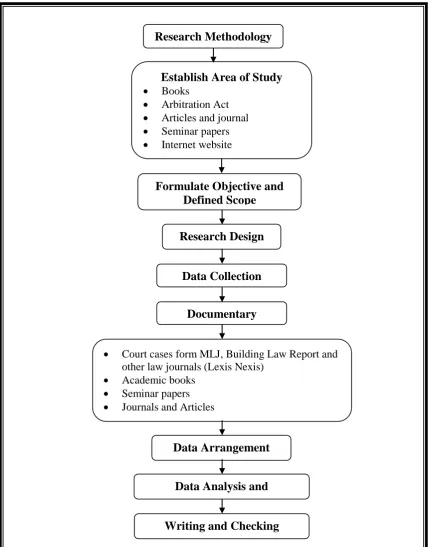
The research objectives had been achieved as a systematic research process have been drawn up and adhered to. The research process consisted of four major stages, namely, identified the research issue, data collection, data analysis and writing. Each stage is shown in detail below. (Refer to Figure 1).
1.6.1 Identified The Research Issue
8 prepared in order to identify the types and sources of materials needed for this research.
1.6.2 Data Collection
This stage involves the collection of relevant data and information. Data had been collected mainly through documentary analysis. All collected data and information had been recorded systematically. Data had been collected mainly from Malayan Law Journal, Singapore Law Report, Building Law Report, Construction Law Report and other law journals. Data had been collected by browsing through the LexisNexis legal database. All the cases relating to the research topic had been sort out from the database. Important and relevant cases had been collected and used for the analysis at the later stage.
In addition, secondary data was also collected from books, article reports, seminar papers, newspapers and articles from the internet. All the relevant books had been obtained from the Universiti Teknologi Malaysia library and other public libraries. Moreover, seminar papers, article reports and newspapers were reinforced the theories found in books. All these sources are important for the literature review.
1.6.3 Data Analysis and Interpretation
9 was carefully reviewed the relevant case laws collected and also pay special attention to the facts of the case, issues and judgments presented by each case law.
1.6.4 Writing
10
Figure 1.1: Research Methodology Flowchart Research Methodology
Establish Area of Study
Books
Arbitration Act
Articles and journal
Seminar papers
Internet website
Formulate Objective and Defined Scope
Research Design
Data Collection
Documentary Analysis
Court cases form MLJ, Building Law Report and other law journals (Lexis Nexis)
Academic books
Seminar papers
Journals and Articles
Data Arrangement
11
1.7 Chapter Organization
This research dissertation will be divided into 5 chapters
Chapter 1
This chapter sets out the background of the study and identified the research issues. It also consists of the objective of the research that stated the aims of the study, scope and limitation of the study, research methodology to be carried out to reach the objective of the dissertation and the organization of the chapter.
Chapter 2
This chapter discusses the fundamental principle of insurance; types of insurance required under the standard form of construction contract and insurance clause under the contract.
Chapter 3
This chapter discuss in detail the principle of subrogation under the insurance law.
Chapter 4
This chapter review and analysis the court cases had been selected in order to discuss the circumstances that do not allowed the insurer to exercise their right of subrogations.
Chapter 5
89
REFERENCES
(1986). Construction Contracting. 5th Edition. New York: John Wiley & sons.
Birds, J. (1988). Modern Insurance Law. 2nd Edition. London: Sweet & Maxwell.
Byrne, A. (2009). Construction Projects and the Apportionment of Liability Insurance & Reinsurance Forum. Allens Arthur Robinson,
Chow. K.F.. (1983). The Law Related to Building Contracts Cases & Materials. Malaysia & Singapore: Quins. 262-263.
Clouugh, R.H. (1986). Construction Contracting. 5th Edition. New York: John Wiley & Sons. p.208-254, 216-216.
Concise Oxford English Dictionary. 11th Edition.
Construction Insurance: RICS Guidance Note. 1st Edition. UK: RICS Practice Standards. p.51.
Derhan, R. (1985). Subrogation in Insurance Law.
Fred, D.W. and Eric, A.B. Construction Checklist: A Guide to Frequently Encountered Construction issues.
90 John, M. M, John, A.V. and Sean, R.L. (2006). Subrogation: Basic Principles,
Emerging Trends and Practical Considerations.
Khoo, G. H. (1995). Articles: Construction Insurance. Malayan Law Journal Articles. LexisNexis.
Laura, D., et. al. (2010). Subrogation Under Particular Types of policies or Under Particular Circumstances. American Jurisprudence, 2nd Edition. LexisNexis.
Madge, P. (1985). A Guide to the Indemnity and Insurance: Aspect of Building Contracts. London: RIBA Publications Limited.
Micheal, F.J. (2002). Construction Law: Liability for the Construction of Defective Buildings. New York: Palgrave.
Mitchell, C. (1994). The Law of Subrogation. United State: Clarendon Press Oxford.
Murdoch, J., and Hughes, W. (2008). Construction Contracts Law and Management. 4th Edition. London and New York: Taylor & Francis.
Nael, G.B. (2003). Risk and Insurance in Construction. 2nd Edition. London and New York: Spon Press. p.196-197.
Nasser, H. (2009). Insurance Law. Malaysia: Gavel Publications. p 281-288.
Palmer, W.J., Maloney, J.M., and Heffron, J.L.. (1996). Construction Insurance Bonding & Risk Management. United State of America: McGraw Hill. p.214-215.
Patrick, J. (2007). Recent Issues in property Coverage. LexisNexis: William Mitchell Law Review. p.30.
91
Poh, C. C.(1986) Law of Insurance. Singapore: Malayan Law Journal Pte Ltd. p. 177.
Radhakrishnan. (1999). Legal Aspects of Insurance for Engineering Projects. Malayan Law Journal Articles. LexisNexis.
Richard, L. and John, E. Urban Project Project Management. p.208.
Robinson, N. M. et. al.(1996). Construction Law in Singapore and Malaysia. Singapore : Butterworths. p.195-203, 218-222.
Sabo, W. and Sabo, Esq. (2008). Legal Guide to AIA Document, 5th edition. United Brian, E. (1996). The New Engineering Contract A Commentary. USA: Blackwell Publishing. p.235-247.
Skinner, M. and Coss, J. (2006). Subrogation. Allens Arthur Robinson.
Sweeney, N.J. (2009). Construction Law Update 2009. p.355-256.
The Architects Handbook of Professional Practice.12th Edition. American Institute of Architects.
(2008). Do you have it Covered? Construction Contracts: indemnity of third party Co-insured in Contract Works and Public Liability Insurance Policies. HWL Ebsworth Lawyers. Available at:
http://hwlebsworth.ensoconsultancy.com.au/building_construction_august08/ index.html. [Accessed 27 April 2010]
(2008). Six Things You Need To Know About Construction Insurance. ContractJournal.Com. Available from:
92 Builder's Risk Insurance. Adjusters International. Available from:
http://www.adjustersinternational.com/AdjustingToday/ATfullinfo.cfm?start =1&page_no=1&pdfID. [Accessed:16 May 2010]
Gates, K.L. (2007). Waiver of Subrogation: Clauses Do Not Bar Actions Arising Out of Gross Negligence or Violation of Statute or Regulation. Available at: http://www.klconstructionlawblog.com/2007/12/articles/case-summaries/ma- case-summaries/waiver-of-subrogation-clauses-do-not-bar-actions-arising-out-of-gross-negligence-or-violation-of-statute-or-regulation/ [Accessed 28 March 2010]
Gould, N. (2003). Construction: Insurance Issues. Available from:
http://www.fenwickelliott.co.uk/files/docs/articles/html/constr_insurance_iss ues.htm [Accessed: 11 May 2010]
Insurance Principle. Irish Brokers Association. Available from:
https://www.iba.ie/development2009/index.php?option=com_content&view= article&id=76&Itemid=167 [Accessed:30 May 2010].
Lloyd‟s maritime and Commercial Law Quarterly [2001] L.M.C.L.Q. 193”, i-law.com. Available From:
http://www.i-law.com/ilaw/doc/view.htm?id=130260 [Accessed 13 June 2010]
Moshonas, J.M., Vamplew, J.A. and Lerner, S.R.. (2006). Subrogation: Basic principles, Emerging Trends and Practical Consideration. Whitelaw Twining law Corporation. Available from:
http://www.whitelawtwining.com/pdfs/594752_1.pdF. [Accessed: 28 May 2010]
Neumann, F.. Notes on Financial Guarantees & Contractor All Risk Policies.
93 Professional Liability Insurance. Wikipedia. Available from:
http://en.wikipedia.org/wiki/Professional_liability_insurance [Accessed:30 May 2010].
Slavens, K.A.. (2002). “What is Subrogation… and Why is My Contract Waiving it?”, Available from:
http://www.irmi.com/expert/articles/2000/slavens12.aspx. [Accessed: 28 May 2010].
Timothy, R.H., Alison. R.M.. (2008). Waivers of Subrogation. Available from: http://www.ecmag.com/?fa=article&articleID=8677 [Accessed 10 May 2010]
Waivers of Subrogation. Available at:
http://www.kayandandersen.com/WSPE%20August%202008.pdf [Accessed 27 April 2010]