DIFFERENCES BETWEEN DECOUPLED AND INTEGRAL AIRPLANE
CRASH ANALYSIS REGARDING COMPUTATION OF RESPONSE
SPECTRA FOR COMPONENT DESIGN
Alexander Siefert1, Marcus Ries2 and Fritz-Otto Henkel3
1 Manager Impact Loads, Woelfel, Hoechberg, Germany ([email protected]) 2 Manager Electrical Components, Woelfel, Hoechberg, Germany ([email protected]) 3 Managing Director, Woelfel, Hoechberg, Germany ([email protected])
ABSTRACT
Due to the ongoing development for Finite Element (FE) simulations using standard software packages as e.g. ABAQUS a crash analysis by an integral approach is nowadays possible (Kostov (2011), Siefert (2011)). Thereby both parts, airplane and reactor building, and their interaction due to the impact are computed within one simulation. This procedure provides the advantage to simulate the impact scenario, i.e. the structural setup of the airplane, its flight direction and finally the shape of the building realistically. Compared to the traditional decoupled approach this leads to a higher accuracy especially for the analysis of local damage.
Beside its complexity a disadvantage of the integral method is its high frequency content. Reasons therefore are numerical effects, which already can be observed for the load-time-function (Ft-function) computed by an impact on a rigid wall. Regarding the design of components this represents a problem as the amplitude level in the higher frequency range is increased. Generally this holds also for the decoupled approach if the Ft-function is not smoothed by a filter or any other method. As this kind of smoothing cannot be directly included within the integral approach a workaround could be its application within the post-processing. Within the paper this procedure is presented and applied for the impact of a commercial passenger aircraft (A320) on an exemplary nuclear reactor building. Finally the results of the response spectra are compared for the decoupled and the integral (original and enhanced) approach to assess the developed procedure.
INTRODUCTION
Since the incident of 9/11 the crash of a commercial aircraft plays an important role in the design of new nuclear power plants and in the assessment of existing ones, Henkel (2007). In several publications (Calonius (2011), Arros (2007)) it was already shown that local damages can be investigated by using an integral simulation approach. Thereby the airplane, the nuclear reactor building and their interaction are considered within one computation. This represents a new development compared to the traditional decoupled approach where the load definition is separated from its application to the structure. An advantage of the integral approach is that three-dimensional geometric effects of the impact scenario as flight direction or shape of the outer building surface can be taken into account. Furthermore local damage effects which are related to the structural setup of the airplane can be considered in detail.
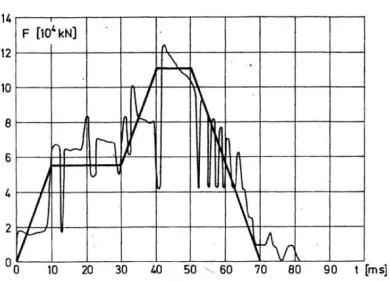
Figure 1: Ft-function of F4: Simulation result and enveloping by polygonal line.
For eliminating these numerical effects the Ft-function was enveloped by a polygonal line, see figure 1 , Drittler (1975). Alternatives to this manual smoothing procedure are analytical methods as e.g. the application of low-pass filters. This workaround to overcome the issues in the high frequency range cannot be applied for the integral approach as the load definition is not separated from the final simulation with the building.
Following the initial goal to investigate the local damage and to compute the response spectra within one simulation an enhanced post-processing is developed for the integral approach. Thereby the smoothing procedure by a low-pass filter is applied to the acceleration time signals of the component locations. Within this paper the method is presented and applied for the crash of a commercial passenger aircraft onto a nuclear reactor building. Finally a comparison for the computed response spectra of the integral and the decoupled approach is shown.
METHOD
The following sketch, figure 2, illustrates in the upper row the traditional decoupled approach. Thereby the Ft-function is first computed by the crash onto a rigid wall. Afterwards numerical artifacts are eliminated by applying smoothing algorithms as e.g. the enveloping by a polygon line or low-pass filters. Finally the load is applied as a pressure on the outer surface of the nuclear reactor building and the response spectra are computed.
In the second row the developed procedure for the integral approach is shown. Thereby the first step is the crash simulation of the aircraft to the outer surface of the building. Afterwards the smoothing algorithms are applied to the computed accelerations results of component locations. It is very important that the same smoothing algorithms are applied as for the decoupled approach so that existing knowhow of the evaluation process can be used. Finally the response spectra are computed by the smoothed time domain signals.
MODEL SETUP
Model Of Commercial Passenger Aircraft A320
Within the presented study an aircraft model of the plane type A320, see figure 3, is used, as it is widely spread and hence represents a standard load case for almost all nuclear power plants worldwide. The model setup is mainly defined with respect to investigate local damages of the nuclear reactor building. As the simulation is carried out with an explicit solver scheme only the main features of the structure are considered to reduce the computational effort. The geometric input data is taken from official publications of the manufacturer.
Figure 3: Finite-Element model of Airbus type A320: exterior view and stiffening parts.
The airplane structure is modeled via shell and beam elements. The payload and the fuel are distributed over the relevant areas of the airplane. The modeling by discrete mass elements represents a conservative approach as splashing effects of the fuel are neglected. Altogether the model consists of 45,000 nodes, 43,000 elements and 163,000 degrees of freedom. The material definition reflects the nonlinear and strain dependent behavior and failure defined by maximum strains and stresses. As no detailed information of the stress-strain behavior of the materials, used for the A320, are known, standardized materials of aeronautical engineering are considered. The total mass of the model is about 75 t representing the maximum take-off weight.
Model Of Nuclear Reactor Building
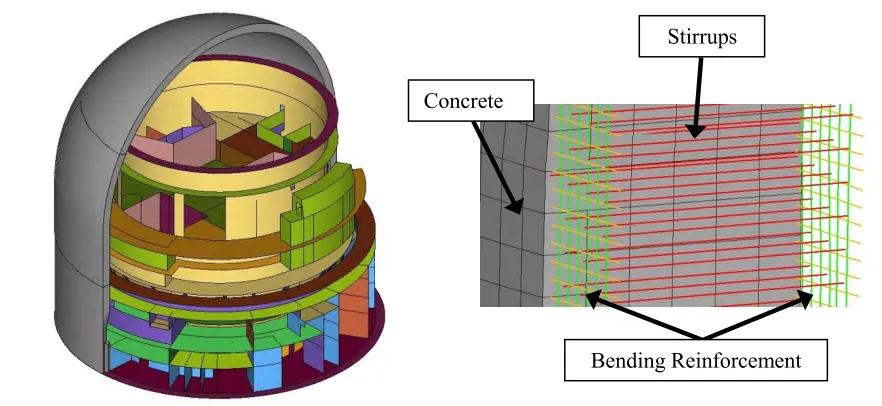
Figure 4: Model setup of nuclear reactor building and modeling detail of reinforcement in the impact area.
The bending reinforcement is modeled by discrete beam elements in the impact area. Outside the impact area a lumped approach via shell elements is used. The shear reinforcement modeled via discrete beams is only considered in the impact area. The dimensions of the reinforcement represent standard values of nuclear power plants. The interaction between the volume elements for the concrete and the discrete elements for the reinforcement is carried out via kinematic couplings, see figure 4 (right). Altogether the model consists of 1,130,000 nodes, 510,000 elements and 2,870,000 degrees of freedom. The material definition of the concrete and the reinforcement are nonlinear, rate dependent and include failure with respect to strain limits.
COMPUTATION AND RESULTS OF LOAD-TIME-FUNCTION
A first step within the development of the enhanced integral procedure is the identification of an appropriate analytical smoothing algorithm which must fulfill the following requirements:
1. After its application the computed Ft-function must represent the main characteristics of the original Ft-function;
2. Computing the dynamic load factor the initial content in the upper frequency range must be eliminated;
3. The same procedure must be applicable for all impact scenarios;
4. Using the smoothed Ft-function within the decoupled approach similar results as for smoothing the Ft-function by a polygon line must be observed.
While the fourth requirement can only be evaluated by an analysis of a nuclear reactor building the first three ones can already be checked by applying the smoothing algorithms to the Ft-function. Therefore the crash on a rigid wall is first simulated by using the above shown model of the A320. As initial velocity the value of 175 m/s is chosen. The following figure 5 shows the computational result for the Ft-function superimposed with its smoothing by five different algorithms: polygon line, polynomial of 20th order, straight average method with dt = 0.02 s, low-pass filter 30 Hz and low pass filter 50 Hz.
Concrete
Stirrups
Figure 5: Ft-function A320 (v=175 m/s) – Comparison of different smoothing approaches.
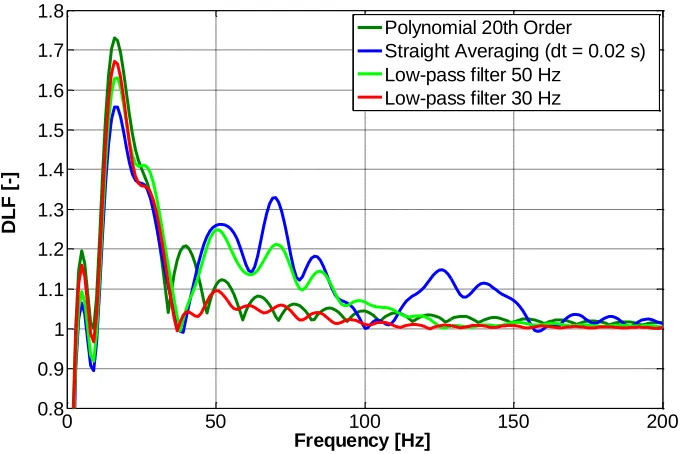
As can be observed all smoothing algorithms are reflecting the main characteristics of the Ft-function, i.e they are fulfilling the first requirement. Smaller differences can only be determined for the smoothing with the polynomial due to the chosen order. This could be improved by changing the order. As this must be done for every new impact scenario (type of airplane and velocity) the goal for applying one smoothing approach for all cases, i.e. the requirement three, is not met. For evaluating the frequency content of the different smoothing algorithms the dynamic load factor is computed. In figure 6 the results for a calculation with a damping value of 2 % are presented.
Figure 6: Dynamic load factor computed for different smoothing algorithms.
0 0.05 0.1 0.15 0.2 0.25
0 50 100 150 200 250 Time [s] F o rc e [M N ] Ft-Function computed Polygon line
Polynomial 20th Order
Straight Averaging (dt = 0.02 s) Low-pass filter 50 Hz
Low-pass filter 30 Hz
0 50 100 150 200
0.8 0.9 1 1.1 1.2 1.3 1.4 1.5 1.6 1.7 1.8 D L F [-] Frequency [Hz]
Polynomial 20th Order
Straight Averaging (dt = 0.02 s) Low-pass filter 50 Hz
As is shown by the xy plot the smoothed signals of the straight average method and the low-pass filter with 50 Hz have a relevant content in the higher frequency range above 50 Hz. Therefore they are not fulfilling the second requirement. Summarizing the evaluation based on the Ft-function only the smoothing approach using a low-pass filter of 30 Hz fulfills all requirements.
COMPUTATION AND RESULTS OF RESPONSE SPECTRA
Finally the results for the response spectra of the integral approach are compared with the decoupled procedure. While the smoothing using the low-pass filter of 30 Hz is applied for both procedures, the application of the polygon line is only used for the decoupled method.
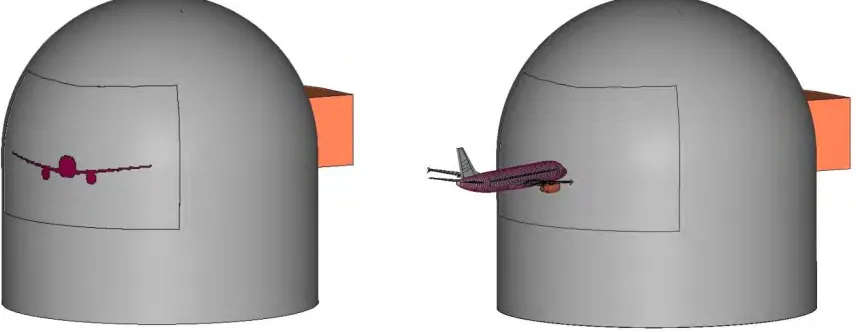
For the simulation of the complete nuclear reactor building the impact area is defined on the transition zone of cylinder and hemisphere. The load areas for applying the smoothed Ft-functions are defined by a straight projection of the structural parts (turbines, wings and fuselage) on the outer surface of the reactor building, see figure 7 (left). The load is applied equally as a pressure normal to the surface of the containment. Respectively any three-dimensional geometric effects due to flight angle are neglected. For the integral crash simulation the aircraft is positioned in front of the outer surface. Then the computation is started with an initial velocity of 175 m/s for the A320. The interaction between all model parts is defined by the general contact algorithm.
Figure 7: Start of Simulation: Decoupled and Integral Approach.
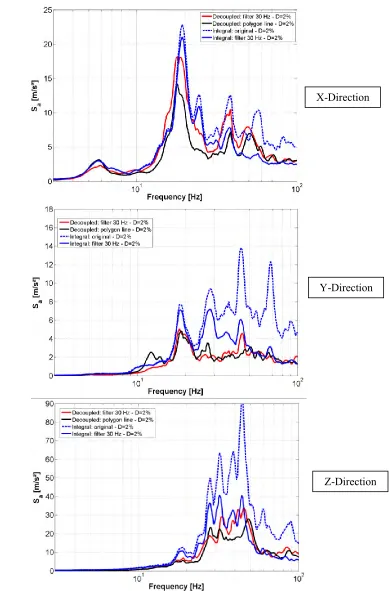
Figure 8: Comparison of response spectra for decoupled and integral approach for acceleration in x, y and z direction – location at the center of the building above the reactor pressure vessel.
X-Direction
Y-Direction
It can be observed that the results for the original integral approach show a higher amplitude level in the upper frequency range, what was expected. Applying the low-pass filter of 30 Hz on the time domain the results for the integral approach are improved and correlate finally with respect to the main characteristics with the values computed by the decoupled procedure.
CONCLUSION
The work here presented showed a comparison between using the decoupled and the integral simulation approach for the computation of the response spectra due to the crash of a commercial passenger aircraft on a nuclear reactor building.
Thereby the integral approach was enhanced by a smoothing algorithm for the post-processing to eliminate numerical artifacts which normally lead to an increase of the amplitude level in the upper frequency range. Assessing the different smoothing methods by defined requirements a low-pass filter of 30 Hz was finally chosen based on the results for the Ft-function of a crash on a rigid wall.
The comparison of the response spectra was carried out for the crash analysis of an A320 with an initial velocity of 175 m/s on a standard nuclear reactor building. The acceleration was evaluated on 15 locations spread over the inner structural setup of the building. Comparing the results of the standard integral approach (without enhanced post-processing) with the decoupled procedure a higher amplitude level in the upper frequency range above 50 Hz could be observed. Enhancing the post-processing of the integral procedure by the low-pass filter of 30 Hz the artificial effects in the upper frequency range are eliminated and a similar curve characteristic of the response spectra as for the decoupled simulations is achieved (obtained).
Using this enhanced post-processing for the integral approach the limitations with respect to the investigation of response spectra seem to be eliminated. Accordingly this new developed procedure could enable the analysis of local damages and the response spectra within one simulation which represents a relevant reduction of computational efforts for the crash analysis of aircrafts on nuclear reactor buildings. For validating this new method additional impact scenario should be investigated.
REFERENCES
ABAQUS (Software Package), Version 6.12-1 (2012), ABAQUS Inc., Providence, USA, www.abaqus.com
Arros, J., Doumbalski, N. (2007): Analysis of aircraft impact to concrete structures. Journal of Nuclear Engineering and Design, Volume 237, pp. 1241-1249
Calonius, K., et al. (2011): Punching failure of a reinforced concrete slab due to hard missile impact (iris_2010 case). 21th SMiRT, Paper #668, New Delhi, India.
Drittler, K., Gruner, P. (1975): Zur Auslegung kerntechnischer Anlagen gegen Einwirkungen von Aussen: Teilaspekt: Berechnung von Kraft-Zeit-Verläufen beim Aufprall deformierbarer Flugkörper auf eine starre Wand. Institut für Reaktorsicherheit
Henkel, F.-O., Klein, D. (2007): Variants of Analysis of the Load Case Airplane Crash. Proceedings of the 19th international conference on SMiRT, Toronto, Canada, August 2007
Kostov, M., Henkel F.-O., Andonov, A. (2011) Safety Assessment of A92 Reactor Building for Large Commercial Aircraft Crash. 21th SMiRT, Paper #222, New Delhi, India.
Riera, J.D. (1968). On the Stress Analysis of Structures Subjected to Aircraft Impact Forces. Nuclear Engineering and Design, Vol. 8, pp. 415-426