University of Windsor University of Windsor
Scholarship at UWindsor
Scholarship at UWindsor
Electronic Theses and Dissertations Theses, Dissertations, and Major Papers
2019
A deep learning approach to real-time short-term traf
fi
c speed
A deep learning approach to real-time short-term traf c speed
prediction with spatial-temporal features
prediction with spatial-temporal features
Sindhuja Gutha University of Windsor
Follow this and additional works at: https://scholar.uwindsor.ca/etd
Recommended Citation Recommended Citation
Gutha, Sindhuja, "A deep learning approach to real-time short-term traffic speed prediction with spatial-temporal features" (2019). Electronic Theses and Dissertations. 7704.
https://scholar.uwindsor.ca/etd/7704
This online database contains the full-text of PhD dissertations and Masters’ theses of University of Windsor students from 1954 forward. These documents are made available for personal study and research purposes only, in accordance with the Canadian Copyright Act and the Creative Commons license—CC BY-NC-ND (Attribution, Non-Commercial, No Derivative Works). Under this license, works must always be attributed to the copyright holder (original author), cannot be used for any commercial purposes, and may not be altered. Any other use would require the permission of the copyright holder. Students may inquire about withdrawing their dissertation and/or thesis from this database. For additional inquiries, please contact the repository administrator via email
A deep learning approach to real-time short-term traffic
speed prediction with spatial-temporal features
By
Sindhuja Gutha
A Thesis
Submitted to the Faculty of Graduate Studies
through the School of Computer Science
in Partial Fulfillment of the Requirements for the
Degree of Master of Science
at the University of Windsor
Windsor, Ontario, Canada
2019
c
A deep learning approach to real-time short-term traffic speed prediction with
spatial-temporal features By
Sindhuja Gutha
APPROVED BY:
H. Maoh
Department of Civil and Environmental Engineering
X. Yuan
School of Computer Science
M. Kargar, Co-Advisor
School of Computer Science
J. Chen, Advisor
School of Computer Science
DECLARATION OF ORIGINALITY
I hereby certify that I am the sole author of this thesis and the intellectual content of this
thesis is the product of my own work and that no part of this thesis has been published or
submitted for publication.
I certify that, to the best of my knowledge, my thesis does not infringe upon anyones
copyright nor violate any proprietary rights and any ideas or techniques and all the
as-sistance received in preparing this thesis and sources have been fully acknowledged in accordance with the standard referencing practices. Furthermore, to the extent that I have
included copyrighted material that surpasses the bounds of fair dealing within the meaning
of the Canada Copyright Act, I certify that I have obtained a written permission from the
copyright owner(s) to include such material(s) in my thesis and have included copies of
such copyright clearances to my appendix.
I declare that this is a true copy of my thesis, including any final revisions, as approved by my thesis committee and the Graduate Studies office, and that this thesis has not been
ABSTRACT
In the realm of Intelligent Transportation Systems (ITS), accurate traffic speed prediction
plays an important role in traffic control and management. The study on the prediction of
traffic speed has attracted considerable attention from many researchers in this field in the
past three decades. In recent years, deep learning-based methods have demonstrated their
competitiveness to the time series analysis which is an essential part of traffic prediction.
These methods can efficiently capture the complex spatial dependency on road networks and non-linear traffic conditions. We have adopted the convolutional neural network-based
deep learning approach to traffic speed prediction in our setting, based on its capability of
handling multi-dimensional data efficiently. In practice, the traffic data may not be recorded
with a regular interval, due to many factors, like power failure, transmission errors, etc., that
could have an impact on the data collection. Given that some part of our dataset contains a
large amount of missing values, we study the effectiveness of a multi-view approach to im-puting the missing values so that various prediction models can apply. Experimental results
showed that the performance of the traffic speed prediction model improved significantly
after imputing the missing values with a multi-view approach, where the missing ratio is
DEDICATION
Dedicated to my parents Shobha and Ravinder Reddy, my
ACKNOWLEDGMENT
I would like to sincerely express my most profound gratitude towards my supervisors Dr.
Jessica Chen and Dr. Mehdi Kargar for providing invaluable guidance, continuous support
and motivation.
I would also like to thank my thesis committee members Dr. Hanna Maoh and Dr.
Xiaobu Yuan for their valuable guidance, comments and suggestions that added more value
to my thesis work.
I would like to take this opportunity to sincerely thank Dr. Mina Maleki. As my guide
and mentor, she has taught me more than I could ever give her credit for here. I would like
to thank my mentors Dr. Hanna Maoh and Dr. Mina Maleki from my research at
Cross-Border Institute (CBI) for giving me the opportunity to be a part of this institute for my
thesis work.
Also I would like to thank all the staff of Graduate Society of Computer Science for their kindness. I am extending my thanks to all my friends and colleagues who supported and
helped me during this period.
On a personal note, I would like to express my deepest gratitude to my parents, my
husband, my inlaws and my sister for their immense support from the very beginning.
Collectively, all of their support and guidance has enabled me to successfully complete
TABLE OF CONTENTS
DECLARATION OF ORIGINALITY . . . iii
ABSTRACT . . . iv
DEDICATION . . . v
ACKNOWLEDGMENT . . . vi
LIST OF TABLES . . . ix
LIST OF FIGURES . . . x
LIST OF SYMBOLS . . . xi
1 INTRODUCTION . . . 1
1.1 Motivation . . . 1
1.2 Research Objective & Solution Outline . . . 3
1.3 Structure of thesis . . . 5
2 BACKGROUND STUDY . . . 7
2.1 Artificial Neural Networks . . . 7
2.1.1 Feed Forward Neural Networks . . . 9
2.1.2 Recurrent Neural Networks . . . 12
2.1.3 Convolutional Neural Networks . . . 14
2.2 Multi View Learning Approach . . . 16
2.2.1 Temporal Collaborative Filtering . . . 16
2.2.2 Spatial Collaborative Filtering . . . 18
2.3 Regression techniques . . . 19
2.3.1 K- Nearest Neighbours . . . 19
2.3.2 Support Vector Regression . . . 20
3 LITERATURE REVIEW . . . 21
3.1 Related works on the imputation of missing values . . . 21
3.2 Related works on the traffic prediction during unusual traffic con-ditions . . . 32
3.3 Related works on the traffic prediction . . . 38
4 METHODOLOGY . . . 58
4.1 Data Processing . . . 58
4.1.1 Speed profile extraction . . . 66
4.2 Imputing missing values- Multi-view approach . . . 69
4.3 Unusual traffic patterns . . . 74
4.3.1 Traffic patterns in different locations . . . 76
4.4 Recursive prediction employing dynamic kNN method . . . 79
4.5 Real-time speed prediction . . . 81
4.6 Experimental settings and evaluation metric . . . 82
5 RESULTS AND DISCUSSIONS . . . 85
5.1 Network-wide traffic speed prediction without imputing the miss-ing values . . . 85
5.1.1 Analysis on the number of time lags . . . 85
5.1.4 Analysis on multi-step speed prediction with CNN model . . . 88
5.1.5 Analysis on single-step network-wide speed prediction with CNN and LSTM models . . . 90
5.1.6 Analysis on network-wide speed prediction with CNN mask . 91 5.1.7 Analysis on speed prediction using weekday and hour . . . 92
5.2 Network-wide traffic speed prediction with imputing the missing values . . . 93
5.3 Analysis on unusual traffic speed . . . 98
5.4 Analysis on recursive traffic speed prediction using dynamic k-NN . 101 5.5 Analysis on real-time traffic speed prediction with missing values . 102 6 CONCLUSIONS AND FUTURE WORK . . . 106
6.1 Conclusions . . . 106
6.2 Future Work . . . 107
BIBLIOGRAPHY . . . 108
LIST OF TABLES
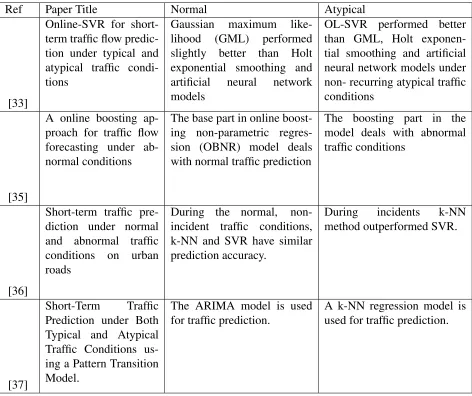
3.1 Summary on traffic prediction during normal and unusual traffic conditions 36
3.2 Summary on traffic prediction considering various traffic patterns . . . 37
3.3 Summary on methods for network-wide traffic prediction . . . 54
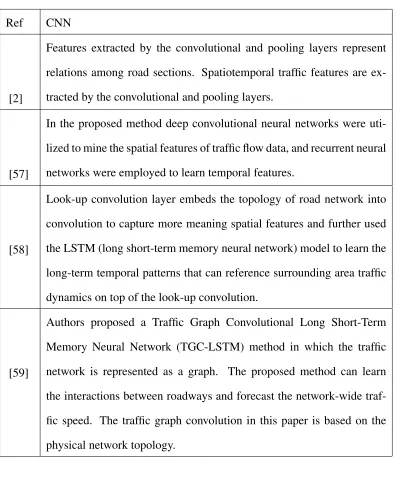
3.4 Summary on methods using CNN for traffic prediction . . . 55
4.1 Percentage of missing values in each location . . . 60
4.2 Sample records from raw Geotab data . . . 62
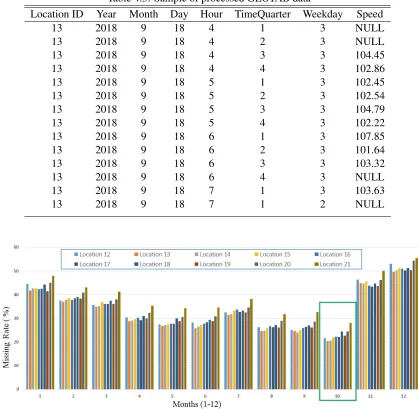
4.3 Sample of processed GEOTAB data . . . 63
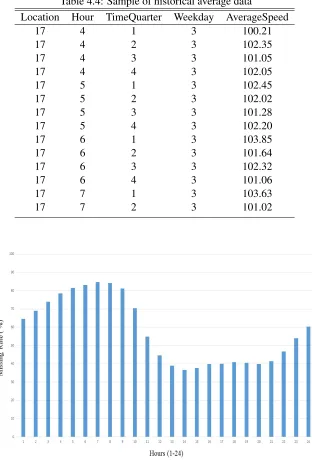
4.4 Sample of historical average data . . . 64
4.5 An example of time series with length 20 . . . 67
4.6 An example showing speed profile with subsequence length 4 . . . 69
4.7 Speed count less than 70 . . . 77
4.8 Unusual traffic patterns . . . 79
5.1 Traffic speed prediction for 2 hours using CNN, LSTM, ANN models . . . 87
5.2 CNN recursive multi-step prediction - MAPE . . . 89
5.3 CNN single-step prediction- MAPE . . . 90
5.4 LSTM and CNN for single step prediction - MAPE . . . 91
5.5 CNN single-step prediction with mask - MAPE . . . 92
5.6 CNN model with weekday and hour - MAPE . . . 93
5.7 Comparison of different imputing methods for missing values - MAPE . . . 96
5.8 CNN model with different missing rates in train data - MAPE . . . 97
5.9 CNN model before and after filling the missing values in train data - MAPE 98 5.10 Atypical sequence information where historical speed- actual speed >0 -Temporal . . . 99
5.11 Atypical sequence information where historical speed- actual speed>10 -Temporal . . . 99
5.12 Atypical sequence information where historical speed- actual speed>20 -Temporal . . . 100
5.13 Atypical sequence information where historical speed- actual speed>30 -Temporal . . . 100
5.14 CNN recursive multi-step prediction with dynamic- kNN - MAPE . . . 102
5.15 Real-time prediction with 10% missing rate . . . 103
5.16 Real-time prediction with 20% missing rate . . . 104
5.17 Real-time prediction with 40% missing rate . . . 104
5.18 Real-time prediction with 80% missing rate . . . 105
LIST OF FIGURES
1.1 Representation of missing data . . . 4
2.1 A Neuron . . . 8
2.2 Feed Forward Neural Networks . . . 9
2.3 a) Convolutional Neural Networks . . . 15
2.4 b) Convolutional Neural Networks . . . 15
2.5 CF Temporal . . . 17
2.6 CF Spatial . . . 19
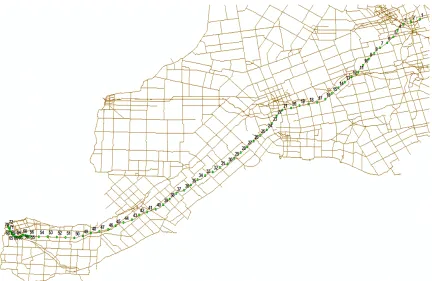
4.1 72 Locations across the 401 Highway . . . 59
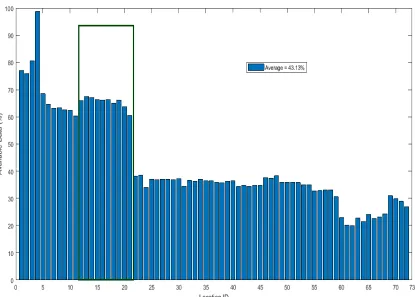
4.2 More percentage of available data in locations 12 to 21 . . . 61
4.3 Locations 12 to 21 across highway 401 . . . 62
4.4 Less percentage of missing values in October . . . 63
4.5 Percentage of missing values in each hour . . . 64
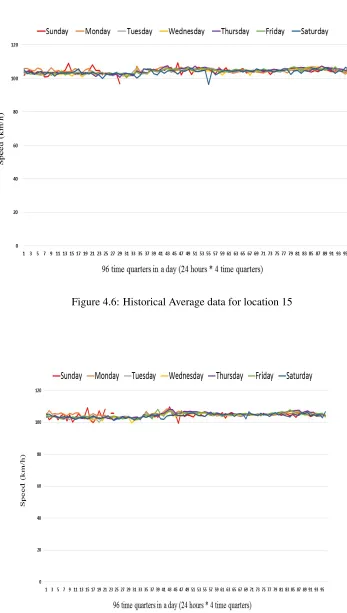
4.6 Historical Average data for location 15 . . . 65
4.7 Historical Average data for location 19 . . . 65
4.8 Type 1 missing pattern . . . 70
4.9 Type 2 missing pattern . . . 70
4.10 Type 3 missing pattern . . . 71
4.11 Type 4 missing pattern . . . 71
4.12 Multi View . . . 72
4.13 Temporal unusual traffic pattern . . . 74
4.14 Unusual traffic pattern in location 16 . . . 75
4.15 Unusual traffic pattern in location 17 . . . 75
4.16 Unusual traffic pattern in location 18 . . . 76
4.17 Traffic patterns in all locations . . . 78
4.18 Recursive model prediction with dynamic k-value . . . 81
4.19 Real time model prediction . . . 82
5.1 Traffic speed prediction using CNN with different number of time lags . . . 86
LIST OF SYMBOLS
Symbol Definition
ANN Artificial Neural Networks
DNN Deep Neural Networks
RNN Recurrent Neural Networks
CNN Convolutional Neural Networks
LSTM Long short term memory neural networks GRU Gated Recurrent Units
SVR Support Vector Regression
CF Collaborative Filtering
SQL Structured Query Language
kNN k Nearest Neighbors
SF Spatial Features
Chapter 1
INTRODUCTION
1.1
Motivation
In the transportation field, accurate traffic prediction plays an important role in traffic
control and management, and it has gained considerable attention from transportation
re-searchers and practitioners. Analyzing, understanding and estimating future traffic condi-tions can certainly help road users to settle on better travel choices, improve the quality
of traffic operations and reduce traffic congestion. And, to support traffic managers in
allocating resources systematically and help people with complete traffic information,
un-derstanding traffic movement for the whole road network is of great significance [1]. Due
to computational complexity caused by road network topology, spatial correlations in
traf-fic data expanding on a two-dimensional plane, long term prediction to reflect congestion propagation, large-scale network traffic speed prediction is challenging [2]. The main aim
of our research work is to predict traffic speed at multiple locations simultaneously on
high-way 401 in Canada. This highhigh-way is one of the busiest corridors in North America. This
highway extends from Windsor in the west to the Ontario Quebec fringe in the east [3].
Also, this highway connects to the Ambassador bridge which is an essential single freight
link in the Canada-US trade relationship. It carries about 2.5 million trucks for each year, accounting for about 20% of Canada-US trade [4].
In the real-time, traffic speed may be low during a certain time of the day (peak hours
traf-fic) and usually, weekday traffic is different from weekend traffic. Features extracted from
this type of information which depends on time are called temporal features. Similarly,
from this type of information are called spatial features. And, sometimes the planned
in-cidents such as road maintenance works/construction works affect the traffic conditions. Sometimes unplanned incidents and accidents result in atypical traffic conditions. In
addi-tion to the spatial and temporal features, our research work also focuses on atypical traffic
conditions because the identification of these conditions can help in better traffic
forecast-ing, provide information to transportation engineers for better road network design and can
be used to reduce congestion. Atypical traffic speed can be a significant drop in speed on a
section of highway.
These days a large amount of real-time traffic information is available due to the
de-velopment and deployment of the latest technologies in intelligent transportation systems
(ITS). Loop detectors, Global Positioning Systems (GPS) devices and Remote Traffic
Mi-crowave Sensors (RTMS), etc. can readily collect traffic data. However, the traffic data is
often missing regardless of the technology used. Reasons for incomplete traffic data can be
power failures, errors in transmitting the data, hardware or software malfunctions. In many
traffic-related times series datasets, missing data are prevalent [5]. Efficient data analysis depends on the quality of data, and the missing data affects the performance of data
anal-ysis like traffic forecasting. The performance of several forecasting models will reduce if
missing data is present. Even in our dataset, most of the locations contains around 40%
of missing data and in some locations it is more than 90%; hence it is necessary to impute
the missing data with efficient imputation models. In our dataset, the speed information is
collected through cutting edge GPS based vehicle tracking devices which are installed in vehicles. If the vehicles with GPS vehicle tracking devices do not go through any location
and during any timestamp then the speed will not be recorded during that timestamp and
location. Because of this, we have missing information in our dataset. The missing data
problem is challenging especially when the missing data percentage is more. Attributing
tem-poral features and study the effects of missing data on the performance of traffic prediction
, profoundly motivated the present research work.
This thesis first focuses on imputing the missing values based on the Multiview approach
[5, 6]. For local temporal and local spatial views we considered collaborative filtering
techniques and simple average techniques, and for the global temporal and global spatial
views we used the historical average data. Once the complete dataset is available (i.e.,all
missing values are imputed), we build the traffic speed prediction model based on CNN [2]
and predict the network-wide traffic speed for the next two hours.
The data used in this thesis is collected by GEOTAB and provided to us by the
Cross-Border Institute at the University of Windsor. The obtained dataset contains traffic speed
records across 72 locations on the 401 Highway from November 2017 to October 2018.
The traffic speed data is aggregated in 15-minute time intervals. We used the first eleven
months of data for training various models and retain one-month data, i.e., October 2018
data for testing.
The network-wide traffic speed prediction in this research work help in travel time pre-diction on specific locations on highway 401, crossing time prepre-diction over one of the
busiest US Canada bridges, the Ambassador Bridge.
1.2
Research Objective & Solution Outline
This research outlines the prediction of traffic speed using spatial and temporal features across highway 401 at specific locations for the next two hours in the future. The
accu-racy of the traffic speed prediction depends on many factors like the amount of available
historical data, how well the patterns are represented in the historical data, which model is
suitable for the nature of the dataset, etc. Our dataset contains more than 40% of missing
forecast-ing model. Hence, our first task is to impute the missforecast-ing values. Once the complete dataset
is available, we build the traffic speed prediction model and predict the traffic speed. The problem statement for the missing value imputation in traffic time series data can be
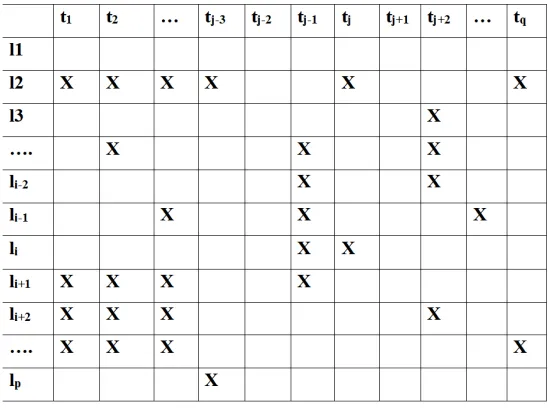
de-fined as follows: Given data = [l1,l2,li,....,lp] with p locations, Where eachli= [t1, t2,....,tq]
represents the time series of traffic speed during q time intervals from the sensorli. The
un-available values in this data are called missing values. Based on the un-available information,
missing value imputation models predicts the unavailable data. In Figure 1.1, X represents
the missing value. Predicting the future traffic speed of the road segment based on the
his-Figure 1.1: Representation of missing data
torical observations is called Traffic speed prediction. Traffic speed prediction comes under
supervised learning which means we must train the model with input/output pairs and the
trained model would predict the output for the given input. Such problems come under the
category of regression problems. The input data for predicting the traffic speed at single
location is w(time lags) historical time steps as shown in the below equation
Si= [Si,t−1,Si,t−2, . . .Si,t−w]
locations. Sometimes traffic congestion may propagate from far away locations. In this
study, we consider these network-wide impacts into account. Hence the input data for the prediction model is the network-wide traffic speed. We have p locations, and we need to
predict the traffic speeds at future n time steps by using w time lags. This input speed data
is represented in the matrix format as shown in the below equation.
XT =
S1,t−1 S1,t−2 S1,t−3 . . . S1,t−w
S2,t−1 S2,t−2 S2,t−3 . . . S2,t−w
..
. ... ... . .. ...
SP,t−1 SP,t−2 SP,t−3 . . . SP,t−w
The predicted output is represented in the matrix format as shown in the below equation.
YT =
S1,t S1,t+1 S1,t+2 . . . S1,t+n
S2,t S2,t+1 S2,t+2 . . . S2,t+n
..
. ... ... . .. ...
SP,t SP,t+1 SP,t+2 . . . SP,t+n
We have adopted the CNN based model for network-wide traffic speed prediction
be-cause CNNs can capture the spatiotemporal features of network traffic with a high
predic-tion accuracy [2]. The objective of this thesis is to impute the missing values and predict
network-wide traffic speed. The methods for assigning the missing values include collabo-rative filtering techniques, simple average and historical data.
1.3
Structure of thesis
The remaining part of this thesis is organized as follows:
for regression problems.
Chapter 3 briefly describes previous studies in the field of transportation for traffic pre-diction. Various machine learning models and their variations, and other similar approaches
for finding missing values are presented in this chapter. And works related to atypical
traf-fic patterns are summarized in this chapter. Several works related to predicting traftraf-fic speed
are included in this chapter.
Chapter 4 presents the primary contribution of this thesis and describes the
implementa-tion details of our approach. The significant contribuimplementa-tions of this research are :
• Implementing a multi-view approach for imputing missing values, a CNN
based model for network-wide traffic speed prediction with analysis on unusual
traffic speed patterns.
• Study the effects of missing data on the performance of traffic prediction.
• Implementing dynamic k-NN combined with CNN model.
• Real-time traffic speed prediction with missing data.
Chapter 5 reports the experimental results along with the detailed discussions.
Chapter 2
BACKGROUND STUDY
2.1
Artificial Neural Networks
Artificial neural networks (ANNs) have been used in various disciplines for solving
com-plex real-world problems. These are computing systems which are inspired by the
biolog-ical neural networks. In traffic prediction problems, they approximate a mapping function from input variables to output variables based on the historical data (training data). Deep
neural networks (DNNs) are ANNs with multiple layers between the input and output
lay-ers , and the set of mathematical operations are used to turn the input into the output. In
recent years, deep learning-based methods (such as LSTM, CNN) have demonstrated its
competitiveness to the time series analysis which is an essential part of traffic prediction.
These methods can handle the complicated nonlinear spatial, and temporal correlations and the different variants of these methods have been used for traffic speed prediction.
The structure of the ANN is analogous to the structure of a biological neural system. It
is composed of multiple processing units (called artificial nodes or neurons) connected in
consecutive layers to work together and produce the final output. ANNs have a fantastic
information processing characteristics such as non-linearity, fault and failure tolerance,
ro-bustness, high parallelism, and their capability to generalize [7]. In transportation research, ANN models have a long application history. Compared to the classical statistical models,
ANN models can capture the nonlinear relationship between dependent and independent
A Neuron in the context of transportation
The basic building block of ANN is the neuron. It can be considered as a computational unit which receives input and process that input to produce the output. Each input has
some weight. This processing can be the simple summation of products of inputs and their
weights or the summation of products of inputs and their weights passed through some
activation function. The activation function is to provide the non-linearity to ANNs. The
activation function produces the output in the desired range such as 0 to 1 or -1 to 1 . For
example, the logistic activation function produces the output in the 0 to 1 range [9]. Suppose the last one-hour traffic speed information is used to predict the speed in the next
15 minutes and the traffic speed data collected is for every 15 minutes. In this scenario, the
number of input features for the neuron is four , and the output is one.
In Figure 2.1, x1, x2, x3, x4 are input features and their respective weights are w1, w2,
w3, w4. w0 represents the bias value and y represents the output value.
Figure 2.1: A Neuron
Output value y is computed by the below equation which is the function of sum of
ˆ
y= f(W X+w0) (2.2)
f(x) =φ(x) (2.3)
whereφ represents the activation function
If f(x) =x, the output value of the neuron y=W X+w0 which is the equation for linear
regression, here the activation function is identity function.
If f(x) =sigmoid(x), the output value of the neurony=1+e−(W X1 +w
0) which is the equation
for logistic regression, here the sigmoid is the activation function.
The parameters in the above model (single neuron) are weights(W) and the bias values(w0).
These values are learned from the training dataset. Artificial neural networks are just the
combination of many such neurons in multiple consecutive layers which are called hidden
layers. These neurons are connected in such a way that they can process the information together and solve complex problems.
2.1.1 Feed Forward Neural Networks
In this neural network, information flows in one direction only from the input layer to
the output layer and the neurons from one layer are connected to all the neurons in the next
following layer as shown in Figure 2.2.
The neurons are connected by weighted connections, which carry the information from one
layer to the subsequent layer. These neural networks consist of one or more hidden layers. They can approximate nonlinear functions by adapting nonlinear activation functions. The
model can be called a deep neural network if it has two or more hidden layers.
Training of the neural network model A common objective for ANN in regression
problems is to minimize the sum of squared errors which means to reduce the error
be-tween the actual values and predicted values (Equation 2.4). To achieve this objective, we
need to train the neural network model. Training means adjusting the parameters of the model from the training dataset. In other words, it means estimating the best set of
param-eters i.e., weights and bias of the model such that there will be less error in prediction. A
backpropagation approach is typically used to train the neural network model [8] and it has
been applied in predicting traffic speed. A number of other optimization algorithms were
also developed to achieve this goal like the Genetic algorithm etc.
J=1/n n
∑
i=1(yi−yˆi)2 (2.4)
The backpropagation algorithm is a supervised learning algorithm which is based on a
gradient descent technique to train neural networks. The primary goal of this gradient
descent method is to minimize the error function (which is also called as a cost function or
objective function) by adjusting the parameters in the model. In each training step, error
function (Equation 2.4) is calculated, and the parameters(weights and bias) of the neural network are adjusted by back-propagating the error from the output layer to the input layer
so that the error in the next iteration will be reduced. In other words, the training process
involves running the model in both directions. First, we get the prediction using the current
model parameters by forward pass which means we pass the input to the input layer and
calculate the error function (Equation 2.4). Then we calculate the partial derivative of the
error function (gradient). In the next step we update the parameters of the model along the opposite direction of a gradient to minimize the error function value. Once the model
is ready (error rate converged or reached maximum number of epochs), we can use it for
prediction.
Gradient descent techniqueIt is a popular optimization method which is used to find
maxima/ minima of a differentiable function. It minimizes the error function by iteratively
updating the parameters in small steps by using the direction of the gradient of the error function w.r.t. to the parameters.
Let W be the set of parameters
Step 1: Initialize W randomly
Step 2: Update the parameters based on the below equation
W hile not converged or till the maximum number o f epochs:
W =W−η∗gradient(cost f unction,trainingdata,w)
Hereη is the learning rate which decides how much the parameters are updated in each
step and one epoch means all training samples are passed through the neural network only
once.
There are three variants of gradient descent. The difference between these three is in
how much of the total training data is used to compute the gradient of the error function
(also called loss or cost function) [10].
• Vanilla gradient descent: The gradient of the cost function w.r.t. to the
pa-rameters is computed using the entire training dataset. Here to perform just one
update, the gradients for the whole dataset are calculated. It can be very slow when the size of the dataset is large.
sample. For large datasets, redundant computations are performed in vanilla
gradient descent as gradients are recomputed for similar examples. SGD solves this by performing one update at a time. It is much faster in learning, but the
frequent updates can cause the cost function to fluctuate more.
• Mini-batch gradient descent: Parameters are updated for every mini-batch
of training samples. It requires less memory and leads to more stable
con-vergence. This batch size is one of the hyperparameters in training the neural
network model.
There are several gradient-based optimization techniques such as Adagrad, Adadelta,
RMSprop, Adam, AdaMax, etc. widely used by Deep Learning community [10] . And
also various activation functions exist such as sigmoid, tanh, ReLu, etc. In this study, for all the neural network models we use the Adam optimization algorithm and the ReLu
activation function in CNN model, tanh activation function in LSTM model.
2.1.2 Recurrent Neural Networks
The traditional feedforward neural networks do not consider the temporal information
for time series inputs. For example, if we consider four previous time lags to predict speed
in the next time interval, then these four-time lags are regarded as independent features and the temporal information between these time lags is not considered. Recurrent neural
networks can learn the temporal information; hence they are suitable for dealing with time
sequences. RNN hidden units receive feedback from the previous state to current state [11].
RNNs use the context information from previous time steps, which is usually referred to
as memory. Because of this capability, they can capture flexible temporal dependencies
and the final output not only depends on the current input but also depends on the previous
hidden layer output.
These networks were initially used for language models. RNNs unfold into the very
deep feedforward neural networks with more time lags. Because of this, the gradients of
the network may vanish or explode. In other words, if the time span becomes longer, the
accuracy of the network may reduce due to the vanishing gradient and exploding gradient
problems. The neural network models LSTM and GRU (Structures of RNN) were proposed
to solve this problem.
LSTM model was proposed [12] to overcome the vanishing gradient problem in
tradi-tional RNNs. Vanishing gradient problem prevents the RNNs from capturing the long-term
dependencies. A mechanism referred to as a gating mechanism in this model makes the
de-cisions about updating its memory. Typical LSTM unit consists of an input gate, an output
gate, a forget gate and a cell. Input gate decides what amount of new information should
be stored in the memory; the output gate decides what information in the memory is used
to calculate the output of the LSTM unit; the forget gate decides what information should be deleted from the memory. Here the cell represents the memory.
Due to this forget gate, the method can decide when to forget certain information. Output
layer of the LSTM cell is the linear regression layer. By maintaining a memory state of the
cellct, LSTM can learn sequential correlations. The output of the memory cell is controlled
by the output gate.
Hidden layers are treated as memory units in LSTM network. They can learn the corre-lations within time series in both short term and long term. The center of the LSTM unit
is the memory cell, and the state of it is denoted byct. Input datast (traffic speed at time
interval t) and output of the LSTM cell in the previous time intervalht−1 are the inputs of
calculated using the below equations.
it=σ(Wi,sst+Wi,hht−1+bi) (2.5)
ft =σ(Wf,sst+Wf,hht−1+bf) (2.6)
ot =σ(Wo,sst+Wo,hht−1+bo) (2.7)
˜
ct=tanh(Wc,sst+Wc,hht−1+bc) (2.8)
ct=itc˜t+ftct−1 (2.9)
ht =ottanhct (2.10)
The input gate, the forget gate and the output gate at time interval t are denoted as it, ft,
ot. Tanh is a hyperbolic tangent function and o denotes Hadamard product. These both
functions are element-wise.
In another variant of LSTM, the input, output, and forget gates also look at the memory state of the cellct along withst,ht−1.
2.1.3 Convolutional Neural Networks
A CNN is an efficient image processing algorithm and achieved successful results in the
computer vision and image recognition fields [13].
Hidden layers in CNN architecture are convolution layers, pooling layers, fully
con-nected layers. Different filters (or kernels) in a convolution layer extracts different features.
These filters are set of weights which are learned through the training process to produce the output features. A pooling layer is usually applied after a convolution layer which
se-lects the essential features from the extracted features of the convolution layer , and due to
this, the model parameters are reduced tremendously. In traditional feedforward networks,
capture the local spatial features. The typical fully connected layers are used only in the
last stage after the convolution and pooling layers.
Figure 2.3: a) Convolutional Neural Networks
Figure 2.4: b) Convolutional Neural Networks
If we place the convolution filter on top of the input matrix, then the product between
the numbers at the same location in the input matrix and the filter are calculated and these products are summed up together to get a single number which is the convolution result
of this operation. Then the filter is moved to its right by one element (Here the stride is
(1,1) which means filter moves by one element to the right, one element to the down until
throughout the input matrix to get the final convolution result matrix. In the traffic context,
if the size of the input matrix is ten rows which represents the locations, eight columns which indicates time steps and 32 filters with size 3X3, then the convolution result is of
size 8 X 6 X 32 as shown in Figure 2.3. In Figure 2.3, input to the CNN model is the traffic
speed matrix with size 10 x 8 where we consider traffic speed data from 10 locations and
8 previous time steps(time lags) to predict the speed at 10 locations in the future time step.
Extracted features through set of filters from the input speed matrix will be the input to the
fully connected layers. The last layer in Figure 2.4 is with the identity activation function and predicts the final output for a given input.
2.2
Multi View Learning Approach
Collaborative filtering techniques are widely used in recommender systems. In
recom-mender system, the similar users make similar rating for similar items [14].
2.2.1 Temporal Collaborative Filtering
In the temporal view for traffic context, each traffic data point at ti is considered as an
item. Let p be the number of locations and traffic speed is represented by s; locations
are represented by i; timestamps are represented by j. The similarity between the two
traffic data points which are at two different timestamps can be computed according to the
Equation 2.11.
sim(tmiss,tj) =
1
s p ∑ i=1
(si,miss−si,j)2/p
(2.11)
2.12.
ˆ
s(tmiss) = w ∑ j=1
sj∗sim(tmiss,tj)
w ∑ j=1
sim(tmiss,tj)
(2.12)
Herewis the window size, it provides the range in which traffic speeds should be consid-ered andtmissrepresents the timestamp at which traffic speed is missing. Here the missing
traffic speed (attmiss) is computed as the weighted average of traffic speeds which are in
the same location astmiss. The weights are the similarities between two timestamps (tmiss,
tj) at different locations.
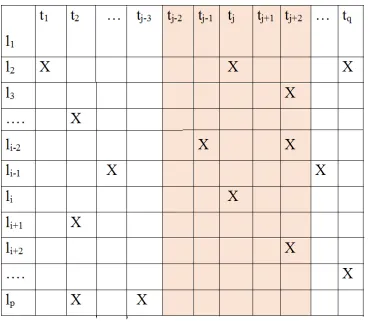
Figure 2.5: CF Temporal
To fill the missing value attj, we must compute the weighted average of traffic speeds
which are in the window range,tj−2(w1) +tj−1(w2) +tj+1(w3) +tj+2(w4)/ (w1+w2+w3+w4)
is the similarity of two-time stamps (tj, tj−1) at different locations,w3is the similarity of
two-time stamps (tj,tj+1) at different locations,w4is the similarity of two-time stamps (tj,
tj+2) at different locations.
2.2.2 Spatial Collaborative Filtering
In this view, the locations are considered as items. The similarity of two locations at
different timestamps can be calculated according to Equation 2.13.
sim(lmiss,li) =
1
s w ∑ j=1
(smiss,j−si,j)2/w
(2.13)
Here w represents the window size and si,j is the traffic speed at ith location and jth
timestamp. The Equation 2.14 computes the local variation in spatial view.
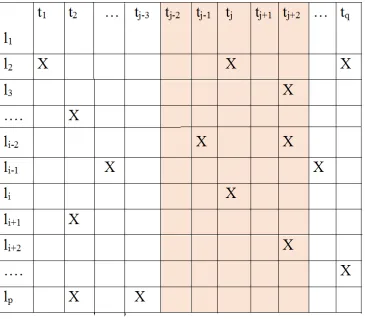
To predict the missing value at location li, the weighted average of all available data
points at various locations must be computed (same timestamp for locationliand all other
locations).
li−2(w1) +li−1(w2) +li+1(w3) +li+2(w4)/ (w1+w2+w3+w4)
Here w1 is the similarity between the two locations (li, li−2) at different time stamps
which are in the window range. Similarly w2 is the similarity between the two locations
(li,li−1) at different time stamps which are in the window range, w3 is the similarity between
the two locations (li,li+1) at different time stamps which are in the window range, w4 is
the similarity between the two locations (li,li+2) at different time stamps which are in the
window range.
ˆ
s(lmiss) = p ∑ i=1
si∗sim(lmiss,li)
p
∑ sim(lmiss,li)
Figure 2.6: CF Spatial
2.3
Regression techniques
2.3.1 K- Nearest Neighbours
The k-nearest neighbor’s algorithm is a supervised non-parametric technique used for
both regression and classification [15]. It is one of the most straightforward and efficient
machine learning algorithms. In the k-NN regression, we choose the k nearest neighbors
from the training dataset and compute the output as the average of these k nearest neighbors.
k-NN regression algorithm:
• Sort the training samples by ascending order
• Choose the first k nearest neighbors from this sorted array
• Compute the output by taking an average of these k nearest neighbors
Here the distance metric can be Euclidean or any other distance metric. There are various
types of k-NN regression models in which different weights can be assigned to neighbors
or for features in the sample. These algorithms are robust to noisy training data and can be
efficient if training data represents almost all patterns. However, it may take more time to compute the distances for each query sample when the training data size is huge.
2.3.2 Support Vector Regression
The support vector machines (SVM) are one of the popular supervised learning models
in machine learning which are used for classification and regression tasks. Authors [16]
proposed a version of SVM for regression, called as support vector regression (SVR). This
method constructs a hyperplane or a set of hyperplanes in a high dimensional space on training data. Later on, this hyperplane would help us in predicting the value. Two
bound-ary lines create a margin, and these are different from the hyperplane. The best hyperplane
represents the largest margin. The cost function for building the SVR model depends only
on a subset of training data; hence it is memory efficient. In summary, the SVR regression
model first maps the input onto a high dimensional feature space using nonlinear mapping
Chapter 3
LITERATURE REVIEW
This chapter gives a brief overview of the research work carried out for imputing the
miss-ing values and predictmiss-ing the network wide traffic speed prediction. A lot of research work
has been done in the both areas. Methods for imputing the missing values can be the
sim-ple mean value imputation or the comsim-plex spatial-temporal imputation methods. These
methods are also highly depend on the nature of dataset, amount of the available data, etc. In this section, we briefly introduce various methods used to impute missing values.
Various types of methods have been developed and different techniques are used as per
different application needs.
3.1
Related works on the imputation of missing values
Methods for imputing the missing data can be divided into three categories: interpolation
based, statistical learning based, and prediction based [17]. In interpolation-based methods,
we fill the missing data with an average or weighted average of historical data observations
either from the same sensor and same time in neighboring days or from the same sensor
and same time in other days with similar traffic pattern. In this category one of the popular
approaches to impute missing traffic data for a road segment is the historical average. In this method, the missing data point is imputed for a road segment based on the average
value of historical data corresponding to the same time interval and same location [18].
However, this approach performs poorly in the presence of unusual traffic conditions. The
most popular pattern matching interpolation methods are based on k-nearest neighbors
whole dataset [19]. The k nearest neighbors are similar traffic patterns in other days. The
performance of these approaches is affected by the availability of neighboring data.
Statistical learning-based methods try to take advantage of the statistical feature of
traf-fic data. These methods assume a special probability distribution from the available data
and the values which best fit the assumed probability distribution will be used to impute
the missing data. Markov Chain Monte Carlo (MCMC) imputation method [20] and
Prob-abilistic Principal Component Analysis (PPCA) based imputation methods are popular in
this category. The PPCA- based model combines two techniques: a) principal component analysis (PCA) which is used to separate the significant parts of the traffic data from the
unable to model parts. B) The second technique is maximum likelihood estimation (MLE)
which is used to estimate the missing values based on the obtained significant parts. In
other words, PPCA extracts the statistical characteristics of the available data and
indi-rectly builds the regression model. This model makes a reasonable trade-off between the
local predictability, periodicity and other statistical properties of the traffic data [21].
Au-thors [17] extended the probabilistic principal component analysis (PPCA) based imputing method by considering multiple sensors measurements. Experimental results show that the
temporal-spatial dependence is nonlinear, and it could be better retrieved by kernel
prob-abilistic principal component analysis (KPPCA) based method instead of PPCA method.
Overall if temporal- spatial dependence is appropriately considered, the imputing errors
can be significantly reduced. The KPPCA model is more powerful than the PPCA model
because it is less strict about the linear mapping assumption of PPCA model because it as-sumes a nonlinear relationship between an observed sample and a latent variable. Authors
in this paper compared the performance of these two methods for four different scenarios
with missing ratios 5% to 30%. In the first scenario, they collected the data from a single
detector for one month. The RMSE error value for these two methods is smaller than the
months), nearest historical imputing method (collected at the same daily point in the
near-est day) and spline interpolation method. However, the difference between the PPCA and KPPCA method is minimal. In the second scenario, the dataset is from a single detector,
but it is collected for three months. The error rate is unchanged in this scenario which
indi-cates that the imputing error cannot be reduced by feeding more data. In the third scenario,
one-month data is collected from three detectors. Error rates are decreased in this scenario
which shows the advantages of spatial dependencies in PPCA and KPPCA methods. The
fourth scenario is like the third one, but the influence of time lag is considered. In this one, KPPCA method is better than the PPCA method. Authors stated that the calculation time
of KPPCA method is more than PPCA. Hence, this method considering only spatial
depen-dence is highly recommended for online systems. In summary, the performance of PPCA
based methods are often better than the conventional methods although these methods have
a strong assumption on the data. Another group of approaches are based on regression
algorithms which include linear regression model, quadratic regression model, etc. To
cap-ture the relationship between neighboring sensors, authors in [22] used a linear regression model to impute missing traffic volumes and occupancies. Authors in this paper modeled
each pair of neighbors linearly and the parameters of the model are fixed based on the
historical data.
Prediction based methods use existing traffic prediction methods. Some of the famous
traffic prediction models are time series models based on the Auto-Regressive Integrated
Moving Average (ARIMA) model, Support Vector Regression (SVR), Artificial Neural Networks, etc. In these models value is predicted using the function which is formed from
historical data pairs (Input/ Output) [23]. Authors in [24] studied the effects of missing
data on ARIMA and neural network model performances. They developed two-hybrid
approaches. One is based on the self-organizing map (SOM) and ARIMA, and other
used. In SOM/ARIMA hybrid approach, a series of traffic patterns are classified using a
Self-Organised Map and then ARIMA model is associated with each SOM cluster. The SOM/MLP model was similar to the SOM/ARIMA model. Three other naive models were
also used for forecasting. The first one simply used the current traffic flow as the predicted
value. The second naive model assumes the linear relationship between the predicted,
present and the last traffic flows. In this study, SOM/MLP model achieved the best
fore-casting performance compared to all other models. To study the effects of missing data
on forecasting performance, missing data is generated randomly until 30%. Three meth-ods were used to deal with the missing data. The first method is the average value of data
used for forecasting, second is replacing the missing value with 0, and the third one is the
average of all traffic flow data. The first method showed the best results among all. The
second method is the worst option among all. And also, ARIMA models are more
sen-sitive to the percentage of missing data when compared to neural networks. Most of the
prediction models predict the data by considering a few current time lags before the value
to be predicted. In this scenario, they do not use the data after missing timestamp, and if the specified time lag data is missing, these prediction models fail to give the results.
In recent years, several machines learning based approaches have been proposed for
imputing missing traffic data. The data usually determine the form of the function in these
approaches. They try to take full advantage of the data. One of the popular machine
learning based approaches for imputing the missing values are tensor-based methods [25,
26]. In this paper [27] authors proposed a Bayesian probabilistic imputation framework for imputing the spatiotemporal traffic data. In this method, the Bayesian probabilistic matrix
factorization model was extended to higher order tensors and applied it for imputation tasks.
The performance of the method is evaluated by using a nine-week traffic speed dataset. The
spatiotemporal traffic data can be organized into a multidimensional array (road segment *
three different representations (A) Matrix (road segment * time series), (B) Third-order
tensor (road segment * day * time interval), and (C) Fourth-order tensor (road segment * week * day * time interval). The performance of different tensor-based approaches are
evaluated using these three representations. Through extensive experiments, this study
showed how different data representations affect imputation performance and proved that
data representation is an essential factor for model performance. And also showed that a
third order tensor structure outperforms the matrix and fourth order tensor representations.
The Kriging method can also be used for imputing the missing data. It was first devel-oped as an interpolation technique for geographical surfaces, it has become a representative
geostatistical approach to predict an unknown value at an unobserved location by adopting
various statistical assumptions and conditions in the modeling and has further advanced
to different kriging methods. Here the interpolation was formulated as a weighted sum of
the values of their known neighbors. The multivariate extension of kriging is Cokriging
which allows using secondary data sources to complement observed primary data. In this
study [28], authors employed ordinary and simple cokriging methods to use a secondary trac dataset for imputing the missing detector data. Using the information from multiple
data sources can improve the imputation results of the spatial-temporal cokriging approach.
Authors in this paper proposed two cokriging methods that exploit the existence of
spatial-temporal dependency in trac data and employ multiple data sources, each with
indepen-dently missing data, to impute high-resolution traffic speed data under dierent data missing
pattern scenarios. Consider secondary data sources only if they are highly correlated with the primary data to improve the prediction performance of cokriging. The cokriging
meth-ods may have the test errors if there is a relatively weak correlation between two data
sources. When the missing pattern follows not random in time and location pattern, using
secondary data sources with the simple cokriging can improve prediction results. The
the proportion of high-speed observations in the validation dataset of a higher missing rate
scenario increases. The overall imputation error decreases as the size of missing block increases, since these high-speed observations are like the mean of the RTMS data used
in this study. Overall, this paper provides a brief guidance of when and how to utilize
multi-source data for traffic speed data imputation using the real traffic datasets.
Clustering based approaches have also been proposed for imputing the missing traffic
data. Authors in this paper [29] proposed the method in which first the road segments with
similar traffic flow patterns are grouped through k-means clustering. In the next step, for each group of road segments, a deep learning model based on stacked denoising
autoen-coders is used to extract the spatial-temporal relationships between those road segments
and use this information for imputing the missing data points. Implemented experiments
show that under different missing rates, the imputation accuracy of the proposed method
is robust. In the proposed method, missing data is imputed collectively for a group of
road segments. An autoencoder is a neural network which has the same number of input
and output neurons. The input vector is reconstructed in this model. A denoising autoen-coder (DAE) is a variant of autoenautoen-coder for which corrupted input is passed during the
training process. In this model, the hidden layer learns the robust features underlying the
input data. For the training sample, some random entries in the input are masked with
zero. This training sample is considered as the incomplete traffic data with some missing
values. Each layer in the proposed method is pre-trained using a greedy layer-wise
ap-proach and to improve the imputation performance; the whole network is fine-tuned. The proposed method can impute the missing data on any road segment using the traffic flow
relationships with other road segments in the same cluster. Authors in this paper [30]
pro-posed a denoising stacked autoencoders (DSAE) model for imputing traffic flow data. This
model consists of two blocks, one is autoencoders (AEs) and the other one is denoising
cap-ture the statistical dependencies between the inputs. If DAEs are connected to form deep
networks, then such models are called stacked denoising autoencoders (SDAE). However, both DAE and SDAE can be used for cleaning or denoising the data. In this paper,
au-thors combined the DAE which is used for denoising the corrupted traffic data, with the
stacked AEs which help in extracting the features from high dimension traffic data. This
combination of models results in forming a deep learning model named DSAE which has
the advantages of both DAE and stacked AEs. Overall this model recovers the data through
statistical dependency learning and the feature extraction. The traffic flow data from PeMS aggregated in five-minute intervals is used in this paper. Traffic flow data for each day are
represented in the form of vectors. Each vector indicates whether it is a weekday or not.
Authors used a k means clustering method to group these vectors into weekdays and
non-weekdays. They assumed that vectors of the same date from different VDSs are similar
(same weekday property). So, there are two clusters, one with weekday pattern and the
other with the non-weekday pattern. A new corrupted vector is assigned to the closest
clus-ter based on the distance. Authors in this paper investigated 18 different scenarios for the model with different spatial (upstream, downstream, all other VDSs) and temporal factors
(weekdays and non-weekdays). Experimental results show that the model using all VDSs
data of weekdays and non- weekdays is the best. The proposed model is compared with
the history model, ARIMA and BP neural network model under the missing rates ranging
from 5% to 50%. The experimental results show that the imputation accuracy is better in
the proposed model. Also, authors in this paper show the consistency of the imputed data by the proposed model with the observed data.
Authors in this paper [31] proposed two machine learning approaches to impute missing
data. One approach is based on the information provided by surrounding sensors, and the
other method is a clustering technique that use optimal pattern clusters to impute missing
holiday information. Authors used an Extreme Learning Machine model optimized with
a genetic algorithm to capture surrounding sensors information. The dataset used in this paper is collected from the city council of Madrid (Spain) and it is aggregated in 15-minute
periods for the years 2014, 2015 and three months of 2016. The model on surrounding
sen-sors depend on neighboring sensen-sors with complete information. So, for training and testing
of this model, authors choose sensors with more than 98% available data. This model
de-pends on the relationships between measurements of different sensors at the center of the
city. These sensors need not be nearby sensors. In this, the model is like a forecasting model which use the information provided by other sensors and predicts the missing data value.
The second method proposed in this paper includes both clustering and classification. The
day wise traffic flow vectors are constructed, and a clustering technique is performed on
this dataset to obtain groups of days with similar measurements. Clustering on data with a
large number of dimensions needs enormous computational resources. And also, it could
be biased by localized, high-frequency noise and produce too many numbers of clusters.
To overcome this, the dataset is preprocessed by averaging every k samples. Authors con-sidered both DBSCAN and Affinity Propagation clustering techniques and stated that both
algorithms produced similar results if their parameters are appropriately chosen. Hence,
DBSCAN is used for all the experiments. Missing values are imputed by choosing the
closest cluster. This clustering method may not be able to impute the missing values for a
day with all measurements missing. To overcome this issue, authors used the classification
technique where clusters are the classes, features are the day of the week, the month and a binary feature to indicate a day is a bank holiday or not. The random forest supervised
classifier is used for training on the dataset with these three features and C classes
(clus-ters). Through this process, cluster can be assigned to the day with all missing values. The
percentage of missing values in this paper range from 1% to 100%. In this paper, the
stated that if the percentage of missing data is less, the rest of the data is enough to build
a good forecasting model. If a machine learning based approach capable of dealing with noisy data is used for prediction and the percentage of imputed data is less than 10%, then
these values will have less impact on the final forecasting performance. For large amounts
of missing data, the proposed algorithms in this paper produce robust predictions.
Recently, Long Short-term Memory (LSTM) neural network has been applied to
time-series forecasting tasks. When a large amount of annotated data is provided, the inference
accuracy can be improved. Most of the existing approaches utilize only valid data to train the network model, which dramatically decreases the training set size. Some approaches
utilize a temporal smoothness constraint to infer the missing data or take advantage of the
mean to study the missing data. But these solutions often cause the compensation process
to differ from the prediction models and the missing patterns to be explored inefficiently,
thereby resulting in suboptimal analyses and predictions. In this paper [32], authors
de-veloped a novel LSTM-based traffic ow forecasting method which not only acquires the
long-term and short-term temporal dependencies of time-series observations but also uti-lizes the missing patterns to improve the prediction results. Authors stated that although
LSTM networks have achieved competitive results in traffic ow prediction, there has been
little work on handling missing values in the LSTM network structure. When a missing
value is imputed via mean or temporal smoothing, it is impossible to distinguish whether
the value is an imputed missing value or a true value. Merely concatenating the time
in-terval vectors and the valid masking fails to exploit the temporal structure of the missing values. In this paper, the missing patterns in the data are modeled in the network structure.
Most missing observations can be divided into two categories (I) short-period missing
val-ues, which can last less than 5 min and these missing values are chiey caused by unsteady
equipment or a cluttered environment. II) long-period missing values, which can last hours,
model LSTM-M manages the missing data from the two categories, in which a long period
and a short period mechanism are designed for modeling missing data in the input variables. Masking vector is used to represent the missing flag at time step t. The proposed time-series
model for missing data incorporates two temporal prediction scales to obtain the missing
data directly from the input values and implicitly in the RNN states. Authors utilized an
inuence factor considering a missing observation to represent the weight of the previous
observation and an inuence factor to represent the weight of the periodic factor. Authors
simulated the residual between the predicted value and the ground truth value in the LSTM unit by introducing a masking vector directly into the model. The proposed model is
com-prised of 6 LSTM layers and one fully connected (FC) layer. The size of the hidden unit in
the LSTM is 32 throughout this paper, and the observation variable (input) has dimension
1. The activation function for the LSTM layer is the tanh function. Adam algorithm is used
for optimization because the traffic ow data are noisy, and Adam is appropriate for
prob-lems with very noisy and/or sparse gradients. Training is terminated after 10 epochs has
been reached. The mini-batch size is set as 32 and the other hyperparameters are optimized via cross-validation. The proposed model can be trained within 3 hrs on a single Titan X
GPU. Authors used the mean absolute error (MAE), the mean relative error (MRE), and
the root-mean-squared error (RMSE) as the evaluation criteria to calculate the prediction
accuracy. Performance of LSTM and the LSTM-M approaches are compared in
short-time-interval sequences (5 min short-time-intervals) in peak (8.10 am and 17.19 pm) and off-peak times.
The MAE of the LSTM model is 16.86, while that of the proposed model LSTM-M model is 14.57 (improved by 2.29). The MRE of the LSTM model is 6.97%, whereas that of the
proposed model LSTM-M is 5.12% (improved by 1.85%). And, the RMSE of the LSTM
model is 26.24, whereas that of the proposed LSTM-M model is 21.98 (improved by 4.26).
The proposed model has a lower error rate in comparison with the LSTM model, which
missing data. Overall, the experimental results on the PeMS data set and the authors own
data set show that the proposed approach outperforms several state-of-the- art methods in terms of accuracy.
Authors [5] in this paper proposed a multi-view learning method (MVLM) to impute
the missing values for traffic-related time series data. In the proposed method authors
considered four views. A) Global variation in temporal view which means in the data, there
exists a change regularity over a long time period. LSTM prediction model was used for this
view B) Traffic volume fluctuates from non-peak hours to peak hours which is considered as local variation in temporal view. Collaborative Filtering technique was used for this
view. C) In the local variation in spatial view, traffic state of a specific sensor is affected
by its adjacent sensors traffic state and proportional to the distance. Collaborative Filtering
technique was used for this view.D) Data in adjacent locations will be missing in block
missing scenarios. In this situation data from the long-distance sensor is considered which
is called the global variation in the spatial view. SVR is applied for this view. LSTM is used
to capture the global variation in the temporal view. The input of the LSTM is (x1, x2,,xt) which is considered as historical complete traffic data and output is (y1, y2,,yt) which is the
estimated missing values. The relationship among all the locations where to obtain traffic
flow data is modeled by SVR. In SVR (x1,y1)..(xn,yn), traffic data from the target site is
represented by y, x represents the traffic data from all other sites. In the proposed method,
block missing values are initialized with GVTV, GVSV. Next missing values estimated
from four different views are combined using a linear kernel function based on a multi-view learning algorithm. PeMS dataset is used in this paper for conducting experiments.
The data is updated every 5 minutes and collected over one year. First 8 months is used to
train the models, and the rest is used to evaluate the models. Stability of the model is tested
across different missing ratios 5% to 50%. The proposed method improved the accuracy of
3.2
Related works on the traffic prediction during unusual traffic
con-ditions
Online Support vector regression (OL-SVR) model was proposed by the authors [33]
for short term traffic prediction under both typical and atypical conditions. In this paper,
authors compared the OL-SVR model with three well-known prediction models which are
Gaussian maximum likelihood (GML), Holt exponential smoothing and artificial neural network models under two scenarios, 1-typical, and 2-atypical traffic conditions.
Califor-nia Freeway Performance Measurement System (PeMS), version 7.0 data was used in the
experiments. This data also includes traffic incident data. In the scenario-1, data related to
the special occurrences is not present. Only data with normal traffic behavior is included.
Sixteen days of 5-min traffic flow data from 5:00 am to 10:00 am for each of the seven
randomly selected freeway locations was collected. The first 15 days of data were used for model training and the 16th day was used for model testing. In the scenario-2, the only
difference is that the testing day (16th day) had an unexpected event or was a holiday. For
one-step ahead short-term prediction under normal conditions, the GML method is slightly
better. OL-SVR method outperformed other methods under atypical conditions at some
vehicle detection stations.
Authors [34] tested three machine learning models such as Time Delay and Recurrent Neural Networks and the k-Nearest Neighbour (kNN) algorithms during both normal and
incident conditions using three different models with increasing information in explanatory
variables. To predict the flow at f(t+h), the first model used four temporal lags, four spatial
lags. In addition to the features in the first model, the historical average is used in the
second model. The third model used error feedback mechanism in addition to the features