University of Windsor University of Windsor
Scholarship at UWindsor
Scholarship at UWindsor
Electronic Theses and Dissertations Theses, Dissertations, and Major Papers
10-5-2017
ARAB IMMIGRANT HIGH SCHOOL STUDENTS’ PERCEPTIONS OF
ARAB IMMIGRANT HIGH SCHOOL STUDENTS’ PERCEPTIONS OF
THEIR HIGH SCHOOL EXPERIENCES IN CANADA: A NARRATIVE
THEIR HIGH SCHOOL EXPERIENCES IN CANADA: A NARRATIVE
INQUIRY
INQUIRY
Nesreen Elkord
University of Windsor
Follow this and additional works at: https://scholar.uwindsor.ca/etd
Recommended Citation Recommended Citation
Elkord, Nesreen, "ARAB IMMIGRANT HIGH SCHOOL STUDENTS’ PERCEPTIONS OF THEIR HIGH SCHOOL EXPERIENCES IN CANADA: A NARRATIVE INQUIRY" (2017). Electronic Theses and Dissertations. 7252.
https://scholar.uwindsor.ca/etd/7252
This online database contains the full-text of PhD dissertations and Masters’ theses of University of Windsor students from 1954 forward. These documents are made available for personal study and research purposes only, in accordance with the Canadian Copyright Act and the Creative Commons license—CC BY-NC-ND (Attribution, Non-Commercial, No Derivative Works). Under this license, works must always be attributed to the copyright holder (original author), cannot be used for any commercial purposes, and may not be altered. Any other use would require the permission of the copyright holder. Students may inquire about withdrawing their dissertation and/or thesis from this database. For additional inquiries, please contact the repository administrator via email
ARAB IMMIGRANT HIGH SCHOOL STUDENTS’ PERCEPTIONS OF THEIR HIGH SCHOOL EXPERIENCES IN CANADA: A NARRATIVE INQUIRY
by
Nesreen Elkord
A Dissertation
Submitted to the Faculty of Graduate Studies through the Faculty of Education in Partial Fulfillment of the Requirements for
the Degree of Doctor of Philosophy at the University of Windsor
Windsor, Ontario, Canada
2017
Arab Immigrant High School Students’ Perceptions of Their High School Experiences in Canada: A Narrative Inquiry
by
Nesreen Elkord
APPROVED BY:
______________________________________________ F. Elbaz-Luwisch, External Examiner
Academic College of Education, University of Haifa
______________________________________________ T. Najem
Department of Political Science
__________________________________________________ D. Ciuffetelli Parker
Department of Teacher Education – Brock University
______________________________________________ G. Zhou
Faculty of Education
______________________________________________ S. Xu, Advisor
Faculty of Education
iii
DECLARATION OF ORIGINALITY
I hereby certify that I am the sole author of this thesis and that no part of this thesis has
been published or submitted for publication.
I certify that, to the best of my knowledge, my thesis does not infringe upon anyone’s
copyright nor violate any proprietary rights and that any ideas, techniques, quotations, or any
other material from the work of other people included in my thesis, published or otherwise, are
fully acknowledged in accordance with the standard referencing practices. Furthermore, to the
extent that I have included copyrighted material that surpasses the bounds of fair dealing within
the meaning of the Canada Copyright Act, I certify that I have obtained a written permission
from the copyright owner(s) to include such material(s) in my thesis and have included copies of
such copyright clearances to my appendix.
I declare that this is a true copy of my thesis, including any final revisions, as approved
by my thesis committee and the Graduate Studies office, and that this thesis has not been
iv ABSTRACT
This qualitative study explores the lived experiences of 4 Arab immigrant high school students in the Windsor, Ontario area. Student participants’ time spent in Canada varied from 1 to 5 years; three had attended grade school in Canada prior to enrolling in high school while 1 enrolled in high school immediately upon arrival. Allowing for a broader perspective of Arab immigrant high school students’ experiences in Canadian high schools, narratives of another 3 Arab student supplementary informants are used to enhance the interpretations and discussions. Participants’ and informants’ families emigrated from a number of Arab countries (Somalia, Syria, Kuwait, Iraq, Palestine, and Jordan) seeking better life and educational opportunities, to join family and relatives, or to flee war traumas. Student participants identified as either Christian or Muslim and attended Windsor-area Catholic or public high schools. Discussions with student participants and research informants (parents, teachers, and school officials) encompassed multifaceted topics such as home and school life; school environment and climate; stereotypes; school relations; engagement and sense of belonging; and influences both in and out of school that encourage or hinder students’ education, learning, and integration. Using narrative research approach
non-v
negligible relationship between home and schooling experiences. These individual, family, and societal factors then translate into their schooling experiences in their Canadian high schools and the degree of interaction within their environments. Based on the findings of the study,
vi DEDICATION
“At times, our own light goes out and is rekindled by a spark from another person. Each of us has
cause to think with deep gratitude of those who have lighted the flame within us.”
~ Albert Schweitzer1
I dedicate my accomplishments and work first and foremost to my husband, Wessam Haggag, and my children, Faris, Sufyan, and Samia. They have stood by my side patiently and supportively as I learned and wrote each day throughout this journey.
Second, I lovingly dedicate my work to my mother, Samia, and my father, Mohamed, who were always there for me and for my family every step of the way, when I made my decision to invest years of my life for this cause.
Finally, I dedicate this work to all Arab immigrant high school students and their families whom I can strongly identify with as they make their way through the daunting challenges of immigration, and whose dedication and success is an inspiration for us all.
vii
ACKNOWLEDGMENTS
First and foremost, all praise is due to God, the most gracious and most merciful for giving me the patience and perseverance to complete this research and doctorate journey. Then, I wish to extend my thanks to my thesis supervisor, Dr. Shijing Xu. Your continuous support and infinite guidance throughout my learning journey has been tremendous. Your care, counsel, mentoring, support, encouragement, wisdom, patience, and commitment to guiding me while watching my slow steps towards understanding and learning have helped me in ways you cannot imagine. You have helped me understand the meaning of acceptance and appreciation of
people’s experiences, feelings, and thoughts. Thank you for helping me change, learn, and achieve my goals.
I sincerely appreciate the encouragement and professional expertise shown by all of my doctoral committee members: Dr. George Zhou, Dr. Tom Najem, and Dr. Darlene Ciuffetelli Parker. I would have never been able to complete my dissertation without your guidance. Special thanks go to Dr. George Zhou, for your kindness and willingness to help and support me from the very beginning, even before you became my doctoral seminar II instructor and later a
member of my supervising committee. Dr. Elbaz-Luwisch, thank you for the enriching feedback and suggestions in the final stages of my dissertation writing. It was an honour to have you review my dissertation as my external reviewer.
I also wish to extend my thanks to all of the instructors who have contributed to my change and learning process through thought-provoking courses, challenging assignments, and group discussions.
Furthermore, with great gratitude I acknowledge the dedication and commitment of the research participants who have made this inquiry a possibility through the sharing of their inspiring persistence and strong will stories. You have all taught me so much.
viii
proposals, and ethical review applications. We also met regularly to discuss issues we encountered along the journey as we offered each other support and guidance. Your support has been important in my learning journey. Thank you, Dr. Ju Haung, Xuan Nguyen and Minghua Wang, and thank you Dr. Xu for encouraging us to maintain meetings and collaboration within our support group.
Not to forget the support, kindness, and willingness to go an extra mile to lend a helping hand from the most wonderful department secretaries and supports, Gayle Tait, Pierre Thibodeau, and Mandy Turkalj. I wish I could return your favours one day!
ix
TABLE OF CONTENTS
Page
DECLARATION OF ORIGINALITY ... iii
ABSTRACT ... iv
DEDICATION ... vi
ACKNOWLEDGMENTS ... vii
LIST OF FIGURES ... xv
CHAPTER 1: INTRODUCTION ... 1
Prologue: What Does It Mean to Become “Canadian”? ... 1
The Study………. 3
Context of the Study ... 3
Who are Arabs?... 5
Arab immigrants in the Windsor-Essex region……… 8
Focus of the Study ... 12
Purpose of the Study ... 13
Research Questions ... 14
Significance of the Study ... 15
Definition of Terms... 18
A Road Map Through the Thesis Inquiry ... 19
Mapping the Thesis ... 19
Core Student Participant Stories ... 20
Emergent Themes ... 21
Conclusions and Recommendations ... 21
Why Student Participants From Certain Countries? ... 22
CHAPTER 2: LITERATURE REVIEW ... 23
History of Arab Immigration to Canada ... 23
Why Arabs Choose to Immigrate to Canada ... 24
Immigrant Students of Arab Origin in Canadian Schools ... 26
Challenges for Arab Immigrant Students ... 26
Arab students’ identity-related dress codes ... 28
Portrayal of Arab immigrant students as outsiders ... 30
Stereotyping of Arabs in the media and its effect on Arab students ... 31
Racism and discrimination ... 32
Home and school conflicting values ... 33
Family loyalty versus individual competency ... 33
Policy to Promote Equity and Inclusion of Arab Immigrant Students in Canada ... 35
x
Joining the Discussion ... 41
CHAPTER 3: QUALITATIVE RESEARCH METHODOLOGY AND PROCEDURES ... 45
Narrative Inquiry Methodology and Modes of Thinking and Knowing ... 45
Why Narrative Inquiry? ... 45
Research Boundaries ... 48
Conceptual Framework ... 49
Experiential Learning and Three-Dimensional Narrative Inquiry Space ... 49
Temporal continuums ... 50
Personal–social continuums ... 51
Continuums of place ... 52
Schwab’s Theory of Practice—Commonplaces of Curriculum... 54
Criteria of Narrative Research Rigour ... 56
Trustworthiness and authenticity ... 58
Verisimilitude—True lifelikeness ... 58
Utility of research study ... 60
Narrative Framework Design ... 61
Negotiation of Entry Into Research Field—Participatory Involvement ... 61
A Fluid School-Based Inquiry ... 62
School Settings... 64
Windsor public high school ... 65
St. Mary’s Catholic high school... 65
Queen Elizabeth public high school (QEHS) ... 67
Research Participants ... 68
Research Methods ... 71
Collecting field texts through participatory observation ... 71
Collecting field texts through individual interviews ... 72
From field texts to research texts ... 75
From interim research texts to research texts ... 77
Traveling Through Multiple Narrative Accounts—Emergent Themes ... 80
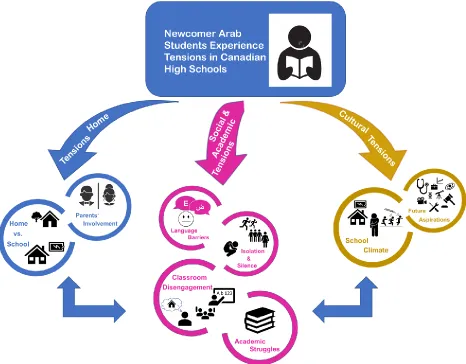
CHAPTER 4: SOCIAL AND ACADEMIC CHALLENGES... 84
Safa—Story of a 17-Year-Old Somali Student ... 84
Meeting Safa’s Family ... 84
Safa’s Transitional Experiences Between Canada and Somalia ... 86
Safa’s life in Somalia ... 87
Safa’s schooling in Somalia (grades 1 to 9) ... 87
Safa’s challenges in Somali high school ... 89
xi
Safa’s new challenge in Somali high school ... 90
Father’s Decision to Bring Family Back to Canada ... 91
Safa’s Family Returns to Canada ... 92
Safa’s life in Canada ... 92
Safa’s schooling in Canada ... 94
Safa’s family in Canada ... 101
Safa’s Ambitions to Become a Surgeon ... 104
Things Start to Improve ... 105
Summary of Safa’s Story... 106
CHAPTER 5: HOME TENSIONS ... 107
Basel’s Story—A 14-Year-Old Syrian Student ... 107
Meeting Basel’s Family ... 107
Basel’s Life in Syria Before Returning to Canada ... 108
Basel’s family in Syria ... 108
Basel’s schooling in Syria ... 113
Basel’s Life in Canada After 2013... 113
Basel’s family in Canada ... 113
Basel’s schooling in Canada ... 114
Basel—5 Years From Now ... 120
Summary of Basel’s Story ... 122
CHAPTER 6: SCHOOL MILIEUS AND CULTURAL TENSIONS ... 124
Deema—Story of a 17-Year-Old Palestinian Student ... 124
Meeting Deema at Queen Elizabeth Public High School ... 124
Deema’s Transitional Experiences Between Iraq, Jordan, and Syria ... 125
Deema’s life in Iraq and Jordan ... 125
Deema’s life in a refugee camp in Syria ... 126
Deema’s schooling in Jordan and Syria (grades 1 to 6) ... 126
Deema’s Family Arrives in Canada ... 128
Deema’s life in Canada ... 128
Deema’s schooling in Canada (grades 7 to present) ... 128
Following-Up With Deema... 135
Summary of Deema’s Story ... 136
CHAPTER 7: PERSISTENCE AND SUPPORT—THE KEY TO SUCCESS ... 137
Lauren—Story of A 17-Year-Old Iraqi Student ... 137
Meeting Lauren at St. Mary’s Catholic High School ... 137
Lauren’s Transitional Life Between Iraq and Syria Before Immigration... 137
Lauren’s schooling in Iraq and Syria (Grades 1 to 7)……… 138
Lauren and Family Immigrate to Canada ... 139
xii
Following-Up With Lauren ... 153 Summary of Lauren’s Story ... 154
CHAPTER 8: DISCUSSION ... 155 Section 8.1: The Temporal Dimension of the Experiences of Arab Immigrant
Students in Canadian High Schools ... 159 Newcomer Arab Students Join High School in Canada ... 160
How do past learning and social milieus influence the transition
of Arab newcomer students into Canadian high school? ... 160 Transformational High Schooling Experiences of Newcomer Arab
Students in Canada ... 170 How do newcomer Arab students overcome initial adjustment
challenges? ... 170 How do newcomer Arab students become engaged within their
schools over time?... 172 How does temporality impact newcomer Arab students’ academic
adjustment over time? ... 174 Section 8.2: The Personal-Social Dimension of the Experiences of Arab
Immigrant Students in Canadian High Schools... 177 Personal Qualities ... 178 Peer Relations ... 180
How do interactions with peers impact Arab students’ high
schooling experiences and perceptions?... 1800 How do Arab immigrant students’ personal qualities and cultural
values influence their peer interactions in high school?... 1822 How do Arab students develop friendships with peers within
Canadian high schools?... 18383 How does cross-cultural in/competence impact Arab students’
interactions with school peers?... 18686 Student–Teacher Relations ... 192
How does teachers’ level of support impact the schooling
experiences of Arab students? ... 193 Why do the majority of Arab students shy away from seeking
their teachers’ support in Canadian high schools? ... 196 How do teachers’ perceptions and understanding of their Arab
students’ academic motivation and future aspirations impact the
students’ schooling experiences? ... 198 How does teachers’ cross-cultural in/competence and cultural-
responsiveness impact the schooling experiences of their Arab
students’? ... 201 How does teachers’ acknowledgment of their Arab students’
xiii
Family Relations ... 207 How do Arab students’ feelings of life-long debt to their parents
impact their schooling experiences? ... 207 How does Arab parents’ involvement in their children’s schooling
impact these students’ schooling experiences? ... 210 What factors hinder some Arab parents’ involvement in their
children’s high schooling? And how are the schooling experiences
of these students impacted as a consequence? ... 213 Section 8.3: The Place Dimension of the Experiences of Arab Immigrant
Students in Canadian High Schools ... 217 Arab Students’ Experiences in Home Countries Versus in Canada ... 218
How do Arab students’ early schooling experiences in their home
countries impact their high schooling experiences in Canada ... 218 Arab Students’ Experiences in Home Versus in School in Canada... 222
How do the lived experiences of Arab student participants in their
family homes impact their Canadian high schooling experiences? .... 222 Arab Students’ Experiences within Support Programs at Canadian
Schools ... 226 How do English Language Learning support programs in
Canadian high schools impact Arab student participants’ schooling
experiences ……… 227 How do After-school academic support programs in Canadian high
schools impact Arab student participants’ schooling experiences and
perceptions? ... 229 How does the Newcomer Orientation Week (NOW) program in
Canadian high schools impact Arab student participants’ schooling
experiences and perceptions? ... 231 The Canadian High School – A Place of Being and Knowing ... 233
How are Arab student participants’ schooling experiences and
perceptions impacted within high schools in the city? ... 233 Concluding Remarks for Discussion: Intersection of the Three
Dimensions of Life Space ... 236
CHAPTER 9: IMPLICATIONS, CONCLUSIONS AND RECOMMENDATIONS 239 Section 9.1: Making Educational Meaning of Arab Immigrant Students’
Cross-Cultural High Schooling Experiences……….. 240 A Transitional Journey Through Social and Cultural Integration ... 241
Language barriers and Arab immigrant students’ social and cultural
integration ... 242 Personal qualities and Arab immigrant students’ social and cultural
Integration……… 244 Past relational experiences and Arab immigrant students’ social and
xiv
Cultural differences and Arab immigrant students’ social and cultural
integration ... 245
Raising cross-cultural awareness and Arab immigrant students’ social and cultural integration ... 247
School milieus and Arab immigrant students’ social and cultural integration ... 249
Developing friendships and Arab immigrant students’ social and cultural integration ... 251
Academic Achievement: A Major Life-long Goal ... 251
Family relations and Arab immigrant students’ academic achievement 252 School relations and Arab immigrant students’ academic achievement 254 Personal qualities and Arab immigrant students’ academic achievement 256 Section 9.2: Implications and Recommendations for School/Educational Policy Makers……….. 257
Using Schwab’s Commonplaces of Curriculum Making……… 258
Curriculum as Experience in Situations……… 258
Schwab’s Practicality in Education ... 259
Recommendations for School/Educational Policy Makers... 261
The Teacher ... 261
System-wide diversity model ... 261
The Milieu ... 263
Partnerships for cultural learning ... 264
Newcomers’ enrollment policies ... 265
Family support resources ... 265
The Learner ... 267
Newcomer student orientation programs ... 268
Early identification of disadvantaged newcomer Arab students... 268
The Subject Matter ... 270
Enhanced/modified course streaming practices ... 270
Recommendations for Further Research ... 271
Final Words ... 271
REFERENCES ... 275
APPENDICES ... 300
1
CHAPTER 1: INTRODUCTION
Prologue
What Does It Mean to Become “Canadian”?
The air was getting cooler as I took my morning walk after dropping off my children at school on an October morning in 2012. I had resolved to walk for an hour each morning before going to the university to prepare for my graduate assistantship work in order to sharpen my physical and mental capabilities as I began my doctoral journey. I knew from the outset that it was not going to be easy, but what I did not realize then was how difficult it would be to make educational meaning of it all and to be of the greatest service for the upcoming generation of new Canadians. I felt a rising tension as the fall 2012 semester was winding up and time to declare my research topic was fast approaching. I always knew I wanted to make myself and my research useful for my Canadian community, yet determining the exact venue and means through which I would do so was something I had to grapple with.
On that morning, I reached into my shoulder bag for my water bottle only to discover that I had forgotten to pack it before leaving home earlier that day. I decided to make a quick stop to buy a new bottle from a local Dollarama store that I passed each day on my morning walks. I grabbed a bottle from the front fridge and as I approached the cashier, a middle-aged Arabic-speaking woman greeted me and said in Arabic, “May I ask you a question?” I paused to listen as she introduced herself as a newly arrived Arab immigrant and she then asked me, “What does it mean to become Canadian?”
I listened to her as she recounted an argument she had had with her husband regarding their family’s decision on whether to decorate their front yard for Halloween. She explained, “My children are excited for Halloween. They see front yards decorated as we walk around the neighbourhood and they ask if we will do the same. They have been introduced to Halloween at school as a fun and exciting occasion filled with decorations, adventures, candies, and treats.” She justified her point of view: “We have been through a lot and I think it’s finally time for my children to be happy and they need to feel like they belong. My husband insists they do not need to do the same as everyone in order to be happy. I understand he is afraid of them losing their identities and forgetting their heritage and Arabic traditions, but I argued they do not need to be different in order to keep their Arab connections.”
As the woman told me of the Halloween argument with her husband, she said that her spouse had challenged her with the following question: “How Canadian do you want them to become?” The woman said she did not have a ready answer for his question, nor was she even sure what it meant to “become Canadian.” (Diary excerpts—September 27, 2012)
2
immigration experience, and how impressed I was by the beautiful fall days followed by spectacular Christmas lights during winter, as well as other “Canadian” occasions that made learning about Canada fun and exciting. I continued to reflect on my school days as I recalled how I felt during my first few years in Canada. I recalled Ms. Sandra, my English as a Second Language teacher, who greeted me and my fellow newcomer classmates with the widest smile every day. She used to place a bowl of candies on her desk and she would tell us a little about the connection between the types of candies in the bowl and any given seasonal festivities. She would then let us sample the candies and sometimes we would share something traditional from our own cultures as well. These memories made me appreciate the effort Ms. Sandra put into preparing these classroom ice-breaker activities. Recalling these memories while thinking of the woman’s argument with her husband about Halloween, I realized that well-intentioned gestures like Ms. Sandra’s may have led to similar arguments in the homes of some newcomers. And then, I was struck by the thought of how such sincere efforts by educators who are passionate and caring may not
necessarily be in the best interest of all involved, if such classroom practices were not based on a solid ground of cultural knowledge and practical planning.
Pondering this woman’s dilemma about Halloween, it struck me that I too had experienced similar challenges in my childhood home and some had continued into my adulthood as a parent. Yet, although I now had been in Canada for two decades, did I have the answers to the woman’s questions? As an immigrant, a former Canadian public-school student, and now a parent living in Canada with my own children attending public schools, did I know how to resolve such conflicts in my own home? Such thoughts provoked my interest in exploring the experiences and perceptions of Arab immigrant students. And at that point, I was convinced that I needed to find the answers by learning more about the different stories of other Arab immigrants. I thought to myself, “How much do we know about what these newcomer immigrant students experience? How effective can our efforts, as educators, be without knowing what these students themselves feel and think?” I
3
The Study
Context of the Study
Reflecting on the questions the woman at the Dollarama store posed during our encounter,
I realized that I could identify with her uncertainty. Having immigrated from the United Arab
Emirates—a rapidly growing and advancing country in terms of its academic and economic
resources and its diversified culture—to Halifax, Nova Scotia, Canada in the early 1990s, I was
not sure I understood what the woman meant when she also had told me that “we have been
through a lot.” Her testimony reminded me of how little I knew about the experiences of Arab
immigrants and/or refugees from different countries prior to their arrival in Canada. I thought to
myself, if I knew so little about the lives of Arab students, how could mainstream Canadian
teachers, from other cultures, know anything at all on the subject if they are even less informed
than I? My parents immigrated to Canada in search of better educational opportunities for myself
and my siblings, but we had a good life back in the UAE. As I thought more about the topic, I
came to realize that not all Arabs leave their home countries for the same reasons and that there
is so much for me to learn about from different Arab immigrant students.
In fact, while drafting my research proposal a few days after my encounter with the
newcomer Arab woman at Dollarama, I recalled my parents arguing about similar issues during
the first few years of our family’s quest to “become Canadian”. My father was always occupied
with providing ways to keep me and my younger siblings connected to our Arabic roots and
traditions, though he knew little about our schooling and the completely different lives we were
living while at school. Upon my family’s immigration to Canada, I attended a public high school
for 3 years, during which time I had multiple experiences that gave me mixed feelings about my
4
immigration to Eastern Canada had been newly introduced to the area, which was met by
different forms of resistance in the city. As an adolescent, I arrived with my own mixed feelings
of excitement and worries about the unknown, and I was not prepared for the challenges that I
would soon face on so many levels. My excitement quickly dissipated within the first few
months as I tried to cope with my new life circumstances as an Arab immigrant girl.
Later, as I moved on to resume higher education after earning a bachelor’s degree in
mathematics; years after I completed my high school, I witnessed the increased media portrayal
of Arabs as extremists and terrorists after the surge of collective emotion following the traumatic
events of 9/11 in the USA. As a consequence, Arabs in North America reported suffering
tremendously from issues related to labeling and discrimination. Arab students at the high school
level were always in my thoughts as I learned about the difficulties many encountered in the
years that followed. Research at the time also indicated that students of this age group are
generally met with more challenges in coping with their new school environments than younger
newcomers (e.g., Janzen & Ochocka, 2003; Lee, 2005; Manavathu & Zhou, 2012). I also came to
know that studies also report academic and social struggles which may be natural risks to
students during adolescence in general (e.g., Suárez-Orozco, Suárez-Orozco &Todorova, 2008;
Suárez-Orozco, Bang, & Onaga, 2010). I therefore, decided to make Arab immigrant high school
students the focus of my study with the hope of helping to ease their transition into their new
Canadian high schools.
Having become a member in the education field, and as an educator, I consequently
thought of how my research could inform teachers as they strive to help Arab newcomers
transition into their new lives in Canada. I realized then that people like myself are directly
5
thus set out in my doctoral work to add to the knowledge base on this subject with the goal of
facilitating and improving educators’ ability to lessen the challenges faced in this transition.
Having realized my obligation to contribute to the building of bridges between passionate
school communities and newcomer immigrant families and their children, I started drafting my
research proposal in late 2012. Following much thought, reflections, and advice from colleagues
and professors, Arab Immigrant High School Students’ Perceptions of Their High School
Experiences in Canada: A Narrative Inquiry has been the title of my doctoral thesis inquiry since
February 2013, when I began talking to and leading an inquiry into the lived experiences of Arab
Immigrant high school students in the Windsor, Ontario area. I particularly decided to use
Clandinin and Connelly’s (2000) framework of narrative inquiry, where Arab immigrant student
narratives and stories are both the methodology and phenomenon of the study. Moreover, I had
been inspired by Schwab’s (1973) theorizing of the significance of teacher, learner, subject
matter, and milieu, as the four commonplaces of curriculum making. I thus began thinking of
ways to borrow from his work in framing implications for education and policy makers once the
inquiry is concluded. Further explanation of the research methodology and procedures follow in
Chapter 3.
In this light, with the focus of my research study on the high schooling experiences of
children from the Arab community, it is necessary to begin by briefly defining who Arabs are.
Who are Arabs? In general, the word “Arab” is used throughout popular and so-called
official media—such as Wikipedia’s entry for “Arab World” (2016) and Statistics Canada’s
6
Middle Eastern member states of the Arab League2, a world that has common traditions, customs
and a single unifying languagewith a total population of 359 million people as of July 2013
(Wikipedia, 2017). While Arabs hold beliefs from three major faiths—Islam, Christianity, and
Judaism—the majority are Muslims, and although 90% of the Arabs are Muslims today they
represent less than 20% of the Muslims of the world (The Arabic tapestry, 2008).
While this can serve as a unifying definition of Arabs for the purposes of this study, it is
important to highlight the huge diversity within the countries of the Arab League; given that the
Arab League member states cover over 13 million km2 and straddle two continents, Africa and
Asia. The Arab league countries stretch from the Atlantic Ocean in the west to the Arabian Sea
in the east, and from the Mediterranean Sea in the north to the Horn of Africa and the Indian
Ocean in the southeast (Wikipedia’s entry for “Arabs”, 2017). While people of the Arab world
are bound by ethnic, linguistic, cultural, historical, identical, nationalist, geographical and
political ties (al-bab, 2015; El-Shamy, 1995), they constitute vastly diverse communities with an
estimated total population of 450 million, 150 million of whom are in the global diaspora
(Nydell, 2005).
Writers in modern times use two identifying terms to identify people of the Arab world: (a)
Arabians to identify people of the Arabian Peninsula, consisting of Yemen, Oman, Qatar,
Bahrain, Kuwait, Saudi Arabia and the United Arab Emirates, and parts of Jordan and Iraq
(Rowmann & Lanham, 2003), (b) Arabs to identify Lebanese, Syrians, Iraqis, Palestinians,
Egyptians, and North Africans. An alternative is to call all people of the Arab league member
states Arabic speaking people, while keeping in mind that although the official language of the
2 Arab league member states: Saudi Arabia, Egypt, UAE, Qatar, Algeria, Iraq, Kuwait, Morocco,
7
Arab League is Arabic, however, a number of Arab League member states have other co-official
or national languages, such as Somali, Berber, Kurdish, Assyrian, Chaldean, and Nubian. While
most Arabs are followers of three major faiths (Islam, Christianity, and Judaism) the majority—
“well in excess of 90%” (Hayani, 2014, Religious Affiliation and Diversity section, para. 1)—are
Muslims. Moreover, an estimated 15 million Christians combined live in Egypt, Iraq, Jordan,
Lebanon, Palestine, Sudan and Syria, in addition to smaller but significant numbers of Druze,
Yazidis, Shabaks, and Mandaeans (Religious Diversity around the World – Pew Research
Center, 2014).
According to Statistics Canada (2007), in 2001, 44% of Canadians of Arab origins
indicated that they were Muslim, while 44% reported that they belonged to a Christian faith
group. Wingfield (2006) also introduces an interesting description or definition of Arabs:
Arabs, like Hispanics, are a linguistic and cultural community, not a racial or religious group. Arabs are those who speak Arabic as their primary language and share in the culture and history of the Arab world, which stretches from Morocco to the Arabian Peninsula. (p. 254)
In short, although it would be difficult (and somewhat inaccurate) to say that Arabs have a
singular overarching tradition or share a commonly held belief, it is easier to identify some of the
more popular beliefs and values among Arabs of different faiths. Al-Hazza and Bucher (2010)
begin by defining the word “Arab” and classifying Arabs into their geographic demographics;
however, they note that within the Pan-Arabic culture, “despite the rich array of traditions and
diversity of customs, all Arabs are held together by the common identity of being Arab” (p. 6).
Moreover, I chose to conduct the study in Windsor because I hoped that Windsor’s longer
history of immigration and that the region is considered an important immigrant destination site
8
(Selimos, 2017), would give it precedence in the field of educating newcomer immigrant
children.
In addition, I have identified Windsor’s significant multiculturalism when compared to
other parts of Canada, such as where I grew up in the Eastern provinces, given that
Windsor-Essex region is the fourth most ethno-culturally diverse city in Canada (Statistics Canada, 2006),
where one in four people is an immigrant and the newcomer population represents 21% of the
total population (Windsor-Essex Immigration, 2014). According to Zhong and Zhou (2011),
relatively mild winters, opportunities to commute to the United States, and the existence of large
specific ethnic communities attract an increasing number of immigrants to settle in Windsor.
Arab immigrants in the Windsor-Essex region. In addition to Windsor’s long history of
immigration and significant multiculturalism, Windsor has a proportionately larger population of
Arab immigrants; as Windsor’s Arabic community represented 8.15% of the city’s population in
2006 (Citizenship and Immigration Canada, 2010), and Arabic was reported to be the most
common non-official-language mother tongue in Windsor in a 2011 census (Statistics Canada,
2016). Furthermore, experts in the field are skeptical of the preceding statistics and believe that
people of Arab descent in the Windsor region are under-reported; due to a number of factors
including the preference of some not to be identified as different from the majority, and/or the
non-active participation of some in national surveys done for statistical data collection purposes.
In fact, it is believed the population of Arab residents in the region may be considerably higher
(Najem, personal communications 2017).
According to Arab historians and community members of Windsor, history of Arab
immigration to the region dates back to late 1800s when early immigrants came predominantly
9
early 1950's, mostly Christians. They had little education and little money but were hardworking
young people, who worked in any available jobs and learned English on the job (Canadian Arab
Community, 2008).
In the second half of the 20th century immigrants from other Middle Eastern countries
came to the region due to socio-economic reasons, to escape war, famine, religious and/or
political persecution, bringing Muslim Arabs in addition to Arabs of other religious
denominations to the region (Hayani, 2014, Religious Affiliation and Diversity section). This is
when a great diversity within Arab communities in Windsor began to take shape. There were
those who arrived with little education and no money, hoping to start a new life in Canada. For
example, like the wave of Somalis arriving between 1980s and 2000, “as a result of a long and
ongoing civil war that started in Somalia in 1991, and major droughts that hit the country in
recent years” (Ayoub & Zhou, 2016, p. 2), and mostly settling in Sandwich Town. Those
immigrants and their children required supports in financial, healthcare, and language learning in
addition to other areas. On the other hand, there were those arriving from the Arabian Peninsula,
originally from other countries in the Middle East, such as Iraq, Egypt, Palestine, Syria, and
Lebanon, as immigrant business investors or professionals (Canadian Arab Community,
Immigration to Windsor and Essex County, 2008). The majorities of these immigrants were
highly educated professionals or entrepreneurs and were better assisted by governmental
organizations in finding jobs, housing, learning English and health care, compared to early Arab
settlers, and mostly settled in South Windsor. They invested their wealth and professional
expertise in the Windsor-Essex region and quickly flourished. These constitute the considerable
percentage of working physicians of Arabic background as well as many other professionals,
10
individuals in the community. As Hayani documents “throughout the years, Arab immigrants and
their descendants have entered all levels of the occupational hierarchy, some of them achieving
renown in their respective fields” (Hayani, 2014, A Socio-Economic Profile of Arab Canadians
section, para. 5). More details follow in the History of Arab immigration to Canada section of
Chapter 2.
Diversity within the Arab communities in the region and the needs of their children within
the education system continued to grow. For example, up until today, Maronite Lebanese who
are considered to be among the most ancient Arab settlers in the region continued to bring family
members from Lebanon through marriages and for family reunification. Many of those
newcomer Maronite Lebanese are highly educated, have better socio-economic capabilities, and
fluently speak English, and some, French as well. While their children speak the language, and
may not require language learning supports, they may still require different types of supports
within Canadian schools than non-English speaking newcomers. On the other hand, Arabs from
other socio-economic and geopolitical backgrounds continue to settle in the region bringing
various degrees of means and influence in the city, while requiring significantly varied needs
within the education system (Conger, Conger, Lorenz, Simons, & Whitbeck, 1992). This, in
addition to the most recent arrival of waves of Syrian refugees to the region, created an even
larger diversity within the residing Arab communities. Arab descendants in the region vary
between third and fourth generation Canadians to recent newcomers and between wealthy,
well-established professionals to welfare assisted individuals and families. With such a growing
diversity within the residing Arab community in the Windsor-Essex region, a number of
religious and nationality-specific communities branched out and established several community
11
make available culturally traditional goods and groceries for immigrants arriving from the Arab
world and the Windsor-Essex community at large. For example, one can drive along a
two-kilometer stretch of Wayndotte Street and find Arab stores on both sides of the street; Arabic
restaurants serving Arabic cuisine, grocery stores whose shelves stock all kinds of Arabic food
and other products, a number of bakeries that produce and sell hundreds of pita bread daily,
confectionery/sweet shops similar to those found in the Arab world, and Arabic clothing stores
as well.
For recent Arab immigrant and refugee newcomers, settling in the Windsor region during
the past decade or so, meant coming into institutionally complete communities. Hayani (2014)
asserts that “both the religious and secular ethnic institutions have provided a link with the
ancestral land, ….., they have played an important adaptive role, encouraging acculturative
change and integration with the host society” (Religious Affiliation and Diversity section, para.
6). Children of some of those newcomers may have different immigration experiences than
earlier Arab community settlers. In this regard Hermansen (1991) in considering the influence of
the region and specifically the community to which the Arab immigrant lands, argues that "large
urban centers where Muslim and ethnic groups can constitute subcultures mean less pressure to
acculturate" (p. 190).
Moreover, those considering themselves a religious or linguistic minority within their
home countries may find it easier to adjust in such a highly diverse region. Chaldeans (1 million
Chaldeans to approximately 22 million Iraqis in Iraq), for example, who make up a large
percentage of Arab newcomers in the region may feel that Windsor’s population composition
12
Schooling children of Arab immigrants with such diverse backgrounds, family
circumstances, and socio-economic situations in Canada at large, and in Windsor in specific, all
create such complex dynamics within Canadian schools. Such complexities in turn call for
exploring different strategies and venues to address the various needs of this very diverse portion
of school communities.
My aim as I began my inquiry was to find out about the schooling experiences of Arab
immigrant students in city high schools. The majority of Arab immigrant students at the high
school level in Windsor mainly attend schools of either the Public or Catholic school boards.
Those with French as an additional language attend French schools, the majority of whom are
children of well-established and wealthier Arab immigrant families. The rest mostly enroll in the
mainstream English schools. Some schools are more populated with immigrant students than
others because they offer specialized programs targeted at supporting immigrant students upon
their arrival in Canada. While it is significant to explore the varied perceptions of Arab students
of different socio-economic and geopolitical contexts within Canadian schools, more time and
resources would need to be invested in this cause. With such a massive population of varied
backgrounds, means and needs, I focused on the experiences of Arab immigrant high school
students attending English public and Catholic schools in the city, within this inquiry. I was
privileged to observe some of the participants of the study when visiting and volunteering at a
number of different schools, which I discuss in greater detail in the methodology chapter of this
dissertation.
Focus of the Study
The focus of this study is to explore and understand the lived experiences of Arab
13
three-dimensional narrative inquiry as the research method and methodology. With the Arab
immigrant high school students as the unit of analysis in this narrative inquiry, it is necessary to
understand and learn about their past experiences in their home countries, their traditions and
values, and the tensions they experience while aspiring to attain their goals as they adapt to their
new homes in Canada; in order to adequately understand their current lived experiences. My
study is a fluid inquiry (Xu & Connelly, 2010) that focuses on student participants’ day-to-day
lived experiences and that considers “the research site in dynamic, fluid terms and it means
thinking of it simultaneously, all at once, in terms of its analytic structural dimensions” (p. 363).
Further explanation on the fluidity of the study follows in the methodology chapter.
Purpose of the Study
By focusing on the lived experiences and perceptions of Arab immigrant high school
students, I trace the lives of the student participants back in their home countries as I seek to
understand their current living circumstances during their transition into their Canadian high
schools. I do this in an effort to bridge communication gaps in communicating cultural and
educational values between school communities and Arab immigrant students, and their families,
in Canada. My adoption of Clandinin and Connelly’s (2000) three-dimensional narrative
research methodology enables me to study student participants’ past and current lived
experiences, including the tensions and challenges they face while adapting to their new home
environments, as well as the efforts made by school communities and policy makers to support
them in this regard. It also allows me to address implications, while I emphasize the significance
of the four commonplaces of curriculum within any educational situation (Schwab, 1973); that
ultimately may enhance resources for supporting Arab immigrant students.
14
educational values are and can be communicated within Canadian high school environments. It is
my assumption that Canada—a nation built on generosity, acceptance, and tolerance of
diversity—offers great opportunities and quality of life for immigrants of diverse backgrounds
and for all Canadian citizens alike. Hence, the broad purpose and scope of this study is narrowed
down to the following specific objectives:
1. Explore, understand, and make meaning of the lived experiences of Arab immigrant high
school students in Canadian schools, through a better understanding of how these students
perceive their school environments and the existing support systems designed to help them;
2. Present a view of some of the diversity of backgrounds of Arab immigrant students in an
effort to familiarize educators and school communities in general with such students’
cultural values and traditions;
3. Provide insights to help Arab immigrant youth and their parents better understand the
immigration experience to succeed throughout the process. It is vitally important for
parents to understand “in more profound ways how their children’s experiences [are] being
shaped” (Clandinin, 2013, p. 37). This can happen by raising awareness among them about
the federal and provincial policies and school programs implemented within the Canadian
educational systems.
4. Provide insights aimed at informing schools, curricula developers, policy makers, and related
stakeholders so they collectively could respond to immigrant students’ needs more
effectively, thus enabling such students to succeed both academically as well as in other
areas of their everyday lives.
Research Questions
15
the research with certain assumptions and limiting the scope of the study to certain questions,
student participants co-construct and lead the flow of their narratives and stories (Xu, Connelly,
He, & Phillion, 2007). In doing a narrative inquiry research, I also think of the research questions
as a collection of research puzzles, carrying with it a sense of searching for and re-searching
(Clandinin, 2013; Xu, 2006) information that need to be explored, found, and put together to
create a well-framed picture of what has shaped student participants’ experiences, personalities,
and lives. Nonetheless, the following main research questions frame the study:
1. How do Arab immigrant students experience and perceive their schooling in and out of
their Canadian high schools?
2. How do Arab immigrant students perceive their high schools’ climates and environments?
3. To what extent do Arab immigrant students benefit from their high schools’ support
systems and the programs designed to enhance immigrant students’ learning experience,
and how do they perceive the effectiveness of such programs/systems in helping them learn
Canadian language(s) and culture(s)?
4. What recommendations can be made to best support Arab immigrant high school students’
language, cultural learning, and integration?
Significance of the Research Study
According to Citizenship and Immigration Canada (1999, 2007, 2011, 2015), Canadian
immigration rates have more than tripled over the last few decades (increasing from 89,377
immigrants in 1983 to 256,757 in 1993, 262,239 in 2005, 280,691 in 2010, and 260,404 in 2014)
with Middle Eastern immigrants representing the third-largest group in 2001 and the
second-largest group in 2010 (Citizenship and Immigration Canada, 1999, 2007, 2011, 2015). According
16
in 2010, Arab immigration to Canada reached an all-time high, with the arrival of 34,657 citizens of Arab countries. Arab immigrants represented 12.4% of the total immigration to Canada, second only to the Philippines (13.0%) and, for the first time, ahead of China and India (at 10.8% each), long the top two source countries of immigrants to Canada. In 2011, Arab immigration dropped slightly to 12.25% of total immigration, remaining in second place behind the Philippines. (para. 1)
According to the CAI’s (2014) Reports on Immigration and Refugee Data, the Canadian
Arab community increased 33.25% in 2011, more than doubling the 368,530 Canadian Arab
populations of 2001; moreover, one in every five refugees to Canada between 2008 and 2012 has
come from an Arab country. These statistics alone clearly indicate the need for a better
understanding of the cultural values and traditions of Arab Canadian immigrants and their
children’s schooling experiences.
While in Canadian statistics cited here, as well as for the purposes of my research both
immigrant and refugee Arabs are referred to as immigrants, it is worth noting that a distinction
has been made by researchers between the coping abilities of immigrant and refugee students.
Ayoub and Zhou (2016) conducted a study in one of Windsor’s public elementary schools,
investigating the challenges experienced by Somali refugee students, where they made a clear
distinction between the pre-and post-immigration experiences of refugee versus immigrant
students. Such differences manifest mainly in their reasons for immigration, academic
experience prior to immigration, and post-immigration social and emotional adjustment.
In addition, Canada’s rich cultural heritage was foregrounded in Prime Minister Justin
Trudeau’s address on election night in 2015: “We believe in our hearts that this country’s unique
diversity is a blessing bestowed upon us by previous generations of Canadians, Canadians who
stared down prejudice and fought discrimination in all its forms” (“Justin Trudeau, for the
Record,” 2015, para. 28). I share the Prime Minister’s vision and hope that Canada will continue
17
Canadian society, including schools. I also agree with Prime Minister Trudeau’s remarks that
Canada’s “enviable, inclusive society didn’t happen by accident and won’t continue without
effort” (“Justin Trudeau, for the Record,” 2015, para. 28). Indeed, given the influx of new Syrian
refugees in Canada in late 2015 and early 2016 (“Syrian Refugees,” 2015), understanding the
backgrounds, life circumstances, values, traditions, and types of tensions such newcomer youth
bring into Canadian culture becomes a necessity.
With extensive research on education-related matters guiding the practice of education
stakeholders, curricula developers, and policy makers, a gap remains unfilled with regards to Arab
immigrant students’ education. As Wannas-Jones (2003), Eid (2007), and Khouri (2016) clearly
emphasize, despite Arab Canadians’ contributions to Canadian society since the late 19th century,
there remains very little research on this apparently homogeneous yet diverse segment of society,
particularly the education of their children. I therefore ask: Are Arab students’ needs any different
from those of immigrant students of diverse ethnic backgrounds? Do teachers and school
communities know enough to assist newcomer students of Arab backgrounds as they enroll in
Canadian schools? These are all questions worth researching and investigating.
Furthermore, while several Canadian studies have shed some light on issues related to
Arab immigrants’ integration in society (e.g., Abu-Laban, 1980; Abu-Laban & Abu-Laban,
1999; Abu-Rabia, 2006; Nassar-McMillan & Hakim-Larson, 2003; Phinney, Horenczyk,
Liebkind, & Vedder, 2001), few have focused on Arab immigrant students’ perspectives on
school integration; as Eid (2007) indicates, “The paucity of literature on this group is hardly
consistent with the important size of the Arab-Canadian population” (p. 16). In addition, with a
18
communities with the diverse backgrounds and circumstances of their children is of ultimate
significance.
Consequently, further research is needed so that Canadian schools can remain vigilant and
provide particular support systems that address the unique needs of their immigrant student
populations. Also, given that five in six Arab immigrants settle in Ontario or Quebec (El-Assal,
2014), it is important to explore Arab immigrant students’ perceptions of existing high school
programs in Ontario schools in order to efficiently put these resources to best use.
As an Arab Canadian mother and academic, I also hope that this inquiry can help improve
pedagogical practices and societal relations through its dissemination of information to all
pertinent stakeholders in our communities. Although the study focuses on four student
participants, it is intended to shed light on a larger population’s experiences, perceptions, and
attitudes. This study could contribute to the growing body of literature on the immigrant
educational experience and is of particular importance given the paucity of literature
corresponding to Middle Eastern immigrants’ schooling experiences in comparison to studies
addressing those of Asian, African, and European immigrants and other ethnic groups.
Definition of Terms
While a detailed definition of who the term Arab refers to is provided in the Who Are
Arabs section earlier in the chapter, the following terms are used throughout the study and have
the meanings set forth below, as used in the context of this study:
• Arab immigrant high school students: First generation immigrant or refugee students
enrolled in a Canadian public or Catholic high school, and who have come to Canada, from
19
• Refugee students: children of refugee families, who are hosted in Canada as refugees due to
war and/or severe conflicts in their countries of origin. For the purposes of my research both
immigrant and refugee Arabs are referred to as immigrants.
• Newcomer students: students who have arrived in Canada less than five years ago as
immigrants or refugees.
• Hijab: Head veil worn by Muslim girls and women starting at age of puberty as part of
their religious dress code.
• Hijabi: A girl or a woman observing hijab as part of practicing Islamic teachings.
• Muslim: A person who believes in the Islamic religion, despite their ethnicity, nationality,
colour, or place of origin. Note that not all Muslims are Arabs, and vice versa.
The aforementioned definitions are provided to ensure uniformity and understanding of these
terms throughout the study.
A Road Map Through the Thesis Inquiry
Mapping of the Thesis
Chapter 1 provides an overview of the study, which introduces the context, focus, and
purpose of the study; the primary research questions of the study; the significance of the study;
and a definition of terms used throughout the study. Chapter 2 contains a literature review of the
previous research related to the phenomenon being explored. The chapter provides contextual
information on Arab immigration to Canada, examines literature pertaining explicitly to Arab
populations and their challenges in adapting to their new environments, most notably Arab
students’ tensions with acculturation in new school systems. Chapter 3 discusses narrative
inquiry as my chosen research method and methodology, and the procedures I use to gather and
20
chapters in the form of participants’ life stories; and chapters 8 and 9 contain the discussion and
conclusion of the thesis.
Core Student Participant Stories
The core thesis chapters (4, 5, 6, and 7) contain the stories of the main Arab newcomer
student participants o the study: four newcomer Arab immigrant high school students comprising
two students recruited from Arab community relations both attending public high schools; one
student recruited from a public high school; and one student recruited from a Catholic high
school, in Windsor. Additional research supplementary informants, who were interviewed for
their perspectives on Arab immigrant student experiences in high school, include: three Arab
students, three mothers; an English literature teacher from a public school; and a guidance
counselor from a Catholic school.
The main student participants are: Safa (in grade 11), from Somalia attending a public
school; Basel (in grade 9), from Syria also attending a public school; Lauren (in grade 12), from
Iraq attending a Catholic school; and Deema (in grade 10), from Palestine attending a public
school.
As a narrative inquirer, I see great value in presenting the stories of student participants in
a chronicle manner to show the temporal continuums in the lives and experiences of the student
participants whose current and ongoing experiences cannot be thought of as independent of past
experiences, and because, as Connelly and Clandinin (2006) note, a story “is a portal through
which a person enters the world and by which his or her experience of the world is interpreted and
made personally meaningful” (p. 477). It is through the telling and retelling of those stories that we
make meaning and come to understand the stories of others. I also seek to make student
21
each student participant’s life, because as Craig (2007) emphasizes, “the stories individuals tell
illuminate their personal thoughts and actions at the same time as the individuals make sense of
their relationships with others and their stance in the world” (p. 176).
Emergent Themes
After presenting field texts (data) in the form of student participants’ stories in the core
chapters 4, 5, 6, and 7, several overarching themes are elucidated in chapter 8. I then “unpack”
tensions experienced by student participants and interpret them within a three-dimensional
narrative inquiry space—physical, social, and temporal (Clandinin & Connelly, 2000)—with a
focus on student participants’ changing high school experiences, as “They are intended to engage
audiences [i.e., school stakeholders] to rethink and reimagine the ways in which they practice
and the ways in which they relate to others” (Clandinin, 2013, p. 51).
Conclusions and Recommendations
The developers of narrative inquiry as a research methodology, Clandinin and Connelly
(1988, 1992, and 2000) consider teachers as curriculum makers rather than curriculum
implementers while drawing on Schwab’s (1973) curricular model of the four commonplaces of
curriculum making. As I explain further in the Conceptual Framework section of Chapter 3, in
the conclusion of my study presented in chapter 9, I discuss implications and make
recommendations for schools and stakeholders based on the findings of the study. I draw on
Clandinin and Connelly’s (1992) theorizing to emphasize the importance of teachers’ support for
Arab immigrant high school students as I also borrow from the elements of Schwab’s four
commonplaces of curriculum making—teacher, learner, subject matter, and milieu—as equally
important elements in the making of curriculum; to make educational meaning of student
22
I hope to produce educationally meaningful insights that can be disseminated to all school
stakeholders (Craig, 2013).
Why Student Participants From Certain Countries?
Narrative researchers enter the lives of participants, essentially “entering into, and working
within, the life flow of their [participant] students” (Xu & Connelly, 2009, p. 225). As the
participants in this study were regularly occupied with life commitments encompassing their
school, personal, and family lives, I followed the flow of life within the research context of
student participants’ family and school lives.
In addition, within the narrative research approach the purpose of my study is to gain a
deep understanding of the lived experiences of student participants. Therefore, it is beyond the
scope of this study to have participants from all the world’s 22 Arab countries. It was not my
intention to select student participants from any particular country amongst the 22 Arab nations,
yet I ended up presenting a diverse collection of valuable data encompassing the life stories of
four main participants and 3 additional supplementary informants; all of whom have emigrated
23
CHAPTER 2: LITERATURE REVIEW
History of Arab Immigration to Canada
As mentioned earlier in the Context of Study, immigration to Canada from the Arab world
began in the late-18th century (Aboud, 2000; Abu-Laban, 1980; Hayani, 2014). Aboud’s (2000)
study suggests that Arabs immigrated to Canada largely due to economic reasons, whether to gain
status as workers or as investors. Abu-Laban (1991) further explains that postwar Arab
immigration “comprised a broader mixture of Christian groups and a substantial number of
Muslims and Druze who were motivated by the desire to escape unfavourable social, economic,
and political conditions in their homelands” (p. 17). Abraham’s (1994) study of Arab
immigration provided a more comprehensive survey:
The third wave [after 1980] included many professionals, entrepreneurs, and unskilled and semi-skilled laborers. These immigrants often fled political instability and wars engulfing their home countries. They included Lebanese Shiites from southern Lebanon, Palestinians from the Israeli-occupied West Bank, and Iraqis of all political persuasions. But many professionals from these and other countries like Syria, Egypt, and Jordan, and unskilled workers from Yemen also emigrated in search of better economic opportunities. Had conditions been more hospitable in their home countries, it is doubtful that many of these immigrants would have left their native countries. (p. 1)
Arab immigration to Canada has risen significantly in the last 25 years. As the Canadian
Arab Institute (2013) reports,
high numbers of Arab immigrants marked the 1990-1993 period, with a heavy influx of immigrants fleeing the war in Lebanon, augmented by large numbers fleeing Somalia following the collapse of the government in 1991 (close to 6,000 Somalis arrived in 1992). In 1990 Arab immigration represented over 10% of total immigration to Canada (24,160). (para. 5)
Despite a slight drop reported in 2011, it is predicted that Arab immigration and refugee
rates will increase again over the next few years. According to Statistics Canada’s (2010)
Projections of the Diversity of the Canadian Population study, “By 2031 … between 25%
24
groups could more than triple, the fastest growth among all groups” (Visible Minorities section,
para. 5).
According to Paterson and Hakim-Larson (2012), Arab youth comprise a significant
percentage of the immigrant youth population in Canada, while a December 2015 news report
indicates there could be as many as 50,000 Syrian refugees in Canada in 2016 (“Syrian
Refugees,” 2015). Still, despite such data, Arabs in Canada are considered to be a visible
minority. The Employment Equity Act defines visible minorities as “persons, other than
Aboriginal peoples, who are non-Caucasian in race or non-white in colour.” Categories in the
Visible minority variable include South Asian, Chinese, Black, Filipino, Latin American, Arab,
Southeast Asian, West Asian, Korean, Japanese, Visible minority, n.i.e. (“n.i.e.” means “not
included elsewhere”), Multiple visible minorities, and Not a visible minority (Statistics Canada,
2015, Definitions and Concepts section, para. 2).
Why Arabs Choose to Immigrate to Canada
Although this study focuses on Arab immigrant students, it is also worth looking at reasons
that may influence Arab immigrant parents’ decision to choose Canada as their destination over
other countries. In addition to the reasons cited earlier in this chapter, Canada in particular
attracts immigrants from different parts of the world due to other factors such as educational
opportunities and the fact that Canadians embrace multiculturalism, human rights, and diversity
as fundamental values, as expressed by the Ontario Ministry of Education (OME, 2011). In fact,
Canada is one of very few countries with an official multicultural policy (established in 1971 and
ratified in 1988) that intended to promote all cultures, religions, and languages equally (Parekh,
2000), and such multiculturalism represents an essential element in the country’s educational
25
positing that all people must be respected, regardless of age, race, ethnicity, gender,
socioeconomic status, religion, physical ability, sexuality identity, and mental ability. Banks and
McGee Banks (2007) in turn define multicultural education as an idea, a reform movement in
educational institutions that aims to ensure that all students have equal opportunities to achieve
academically regardless of their social identity.
Research on immigrants of various ethnic groups indicates that educational success is one
of the main goals many immigrant parents seek for their children when coming to Canada (e.g.,
Zhong & Zhou, 2011). Berry, Phinney, Sam, and Vedder (2006) indicate that immigrant parents
often encourage their children to hold values consistent with their inherited culture, and as
Lavenda (2011) found, “Arab parents … value education as a key component for future success,
therefore making more efforts to promote the younger generation's education” (p. 933).
Abu-Saad (1999), Ajrouch (2000), and Simmons and Simmons (1994) similarly found that education
is highly valued in Arab culture for both genders and that its value is derived from its
significance in ensuring economic success for families and individuals, as well as enhancing the
transmission of religious knowledge. Al-Khatab (1999) also emphasizes that for Muslims, the
Qur’an (Holy Scripture) strongly stresses the importance of education.
Empirical data corresponding to Arab immigrants’ views on education emphasize its
importance in the Arab community. Statistics Canada (2007) data show that
Canadians of Arab origin are twice as likely as other Canadians to have a university degree. In 2001, 30% of Canadians of Arab origin … had either a bachelor’s or post-graduate degree, compared with 15% of the overall adult population. Canadian adults of Arab origin are also more than twice as likely as their counterparts in the overall
population to have a post-graduate degree. (“Education,” para. 1)
Similarly, Statistics Canada (2007) also reports that