STOCHASTIC GROUNDWATER FLOW A CASE STUDY IN PONTIAN
NURAMIRAH BINTI JUMA’AT
STOCHASTIC GROUNDWATER FLOW A CASE STUDY IN PONTIAN
NURAMIRAH BINTI JUMA’AT
The thesis is submitted in partial fulfillment of the requirements for the award of the degree of Master of Science (Engineering Mathematics)
Faculty of Science Universiti Teknologi Malaysia
iii
To my beloved family.
Juma,at bin Idris
Norhanah binti Md. Danuri
Danuri binti Ramit
Norfarahin binti Juma’at
Mohd. Izzad bin Juma’at
Muhamad farhan bin Juma’at
iv
ACKNOWLEDGEMENT
Alhamdulillah, all praise and thanks to Allah S.W.T for giving me the strength and good health to complete this report.First and foremost, I would like to express my heartfelt gratitude to my supervisor, Dr. Arifah Bahar for the guidance, constant motivation and invaluable knowledge given to me during my research. Her constructive suggestions are really appreciated.
I also would like to thank my family for their continuous encouragement. Without their support, this project would have been difficult to accomplish. My sincere appreciation also goes to my friends for the encouragement and the suggestion for improvement they gave me.
v
ABSTRACT
Groundwater is the nation’s most importance sources. Therefore, it has motivated many researchers to study about groundwater. Nowadays, we have many researches done using stochastic model in groundwater flow. Hydraulic conductivity, K is one of the important parameters in groundwater. This research studied about groundwater property at Pontian, Johor. The secondary data consists of depth of water table and time taken for two different radius. From the secondary data, the values of hydraulic conductivity were obtained by using Earnst and Hooghout formula. From the calculation, the range of hydraulic conductivity is between
3
vi
ABSTRAK
Air bawah tanah merupakan sumber negara yang paling penting. Oleh itu, ia telah mendorong para penyelidik untuk mengakaji mengenai air bawah tanah. Pada masa kini, dapat dilihat banyak penyelidikan dengan mengkaji proses stokastic untuk air bawah tanah. Kekonduksian hidraulik, K merupakan salah satu parameter yang penting dalam alir air bawah tanah. Kajian ini mengkaji kekonduksian hidraulik air bawah tanah di Pontian, Johor. Data sekunder yang diperolehi mengandungi kedalaman aras air dan masa diambil bagi dua radius yang berbeza. Hasil dari pengumpulan data tersebut, nilai kekonduksian hidraulik, K diperolehi menggunakan formula Earnst dan Hooghout. Melalui hasil pengiraan, julat bagi kekonduksian hydraulic adalah diantara 0.118 10 3cm s/ hingga 6.948 10 3cm s/ yang menunjukkan kekonduksian hidraulik tanah gambut yang mempunyai julat diantara
4 10
hingga 103. Selain itu, kajian ini juga mengkaji hubungan antara kekonduksian hidraulik sebagai pemboleh ubah bergantung dengan kedalaman paras air dan jejari lubang gerimit sebagai pemboleh ubah bebas. . Oleh itu, model regresi linear berganda digunakan untuk mengkaji hubungan tersebut dan dapat dibuktikan bahawa kedalaman aras air dan jejari lubang gerimit mempengaruhi kekonduksian hydraulic secara signifikan.. Akhir sekali, penyelesaian stokastik digunakan untuk menyelesaikan persamaan air bawah tanah bagi satu dimensi, keadaan mantap dan tepu. Fungsi jangkaan stokastik yang terhasil adalah dalam bentuk fungsi jangkaan
( )
vii
TABLE OF CONTENTS
CHAPTER TITLE PAGE
DECLARATION ii
DEDICATION iii
ACKNOWLEGEMENT iv
ABSTRACT v
ABSTRAK vi
TABLE OF CONTENTS vii
LIST OF TABLES xi
LIST OF FIGURES xii
LIST OF SYMBOL xiv
LIST OF APPENDICES xvi
1 INTRODUCTION
1.2 Background of the Research 1 1.2 Statement of the Problem 2 1.3 Objectives of the Research 2
1.4 Scope of the Research 3
1.5 Significance of the Research 3
2 LITERATURE REVIEW
2.1 Introduction 4
viii
2.3 Groundwater Structure 5
2.3.1 Types of Aquifer 5 2.3.1 Zones in Groundwater 7
2.4 Auger Hole Method 8
2.5 Hydraulic Conductivity 9 2.5.1 Effect Hydraulic conductivity 10
in Peat Soil.
2.6 Groundwater in Malaysia 10 2.6.1 Groundwater Structure in 16 Pontian
2.7 Stochastic Application in Groundwater 19
3 RESEARCH METHODOLOGY
3.1 Introduction 22
3.2 Groundwater Modeling 23
3.3 Darcy’s Law 24
3.4 Data Description 25
3.4.1 Auger Hole Method 25 3.4.2 Measurement of Hydraulic 25
Conductivity
3.5 The Gaussian Probability Distribution 27 Function
3.6 Deterministic to Stochastic 28
3.7 Brownian Motion 29
ix
3.9 Regression Estimation 32
3.10 It Solution 32
3.11 Parameter Estimation 33 3.12 Stochastic Random Field 34
3.13 Conclusion 35
4 Data Analysis
4.1 Introduction 36
4.2 Data Modeling and Analysis 37 4.2.1 Measurement of Hydraulic 37 Conductivity of Soil in Pontian
4.3 Data Analysis 37
4.3.1 Data 1 (Diameter 80mm) 37 4.3.1.1 Regression Estimation 41 4.3.2 Data 2 (Diameter 50mm) 43 4.3.2.1 Regression Estimation 46 4.4 Relationship between K Values with 48
Depth and Radius of Auger Hole
4.5 Model of Hydraulic Conductivity 51 4.6 Stochastic Solution of Groundwater 52
Model
4.6.1 Data Analysis on Exact Stochastic 56 Solution
x
4.7 Summary 59
5 CONCLUSIONS AND RECOMMENDATIONS
5.1 Introduction 60
5.2 Conclusions 61
5.3 Recommendations 63
REFERENCES 64
xi
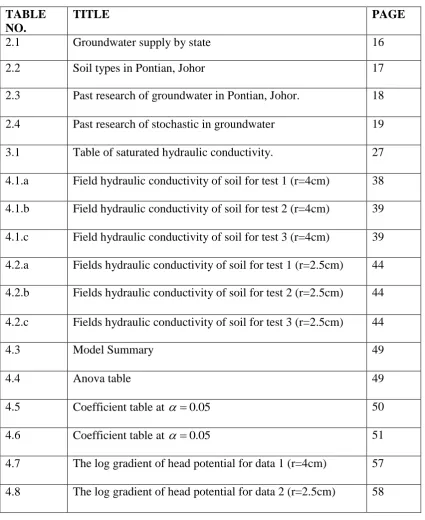
LIST OF TABLES
TABLE NO.
TITLE PAGE
2.1 Groundwater supply by state 16
2.2 Soil types in Pontian, Johor 17
2.3 Past research of groundwater in Pontian, Johor. 18 2.4 Past research of stochastic in groundwater 19 3.1 Table of saturated hydraulic conductivity. 27 4.1.a Field hydraulic conductivity of soil for test 1 (r=4cm) 38 4.1.b Field hydraulic conductivity of soil for test 2 (r=4cm) 39 4.1.c Field hydraulic conductivity of soil for test 3 (r=4cm) 39 4.2.a Fields hydraulic conductivity of soil for test 1 (r=2.5cm) 44 4.2.b Fields hydraulic conductivity of soil for test 2 (r=2.5cm) 44 4.2.c Fields hydraulic conductivity of soil for test 3 (r=2.5cm) 44
4.3 Model Summary 49
4.4 Anova table 49
4.5 Coefficient table at 0.05 50
4.6 Coefficient table at 0.05 51
xii
LIST OF FIGURE
FIGURE NO.
TITLE PAGE
2.1 Hydrological cycle 5
2.2 Structure of the aquifer 6
2.3 Zones of underground water 8
2.4.a Type of Aquifer in Malaysia 12
2.5 Hydrology map in peninsular Malaysia. 13 2.6 Hydrology map in Sabah and Sarawak 14 2.7 Location of groundwater monitoring sites 15
2.8 Soil Types in Pontian 17
2.7 Hydrology map in Sabah and Sarawak 14
2.8 Soil Types in Pontian 17
3.1 Auger hole method 25
4.1 Relationship between K values and Depth for radius 4cm 39 4.1.a Linearity between K values and Depth from radius4cm for
test 1
41
4.1.b Linearity between K values and Depth from radius 8cm for test 2
41
4.1.c Linearity between K values and Depth from radius 8cm for test 2
42
4.2 Relationship between K values and Depth for radius 5cm 45
4.2.a Linearity of the hydraulic conductivity with radius 2.5cm for test 1
xiii
4.2.b Linearity of the hydraulic conductivity with radius 2.5cm for test 2
46
4.2.c Linearity of the hydraulic conductivity with radius 2.cm for test 3
47
4.3 Graph of partial regression plot of hydraulic conductivity with depth and radius
49
4.4 Normal P-P plot regression standardized residual 50
4.5 Graph of log hydraulic conductivity versus depth of water table (r=4cm)
58
4.6 Graph of log hydraulic conductivity versus depth of water table (r=2.5cm)
xiv
LIST OF SYMBOLS
q = specific discharge or flow rate Q, through cross sectional area A
L T/
Q = flow rate L T3/
A = cross sectional area through which flow occurs L2 K = hydraulic conductivity
H = hydraulic head potential
s
K = hydraulic conductivity of the saturated soil (m/d)
y
= average of level water in the hole (cm)
t
= time interval (s).
C = factor depends on the depth of an impermeable layer below the bottom of the hole (S)
r = radius of the hole (cm)
y = average depth of the water level in the hole below the water table (cm)
1
D = depth of water table (cm).
t
I = Ito stochastic integral
W = wiener process. (.)
X = stochastic process
= drift coefficient of the stochastic differential equationxv
LIST OF APPENDICES
APPENDIX TITLE PAGE
A Hydraulic conductivity measurement of peat soil with auger hole radius 4cm
67
B Calculated value of hydraulic conductivity with radius 4cm
68
C Hydraulic conductivity measurement of peat soil with auger hole radius 2.5cm
69
D Calculated value of hydraulic conductivity for radius 2.5cm
CHAPTER 1
INTRODUCTION
1.1 Background of Research
Groundwater is the nation’s most importance sources. Therefore, it has motivated many researchers to study about groundwater. Nowadays, we have many researches done using stochastic model in groundwater flow. It is because, from Christakos et. al (1993), standard deterministic theories of flow and transport proven that it is quite inadequate when tested on natural phenomena since they do not involve with uncertainties in parameter that can lead to huge error. Therefore stochastic is alternative in studying groundwater behavior since it involved uncertainties parameter into groundwater flow. Stochastic model also provide theoretical and practical concepts to describe the combinations of complexities, heterogeneities in this phenomena.
Water is essential to human life and the largest source of fresh water is from underground. Therefore, the development of underground water has been made because the increasing demands for the fresh water and limiting supplies. Groundwater is a major source of industrial uses, agriculture and public uses. In order to maintain the groundwater supply, it is needed to protect the groundwater from contamination, resources depletion, and land subsidence.
2
In Johor especially in Pontian the utilization of groundwater is at infancy stage. Pontian is one of the largest areas with peat soil type in Malaysia. Generally, the development of agriculture, industrial and urbanization activities will increase the demand for water supply. Current global environmental crisis which is flood in Pontian has reinforced the need for developing flexible mathematical model to obtain better understanding of the environmental problem. Therefore, in this research, stochastic model and analysis tools can help the environment scientist obtain more accurate information to be used in mitigating the adverse impacts and protecting this valuable resource. In addition, the analysis of groundwater flow is based on the structure of groundwater which consists of aquifer, soil type, porosity, permeability, head potential, and hydraulic conductivity.
1.2 Statement of Problem
Due to the rapid growth of population and irrigated agriculture has led the demand on water supply in Pontian. It is important issues so that deep knowledge about groundwater is important to manage the water resource efficiently. But the development of the groundwater system in Pontian is slow. Good mathematical model can help in decision making to manage water resource efficiency. Recently, deterministic model of groundwater has been used, but the uncertainties are not included which can lead to large error. Therefore, stochastic modeling can be used to study groundwater as the uncertainties are unavoidable in groundwater.
1.3 Objectives of the Research
The objectives of this research are:
1. To calculate value of hydraulic conductivity of peat soil.
3
3. To model of one dimensional, steady state groundwater flow by incorporating stochastic approach.
1.4 Scopes of the Research
This research limits the scope area for the groundwater study is in Pontian, Johor. Besides that, peat soil is the type of aquifer in Pontian. In this study the model of hydraulic conductivity is constructed through multiple linear regressions. Besides that, the secondary data obtained consists of depth of water table and time taken for two different radius is collected by Abdullah (2006). Besides that, the groundwater flow equation of one dimensional, steady state, saturated is used to be solved by using stochastic method.
1.5 Significance of the Research
From this research, it can help in better estimation on the groundwater that will help environment scientist/specialist to design/manage groundwater resources more efficiently
64
REFERENCES
Allen, E. (2007). Modelling with Itoˆ Stochastic Differential Equations. Texas: Springer. Manila: Internation Centre for Living Aquatic Resources Management.
Amoozegar, A., Wilson, G. V. (1997). Groundwater Recharge with Reclainmed
Minicipal Wastewater Health and Regulatory Consederation. Madison:
American Society of Agronomy, Crop Science of America and Soil Society. Asano, T. and Cotruvo, J. A. (2004). Groundwater Recharge with Reclaimed
Municipal Wastewater Health and Regulatory Considerations. Water
Research.
Asean/Us Crmp (1991). The CoastalEnvironment Profile in South Johor, Malaysia. Christakos, K., Miller, C.T and Oliver. D. (1993). Stochastic Perturbation Analysis
of Groundwater Flow. Spatially Variables Soils, Semi-Infinite Domains and Large Fluctuations. Stochastic Hydrology and Hydraulics. 7,213-239 Beers, W. F. J. (1983). The Auger Hole. (6th ed.). The Netherland: International
Institute for Land Reclamation and Improvement.
Heath, R. C. (1987). Basic Groundwater Hydrology. United Stated: United Stated Government Printing Office.
Illangasekare, T. H and Saenon, S. (2004). Application of Stochastic Methods in the Study of Fluid Flow, Solute Transport, and Multiphase Fluid Behavior in Heterogeneous Porous Media. Proceedings of th Tenth Asian Congress of Fluid Mechanics. 17-21 May. Peradeniya, Sri Lanka
Jeisman, J. (2005). Estimation of Parameter from Stochastic Differential Equation. Ph.D Thesis. Iniversiti Teknologi Malaysia.
Johnson, J. (2010). Framework to Effectively Quantify and Communicate Groundwater Model Uncertainty to Management and Clients.
65
Katimon, A. (1997). Field Hydraulic Conductivity of Some Malaysian Peat. Jurnal Kejuruteraan Awam. 10(1), 14-20.
Khairul Abdullah Abdullah (2007). Field Hydraulic Conductivity of Peat Soil Using Auger Hole Method. Degree Thesis. Universiti Teknologi Malaysia, Skudai. Madi, N. B. (2010). Groundwater Study for Shallow Alluvium Aquifer in Kota Bharu,
Pontian. Master Thesis. Universiti Teknologi Malaysia.
Miller, C.T and Oliver. D. (1993). Stochastic Perturbation Analysis of Groundwater Flow. Spatially Variables Soils, Semi-Infinite Domains and Large
Fluctuations. Stochastic Hydrology and Hydraulics. 7, 213-239 Mineral and Geosciences Department.
Mohamed, I. C., and Karim, M. H. A. (2010). Groundwater Availability and Quality in Malaysia. Mineral and Geosciences Department Malaysia.
Mohemed, A. (2010). Promoting Sustainable Development & Management of Groundwater – Sime Darby Bhd. Perspective. Workshop on Groundwater in the Context of IWRM. 15 June.
Mohemed, A. (2013). Be Buffered by Groundwater. MHP and IPS Malaysia Technical Talk. 14 June.
Mtundu, N. D and Koch, R. W. (1987). A Stochastic Differential Equation Approach to Soil Moisture. Stochastic Hydrology and Hydraulic. 1, 101-116.
Nurly, G. (2006). Determination of Coefficient of Rate of Horizontal Consolidation of Peat Soil. Ph.D Thesis. Universiti Teknologi Malaysia.
Oosterbaan, R. J and Nijland, H. J. (1994). Drainage Principle and Applications. (2nd ed). The Netherlands: International Institute for Land Reclaimation
Improvement.
66
Saavalainen, J. and Virtanin, S. (1989). Methods to Improve the Efficiency of Drainage and Clay in Peats Soil in Finland. Agriculture Engineering: Land and Water Use.
Safeen, B. & Azmi, I. (1998). Variation and Nitrate Levels in Groundwater in
Pontian RiverValley. Geological Survey Department, Malaysia
Salleh, M. A., Ramli, A. T., Alajerami, Y., and Aliyu, S. A. (2013). Assessment of Natural Radiation Levels and Associated Dose Rates from Surface Soils in
Pontian District, Johor, Malaysia. Journal of Ovanic Research. 9(1), 17-27. Simmons, C. T. (2008). Henry Darcy (1803- 1858): Immortalized by His Scientific
Legacy. The Netherland: Taylor & Francis.
Todd, D. K. (1976). Groundwater Hydrology. New York: John Wiley & Sons Inc Uhegbu, C. A. and Igboekwe, M. A. (2011).Fundamental Approach in Groundwater
Flow and Solute Transport Mdelling Using Finite Difference Method.
Michael Okpara University of Agriculture, Umudike, Nigeria.