A Methodology of Malware Analysis, Tools and
Technique for windows platform – RAT Analysis
Nayan Zalavadiya1 Dr. Priyanka Sharma2
1
M. Tech cyber Security, Department of Information Technology, Raksha Shakti University, Ahmedabad, India 2
Professor, Department of Information Technology, Raksha Shakti University, Ahmedabad, India
ABSTRACT: Now a days internet threats are increasing day by day at the faster rate, which makes injection of malware
inside the system a very easy process. Through malware, we can access the system in the way in which we want, can make desirable changes in the malicious manner, which will eventually make the security of the system a questionable concern. Therefore we will try to explore malware types, tools, techniques and will emphasize on analysis of particular malware which is remote access Trojan (RAT). RAT is very harmful malware because with the help of this malware we can access the remote system for malicious activity.
KEYWORDS: Malware analysis, Remote Access Trojan, malicious code, Trojan, virus, worm, spyware,Static Malware
analysis, Dynamic Malware analysis, System Threats
I. INTRODUCTION
With the advancement of rural and urban life,Internet is becoming an essential part of the day to day life of people on the globe. With the help of internet one can avail many services just with the help of few clicks. The rate of netizens are increasing by leaps and bounds and hence the secure access to internet is becoming the major concern. The Internet has developed gradually from a basic network of communication to an interconnected set of information sources which helps in establishing a new platform for interactions, marketing and for selling of products and services. Online banking or advertisement of different services and products are the examples of the commercial services of the Internet. Same as in the physical world, there are various people on the Internet with evil-minded intents that attempts to enhance themselves by taking advantage of legitimate users whenever money is involved in the process. Malware is the software which has malicious intent can be used by attackers to accomplish their goals.
II. WHATISMALWARE
Malware stands for malicious software, which is programmed to damage or to gain access to a computer system without the knowledge of the owner of the system. Viruses, Worms, Trojan, Key loggers and Spyware are the examples of mostly used malware. In simple words we can define malware as a Software that “intentionally achieve the harmful goal of an attacker” and it is commonly mentioned as malicious software or malware. Terms, such as “worm”, “virus”, or “Trojan horse” are used for classification of malware that shows similar malicious behaviour.
III.MALWARECLASSIFICATION
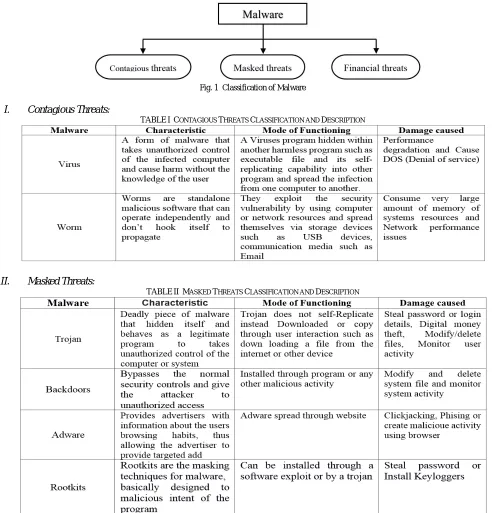
The malwareclassification is cumbersome process. Malware can be classified in various classes and categories which generally are categorized according to their propagation processes and their reactions which is achieved on the infected system which depends on designing and development process of malicious program. The following diagram shows the various types of malware.
Fig. 1 Classification of Malware
I. Contagious Threats:
TABLEI CONTAGIOUS THREATS CLASSIFICATION AND DESCRIPTION
II. Masked Threats:
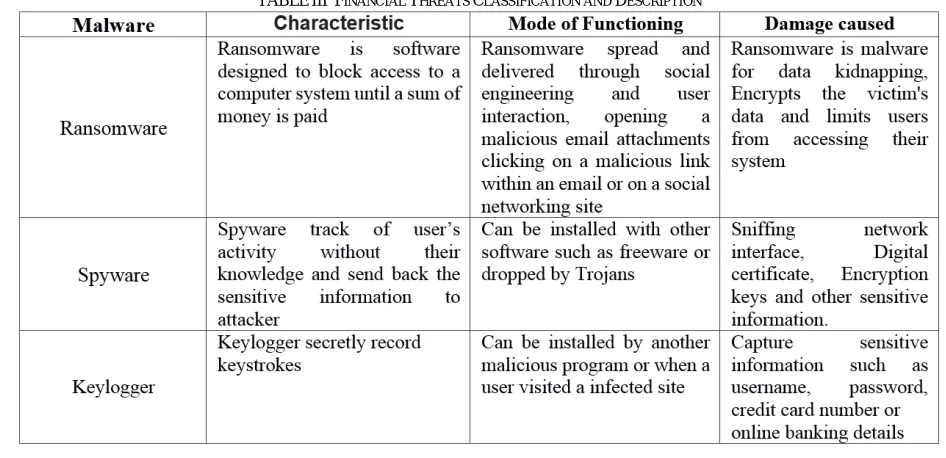
III. Financial Threats:
TABLEIII FINANCIAL THREATS CLASSIFICATION AND DESCRIPTION
IV.MALWAREANALYSIS
Malware analysis means a process of determining the functionality and purpose of the given malware sample which can be a virus, worm, or Trojan horse. For the effective detection technique of malicious codethe below described hierarchy should be considered [1].
Fig. 2Classification of Malware Analysis and Detection techniques
I. Static analysis:
Static analysis can be described as analysing of the software before its execution. The static analysis is performed at the pre- execution time. On different representation of a program, static analysis can be performed. If the source code of the program is available, then with the help of static analysis tools the developer can find memory corruption flaws and can determine the correctness of models for a given system.
Various techniques are used for static malware analysis:
File fingerprinting[1]
Extraction of hard coded string[1]
File format[1]
Packer detection[1]
Disassembly[1]
A. Signature based detection technique:
Signature based detection technique is also known as pattern matching or string or mask or fingerprinting technique. A signature is a sequence of bits which is injected in the application program by malware writers, which uniquely identifies a particular type of malware. For detection of a malware in the code, the malware detector will search for a previously specified signature in the code.
B. Heuristic detection technique:
This technique is also known as proactive technique. There are many similarity between the signature based technique and heuristic detection technique, with a slightdifference that is instead of searching for a particular signature in the given code which is performed in signature based technique now in heuristic detection ,the malware detector will searchfor the commands or instructions that are not present in theapplication program. The main advantage of this technique is that with it becomes easy to detect new variants of malwarethat had not yet been discovered [2].
II. Dynamic analysis:
Dynamic malware analysis is also called as the analysis of infected file during its execution. During the dynamic analysis process, the infected files are analysed in simulated environment, something like a virtual machine. Dynamic analysis is not performed in real environment.
Mainly two basic approaches are followed for dynamic malware analysis:
Analysing the difference between defined points: In this approach, thegiven malware sample is analysed for a certain period of time and afterwards the modifications are made to the system and again the malware isanalysed with respect to the initial system state. In this approach, the behaviour of malware is stated in the Comparison report [1].
Observing runtime-behaviour: In this approach,malicious program which launches the malicious activities are monitored during runtime by using a specialized tool [1].
III. Hybrid analysis:
Hybrid analysis technique is the combination of both static analysis and dynamic analysis. It follows a very simple procedure in which it first checks for any malware signature available in the code, if the inspection process shows any malware signature present in the code thenit will monitor the behaviour of the code [2].
V. MALWARE ANALYSIS TOOLS
TABLEV BRIEF OVERVIEW OF STATIC ANALYSIS TOOLS
Sandboxes:For executing untrusted malicious programs in safe environment sandbox security mechanism is used. Use of
sandbox helps in providing an environment in which “real” physical systems are safe. It comprises virtualized environments in such a way that ensures that if the malware is being tested it will function normally
TABLEVIMALWARE ANALYSIS SANDBOX TOOLS
VI.MALWARE CATEGORIES
I. Encrypted Malware
II. Oligomorphic Malware
The advanced version of encrypted malware is oligomorphic malware. Thousands of new malwares are created every time when the malware authorschanges the decryptor. But still, with the help of its signature it can bedetected, as decryptor can replicate itself finite number of times [2].
III. Polymorphic Malware
The polymorphic malware has many similarity with oligomorphic malware, with a minute difference that is,infinite number of decryptor are generated by using different obfuscation techniques. Every time when the decryption is performed the basic function ofpolymorphic malware remains the same, only the code changes. Mutation Engine (ME) toolkit is used in order to change non-obfuscated code topolymorphic code. With each iteration, one part of the code remains the same, hence it can beeasily detected by Antivirus Scanner [2].
IV. Metamorphic Malware
New malware which is different from the previous malware is created at the time of each iteration and this malware is known as metamorphic malware. This type of malware can easily pass through AVS (Anti-Virus scanner) because AVSscanner is incapable in matching the signature of this malware. Metamorphic malware are not packedmalware, therefore, they never leave any traces in the memory that is uniquesignature related to the malware, as these signatures are not left in the memory no signature matching process can be accomplished[2].
VII. WHAT IS RAT
RAT is one type of Trojan which is widely known as Remote Access Trojan. RAT is a program which is used by intruders or attackers to control of the victim’s computer and after gaining access to victim’s computer attacker will perform various malicious activities. The below diagram describes the complete malware family which shows the various types of malware and classification of RAT malware:
Fig. 3Classification of Different types of Trojan
Basically there are two types ofworking approach for Remote Access Trojan:
I. Local Network ( Within Network )
Net Bus
II. Wide Network ( Different Network )
Cyber Gate
Dark Comet
Sub7
Beast
VIII. CONFIGURATION OF REMOTE ACCESS TROJAN
This will include Setting up a popular remote administration Trojan known as Dark comet and creating a basic RAT setup to grab slaves. This paper will summarize the making of a basic RAT server with Dark Comet5. RAT is remote administration Trojan, which is generally used by attackers to steal login credentials, user data, user keystrokes and much more. We are hereby discussing the setup of a well-known RAT Dark comet
1. PORT SELECTION:
Open DarkComet-RAT and Right click on Socket/Net tab and choose "Add port to listen" for description process. We are using port 1604, you can use any port you wish to use. Then hit listen. It will look like this
Fig. 4Port Selection
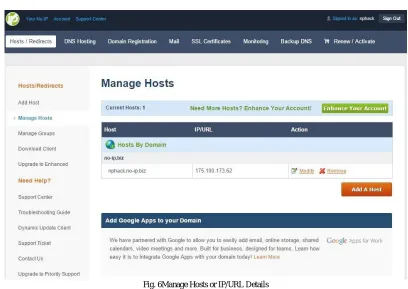
After selecting your desired port number you will need to do port forwarding (No-IP Provide free static IP service)
2. SETTING UP A NO-IP:
Fig. 5Configure Host using Add Host and fill Host Information
Fig. 6Manage Hosts or IP/URL Details
3. SETTING UP DUC:
C. Hit select host then click in the check box next to the no-ip hostname you are using then hit save. D. Now just hit refresh and you are done.
4. CREATING SERVER:
A. Open DarkComet 5
B. Click on the orange DarkComent-RAT and Click "Server module>> Full editor" (RATConfiguration)
Fig. 7Creating Server Module
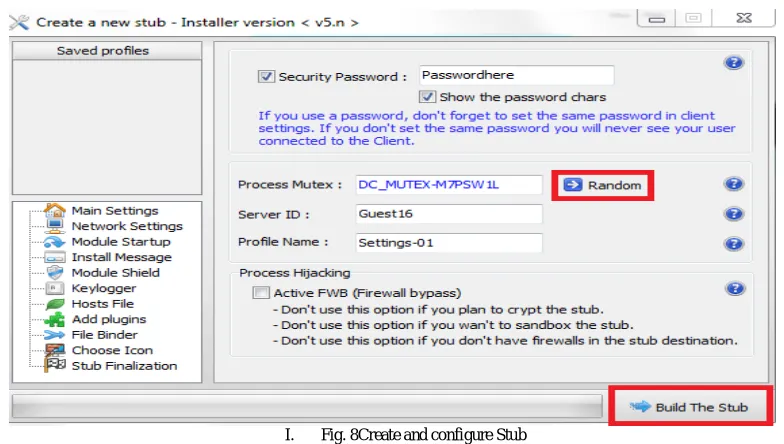
C. In the Main Setting Click“generate few time” and leave everything else as it is. Shown in (Fig. 8)
D. Next clickNetwork settings in the "IP/DNS" type in your No-ip info and the same port you used to listen in. Then hit "Add this configuration"
E. Next click “Module Startup” and you can change various window startup options and file attributes. F. Next click “Module shield” and you can disable system function stealth functions.
G. One by one you can modify setting like: keylogger, Host file, Add plugins, File Binder, Choose Icon.
H. Final Option is Stub Finalization then you have to click on Build the Stub and your file is created you can send or copy using usb to malicious activity.
IX.IMPLEMENTATIONREMOTEACCESSTROJAN
1: Open DarkComet-RAT control panel (Perform this task in virtual environment. e.g. VMware workstation, virtualbox)
Fig. 9Darkcomet control panel
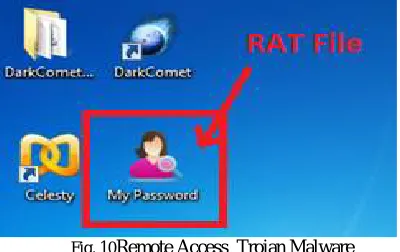
2: After Creating Infected File lock like this. (This malware is delete all doc files in windows system)
Fig. 10Remote Access Trojan Malware
3: Open “My Password” RATMalware or you canintegrate with other file like: Doc, PDF, exe, rar , etc.
Fig. 11Open Malware File
Fig. 12Malware error message
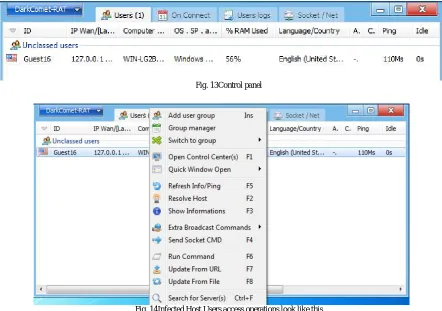
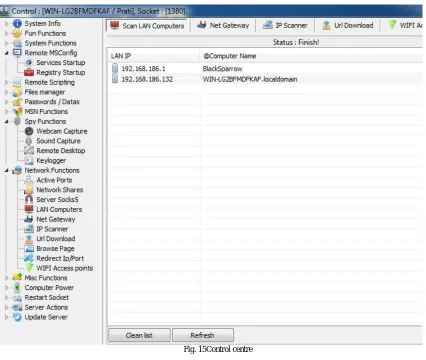
After Remote access Trojan injected, open DarkComet control panel and look user’s panel. It display Infected Host System. By using control panel you can monitor host system remotely.
Fig. 13Control panel
Fig. 14Infected Host Users access operations look like this
Fig. 15Control centre
X. YARA RULES
Rule Name is the identifier of the rule.They can contain any alphanumeric character and the underscore character, but the first character cannot be a digit. Rule identifiers are case sensitive and cannot exceed 128 characters [7]. Strings: This section contains the strings/pattern/signature that we need to match against a file. It is optional [7]. Conditions: Conditions sets evaluate Boolean expressions
XI.CONCLUSIONS
In this paper, we have learned about malware, malware analysis and detection techniques. We have also learned some limitations of static malware analysis. After analysing both static and malware analysis, we have reached to conclusion that Dynamic malware analysis is the best way to analyse malware samples. In this process of malware analysis we have gathered meaningful knowledge regarding some tools which are effective for the same. After studying malware and malware analysis techniques, we can say that sandbox environment is the best way to analyse dynamic malwares.
This paper elaborates effective and efficient methodology which can be applied to improve the performance of detection and removal of malwareswhich are collected and detected over an extended period of time. And the target of such a system is 97% malware detection and classification accuracy, which therefore significantly shows an improvement on current work.
REFERENCES
[1] Savan Gadhiya and Kaushal Bhavsar, “Techniques for Malware Analysis”, International Journal of Advanced Research in Computer Science and Software Engineering, Vol. 3, Issue 4, pp. 972-975, April 2013.
[2] Dolly Uppal, Vishakha Mehra and Vinod Verma, “Basic survey on Malware Analysis, Tools and Techniques”, International Journal on Computational Sciences & Applications, Vol. 4, No. 1, February 2014.
[3] Syarif Yusirwan S, Yudi Prayudi and Imam Riadi, “Implementation of Malware Analysis using Static and Dynamic Analysis Method”, International Journal of Computer Applications, Vol. 117, No. 6, pp. 0975-8887, May 2015.
[4] M. Asha Jerlin and C. Jayakumar, “A Dynamic Malware Analysis for Windows Platform - A Survey”, Indian Journal of Science and Technology, Vol 8, No. 26, October 2015.
[5] Rohitkumar Gautam, Sanjeev Kumar and Jhilik Bhattacharya, “CPU Mining Malware: Complete Analysis of Real World Virus”, International Journal of Research in Advent Technology, Vol. 3, No. 9, E-ISSN: 2321-9637, September 2015.
[6] M. Wagner, F. Fischer, R. Luh, A. Haberson, A. Rind, D. A. Keim and W. Aigner “A Survey of Visualization Systems for Malware Analysis”, Eurographics Conference on Visualization, 2015.
[7] http://resources.infosecinstitute.com/yara-simple-effective-way-dissecting-malware/
[8] Waqas Aman, “A Framework for Analysis and Comparison of Dynamic Malware Analysis Tools”, International Journal of Network Security & Its Applications, Vol. 6, No. 5, September 2014.
[9] Gursimran Kaur and Bharti Nagpal, “Malware Analysis & its Application to Digital Forensic”, International Journal on Computer Science and Engineering. [10] Konrad Rieck, Philipp Trinius, Carsten Willems and Thorsten Holz, “Automatic Analysis of Malware Behavior using Machine Learning”, Journal of Computer
Security, 2011.
[11] Jozsef Hegedus, Yoan Miche, Alexander Ilin and Amaury Lendasse, “Methodology for Behavioral-based Malware Analysis and Detection using Random Projections and K-Nearest Neighbors Classifiers”, Department of Information and Computer Science.
[12] Dr. Engin Kirda and Dr. Christopher Kruegel,“Large-Scale Dynamic Malware Analysis” December 2009. [13] Murray Brand,“Analysis Avoidance Techniques of Malicious Software”, November 2010.
[14] Xin Hu, “Large-Scale Malware Analysis, Detection, and Signature Generation”, Computer Science and Engineering in the University of Michigan, 2011. [15] Ronghua Tian,“An Integrated Malware Detection and Classification System” August 2011.
[16] “Darkcomet – setting up the Remote Administration Tool”, OpenFire Security.
[17] Nwokedi Idika and Aditya P. Mathur, “A Survey of Malware Detection Techniques”, Department of Computer Science, February 2007. [18] https://github.com/Yara-Rules/rules/tree/master/malware
[19] https://github.com/Yara-Rules/rules/blob/master/malware/RAT_DarkComet.yar [20] http://www.darkcomet-rat.com/
[21] http://www.noip.com/
[22] Kris Kendall, “Practical Malware Analysis”
[23] Dennis Distler, “Malware Analysis: An Introduction”, SANS Institute InfoSec Reading Room, December 2007.
BIOGRAPHY
Nayan Zalavadiya received his bachelor’s degree in Information Technology from Gandhinagar Institute of Technology in 2013. He is currently pursuing his M.Tech in Cyber Security at Raksha Shakti University, Ahmedabad, India.