ENHANCING WEB SERVICE SELECTION USING ENHANCED FILTERING MODEL
AJAO, TAJUDEEN ADEYEMI
A dissertation submitted in partial fulfillment of the requirements for the award of the degree of
Master of Science (Computer Science)
Faculty of Computing Universiti Teknologi Malaysia
iv
ACKNOWLEDGEMENT
I wish to express my appreciation to my supervisor, Prof. Dr. Safaai Deris for his invaluable guidance, precious advice and endless support during my study and research work at Universiti Teknologi Malaysia (UTM). He inspired me on this research work and taught me the rules of the game. His willingness to imparting knowledge is unparalleled. Thank you Prof.
Besides, I would like to appreciate Dr. Mamoun Mohamad Jamous for his valuable assistance on my research work, my lab mates (Artificial Intelligence & Bioinformatic Research Group) for the good interactions we had together. Also, my gratitude goes to the authority of the Faculty of Computing, Universiti Teknologi Malaysia for providing the enabling environment for learning and research.
Furthermore, I wish to express my appreciation to my kind and understanding Director General, Mr. Alex Abaito Ohikere and the management team of National Steel Raw Materials Exploration Agency, Malali, Kaduna, Nigeria for giving me the opportunity to study in UTM, Malaysia.
ABSTRACT
vi
ABSTRAK
TABLE OF CONTENTS
CHAPTER TITLE PAGE
DECLARATION ii
DEDICATION iii
ACKNOWLEDGEMENT iv
ABSTRACT v
ABSTRAK vi
TABLE OF CONTENTS vii
LIST OF TABLES x
LIST OF FIGURES xiii
LIST OF ABBREVIATIONS xiv
LISTOF APPENDICES xv
1 INTRODUCTION
1.1 Introduction 1
1.1.1 Quality of Service (QoS) and Web Services
Discovery 3
1.1.2 Benefits of QoS Usage for Web Services 4
1.2 Problem Background 4
1.3 Problem Statement 6
1.4 Research Aim 7
1.5 Research Objectives 7
1.6 Research Scope 8
1.7 Significance of the Research 8
viii
1.9 Summary 9
1.10 Dissertation Organization 9
2 LITERATURE REVIEW
2.1 Introduction 11
2.2 Web Services 12
2.3 Web Services Technologies 13
2.4 Universal Description Discovery and Integration (UDDI) 14
2.5 Web Services Discovery 15
2.6 Role of QoS on Web Service Discovery/Selection 16
2.7 Web Services Discovery Mechanisms 17
2.7.1 Syntactic-Based and Semantic-Based Web Service
Discovery 18
2.8 Web Service Selection 24
2.8.1 Quality of Service and Web Service Selection 25 2.8.2 Filtering Approaches to Web Service Selection 25
2.8.3 Trends and Direction 30
2.9 Summary 32
3 RESEARCH METHODOLOGY
3.1 Introduction 34
3.2 Research Framework 35
3.3 Research Design 36
3.3.1 Phase 1: Problem Formulation 36
3.3.2 Phase 2: System Design and Development 36
3.3.2.1 Datasets Preparation 37
3.3.3 Phase 3: Implementation and Evaluation 39
3.4 Summary 39
4 ENHANCED QoS-BASED FILTERING MODEL
4.1 Introduction 40
4.2 Proposed Method 40
4.2.3 QoS Requirement for Web Services 43
4.2.4 QoS Tendency 45
4.2.5 QoS Data Normalization 45
4.2.6 Computation of Normalization value 46
4.2.7 Computation of Weight 47
4.2.8 Computation of Score for each service 47 4.2.9 Service Discovery, Filtering and Ranking 48
4.3 Summary 48
5 IMPLEMENTATION AND EVALUATION
5.1 Introduction 50
5.2 Implementation and Testing Environment 51
5.3 Experiment Design 52
5.4 Experiment 53
5.4.1 Test Scenario 1: Requester A 55
5.4.2 Test Scenario 2: Requester B 57
5.4.3 Test Scenario 3: Requester C 59
5.5 Results and Evaluation 61
5.5.1 Requesters with Same Functional Requirement but
Different QoS Constraints using Proposed method (EFM-Q) 62 5.5.2 Comparison with Other Approaches 63
5.6 Discussions 67
5.7 Summary 70
6 CONCLUSION AND FUTURE WORK
6.1 Conclusion 71
6.2 Research Contributions 72
6.3 Future Work 73
REFERENCES 74
x
LIST OF TABLES
TABLE NO. TITLE PAGE
2.1 Web Service Standard 14
2.2 Trends and Direction –Discovery and Selection 30 2.3 Trends and Direction –Filtering Approaches 31
3.1 Research Operational Framework 35
3.2 Sample Datasets 38
4.1 Explanation on QoS Parameters used in Proposed
Model 44
4.2 QoS Tendency 45
5.1 List of functional candidates for requesters A, B and C 54 5.2 List of Functional candidate services with their QoS
values 54
5.3 QoS constraints for Requesters A, B and C 54 5.4 List of Filtered Candidates returned for Requester A by
both EFM-Q & WSSRM 55
5.5 Filtered Candidates with Normalized QoS for
Requester A, returned by EFM-Q 55
5.6 Filtered Candidates with Normalized QoS for
Requester A, returned by WSSRM 55
5.7 Weighted Sum of Normalized Filtered Candidates for
Requester A, returned by EFM-Q 56
5.8 Weighted Sum of Normalized Filtered Candidates for
Requester A, returned by WSSRM 56
5.9 Ranked/Best Service for Requester A returned by
EFM-Q 56
5.10 Ranked/Best service for Requester A returned by
5.11 Filtered Candidates for Requester B returned by
EFM-Q 57
5.12 Filtered Candidates for Requester B returned by
WSSRM 57
5.13 Filtered Candidates with Normalized QoS for
Requester B returned by EFM-Q 58
5.14 Filtered Candidates with Normalized QoS for
Requester B returned by WSSRM 58
5.15 Weighted Sum of Normalized Filtered Candidates for
Requester B returned by EFM-Q 58
5.16 Weighted Sum of Normalized Filtered Candidates for
Requester B returned by WSSRM 58
5.17 Ranked/Best Service for Requester B returned by
EFM-Q 59
5.18 Ranked/Best Service for Requester B returned by
WSSRM 59
5.19 Filtered Candidates for Requester C returned by
EFM-Q and WSSRM 60
5.20 Filtered Candidates with Normalized QoS for
Requester C returned by EFM-Q 60
5.21 Filtered Candidates with Normalized QoS for
Requester C returned by WSSRM 60
5.22 Weighted Sum of Normalized Filtered Candidates for
Requester C returned by EFM-Q 60
5.23 Weighted Sum of Normalized Filtered Candidates for
Requester C returned by WSSRM 61
5.24 Ranked/Best Service for Requester C returned by
EFM-Q 61
5.25 Ranked/Best Service for Requester C returned by
WSSRM 61
5.26 Service ranking based for Requesters A, B and C based
on their Preferences on EFM-Q 62
5.27 Condition for categorization of services based on QoS
values (WSFM) 63
5.28 Trigger values for QoS parameters (WSFM) 63
5.29 Service categorization from WSFM 64
xii
5.31 Output of EFM-Q and WSSRM for Requester B 65 5.32 Output of EFM-Q and WSSRM for Requester C 66 5.33 Comparison of outputs from existing and proposed
models 68
5.34 Validation Using Euclidean Distance (Case of
Requester B) 69
5.35 Validation Using Euclidean Distance (Case of
LIST OF FIGURES
FIGURE NO TITLE PAGE
1.1 Web Service Architecture 2
2.1 Web Services Technology Stack 13
2.2 Web Services Discovery 16
2.3 Taxonomy of Web Service Discovery Mechanisms 17
3.1 Screenshot of QWS Dataset 37
4.1 Enhanced QoS-based Filtering Model 41
4.2 Filtering, Ranking and Selection Algorithm 42
5.1 Screenshot of System Configuration 51
5.2 Screenshot of WSDis prototype Application 52 5.3 Service ranking for requester A on EFM-Q and
WSSRM 65
5.4 Service ranking for requester B on EFM-Q and
WSSRM 66
5.5 Service ranking for requester C on EFM-Q and
xiv
LIST OF ABBREVIATIONS
DTD Document Type Definition
FTP File Transfer Protocol
HTTP HyperText Transfer Protocol
IIOP Internet Inter-Orb Protocol
JMS Java Message Service
OWL Ontology Web Language
OWL-S Ontology Web Language-Semantics
QoS Quality of Service
QWS Quality of Web Service
SMTP Simple Mail Transfer Protocol
SOAP Simple Object Access Protocol
UDDI Universal Description, Discovery, and Integration
URL Uniform Resource Locator
WSDL Web Service Description Language
WSDL-S Web Service Description Language-Semantics
WSMO Web Service Modeling Ontology
WWW World Wide Web
LIST OF APPENDICES
APPENDIX TITLE PAGE
A SAMPLE OF QWS DATASET 82
CHAPTER 1
INTRODUCTION
1.1 Introduction
Service Oriented Architecture (SOA) is an infrastructure that enables exchange of data between diverse applications as they partake in business procedures (Rajendran and Balasubramanie, 2010). SOA provides means by which distributed applications can be created which allows publishing, discovery and binding of web services for the purpose of building complex composed services. Therefore, applications are more flexible owing to their interacting abilities with any implementation of any contract (Papazoglou and Van Den Heuvel, 2007).
The basic building block of SOA is the service. A service is a self-independent software module which performs a specified task. W3C Working Group (2004) defines web service as a software module which is implemented through standard XML-based technologies such as WSDL and SOAP. Web Services are self-independent application that exhibits modular and distributed concepts (IBM WSAT).
purpose of finding web services. Publishing, binding, and discovering web services are three major tasks in the architecture.
Discovery of web services entails locating web services that satisfy specified requirements. It is a crucial task in web service architecture towards optimal selection of services by requester.
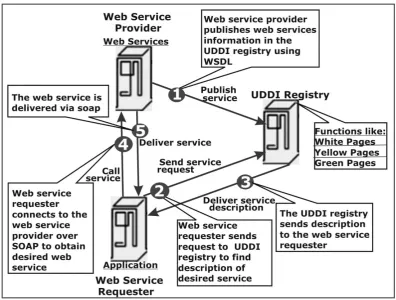
The web service architecture in Figure 1 illustrates the service requester, providers, and discovery system with their interactions.
Figure 1.1: Web Service Architecture (Govatos, 2002)
As illustrated in figure 1.1 above:
i. The service providers build web services that offer specified functions for users’ which is made available on the internet for their consumption.
3
iii. The web service registry is a centralized directory of services where service providers publish their service information. The specified information is kept in the registry and examined on submission of request by requester. Universal Description, Discovery and Integration (UDDI) is the registry standard for Web services.
1.1.1 Quality of Service (QoS) and Web Service Discovery
There have been various definitions of QoS and diverse metrics measurements which are often confusing. As a way out, of this undesirable confusion, the World Wide Web Consortium (W3C) gives a summarized guide about defining QoS and its metrics.
“Quality of Service (QoS) is a set of non-functional attributes that may influence the quality of service provided by a web service which may include performance, reliability, scalability, capacity, robustness, exception handling, accuracy, integrity, accessibility, availability, interoperability, security, and network-related QoS requirements.”
(W3C Working Group, 2003).
Quality of Service focuses on non-functional requirements for distinct Web services.
The QoS description is an ontology that harmonizes services request with service quality
specification. The semantic matching enables the discovery agent to match requester’s
service request to advertised services of providers using QoS provision and the consumer's
In view of the increasing number of web services offering identical functionality, additional features, such as quality of web services (QoS) e.g response time, availability, etc. are required in order to locate and select the appropriate web services, and these needs have to be taken into consideration in the discovery and selection process. The size of the UDDI registry is increasing significantly, hence, locating and retrieving all matched web services and present them to requesters is becoming more difficult.
1.1.2 Benefits of QoS Usage to Web Services
Some of the advantages offered by QoS include:
i. It helps in ranking services in order to select the one which best responds to the clients’ needs among all the services responding to the clients’ functional demands.
ii. It enhances the fulfillment of customers’ optimal selection.
iii. It paves way for monitoring web services based on QoS properties.
1.2 Problem Background
The upward trends in web service providers, web service consumers as well as web services have posed remarkable challenges in the area of web service description, discovery and selection. Issues concerning effective methods and procedures to locate and select the most appropriate web service for consumers remain an active area of research.
5
the UDDI or WSDL standards with QoS information. There are also works on adding a new role -a broker, to fill this gap, but the challenge of how to find the most optimal service for the consumers using QoS of the services is still an area of research. Determining the extent to which web services can provide the preferred functionality through a combination of Quality of Web Service (QWS) parameters is a major factor, principally in differentiating between services competing in identical domain. QWS incorporates a combination of quality parameters (including throughput, availability, response time and reliability) that can help distinguish web services’ general behavior. Getting the service of interest depends on how well the web service offers these functionalities with respect to QWS.
In practice, service discovery and service selection go hand in hand. In the discovery stage, a requester discovers the service using the functional aspect of the service i.e. what the service is intended to achieve which can be viewed in terms of the input and output entities as well as the outcome. This stage ensures that the returned services meet the requester’s basic (functional) requirements. The selection stage is the identification of the optimal service for the current task; this stage requires nonfunctional information, such as QoS about each service returned in the first stage. This second stage has become an important research area in the domain of web services discovery and selection. Hence, there is the need for efficient mechanisms for effective selection of suitable web service instance with regard to quality and performance factors at the moment of web service usage.
various requesters. A QoS model should be robust enough to allow users to specify their preferences according to their diverse expectations and a selection mechanism should not only return appropriate service to a requester in line with his/her requirement, but also include measures that ensure selection of rational service for the requester regardless of his preferences.
When a requester submits his/her request for a service of interest with specified functional attribute such as “flight service” or “weather information service” the discovery agent use the functional property to return array of services that match requester’s functionality. In order to narrow down the results from the discovery agent, the returned services will have to be filtered based on their QoS properties.
The aim of a rational consumer of web service is to enjoy better service performance e.g. minimum waiting time, low cost, maximum reliability and availability (among others) to use services of interest, however, previous research works failed in one way or the other in satisfying requester’s constraints. For example, majority of the existing approaches either ignore the role of user's non-functional requirements or place unnecessary burden on the requester to provide weights for QoS parameters while others assign arbitrary value of zero to the weight(s) of parameter(s) not specified by the requester in making his request. This has the tendency of generating biased results. As a solution, an Enhanced QoS-based Filtering Model (EFM-Q) for selecting best web service among discovered services with consideration for user’s preferences is proposed.
1.3 Problem Statement
Based on the problem background presented above, the main question drawn is:
Which approach(s) can be utilized to improve the efficiency and quality of web service
selection?
7
i. What are the problems of the existing web service selection? ii. Which method is the best to be applied in this research?
iii What is the performance of the proposed method compared to the existing approaches?
1.4 Research Aim
The aim of this research is to design and develop web service selection model for selecting an optimal web service for requester in line with his/her specified constraints.
1.5 Research Objectives
In order to achieve the aim of this research, the following objectives have to be fulfilled:
(i) To study and analyze existing research works on Web Services Discovery and Selection methods in order to detect areas requiring further investigation.
(ii) To design an enhancement of web service filtering model to provide automated selection of web services.
(iii) To demonstrate the applicability of the proposed model using an upgraded prototype tool (WSDis).
1.6 Research Scope
The focus of this research is to select optimal web services in response to requester’s query and is limited to the following area:
i. This research focuses on the enhancement of web service Filtering Model alone. ii. The enhancement of the proposed Web Service Filtering Model is based on QoS
support for service selection.
iii. Quality of Web Service datasets will be used in this research work.
1.7 Significance of the Research
In this research, the accuracy of web services selection in response to user’s query will be enhanced. Moreover,
i. An enhanced QoS-based filtering model for selecting best web service among discovered services will be developed which could be applied to solve service-oriented selection problems.
ii. A prototype application for implementing web service selection will be upgraded to enhance its capability.
1.8 Contribution of the Research
i. Provision of enhanced QoS-based filtering model for web service selection which allows users flexibility in expressing their preferences.
9
iii. Enhancement of requester’s satisfaction with improved web service selection tailored to their needs.
1.9 Summary
In this chapter, the current issues relating to this research work are discussed. Besides, the aim of the research and background of the problem, as well as the outline for the purpose and objectives of this research are presented. In the next chapter, focus will be placed on the review of literatures that are relevant to this research work.
1.10 Dissertation Organization
This dissertation is organized as follows:
i. Chapter 1 presents the background, problem statement, aim, objectives, scope and significance of the research as well as organization of the dissertation.
ii. Chapter 2 describes some related literatures on web service discovery and selection, and the role of QoS for web services. Then, the chapter provides an overview of web services discovery and selection approaches implemented in previous researches and stresses the advantages and disadvantages of previous approaches. The chapter ends with a summary.
iii. Chapter 3 illustrates the methodologies of this research in terms of data extraction, data preprocessing, design framework, and implementation procedure. iv. Chapter 4 discusses the design and development of the enhanced QoS-based
Filtering Model. The nitty-gritty of the proposed model is presented.
74
REFERENCES
Al-Masri, E., & Mahmoud, Q. H. (2007). Discovering the best web service. In the Proceedings of the 16th international conference on World Wide Web.
Al-Masri, E., & Mahmoud, Q. H. (2008). Investigating web services on the world wide web. In the Proceedings of the 17th international conference on World Wide Web.
Chaari, S., Badr, Y., & Biennier, F. (2008). Enhancing web service selection by
QoS-based ontology and WS-policy. In the Proceedings of the 2008 ACM symposium
on Applied computing.
Crasso, M., Zunino, A., & Campo, M. (2011). A survey of approaches to Web Service discovery in Service-Oriented Architectures. Journal of Database Management
(JDM), 22(1), 102-132.
D'Mello, D. A., Ananthanarayana, V. S., & Santhi, T. (2008). A qos broker based
architecture for dynamic web service selection. In the Modeling & Simulation,
2008. AICMS 08. Second Asia International Conference.
D'Mello, D. A., & Ananthanarayana, V. S. . (2010). A review of dynamic web service
description and discovery techniques. In the Integrated Intelligent Computing
(ICIIC), 2010 First International Conference.
Garofalakis, J., Panagis, Y., Sakkopoulos, E., & Tsakalidis, A. (2004). Web service
discovery mechanisms: looking for a needle in a haystack? In the International
Workshop on Web Engineering.
Giallonardo, E., & Zimeo, E. (2007). More semantics in qos matching. In the Service-Oriented Computing and Applications, 2007. SOCA'07. IEEE International Conference.
Govatos, G. (2002). UDDI is Yellow Pages of Web services. Network World Web
Applications Newsletter. Available at
http://www.networkworld.com/news/tech/2002/0527tech.html [Accessed on 21/12/2012].
Grigori, D., Corrales, J. C., Bouzeghoub, M., & Gater, A. (2010). Ranking BPEL processes for service discovery. Services Computing, IEEE Transactions., 3(3), 178-192.
Hu, J., Guo, C., Wang, H., & Zou, P. (2005). Quality driven web services selection. In the e-Business Engineering, 2005. ICEBE 2005. IEEE International Conference.
IBM WSAT. Web Service Architecture. Available at:
http://www.ibm.com/developerworks/webservices/library/w-ovr/ [Accessed on
23/10/2012].
Jamous, M. M. (2012). Classification and Indexing Algorithms with QoS Filtering Model
to Enhance Web Services Discovery. (PhD Thesis), UTM.
Jamous, M. M., & Deris, S. (2011). Web Services Non-Functional Classification to Enhance Discovery Speed. International Journal of Computer Science Issues, 8(4).
Kirsch-Pinheiro, M., Vanrompay, Y., & Berbers, Y. (2008). Context-aware service
selection using graph matching. In the 2nd Non Functional Properties and
Service Level Agreements in Service Oriented Computing Workshop (NFPSLA-SOC'08), ECOWS. CEUR Workshop proceedings.
Lall, M., Venter, L. M., & Van der Poll, J. A. (2010). Evaluating the second generation web services specifications for satisfying non-functional requirements.
Lee, Y. (2009). Quality-context based SOA registry classification for quality of services.
In the Advanced Communication Technology, 2009. ICACT 2009. 11th International Conference.
Li, J., Huai, J., Hu, C., & Zhu, Y. (2010). A secure collaboration service for dynamic virtual organizations. Information Sciences, 180(17), 3086-3107.
Li, J., Wang, S., Sun, Q., & Yang, F. (2011). A Fast Web Service Selection Approach.
Computing and Intelligent Systems, 502-507.
Maheswari, S, & Karpagam, G. R. (2011). QoS Based Efficient Web Service Selection.
European Journal of Scientific Research, 66(3), 428-440.
76
Marzolla, M., & Mirandola, R. (2010). Qos analysis for web service applications: a survey of performance-oriented approaches from an architectural viewpoint: Technical Report UBLCS-2010-05, University of Bologna.
Meditskos, G., & Bassiliades, N. (2010). Structural and role-oriented Web service discovery with taxonomies in OWL-S. Knowledge and Data Engineering, IEEE
Transactions on, 22(2), 278-290.
Meng, L., Li, J., & Sun, H. (2011). WSRank: A Collaborative Ranking Approach for Web
Service Selection. In the Computer and Information Technology (CIT), 2011
IEEE 11th International Conference.
Mukhopadhyay, D., & Chougule, A. (2012). A Survey on Web Service Discovery Approaches Advances in Computer Science, Engineering & Applications (pp. 1001-1012): Springer.
Nawaz, F., Qadir, K., & Ahmad, H. F. (2008). SEMREG-Pro: a semantic based registry
for proactive Web service discovery using publish-subscribe model. In the
Semantics, Knowledge and Grid, 2008. SKG'08. Fourth International Conference. Paliwal, A. V., Adam, N. R., & Bornhovd, C. (2007). Web service discovery: Adding
semantics through service request expansion and latent semantic indexing. In the
Services Computing, 2007. SCC 2007. IEEE International Conference.
Papazoglou, M. P., Traverso, P., Dustdar, S., & Leymann, F. (2007). Service-oriented computing: State of the art and research challenges. Computer, 40(11), 38-45. Papazoglou, M. P., & Van Den Heuvel, W. (2007). Service oriented architectures:
approaches, technologies and research issues. The VLDB journal, 16(3), 389-415. Priya, N. H., & Chandramathi, S. (2012). Optimal Selection and Composition of Web Services-A Survey. International Journal of Computer Applications, 49(2), 1-5. Raj, R. J. , & Sasipraba, T. (2010). Web service selection based on QoS Constraints. In
the Trendz in Information Sciences & Computing (TISC).
Rajendran, T., & Balasubramanie, P. (2010). An optimal agent-based architecture for
dynamic Web service discovery with QoS. In the Computing Communication and
Networking Technologies (ICCCNT), 2010 International Conference.
Rong, W., & Liu, K. (2010). A survey of context aware web service discovery: from
user's perspective. In the Service Oriented System Engineering (SOSE), 2010
Fifth IEEE International Symposium.
Saaty, T. L. (2008). Decision making with the analytic hierarchy process. International
Said, A., Berkovsky, S., & De Luca, E. W. (2010). Putting things in context: Challenge
on context-aware movie recommendation. In the Proceedings of the Workshop on
Context-Aware Movie Recommendation.
Sathya, M., Swarnamugi, M., Dhavachelvan, P., & Sureshkumar, G. (2010). Evaluation of qos based web-service selection techniques for service composition.
International Journal of Software Engineering, 1(5), 73-90.
Sprott, D., & Wilkes, L. (2004). Understanding Service-Oriented Architecture. Microsoft Architect Journal. Available at http://msdn.microsoft.com/en-us/architecture/aa480021 [Accessed on 13/12/2012].
Toma, I., Roman, D., Fensel, D., Sapkota, B., & Gomez, J. (2007). A multi-criteria service ranking approach based on non-functional properties rules evaluation.
Service-Oriented Computing–ICSOC 2007, 435-441.
Tsai, Y., Hwang, S., & Tang, Y. (2011). A Hybrid Approach to Automatic Web Services
Discovery. In the Service Sciences (IJCSS), 2011 International Joint Conference.
UDDI.org. UDDI Spec Technical Committee Draft. Available at http://www.uddi.org/pubs/uddi_v3.htm#_Toc85907967 [Accessed 05/11/2012].
W3C Working Group. (2003). QoS for Web Services:Requirements and Possible Approaches. [Available at http://www.w3c.or.kr/kr-office/TR/2003/ws-qos/ [Accessed on 15/11/2012]
W3C Working Group. (2004). Web Services Architecture. Available at http://www.w3c.org/TR/ws-arch/ [Accessed on 05/11/2012].
W3C.org. OWL-S: Semantic Markup for Web Services. Available at http://www.w3c.org/submission/OWL-S/ [Accessed on 27/10/2012].
Wang, Y., & Vassileva, J. (2007). Toward trust and reputation based web service selection: A survey. International Transactions on Systems Science and
Applications, 3(2), 118-132.
Wen-yue, G., Hai-cheng, Q., & Hong, C. (2010). Semantic web service discovery algorithm and its application on the intelligent automotive manufacturing system.
In the Information Management and Engineering (ICIME), 2010 The 2nd IEEE International Conference.
Xu, Z., Martin, P., Powley, W., & Zulkernine, F. (2007). Reputation-enhanced qos-based
web services discovery. In the Web Services, 2007. ICWS 2007. IEEE
78
Yu, T., Zhang, Y., & Lin, K. (2007). Efficient algorithms for Web services selection with end-to-end QoS constraints. ACM Transactions on the Web (TWEB), 1(1), 6. Zheng, Z., Ma, H., Lyu, M. R., & King, I. (2009). Wsrec: A collaborative filtering based
web service recommender system. In the Web Services, 2009. ICWS 2009. IEEE
International Conference.
Zhou, J., Zhang, T., Meng, H., Xiao, L., Chen, G., & Li, D. (2008). Web service
discovery based on keyword clustering and ontology. In the Granular Computing,