ISSN(Online): 2320-9801
ISSN (Print) : 2320-9798
I
nternational
J
ournal of
I
nnovative
R
esearch in
C
omputer
and
C
ommunication
E
ngineering
(An ISO 3297: 2007 Certified Organization)
Vol. 4, Issue 3, March 2016
Survey on Object Detection and Tracking
Using Fusion Approach
K Bavithra1, X Asha2, R S RamPriya3
UG Student, Department of CSE, Anna University (BIT Campus), Trichy, Tamilnadu, India
UG Student, Department of CSE, Anna University (BIT Campus), Trichy, Tamilnadu, India
Teaching Fellow, Department of CSE, Anna University (BIT Campus), Trichy, Tamilnadu, India
ABSTRACT: Detection, tracking and classification of various moving object is an emerging field in object detection and tracking. The most aim of this review is to present an overview of the disputes involved in the existing systems and also detecting, tracking and classifying the moving object using the fusion approach. The design of fusion approach includes three different sensors like LIDAR, RADAR, and Camera. This fusion approach adds the benefits of Simultaneous Localization and Mapping and Detection and Tracking Moving Object task and reduces the inaccuracy. Many detection and tracking algorithms are discussed in this paper. This survey paper explains how to progress and build up the efficiency in categorization of moving object detection and tracking using Fusion Approach.
KEYWORDS: Fusion Approach; Object Detection; Tracking; SLAM; DATMO
I. INTRODUCTION
Object detection is performed for ensuring the presence of the object in video frame. The object tracking process is sectioning the interested area from a video frames and maintaining track of its movement and its location. The very difficult part in moving object detection and tracking is identifying the characteristics of unstructured environment, which are inherently uncertain and dynamic environment to avoid this difficulty the following techniques are proposed. They are Advanced Driver Assistance System, SLAM, and DATMO.
The first one is helps to keep away the drivers from the difficult driving situations. It provides caution messages hazardous driving situations, attention less drive warnings. The second one generates a map on dynamic environment and simultaneously locates the object within the environment [10]. Many algorithms are used for SLAM like occupancy grid map, octree representation etc. The third one DATMO which discover and chases the moving objects adjacent vehicle and estimates their future behaviour. Classification is seen as a separate task within the DATMO task or as aggregate information for the final view of output.
Fig.1. Observing dynamic environment, detect, track and classifying the object
Detection of object
Shape based information
Visual description
Speed Based Information
Classification and tracking
SLAM Component
ISSN(Online): 2320-9801
ISSN (Print) : 2320-9798
I
nternational
J
ournal of
I
nnovative
R
esearch in
C
omputer
and
C
ommunication
E
ngineering
(An ISO 3297: 2007 Certified Organization)
Vol. 4, Issue 3, March 2016
The above Fig.1explains the three process of detection, tracking and classification. The objects are detected based on three types of information. These are explained in the coming paragraph. Then perform the classification and tracking. The objects are detected from the environment in various forms like Shape based information, Visual description, Speed Based Information. In shape based information the objects are detected based on the shape. It quite simpler than texture based information [18]. Visual description means gives the actual image of an object by using camera sensor. In speed based information the objects are identified and classified based on the speed of the object.
The moving objects detected by the processes like pre-processing, segmentation, foreground and background extraction and feature extraction.
The rest of this paper is divided as follows. Section II evaluates the related work. Section III involves method analysis. Section IV reviews Sensor based detection. Sections V assess Classification of moving objects. Finally the conclusion is declared in Section VI.
II. RELATED WORK
By studying the various proposed approaches we find out the difficulty in that system. In these papers generate 2D based image by using various basic algorithms the methods are frame difference technique, real time background subtraction and shadow detection technique, adaptive background mixture model. These algorithms have some challenges like group of object detection, accuracy, computation complexity.
Detection and tracking the object in 3D format has many problems. For detection and tracking they use octree representation. But it generates inconsistency map. To overcome this they use naïve classification yet it is not applied to a group of objects [4].
From these studies to overcome the disadvantages of existing system we are proposed a new system. The below Fig.2 tells about our proposed system we are using three types of sensors like LIDAR, RADAR and camera. Each sensor provides specific information about the object. The information from the sensors is pre-processed and performs the two level of fusion approach. The levels are low level fusion and detection and track level fusion.
Fig.2.Perceiving the environment using multiple sensors and detect, track, classifying the object involves SLAM and DATMO concept
Low level fusion performed in SLAM component and Detection and track level fusion performed in DATMO component. Classification is performed as a separate task within the DATMO component.
III. METHOD ANALYSIS IN DETECTION AND TRACKING
A. Background Subtraction
It is a simplest method to detect and track the moving object. In this method choose particular value as a threshold value of the background and area of project. If the input frame is in the threshold value it is considered as a background. Otherwise it is considered as a foreground [14]. Read the background from the input subtracted it from the descendant input. Compare with the threshold value. Yet it also has some disadvantages. Such that It is not good in the presence of shadow, Not suitable for multi model background.
B. Adaptive Background Subtraction Model
It first takes reference value from the few frames of video output. Then it subtracts an intensity value of the current image from the reference background image. The reference environment image and the doorsill values are updated with an IIR filter to adapt the dynamically changing environment.
LIDAR Radar
Camera
Pre-processing
the data SLAM
(Low level fusion)
Detection Tracking
Classification
List of moving object and
ISSN(Online): 2320-9801
ISSN (Print) : 2320-9798
I
nternational
J
ournal of
I
nnovative
R
esearch in
C
omputer
and
C
ommunication
E
ngineering
(An ISO 3297: 2007 Certified Organization)
Vol. 4, Issue 3, March 2016
Fig.3. Adaptive Background Subtraction sample.(a) Predictable background (b) Recent image (c) Detected region
The above Fig.3 explains the Adaptive Background Subraction.Fig.3 (a) means the background place without any object movement. The Fig.3 (b) mentions about that the object is move in that place. The Fig.3 (c) shows the algorithm that is the background is subtracted only the moving object is detected. The detected moving object is represented in a red shaded area.
C. Template matching
It is well suited for particular environment. i.e., it is applied only to the predefined area. Drawback of this method is that it has less accuracy and slow process.
D. Segmentation
Segmentation segments a data into the different objects. Distance threshold segmentation groups the points within the determined area. This is an easy top down segmentation method. Due to the occlusion in foreground it fix the object boundaries. With the help of the segmentation technique we can establish a position of an object. [12]
E. Adaptive Contrast Change Detection Method
To overcome the difficulties in Background subtraction and background estimation [11] proposed a method combining wave-base contrast change detector and locally adaptive thresholding method. They are using the alter detector algorithm to notice the changes in video sequence and segment the series into scenes. By using this we can easily detect the multiple objects even in night light condition. First step in this method calculates the difference in the moving objects. And then perform the motion prediction and spatial nearest data association.
F. Tracking Categories
Tracking is classified as follows:
Fig.3. Classification of Tracking
The above Fig3 describes three types of classification. They are Point tracking, Kernel Tracking, Silhouette Tracking. They are explained below in detail.
1. Point Tracking
In this method the successive point area are represented as points. Associate of those points from previous one, which provides the location and shift of the object.
Fig.4.Tracking the object based on the points. Categories
Point Tracking
Kernel Tracking
ISSN(Online): 2320-9801
ISSN (Print) : 2320-9798
I
nternational
J
ournal of
I
nnovative
R
esearch in
C
omputer
and
C
ommunication
E
ngineering
(An ISO 3297: 2007 Certified Organization)
Vol. 4, Issue 3, March 2016
The above Fig.4 shows that Point Tracking. In this figure the man’s malleolus is pointed. Tracking can be formulated as the association of detected objects represented by points across frames. It includes the object location and movement. Point correspondence is a complicated problem-specially in the presence of occlusions, misdetections, entries, and exits of objects. Point tracking broadly classified in to two types. They are statistical and deterministic methods.
2. Kernel Tracking
Kernel refers to the object form and look. It is used for calculating the movement of an object. The common movement form is parametric movement (translation, conformal, affine, etc.). The different type of algorithms are used depends upon the look, number of objects and methods used. It is graphically described in below Fig 5.From this figure we understand about the shape and appearance the moving object. In this figure the object shape and look is identified and tracked. This is the use of kernel Tracking. The motion stored in the form of translation. The kernel may be in the form of oblique or a rectangular pattern. The movement can be calculated by the movement of the kernel in successive frames.
Fig.5.Calculating the movement of the object.
The above Fig.5 displays the man’s movement is calculated interms of his look and appearence.In this figure he is walking and his walking movement measured by using the kernal tracking.Here we use a rectangular shaped kernel form.
3. Silhouette tracking
This method is applied to find the complete description of the shape of the object. Especially it is applied to the complex form of object. This tracking is described in below Fig 6.From this figure we understand about the each points of the image has been identified. That is Silhouette Tracking is used for identification each frame in the image unlike the kernel tracking. In this method the information has been programmed in the internal image. The information is based on the density and shape models.
ISSN(Online): 2320-9801
ISSN (Print) : 2320-9798
I
nternational
J
ournal of
I
nnovative
R
esearch in
C
omputer
and
C
ommunication
E
ngineering
(An ISO 3297: 2007 Certified Organization)
Vol. 4, Issue 3, March 2016
G. Challenges in Conventional Methods
Background subtraction and background estimation is applied to detect only single object. In case of multiple moving objects the object detection is very difficult. Segmentation technique also has disadvantages. It is applied only for current frame [11]. Target localization is also quite difficult in traditional algorithms.
Adaptive Contrast Change Detection Method it produces the noise information. Noise information means it takes the unnecessary information in some cases. To avoid this they use they use correlation technique. Even it has better results it also have some disadvantages. That is it gives only better result for night light conditions. Because of these disadvantages we move on sensor based detection, tracking and classification.
IV.REVIEW ON SENSOR BASED DETECTION AND TRACKING
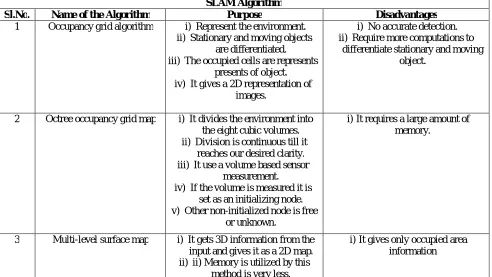
By studying the various papers we understand the sensors are plays an important role in identification and tracking the travelling object. This involved two significant tasks. They are SLAM and DATMO. In addition to this we use a fusion approach which reduces the deficiencies and improve the performance of the SLAM AND DATMO task. SLAM generates a map on the environment for locate the moving and static objects. LIDAR information added to this and generates a 2d occupancy grid map. By using this we can easily identify the moving and static objects separately. They are discussed in below chapters. SLAM use different algorithms.
SLAM Algorithm
Sl.No. Name of the Algorithm Purpose Disadvantages
1 Occupancy grid algorithm i) Represent the environment. ii) Stationary and moving objects
are differentiated. iii) The occupied cells are represents
presents of object. iv) It gives a 2D representation of
images.
i) No accurate detection. ii) Require more computations to
differentiate stationary and moving object.
2 Octree occupancy grid map i) It divides the environment into the eight cubic volumes. ii) Division is continuous till it
reaches our desired clarity. iii) It use a volume based sensor
measurement. iv) If the volume is measured it is
set as an initializing node. v) Other non-initialized node is free
or unknown.
i)It requires a large amount of memory.
3 Multi-level surface map i) It gets 3D information from the input and gives it as a 2D map. ii) ii) Memory is utilized by this
method is very less.
i)It gives only occupied area information
Table 1: Various SLAM Algorithms Uses and its limitations.
This table.1 discussed the various SLAM algorithms their advantages and their disadvantages. These are helps to identify the efficiency of those algorithms.
Because of less efficiency in using single sensor we use multiple sensors like CAMERA, LIDAR and RADAR
A. Camera Sensor
ISSN(Online): 2320-9801
ISSN (Print) : 2320-9798
I
nternational
J
ournal of
I
nnovative
R
esearch in
C
omputer
and
C
ommunication
E
ngineering
(An ISO 3297: 2007 Certified Organization)
Vol. 4, Issue 3, March 2016
B. LIDAR Sensor
We believe that LIDAR (Light Detection and Ranging)scanner as the main sensor in our arrangement due to itshigh declaration and accuracy to detect obstacles. The main goal of the LIDAR processing is to get accurate measurements of the shape of the moving obstacles in front of the vehicle. Vehicle’s location is identified by maximum likelihood approach. We focus on identifying the incompatibilities between free and occupied cells within the grid map M while incrementally building such map. If an occupied dimension is detected on a location previously set as free, then it belongs to a moving object. If a free measurement is observed on a location previously occupied then it probably belongs to a static object.
Using a distance-based clustering process we identify haze of cells that could belong to moving objects. This process provides information about the visible shape of the possible moving object, an estimation of its size, and the distance to the object. Measurements detected as parts of a moving object are not used to update the map in SLAM.
C. RADAR Sensor
The radar sensor uses a fixed mechanism to detect moving obstacles. The list of targets is delivered as input to the perception approach. Each element of the list includes the range, azimuth and relative speed of the detected target. The sensor will produce a target for each object with an important radar cross section. However, targets may correspond to static objects or other moving obstacles, producing fake positives.
In a similar way, frail objectslike pedestrians cannot always be detected, as a result of producing mis-detections. We track every targets using and Interactive Multiple Model (IMM) represented by constant velocity and acceleration models.
V. CLASSIFICATION OF MOVING OBJECTS
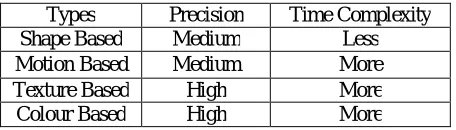
Classification means differentiate the moving object from one another. Many classification methods are Silhouette, Template Based Classification, Naive classification, classification based on shape, classification based on motion, classification based on colour, Texture based classification [5]. The below table 2.explaind about the different types of classification their precision and time complexity. Using this table we can compare the performance of the different types of classification.
Types Precision Time Complexity Shape Based Medium Less Motion Based Medium More Texture Based High More Colour Based High More
Table 2: Different types of classification classified based on its precision and time complexity.
From the above table we understand the different types of classification in term of shape, motion texture, and colour. Beyond this many classification are available. They are broadly discussed in below statements.
Silhouette Template Based Classification consists of two main steps. 1) Offline step
2) Online step A. Offline step
Create a template database of sample object. Silhouettes manually labelling object types. B. Online step
ISSN(Online): 2320-9801
ISSN (Print) : 2320-9798
I
nternational
J
ournal of
I
nnovative
R
esearch in
C
omputer
and
C
ommunication
E
ngineering
(An ISO 3297: 2007 Certified Organization)
Vol. 4, Issue 3, March 2016
VI.SENSOR BASED CLASSIFICATION
The following are the various sensors based classification.
A. LIDAR Sensor
The first part of the classification using LIDAR sensor information is used to analyse the shape of the detected moving objects. The class of the object is inferred from the size and fixed fitting-model approach. It includes no precise classification can be done because of the temporary visibility. To know the noteworthy size of the classes of interest we use a priori knowledge. The position and size of the object is obtained by measuring the detected objects in the 2D occupancy grid map.
B. Camera Sensor
To obtain an appearance based information gathered from camera images. LIDAR detection process provides a set of ROI (Region of Interest) which we use possibilities for generation. For theory of verification, we use the built off-line classifiers to classify the different objects. The camera-based classification generates several sub regions inside each ROI to cover many possible scale and size configurations. Sometimes a ROI can contain more than one object of interest. Once we have obtained the object classification for each ROI, we generate a basic belief assignment.
C. Radar Sensor
The classification is based on the speed of the moving objects. Radar targets are considered as preliminary moving object detections. Therefore, to obtain the object’s class we use the relative target speed delivered by the sensor. Speed threshold is statistically estimated using recorded data from the slowest scenario for vehicles, urban areas.
D. Fusion Approach
After finishing our detection and tracking techniques we are using fusion approach. Fusion approach means combining the information from the different sensors. LIDAR sensors provide a position and shape of the particular object. Camera sensor provides an image of the environment. RADAR sensor gives a speed of the object. All those information are associated using fusion approach. So we improve the efficiency in detection and tracking as well as classification.
VII. CONCLUSION AND FUTURE WORK
In this paper, Moving object detection, tracking and classification techniques are discussed. The advantages and disadvantages of many methods are explained. To overcome the disadvantage of the conventional methods we proposed a fusion approach. This approach locate, way and classify the moving objects of Car, Truck, Pedestrian and bike. In future days we will implement it in detecting all type of moving objects. Moving object detection, tracking and classification are used in wide variety of areas like traffic, shopping malls, bus stops, railway stations, and robotics etc. By using multiple sensor fusion approach we reduce the problems in basic techniques. Classification also easily performed by the fusion approach.
REFERENCES
1. Aggarwal, J. K. and Cai, Q. “Human motion analysis”: A review. Compute. Vision Image Understand. Volume 73,Issue 3, Pages 428-440,March 1999.
2. Ali, A. and Aggarwal, J. 2001. “Detetion and recognition of continuous human activity”. In IEEE Workshopon Detection and Recognition of Events in Video. 28–35.
3. Andreas Ess, Konrad Schindler, Bastian Leibe and Luc Van Gool, ”Object Detection and Tracking for Autonomous Navigation in Dynamic Environments”, International Journal Of Robotics Research, Volume 29, Issue 14, December 2010.
4. Asma Azim and Olivier Aycard, ”Detection, Classification and Tracking of Moving Objects in a 3D Environment”
5. Beymer, D. and Konolige, K. “ Real-time tracking of multiple people using continuous detection.” Artificial Intelligence Center SRI International Menlo Park CA 94025.DARPA through the office of Nval Research.
6. Birchfield, S. 1998. “Elliptical head tracking using intensity gradients and color histograms.” In IEEE conference on Computer Vision and Pattern Recognition , Barbara, California, June 1998.
7. Black, M. and Jepson, A. 1998. “Eigen tracking: Robust Matching And Tracking Of Articulated Objects using a View-based Representation.”
Int. J. Comput. Vision 26, Issue 1, Pages 63–84,January 1998.
8. Boyoon Jung and Gaurav Sukhatme “Detecting Moving Objects using a Single Camera on a Mobile Robot in an Outdoor Environment” in the 8th Conference on Intelligent Autonomous Systems pp. 980--987, Amsterdam, The Netherlands, March 10-13, 2004.
9. C. Mertz et al., J. Field Robot., “Moving object detection with laser scanners,” vol. 30, Isuue 1, pages 17–43, Jan. 2013.
ISSN(Online): 2320-9801
ISSN (Print) : 2320-9798
I
nternational
J
ournal of
I
nnovative
R
esearch in
C
omputer
and
C
ommunication
E
ngineering
(An ISO 3297: 2007 Certified Organization)
Vol. 4, Issue 3, March 2016
11. Dr.Dheeraj Agrawal,Nitin Meena” Performance Comparison of Moving Object Detection Technique in Video Surveillance System” ISSN:2319-1813 ISBN:2319-809.Volume 2 Issue 01 -2013.
12. E.Prassler, J.Scholaz, A.Elfes “Tracking Multiple Moving Objects for Real-Time Robot Navigation”,Journal Of Autonomous Robots ,date mid 1999.
13. Hao Li, Manabu Tsukada, Fawzi Nashashibi, and Michel Parent “Multivehicle Cooperative Local Mapping” IEEE Transactions on Intelligent Transportation Systems, Institute of Electrical and Electronics Engineers, 2014, 15,pp.2089 – 2100.
14. Himani S,Parekh G.Thakore,Udesang K.Jaliya,”A Survey on Object Detection and Tracking Methods” ,International Journal of Innovative Research in Computer and Communication Engineering ,Vol.2.,Issue 2,Febrruary 2014.
15. Q. Baig, “Multisensor data fusion for detection and tracking of moving objects from a dynamic autonomous vehicle,” Ph.D. dissertation, Lab. Inf. Grenoble, Univ. Grenoble, Grenoble, France, 2012.
16. Rajeshwari Sundar, Santhoshs Hebbar, and Varaprasad Golla “Implementing Intelligent Traffic Control System for Congestion Control, Ambulance Clearance, and Stolen Vehicle Detection” IEEE SENSORS JOURNAL ,Vol. 15, No. 2, February 2015.
17. Robert A Maclachlan Christoph Mertz, “Tracking of Moving Objects from a Moving Vehicle using a Scanning Laser Range Finder” Intelligent Transportation Systems 2006, September, 2006, pp. 301-306.
18. Rupali S.Rakibe Bharati D.Patil, ”Background Subtraction Algorithm Based Human Motion Detection –published at: “International Journal of Scientific and Research Publications,ijsrp,Volume 3,Issue 5,May 2013.
19. Sungwook Cho,Sungsik Huh,Hyong Sik and David Hyunchul Shim,Member,IEEE “An Image Processing Algorithm for Detection and Tracking of Aerial vehicles”, 2011 50th Conference on Decision and control and European Control Conference Orland, FL,USA December 12-15,2011.
20. Yigithan Dedeglu, “Moving object Detection, Tracking and Classification for Smart Video Surveillance” A Thesis submitted to the department of Computer Science And Engineering And the Institute of Engineering And Science of BILKENT UNIVERSITY, Augest 2014.
21. T.-D. Vu, “Vehicle perception: Localization, mapping with detection, classification and tracking of moving objects,” Ph.D. thesis, Inst. Nat. Polytechnic. De Grenoble, Univ. Grenoble, Grenoble, France, 2009.
BIOGRAPHY
K Bavithra is a UG Student in the Computer Science and Engineering Department, Anna University (BIT Campus), Trichy, Tamilnadu, India. Her areas of interests are Image Processing, Web Designing, Programming in Java, Python.
X Asha is a UG Student in the Computer Science and Engineering Department, Anna University (BIT Campus), Trichy, Tamilnadu, India. Her areas of interests are Image Processing, Computer Networks, Programming in C, .Net, PHP.