ISSN(Online): 2320-9801
ISSN (Print) : 2320-9798
I
nternational
J
ournal of
I
nnovative
R
esearch in
C
omputer
and
C
ommunication
E
ngineering
(An ISO 3297: 2007 Certified Organization)
Vol. 4, Issue 3, March 2016
Optimizing Object Distortion in Motion
Detection Using Cauchy Distribution Model
D.Kavitha1, E.Monica Rani2, S.A.Jagannathan3, K.Gautham4
Assistant Professor, Dept. of CSE., Valliammai Engineering College, Chennai, India1
UG Scholar, Dept. of CSE., Valliammai Engineering College, Chennai, India2, 3, 4
ABSTRACT: Visual analysis of human behaviour has created a considerable interest in the field of surveillance due to its wide range of applications. The existing multi camera video surveillance models suffer from a number of complexities. The proposed model concentrates on two important fundamental operations of any multi surveillance camera system which are object detection and object tracking. The first and fore most important task is object detection. This paper proposes a new and enhanced object detection technique. The new object detection algorithm is done using Cauchy Distribution system (CDS). CDS permits the object detection to be done without much mathematical complexities, which occurs in the old methods of segmentation. CDS ensures that the objects are identified effectively without distortion and overlapping using frame by frame comparison. The detected image is further differentiated using Absolute Effort Estimation (AEE) and improved using Gray Scale Conversion (GSC). This integration of latest detection ideology with AEE and Grey scale algorithm in a non overlapping multi Surveillance network, robust results have been obtained. The hands on experience shows the following results- 1) the proposed Object Detection algorithm yields distortion free high accuracy images using sum of absolute difference between the consecutive frames, 2) the object tracking system along with the grey scale conversion can create images without overlapping and low arithmetic complexity. Finally, robust performance of the recognition system is obtained using the results from the proposed detection and tracking algorithm for a given input.
KEYWORDS: Cauchy distribution Model, Object detection, absolute effort estimation, grey scale conversion.
I. INTRODUCTION
Recognition of the human behaviour and actions from a live motion video sequence is an important and essential tasks including the object detection its tracking and recognition are necessary. The way the human –computer interaction occurs also needs to be analysed. Due to its importance in surveillance systems a significant amount of research has been done over the years. However, the existing systems suffer from a number of limitations. The old system suffer from the assumption of low level tracking as in [2] or from extraction of a proper silhouettes as in [3],[4],[5]; obtaining an error proof results are not always possible under real time working conditions. Moreover, the newly proposed system configuration are very different from the present in use multi–camera surveillance systems seen in [6],[7],[8] were these systems use the field of view similar images extraction concept to enhance the human motion detection and recognition. Further, the currently prevalent segmentation system involving complex algorithmic calculations used for detecting objects effectively increases the complexity of the entire system. The setup and usage of such multi-surveillance systems is complicated and not easy in real world. The main objective is overcome these drawbacks of the existing systems.
ISSN(Online): 2320-9801
ISSN (Print) : 2320-9798
I
nternational
J
ournal of
I
nnovative
R
esearch in
C
omputer
and
C
ommunication
E
ngineering
(An ISO 3297: 2007 Certified Organization)
Vol. 4, Issue 3, March 2016
segmentation algorithm [9] was used to get better object mask along with AGMM. This was further used with the previous obtained data of background modelling [9, 8]. Though it seems to provide better outline of the image without overlapping using stereo camera it failed [1]. Hence, in this paper we propose a new concept with fewer steps and lesser arithmetic complexities. The proposed framework uses Cauchy detection algorithm. This algorithm along with absolute effort estimation algorithm is used for comparing the background frame and incoming video frame and when any slight difference in the frame or any variation to the main frame are spotted, the object motion is detected instantly. CDS model is used for detecting the pixel variation of the moving objects in the incoming video streams. The old systems use color histograms for object tracking and mapping of the images [1]. This new model proposed to use Grey Scale conversion algorithm to estimate the exact data relevant to background changes.
Other advantage of this system is that all the stages from detection to recognition takes place simultaneously in rapid manner to derive at optimum results. The old framework had a separate block for object tracking which has two parts - one is inter and other in intra tacking in a multi camera surveillance system [10, 11]. The use of the intra tracking system in detail can be understood from the old method used in [12] and this is basically classified as being probabilistic or deterministic and this method was generally preferred due to its effectiveness over the former MS [13] as MS tracker was subjected to lose track of object movement. And finally performance was degraded due to its failure to track efficiently. Hence, the proposed framework of CDS-AEE is used to avoid and eliminate any loss of data occurred during tracking.
In the probabilistic tracking method used in [1] the important information of the object is obtained as a probability density function (pdf) which is iteratively maintained with the new data that is obtained. A state space approach is usually employed with each state taken as object location, velocity, acceleration and bounding box, etc… And the initial frame in this existing system is obtained by an initial tracker. The object particle that are being tracked need to be filtered and associated with weight values in order to deal with the non- Gaussian state densities. This system suffers badly as the number of steps required increases due to the occlusion and crowding that occurs in a given region. The computational complexity keeps rising rapidly when the number of particles tracked and the dimension of the states keep increasing. The output from such a system suffers due to impoverishment of the particle filtering due to degeneracy of the samples.
Another, method that was implemented to overcome the above drawback is to approximate the non-Gaussian state and noise density by Gaussian Mixtures. It can be done using a new type of filter, Bayesian Kalman Filter (BKM) which is a classical formulation by Ho et al [15]. This was used to handle more general pdf. This suffered as it cannot be used for closed form formula evaluation in a multi-dimensional integration. Therefore, to avoid these errors caused due to sensor noises values need to be approximated using various Gaussian methods. To overcome all these above distortion and errors a number of filters need to be used parallel which further makes the former systems more complicated.
Color gives the appealing feature to an image. This is done in the final stage of representing the object in the existing system. Since this is considered to be much attractive to the monochrome alternative. This object representation is done using color histograms [16]. This method is used in the existing system as an appearance model. But they are not efficient like the simple binary black and white object representation. Hence, in this proposed paper, Grey Scale Conversion method is used for faster differentiating the objects represented and to reduce the memory and time required to process.
ISSN(Online): 2320-9801
ISSN (Print) : 2320-9798
I
nternational
J
ournal of
I
nnovative
R
esearch in
C
omputer
and
C
ommunication
E
ngineering
(An ISO 3297: 2007 Certified Organization)
Vol. 4, Issue 3, March 2016
II. RELATED WORK
Year Title Author Names Drawbacks Future works
2011 Dynamic Manifold Warping for View Invariant Action
Recognition
Dian Gong and Gerard Medioni
The information about the very nature of the
co-association matrix is not properly exploited during the clustering
extraction.
Evaluate the approach on more data sets and apply
it to 3D motion recovery and temporal motion
segmentation. 2011 Region-Based
Adaptive Bilateral Filter in Depth Map
Coding
Ilsoon Lim, Hocheon Wey, and Jaejoon Lee
Low distortion but due to adaptive bilateral filter it
causes exponential increase in coding
complexities.
In future, new filters like Kalman filter with outperform the existing the-state-of-the-art de-noising filter including the bilateral filter and the non local means
algorithm. 2013 Learning
View-Invariant Spare Representation for Cross-view Action Recognition Jingjing Zheng, Zhuolin Jiang
Viewing using both the corresponding view-specific dictionary and the common dictionary
causes distortion.
To apply cross-view and multi-view action recognition under unsupervised
and domain adaptation settings. 2008 Learning 4D Action
Feature Models for Arbitrary View Action Recognition
Pingkun Yan, Saad M. Khan, Mubarak Shah
Modelling process starts with reconstructing 3D visual hulls of actors at each time instant causes
calculation errors and time delay.
In future performance of the
proposed method can be evaluated using the IXMAS
data set. 2008 View scale invariant
action recognition using multi-view shape flow models
Natarajan P. And Nevitia
R.
Differentiates clustered images and obtains distortion free images
but causes increased exponential calculation.
To implement multi-person scenario by
detecting each person and then
running our recogniser on each
detection window 2012 Trajectory Based
Modelling of Human Actions with Motion Reference Points
Yu-Gang Jiang, Qi Dai, Xiang yang Xue,
Wei Liu and Chong-Wah
Extensive evaluation is required. Necessary to create a large dataset for combining the trajectory
values
Compress the Trajectory representation value.
And explore this approach in other
computer vision tasks. 2009 Learning Atomic
Human Actions using Variable Length
Markov model
Yu-Ming Liang, Sheng Wen Shih, Chun- Shih, Cheng-
Chung Lin
Lack of realistic and annotated datasets
Human Motion Detection can be
ISSN(Online): 2320-9801
ISSN (Print) : 2320-9798
I
nternational
J
ournal of
I
nnovative
R
esearch in
C
omputer
and
C
ommunication
E
ngineering
(An ISO 3297: 2007 Certified Organization)
Vol. 4, Issue 3, March 2016
Markov model. 2011 Depth Camera Based
Hand Gesture Recognition and its
Applications in Human Computer
Interaction
Zhou Ren, Jing Jing Meng, Junsong Yuan
Limited to very few motions. Capable of recognising only a handful of gestures.
Hand Recognition can be implemented
in the future using RGB-D sensors which use depth information and permits user to move their fingers to
any position.
III.OVERALL ARCHITECTURE OF THE PROPOSED ALGORITHM
Fig 1:Block Diagram Of Proposed System
Object Motion Detection
In the above fig (1) the first block represent the Cauchy distribution algorithm principle of image detection. Image detection is the first step in any surveillance system. Here, the image is detected using the principle of frame by frame comparison. In detail how the variation is pixels are used for motion detection is explained in section IV.
Object Extraction
The second block in the fig (1) represents how the foreground information is extracted from the scene of reference. The pixel variation that occurs in the images from one frame to another frame is clearly differentiated. This helps us understand better about the detected image. This is extraction is done effectively in this proposed system using the Absolute Effort Estimation (AEE) algorithm. Detail of this extraction process in seen below in Section V.
Object Representation
Finally, the detected object needs to be represented for further processing. Initially, the object needs to be mapped for reducing distortions and to obtain a clear image without any holes and unclosed spaces in the outline. Any distortion that occurs due noise and other reasons will be filtered out using relevant filters. Since Color Histogram has its own limitation in this proposed system, the Grey scale conversion algorithm is used. Detail of GSC system is given below in Section VI.
IV. CAUCHY DISTRIBUTION SYSTEM PRINCIPLE
ISSN(Online): 2320-9801
ISSN (Print) : 2320-9798
I
nternational
J
ournal of
I
nnovative
R
esearch in
C
omputer
and
C
ommunication
E
ngineering
(An ISO 3297: 2007 Certified Organization)
Vol. 4, Issue 3, March 2016
method makes it possible to detect the exact position of the moving object. This method produces robust results of better object detection and recognition [18]. Equation (1) represents how the difference between the frames is found.
(∆ ( , ); , ) = 1[
∆( , ) )
(1)
Where ∆ (i, n) - different frame; i= initial frame, n= new frame or frame.
z, w- location on the frame of consideration. b refers to the scaling parameter. The background and foreground region of reference can be distinguished accurately at each pixel level. For obtaining these results the conditional probability model must be created. The first type function can be expressed as follows
(∆ ( , ); , ) = 1[
∆( , ) )
]
(2)
Where is the location parameter of the first type of conditional probability model and it is calculated as below
=∑
∑
(3)
Where the l represents the arbitrary gray level y within the absolute differencing of the image ∆ ( , ) and represents the pixel level corresponding to the exact location where the motion was detected in the frame analyzed. Further to classify the moving object at each pixel, the second type of developed conditional probability model
(∆ ( , ); , ) is used and it is expressed as given in equation 4.
(∆ ( , ); , ) = 1[
∆( , ) )
]
(4)
Where is the location parameter of the second type of conditional probability model and it is calculated as below
=∑∑
(5)
Finally, using the consecutive frames the pixel differences between the frames are obtained as follows.
= ( , ) = 0, >
1, ℎ
(6).
From the above condition it is clear that if there is no movement the function is equal to zero else the function takes a value of one to indicate a motion is been detected.
V. ABSOLUTE EFFORT ESTIMATION ALGORITHM
ISSN(Online): 2320-9801
ISSN (Print) : 2320-9798
I
nternational
J
ournal of
I
nnovative
R
esearch in
C
omputer
and
C
ommunication
E
ngineering
(An ISO 3297: 2007 Certified Organization)
Vol. 4, Issue 3, March 2016
moving with the wind are not considered due to their repetitive motion. Even though the objects are moving constantly with time they are differentiated using AEE algorithm and eliminated. This leads to a drastic reduction in the number of steps needed. Sometimes, there can be two or more objects moving in the scene with a similar threshold value (eg. Two human being) where one person is closer to the camera and the other person at a distance from camera, in such cases the closer object will be taken as the foreground and if the far away object seems very distinct and small it will be ignored. This sometimes can lead to loss of information. Identifying distinctive objects in a scene is necessary in multi surveillance camera. To assure robust results AEE is used which subtracts the not so important information in a frame when compared with the previous frame. This process is done repeatedly to obtain a distortion free image. This technique is an enhancement to the normal segmentation methods. It is very hard to design a perfect absolute effort estimation system for the purpose of surveillance. This method has two main limitations which cannot be ignored as such. Firstly, it must have an effective method to deal with illumination or lighting changes that occur in a particular scene. Secondly, occurs when it cannot extract the relevant information from the surrounding, when it fails to distinguish the object shadow and non stationary objects in the scene. The image extraction process is clearly explained in the fig (2) below.
Fig 2:Frame Comparisons
In the abovefig (2)the figure (a) represents the current frame where the motion of the foreground of object is detected. (b) Represents the initial frame where no movement is noted. (c) Shows the detection of the objects in motion in the scene. (d) This image the extraction of the foreground image from the background takes place by using the frame by frame comparison to extract the valid data. (e) This image represents the final process where the objects of importance are represented with fine details without any distortion.
Hence, AEE algorithm makes it possible to obtain a definite mask of the object in motion without any holes or unclosed spaces.
VI. GREY SCALE CONVERSION ALGORITHM
Though color histogram is an advanced method to represent the image in clear distinctive manner. It suffers from complication of overlapping when similar colors are detected in the same scene. To prevent errors and mathematical complexities the proposed system implements simple monochrome images. The detected color images which are of high resolution are reduced to binary value of One’s and Zero’s to make it simpler and easier to compute the final image post detection. To obtain the above result GSC algorithm is carried out.
ISSN(Online): 2320-9801
ISSN (Print) : 2320-9798
I
nternational
J
ournal of
I
nnovative
R
esearch in
C
omputer
and
C
ommunication
E
ngineering
(An ISO 3297: 2007 Certified Organization)
Vol. 4, Issue 3, March 2016
background image in a scene. A GSC technique describes a method where the intensity of the maximum and minimum of each pixel in a region is estimated when there is no moving object in a scene. This previously estimated information is used when a object motion is detected. The grey scale imagery method is used as shown in the fig (3) below to estimate the background data in a scene.
The main difference of this system is the use of feedback from high level of processes. The feedback is obtained from the classifier unit and the correspondence agents which is essential in the detection process. This assures to give robust results even in case of complex situations. Often when the object moves very slowly, the background information is acquired inaccurately and may result is false alarms.
Fig 3:Block Diagram for GSC
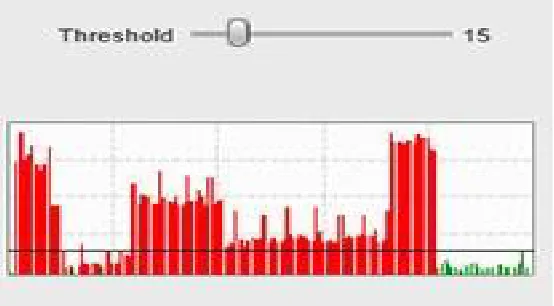
In the above image the camera detects the image and it is converted from RGB to respective binary equivalent. The first detected frame is classified using a classifier and feedback is sent. Using the data obtained the background data is defined and forwarded to the application layer. Simultaneously using corresponding agents the image is tracked according to the camera movements. Hence, the final object is detected without distortions. The Experimental results are graphically represented below fig (4).
Fig 4:Experimental Results
In the above graph a threshold value is assigned. This value determines what type of objects will be detected at a given time. A small threshold is usually preferred as any object beyond that range will be detected. This graph shows the clarity of the images. When they are closer in the histogram it indicates sharper image and slight blur image is represented by evenly spaced out of time in the above graph.
ISSN(Online): 2320-9801
ISSN (Print) : 2320-9798
I
nternational
J
ournal of
I
nnovative
R
esearch in
C
omputer
and
C
ommunication
E
ngineering
(An ISO 3297: 2007 Certified Organization)
Vol. 4, Issue 3, March 2016
Fig 5:Performance Graph
This graph clearly gives us an insight of how the proposed system fares well over the other systems effectively across the various reference frames
VII.CONCLUSION AND FUTURE WORK
This proposed paper concentrates on applying the Cauchy distribution modal along with Absolute effort estimation and Grey scale conversion technique to optimize object distortion while using the system is used in surveillance. Cauchy distribution provides improvement over old distribution modals by reducing the amount of computations required to detect an object motion in a frame. Absolute effort estimation is used to discriminate a foreground object from the background objects in the current frame that is taken under consideration. Grey scale conversion is used to set a static background scene for the current surveillance session. Hence, this proposed system guarantees to provide robust distortion free results.
REFERENCES
[1] Shuai Zhang, Chong Wang, S. C. Chan, X. G. Wei and C. H. Ho. “New Object Detection, Tracking and Recognition Approaches for Video Surveillance over Camera Network” IEEE Transactions on networks, vol.15, NO.5,March, 2015.
[2] A. Efros, A. C. Berg, G. Mori, and J. Malik. “Recognizing action at a distance”. In ICCV, pages 726–733, 2003.
[3] F. Lv and R. Nevatia. “Single view human action recognition using key pose matching and viterbi path searching”. In CVPR, 2007.
[4] C. Sminchisescu, A. Kanaujia, Z. Li, and D. Metaxas. “Conditional Random fields for contextual human motion recognition”. In ICCV, pages 1808–1815, 2005.
[5] D.Weinland, E.Boyer, and R.Ronfard. “Action recognition from arbitrary views using 3d exemplars”. In ICCV, 2007.
[6] O.Akman, A.Alatan, and T.Ciloglu, “Multi-camera visual surveillance for motion detection, occlusion handling, tracking and event recognition,” in Workshop Multi-camera Multi-modal Sensor Fusion Algorithms App., 2008.
[7] F. Fleuret, J. Berclaz, R. Lengagne, P. Fua, “Multi camera people tracking with a probabilistic occupancy map,” IEEE Trans. Pattern Anal. Machine Intel, pp. 267-282, 2008.
[8] A. Mittal, L. S. Davis, “M2Tracker: a multi-view approach to segmenting and tracking people in a cluttered scene,” Intl. J. Comput.Vision, pp.189-203, 2003.
0 1 2 3 4 5 6 7
frame 1
frame 2
frame 3
frame n
No Filter
Mean Segmentation
Gaussian Mixtures
ISSN(Online): 2320-9801
ISSN (Print) : 2320-9798
I
nternational
J
ournal of
I
nnovative
R
esearch in
C
omputer
and
C
ommunication
E
ngineering
(An ISO 3297: 2007 Certified Organization)
Vol. 4, Issue 3, March 2016
[9] D. Comaneci and P. Meer. “Mean shift: A robust approach toward feature space analysis.” IEEE Trans. Pattern Anal. Machine Intell., pp.603-619, May,2002.
[10] X. G. Wang, “Intelligent multi-camera video surveillance: a review,” Pattern Recog. Letters, vol.34, pp.3-19, 2013.
[11] Y. Wu, J. W. Lim, and M. H. Yang, “Online object tracking: a benchmark,” in Proc. IEEE Intl. Conf. Compt. vision Pattern Recog., Jun.2013, pp.2411-2418.
[12] P. Perez, C. Hue, J. Vermaak, and M. Gangnet, “Color-based probabilistic tracking,” in Proc. European Conf. Compt. Vision, 2002, pp.661-675.
[13] D. Comaniciu, V. Ramesh, and P. Meer, “Kernel-based object tracking,” IEEE Trans. Pattern Anal. Machine Intelligence, vol. 25, pp564-577, May2003.
[14] Z. Zivkovic and F. V. D. Heijden, “Efficient adaptive density estimation per image pixel for the task of background subtraction,” Pattern Recog. Letters, vol. 27, pp. 773-780, May 2006.
[15] Y.C. Ho and R. C. K. Lee, “A Bayesian approach to problems in stochastic estimation and control,” IEEE Trans. Automat. Contr., vol. AC-9, pp.333-339, 1964.
[16] L.Ido, M.Linderbaum, and E. Rivlin, “Mean shift tracking with multiple reference color histograms,” Comput. Vision Image Understand, pp.400-408, 2010.
[17] C.-C.Chang, T.-L.Chia, and C.-K. Yang, “Modified temporal difference method for change detection, Opt.Eng” vol.44, no.2, pp.1–10, Feb.2005.
[18] J.-E. Ha and W.-H. Lee, “Foreground objects detection using multiple difference images,” Opt. Eng., vol. 49, no. 4, p.047201, Apr.2010.