An EEG Based Human Mind Reader for
Physically Challenged Using Non-Invasive
Brain Computer Interface
Emmanuel Livingstone.E#1 , Esakki Raja.P#2 , Kannan.D#3 , Kishore Kumar.B#4, R Thillaikarasi5
B.E. Student, Dept. of Computer Science and Engineering, Saranathan College of Engineering, Venkateshwara Nagar,
Panjapur, Trichy, Tamilnadu, India1,2,3,4
Associate Professor, Dept. of Computer Science and Engineering, Saranathan College of Engineering, Venkateshwara
Nagar, Panjapur, Trichy, Tamilnadu, India5
ABSTRACT: The objective is to enable a computer to read and display thoughts of a human using an Electroencephalography (NeuroSky Mind wave EEG) device which is a non-invasive method to record electrical activity of the brain along the scalp. A normal human tends to generate specific electrical signals for each thought. With the use of an EEG sensor we will be able to read the electrical signals generated from the human brain. We use
Arduino board with Human Interface Device (HID) compatibility as an interface between EEG sensor and Computer to convert the data generated from the sensor into its equivalent machine readable form.The Arduino would be coded correspondingly to receive the input from the EEG sensor using Bluetooth module and process the signal and send data through the USB serial port. We have displayed the output in the serial monitor which is in a Human readable format thus achieving Brain Computer Interaction (BCI). There might be variations in the electrical signals for the same thought when different persons are considered and hence a concise value froma 25 persons is taken into account for the design and coding.
KEYWORD: Electroencephalography, Brain Computer Interaction, NeuroSky Mind wave EEG, serial monitor
I. INTRODUCTION
With several developments in the areas of information technology and neurosciences, there has been a surge of interest in turning dreams into reality. The crux of BCI research is to develop a system that allows disabled people to communicate with other persons and contributes to interaction with the external environments. This area includes components like, study of invasive and non-invasive technologies to measure brain activity, evaluation of control signals (i.e. patterns of brain signals that is used for communication), development of algorithms for translation of brain signals into computer commands, and the development of new and efficient BCI applications. This Paper provides an insight into the aspects of BCI by invoking the subject to effectively print alphabets without the use of conventional input devices.
II. HISTORY OF BRAIN COMPUTER INTERACTION
with brain diseases. EEGs allowed completely new openings for the research of human brain activities.The core aim of a direct brain computer interface (BCI) is to enable an individual with severe movement disabilities to have effective control over devices. A BCI system identifies the presence of action-specific patterns in a person’s brain that relates to the person’s thought to trigger control. In our project we will print the alphabet by the attention/meditation ratio of the NerouSkymindwave.The activity of the brain for each alphabets varies significantly which may be noted to display the corresponding alphabets. We make the system wireless and we use the Bluetooth shield (HC-05) with arduino YUN to connect the Neruosky mind wave and the Laptop. The initial task was handling the brain signals using the thinkgear packet and creates the interface of the brain signals ([High And Low]Alpha- beta- gamma- theta-ratio of attention and mediation).The second task was connecting the Bluetooth shield(HC-05) in the arduino to control it wireless. The third task was to run the program to receive data produced from the brain through the EEG mind wave. The fourth task was to consolidate the data received with respect to the alphabets and arrive at conclusions for each alphabet to build the subsequent coding. The final task is to run the program with the consolidated data and display the corresponding letters in the serial monitor.
III. METHODS OF BRAIN COMPUTER INTERACTION
Human brain is one of the most complicated organ that controls the functioning of the whole body. There are three different methods to interact with the Human brain.
1. Invasive BCIs:
Vision: Study of Invasive BCI was doneto repair damaged sight and to provide new functionality for people with paralysis. Invasive BCIs are fixed into the grey matter of the brain during neurosurgery. As they lie in grey matter of the brain, invasive devices produce thestandard quality signals of BCI devices but are prone to scar-tissue build-up, causing the signal to become weak as the body reacts to a foreign object in the brain.
Movement: BCIs that focus on motor neuroprosthetics aim to invoke movement in individuals with paralysis or provide devices to help them, such as interfaces with computers or robot arms [1].
2. Partially Invasive BCIs:
Electrocorticography (ECoG) is a technique used to measure the electrical activity of the brain taken from beneath the skull in an identical manner as compared to non-invasive electroencephalography, but the electrodes are embedded inside a thin plastic pad that is kept above the cortex, under the dura mater [1].
3. Non-invasive BCIs:
Noninvasive EEG-based technologies and interfaces are used for a much broader variety of applications. Although EEG-based interfaces do not require surgery and are easy to wear, they have relatively poor spatial resolution and cannot efficiently use higher-range signals because the skull dampens signals, dispersing and blurring the electromagnetic waves created by the neurons. Interfaces based on EEG also require some time and effort prior to each usage session, whereas non-EEG-based ones, as well as invasive techniques require no prior-usage training. Overall, the best BCI for each user depends on numerous factors [3].
IV. EXISTING SYSTEM
V. PROPOSED SYSTEM
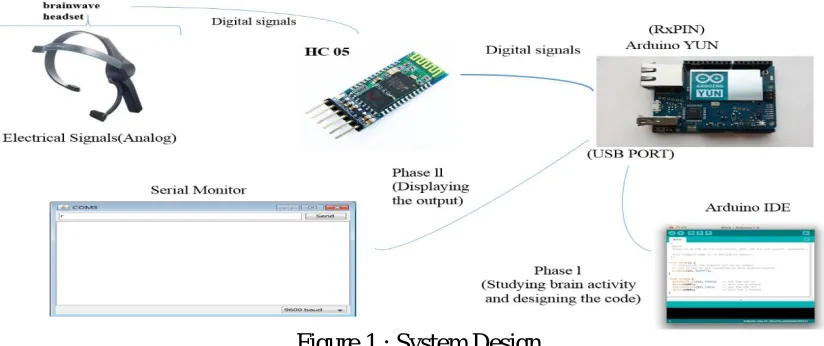
Electro Encephalo Gram based Brain-Computer Interface to read alphabets can help as a powerful support for severely disabled people in their regular activities. This paper proposes and implements a brain signal (mind) controlled alphabet generation. The scheme uses a single electrode pair acquisition scheme and processing of the same arrive at conclusions. The key lies in the mapping of the EEG signal’s attention to achieve the objective. In this project we are developing a cost effective BCI alphabet printing method that will help the physically challenged to lead an independent life with the use of non-invasive techniques on brain signals.The Electroencephalography (EEG) device reads the brain signals which are in analog form and converts it into digital form which is fed into the Arduino Yun. The Arduino Yun is paired with the EEG device using HC-05 module and interfaced with the computer. The brain activity is studied and the code is designed in the first phase and the output is displayed in the second phase.
Figure 1 : System Design
VI. HARDWARE REQUIREMENTS
1. NeuroskyMindwave Mobile
The MindWave Mobile accurately measures and gives the EEG power spectrums (alpha waves, beta waves, etc), NeuroSkyeSense meters such as attention, meditation and eye blinks. The device consists of a headset, an ear-clip, and a sensor arm. The ear clip contains the headset’s reference and ground electrodes and the EEG electrode is on the sensor arm, resting on the forehead above the eye. It uses a single AAA battery. The Mindwave headset is a slim, matte black plastic device which fits comfortably over the left ear. The primary sensor sits on the forehead comfortably, it will take a minute or two to adjust it the first time we put it on. The ear clip fits smoothly, and the whole instrument has the advantage of easily allowing to wear over-ear headphones [5].
2. HC-05 Bluetooth Module
3. Arduino YUN
Arduino is an Open-source physical computing environment based on a simple I/O board and a development environment that is used to implement the Processing or Wiring language. Arduino can be used to develop stand-alone interactive objects or it can be connected to a particular software on your computer. The Arduino Yun is a microcontroller board based on the ATmega32u4 and the Atheros AR9331. Linux distribution was supported by the Atheros processor based on OpenWrt named OpenWrt-Yun. The board has built-in Wi-Fi and Ethernet support, a USB-A port, micro-SD card slot, 20 digital input/output pins, a 16 MHz crystal oscillator, a micro USB connection, an ICSP header, and a 3 reset buttons [6].
The Yun classifies itself from other Arduino boards in that it can communicate with the Linux distribution onboard, and offers a strongly networked computer with the ease of Arduino. In addition to Linux commands like cURL, we can write our own shell and python scripts for sturdy interactions.The Yun is similar to the Leonardo in that the ATmega32u4 has built-in USB communication, omitting the need for a secondary processor. This allows the Yun to appear to a computer under connection as a mouse and keyboard, in addition to the virtual (CDC) serial / COM port.
VII. IMPLEMENTATION
Module 1 Pairing Mindwave mobile with HC-05
Module 2 Analyzing data packets from Mindwave mobile Module 3 Displaying alphabets
Module 1: To determine the mac address of the Mind wave mobile we pair the same with a computer. A wired
connection as shown in figure 2 is made between the Arduino Yun board and the HC 05 Bluetooth module.
Figure 2 : Connecting Arduino Yun with HC 05
To configure HC 05 we bring the Bluetooth module to the command mode using the reset button and subsequently using AT commands the module becomes usable to act as a Brain Computer Interface. Checking the configuration is essential as it will include the binding of the mac address of the mind wave mobile with the HC 05 Bluetooth module [7].
Module 2:ThinkGear is the technology inside every mind wave mobile which is a sensor that enables the mind wave to
interact with the brainwaves. It consists of a sensor that touches the forehead, the contact and reference points located on the ear pad and the chip on the board processes all of the data and provides this data to software and applications in digital form. The raw form of the brainwaves and the eSense Meters (Attention and Meditation) are calculated from the ThinkGear chip [4].
Meditation eSense:This unsigned one-byte value reports the current eSense Meditation meter of the user, which indicates the level of a user's mental “calmness” or “relaxation”. Its value ranges from 0 to 100. However, for most people in most normal circumstances, relaxing the body often helps the mind to relax as well. Meditation is related to reduced activity by the active mental processes in the brain, and it has long been an observed effect that closing one's eyes turns off the mental activities which process images from the eyes, so closing the eyes is often an effective method for increasing the Meditation meter level. Distractions, wandering thoughts, anxiety, agitation, and sensory stimuli may lower the Meditation meter levels. It is typically output once a second [4].
After reading the signals from the brain using EEG via HC-05 the brain activity of several subjects are noted. Computation of the aggregate value for the respective alphabets is done. A higher number of test subjects would result in better result even though the process of determining the aggregate might become tiresome.
Module 3: The attention value which is the signal that responds sharply to these brain activities is changed and the keyboard buffer is used as it not dependent on any single platform and the letters can be displayed wherever required.Read the signals again using the EEG via HC-05 and display the corresponding alphabet in the serial monitor using the meditation value that was pre-defined for the particular alphabet. The alphabets will be printed in the serial monitor of the arduino IDE as shown in figure 3 and figure 4.
Figure 3 : Output of Alphabet E
VIII. CONCLUSION
In a review of the use of Brain Computer Interface Technology, we conclude that the major problem facing BCI applications is how to provide agile, definite, stable control signals. Current BCI systems that operate using actual brain activity will be able to provide communication-and-control facilities that has a practical value mainly for people severely limited in their motor skills and therefore remain restricted with few other options. Widespread use of BCI technology by individuals with little or no disability is implausible in the short-term and would require much greater speed and accuracy than has so far been demonstrated in the scientific literature. Non-invasive and invasive methods would both benefit from improved recording methods. Current invasive methods do not deal sufficiently with the need for long-term stability in performance. Non-invasive EEG electrodes require a level of skill in the person using them, as well as in periodic maintenance to ensure sufficiently good contact with the forehead.Easy-to-use stable electrodes are under development. Improved methods for extracting key features of and translating them into device control, as well as user training, would largely help improve BCI performance.
REFERENCES
[1] Wolpaw J.R., Birbaumer N., McFarland D.J., Pfurtscheller G., Vaughan T. M. (2002). "Brain–computer interfaces for communication and control". Clinical Neurophysiology 113(6): 767–791
[2]Vidal, JJ (1973). "Toward direct brain-computer communication". Annual Review of Biophysics and Bioengineering 2 (1): 157–80
[3]Wolpaw, J.R. and Wolpaw, E.W. (2012). Brain-Computer Interfaces: Something New Under the Sun. In: Brain-Computer Interfaces: Principles and Practice
[4] http://developer.neurosky.com/docs/doku.php?id=thinkgear_communications_protocol#thinkgear_data_values [5]http://www.neurosky.com/Products/MindWaveMobile.aspx
[6]https://www.arduino.cc/en/Main/ArduinoBoardYun
[7] https://www.pantechsolutions.net/interfacing-mindwave-mobile-with-arduino
[8]Stanley, GB; Li, FF; Dan, Y (1999). "Reconstruction of natural scenes from ensemble responses in the lateral geniculate nucleus"(PDF). Journal of Neuroscience19 (18): 8036–42.
[9]O’Doherty, JE; Lebedev, MA; Ifft, PJ; Zhuang, KZ; Shokur, S; Bleuler, H; Nicolelis, MA (2011). "Active tactile exploration using a brain– machine–brain interface". Nature479(7372): 228–231.