ISSN(Online): 2320-9801
ISSN (Print) : 2320-9798
I
nternational
J
ournal of
I
nnovative
R
esearch in
C
omputer
and
C
ommunication
E
ngineering
(An ISO 3297: 2007 Certified Organization)
Vol. 4, Issue 3, March 2016
Mobile Based Healthcare Management using
Artificial Intelligence
Sahil Mulani, Rajat Agarwal, Vivek Jha, Shubham Ambhore, Neha Hajare
Dept. of Computer Engineering, MIT AOE, Pune, India
ABSTRACT: In this growing age of technology it is imperative to maintain a decent health care management system
which should be centpercent accurate but also should be portable so that every person can possess it as a personalized health care tool. The health care system will contain a mobile based Heart Rate Monitor so that the data is easily transferred and diagnosis related to heart rate can be provided quickly within seconds. The Doc-Bot which has been developed is now being transferred to mobile platform and will be incorporated into this health care system for identification and treatment of common diseases. The health care system will also contain an Online Blood Bank which will provide up-to-date details about availability of blood in different hospitals.
KEYWORDS: Health care management, portable, mobile platform, heart rate measurement, Doc-Bot, On-line blood
bank
I. INTRODUCTION
The usage of mobile devices by health care professionals (HCPs) has added many facets and advantages to clinical health care practice. Mobile devices have become common in health care settings, leading to rapid growth in the development of medical software applications for these platforms. Numerous applications are now available to assist HCPs with many important tasks, such as: information and time management; health record maintenance and access; communications and consulting; reference and informationGathering; patient management and monitoring; clinical decision-making; and medical education and training.
Mobile devices and applications provide many benefits for HCPs, perhaps most significantly increased access to point of-care tools, which has been shown to support better clinical decision-making and improved patient outcomes. However, some HCPs remain reluctant to adopt their use. Despite the benefits that they offer, better standards and validation practices regarding mobile medical applications need to be established to ensure the proper use and integration of these increasingly sophisticated tools into medical practice. These measures will raise the barrier for entry into the medical applications market, increasing the quality and safety of the applications currently available for use by HCPs.
The main goal of the project is to design a real time mobile health care management system. To support health care management on a mobile platform, human health and physical condition must be tracked and interpreted in order to recognize the meaningful indications and provide appropriate diagnosis.
In this paper, we present a health care management system that takes input from a simple application and necessary processing steps are done to recognize the physical condition of the users which in turn can be used for providing the health aid and medical help to the user.
II. RELATED WORK
C.LeeVentola, 2014: [1] Mobile devices are invaluable tools for HCPs to use to search or access medical literature, as well as other information sources. A study found that mobile devices were often used to access medical journal websites.
ISSN(Online): 2320-9801
ISSN (Print) : 2320-9798
I
nternational
J
ournal of
I
nnovative
R
esearch in
C
omputer
and
C
ommunication
E
ngineering
(An ISO 3297: 2007 Certified Organization)
Vol. 4, Issue 3, March 2016
Wail M. Omar and A. Taleb-Bendiab, 2006: This is the architecture designing conceptual model to hide the complexity of any model. The discussion of this paper shows how we can construct service oriented architecture that is essential for our proposed system.
Ren-GueyLee ET. Al. 2007: This paper shows how Hypertension and arrhythmia are chronic diseases, which can be effectively prevented and controlled only if the physiological parameters of the patient are constantly monitored, along with the full support of the health education and professional medical care.
Yutaka Hata, et.al. 2009: [3] In this paper, authors describe a human health management system scheme and its practical applications. Specifically, it focuses on health management, medical diagnosis, and surgical support system of systems engineering (SoSE).
P.R. China, 2012: [4] in this paper, authors give the importance of health and being medically fit. The author proposes a review and design based research methodologies via which an expert system can be designed which can be used by the doctors.
Ann Pharmacother, 2013: [5] In this paper the various advantages of mobile devices and how they can be used in the health care sector. Mobile devices (e.g.: smart phones, tablet computers) have become ubiquitous and subsequently there has been a growth in mobile applications (apps). Concurrently, mobile devices have been integrated into health care practice due to the availability and quality of medical apps
III. PROJECT IDEA
In this 21st century, people want everything at their door step. Now-a-days when there is a boom of online service providers on almost every need of ours, choosing a wide variety of electronics, online shopping etc. So why health care should be left behind?
Many aspects of health care discourage patient engagement long lines, complexity, lack of transparency of cost and quality. Much of this is unnecessary. Why should accessing health care require a painstaking wait in the physician's office? You could easily be noticed via text that your physician is running late. Applications can also eliminate complexity. Hence, we got this idea of bridging the gap between people and the doctors by providing health care services. This project will cater to provide health care services just click away.
In the health care sector, speech recognition can be implemented in front-end and back-end of the medical documentation process. Front-end speech recognition is where the provider dictates into a speech recognition engine, the recognized words are displayed as they are spoken and the dictator is responsible for editing the document. Back-end speech recognition is where the provider dictates into a digital dictation system, the voice is routed through a speech recognition machine and the recognized draft document is routed along with the original voice file to the editor, where the draft is edited and report finalized.
The main idea behind this project is to provide basic and advanced health care to a common man. We intend to create a mobile application with facilities like doc-bot, online blood bank and heart rate monitor so that a person in need of health care must be able to access it at a click of a button. We intend to improve the user experience by incorporating speech recognition module into the mobile application.
IV. MATHEMATICAL MODELING
System Description:
Input: Voice or text input by the user of the application
Output: The corresponding results provided by the application for that particular input
Functions:
1. Output Function:
ISSN(Online): 2320-9801
ISSN (Print) : 2320-9798
I
nternational
J
ournal of
I
nnovative
R
esearch in
C
omputer
and
C
ommunication
E
ngineering
(An ISO 3297: 2007 Certified Organization)
Vol. 4, Issue 3, March 2016
Success Conditions: The speech of the user will be exactly converted to text and pattern matching will result in appropriate results for easier inputs.
Failure Conditions: The heart rate of the user may not be estimated accurately due to insufficient light and failure to keep the phone and hand steady for the required amount of time
.
V. WORKFLOW DIAGRAM
The Figure easily explains the process involved in the development of the different modules and the application. User input and authentication is provided via the application from which the user can select the different modules and perform the corresponding actions.
The input commands can be provided via speech or touch. The speech engine is responsible for converting the necessary acoustic signal into required commands thereby performing the necessary actions. A database is included, which contains the all the information about the user and the modules which is dynamically updated.
VI. SIMULATION RESULTS
ISSN(Online): 2320-9801
ISSN (Print) : 2320-9798
I
nternational
J
ournal of
I
nnovative
R
esearch in
C
omputer
and
C
ommunication
E
ngineering
(An ISO 3297: 2007 Certified Organization)
Vol. 4, Issue 3, March 2016
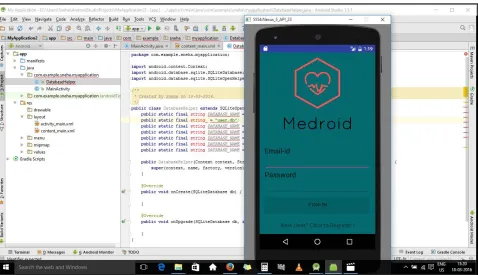
Fig 1. Screenshot depicting the emulation of the application
VII.CONCLUSION
After browsing through all the existing methodologies and applications till date, it has been observed that there are various merits and demerits of the various techniques used in the health care sector. The proposed system aims at developing a mutli purpose application for the users which will provide all medical related help and information at their fingertips at ease. The basic idea still remains bridging the gap between the doctor and the patient by providing an easy method of communicating and sharing information
REFERENCES
[1] C.Lee Ventola,2014- ”MediAssistEdge - Simplifying diagnosis procedure and improving patient doctor connectivity”, Under Graduate project report 2014..
[2] Jaesoon Choi, Member, IEEE, JunW. Park, Member, IEEE, Jinhan Chung, Student Member,IEEE, and Byoung G. Min, Member, IEEE An Intelligent Remote Monitoring System for
Artificial Heart ieee transactions on information technology in biomedicine, vol. 9, no. 4, December 2005.
[3] Yutaka Hata, Senior Member, IEEE, SyojiKobashi, Member, IEEE, and Hiroshi Nakajima,Member, IEEE Human Health Care System of Systems ieee systems journal, vol. 3, no. 2, june 2009
[4] P.R. China 2012 :http://www.google.com
[5] Ann Pharmacother,2013- ”Android Application to get Word Meaning through Voice”, InternationalJournal of Advanced Research in Computer Engineering and Technology, vol. 2, no. 2, 2013.
ISSN(Online): 2320-9801
ISSN (Print) : 2320-9798
I
nternational
J
ournal of
I
nnovative
R
esearch in
C
omputer
and
C
ommunication
E
ngineering
(An ISO 3297: 2007 Certified Organization)
Vol. 4, Issue 3, March 2016
BIOGRAPHY
SAHIL MULANIis a student pursuing his Computer Engineering degree in the Computer Engineering Department,
MIT Academy of Engineering, Pune.
RAJAT AGARWALis a student pursuing his Computer Engineering degree in the Computer Engineering Department,
MIT Academy of Engineering, Pune.
SHUBHAM AMBHOREis a student pursuing his Computer Engineering degree in the Computer Engineering
Department, MIT Academy of Engineering, Pune.
VIVEK JHAis a student pursuing his Computer Engineering degree in the Computer Engineering Department, MIT
Academy of Engineering, Pune.