Multi-Cloud Data Hosting System
Jocelin Asha J#1 ,Kalpana B#2 , Kavina Priya S#3, Lavanya G#4, Venkatasubramanian.S5 B.E. Student, Dept. of Computer Science, Saranathan College of Engineering, Venkateshwara Nagar,
Panjapur, Trichy, Tamilnadu, India1,2,3,4
Associate Professor, Dept. of Computer Science, Saranathan College of Engineering, Venkateshwara Nagar,
Panjapur, Trichy, Tamilnadu, India5
ABSTRACT: This project is aimed at providing a high availability of data in cloud storage.More enterprises and
organizations are hosting their data into the cloud, in order to reduce the maintenance cost and enhance the data reliability .The general status quo is that customers usually store their data in a single cloud(which is subject to vendor lock-in risk) .This system proposes a novel data hosting scheme which includes selecting suitable clouds to store data with guaranteed availability and with minimum cost.
KEYWORDS: cloud, vendor-lock-in-risk, hosting
I. INTRODUCTION
A number of clouds are available for storing large amounts of data. There can occur loss of data due to unexpected circumstances. Though this kind of problem is rare to occur, data loss leads to serious issues and is great threat to handle. Hence providing multiple storage spaces for a data could be of much use. This project deals with multiple clouds where the same data is replicated and stored in the different clouds chosen. Existing clouds exhibit great heterogeneitiesin terms of both working performances and pricing policies. The pricing policies of existing storage services provided by different cloud vendors are distinct in both pricing levels and charging items. For instance, Rackspace does not charge for Web operations (typically via a series of REST ful APIs), Google Cloud Storage charges more for bandwidth consumption, while Amazon S3 charges more for storage space.
Vendor lock-in risk: Facing numerous cloud vendors as well as their heterogeneous performances/policies, customers
may be perplexed with which cloud(s) are suitable for storing their data and what hosting strategy is cheaper. The general status quo is that customers usually put their data into a single cloud and then simply trust to luck. This is subject to the so-called “vendor lock-in risk”, because customers would be confronted with a dilemma if they want to
switch to other cloud venders.For example, Unexpected bankruptcy of cloud vendors further aggravates the situation.
Nirvanix, which has thousands of customers including top 500 companies, suddenly shut down its cloud storage service in Sep. 2013.Therefore a solution to these problems is required and can be provided by this project. It provides storage of data in 3 different clouds(googledrive,dropbox,cloudme). Either one or the other is available always.
II. RELATED WORK
The existing system has only storage of data in a single storage area leading to loss of data unexpectedly. This system leads has higher pricing which is not mostly preferred by customers. People usually store data in a single storage space. When this single storage fails ,it leads to loss of data. The other major problem is that choosing the right storage(clouds) for a minimum cost and great security. So, a novel hosting system is required to provide high availability of data .
III. PROPOSED SYSTEM
FEASIBILITY STUDY
The purpose of the feasibility study is not to solve the problem, but to determine the problem is worth solving. This helps to decide whether to proceed with the problem or not. It involves the analysis of the problem & collection of all relevant information relating to the product such as items that would be input to the system, processing required to carried those data, the output data required to be produced by the system as well the various constraints on the behavior of the system. “Multi-cloud data hosting system” had undergone the feasibility study so that the proposed system is possible for deployment and is available to everyone. . The feasibility study concentrates on the following, such as Operational Feasibility, Technical Feasibility, Economic Feasibility.
A. ECONOMIC FEASIBILITY
The economic feasibility study evaluates the cost software development against the ultimate income or benefits get from the developed system. There must be scope for profit after the success completion of the project.
B. TECHNICAL FEASIBILITY
Technical feasibility study compares the level of technology available in the software development firm and the level of technology required for the development of the product. The level of technology consists of the programming language, the hardware resources, other software tools etc.
C. OPERATIONAL FEASIBILITY
Operational feasibility study tests the operational scope of the software to be developed. The proposed software must have high operational feasibility.
SCOPE AND APPLICABILITY Scope:
This project is aimed atproviding high Data availability.The file we uploaded is replicated and stored in three different clouds. We can collect information from surviving clouds in the absence of any single cloud and to recover the files in failed cloud if the cloud gets destroyed due to any reason.
Applicability:
This project “Multi cloud data hosting system” is applicable for the organizations and for users who need high availability and security for data
IV. SYSTEM ARCHITECTURE
MODULES:
Multi-cloud data hosting system provides the modules like,
Data Sharer Module
Cloud Storage Module
End User Module
A.Data Sharer Module
Data sharer:
Registration & Login
Fig 2 : Registration & Login
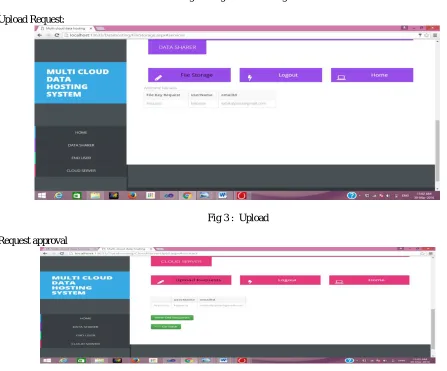
Upload Request:
Fig 3 : Upload
B. Cloud storage module:
The cloud storage module involves the storage of the uploaded file in the given three clouds.The uploaded file is replicated into 5 storage spaces i.e. in the three clouds ,and in the local drive.The path of the cloud folders are given to trace the exact location of the cloud folder in the system.The file uploaded is stored in the specified location and now is available in the 3 clouds.The data sharer can view the encrypted file in his cloud accounts.Other than the data sharer this uploaded file can be viewed by other data sharers who have registered in the system and the end users who have registered.The user who wants the file must have registered in the multi-cloud hosting system in order to view the file in their cloud accounts.
Uploaded file in DROP BOX:
Uploaded file in CLOUD ME:
C. End user module:
The end user module of the system consists of the end user activities, which includes viewing an uploaded file and downloaded file.The end user also must have an account by registering in this system by giving his username, password and email id.An end user can only view file if he is a free user. If he is a premium user he can download the file after decrypting.The end user must send a request to the cloud server asking permission to download the file.The cloud server approves the request and sends a key the end user’s mail.The user uses this key to decrypt the file and download it.Thus the multi-cloud hosting system is hosted and implemented
Download request & File download :
IV. CONCLUSION AND FUTURE WORK
REFERENCES
1. Bessani, M. Correia, B. Quaresma, F. Andre, and P. Sousa, “DepSky: Dependable and secure storage in a cloud-of-clouds,” in Proc. 6th Conf. Comput. Syst., 2013
2. Towards network-level efficiency for cloud storage services 3. Dependable and secure storage in a cloud of clouds 4. Asp.net-tutorials.com
5. www.w3schools.com