ABSTRACT
BASSO, ANNE. Design of Small Molecules toward the Modulation of Molecular Biosystems. (Under the direction of Dr. Christian Melander.)
The design of small molecules toward the modulation of a specific molecular biosystem was explored in two distinctive parts: (PART A) Design of Carbocyclic Peptide Analogues to Counteract a Pre-Determined RNA-Protein Interaction, and (PART B) Design of Imidazole Derivatives toward Biofilm Modulation.
The design of carbocyclic analogues was particularly relevant to RNA-protein interactions due to the ever-raising evidence of RNA’s essential role in cellular functions and high affinity of cyclic peptides with oligonucleotides. A facile route toward the synthesis of carbocyclic heptapeptides counterparts of bTAR RNA cysteine-constrained peptide binders, P1 and P2, was developed through the exploration of ring-closing metathesis conditions with four metathesis catalysts (Grubbs 1st, 2nd and Hoveyda-Grubbs 1st, 2nd generations) on the (1) resin-free, and (2) resin-bound linear di-olefin precursors. Classic Fmoc chemistry was employed to generate the di-olefin precursors prior to cyclization. Optimum ring closing conditions for this crucial step were explored in order to generate the substantial 29-membered macrocyles, and the results of this study are described in PART A.
Design of Small Molecules toward the Modulation of Molecular Biosystems
by Anne Basso
A dissertation submitted to the Graduate Faculty of North Carolina State University
In partial fulfillment of the Requirements for the degree of
Master of Science
Chemistry
Raleigh, NC 2008
APPROVED BY:
Alexander Deiters Reza Ghiladi
Bruce M. Novak Christian Melander
DEDICATION
BIOGRAPHY
ACKNOWLEDGEMENTS
TABLE OF CONTENTS
LIST OF TABLES………... x
LIST OF FIGURES……… xi
PART A Design of Specific Carbocyclic Peptide Analogues to Counteract Pre-Determined RNA-Protein Interaction………. 1
CHAPTER ONE.………. 2
1.1 Importance and Relevance of Protein-RNA Interaction………..……… 3
1.2 BIV-Tat TAR Protein-RNA Interaction………..……… 3
1.3 Targeting RNA-Protein Interaction with Molecules………..………. 3
1.4 Targeting RNA-Protein Interaction with Peptides………….………..……… 4
1.5 Targeting RNA with Cysteine-Constrained Peptides………..……… 5
1.6 Improving Stability of Cysteine-Constrained Peptides with Dicarba Linkage………...………...….. 6
1.7 Formation of Carbocyclic Peptide Analogues via Ring Closing Metathesis….…. 7 1.8 REFERENCES………...………. 8
CHAPTER TWO………... 15
2.1 Introduction……… 15
2.2 General Solid-Phase Synthesis……….. 16
2.3 Synthesis of Carbocyclic Peptides in Solution……….. 17
2.3.1 Synthesis of Linear Peptide on the Wang Resin………..….…… 17
2.3.2 Ring-Closing Metathesis in Solution……… 19
2.3.3 Ring-Closing Metathesis Optimization: Exploration of (1) Temperature, (2) Catalyst Equivalences, and (3) Various Metathesis Catalysts……….... 21
2.3.3.a Exploration of Temperature Conditions……….…. 22
2.3.3.b Exploration of Catalyst Equivalences………. 23
2.3.3.c Exploration of Various Metathesis Catalysts………... 24
in Solution……… 27
2.4 Synthesis of Carbocyclic Peptides on the Rink-Amide MBHA Resin…………. 28
2.4.1 Synthesis of Linear Peptides on Rink-Amide-MBHA Resin……….. 28
2.4.2 Quantification of Resin Loading……….………….……… 29
2.4.2.a The Ninhydrin Test……….…… 30
2.4.2.b The Piperidine Test……….… 31
2.4.3 Ring Closing Metathesis on Rink-Amide-MBHA Resin………..….. 32
2.4.4 Fmoc Resin cleavage and Deprotection………... 33
2.4.5 Assessment of Ring-Closing Metathesis Conditions on Resin……… 34
2.5 Hydrogenation of Unsaturated Carbocyclic Analogues……… 36
2.6 Summary……….. 38
2.7 REFERENCES………. 39
CHAPTER THREE Peptide Synthesis: Experimental Section……… 42
3.1 General.………. 42
3.2 Method and Characterization for Peptide Cyclization in Solution……… 42
3.2.1 General Procedures……...……… 42
3.2.2 Peptide Syntheses and Characterization……….…. 43
3.3 Method and Characterization for Peptide Cyclization on Rink-Amide MBHA Resin………. 45
3.3.1 General Procedures……...……….. 45
3.2.2 Peptide Syntheses and Characterization……….…. 46
PART B Design of Imidazole Derivatives toward Biofilm Modulation……….. 50
CHAPTER FOUR General Introduction to Biofilm Modulation.……...………..…….. 51
4.1 General Introduction………. 51
4.1.1 General Introduction……….…... 51
4.1.2 Relevance and Importance of Biofilms……… 52
4.1.3 Medically Relevant Biofilm Forming Bacterial Strains……….. 53
4.1.3.a Pseudomonas aeruginosa……… 53
4.1.3.c Bordetella bronchiseptica……… 55
4.1.3.d Staphylococcus aureus……… 56
4.2 Development of Biofilm Agents………... 56
4.2.1 General Properties of a Biofilm Agent………. 56
4.2.2 Molecular Scaffolds with the Ability to Modulate Biofilm Development………. 57
4.2.3 General Approach toward Biofilm Agents Development………. 58
4.2.4 General Trends of Current Biofilm Modulators……….. 59
4.2.4.a SAR of Homoserine Lactones………. 59
4.2.4.b SAR of Naturally Occurring Biofilm Modulators………... 60
4.3 Development of Biofilm Agents Derived from the Biologically Active 2-Aminoimidazole Scaffold……… 62
4.3.1 Abundance and Biological Activity of 2-Aminoimidazole………. 63
4.3.2 Origin of the Plethora of 2-Aminoimidazole Type Structures……….…… 64
4.3.3 Development of 2-Aminoimidazole Derivatives of Bromoageliferin as Potent Biofilm Agents……….… 66
4.3.3.a Derivatives of Oroidin……….… 66
4.3.3.b Reverse-Amide 2-Aminoimidazole Derivatives of Dihydrosventrin………..…….…… 68
4.3.3.c Triazole Derivatives of Dihydrosventrin……….… 69
4.3.4 Summary……….…….…. 71
4.4 REFERENCES……….…….… 72
CHAPTER FIVE….……….… 79
5.1 General Introduction………..… 79
5.2 Large-Scale Synthesis of TAGE and CAGE……….… 80
5.2.1 Relevance and Importance of Large-Scale Synthesis………... 80
5.2.2 General Synthesis of TAGE and CAGE………... 82
5.2.4 Novel Route toward the Synthesis of Boc-Protected Amine from
Diol Precursor………...………… 85
5.2.5 Summary……….……….. 86
5.3 Synthesis of 4,5-Substituted 2-Aminoimidazole Analogues………. 88
5.3.1 Relevance and Importance of 4,5-Substituted 2-Aminoimidazole Analogues……….… 88
5.3.1.a Significance of Simplified TAGE Structure……….... 90
5.3.1.b Significance of Simple Norephedrine 2-Aminoimidazole Analogue……….. 91
5.3.2 Retrosynthetic Approach toward the Design of 4,5-Substituted 2-Aminoimidazole Analogues………...………... 91
5.3.3 Synthesis of Simplified 4,5-Substituted 2-Aminoimidazole Analogues………... 92
5.3.3.a Synthesis of TAGE Structure: Cyclohexyl Analogue…………..….. 92
5.3.3.b Synthesis of Norephedrine 2-Aminoimidazole Analogue……..……. 93
5.3.4 Biofilm Preliminary Studies of Norephedrine 2-Aminoimidazole Analogue ……….. 94
5.3.4.a !-proteobacteria: Acinetobacter baumannii……..……….….. 94
5.3.4.b !-proteobacteria: Pseudomonas aeruginosa………..……….. 96
5.3.5 Summary………... 97
5.4 Synthesis of Dihdrosventrin 2-Substituted Analogues …………..………... 97
5.4.1 Importance and Relevance of 2-Substituted Imidazole Derivatives..…….. 98
5.4.2 Retrosynthetic Approach toward the Design of Dihydrosventrin 2-Substituted Analogues……..………. 99
5.4.3 Synthesis of Key Imidazolone Intermediate………..……. 100
5.4.3.a The Akabori Reaction……….…………... 100
5.4.3.b General Synthesis Approach……….…….… 101
5.4.3.c Important Imidazolone Synthetic Notes………...……….…. 102
5.4.4.a Protection of Imidazolone Side-Chain…………..………..…….….. 103
5.4.4.b Formation of 2-Chloroimidazole Intermediate…….………..….….. 104
5.4.5 Summary……….……….... 104
5.5 REFERENCES………..……….. 105
CHAPTER SIX…………...………. 108
6.1 Chemistry………. 108
6.1.1 General Techniques……… 108
6.1.2 CAGE Synthesis………. 108
6.1.3 TAGE Synthesis………..110
6.1.4 Synthesis of TAGE Cyclohexyl Analogue………. 112
6.1.5 Synthesis of Norephedrine 2-Aminoimidazole Analogue….………. 114
6.2 Biology………. 117
6.2.1 General Techniques……… 117
6.2.2 General Static Biofilm Inhibition Assay against P. aeruginosa and A. Baumannii……..……….. 117
APPENDICES...……….. 119
APPENDIX 1 Description of Biofilm Modulation Protocols………120
APPENDIX 2 Dihydrosventrin Biofilm Inhibition Study………...……….. 128
LIST OF TABLES
Table 2.1. Optimization of ring-closing metathesis conditions. Exploration of : (1) temperature (2) catalyst equivalences, and (3) various metathesis
catalysts……… 22 Table 2.2. Summary of resin loading quantification………...…………... 30 Table 2.3. Ring-closing metathesis on RINK Amide MBHA resin. Exploration
of (1) temperature, (2) catalyst equivalents, and (3) various metathesis
LIST OF FIGURES
Figure 1.1. Cysteine constrained-peptide selection and design of more stable carbo- cyclic peptide counterparts…....……….……..……….. 2 Figure 1.2. Cysteine constrained-peptide selection and design of more stable carbo-
cyclic peptide counterparts………. 6 Figure 1.3. Generation of carbocyclic peptide analogues via ring closing metathesis... 7 Figure 1.4. HADDOCK modeling of P1 (A) and P2 (B) with target RNA bTAR;
lowest energy structure for each complex is depicted………...………. 8 Figure 2.1. Design of carbocyclic peptide analogues from cysteine constrained
counterparts…………..……….…….... 16 Figure 2.2. HCTU...……… 17 Figure 2.3. Commercially available RINK-Amide-MBHA and Wang Resins………... 18 Figure 2.4. Synthesis of linear P1 and P2 with olefinic termini…..………..….. 19 Figure 2.5. 1H NMR characteristic of termini olefin………...……….………….. 20 Figure 2.6. Four ring-closing ruthenium metathesis catalysts………...……. 20 Figure 2.7. General ring-closing metathesis in solution. (note: side chain residues are protected as needed)………..……….... 21 Figure 2.8. 50% conversion after ring closing metathesis in solution with 10 mol% Grubbs 2nd generation for 24 hours at 95 C on linear P1…………..….… 23 Figure 2.9. ~ 100% conversion after ring closing metathesis in solution with
2 x 10 mol% Grubbs 2nd generation at t = 0 and 12 hours for 24
hours at 95 °C on linear P1…………...………...…… 24 Figure 2.10. < 10% conversion after ring closing metathesis in solution with
and 14 hours for 24 hours at 95 C on linear P1……….…... 25
Figure 2.11. Synthesis of linear P1 and P2 on RINK Amide MBHA resin...……… 29
Figure 2.12. Ninhydrin Test: Formation of Ruhemann’s purple………...….. 30
Figure 2.13. Ninhydrin Test: Formation of dibenzofulvene chromophore...….……... 31
Figure 2.14. Cleavage of P1 and P2 from RINK Amide MBHA resin…...……….. 34
Figure 2.15. Crude 1H NMR spectra after ring-closing metathesis on RINK resin with linear P2. (A) < 10% conversion with mostly the presence of linear di-olefin proton shift at ! 5.6 – 5.9 ppm (HA) and ! 4.90 – 5.10 ppm, (HB) < 50% conversion with the appearance of cyclic olefin peak at ! 5.2 – 5.4 ppm, and (C) >90% conversion with the disappearance of linear proton shifts and appearance of cyclic olefin chemical shifts at ! 4.95 – 5.55………...………….... 35
Figure 2.16. Unsaturated P1 and P2 analogues after ring closing metathesis on RINK resin………...…………..……….………. 36
Figure 2.17. General hydrogenation……….….………... 37
Figure 2.18. Saturated P1 and P2 carbocyclic analogues...…………..………. 37
Figure 4.1. Biofilm formation: Stage 1 represents reversible adhesion to a surface; Stage 2 highlights irreversible adhesion to a surface through the formation of an extracellullar matrix; Stage 3 evolves as more complex structures within the formed extracellular; Stage 4 represents the evolution of biofilm as a complex heterogenic structures; and Stage 5 represents the fully matured biofilm..……… 51
Figure 4.2. Macrolide antibiotics……… 53
Figure 4.3. Biofilm inhibitors….………... 57
Figure 4.4. QS general mechanism……...………..…... 58
Figure 4.5. SAR of homoserine lactones…….………... 59
Figure 4.6. Quorum sensing inhibitiors…...……….. 60
Figure 4.7. Natural and synthetic furanones………61
Figure 4.9. Bromoageliferin simplified structures toward the development of
an anti-biofilm agent…………..……….. 62
Figure 4.10. Brommoageliferin and its precursors TAGE and CAGE inhibition activities against PA01 and PA14…..………. 63
Figure 4.11. Abundance of 2-aminoimidazoles in nature…….……….…….. 64
Figure 4.12. 2-Aminoimidazole building blocks……….……… 65
Figure 4.13. SAR approach toward 2-aminoimidazoles from oroidin………….…….... 66
Figure 4.14. Oroidin derivatives………67
Figure 4.15. Reserve-amide oroidin library……….……… 68
Figure 4.16. Oroidin derivatives synthesis via the tedious Akabori process……… 69
Figure 4.17. Triazole derivatives of dihydrosventrin……… 70
Figure 5.1. Bromoageliferin simplifications toward the design of 2-amino- imidazole derivates……….………. 79
Figure 5.2. Relevant inhibitory activities against P. aeruginosa toward the development of more advanced derivates mimicking bromo- ageliferin scaffold………..……….. 81
Figure 5.3. General TAGE and CAGE syntheses……….………. 83
Figure 5.4. Syntheses of Boc-Protected amine TAGE and CAGE precursors from the respective trans- and cis- diols………... 84
Figure 5.5. Novel route toward the synthesis of Boc-protected amine precursor…….. 85 Figure 5.6. Advanced biofilm studies. (1) Biofilm assay on glass surface in
PA01 :gfp biofilms..……… 87
Figure 5.7. Simplification of bromoageliferin to simplified 4,5-substituted 2-amino-imidazole analogues…..………….……….…….. 88
Figure 5.8. Relevance of 4,5-substitution on biofilm inhibitory activities……… 89
Figure 5.9. Hypothetical binding of 4,5-subtituted 2-aminoimidazole analogues with an unknown receptor...………..……….. 90
Figure 5.10. Retrosynthesis approach toward the design of 4,5-substituted 2-amino- imidazole analogues…..……….………... 92
Figure 5.11. Synthesis of cyclohexylTAGE 5.13……….. 92
Figure 5.12. Synthesis of norephedrine 2-aminoimidazole analogue 5.14………. 93
Figure 5.13. Dose-response curve for norephedrine 2-aminoimidazole 5.14 against A. Baumannii……….………….. 95
Figure 5.14. Dose-response curve for norephedrine 2-aminoimidazole 5.14 against P. aeruginosa PA14……..……….………. 96
Figure 5.15. Dose-response curve for norephedrine 2-aminoimidazole 5.14 against P. aeruginosa PA14….………..………. 97
Figure 5.16. 2-Substituted dihydrosventrin analogues from bromoageliferin……….... 98
Figure 5.17. Hypothetical interactions of a 2-substituted dihydrosventrin analogue interaction with a target receptor….………...….. 99
Figure 5.18. Retrosynthesic approach toward the design of 2-substituted dihydro- sventrin analogues……….... 99
Figure 5.19. Relevant imidazole intermediates via the Akabori reaction followed by condensation of generated aldehyde with the appropriate cyanate reagent……… 100
Figure 5.20. Synthesis of imidazolone 2.25……… 101
Figure 5.21. Attempted synthetic route toward chlorination of imidazolone 2.25…... 103
Figure A.1.1. Qualitative assessment of biofilm formation………. 122
Figure A.2.2. Dose-response curve of DHS against PDO300……….... 129
Figure A.2.3. Dose-response curve of DHS against A. baumannii………. 130
Figure A.2.4. Dose-response curve of DHS against RB50………. 131
Figure A.2.5. Dose-response curve of DHS against !bp5.……… 132
Figure A.2.6. Growth curve of DHS against A. Baumannii………... 133
PART A
CHAPTER 1
General Introduction: Targeting RNA-Protein Interaction with Small
Molecules
The objective of this study was to synthesize pre-determined carbocyclic peptides that specifically inhibit the BIV Tat-TAR protein-RNA interaction by binding to TAR RNA. After identification of cysteine-constrained peptides through phage display library,
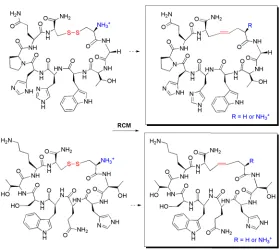
the next objective was to replace the in vivo unstable disulfide bridge with a redox stable dicarba linkage via ring-closing metathesis for retention of bioactivity of the cysteine-constrained counterparts (Figure 1.1).
1.1 Relevance and Importance of Protein-RNA Interaction
Protein-RNA interactions have become an important target for drug therapy.1-3 To date, only 0.005% of the human proteomes 107 discrete proteins is currently modulated by existing medicinal approaches,4 and targeting RNA with small molecules represents a promising approach to expand therapeutic interventions.5-8 RNA’s primary function is protein synthesis, and plays a major role in gene expression and viral replication. RNA is critical for the life of pathogen and progression of the disease.7 Furthermore, RNA’s essential role in cellular functions is ever increasing.9-11 Thus, inhibition of RNA-protein interactions has the potential to treat both infectious and chronic diseases caused by malfunctions of RNA processing events. A great example is the essential interaction between Tat-protein and TAR RNA for HIV replication.8, 12, 13 Small molecules that would compete with Tat binding are thought to be excellent antiviral candidates.8, 12, 13 Therefore, the discovery of small molecules that can bind specifically to a pre-determined RNA structure would prevent essential protein binding, and thus would inhibit progression of the disease and would generate novel therapeutic agents.
1.2 BIV-Tat TAR protein-RNA Interaction
protein, a 36 amino acid peptide, binds specifically to the 5’ hairpin of TAR mRNA to activate viral transcription upon a conformational change of the RNA.12, 18 Therefore, disruption of the Tat-TAR interaction would block the viral transcription essential for replication and infection.12, 13, 15 Furthermore, this inhibition would not only be effective in infected cells, but also in latent cells since the Tat protein is required for reactivation of viral production in these cells.13 Therefore, the BIV-Tat TAR protein-RNA complex is a great model to identify small molecules capable of disrupting this interaction, and was chosen to test our approach.19
1.3 Targeting RNA-Protein Interaction with Molecules
technique has become an attractive approach toward the inhibition of protein-RNA interactions, and was employed in this research to target the well-known BIV Tat TAR interaction.
1.4 Targeting RNA-Protein Interaction with Peptides
well-known like oxytocin (labor induction),5 cyclosporin A (immunosuppressant),7 and sansalvamide A (anti-tumor agent).54 Therefore, the selection and synthesis of cyclic peptides represent a step toward the design of biologically active ligands, and was employed to target our target RNA-protein complex. 19
1.5 Targeting RNA with Cysteine-Constrained Peptides
Our group decided to employ cysteine-constrained heptapeptides to target protein-RNA interactions via phage display library selection. Phage display library is a valuable tool to identify cyclic peptide scaffolds that can bind to a variety of molecular targets, and has been successfully used in anti-cancer and anti-viral therapies. Phage display libraries consist of filamentous bacteriophage engineered to encode random peptides, which are expressed on the surface of the viral coat protein. These libraries can be screened for
binding with biomolecular targets, and subsequently identified through sequencing. Once successful heptapeptides P1 and P2 (Figure 1.2) were identified by Virginia Burns from a comprehensive phage-display library (1.28 x 10⁹ library diversity) screened against the trans-activating response element (bTAR) RNA, the next challenge was to replace the unstable disulfide bridge with a more stable dicarba bridge to form the unsaturated and saturated analogues of P1 and P2 (Figure 1.3), and is described herein.
1.6 Improving stability of cysteine constrained peptides with dicarba linkage
A disadvantage of cysteine constrained cyclic peptides library is the presence of a disulfide bridge formed by two cysteine residues. This disulfide bridge is easily reduced in vivo.1, 2, 46, 55, 56 Peptidomimetic approaches have sought to replace this linkage by more
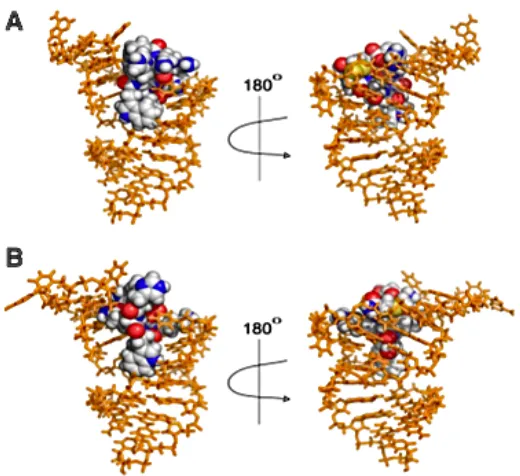
stable bridging to enhance cyclic stability as well as affinity1, 2, 57 of cyclic peptides as seen with oxytocin.46, 55 Installation of the dicarba-linker can potentially increase binding ffinity in addition to in vivo stability.1, 2, 5048, 49 In fact, HADDOCK preliminary modeling of P1 and P2 by Dr. Cavanagh suggested that the di-sulfide linkages do not participate in the H-bond donor/acceptor interactions with the oligonucleotide (Figure 1.4).19 In fact, the di-sulfide linkages only appear to provide covalent linkage for the cyclic structure, and thus replacement with a redox stable dicarba linkage should generate analogues with retained affinity for the RNA target.19 Therefore, we sought to exploit the notorious ring closing metathesis to install redox stable dicarba linkages.
1.7 Formation of Carbocyclic Peptide Analogues via Ring Closing Metathesis
The synthesis of novel cyclic peptide analogues can be derived from the olefin linear precursors via ring closing metathesis.46, 49, 50, 55, 58 In fact, olefin metathesis is a classical method in today’s organic synthesis to install new carbon-carbon bonds,2, 50, 59-61 and is thus a powerful tool to construct biologically relevant molecules of different sizes with a wide spectrum of functional groups.2, 49, 58, 59, 61 More significantly, olefin metathesis with ruthenium-alkylidenes possesses high metathesis activity for amino acids, and thus peptide-containing olefins.2, 49 Furthermore, ring closing metathesis is compatible with substrates bound to a solid support, which makes this methodology even more attractive to install the more stable dicarba-bridge from the olefin linear sequence.62 Lastly, Kasmeier et al. demonstrated that high efficiency olefin metathesis could be obtained even with various ring sizes, allyl moiety positions, and reaction conditions.48, 63 Not surprisingly, olefin metathesis has already been used in peptidomimetics to form peptide macrocycles to improve stability such as with the natural cyclic peptide oxytocin.46, 55 Therefore, we decided to employ olefin metathesis to replace the less stable disulfide bridge with the more stable dicarba-bridge to tune our selected peptide for stability and perhaps affinity as elaborated in Chapter 2 (Figure 1.3).
1.8 References
1. Li, P.; Roller, P. P.; Xu, J. C., Current synthetic approaches to peptide and peptidomimetic cyclization. Current Organic Chemistry 2002, 6, (5), 411-440.
2. Martin, W. H. C.; Blechert, S., Ring closing metathesis in the synthesis of biologically interesting peptidomimetics, sugars and alkaloids. Current Topics in Medicinal Chemistry 2005, 5, (15), 1521-1540.
4. Renfrey, S.; Featherstone, J., Structural proteomics. Nature Reviews Drug Discovery 2002, 1, (3), 175-176.
5. Hermann, T., Chemical and functional diversity of small molecule ligands for RNA. Biopolymers 2003, 70, (1), 4-18.
6. Cheng, A. C.; Calabro, V.; Frankel, A. D., Design of RNA-binding proteins and ligands. Current Opinion in Structural Biology 2001, 11, (4), 478-484.
7. Tor, Y., Targeting RNA with small molecules. Chembiochem 2003, 4, (10), 998-1007.
8. Hamy, F.; Felder, E. R.; Heizmann, G.; Lazdins, J.; AboulEla, F.; Varani, G.; Karn, J.; Klimkait, T., An inhibitor of the Tat/TAR RNA interaction that effectively suppresses HIV-1 replication. Proceedings of the National Academy of Sciences of the United States of America 1997, 94, (8), 3548-3553.
9. Ebralidze, A.; Wang, Y.; Petkova, V.; Ebralidse, K.; Junghans, R. P., RNA leaching of transcription factors disrupts transcription in myotonic dystrophy. Science 2004, 303, (5656), 383-387.
10. Nahvi, A.; Sudarsan, N.; Ebert, M. S.; Zou, X.; Brown, K. L.; Breaker, R. R., Genetic control by a metabolite binding mRNA. Chemistry & Biology 2002, 9, (9), 1043-1049. 11. Robertson, M. P.; Igel, H.; Baertsch, R.; Haussler, D.; Ares, M.; Scott, W. G., The structure of a rigorously conserved RNA element within the SARS virus genome. Plos Biology 2005, 3, (1), 86-94.
12. Athanassiou, Z.; Dias, R. L. A.; Moehle, K.; Dobson, N.; Varani, G.; Robinson, J. A., Structural mimicry of retroviral Tat proteins by constrained, beta-hairpin peptidomimetics: Ligands with high affinity and selectivity for viral TAR RNA regulatory elements. Journal of the American Chemical Society 2004, 126, (22), 6906-6913.
14. Calabro, V.; Daugherty, M. D.; Frankel, A. D., A single intermolecular contact mediates intramolecular stabilization of both RNA and protein. Proceedings of the National Academy of Sciences of the United States of America 2005, 102, (19), 6849-6854.
15. Leeper, T. C.; Athanassiou, Z.; Dias, R. L. A.; Robinson, J. A.; Varani, G., TAR RNA recognition by a cyclic peptidomimetic of Tat protein. Biochemistry 2005, 44, (37), 12362-12372.
16. Gonda, M. A.; Luther, D. G.; Fong, S. E.; Tobin, G. J., Bovine immunodeficiency virus - molecular - biology and virus-host interactions. Virus Research 1994, 32, (2), 155-181.
17. Alper, P. B.; Hendrix, M.; Sears, P.; Wong, C. H., Probing the specificity of aminoglycoside ribosomal RNA interactions with designed synthetic analogs. Journal of the American Chemical Society 1998, 120, (9), 1965-1978.
18. Huq, I.; Wang, X. L.; Rana, T. M., Specific recognition of HIV-1 TAR RNA by a D-Tat peptide. Nature Structural Biology 1997, 4, (11), 881-882.
19. Burns, V. A.; Bobay, B. G.; Basso, A.; Cavanagh, J.; Melander, C., Targeting RNA with cysteine-constrained peptides. Bioorganic & Medicinal Chemistry Letters 2008, 18, (2), 565-567.
20. van Dijk, A. D. J.; de Vries, S. J.; Dominguez, C.; Chen, H.; Zhou, H. X.; Bonvin, A., Data-driven docking: HADDOCK's adventures in CAPRI. Proteins-Structure Function and Bioinformatics 2005, 60, (2), 232-238.
21. McLafferty, M. A.; Kent, R. B.; Ladner, R. C.; Markland, W., Bacteriophage-M-13 displaying disulfide-constrained microproteins. Gene 1993, 128, (1), 29-36.
22. Dominguez, C.; Boelens, R.; Bonvin, A., HADDOCK: A protein-protein docking approach based on biochemical or biophysical information. Journal of the American Chemical Society 2003, 125, (7), 1731-1737.
23. Parmley, S. F.; Smith, G. P., Antibody-selectable filamentous FD phage vectors - affinity purification of target genes. Gene 1988, 73, (2), 305-318.
25. Mingeot-Leclercq, M. P.; Glupczynski, Y.; Tulkens, P. M., Aminoglycosides: Activity and resistance. Antimicrobial Agents and Chemotherapy 1999, 43, (4), 727-737. 26. Pilch, D. S.; Kaul, M.; Barbieri, C. M., Ribosomal RNA recognition by aminoglycoside antibiotics. In DNA Binders and Related Subjects, 2005; Vol. 253, pp 179-204.
27. Michael, K.; Tor, Y., Designing novel RNA binders. Chemistry-a European Journal 1998, 4, (11), 2091-2098.
28. Davies, J. S., The cyclization of peptides and depsipeptides. Journal of Peptide Science 2003, 9, (8), 471-501.
29. Tulla-Puche, J.; Barany, G., On-resin native chemical ligation for cyclic peptide synthesis. Journal of Organic Chemistry 2004, 69, (12), 4101-4107.
30. Krishnamurthy, M.; Gooch, B. D.; Beal, P. A., RNA binding and thiolytic stability of a quinoline-containing helix-threading peptide. Organic & Biomolecular Chemistry 2006, 4, (4), 639-645.
31. Gooch, B. D.; Beal, P. A., Recognition of duplex RNA by helix-threading peptides. Journal of the American Chemical Society 2004, 126, (34), 10603-10610.
32. Gooch, B. D.; Krishnamurthy, M.; Shadid, M.; Beal, P. A., Binding of helix-threading peptides to E-coli 16S ribosomal RNA and inhibition of the S15-16S complex. Chembiochem 2005, 6, (12), 2247-2254.
33. Carlson, C. B.; Stephens, O. M.; Beal, P. A., Recognition of double-stranded RNA by proteins and small molecules. Biopolymers 2003, 70, (1), 86-102.
34. Tamilarasu, N.; Huq, I.; Rana, T. M., Design, synthesis, and biological activity of a cyclic peptide: An inhibitor of HIV-1 Tat-TAR interactions in human cells. Bioorganic & Medicinal Chemistry Letters 2000, 10, (9), 971-974.
36. Frugier, M.; Schimmel, P., Subtle atomic group discrimination in the RNA minor groove. Proceedings of the National Academy of Sciences of the United States of America 1997, 94, (21), 11291-11294.
37. Agris, P. F.; Marchbank, M. T.; Newman, W.; Guenther, R.; Ingram, P.; Swallow, J.; Mucha, P.; Szyk, A.; Rekowski, P.; Peletskaya, E.; Deutscher, S. L., Experimental models of protein-RNA interaction: Isolation and analyses of tRNA(Phe) and U1 snRNA-binding peptides from bacteriophage display libraries. Journal of Protein Chemistry 1999, 18, (4), 425-435.
38. Barrick, J. E.; Takahashi, T. T.; Balakin, A.; Roberts, R. W., Selection of RNA-binding peptides using mRNA-peptide fusions. Methods 2001, 23, (3), 287-293.
39. Barrick, J. E.; Takahashi, T. T.; Ren, J. S.; Xia, T. B.; Roberts, R. W., Large libraries reveal diverse solutions to an RNA recognition problem. Proceedings of the National Academy of Sciences of the United States of America 2001, 98, (22), 12374-12378.
40. Mucha, P.; Szyk, A.; Rekowski, P.; Weiss, P. A.; Agris, P. F., Anticodon domain methylated nucleosides of yeast tRNA(Phe) are significant recognition determinants in the binding of a phage display selected peptide. Biochemistry 2001, 40, (47), 14191-14199.
41. Austin, R. J.; Xia, T. B.; Ren, J. S.; Takahashi, T. T.; Roberts, R. W., Designed arginine-rich RNA-binding peptides with picomolar affinity. Journal of the American Chemical Society 2002, 124, (37), 10966-10967.
42. Battiste, J. L.; Tan, R. Y.; Frankel, A. D.; Williamson, J. R., Binding of an HIV REV peptide to REV responsive element RNA induces formation of purine-purine base-pairs. Biochemistry 1994, 33, (10), 2741-2747.
43. Chen, L.; Frankel, A. D., An RNA-binding peptide from peptide immunodeficiency virus Tat protein recognizes an unusual RNA structure. Biochemistry 1994, 33, (9), 2708-2715.
44. Runyon, S. T.; Puglisi, J. D., Design of a cyclic peptide that targets a viral RNA. Journal of the American Chemical Society 2003, 125, (51), 15704-15705.
46. Stymiest, J. L.; Mitchell, B. F.; Wong, S.; Vederas, J. C., Synthesis of oxytocin analogues with replacement of sulfur by carbon gives potent antagonists with increased stability. Journal of Organic Chemistry 2005, 70, (20), 7799-7809.
47. Reichwein, J. F.; Versluis, C.; Liskamp, R. M. J., Synthesis of cyclic peptides by ring-closing metathesis. Journal of Organic Chemistry 2000, 65, (19), 6187-6195.
48. Kazmaier, U.; Hebach, C.; Watzke, A.; Maier, S.; Mues, H.; Huch, V., A straightforward approach towards cyclic peptides via ring-closing metathesis - scope and limitations. Organic & Biomolecular Chemistry 2005, 3, (1), 136-145.
49. Miller, S. J.; Grubbs, R. H., Synthesis of Conformationally Restricted Amino-Acids and Peptides Employing Olefin Metathesis. Journal of the American Chemical Society 1995, 117, (21), 5855-5856.
50. Miles, S. M.; Leatherbarrow, R. J.; Marsden, S. P.; Coates, W. J., Synthesis and bio-assay of RCM-derived Bowman-Birk inhibitor analogues. Organic & Biomolecular Chemistry 2004, 2, (3), 281-283.
51. Adessi, C.; Soto, C., Converting a peptide into a drug: Strategies to improve stability and bioavailability. Current Medicinal Chemistry 2002, 9, (9), 963-978.
52. Fairlie, D. P.; Abbenante, G.; March, D. R., Macrocyclic peptidomimetics - forcing peptides into bioactive conformations. Current Medicinal Chemistry 1995, 2, (2), 654-686.
53. Bourne, G. T.; Golding, S. W.; Meutermans, W. D. F.; Smythe, M. L., Synthesis of a cyclic peptide library based on the somatostatin sequence using the backbone amide linker approach. Letters in Peptide Science 2000, 7, (6), 311-316.
54. Carroll, C. L.; Johnston, J. V. C.; Kekec, A.; Brown, J. D.; Parry, E.; Cajica, J.; Medina, I.; Cook, K. M.; Corral, R.; Pan, P. S.; McAlpine, S. R., Synthesis and cytotoxicity of novel sansalvamide A derivatives. Organic Letters 2005, 7, (16), 3481-3484.
56. Whelan, A. N.; Elaridi, J.; Harte, M.; Smith, S. V.; Jackson, W. R.; Robinson, A. J., A tandem metathesis-hydrogenation route to dicarba analogues of cystine-containing cyclic peptides. Tetrahedron Letters 2004, 45, (52), 9545-9547.
57. Derksen, D. J.; Stymiest, J. L.; Vederas, J. C., Antimicrobial leucocin analogues with a disulfide bridge replaced by a carbocycle or by noncovalent interactions of allyl glycine residues. Journal of the American Chemical Society 2006, 128, (44), 14252-14253.
58. Blackwell, H. E.; Sadowsky, J. D.; Howard, R. J.; Sampson, J. N.; Chao, J. A.; Steinmetz, W. E.; O'Leary, D. J.; Grubbs, R. H., Ring-closing metathesis of olefinic peptides: Design, synthesis, and structural characterization of macrocyclic helical peptides. Journal of Organic Chemistry 2001, 66, (16), 5291-5302.
59. Ahn, Y. M.; Yang, K.; Georg, G. I., A convenient method for the efficient removal of ruthenium byproducts generated during olefin metathesis reactions. Organic Letters 2001, 3, (9), 1411-1413.
60. Cho, J. H.; Kim, B. M., An efficient method for removal of ruthenium byproducts from olefin metathesis reactions. Organic Letters 2003, 5, (4), 531-533.
61. Galan, B. R.; Kalbarczyk, K. P.; Szczepankiewicz, S.; Keister, J. B.; Diver, S. T., A rapid and simple cleanup procedure for metathesis reactions. Organic Letters 2007, 9, (7), 1203-1206.
62. Dimartino, G.; Wang, D. Y.; Chapman, R. N.; Arora, P. S., Solid-phase synthesis of hydrogen-bond surrogate-derived alpha-helices. Organic Letters 2005, 7, (12), 2389-2392.
CHAPTER 2
Design of Pre-Determined Cysteine-Constrained Cyclic Peptides as the Redox
Stable Carbocyclic Analogues
2.1 Introduction
The ever-increasing importance of peptides as drug candidates has solicited the development of various peptidomimetic approaches in order to enhance pharmacokinetic and pharmacodynamic properties of peptides.1-3 A widely employed methodology is to design carbocyclic peptides via ring closing metathesis.1, 2, 4-12 To date, synthesis of cyclic peptides has been limited to 20-23-membered macrocycles under ring optimized closing metathesis conditions.6-8 Miles et al. reported the synthesis of larger 29-membered macrocyles similar to our system, but under microwave conditions.13 Synthesis of the
macrocycle is highly dependent on the length and sequence of the peptide, and thus requires optimization.5, 9, 14 After selecting biologically active cysteine-constrained peptides P1 and P2 (Figure 2.1),15 the next unequivocal objective was to install a redox stable dicarba linker in place of the metabolically less stable disulfide bridge via optimization of ring-closing metathesis, and thus to generate carbocyclic P1 and P2 (Figure 2.1). Therefore, we sought to develop optimum conditions for this crucial step toward the development of specific RNA binders via optimization of the linear sequence cyclization through two distinct approaches: (1) ring-closing metathesis in solution, and (2) ring-closing metathesis on resin.
2.2 General Solid-Phase Synthesis
Our general approach toward the design of our dicarba-analogues was through the synthesis of the linear sequence with olefin termini via standard Fmoc-chemistry, using 2-(6-Chloro-1H-benzotriazole-1-yl)-1,1,3,3-tetramethylaminium
hexafluorophosphate (HCTU) as the coupling reagent (Figure 2.2), and commercially available protected amino acids
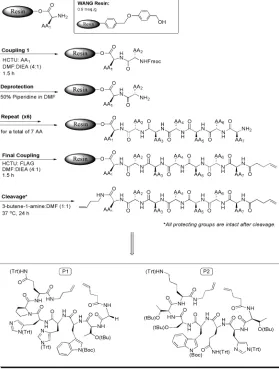
corresponding to P1 and P2 sequences. Protection of the side chains of glutamine (N-Trt), histidine (N-Trt), and tryptophan (t-Boc) with the trityl (Trt) group or tert-butyloxycarbonyl (Boc) was essential to maximize coupling in order to prevent tandem cyclization and dehydration of the primary amide side chain.7 Furthermore, protection of the side chains of threonine (O-tBu), serine (O-tBu) with tert-butyl group (tBu) was necessary to prevent interference of the alcohols in the RCM reaction.7Each amino acid coupling proceeded with the addition of a freshly prepared solution containing 4 equivalents of the desired protected amino acid and of HCTU in N,N-dimethylformamide/ diisopropylethylamine (4:1) to the deprotected resin followed by 1-1.5 hours coupling time. Fmoc deprotection with 50% piperidine solution in N,N-dimethylformamide for 20 minutes afforded the free amine terminus in order to proceed
to the next coupling. After assembly of the desired linear sequence, the peptide sequence was capped with 4-pentenoic acid, and then cleaved with 3-butene-1-amine to afford the terminal olefins in place of the cysteine residues present in original peptide sequences. During the course of the synthesis, both Wang and Rink-Amide-MBHA resins were employed to design the linear sequences in order to meet the different approaches toward cyclization of the linear peptide (Figure 2.3).
2.3 Synthesis of Carbocyclic Peptides in Solution
The first approach toward installation of the dicarba linker was through cyclization of the resin-free bis-olefin linear peptide in solution. This method proceeded through assembly of the linear sequence on the Wang resin followed by resin cleavage in order to afford the resin-free linear peptide for optimization of ring-closing metathesis in solution.
2.3.1 Synthesis of Linear Peptide on the Wang Resin
The synthesis was initiated by the design of P1 and P2 linear sequences on the OH–functionalized Wang resin as depicted in Figure 2.4. The Wang resin was conveniently purchased with the first desired amino acid: Wang Resin-Gln(Trt)-NH(Fmoc) and Wang Resin-Lys(Trt)-Resin-Gln(Trt)-NH(Fmoc) specific to P1 and P2 respectively, from Peptides International Inc. This provided us a facile route to directly proceed to the next coupling with a highly loaded resin, and thus to maximize coupling yields. Once all
protected amino acids were assembled, the resin was capped with 4-pentenoic acid under the same coupling conditions, and then cleaved with 3-butene-1-amine in N,N-dimethylformamide (1:1) at 37 oC for 24 hours to afford the desired peptides P1 and P2 with terminal olefins (Figure 2.4). After cleavage, crude linear P1 and P2 were purified by silica gel column chromatography in methanol/dichloromethane, and analyzed by 1H NMR spectroscopy which was characterized by the olefin termini chemical shifts at ! 5.8-5.6 ppm (broad multiplet, 2H) and ! 5.1-4.9 ppm (broad multiplet, 4H) (Figure 2.5).
2.3.2 Ring-Closing Metathesis in Solution
After the synthesis of the appropriate linear sequences, ring-closing metathesis of linear heptapeptides was attempted in solution for optimization, which provided a facile way to monitor the reaction progress via thin layer chromatography in comparison to ring-closing metathesis on resin-bound peptide. To date, the largest synthetic carbocyclic peptide analogues constructed have been pentapeptide analogues or 23-membered macrocycles. In fact, the only reported carbocyclic heptapeptides analogues were synthesized on solid-support under microwave conditions with 25% conversion, whereas under general ring-closing metathesis conditions Coates et al were mostly unsuccessful at recovering the 28-membered macrocycles.13 Generally, it is well-known that ring size and sometimes the presence of different amino acids affect the tendency for the ring closing metathesis to occur. 5, 9, 14 Thus, synthesis of carbocyclic P1 and P2 was substantial, and required optimization of current ring-closing metathesis approaches. Indeed, we expected general conditions Figure 2.5. 1H NMR characteristic of termini olefin.
previously established for pentapeptides or smaller peptides to generate little or no conversion. Therefore, it was important to have a facile and practical way to monitor the reaction in order to identify optimum reaction conditions for this crucial step in the synthesis. Classical ring closing metathesis conditions were first used as a standard for optimization using 10 mol % Grubbs catalyst 2nd generation (Figure 2.6) in a 10 mM solution of dichloromethane at room temperature as well as reflux (Figure 2.7). As expected, no reaction was observed at ambient temperature. Indeed, refluxing is often required for ring closing to occur for larger tetrapeptides.9, 13, 16 However, under these reflux conditions, no conversion was observed over 24 hours. We postulated that we required higher catalyst concentration to assist ring-closing metathesis. Indeed, another approach toward the cyclization of larger tetrapeptides is the use of high catalyst equivalents up to 50 mol% at room temperature.6, 9, 16, 17 However, these conditions were unsuccessful even after 48 hours. Therefore, these preliminary results prompted us to refine ring-closing conditions to delineate the optimal conditions for this crucial step in our approach to target pre-determined RNA with carbocyclic heptapeptides.
2.3.3 Ring-Closing Metathesis Optimization: Exploration of (1) Temperature, (2) Catalyst Equivalents, and (3) Various Metathesis Catalysts
We decided to optimize RCM conditions by investigation of (1) temperature, (2) catalyst concentration, and (3) various metathesis catalysts: Grubbs 1st (GBI) and 2nd (GBII) generations as well as Hoveyda-Grubbs 1st (HGI) and 2nd (HGII) generations (Figure 2.6), as summarized in Table 2.1. Preliminary results were collected by thin layer chromatography observations and confirmed by 1H NMR spectroscopy.
Table 2.1. Optimization of ring-closing metathesis conditions. Exploration of: (1) temperature, (2) catalyst equivalents, and (3) various metathesis catalysts.
Catalyst n x 10 mol% (n=)
at time
(t=) Solvent T °C
Reaction Duration (h)
Conversion (TLC)
GBII n = 1 t = 0 DCM 40 24 0%
GBII n = 1 t = 0 DCE 85 24 50%
GBII n = 2 t = 0, 12 DCE 85 16 100%
GBII n = 5 t = 0 DCM RT 24 0%
GBI n = 3 t = 0, 12, 14 DCE 85 24 0%
GBI n = 5 t = 0 DCM RT 24 0%
HGI n = 3 t = 0, 12, 14 DCE 85 24 <10%
HGI n = 5 t = 0 DCE RT 24 0%
HGII n = 3 t = 0, 12, 14 DCE 85 24 <10%
2.3.3.a Exploration of Temperature Conditions
Since high temperatures are often necessary to favor ring-closing of larger peptide systems, we hypothesized that commonly used reflux conditions in dichloromethane were not sufficient to favor cyclization of our substantial macrocycle.4 Previous studies by Dimartino et al. found optimal conversion at about 80 oC to cyclize an artificial !–helix via ring closing metathesis from bis-olefin precursors.9 Thus, we opted to change our solvent system to 1,2-dichloroethane in order to generate reflux conditions of 85-90 oC. After one hour, thin layer chromatography observation indicated the disappearance of some starting material (linear P1) and correlated product formation. Nevertheless, after 2, 3, 8, and 24 hours, the reaction did not reach completion. Indeed, crude 1H NMR studies confirmed product formation via the appearance of a broad multiplet at " 5.4-5.2 ppm (#), in between the linear di-olefin HA and HB chemical shifts in about ~ 50% conversion as depicted in Figure 2.8. Indeed, formation of the resulting cyclic olefin was confirmed by. Encouraged by these preliminary results, we maintained reflux conditions at about 85 oC and decided to explore catalyst stochiometries. 6, 9, 16, 17
2.3.3.b Exploration of Catalyst Equivalents
After these encouraging results, increasing catalyst equivalents appeared necessary to further favor ring closing metathesis especially since degradation of ruthenium metathesis catalysts at elevated temperatures is well-known. Thus, we hypothesized that re-addition of catalyst was necessary to favor cyclization due to the drastic temperature conditions. Therefore, we decided that the next step toward optimization was to evaluate the re-addition of 10 mol% catalyst, n times, at various time intervals (t) throughout the reaction. Reaction progress was monitored by thin layer chromatography. These conditions were encouraging, since we observed complete conversion by TLC when linear P1 was reacted with 2 x 10 mol% Grubbs 2nd generation
added at t = 0 and t = 12 hours in 10 mM peptide solution in 1,2-dichloroethane under reflux for 16 hours (Table 2.1). To confirm cyclization of linear P1, 1H NMR of the
crude peptide was analyzed. Indeed, we noted ~ 100% conversion since the expected cyclic olefin protons (!) chemical shifts at 5.4-5.6 ppm (broad multiplet, 2H) were present in the absence of the linear di-olefin protons, HA and HB, chemical shifts as
indicated in (Figure 2.9).
2.3.3.c Exploration of Various Metathesis Catalysts
Lastly, we were interested in evaluating the effect of various ring-closing metathesis catalysts upon our macrocycle system at reflux and ambient temperature. This methodology presented an opportunity to optimize reaction conditions by minimizing the amount of catalyst used and the reaction time, and thus to identify the optimum conditions for preparation of the 29-membered macrocycle. Furthermore, the nature of novel catalysts ligands may minimize the catalyst equivalents and may reduce formation of ruthenium catalyst contaminants.17-19 In fact, Hoveyda-Grubbs 2nd generation catalyst was shown to generate by-products that facilitate purification.9 Thus, we decided to explore four well-known commercially available ring-closing catalysts: (1) Grubbs 1st generation, GBI; (2) Grubbs 2nd generation, GBII; (3) Hoveyda-Grubbs 1st generation, HGI; (4) Hoveyda-Grubbs 2nd generation, HGII (Figure 2.6). The general procedure followed the optimized conditions previously developed with Grubbs 2nd generation: 10 mM solution of di-olefin peptide in degassed 1,2-dichloroethane, 2 x 10 mol% catalyst added at t = 0 and 12 hours and refluxed at 85-90 oC for a minimum of 16 hours. After 14 hours thin layer chromatography observations indicated little or no conversion of linear
Figure 2.10. < 10% conversion after ring closing metathesis in solution with 2 x 10 mol% Hoveyda-Grubbs 1st and 2nd generations at t = 0, 12 and 14 hours for 24 hours at 95 oC on linear P
P1. Thus, we decided to add another 10 mol % of the desired catalyst at t = 14 hours. No changes were observed even after 24 hours. In order to confirm the thin layer chromatography results, 1H NMR of the crude samples were taken. The Hoveyda-Grubbs 2nd generation catalyst showed minor conversion, while Grubbs 1st generation led to no conversion as depicted in Figure 2.10 with the abundant presence of the linear di-olefin HA and HB chemical shifts (! 5.8-5.6 ppm and ! 5.1-4.8 ppm) and minor or absent presence of the cyclic olefin " chemical shifts (! 5.5-5.2 ppm). Furthermore, ring-closing metathesis was run at ambivalent temperature with 50 mol% of each catalyst catalyst as summarized in Table 2.1. However, no conversion was observed. Therefore, 2 x 10 mol% of Grubbs 2nd generation added at t = 0 and 12 hours for 16 hours at 85-90 oC was the only promising route to generate large carbocycles.
2.3.4 Purification Dilemma
However, we never isolated pure product obtained via cyclization under Grubbs 2nd generation conditions. We hypothesized that charcoal absorbed the desired peptide due to its hydrophobic nature. From different methodologies, 7, 17-19 we opted to attempt next the
widely used and mildly oxidative conditions reported by Georg et al.,18 which involves the addition of 50-100 equivalents of dimethylsulfoxide or trimethyl phosphine at ambient temperature directly after ring closing metathesis for a minimum of 12 hours. This methodology converts the ruthenium catalyst contaminants into polar undefined products that are facile to remove by reverse-phase HPLC chromatography, and has been recently applied to the cyclization of macrocycles.18 Furthermore, larger cyclic peptides have been synthesized on resin-support in order to minimize the amounts of known by-products as well as potential problems from dimerization and poor peptide solubility.6, 10,
14 Therefore, we decided to attempt the more common ring-closing metathesis on resin
followed by the addition of dimethylsulfoxide to facilitate cyclization and purification of our macrocycles.
2.3.5 Summary of Ring-Closing Metathesis Optimization Conditions in Solution
2.4 Synthesis of Carbocyclic Peptides on Rink-Amide MBHA Resin
After encountering purification difficulties with the cyclized peptides in solution, we decided to overcome this impediment via cyclization on resin followed by the consecutive additions of dimethylsulfoxide in order to limit by-products formation and to facilitate their removal. Therefore, we decided to explore this methodology while implementing the conditions developed in solution.
2.4.1 Synthesis of Linear Peptides on Rink-Amide-MBHA Resin
2.4.2 Quantification of Resin Loading
After coupling of the L-allylglycine residue, resin loading was quantified by UV-visible spectroscopy in order to delineate the optimum loading conditions for high coupling yields. To test the loading of the resin with Fmoc-L-allylglycine, two quantification assays were utilized: the ninhydrin test and the piperidine test as described below and summarized in Table 2.2.
2.4.2.a The Ninhydrin Test
The ninhydrin test, commonly referred as the Kaiser test, is frequently used to assess resin loading via the formation of Ruhemann’s purple generated by the reaction of ninhydrin with the terminal deprotected amino acid (Figure 2.12). The absence of the UV signature for Ruhemann’s purple indicated that loading was unsuccessful with only 0.04 meq.g-1 of Fmoc-L-allylglycine loaded onto the resin compared to 0.30 meq.g-1 for our control with residue leucine. Therefore, we attempted other conditions to promote coupling (Table 2.2). We tried the same coupling conditions at 37 oC as well as 8 equivalents of both Fmoc-L-allylglycine and HCTU at 37 oC. However, none of these conditions improved the loading efficiency. Thus, 4 equivalents of both
Table 2.2. Summary of resin loading quantification.
Temperature
(oC) A570 (mmol.gLoading -1) A302 (mmol.gLoading -1)
RT 0.700 0.26 0.613 0.34
4eq. HCTU, 4eq. FLAG RT 0.542 0.017 0.660 0.35 8eq. HCTU, 8eq. Leucine 37oC 0.748 0.29 0.612 0.37
8eq. HCTU, 8eq. FLAG 37 oC 0.484 0.045 0.573 0.34
4eq. DCC, 4eq. HOBt, Leucine RT 0.767 0.24 0.312 0.16 4eq. DCC, 4eq. HOBt, FLAG RT << 0.1 << 0.1 0.117 0.081
Ninhydrin Test Piperidine Test Coupling conditions
4eq. HCTU, 4eq. Leucine
Couping reagents
hydroxybenzotriazole (HOBt) and N,N'-Dicyclohexylcarbodiimide (DCC) were tested as coupling agents to improve loading efficiency. However, this last coupling condition was not even successful with control leucine. We decided to try the piperidine test to verify the results assessed from the ninhydrin test since this latter is known to not always work with certain residues such as L-allylglycine.
2.4.2.b Piperidine Test
The piperidine test is another well-known assay to quantify resin loading. The terminal amino acid is deprotected with 20% piperidine in dimethylformamide to form dibenzofluvene, which can be quantified by UV-visible spectroscopy (Figure 2.13).21 Loading of the RINK resin was successful, and was found to be as high as 0.4 mmol.g-1 when using 4 equivalents of both Fmoc-L-allylglycine and HCTU at room temperature. Increasing to 8 equivalents of Fmoc-L-allylglycine and HCTU and/or coupling at 37 oC did not increase loading. Nevertheless, loading with HOBt/DCC as coupling reagent was not successful. Therefore, the final loading conditions employed for peptide synthesis were 4 equivalents of both HCTU and Fmoc-L-allylglycine in a 4:1 solution of dimethylformamide/ diisopropylethylamine with a catalytic amount of 4-dimethylaminopyridine for 5-6 hours at room temperature, and the loading was controlled through the piperidine assay to generate 0.33 - 0.40 mmol.g-1. This loading quantification
was used for the amino acid coupling and ring closing equivalents.
2.4.3 Ring Closing Metathesis on Rink-Amide-MBHA Resin
After synthesis of P1 and P2 linear sequences on the RINK resin, ring-closing
metathesis was attempted on solid-support. The major advantage of on-resin cyclization is the minimization of highly colored and toxic ruthenium by-products. Furthermore, Stymiest et al. found that the addition of 50-100 equivalents of dimethylsulfoxide (or triphenyl phosphine)18, a mildly reactive and highly compatible reagent, prevents tight
Table 2.3. Ring-closing metathesis on RINK Amide MBHA resin. Exploration of (1) temperature, (2) catalyst equivalents, and (3) various metathesis catalysts.
Catalyst n x 10 mol% (n =) at time (t =)
Reaction Duration
(h)
Solvent T oC Conversion % (1H NMR)
Grubbs I n = 2 0, 12 14h DCE 85-90 0%
Grubbs I n = 5 0 48h DCE RT 0%
Grubbs II n = 2 0, 12 14h DCE 85-90 < 50%
Grubbs II n = 5 0, 12, 15, 18, 21 24h DCE 85-90 > 90%
Grubbs II n = 5 0 48h DCE RT 0%
Hoveyda Grubbs I n = 5 0, 12, 15, 18, 21 24h DCE 85-90 > 50%
Hoveyda Grubbs I n = 5 0 48h DCE RT 0%
Hoveyda Grubbs II n = 5 0, 12, 15, 18, 21 24h DCE 85-90 > 90%
binding of almost all of the ruthenium by-products to the desired peptide,7 as previously describe by Ahn et al on a non-related peptide system.18 Indeed, this mild reactive
procedure converts Grubb’s catalyst to an undefined product that can be easily removed by column chromatography or HPLC purification.7 Failure to add dimethyl sulfoxide (or triphenyl phosphine) yielded product contaminated with ruthenium-containing by-products extremely defifficult to remove.7, 8, 18 Therefore, this procedure appeared to be highly adequate for synthesizing larger peptides especially under the developed conditions, which included high catalyst loads. The metathesis reaction was run using the developed conditions during the cyclization in solution as a basis for further optimization on the RINK resin. On-resin ring closing metathesis conditions were 10 mM peptide solution in degassed dichloroethane with n x 10 mol% catalyst added initially, after 12 hours and every 3 hours until completion, at 85-90 oC for 24 hours. All four catalysts were tried following this procedure (Table 2.3). In addition, we also tested the reaction with all four catalysts at 50 mol% equivalents for 48 hours at room temperature (Table 2.3). Small samples were collected at each time point to assess the optimal catalyst loadings. Each sample was then stirred with 100 equivalents of dimethylsulfoxide at room temperature for an additional 12-16 hours prior to TFA cleavage and 1H NMR analysis of crude product in order to facilitate purification of ruthenium-contaminants.
2.4.4 Fmoc Resin Cleavage and Deprotection
peptides using a solution of TFA/water/silane scavenger (95: 2.5: 2.5). In our synthesis, we used triisopropylsilane (TIS) or triethylsilane (TES) as the scavenger for the freshly prepared TFA solution (Figure 2.14). The mixture was added to a thoroughly washed and dried resin, and left to stand at ambient temperature for 2-2.5 hours with occasional mixing. Filtration and isolation of the peptide via ether precipitation afforded resin-free carbocyclic P1 and P2 with fully deprotected side-chain residues (Figure 2.14).
2.4.5 Assessment of Ring-Closing Metathesis Conditions on Resin
Once the synthesized peptides were cleaved from the resin, it was possible for us to assess which conditions were successful via 1H NMR spectroscopic analysis of the crude samples, as previously depicted in Table 2.3. From Table 2.3 the following conclusions
are noted: (1) Grubbs’ 1st generation catalyst was unsuccessful under any condition (Figure 2.15.A); (2) Hoveyda Grubbs’ 1st/2nd and Grubbs’ 2nd generations were
successful when 5 x 10 mol% equivalents were added at 85-90 oC during 24 hours.
However, Hoveyda-Grubbs 1st generation was only mildly reactive (< 50% conversion,
Figure 2.15.B) whereas Grubbs’ 2nd generation yielded > 90% conversion as with Hoveyda-Grubbs 2nd (Figure 2.15.C), but generated more highly colored and unseparable ruthenium by-products. Thus, after optimization we postulated that the most successful approach was 5 x 10 mol% of Hoveyda-Grubbs 2nd generation as catalyst, 10 mM peptide solution of degassed DCE, at 85-90 oC for 24 hours. The purified analogues were obtained as a non-separable mixture of cis/trans isomers by HPLC in 12.5 % acetonitrile with 0.1 % TFA solution in 48-64% yield for carbocyclic P2 and 57-70% yield for
carbocyclic P1 (Figure 2.16). (Note: Structure characterization was confirmed by 1H
NMR spectroscopy and mass spectrometry).
2.5 Hydrogenation of Unsaturated Carbocyclic Analogues
Generation of the saturated analogues carbocyclic P1 and P2 L-allylglycine at the N-terminus were synthesized under standard hydrogenation conditions at 1 atm H2 for 4 days (Figure 2.17). The pure analogues were obtained via HPLC purification in 12.5 % acetonitrile with 0.1 % TFA solution in ~ 50 % conversion (Figure 2.18). We hypothesized that the reduce conversion yield compared to the 100 % reported yield parallels the presence of both cis:trans isomers. Indeed, trans- isomers are notorious to be
very stable and not undergo hydrogenation.7 Thus, we postulated that our saturated analogues were composed of about the same ratio of cis:trans isomers. Hydrogenation of the unsaturated analogues was observed by 1H NMR spectroscopy through the disappearance of the ethylene peaks between 5-6 ppm to afford saturated carbocyclic P1
and P2 (Note: Structure confirmation was obtained by 1H NMR spectroscopy for all
peptide analogues).
2.6 Summary
heptapeptide phage-display comprehensive libraries, and thus the ability to extend this approach to multiple pre-determined RNA sequences toward the development of protein-RNA interaction inhibitors for drugs therapeutics.
2.7 References
1. Li, P.; Roller, P. P.; Xu, J. C., Current synthetic approaches to peptide and peptidomimetic cyclization. Current Organic Chemistry 2002, 6, (5), 411-440.
2. Martin, W. H. C.; Blechert, S., Ring closing metathesis in the synthesis of biologically interesting peptidomimetics, sugars and alkaloids. Current Topics in Medicinal Chemistry 2005, 5, (15), 1521-1540.
3. Davies, J. S., The cyclization of peptides and depsipeptides. Journal of Peptide Science 2003, 9, (8), 471-501.
4. Kazmaier, U.; Hebach, C.; Watzke, A.; Maier, S.; Mues, H.; Huch, V., A straightforward approach towards cyclic peptides via ring-closing metathesis - scope and limitations. Organic & Biomolecular Chemistry 2005, 3, (1), 136-145.
5. Reichwein, J. F.; Versluis, C.; Liskamp, R. M. J., Synthesis of cyclic peptides by ring-closing metathesis. Journal of Organic Chemistry 2000, 65, (19), 6187-6195.
6. Whelan, A. N.; Elaridi, J.; Harte, M.; Smith, S. V.; Jackson, W. R.; Robinson, A. J., A tandem metathesis-hydrogenation route to dicarba analogues of cystine-containing cyclic peptides. Tetrahedron Letters 2004, 45, (52), 9545-9547.
7. Stymiest, J. L.; Mitchell, B. F.; Wong, S.; Vederas, J. C., Synthesis of biologically active dicarba analogues of the peptide hormone oxytocin using ring-closing metathesis.
Organic Letters 2003, 5, (1), 47-49.
9. Dimartino, G.; Wang, D. Y.; Chapman, R. N.; Arora, P. S., Solid-phase synthesis of hydrogen-bond surrogate-derived alpha-helices. Organic Letters 2005, 7, (12), 2389-2392.
10. Tulla-Puche, J.; Barany, G., On-resin native chemical ligation for cyclic peptide synthesis. Journal of Organic Chemistry 2004, 69, (12), 4101-4107.
11. Blackwell, H. E.; Sadowsky, J. D.; Howard, R. J.; Sampson, J. N.; Chao, J. A.; Steinmetz, W. E.; O'Leary, D. J.; Grubbs, R. H., Ring-closing metathesis of olefinic peptides: Design, synthesis, and structural characterization of macrocyclic helical peptides. Journal of Organic Chemistry 2001, 66, (16), 5291-5302.
12. Derksen, D. J.; Stymiest, J. L.; Vederas, J. C., Antimicrobial leucocin analogues with a disulfide bridge replaced by a carbocycle or by noncovalent interactions of allyl glycine residues. Journal of the American Chemical Society 2006, 128, (44), 14252-14253.
13. Miles, S. M.; Leatherbarrow, R. J.; Marsden, S. P.; Coates, W. J., Synthesis and bio-assay of RCM-derived Bowman-Birk inhibitor analogues. Organic & Biomolecular Chemistry 2004, 2, (3), 281-283.
14. Kazmaier, U.; Maier, S., Application of the peptide claisen rearrangement toward the synthesis of cyclic peptides. Organic Letters 1999, 1, (11), 1763-1766.
15. Burns, V. A.; Bobay, B. G.; Basso, A.; Cavanagh, J.; Melander, C., Targeting RNA with cysteine-constrained peptides. Bioorganic & Medicinal Chemistry Letters 2008, 18, (2), 565-567.
16. Ghalit, N.; Rijkers, D. T. S.; Liskamp, R. M. J., Alkene- and alkyne-bridged mimics of nisin as potential peptide-based antibiotics. Journal of Molecular Catalysis a-Chemical 2006, 254, (1-2), 68-77.
17. Cho, J. H.; Kim, B. M., An efficient method for removal of ruthenium byproducts from olefin metathesis reactions. Organic Letters 2003, 5, (4), 531-533.
18. Ahn, Y. M.; Yang, K.; Georg, G. I., A convenient method for the efficient removal of ruthenium byproducts generated during olefin metathesis reactions. Organic Letters
19. Galan, B. R.; Kalbarczyk, K. P.; Szczepankiewicz, S.; Keister, J. B.; Diver, S. T., A rapid and simple cleanup procedure for metathesis reactions. Organic Letters 2007, 9, (7), 1203-1206.
20. Miller, S. J.; Grubbs, R. H., Synthesis of Conformationally Restricted Amino-Acids and Peptides Employing Olefin Metathesis. Journal of the American Chemical Society 1995, 117, (21), 5855-5856.
CHAPTER 3
Peptide Synthesis Experimental Section
3.1 General
1H NMR (300 or 400MHz)spectra were measured in DMSO and referenced
against the solvent resonance at ! 2.50 ppm. Chemical shift (!) are given in ppm relative to tetramethylsilane or the respective NMR solvent; coupling constants (J) are in hertz (Hz). Abbreviations used are s = singlet, bs = broad singlet, d = doublet, bd = broad doublet, m = multiplet, and bm = broad multiplet. Silica gel (40 µM average particle size) was used for column chromatography. Mass spectral data were obtained from the North Carolina State University Department of Chemistry’s Mass Spectrometry laboratory. Dichloroethane (DCE) was degassed by bubbling nitrogen through the solvent for several minutes. All solvents were specifically purchased for peptide synthesis (" 99.8% purity) and used without any further purification.
3.2 Method and Characterization for Peptide Cyclization in Solution
3.2.1 General Procedures
General peptide synthesis on Wang-AA1 resin for cyclization in solution: Syntheses
of linear P1and P2. All peptides were synthesized manually. Solid phase synthesis was
carried out on a 0.4 mmol scale using Fmoc chemistry on Fmoc-Gln(Trt)-Wang for linear P1 and Fmoc-Leu-Wang resins for linear P2 (100-200 mesh, 1% DVB, 0.41 meq.g-1