A Distributed Efficient and Accurate Routing
Protocol to Increase the Capacity of Hybrid
Wireless Networks
Anju Prabha1, Silpa Muraliraj2
M.Tech Student, Dept. of Computer Science & Engineering, Sree Narayana Gurukulam College of Engineering,
Kerala, India1
Assistant Professor, Dept. of CSE., Sree Narayana Gurukulam College of Engineering, Kerala, India2
ABSTRACT -A hybrid wireless network is efficient and reliable data routing for protocol is a critical component that affects the throughput capacity of a wireless network in data transmission. The routing protocols in hybrid wireless networks combine the cellular transmission mode (i.e. transmission mode) in infrastructure wireless networks and the ad-hoc transmission mode in mobile ad-hoc networks. A challenge here is if we can coordinately develop an efficient routing algorithm and effective cooperation incentives for reliable routing. The protocols used in the multi-hop routing to forward a message to the mobile gateway nodes that are closest to the base station or have the highest bandwidth to the base stations. The widespread base station, the mobile nodes have a high probability of encountering a BS while moving. Existing Two-Hop Routing protocols are produce High overhead and Low Reliability. Taking advantage of this feature, we propose a Distributed Three-hop Data Routing protocol (DTR) and a peer-to-peer (P2P)-based Market-guided Distributed Routing mechanism (MDR). MDR takes advantage of widespread base stations to coordinately realize highly efficient data routing, and effective reputation management and trading market management for reliable data routing. In DTR a source node divides a message stream into a number of segments. The proposed protocol compares to Two-Hop Routing protocol improve the Network Efficiency and reduce the Overhead.
KEYWORDS: Hybrid wireless Network, Three- Hop, Distribution, Throughput, Data Routing, Overhead.
I. INTRODUCTION
Wireless networks including infrastructure wireless networks and mobile ad-hoc networks (MANETs) have attracted significant research interest. The growing desire to increase wireless network capacity for high performance applications has stimulated the development of hybrid wireless networks. A hybrid wireless network consists of both an infrastructure wireless network and a mobile ad-hoc network. Wireless devices such as smart-phones, tablets and laptops, have both an infrastructure interface and an ad-hoc interface. As the number of such devices has been increasing sharply in recent years, a hybrid transmission structure will be widely used in the near future. Such a structure synergistically combines the inherent advantages and overcome the disadvantages of the infrastructure wireless networks and mobile ad-hoc networks. In a hybrid wireless network that combines a mobile ad-hoc network and an infrastructure network, efficient and reliable data routing is important for high throughput. Existing routing schemes that simply combine ad-hoc and infrastructure routings inherit the drawbacks of ad-hoc routing including congestion and high overhead for route discovery and maintenance. In the absence of the central control infrastructure, in mobile adhoc network the data is routed to its destination through the intermediate nodes in a multi-hop manner. The multi-hop routing needs on-demand route discovery or route maintenance. The messages are transmitted in wireless channels and through dynamic routing paths, the mobile ad-hoc networks are not reliable as the infrastructure wireless networks. Because of the multi-hop transmission feature, mobile ad-hoc networks are only suitable for local area data transmission.
Although current reputation systems help increase routing reliability, they rely on local information exchanges between nodes to evaluate node reputations, so they are not sufficiently effective and efficient. A challenge here is if we can coordinately develop an efficient routing algorithm and effective cooperation incentives for reliable routing.
A hybrid wireless network synergistically combines an infrastructure wireless network and a mobile ad-hoc network to leverage their advantages and overcome their shortcomings, and finally increases the throughput capacity of a wide-area wireless network. A routing protocol is a critical component that affects the throughput capacity of a wireless network in data transmission. Most current routing protocols in hybrid wireless network simply combine the cellular transmission mode (i.e., BS transmission mode) in infrastructure wireless networks and the ad-hoc transmission mode in mobile ad-hoc networks. The protocols used in the multi-hop routing to forward a message to the mobile gateway nodes that are closest to the BSes or have the highest bandwidth to the BSes. In an infrastructure network, nodes communicate with each other through base stations (BSes). Because of the long distance one-hop transmission between BSes and mobile nodes, the infrastructure wireless networks can provide higher message transmission reliability and channel access efficiency, but suffer from higher power consumption on mobile nodes and the single point of failure problem
The bandwidth of a channel is the maximum throughput (i.e., transmission rate in bits/s) that can be achieved. The mobile gateway nodes then forward the messages to the BSes, functioning as bridges to connect the ad-hoc network and the infrastructure network. To handle the challenge, this paper presents a peer-to-peer (P2P)-based Market-guided Distributed Routing mechanism (MDR). MDR takes advantage of widespread base stations to coordinately realize highly efficient data routing, and effective reputation management and trading market management for reliable data routing. The packets from a source node are distributively transmitted to base stations directly or indirectly, and then they are transmitted to the destination. The base stations form a P2P structure for reputation collection and querying to avoid local information exchanges, and for managing the service transactions between nodes in the trading market. By leveraging the single-relay transmission feature, base stations can monitor the actual transmitted packets of relay nodes to more accurately and efficiently evaluate their reputations and execute trading market management, as well as detect falsely reported reputation information. We further propose market-based policies to strengthen cooperation incentives. Simulation results show that MDR outperforms the traditional hybrid routing schemes and reputation systems in achieving high throughput.
reputation collection and querying to avoid local information exchanges, and for managing the service transactions between nodes in the trading market. By leveraging the single-relay transmission feature, BSes can monitor the actual transmitted packets of relay nodes to evaluate their reputation and execute trading market management, as well as detect falsely reported reputation information. Thus, a node’s reputation is based on actual relaying behavior, and partial reputation information, which can calculate more accurate reputation.
II. RELATED WORK
In the year 2007 H. Shen and C. Xu, proposed a paper on “Locality-aware and churn-resilient load balancing algorithms in structured peer-to-peer networks,” [16] based on a balancing algorithm in peer to peer network. Structured peer-to-peer overlay networks, like distributed hash tables (DHTs), map data items to the network based on a consistent hashing function. This paper presents a locality-aware randomized load- balancing algorithm to deal with both the proximity and network churn at the same time. In the year 2012 Z. Li and H. Shen, “MDR: A p2p-based market-guided distributed routing mechanism for high-throughput hybrid wireless networks”[21] Efficient and reliable data routing is important for high throughput in such networks. Existing routing schemes that simply combine ad-hoc and infrastructure routings inherit the drawbacks of ad-hoc routing and fail to take advantage of the infrastructure for high efficiency. Taking advantage of the high density of base stations, the packets from a source node are distributively transmitted to base stations directly or indirectly.
The packet transmission in MDR is modeled as a market trading behaviors, in which source nodes pay credits to relay nodes. The service price is determined by the supply and demand equilibrium of the nodes in the system. An erasure coding-based distributed routing algorithm is also proposed to facilitate an efficient and reliable market trading. Theoretical analysis demonstrates the distinguishing features of MDR and simulation results show that MDR outperforms the traditional hybrid routing schemes and reputation systems.“Connectivity in ad-hoc and hybrid networks” [4] paper by Olivier Dousse, Patrick Thiran and Martin Hasler proposed that a large-scale wireless network, but with a low density of nodes per unit area. Assume here that power constraints are modeled by a maximal distance above which two nodes are not (directly) connected. The introduction of base stations will allow distant nodes to communicate through a fixed, wired infrastructure. It represents a trade-off between today’s cellular networks and large-scale ad-hoc networks.“Hybrid Wireless Network Protocols [7] “Ruay-Shiung Chang, Wei-Yeh Chen, and Yean-Fu Wen proposed that One is base-station (BS) oriented and the other is the ad hoc wireless network. In BS-oriented wireless networks, the mobile hosts communicate with base stations, while in the ad hoc wireless networks, the mobile hosts communicate with one another directly. The BS-oriented wireless network has better performance and is more reliable. In this paper, propose hybrid wireless network protocols to combine the advantages of BS-oriented and ad hoc wireless networks.The proposed system is more reliable, increases bandwidth utility, saves battery power, and is more fault-tolerant to BS failures.
III. PROPOSED SYSTEM
3.1 Distributed Three-Hop Routing Protocol with security (DTR) :
Distributed Three-hop Data Routing protocol (DTR), a source node divides a message stream into a number of segments. Each segment is sent to a neighbor mobile node. DTR and a peer-to-peer (P2P)-based Market-guided Distributed Routing mechanism (MDR). MDR takes advantage of widespread base stations to coordinately realize highly efficient data routing, and effective reputation management and trading market management for reliable data
routing. In DTR a source node divides a message stream into a number of segments. The proposed protocol compares
3.2 Advanced Distributed Three-Hop Routing Protocol Algorithm:
Step 1: The Message stream of source node divide the several segments. Step 2: Source node distribute the segments to the near(first) Base Station.
Step 3: After a Base station receive the segments needs to forward the Destination node.
Step 4: DTR select the neighbor node based on the Capacity(each node periodically exchange their capacity level). Step 5: The Base station sends a key to neighboring nodes.
Step 6: Nodes in the cluster sends a session acknowledgement to its Base station. Step 7: The Base station sends a connection message to other base stations. Step 8: The source sends message to the base station
Step 9: The neighbor node transmit the segments to Final Base station (near for Destination).
Step 10: After the destination Base Station receives the segments of a message it and re-arrange the segments in to original message and the sends to Destination node.
IV. PERFORMANCE EVALUATION: 4.1 Network Simulator – NS-2:
NS-2 is an open-source simulation tool running on Unix-like operating systems. It is a discreet event simulator. It has many advantages that make it a useful tool, such as support for multiple protocols and the capability of graphically detailing network traffic.
4.2 Simulation setting:
We conducted the simulation experiments using network simulator-2 and considered the network with 10 mobile nodes. Here the base station transmit the packets randomly. The DTR algorithm will be running on background, it will measure the Performance of Packet delivery ratio, Delay, Average energy consumption, overhead and Throughput.
Fig.2Simulation setting
4.3 Data routing Process in DTR:
Data Routing Process in DTR divided Two steps:
1. Uplink Data Routing- Source node to First BS
4.4 Simulation results:
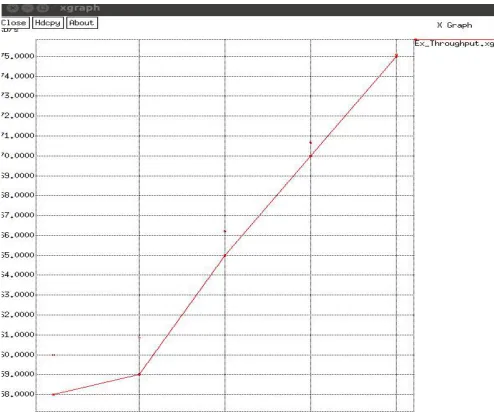
Fig 3 Throughput of existing system
Fig 4 Throughput of proposed system
The graph shows the throughput of the proposed system which is 30 % greater than the case of the existing system .The computations are limited to nodes thus reducing the energy consumption of each node.
V. CONCLUSION
REFERENCES
[1] H Luo, R. Ramjee, P. Sinha, L. Li, and S. Lu. Ucan: A unified cell and ad-hoc network architecture. In Proc. of MOBICOM, 2003.
[2] H. Wu, C. Qiao, S. De, and O. Tonguz, “Integrated cell and ad hoc relaying systems: iCAR,” IEEE J. Sel. Areas Commun., vol. 19, no. 10, pp. 2105–2115, Oct. 2001.
[3] Y. D. Lin and Y. C. Hsu, “Multi-hop cellular: A new architecture for wireless communications,” in Proc. IEEE Conf. Comput. Commun ,2000, pp. 1273–1282.
[4] P. Thiran, O. Dousse, and M. Hasler, “Connectivity in ad hoc and hybrid networks,” in Proc. IEEE Conf. Comput. Commun., 2002, pp. 1079– 1088
[5] V. D. Park and M. Scott Corson, “A highly adaptive distributed routing algorithm for mobile wireless networks,” in Proc. IEEE Conf. Comput. Commun., 1997, p. 1405
[6] D. Johnson and D. Maltz, “Dynamic source routing in ad hoc wireless networks,” T. Imielinski and H. Korth, eds. Mobile Computing, volume 353 of The Kluwer International Series in Engineering and Computer Science, Springer US, pp. 153–181, 1996.
[7] R. S. Chang, W. Y. Chen, and Y. F. Wen, “Hybrid wireless network protocols,” IEEE Trans. Veh. Technol., vol. 52, no. 4, pp. 1099–1109, Jul. 2003.
[8] K. Akkarajitsakul, E. Hossain, and D. Niyato, “Cooperative packet delivery in hybrid wireless mobile networks: A coalitional game approach,” IEEE Trans. Mobile Comput., vol. 12, no. 5, pp. 840–854, May 2013
[9] B. Liu, P. Thiran, and D. Towsley, “Capacity of a wireless ad hoc network with infrastructure,” in Proc. 8th ACM Int. Symp. Mobile Ad Hoc Netw. Comput., 2007, pp. 239–246.
[10] P. Gupta and P. R. Kumar, “The capacity of wireless networks,” IEEE Trans. Inf. Theory, vol. 46, no. 2, pp. 388–404, Mar. 2000.
[11] Z. Li and H. Shen, “A distributed three-hop routing protocol to increase the capacity of hybrid networks,” in Proc. Int. Conf. Parallel Process., 2009, pp. 277–284.
[12] Haiying Shen, Senior Member, IEEE, Ze Li, and Chenxi Qiu “A Distributed Three-Hop Routing Protocol to Increase the Capacity of Hybrid Wireless Networks” VOL. 14, NO. 10, october 2015
[13] C. Sarr, C. Chaudet, G. Chelius, and I. G. Lassous, “A node-based available bandwidth evaluation in IEEE 802.11 ad hoc networks,” Int. J. Parallel Emergent Distrib. Syst., vol. 21, no. 6, pp. 423–440, 2006.
[14] T. Rouse, I. Band, and S. McLaughlin, “Capacity and power investigation of opportunity driven multiple access (ODMA) networks in TDD-CDMA based systems,” in Proc. IEEE Int. Conf. Commun., 2002, pp. 3202–3206.
[15] Y. H. Tam, H. S. Hassanein, S. G. Akl, and R. Benkoczi, “Optimal multi-hop cellular architecture for wireless communications,” in Proc. Local Comput. Netw., 2006, pp. 738–745.
[16] H. Shen and C. Xu, “Locality-aware and churn-resilient load balancing algorithms in structured peer-to-peer networks,” IEEE Trans. Parallel Distrib. Syst., vol. 18, no. 6, pp. 849–862, June. 2007.
[17] W. Shin, S. Jeon, N. Devroye, M. Vu, S. Chung, Y. Lee, and V. Tarokh, “Improved capacity scaling in wireless networks with infrastructure,” IEEE Trans. Inf. Theory, vol. 57, no. 8, pp. 5088– 5102, Aug. 2011.
[18] Y. Liu, K. Li, Y. Jin, Y. Zhang, and W. Qu, “A novel reputation computation model based on subjective logic for mobile ad hoc networks,” Future Generation Comput. Syst., vol. 27, no. 5, pp. 547– 554, 2011
[19]C. Li, Z. Yang, and F. Tian, “A relaying incentive scheme for multihop cellular networks based on coalition game with externalities,” Wireless Pers. Commun., vol. 58, no. 4, pp. 785–805, 2011.
[20]H. Zhu, X. Lin, R. Lu, Y. Fan, and X. Shen, “SMART: A secure multilayer credit-based incentive scheme for delay-tolerant networks,” IEEE Trans. Veh. Technol., vol. 58, no. 8, pp. 4628–4639, Oct. 2009.
[21] Z. Li and H. Shen, “MDR: A p2p-based market-guided distributed routing mechanism for high-throughput hybrid wireless networks,” in Proc. IEEE 9th Annu. Conf. Sens., Mesh Ad Hoc Commun. Netw., 2012, pp. 236–244.
BIOGRAPHY
Ms.Anju Prabha received her B E degree in Computer Science & Engineering from Anna University,Chennai,India. And is currently pursuing M.Tech Degree in Computer Science & Engineering in Sree Narayana Gurukulam College of Engineering, Kerala, India and is affiliated to Mahatma Gandhi University, India. Her area of research includes Computer Networks.