ISSN(Online): 2320-9801
ISSN (Print) : 2320-9798
I
nternational
J
ournal of
I
nnovative
R
esearch in
C
omputer
and
C
ommunication
E
ngineering
(An ISO 3297: 2007 Certified Organization)
Vol. 4, Issue 7, July 2016
Performance Comparison of Digital
Modulation Techniques used in Wireless
Communication System
Jyotsana Tewari¹, Hari Mohan Singh²
M.Tech Scholar, Dept. of CSIT, SHIATS, Allahabad, U.P, India¹
Assistant Professor, Dept. of CSIT, SHIATS, Allahabad, U.P, India²
ABSTRACT: The move to digital modulation provides more information capacity, compatibility with digital data services, higher data security, better quality communications, and quicker system availability. The main objective of this paper is to give an overview of the digital modulation techniques used in wireless communication systems and to conclude with a better modulation technique among those , which are compared in this work. This paper presents different modulation techniques with the help of MATLAB/SIMULINK that are amplitude shift keying (ASK), quadrature phase shift keying (QPSK), binary phase shift keying (BPSK), frequency shift Keying (FSK) ,On-off keying (OOK), DPSK & 8-PSK. Simulation models of above techniques involved in signal modulation are proposed in this paper and comparative study of the same have been done at the later stages which includes the performance of these techniques based on bit error rate (BER).
KEYWORDS: Digital Modulation, MATLAB/SIMULINK, ASK, FSK, QPSK, BPSK, OOK, DPSK, 8-PSK
I. INTRODUCION
Modulation is the process of varying one or more properties of a periodic waveform, called the carrier signal, with a modulating signal that typically contains information to be transmitted. A modulator is a device that performs modulation. A demodulator (sometimes detector or demod) is a device that performed, the inverse of modulation. A modem (from modulator–demodulator) can perform both operations. The aim of digital modulation is to transfer a digital bit stream over an analog band pass channel, for example over the public switched telephone network (where a bandpass filter limits the frequency range to 300–3400 Hz) or over a limited radio frequency band.
The next generation wireless communication systems require higher data transmission rates in order to meet the higher demand of quality services. Communicating effectively over a huge distance has always been the challenge for engineers and scientists and with the transition of modulation systems from analog to digital has further complicated the situations. Digital modulation schemes provide more information carrying capacity, better quality communication, data security and RF spectrum sharing to accommodate more services. The digital modulation schemes are preferred over analog modulation schemes because digital modulation schemes provide larger immunity to noise at the cost of large bandwidth requirements, whereas the requirement of video, audio and data over the computer network or the mobile telephony network termed as the third generation mobile communication poses a serious problem for the bandwidth, so the existing modulation schemes need to be modified for the purpose, where it can handle both the situations of noise and bandwidth efficiency [6].
Figure1. block diagram of communication system
Digital Modulation Techniques
In digital modulation techniques, an analog carrier signal is modulated by a binary code. The digital modulator device acts an interface between the transmitter and the channel. The digital modulation schemes can be categorized basically either on the basis of their detection characteristics or in terms of their bandwidth compaction characteristics. The basic criteria for best modulation scheme depends on Bit Error Rate (BER), Signal to Noise Ratio (SNR), Available Bandwidth, Power efficiency, better Quality of Service, cost effectiveness. The performance of each modulation scheme is measured by estimating its probability of error with an assumption that system are operating with Additive White Gaussian Noise. Modulation methods which are capable of transmitting more bits per symbol are more immune to error caused by noise and interference induced in the channel . The delay distortion can be an important measure while deciding modulation scheme for digital radio.
II. LITERATURE SURVEY
D.K.Sharma, A. Mishra & Rajiv Saxena,3 July 2010: A tremendous technological transformation during the last two
decades has provided a potential growth in the area of digital communication and lot of newer applications and technologies are coming up everyday due to these reasons. Restricting overself to the domain of modulation techniques a brief overview over different analog and digital modulation techniques has been provided in this article through extensive literature survey in a tabular manner enabling to analyze and establish the superiority at a glance of a specific modulation technique for a particular application.
Umesh Sharma, August 2012: The migration to 4G networks will bring a new level of expectation to wireless
communications. As after digital wireless revolution made mobile phones available for everyone, the higher speeds and packet delivery of 4G networks will make high quality multimedia available everywhere. The key to achieving this higher level of service delivery is a new air interface. Orthogonal Frequency Division Multiplexing (OFDM) is an alternative wireless modulation technology to CDMA. OFDM is a digital modulation and multiplexing technique. In this paper, we have discussed various digital modulation techniques such as BPSK (2bits), QPSK (4 bits), QAM, 16 QAM and 64 QAM. We have designed simulation environment in MATLAB with various configurations of OFDM technique. The main objective of our work is to measure Bit Error Rate with different modulation schemes and come to the best configuration to achieve better utilization of bandwidth. We have studied existing configurations with analog and digital modulation techniques and compared the results. The driving force behind the need to satisfy this requirement is the explosion in mobile telephone, Internet and multimedia services coupled with a limited radio spectrum.
M. Sheik Dawood, R. Aiswaryalakshmi, R Abdul Sikkandhar,G. Athisha , February 2013: A standard wireless sensor
ISSN(Online): 2320-9801
ISSN (Print) : 2320-9798
I
nternational
J
ournal of
I
nnovative
R
esearch in
C
omputer
and
C
ommunication
E
ngineering
(An ISO 3297: 2007 Certified Organization)
Vol. 4, Issue 7, July 2016
Sensor Networks. The survey also analyzes the role of modulation and coding techniques apply to different channel conditions to improve the lifetime of the clustered sensor network.
Harjeevan Singh, Mohit Arora, January 2015: Free space optical (FSO) communication link is a line of sight (LOS)
wireless link between the nodes separated by an unguided medium such that visible and infrared bands of the spectrum are used as data carrier. Recent past has witnessed huge revival of research interest in this field so as to make FSO commercially viable and looking into this prospective, data modulation techniques are one of the primary ways to enhance link sustainability. In this paper, comparison of modulation techniques like M-ary QAM, BPSK and DPSK has been studied by creating turbulent atmospheric conditions using gamma-gamma turbulence model. During this link analysis, BPSK performed far better in comparison to DPSK and M-ary QAM in terms of BER for similar SNR values and interestingly, higher the order of M-QAM and higher the link range, greater was the degradation of link performance observed.
III. MATLAB SIMULATION AND RESULT
The coding done for different modulation techniques have been implemented on MATLAB 7.11 (R2010b) and the system configuration of Intel Core i3- 1.90 GHz with 64 bit operating system. Several functions of respective modulation techniques have been developed which is then called by master code. This code creates a window in which options for modulation techniques are available. The output plots of these techniques have been discussed below simultaneously. Simulation result is then obtained in which bit error rate curves are obtained on the basis of which the best technique is decided.
A.Binary Phase Shift Keying (BPSK)
BPSK (also sometimes called PRK, phase reversal keying, or 2PSK) is the simplest form of phase shift keying (PSK). It uses two phases which are separated by 180° and so can also be termed 2-PSK. It does not particularly matter exactly where the constellation points are positioned, and in this figure they are shown on the real axis, at 0° and 180°. This modulation is the most robust of all the PSKs since it takes the highest level of noise or distortion to make the demodulator reach an incorrect decision. It is, however, only able to modulate at 1 bit/symbol (as seen in the figure) and so is unsuitable for high data-rate applications.
Figure2.Phase change of frequency with binary signal
B. Quadrature phase shift keying (QPSK)
Figure3.Phase change of QPSK signal with time
C. Amplitude shift keying (ASK)
Amplitude-shift keying (ASK) is a form of amplitude modulation that represents digital data as variations in the amplitude of a carrier wave. In an ASK system, the binary symbol 1 is represented by transmitting a fixed-amplitude carrier wave and fixed frequency for a bit duration of T seconds.
Figure4.Modulation signal of ASK
D.Frequency shift keying (FSK)
Frequency-shift keying (FSK) is a frequency modulation scheme in which digital information is transmitted through discrete frequency changes of a carrier wave. The simplest FSK is binary FSK(BFSK). BFSK uses a pair of discrete frequencies to transmit binary (0s and 1s) information.
ISSN(Online): 2320-9801
ISSN (Print) : 2320-9798
I
nternational
J
ournal of
I
nnovative
R
esearch in
C
omputer
and
C
ommunication
E
ngineering
(An ISO 3297: 2007 Certified Organization)
Vol. 4, Issue 7, July 2016
E. On-off keying (OOK)
OOK modulation (On/Off Key) is the special case of ASK (Amplitude Shift Key) modulation where no carrier is present during the transmission of a zero. FSK modulation (Frequency Shift Key) is commonly believed to perform better in the presence of interfering signals.
Figure6. (On/Off Key) modulation
F. DPSK
Differential phase shift keying (DPSK) is a common form of phase modulation that conveys data by changing the phase of the carrier wave. As mentioned for BPSK and QPSK there is an ambiguity of phase if the constellation is rotated by some effect in the communications channel through which the signal passes. This problem can be overcome by using the data to change rather than set the phase
Figure7.Differential phase shift keying (DPSK)
G. 8-PSK
In BPSK modulation digital data of 1 and 0 is represented by 180 degree phase change. In QPSK by phase shift of 90 degree, here 2 bits are mapped on each signal. In Multilevel PSK more than 2 bits are mapped using different phase angles. In 8-PSK eight different phase angles are used to represent bits, here 3 bits. Figure below shows constellation of 8-PSK signal.
Figure8.Output of 8-PSK
IV. COMPARISON
User Interface which is shown below. In this GUI, there are options for the user to do analysis of the said modulation techniques. These options include, the Matlab models of each modulation techniques through which the simulation results can be obtained, comparison on basis of bit error rate of all the techniques and it also includes options for direct simulation of these digital modulation techniques.
Figure 9 . Graphical User Interface
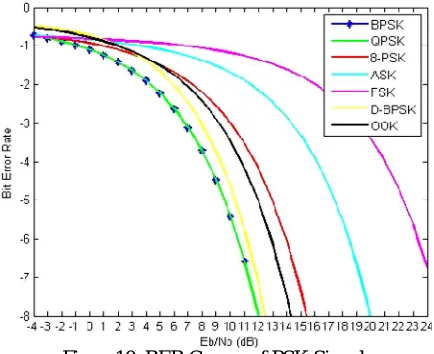
Eb/N0 (the energy per bit to noise power spectral density ratio) is an important parameter in digital
communication or data transmission. It is a normalized signal-to-noise ratio (SNR) measure, also known as the "SNR per bit". It is especially useful when comparing the bit error rate (BER) performance of different digital modulation schemes without taking bandwidth into account.
Figure10. BER Curves of PSK Signal
ISSN(Online): 2320-9801
ISSN (Print) : 2320-9798
I
nternational
J
ournal of
I
nnovative
R
esearch in
C
omputer
and
C
ommunication
E
ngineering
(An ISO 3297: 2007 Certified Organization)
Vol. 4, Issue 7, July 2016
for higher SNR values, BPSK modulation technique delivers better BER performance than the other discussed techniques.
IV. CONCLUSION
A comparative study has been done of digital modulation techniques used in wireless communication system. The simulation model and the output waveform of the different digital modulation techniques have been discussed in this paper. The selection of digital modulation technique is exclusively dependent on the type of specific application, as one application may need higher precision in reception of data, where as the other application requirement may be available bandwidth or power. The quality of service provided by wireless communication system can be greatly enhanced with the help of correct selection of modulation scheme.
The performance of all the modulation techniques is more or less the similar but for higher SNR values, BPSK modulation technique delivers better BER performance than the other discussed techniques.
Thus, increased radio coverage and reduced power consumption can be obtained by the proper selection of digital modulation technique. But the search for a better modulation scheme doesn't end here as the criterion for higher data rate communication is taking the lead role in almost every field of communication and thus the Inter Symbol Interference and Bit Error Rate calculation become very crucial and important aspect for any ultramodern digital modulation scheme.
REFERENCES
[1] A.Islam, A.Z.M.Touhidul Islam, Performance of Wi-Max Physical Layer with Variations in Channel Coding and Digital Modulation under Realistic Channel Conditions, IJIST, Vol.2, No. 4, July 2012.
[2] S.A.Oyetunji, A.A.Akinninranye, Performance Evaluation of Digital Modulation Techniques in AWGN Communication Channel, IJERT, ISSN: 2278-0181, Vol. 2, Issue 5, May 2013.
[3] V.Tilwari, A.S.Kushwah, Performance Analysis of Wi-Max 802.16e Physical Layer using Digital Modulation Techniques and Code Rates , IJERA, ISSN: 2248-9622, Vol. 3, Issue 4, July-Aug. 2013, pp 1449-1454.
[4] S.Dowrla, K.J. Rani, VLSI Implementation and Design of Digital Modulation using Xi-link , IJRCCT, ISSN 2278-5841, Vol. 2, Issue 9, Sept. 2013.
[5] P.Vinoth, P.Jayakumar, A Survey on Modulation Schemes used for Link Adaption in Wi-Max Networks , IJCA (0975-8887), Vol.-73,No.4, July 2013.
[6] Geetu, H. Singh, M. Singh, Optimization Method for Analysis of Bit Error Rate with BPSK Modulation Technique, IJSER, ISSN: 2229-5518, Vol.3, Issue 6, June 2012.
[7] S.Chatterjee, S.Sen, Various Effects of Modulation Schemes on Wi-Fi Network of Urban Scenarios using QUALNET Simulator, IJSER, (ISSN: 2229-5518), Vol.-3, Issue 5, May 2012.
[8] K.Murota, K.Hirade, GMSK Modulation for Digital Mobile Telephony, IEEE Transactions on Communications, Vol. COM-29, No. 7, 1981, pp 1044-1050.
[9]D.K.Sharma, A.Mishra and R.Saxena, Analog and Digital Modulation Techniques : An Overview, TECHNIA-IJCSCT, ISSN 0974-3375,VOL. 3, NO. 1, July 2010.
[10] J.Gurugubelli, C.Indrajit, Design and Implementation of Generalised Parametrizable Modulator for a Recofigurable Radio, TENCON 2009, IEEE Region 10 Conference, pp. 1-6, sept. 2009.