ISSN(Online): 2320-9801
ISSN (Print): 2320-9798
I
nternational
J
ournal of
I
nnovative
R
esearch in
C
omputer
and
C
ommunication
E
ngineering
(An ISO 3297: 2007 Certified Organization)
Vol. 4, Issue 7, July 2016
Device to Device Communication in
Spontaneous Ad Hoc network
Swapnali D. Patil1, V.N Nitnaware2, Sandeep Shelke3
M.E Student, Dept. of E&TC, D.Y.Patil School of Engineering Academy, Ambi, Talagaon, Pune, India 1 Principal, Dept. of E&TC E&TC, D.Y.Patil School of Engineering Academy Ambi, Talagaon, Pune, India 2 Professor, Dept. of E&TC E&TC, D.Y.Patil School of Engineering Academy Ambi, Talagaon, Pune, India 3
ABSTRACT: Device-to-device(D2D) communication that efficiently facilitate direct communication between nearby devices without using any backbone network or infrastructure network. Now days, smartphones are not only limited to communication purpose but it has several application. Due to this continuously increasing demand for wireless access, a huge amount of data is circulating over today’s wireless networks. It led to increase in volume of wireless traffic. D2D communication is seen as a significant technology to illuminate wireless capacity problem and enable new services. It has advantage like minimizing the load of network, improves spectral efficiency, energy efficiency, overall throughput, while enabling new peer to peer and location based applications.
The discovery and pairing of nearby devices is important part of D2D communication. This paper proposes pairing algorithm which enables discovery and pairing of nearby devices. Simulation results show that which protocol is best suit for discovery process. We also analyze security of network with which device is revoke from the network.
KEYWORDS: Device-to-Device communication, spontaneous network, security, throughput, revoke.
I. INTRODUCTION
As telecomm world are struggling through new type of traffic which is application of smartphone and tablets, which generate huge amount of data traffic by accessing network and their applications which create burden on wireless network. The D2D technology extends traditional wireless system which enables two devices directly establish wireless link between each other without any backbone network or access point as shown in figure 1 [1]. Its connect devices which are geographically close to each other i.e. in proximity area. This gives us to improve spectral efficiency and minimize load on backbone network. It has two operation modes: devices can directly communicate in licensed spectrum or in unlicensed spectrum like traditional radio technology.
Though, the advantages of D2D communication is not limited enhanced spectral efficiency, D2D communication can potentially improve throughput, energy efficiency, delay, power consumption and reduce latency [2]. Numbers of literature have studied the application scenario and possible technical solution for D2D communication. The first attempt to implementing D2D communication was made by Qualcomm’s FlashlinQ [3]. In [4], the author proposes integration of D2D into LTE-Advanced network. Later the work in [5]-[7] investigated the potential of D2D communication for improving spectral efficiency of wireless networks. Author [8], discuss about mode selection. In particular the discoveries of proximity devices are studied in [9].Number of challenges that need to be addressed. Discovery or pairing of devices is one of the major concerns in D2D communicationDuring discovery phase devices try to discover the presence of other nearby devices in the network in order to initiate the communication between them.
ISSN(Online): 2320-9801
ISSN (Print): 2320-9798
I
nternational
J
ournal of
I
nnovative
R
esearch in
C
omputer
and
C
ommunication
E
ngineering
(An ISO 3297: 2007 Certified Organization)
Vol. 4, Issue 7, July 2016
Figure 1. D2D Communication topology and Discovery [1]
solution for D2D link discovery is analyzed briefly in this paper. In which pairing of node take into considerations for that new algorithm is designed this is used for paring of nodes. We consider ad-hoc network in which a network initiator is elected. This solution could be used to support device discovery in cellular network where role of network initiator is assigned to base station. Major focus of this paper is design of pairing algorithm. This algorithm utilize a prior pairing scheme i.e. discovery of node take place before actual communication of devices with comparison of different protocol like DSR, AODV, and DSDV. A comparison of protocols, in terms of throughput is performed with security concern by comparing with revocation and without revocation process.
II. SYSTEM MODEL
In proposed system model a circular area is consider in which devices i.e. node are uniformly distributed over that area and one of node in this network acts as network initiator. Communication nodes are assigning by randomly selecting pairs. Figure 2 gives us pictorial view about system model. We assume that only two nodes are participating in pairing process. The network initiator started discovery process, after this process pairing of nodes take place using designed algorithm. The role of network initiator is very important here because it provides important information about a node in network. This information allows them to discover devices and join them. The nodes who want to establish communication in a network act as network initiator that means any device or node act as network initiator. Network initiator floods the request in network. The devices who want to communicate respond back to network initiator. This way it finds out communicating node in a network. Only network initiator initiate pairing process is shown with no of nodes.
ISSN(Online): 2320-9801
ISSN (Print): 2320-9798
I
nternational
J
ournal of
I
nnovative
R
esearch in
C
omputer
and
C
ommunication
E
ngineering
(An ISO 3297: 2007 Certified Organization)
Vol. 4, Issue 7, July 2016
III.PAIRING ALGORITHM
In this section, pairing of algorithm are presented and described in detail. This algorithm allows discovering and joining the node in network. The proposed algorithm describes a process in which network initiator with necessary information to join nodes in network. Before proceedings to pairing process, it is important to know what node discovery means. A new pair of devices wants to establish communication between them. It will possible only when both the devices know the identity of each other and satisfy the proximity criterion. The phrase proximity is used to define the devices which are close to each other or nearby so that D2D communication is favourable.
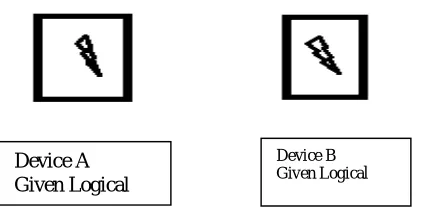
The discovery of nodes is possible by exchange of signalling message between nodes that want to initiate communication. First of all, signalling messages should contain the identification of connecting nodes. This allows the identification of communication nodes. In order to describe proposed pairing algorithm, let us assume a pair of node as shown in figure 3. Here consider two nodes A and B. In which node A is network initiator which initiates process by transmitting first message and B is another node who wants to join network. Both nodes have individual logical ID and secret key. They can authenticate each other by sharing logical ID and secret key. The pairing process depends on logical IDwhich holds by every node in network. It is unique for every user which contains identification information. Nodes also contain keys with creation and expiration keys and IP address proposed by users and user signature which create by secure hash algorithm. In discovery process network initiator i.e. device A initiate message that who want to join network. After this another node who want to join network respond back i.e. node B. Device A request to device B, to expect a discovery message from node A. Then it requests device A to sending joining message to device B. If message is not received by device B, which means no device want to communicate with node A.
Figure 3.Device information.
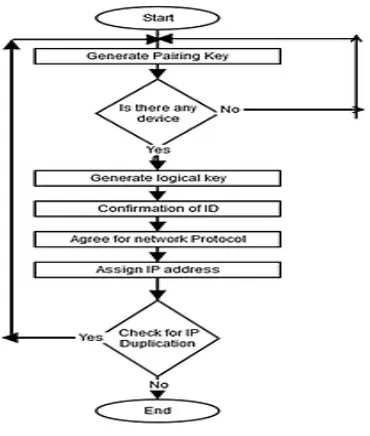
It again raised request for joining the network. Once node A and B is joined network pairing process is start. Pairing process is depends on logical ID, private and public keys associated with each node. For validation A send its public key. Then, b will send its logical ID signed by A’s public key. Next, A validates the received data and verifies message. This way trust level establish between A and B. Finally, node A will send its logical ID data to B. This signed by public key of node B which validate node A Logical ID and create trust with node A. An algorithm shown in figure 4, signifies the availability, integrity and authentication of nodes in network.
Device B Given Logical
ISSN(Online): 2320-9801
ISSN (Print): 2320-9798
I
nternational
J
ournal of
I
nnovative
R
esearch in
C
omputer
and
C
ommunication
E
ngineering
(An ISO 3297: 2007 Certified Organization)
Vol. 4, Issue 7, July 2016
Figure 4: Pairing algorithm
IV.SIMULATION RESULTS
In this section, the simulation results are presented. NS-2 (Network simulator) tool is used to create simulation environment. It is used for simulating wireless network with specific network protocol and their behavior. . Table I shows the initial parameter to configured for node to performing simulation and obtaining result on NS-2.First, D2D communication nodes are uniformly distributed over circular area. Then we create ad-hoc network scenario in which different routing protocol like DSR, AODV and DSDV are compared with respect to throughput.
Table 1
Simulation Parameter
Parameter Value
Area 600*600
No. of nodes 20
Routing Protocol DSR, AODV and DSDV Antenna Model Omni Directional
Type Of Mac 802.11
Simulation Time 100ms
ISSN(Online): 2320-9801
ISSN (Print): 2320-9798
I
nternational
J
ournal of
I
nnovative
R
esearch in
C
omputer
and
C
ommunication
E
ngineering
(An ISO 3297: 2007 Certified Organization)
Vol. 4, Issue 7, July 2016
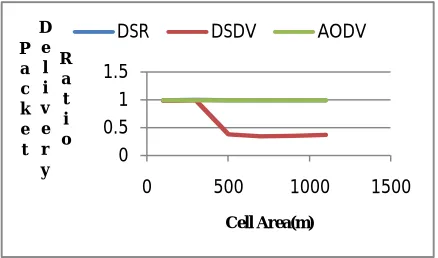
As shown in figure 5 the DSR routing protocol has constant throughput by varying cell area compare to DSDV and AODV protocol. This result shows that using DSR routing protocol for joining the nodes is the best option in spontaneous ad hoc network. The same DSR routing protocol gives best result for end to end and packet delivery ratio.A shown in figure 6 and 7, DSR works better compare to other two routing protocol. From all the simulation result it is include that DSR is best suitable for discovering and joining the devices for communication in spontaneous ad-hoc network.
Figure 5: Protocol comparison for Throughput
Figure 6: Protocol comparison for End to End delay
Figure 7: Protocol Comparison for Packet Delivery Ratio. 0
50 100
0 500 1000 1500
T h r o u g h p u t ( k b p s ) Cell Area(m)
DSR DSDV AODV
0 50 100
0 500 1000 1500
D e l a y ( m s ) Cell Area(m)
DSR DSDV AODV
0 0.5 1 1.5
0 500 1000 1500
P a c k e t D e l i v e r y R a t i o Cell Area(m)
ISSN(Online): 2320-9801
ISSN (Print): 2320-9798
I
nternational
J
ournal of
I
nnovative
R
esearch in
C
omputer
and
C
ommunication
E
ngineering
(An ISO 3297: 2007 Certified Organization)
Vol. 4, Issue 7, July 2016
V. CONCLUSION
In this paper, we addressed the issue in relation to the discovery and pairing of two nodes. The solution to the above issue is implemented in the paper using pairing algorithm which can be used for checking the availability, integrity and authentication of the nodes. This algorithm was compared for three protocols DSR, DSDV and AODV. The DSR resulted in the throughput, delay and packet delivery ratio which is better than the DSDV and AODV protocols. Furthermore, the performance of proposed algorithm is evaluated in respect to the security of the nodes based on revocation. This algorithm is rightly implemented and validated for the ad hoc networks. For D2D communication in cellular network, the same technique can be tested for the cellular networks, where the network initiator will act as a base station and can be validated for the same.
REFERENCES
1. http://www.unwiredinsight.com/2014/lte-d2d
2. Asadi.A, Qing Wang and Mancuso.V, "A Survey on Device-to-Device Communication in Cellular Networks," in Communications Surveys &
Tutorials, IEEE , vol.16, no.4, pp.1801-1819, Fourthquarter 2014.
3. D. B. Johnson and D. A. Maltz, "Dynamic Source Routing in Ad Hoc Wireless Networks," IEEE Trans. on Mobile Computing, vol. 353, pp.
153-181,1996.
4. K. Doppler, M. Rinne, C. Wijting, C. Ribeiro, and K. Hugl, “Device to device communication as an underlay to LTE-advanced networks,”IEEE
Communications Magazine, vol. 47, no. 12, pp. 42–49, 2009.
5. T. Peng, Q. Lu, H. Wang, S. Xu, and W. Wang, “Interference avoidance mechanisms in the hybrid cellular and device-to-device systems,” in
Proceedings of IEEE PIMRC, pp. 617–621, 2009.
6. S. Xu, H. Wang, T. Chen, Q. Huang, and T. Peng, “Effective interference cancellation scheme for device-to-device communication underlaying
cellular networks,” in Proceedings of IEEE VTC-Fall,pp. 1–5, 2010.
7. P. Janis, V. Koivunen, C. Ribeiro, J. Korhonen, K. Doppler, and K. Hugl, “Interference-aware resource allocation for device-to-device radio
underlaying cellular networks,” in Proceedings of IEEE VTCSpring pp. 1–5, 2009.
8. K. Doppler, C.-H. Yu, C. B. Ribeiro, and P. Janis, “Mode selection for device-to-device communication underlaying an LTE-advanced
network,” in Proceedings of IEEE WCNC, pp. 1–6, 2010.
9. A. Thanos, S. Shalmashi and G. Miao, "Network-assisted discovery for device-to-device communications," Globecom Workshops (GC
Wkshps), 2013 IEEE, Atlanta, GA, pp. 660-664, 2013.
10. B. Zhou, S. Ma, J. Xu, and Z. Li, “Group-wise channel sensing and resource pre-allocation for LTE D2D on ISM band,” in Proceedings of IEEE WCNC, pp. 118–122, 2013.
11. B. Raghothaman, E. Deng, R. Pragada, G. Sternberg, T. Deng, and K. Vanganuru, “Architecture and protocols for LTE-based device to device
communication,” in International Conference on Computing, Networking and Communications (ICNC). IEEE, 2013, pp. 895–899.
12. K. Sanzgiri, B. Dahill, B. N. Levine, C. Shields and E. M. Belding-Royer, "A secure routing protocol for ad hoc networks," Network Protocols,
2002. Proceedings. 10th IEEE International Conference on, pp. 78-87, 2002.
13. Junguo Zhang; Wenbin Li; Dongxu Cui; Xueliang Zhao; Zhongxing Yin, "The NS2-Based Simulation and Research on Wireless Sensor
Network Route Protocol," in Wireless Communications, Networking and Mobile Computing, 2009. WiCom'09. 5th International Conference on , vol., no., pp.1-4, 24-26 Sept. 2009
BIOGRAPHY
![Figure 1. D2D Communication topology and Discovery [1]](https://thumb-us.123doks.com/thumbv2/123dok_us/1440021.1176390/2.595.110.457.617.775/figure-d-d-communication-topology-discovery.webp)