1
Development of the DERU Evaluation System of NDT for Power Boiler
Pi-Kuan Chen
Technology Planning & Development Dept. China Steel Corp. Taiwan, ROC ABSTRACT
The utility of power generating system occupies the extremely important status in the company productive efficiency. When the equipment failure or accident occurs, will cause the large amount cost losses, also initiate the labor safety and environmental protection problem. Therefore in order to maintain the power generating system running smooth must regularly carry out by the non- destructive examination.
In view of essential equipment ( boiler 、 high/low pressure heater and so on), take DERU evaluation system for enhancement and accuracy the examination analysis.
The DERU evaluation system, will transfer the NDT result separately to express the component [deteriorated degree] (Degree; D), [deteriorated scope] (Extend; E), [deteriorated status related to structure] (Relevancy; R), and based on deteriorated service [urgent] (Urgency; U) makes the handling suggestion.
INTRODUCTION
The equipments of power plant occupy the extremely important status in the company productive efficiency. Usable rate under its normal running is an important index for measuring the safe power supply. However demonstrates in the power plant breakdown according to the American Electric power Research Institute (EPRI) investigation, the boiler damage approximately composes above 70%, but causes the generating set availability factor to reduce 3%, this kind of accident except forces the equipments to need shut down, causes the production halts, creates the large amount cost lose, also possibly endangers the industrial safety perhaps the initiation environmental protection problem. Therefore to maintain the performance of electricity generation boiler system as well as the operation security must carry on the non-destructive examination regularly to the electricity generation boiler.
This unit (T423) aims at this kind of key equipment, promotes the whole generating set systematization examination positively, therefore forms the DERU Evaluation System of NDT for Power Boiler to knowing the condition of objects , by quantification, and objective indicator to enhancement the accuracy of the examination systematization analysis.
ESTABLISHMENT OF THE DERU EVALUATION SYSTEM .
Refer the failure mechanism of the generating set to establish the deteriorated condition indicator, have the following characteristic:
1. Establishment systematizations, organization of examination structure: Lists in detail of various components of deteriorate and the location of examination item by item, makes the examiner to be possible to understand clearly, to reach the examination standardization for prevent the omitted or lose examination, and to have backward.
2. Simplified examination and reduces document filling in: Using check-list for recording the examination in jobsite, makes the examination report concise, clear, reaches the goal of simplification and efficiency.
3. Proposes the maintenance interval in view of service urgent:: To have the clear explicit suggestion for handling the deteriorated component , may enable the maintenance interval decision-making to have the concrete concept, and facilitates carries on the maintenance work planning.
4. Picks up the essential meaning of RBI (Risk Base Inspection), presents the whole exanimate facility comprehensive condition indicator, the coordinate quantification indicator and considers weight of the component importance to estimates the overall indicator, and integrates the RBI evaluation system, makes RBI linked to the actual condition ,and tends to the objective evaluated analysis.
NON-DESTRUCTIVE EXAMINATION DATA SHEET
When establishment the DERU Evaluation System of NDT for Power Boiler, should have the characteristic besides the content, and must be faced many examination object, the examination technology is complex as well as test result diversification and so on, first depends on each component’s function to plan the examination object, then by way of the potential failure pattern of object to select suitable examination method (for example in appendix 1). Using check list separately on the boiler, the condenser, the high-pressured heater as well as the low pressure heater establishes the non-destructive examination data sheet (detailed in appendix 2). To make the examiner record report absolutely clear, raises the examination efficiency, its content divides into the examination object, the examination method as well as the test result generally, each item states as follows:
1. Examination Object
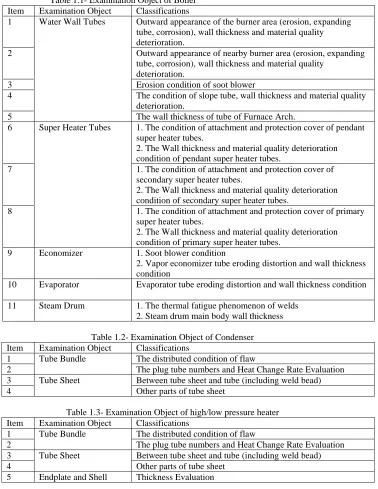
Analyzing the critical items of generating set, to drawing up the examination object. According to the sequence of item to make examination planning for smoothly examination. The content of plan is show as table 1.1 to table 1.3.
Table 1.1- Examination Object of Boiler Item Examination Object Classifications
1 Outward appearance of the burner area (erosion, expanding tube, corrosion), wall thickness and material quality deterioration.
2 Outward appearance of nearby burner area (erosion, expanding tube, corrosion), wall thickness and material quality
deterioration.
3 Erosion condition of soot blower
4 The condition of slope tube, wall thickness and material quality deterioration.
5
Water Wall Tubes
The wall thickness of tube of Furnace Arch.
6 1. The condition of attachment and protection cover of pendant super heater tubes.
2. The Wall thickness and material quality deterioration condition of pendant super heater tubes.
7 1. The condition of attachment and protection cover of secondary super heater tubes.
2. The Wall thickness and material quality deterioration condition of secondary super heater tubes.
8
Super Heater Tubes
1. The condition of attachment and protection cover of primary super heater tubes.
2. The Wall thickness and material quality deterioration condition of primary super heater tubes.
9 Economizer 1. Soot blower condition
2. Vapor economizer tube eroding distortion and wall thickness condition
10 Evaporator Evaporator tube eroding distortion and wall thickness condition 11 Steam Drum 1. The thermal fatigue phenomenon of welds
2. Steam drum main body wall thickness Table 1.2- Examination Object of Condenser Item Examination Object Classifications
1 The distributed condition of flaw
2
Tube Bundle
The plug tube numbers and Heat Change Rate Evaluation
3 Between tube sheet and tube (including weld bead)
4
Tube Sheet
Other parts of tube sheet
Table 1.3- Examination Object of high/low pressure heater Item Examination Object Classifications
1 The distributed condition of flaw
2
Tube Bundle
The plug tube numbers and Heat Change Rate Evaluation
3 Between tube sheet and tube (including weld bead)
4
Tube Sheet
Other parts of tube sheet 5 Endplate and Shell Thickness Evaluation 2. Examination Methods
Base on the potential failure pattern on each kind of generating set, draws up the examination method, its designation principle like appendix 1, but each examination standard procedure, as shown in Table 2.
Table 2-. Examination Standard Procedure
Examination Method Standards No. Title of Standard Procedure
Visual Examination CNS 12847 General Rules for Visual Testing
Liquid Penetrant Examination CNS 11376/11398 Liquid Penetrant Test for Forgings / Welds
Magnetic Particle Examination CNS 11377/11378 Magnetic Particle Test for Casting
3
and Forgings / Welds Ultrasonic Thickness and
Attenuation Measurement GB-T232-B02
Ultrasonic Thickness and Attenuation Measurement
On-Site Metallographic GB-T232-B03 On-Site Metallographic
3. Examination Results
The non-destructive examination result is produces the primary data of D, E, R, and U value, to achieve this goal, therefore the test result must cover the flaw shape, the type, the size, quantity as well as the position, its content principle as shown in Table 3.
Table 3- The Principle of Examination Result Content
Unusual Object Type of Flaw Size / Quantity
Flaw Round / Linear Length and numbers
The outward appearance is unusual
The expanding tube, falls off, eroding, the distortion, the high-temperature oxidation
Length
Thickness is abnormal by UT Corrosion/Erosion Control abnormal area Attenuation measurement is
abnormal by UT
Material quality deterioration Control abnormal area Metallographic abnormal Material quality deterioration Control abnormal area
Tubes are abnormal Corrosion/Erosion/Plug Number of Tubes
THE DEFINITION OF DERU AND CI VALUE
The DERU deterioration evaluation system is according to the examination result of each component of generating set, by the quantification the component's deteriorated situation of generating set, and establishes the basic management material of the present situation, then avoids the examination subjective consciousness, but creates fault of the
maintenance decision-making.
The DERU evaluation system, will transfer the NDT result separately to express the component [deteriorated degree] (Degree; D), [deteriorated scope] (Extend; E), [deteriorated status related to structure] (Relevancy; R), and based on deteriorated service [urgent] (Urgency; U) makes the handling suggestion. Finally, depends on DER value of various components to assessment the overall condition index of present equipment situation (Condition Index; CI), takes the maintenance optimal arrangement basis.
1. Deteriorated Degree(D):Examines according to NDT knows the flaw shape and the criterion, takes degree of the component deterioration.
2. Deteriorated Scope(E):According to the flaw criterion (area, length), quantity to compute the proportion of the deteriorated scope of the component.
3. Deteriorated Status related to Structure] (Relevancy; R):According to component deterioration situation and this component to equipment security and functionality important degree influence.
4. Urgency (U) :Must give urgent of maintenance for this deteriorated component
NDT overall equipment condition index (CI): Because differently combines the component to have differently to importance of the generating set, when calculates the overall equipment condition index, (the R value) as the weight (weight) is riding importance of take the various components take the equipment deterioration condition index (D value +E value) as its essential meaning, its formula as follows:
i N
i
i i i N
i
R
R
E
D
CI
∑
∑
=
×
+
=
1
)
(
THE APPLICATION OF DERU DETERIORATION EVALUATION
1. DERU Evaluation flow
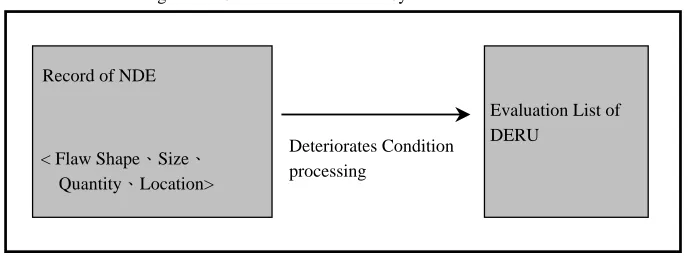
When uses the DERU evaluation flow, first the affiliation by each kind of equipment non- destructive examination record to various equipment component to the jobsite measured knows the non- destructive examination result (to contain flaw shape, size, quantity), then consider deteriorated condition to correspond the evaluate logic (detailed like appendix 3) to produce D , E, R, U value of various equipment component, its evaluate system schematic drawing, like fig. 1 shows.
Fig. 1 The Schematic of Evaluate System
2. The Examination Comments and Relationship of DERU Deterioration Condition
Each generating set by the nondestructive examination deterioration condition, respectively to DERU comments and divides into 4 levels, its definition like table 4 shows.
Table4 deterioration The explanation of DERU Comments 0
1 2 3 4
D
Does not have this object or has not made the examination
Good Acceptable Difference Obvious
Damage
E
Unable to examine or have not the deterioration
Smaller Than
1% 1% to 3% 3% to 5% Larger Than 5%
R Unable to examine or unable to determine Slight Small Medium Large
U
Unable to examine or have not the deterioration
The slight deterioration does not have to process
Next time will be supposed to trace
Suggests maintenance
Hads to immediately maintenance
3. The Rank of Overall Condition Index (CI)
The non- destructive examination overall equipment condition by the CI index ,divides into 4 levels, its definition as follows:
1).0 ≦ CI < 3,The firs grades, Equipment safety and function has not consider
2).3 ≦ CI < 5,The second grades, Safety have not consider, But has to enhance spot-check ratio.
3).5 ≦ CI < 6,The third grades, Safety have not consider, But has to increase checkout frequencies, or further evaluation detection.
4).CI ≧ 6,The fourth grades, Device function can consider, Had to further proceed detail detection, As knows component break status. In case of necessity immediately stops usage, and proceeds equipment maintain or reestablishment.
BENEFIT
DERU evaluation system is technical index of NDT original create by T423, is systematization the non- destructive examination of generating set, and achieves effect of the examination standardization.
D, E, R, U value examines the result quantification, will cause the RBI risk assessment to be more objective, has really greatly help to applies for the risky equipment to lengthen the inspection cycle or the substitution inspection examination,.
In the execution generating set whole systematization examination, besides the efficiency enhancement, and causes its trend integrity.
Provide quantification information of the equipment condition, assists the decision-making of equipment maintenance processing in the jobsite.
CONLUSION
Record of NDE
< Flaw Shape、Size、 Quantity、Location>
Deteriorates Condition processing
Evaluation List of DERU
5
The DERU examination deterioration evaluation system, tends to the generating set examination the validity and traceability, and causes the examination whole systematization to be clear, enhances the examination efficiency, can achieve the equipment safe examination many demand day by day, and makes up content of the RBI assessment system by the DERU index, by can smoothly lengthen or examination the substitution inspection through the risky equipment interior inspection.
REFERENCES
1 .Kun-Chen Yu, “Electricity generation boiler examination standardization”
2. Kun-Chen Yu, “The establishment of non- destructive examines of DERU deterioration evaluation system for petrochemical equipment”
3. JIS G 0571-Method of 10 percent Oxalic Acid Etch Test for Stainless steels. 4. JIS G 0572- Method of Ferric Sulfate-Sulfuric Acid Test for Stainless steels. 5. JIS G 0573- Method of 65 per cent Nitric Acid Test for Stainless steels 6. JIS G 0574- Method of Nitric-Hydrofluoric Acid Test for Stainless steels. 7. JIS G 0575- Method of Copper Sulfate-Sulfuric Acid Test for Stainless Steels. 8. ASM Volume 9 Metallography and Microstructures.
9. Shuen-Nan Chung, Future Publish Co.,” Boiler and Accessories “P.206~P.235
10. Ying-Ming Kuan, Chemical Industry Co.,” Electric power industry corrosion and protection “ch.3,ch.4