ABSTRACT
LIU, SIWEN. Effects of Early Experiences with Interaction Style on Usability and Acceptance of New Technologies by Older Adults: A Generation-Oriented Approach. (Under the direction of Dr. Sharon M. B. Joines).
Most of the previous studies on older adults’ usage and acceptance of new technologies were from an aging perspective and focused on older adults’ age-related ability declines. However, recent studies have shown that older adults’ lack of prerequisite knowledge and experience as an older generation could also influence their technology usage and acceptance.
This study took a technology generation perspective and focused on older adults’ generation-specific knowledge and experience, more specifically, their early experiences with the interaction style of consumer products during their formative years (10–25 years old) and their consequent familiarity with and expectations of these products.
A previous study identified that today’s older adults typically belong to the electro-mechanical generation (born 1930–1960) and were exposed to the electro-electro-mechanical style during their formative years. The electro-mechanical style featured hardware-based input and output devices with concrete physical manipulation and tangible feedback, 1:1 mapping between control and function, and single-layered operation.
This study experimentally separated two components of the electro-mechanical style (interaction technique and interaction structure) to isolate the influences attributable to each, and investigated the effect of older adults’ early experiences with each component of the electro-mechanical style on usability and acceptance of new technologies.
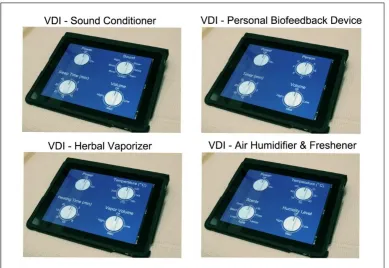
Four interface types with different interaction techniques were assessed in Experiment 1. Three interface types with different interaction structures were assessed in Experiment 2. Participants from two age groups (technology generations) were recruited in each experiment, a younger group (18–33 years) and an older group (65–80 years). The younger group served to establish benchmark comparisons.
Results showed that older adults’ early experiences with the electro-mechanical style had given them some advantages with respect to task completion time, in that the age group difference was the least pronounced in the interaction technique and the interaction structure belonging to the electro-mechanical style. However, usability and preference for a more recent interaction technique was significantly higher.
Results showed that older adults had negative attitudes toward accepting new technologies employing the interaction technique of the electro-mechanical style, because it seemed old-fashioned. However, they had positive attitudes toward accepting new technologies employing the interaction structure of the electro-mechanical style.
In addition, results showed that older adults’ early experiences with the interaction structure of the electro-mechanical style played a greater role in their performance with and acceptance of new technologies. It implied that the essence of the electro-mechanical style was expressed in the features of its interaction structure (1:1 mapping and single-layered operation), which had a great impact on the electro-mechanical generation’s future interactions with new technologies in regard to usability, technology acceptance, and preferences.
Results also suggested that the aging factor (age-related ability changes) and the generation factor (generation-specific knowledge and experiences) both played significant roles in older adults’ interactions with new technologies with different interaction styles.
Effects of Early Experiences with Interaction Style on Usability and Acceptance of New Technologies by Older Adults: A Generation-Oriented Approach
by Siwen Liu
A dissertation submitted to the Graduate Faculty of North Carolina State University
in partial fulfillment of the requirements for the degree of
Doctor of Philosophy
Design
Raleigh, North Carolina 2013
APPROVED BY:
_______________________________ ______________________________
Dr. Sharon Joines Prof. Haig Khachatoorian Associate Professor of Industrial Design Professor of Industrial Design Committee Chair
________________________________ ________________________________
Dr. Anne McLaughlin Dr. Ronald Endicott
ii
DEDICATION
For Mom and Tianren.
iii
BIOGRAPHY
iv
ACKNOWLEDGMENTS
This research would not be possible without the support and help from numerous people. My first thanks go to my committee chair and all my committee members. I thank Dr. Sharon Joines for introducing me to research design and research methodologies, supervising my doctoral studies, and supporting me to develop my research career over the past four years. With her help and guidance, I have grown from a graduate student, who knew little about research, to a young and determined researcher with extensive research experience and strong research skills. I could not have asked for a better advisor or role model. I thank Prof. Haig Khachatoorian for his guidance, care, and valuable feedback. His enormous knowledge about design and his generosity in tirelessly helping students were invaluable to my future career development as a design educator. I thank Dr. Anne McLaughlin for her methodological guidance, her kindness in answering the challenging questions throughout the process, and her helpful feedback which inspired the development of the proposed framework of this research. I thank Dr. Ronald Endicott for introducing me to cognitive science, for his enthusiasm about research, and for supervising my studies in my minor in cognitive science.
I thank my husband Tianren for his love and support. I also thank him for his help with prototyping the interfaces of the two experiments. I thank my parents and parents-in-law for their support, encouragement, and sacrifices.
I also would like to thank Ms. Tricia Inlow-Hatcher, the director of the Encore Program for Lifelong Enrichment at NCSU for her help with recruiting older participants for my research. I am eternally grateful to all the younger and older volunteers who gave up their time to come to the lab and to take part in my research.
v
TABLE OF CONTENTS
LIST OF TABLES ... vii
LIST OF FIGURES ... ix
CHAPTER 1INTRODUCTION ... 1
Background ... 1
Problem Statement ... 2
Focus and Scope ... 5
Objectives ... 6
Significance ... 7
Outline of the Thesis ... 8
CHAPTER 2LITERATURE REVIEW ... 10
Prior Knowledge and Experiences ... 10
Role of Prior Knowledge and Experience on Usability ... 14
Role of Prior Knowledge and Experience on Acceptance ... 17
Technology Generation and Interaction Style ... 20
Cognitive Abilities vs. Prior Experiences and Knowledge ... 25
Summary of Literature Review ... 25
CHAPTER 3DEVELOPING A FRAMEWORK OF GUIDING INTERFACE DESIGN FOR OLDER ADULTS ... 27
Introduction ... 28
Review ... 29
Guiding Interface Design for Older Adults ... 33
Discussion ... 37
Acknowledgement ... 37
References ... 37
CHAPTER 4OVERVIEW OF THE RESEARCH ... 42
Research Objective ... 42
Research Questions ... 42
Definitions of Key Terms ... 43
Research Design ... 44
CHAPTER 5EXPERIMENT 1 (INTERACTION TECHNIQUE) ... 48
Overview of Experiment ... 48
Methods ... 49
Results ... 67
Discussion ... 87
Conclusion ... 93
CHAPTER 6EXPERIMENT 2 (INTERACTION STRUCTURE) ... 95
Overview of Experiment ... 95
Methods ... 96
Results ... 113
Discussion ... 138
vi
CHAPTER 7DISCUSSION OF EXPERIMENT 1 AND EXPERIMENT 2 ... 145
Comparison of Results of Experiment 1 and Experiment 2 ... 145
Implications of Proposed Framework ... 148
CHAPTER 8GENERAL CONCLUSIONS ... 151
Major Findings ... 151
Recommendations on Reshaping the Electro-Mechanical Style ... 155
Recommendations on Designing New Interaction Styles for Older Adults Highlighting their Early Experience ... 156
Theoretical Contributions ... 157
Practical Contributions ... 157
Research Limitations ... 158
Future Studies ... 1599
REFERENCES ... 160
APPENDICES ... 173
Appendix A. Technology Experience Questionnaire ... 174
Appendix B. Demograhic Questionniare ... 180
Appendix C. Workload Questionnaire ... 181
Appendix D. Satisfaction Questionnaire ... 182
Appendix E. Technology Acceptance Questionnaire (Exp 1) ... 183
Appendix F. Preference Questionnarie (Exp 1) ... 187
Appendix G. Structured Interview Script and Data Collection Sheet (Exp 1) ... 188
Appendix H. Technology Acceptance Questionnaire (Exp 2) ... 190
Appendix I. Preference Questionnarie (Exp 2) ... 193
Appendix J. Structured Interview Script and Data Collection Sheet (Exp 2) ... 194
Appendix K. Task Analysis (Exp 2) ... 196
vii
LIST OF TABLES
Table 2.1 Featue of the Electro-Mechanical Style, the Display Style, and the Menu Style ... 23
Table 5.1 Participant Demographics (Exp 1) ... 50
Table 5.2 Ability Test and Technology Experience Test Scores (Exp 1) ... 50
Table 5.3 Wilconxon-Mann-Whitney Tests for Demographic Differences between Age Group (Exp 1) ... 51
Table 5.4 T-Tests for Three Abilities and Technology Experience between Age Group (Exp 1). ... 52
Table 5.5 Characteristics of the Four Interface Types (Exp 1) ... 53
Table 5.6 Description of Ability Tests (Exp 1)... 59
Table 5.7 Task Instructons (Exp 1) ... 63
Table 5.8 Mesurements and Tools (Exp 1) ... 66
Table 5.9 Mixed ANOVA (Task Completion Time-Exp 1) ... 67
Table 5.10 Self-Reported Workload of the Four Interface Types (Older Adults). ... 70
Table 5.11 Self-Reported Workload of the Four Interface Types (Younger Adults). ... 71
Table 5.12 Satisfaction of the Four Interface Types. ... 76
Table 5.13 Scale Reliability (Cronbach’s Alpha-Exp 1) ... 77
Table 5.14 Behavior Intention toward the Four Interface Types. ... 77
Table 5.15 Perceived Usefulness of the Four Interface Types. ... 78
Table 5.16 Perceived Ease of Use of the Four Interface Types ... 79
Table 5.17 Preference of the Four Interface Types (Personal Preference). ... 79
Table 5.18 Counts of the “Most Preferred” among the Four Interface Types (Personal Preference) ... 81
Table 5.19 Coding Schema Used to Code the Comments (Most Preferred) ... 81
Table 5.20 Counts of the “Least Preferred” among the Four Interface Types (Personal Preference) ... 82
Table 5.21 Coding Schema Used to Code the Comments (Least Preferred). ... 83
viii
Table 5.23 Aging Factor and Generation Factor (Exp 1) ... 86
Table 6.1 Participant Demographics (Exp 2) ... 97
Table 6.2 Ability Test and Technology Experience Test Sores (Exp 2) ... 97
Table 6.3 Wilconxon-Mann-Whitney Tests for Demographic Differences between Age Groups (Exp 2) ... 98
Table 6.4 T-Tests for Three Abilities and Technology Experience between Age Groups (Exp 2). ... 99
Table 6.5 Characteristics of the Three Interface Types (Exp 2) ... 100
Table 6.6 Description of Ability Tests (Exp 2)... 106
Table 6.7 Task Instructions (Exp 2). ... 110
Table 6.8 Measurements and Tools (Exp 2) ... 113
Table 6.9 Mixed ANOVA (Task Completion Time-Exp 2). ... 114
Table 6.10 Self-Reported Workload of the Three Interface Types (Older Group). ... 120
Table 6.11 Self-Reported Workload of the Three Interface Types (Younger Group)... 121
Table 6.12 Satisfaction of the Three Interface Types ... 126
Table 6.13 Scale Reliability (Cronbach’s Alpha-Exp 2) ... 128
Table 6.14 Behavior Intention toward the Three Interface Types ... 128
Table 6.15 Perceived Usefulness of the Three Interface Types ... 130
Table 6.16 Perceived Ease of Use of the Three Interface Types ... 131
Table 6.17 Preference of the Three Interface Types ... 132
Table 6.18 Counts of the “Most Preferred” among the Three Interface Types (Personal Preference) ... 133
Table 6.19 Counts of the “Least Preferred” among the Three Interface Types (Personal Preference) ... 134
Table 6.20 Counts of the “Most Preferred” among the Three Interface Types (Friend’s Preference) ... 134
ix
LIST OF FIGURES
Figure 2.1. Continuum of Knowledge in Intuitive Interaction.. ... 11
Figure 2.2. The Intuitive Interaction Continuum ... 11
Figure 2.3. Technology Acceptance Model ... 18
Figure 2.4. Lifespan Research on Two Components of Cognition, the Fluid Mechanics and the Crystallized Pragmatics ... 21
Figure 2.5. Components of Interaction Style. ... 22
Figure 3.1. A Framework of Guiding Interface Design for Older Adults ... 34
Figure 5.1. Layout of the Four Interface Types ... 54
Figure 5.2. Four Prototypes of the Physical Button Interface (PBI) ... 56
Figure 5.3. Four Prototypes of the Physical Dial Interface (PDI) ... 57
Figure 5.4. Four Prototypes of the Visualized Button Interface (VBI) ... 57
Figure 5.5. Four Prototypes of the Visualized Dial Interface (VDI) ... 58
Figure 5.6. Range of Correct Setting of the Two Dial-based Interfaces (PDI and VDI). ... 65
Figure 5.7. Task Completion Time (Log-Transformed) for Two Trials... 68
Figure 5.8. Interaction of Age Group and Interface Type ... 68
Figure 5.9. Simple Main Effect of Age Group at Each Level of Interface Type.. ... 69
Figure 5.10. Simple Main Effect of Interface Type at Each Level of Age Group. ... 70
Figure 5.11. Overall Workload for the Four Interface Types ... 72
Figure 5.12. Mental Workload for the Four Interface Types ... 73
Figure 5.13. Physical Workload for the Four Interface Types. ... 73
Figure 5.14. Temporal Workload for the Four Interface Types ... 74
Figure 5.15. Effort for the Four Interface Types ... 75
Figure 5.16. Success for the Four Interface Types ... 75
Figure 5.17. Satisfaction for the Four Interface Types ... 76
Figure 5.18. Behavioral Intention (BI) for the Four Interface Types ... 78
Figure 5.19. Preference for the Four Interface Types.. ... 80
Figure 5.20. Reasons for Selecting the VBI as the “Most Preferred.” ... 82
x
Figure 6.1. Structure of the SFSLI ... 101
Figure 6.2. Structure of the MFI ... 101
Figure 6.3. Structure of the MLI ... 102
Figure 6.4. Three Prototypes of the SFSLI. ... 104
Figure 6.5. Three Prototypes of the MFI. ... 104
Figure 6.6. Three Prototypes of the MLI ... 104
Figure 6.7. Interaction of Age Group and Interface Type ... 115
Figure 6.8. Simple Main Effect of Age Group at Each Level of Interface Type ... 115
Figure 6.9. Simple Main Effect of Interface Type at Each Level of Age Group. ... 116
Figure 6.10. Interaction of Age Group and Trial ... 117
Figure 6.11. Simple Main Effect of Age Group at Each Level of Trial ... 117
Figure 6.12. Simple Main Effect of Trial at Each Level of Age Group ... 1188
Figure 6.13. Interaction of Interface Type and Trial ... 118
Figure 6.14. Simple Main Effect of Trial at Each Level of Interface Type ... 119
Figure 6.15. Simple Main Effect of Interface Type at Each Level of Trial ... 120
Figure 6.16. Overall Workload for the Three Interface Types ... 122
Figure 6.17. Mental Workload for the Three Interface Types ... 123
Figure 6.18. Physical Workload for the Three Interface Types ... 12323
Figure 6.19. Temporal Workload for the Three Interface Types ... 124
Figure 6.20. Effort for the Three Interface Types ... 125
Figure 6.21. Frustration for the Three Interface Types ... 125
Figure 6.22. Success for the Three Interface Types ... 126
Figure 6.23. Satisfaction for the Three Interface Types ... 127
Figure 6.24. Behavioral Intention (BI) for the Three Interface Types ... 129
Figure 6.25. Perceived Usefulness (PU) for the Three Interface Types ... 130
Figure 6.26. Perceived Ease of Use (PEOU) for the Three Interface Types ... 1311
Figure 6.27. Preference for the Three Interface Types ... 1333
Figure 6.28. Friend’s Preference (Younger Group). ... 135
1 CHAPTER 1
INTRODUCTION
Background
Many industrialized countries are experiencing an increase in the percentage of older populations of ages 65 or older (Lloyd-Sherlock, 2000). In the United States, the older population (ages 65 or older) increased at a faster rate (15.1%) than did the total U.S. population (9.7%) between 2000 and 2010 (Werner, 2011). Since 2011, a substantial increase in the number of U.S. older adults is expected to occur as the Baby Boom generation (people born between 1946 and 1964) begins to cross into this category by turning 65 years old (He, Sengupta, Velkoff, & Debarros, 2005). According to U.S. Census Bureau projections, nearly one in five U.S. residents will be age 65 or older in 2030, and the number of Americans of age 65 and over is projected to be 88.5 million in 2050, more than double its population in 2010 (Vincent & Velkoff, 2010). The growth of the population of age 65 and over presents challenges to policy makers, businesses, families, and health care providers to meet the needs of aging individuals and improve their quality of life (He et al., 2005).
At the same time, we are experiencing and witnessing an increasing proliferation of technologies in almost every aspect of our everyday lives, which could lead to beneficial outcomes for an aging population. Technologies can play important roles and assist older adults in their everyday activities, such as monitoring health, managing health concerns, communicating with friends and family members, learning, shopping, and transportation (Charness & Boot, 2009; Mitzner et al., 2010; Tacken, Marcellini, Mollenkopf, Ruoppila, & Széman, 2005).
2 ensuring a more fulfilled and independent lifestyle for older adults on social and ethical levels, and also expanding the market share and increasing revenue for industry on organizational and economical levels.
Problem Statement
Studies have shown that older adults typically have more difficulties than do younger adults in operating modern technologies, such as computers (Birdi, Pennington, & Zapf, 1997; Czaja, Sharit, Ownby, Roth, & Nair, 2001), mobile phones (Ziefle & Bay, 2005), PDAs (Arning & Ziefle, 2006), smart phones (Nauman, Wechsung, & Hurtienne, 2004), remote controls (Freudenthal, 1999), digital cameras (Blackler, Popovic, & Mahar, 2010), microwaves (Lewis, Langdon, & Clarkson, 2007), and digital radios (Langdon, Lewis, & Clarkson, 2010). Studies have also revealed that older adults accept and adopt technologies to a lower degree than younger adults do (Duggan & Rainie, 2012; Jones & Fox, 2009; O’Brien, 2010; Ofcom, 2009).
Most of the previous studies in the literature focused on understanding this age group’s differences in using and accepting technologies from an aging perspective and provided design recommendations to accommodate older adults’ age-related changes (declines) in sensory, physical, and cognitive abilities (Hawthorn, 2000; Morris, 1994; Pattison & Stedmon, 2006; Zajiek, 2001a). These design recommendations were generated from an aging perspective, which were termed as “aging-oriented approach” in this thesis.
3 However, it has been suggested that the age group’s differences in using and accepting new technologies may be caused by not only the age-related declines in abilities that are closely associated with interacting with technologies, but also the generation-related differences in knowledge base and previous experiences (Docampo Rama, 2001; Freudenthal, 1998; O’Brien, 2010). Czaja et al. (2006a) wrote that “age differences in adoption and use of technology are probably best viewed as reactions of older generations to historical change rather than age-related declines per se” (Czaja et al., 2006a, p.349). The authors called for taking a generational perspective on older adults’ performance and acceptance of new technologies.
Older adults’ fundamental knowledge base, regarding interaction with products and interfaces, is different from that of younger adults because older adults grew up with different devices and had different interaction experiences during their formative years (10– 25 years old), consequently acquiring different knowledge and skills (Docampo Rama, 2001). However, due to the advancement of technologies over the decades, a great deal of the knowledge and skills that older adults acquired during their formative years is no longer relevant for interacting with today’s technologies. Hence, there might be a gap between the established knowledge base of older adults and the knowledge required by the modern technologies. Knowledge gap was defined as “the space between the current knowledge and target knowledge points”, where the current knowledge point represents “the amount of knowledge they have when they approach the interface”, and the target knowledge point represents “how much knowledge the user needs to know to accomplish their objective” (Spool, 2005, p. 2-3).
Only a few of the previous studies have focused on older adults’ prior knowledge and experience, and provided recommendations to leverage their knowledge base (Docampo Rama, 2001; O’Brien, 2010). In this thesis, design recommendations generated from a technology-generation perspective that highlights older adults’ generation-specific knowledge and experience were termed as “generation-oriented approach”.
4 performance in their interactions with products. For example, Blackler (2006) recommended that designers use existing features, labels, or icons that users have seen before in similar products and put them in a familiar or expected position to facilitate interaction. O’Brien (2010) suggested that a re-use of the most frequent interaction styles may be particularly helpful for older adults. These recommendations have been empirically proved to be helpful in increasing users’ performance in terms of efficiency and effectiveness (Blackler, 2006; Lewis et al., 2007). However, these recommendations did not address the issue of technology acceptance, and it remained unknown whether a re-use of existing features or style would evoke positive or negative attitudes of the users toward accepting the technologies.
Most of the existing design recommendations did not provide guidance on how to develop new features or interaction styles, while highlighting users’ prior knowledge and experience. It has been pointed out that recommendations for reusing existing and familiar features may hamper design innovations (Hurtienne, 2004; Raskin, 1994).
In addition, it was unclear how the aging factor (age-related abilities changes) and the generation factor (generation-specific knowledge and experiences) were related in older adults’ interactions with new technologies. There are mixed findings on how older adults’ cognitive abilities and prior experience came into play in their performance of interacting with new technologies (Blackler, Mahar, & Poovic, 2009; Langdon, Lewis, & Clarkson, 2007; Lewis et al., 2007).
5 Focus and Scope
A previous study on technology generations (Docampo Rama, 2001) indentified that today’s older adults typically belonged to the electro-mechanical generation (born between 1930 and 1960) and the predominant interaction style of consumer products during their formative years (10–25 years old) was the electro-mechanical style.
By taking a generation-oriented approach, this study focused on investigating the effects of older adults’ early experiences with the interaction style of consumer products (the electro-mechanical style) on usability and acceptance of new technologies. Interaction style was chosen as a focus for several reasons.
First, interaction style is a prominent feature of a product and has already been shown to influence users’ performance and acceptance (e.g., Lewis et al., 2007; Wiedenbeck & Davis, 1997). For example, Lewis et al. (2007) found that older adults performed better with a product employing the electro-mechanical style (a dial-based model) than they performed with a product with a newer interaction style (a button-display model). However, since an interaction style consists of several components, it was unknown which component produced the usability benefit. Its impact on technology acceptance was also known—whether older adults are more likely to accept a technology employing the electro-mechanical style that they were exposed to during their formative years or that with a newer interaction style.
Second, there is well-documented historical analysis on changes of interaction style between 1930 and 2000 (Docampo Rama, 2001). The analysis has covered the interaction styles that today’s older adults were exposed to during their formative years and other newer interaction styles introduced after their formative years. The historical analysis provided detailed information regarding the feature of each main component of all the interaction styles.
6 This study was concerned with two main components of the interaction style, namely the interaction technique and the interaction structure. It investigated the effects of older adults’ early experiences with these two different components of the electro-mechanical style on usability and acceptance of new technologies.
The scope of this study was limited to (a) today’s older adults (the electro-mechanical generation) and their early experiences with the electro-mechanical style; (b) older adults (of ages 65 and over) in the United States; (c) technologies that do not have many functions; (d) technologies that have interactive interfaces; (e) technologies that are intended to be used with little or no assistance the first time; and (f) investigation of the influences on usability and acceptance.
Hence, older adults in other cultures and regions, complex technologies that have many functions, technologies that do not have interactive interfaces, technologies that are intended to be used with instructions and personal assistance, and the issues of emotions and aesthetics that could also be influenced by older adults’ early experiences with interaction style of consumer products (e.g., nostalgia) are beyond the scope of this study.
Objectives
This study assessed older adults’ performance with and acceptance of new technologies employing different design features of the interaction techniques and the interaction structures belonging to several interaction styles across the historical development. It included the interaction style that today’s older adults grew up with (within their technology generation) and newer interaction styles introduced after their formative years (beyond their technology generation). This study focused on understanding the impacts of older adults’ early experiences with the predominant interaction style of consumer products during their formative years (10–25 years old) and their consequent familiarity with and expectations of interaction style.
7 the interaction structure of the electro-mechanical style influenced usability and acceptance of new technologies by older adults.
The second objective of this study was to compare the impacts of older adults’ early experiences with the interaction technique and the interaction style of the electro-mechanical style, to investigate which component of the electro-mechanical style had a greater impact on their future interactions with new technologies. Knowledge of this type was fundamental for reshaping or redesigning the electro-mechanical style.
The third objective of this study was to provide the understanding of how aging factor (age-related abilities) and generation factor (generation-specific knowledge and experience) come into play in older adults’ interactions with new technologies.
The fourth objective of this study was to provide design recommendations that could inform designers about redesigning the electro-mechanical style and also designing new interaction styles tailored to the specific technology generation of today’s older adults by taking into account their familiarity and expectations that were developed during their early experiences with the electro-mechanical style.
The last objective of this study was to develop a framework for older adults of guiding interface design that systematically combined the aging-oriented approach and the generation-oriented approach.
Significance
This study would contribute to understanding from a generation perspective the role of age difference in using and accepting new technologies, which takes into account the different interaction knowledge and experiences required by the available product interfaces during the formative years of different technology generations. This study would encourage more studies to investigate older adults’ generation-specific knowledge and experiences and provide design recommendations on developing user interfaces for new technologies that are consistent with older adults’ knowledge bases, representations, and expectations.
8 contribute to the existing recommendations in two ways. First, the design recommendations generated in this study would also take into account the issue of technology acceptance rather than the issue of usability alone, which would ensure that older adults are able and also willing to use the new technologies. Second, it would go beyond suggestions for a reuse of existing design features or interaction styles that are familiar to the users; it would provide guidance on how to reshape or redesign the interaction style that today’s older adults grew up with and how to design new interaction styles while highlighting their early experiences with the particular interaction style with which they had early experiences.
The findings of this study would improve the understanding of the roles of aging factor (age-related abilities) and generation factor (generation-specific knowledge and experience) in older adults’ interactions with new interfaces. It would provide designers a framework of guiding interface design for older adults that takes into account both aging factor and generation factor (by applying both the aging-oriented approach and the generation-oriented approach).
The generated design recommendations and the proposed framework of guiding interface design for older adults would support usability specialists, product designers, interaction designers, product manufacturers, and others involved in the design and development of user interfaces of new technologies for older adults. The findings of this study would be helpful to inform them on how to increase the usability and acceptance of new technologies. The findings of this study would also benefit today’s older adult population in providing them new technologies that take into consideration their knowledge bases, past histories of usage, and expectations, in order to assist them to live independently and increase their quality of life. In addition, the results of this study would raise designers’ awareness during the user-interface design process for new technologies for older adults so that designers understand and consider older adults’ generation-specific knowledge and experiences and their consequent expectations.
Outline of the Thesis
10 CHAPTER 2
LITERATURE REVIEW
Prior Knowledge and Experiences
User characteristics—prior knowledge and experiences. ISO 20282-1: 2006 (E) entitled Ease of Operation of Everyday Products suggested that the design of an everyday product should take into account all user characteristics. Three main groupings of user characteristics were defined as follows: (a) demographics, (b) physical and sensory characteristics; and (c) psychological and social characteristics.
Users’ knowledge and experiences were identified within the psychological and social characteristics group. Prior knowledge and experiences of the users are important aspects of user characteristics and should be taken into account when designing products and interfaces. Otherwise, usability problems would result from failure to study and understand the knowledge base and experience of the target user group.
11
Figure 2.1. Continuum of Knowledge in Intuitive Interaction (Hurtienne & Israel, 2007).
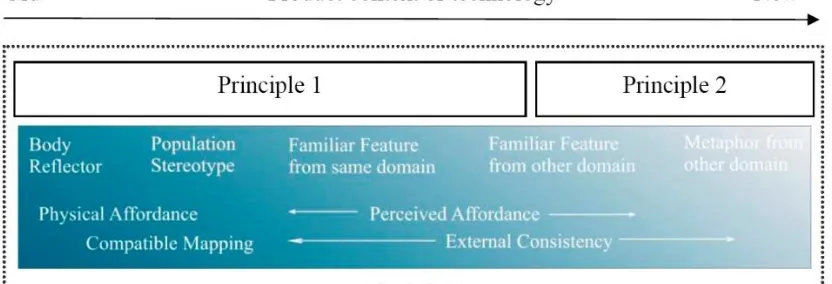
Blackler (2006) proposed a continuum of knowledge in users’ heads that could be leveraged by designers, including body reflector, population stereotype, familiar features from the same domain, familiar features from other domain, and metaphor from other domain (Figure 2.2).
Figure 2.2. The Intuitive Interaction Continuum (Blackler, 2006).
12 features from the same domain and familiar features from other domain are linked to the tools level, and the metaphor from other domains is linked to all levels except the innate level.
There are also other ways to classify the knowledge associated with product interaction. For example, Dixon and Gabrys (1991) distinguished two kinds of knowledge that might contribute to one’s ability to learn a new task: conceptual knowledge and operational knowledge. “Conceptual knowledge refers to the device and how it works, whereas operational knowledge refers to the operating procedure for the device at a purely formal structural level” (Dixon & Gabrys, 1991, p.103). Anderson (1983) distinguished two types of knowledge: declarative knowledge and procedural knowledge. Declarative knowledge is the factual information stored in memory. Procedural knowledge is the stored information about how to perform tasks.
Hurtienne, Horn, and Langdon (2010) identified three different components of prior experience: (a) exposure, (b) competence, and (c) subjective feeling. Exposure to technology describes the duration, intensity, and diversity of use. Competence with technology describes the level of skills and knowledge required for interaction with a product. Subjective feeling relates to the actual user experience when using the product. Hurtienne et al. (2010) identified three levels of prior experience associated with product interaction: (a) prior experience with the same product, (b) prior experience with other products of the same type, and (c) prior experience with a broad range of products of different types.
13 used the term “functional similarity” for tasks in which the same sequence of sub-goals was involved, “procedural similarity” for those in which the same steps were used to achieve a given sub-goal, and “interface similarity” for those in which the same motor-control schema was used to carry out a given step.
Prior knowledge and experiences—long-term memory. Memories relating to the experience of product interactions are stored in the long-term memory. “It is the repository of the collective experience and learning of a person. It contains both factual knowledge as well as knowledge of how to perform procedures.” (Pirolli, 1999, p. 449)
Based on the Model Human Processor (Pirolli, 1999), the cognitive process of people using prior knowledge and experiences to guide their interactions with new technologies can be described as follows: (a) information of a new technology is at first input from the world through the user’s perceptual processors (visual processor and auditory processor) into the visual and auditory stores, (b) some of the information enters into the user’s working memory, (c) the cognitive processor then uses the associations between information in the working memory (information about the new technology) and information in the long-term memory (knowledge and experience gained relevant to using this technology) to make decisions and formulate actions, and (d) the motor processor is triggered by working memory to perform the actions. Lewis, Langdon, and Clarkson (2006) suggested that the ability to retrieve that memory depends on the cues provided (associations between the perceived information and the long-term memory) and the amount of previous experience, which entails how well the information was encoded in the long-term memory.
14 Designing by leveraging older adults’ prior knowledge and experiences would utilize their crystallized intelligence rather than their fluid intelligence. It has been found that the crystallized intelligence remains throughout the lifespan, but the fluid intelligence declines with age. Crystallized intelligence is the ability related to retaining and applying previous knowledge gained through past experiences. Fluid intelligence is the ability related to novel problem solving (Ackerman, 1996).
In addition, designing by leveraging older adults’ prior knowledge and experiences would minimize the learning needed to use the technologies. Older adults usually have more problems learning to use new technologies because they have to learn new skills (Reddy, Blackler, Popovic, & Mahar, 2009). Studies have shown that learning ability tends to decline with age. The level of skill acquisition of older adults is lower than that of younger adults (Baltes, 1997; Fisk, Rogers, & Giambra, 1990; KIiegl, Smith, & Baltes, 1989; Rogers & Fisk, 1991; Rogers, Fisk, & Hertzog, 1994).
Risks of leveraging prior knowledge and experiences in designing for older adults. Blackler, Popovic, and Mahar (2005) suggested that designers need to identify the target market for each product and get information about what users are familiar with (what they know). However, Hurtienne, and Langdon (2009) pointed out that data about prior knowledge and experiences on tool usage (e.g., the familiar appearance and location of a feature) quickly become outdated as technology develops, so it is not cost-effective to access the very specific product feature that are familiar to the users.
More importantly, simply repeating the existing features is not friendly to design innovation (Hurtienne, 2004; Raskin, 1994). Hence, one of the risks of leveraging prior knowledge and experiences in designing for older adults is that it may reduce design innovation if the prior knowledge, experience, and memory are overemphasized.
Role of Prior Knowledge and Experience on Usability
15 accuracy and completeness of a goal), efficiency (e.g., time and mental or physical effort), and satisfaction of users working with a product.
Studies have found that prior knowledge and experiences have an impact on users’ performances. Products that better match users’ prior knowledge and experiences can improve users’ performance.
Background knowledge. Kang and Yoon (2008) discovered that background knowledge is an important factor for workload and interaction strategy. They found that older adults’ lack of background knowledge about PCs resulted in higher ratings of effort and their lack of background knowledge about PCs and the Internet resulted in higher ratings of frustration when using a portable multimedia player (PMP). They also found that older adults’ lack of background knowledge about cellular phones resulted in higher ratings of frustration when using an MP3 player. In addition, they found that older adults did not have the background knowledge of various electronic devices which could help facilitate their operation of new devices and this lack of background knowledge resulted in a trial-and-error interaction strategy. The trial-and-error strategy was typically not a characteristic of older adults, but it was a characteristic of novice users. Ziefle (2002) also found that general background knowledge about mobile phones was proven to play an important role for the usability of mobile phones used in the experiments. Users with higher general background knowledge about mobile phones solved the tasks more efficiently and effectively.
Mental model knowledge. Freudenthal (2001) found that users’ prior knowledge about the mental model of a simulated medical laser facilitated their performances. The presence of the mental model of the device reduced the number of actions needed to complete the tasks and increased the efficiency of interactions (avoided controls irrelevant to the task). Kiereas and Bovair (1984) also found that users’ prior knowledge about the mental model of a device has an effect on their performances. Participants’ knowledge about the working of the device helped them with operating procedures.
16 responded faster when the labeling of a vertical button layout was compatible with the metaphors “good is up”, “bad is down”, or “virtue is up”, and “depravity is down” than when labeling was not compatible. Image schema is a form of sensorimotor knowledge gained by repeated interactions with the physical world (Hurtienne, Weber, & Blessing, 2008). Hurtienne and Israel (2007) also suggested other groups of image schemas that designers could utilize when developing intuitive user interfaces, including space (e.g., left-right, near-far, and front-back), containment (e.g., in-out and full-empty), multiplicity (e.g., part-whole and count-mass), attribute (e.g., heavy-light, dark-bright, and warm-cold), indentify (e.g., face and matching), process (e.g., iteration and cycle), and force (e.g., diversion and counterforce).
17 knowledge about the technology feedback of a control (expectations on what is likely to happen when a control is activated) was also an important factor. Wilkinson et al. (2011) discovered that users’ knowledge about product features and warning icons contributed to better interactions with a laser level.
Prior experience with interaction style. Lewis, Langdon, and Clarkson (2008) found that older adults performed tasks more quickly and accurately with a microwave that employed an interaction style that they were very familiar with (a dial model) than they did with a microwave employing an interaction style they were less familiar with (a button-display model). Wilkinson, Langdon, and Clarkson (2010) suggested that a well-rehearsed or well-learned interaction style could aid successful initial and subsequent interactions by users. Okoye (1998) pointed out that familiarity of the interaction style appeared to be a key feature for successful and intuitive interaction. O’Brien (2010) also mentioned that reuse of the interaction style within the technology generation of today’s older adults may be particularly helpful due to their great familiarity with the specific interaction style.
Role of Prior Knowledge and Experience on Acceptance
Technology acceptance can be described as the “approval, favorable reception and ongoing use of newly introduced devices and systems” (Arning & Ziefle, 2007, p. 2905). A distinction between technology acceptance and technology adoption was pointed out by Renaud and Bijon (2008). Technology acceptance is an attitude toward a technology, while technology adoption is a process that starts with the user becoming aware of the technology and ends with the user embracing the technology and making full use of it.
18 According to the Technology Acceptance Model (Davis, 1989), technology usage is determined by users’ behavioral intention (BI) to use the technology, and the BI is determined by users’ attitude toward using the technology (ATU), which, in turn, is determined by users’ perceived usefulness (PU) and perceived ease of use (PEOU) of the technology. The model also suggests that PEOU and PU are directly determined by external variables (Figure 2.3).
Figure 2.3. Technology Acceptance Model (Davis, 1989).
There are also other models which have been proposed to explain and predict user acceptance technology (e.g., Goodhue & Thompson, 1995; Kwon & Chidambaram, 2000; Melenhorst et al., 2001; Mollenkoph et al., 2003; Venkatesh & Davis, 2000; Venkatesh et al., 2003).
19 the expectations toward the technology, which had an impact on perceived ease of use, as well as perceived usefulness (Widenbeck & Davis, 1997).
Skills. As the theory of resource allocation suggested, as skills are acquired and improved and the tasks become automated, the demands on cognitive effort are greatly reduced, which leads to perception of the tasks (using the technology) as easier to do (Kanfer, Ackerman, Murtha, Dugdale, & Nelson, 1994).
Anxiety. Studies have found that experience is negatively associated with anxiety. Igbaria and Chakrabarti (1990) reported that computer experience is negatively associated with computer anxiety, in that higher computer experience is related to lower computer anxiety. Similarly, Necessary and Parish (1996) reported that computer anxiety was higher for the users with little or no computer experience than it was for users with previous experience. Anxiety was found to be negatively associated with perceived ease of use, in that lower anxiety was related to higher perceived ease of use (e.g., Hackbarth et al., 2003).
Efficacy. Studies have found that experience is positively associated with self-efficacy. Self-efficacy describes the confidence in one’s personal abilities to use the targeted or related technologies (Kinzie, Delcourt, & Powers, 1994). Potosky (2002) reported that increased exposure and knowledge (computer training) was positively associated with computer self-efficacy. Similarly, Igbaria and Iivari (1995) found a positive relationship between computer experience and computer self-efficacy. Besides, self-efficacy was found to be positively associated with perceived ease of use, in that higher self-efficacy was related to higher perceived ease of use (e.g., Chung et al., 2010; Hong et al., 2002).
20 interface in the second session of training. The authors found that the group that used the direct-manipulation interface prior to using a menu-based or command-based interface had a significantly negative perception toward the menu-based or the command-based interface (lower perceived ease of use and lower perceived usefulness) than did the group that used a menu-based or command-based interface at the initial training session. The results indicated users’ histories of past usage and their prior experiences colored their expectations toward the technologies, which had an effect on perceived ease of use and perceived usefulness of the technologies.
Technology Generation and Interaction Style
Early experience. Early experience refers to the experience acquired during one’s formative period (adolescence and young adulthood; about 10–25 years old). It is argued that one’s most established knowledge is the knowledge that was acquired during this period of time in life. Studies have shown that people could answer general-knowledge and semantic-memory questions about information learned during adolescence and young adulthood more accurately than they could answer questions about information learned after these years (Rubin, Rahhal, & Poon, 1998). This effect of early experience could be explained by findings from developmental studies and sociological studies.
21
Figure 2.4. Lifespan Research on Two Components of Cognition, the Fluid Mechanics and the Crystallized Pragmatics (Baltes, et al., 1999).
Sociological studies have found that experience gained from frequent and close exposure during a critical period early in one’s life has an imprinting-like effect on one’s lifetime values and preferences (Holbrook & Schindler, 1989). Schindler and Holbrook (2003) found that early experience played a strong positive role in shaping the development of preferences in that users’ preferences peaked for products that were popular when they were young.
Technology generation. Docampo Rama (2001) developed the concept of technology generation and distinguished three technology generations based on the predominant interface type (interaction style) of electrical consumer products (e.g., television, telephone, and video recorder) to which people were exposed during their formative periods (early experience).
22 According to the technology generation boundaries, today’s older adults (65 years and older) typically belong to the electro-mechanical generation, and today’s younger adults belong to the menu generation.
Components of interaction style. As shown in Figure 2.5, an interaction style can be decomposed into conceptual operation, interaction technique, and interaction structure (De Vet & De Ruyter, 1996).
Figure 2.5. Components of Interaction Style (De Vet & De Ruyter, 1996).
According to De Vet and De Ruyter (1996), conceptual operation refers to functionality or overall tasks. Interaction technique refers to input and output devices. Interaction structure refers to interaction procedures. Interaction structure (operational procedure) is characterized by both the mapping between control and function (one control with one function or one control with multiple functions) and the number of layers (single-layered operation or multi-(single-layered operation).
Historical development of interaction style. Docampo Rama (2001) overviewed and analyzed the historical development between 1930 and 2000 of the interaction style of the information, communication, and entertainment appliances (including television, telephone, and video recorder). The historical overview and analysis covered all three main components of an interaction style, including the conceptual operation, the interaction technique, and the interaction structure of these devices.
23 and the menu style (1990–2000). Based on the findings of Docampo Rama (2001), the features of the three interaction styles are summarized in Table 2.1.
Table 2.1.
Features of the Electro-Mechanical Style, the Display Style, and the Menu Style
Components of Interaction Style Electro-Mechanical Style (1930-1980) Display Style (1980-1990) Menu Style (1990-2000) Conceptual Operations
(Functions or Overall Tasks)
Basic functions More functions A large amount of functions
Interaction Techniques
(Input and Output Devices)
Hardware-based input and output devices
Software-based input and output devices
Visualized software-based input and
output devices
Interaction Structures
(Operational Procedures)
One input device (control) has one function & One-layered operations
One input device (control) has multiple
functions
Multi-layered operations
Note: This table is a summary of the findings of Docampo Rama (2001).
Since the beginning of the twenty-first century, with the development of new technologies, other newer interaction styles have emerged and are becoming increasingly popular, such as touch-based interfaces (Häikiö et al., 2007), speech-based interfaces (Ibrahim & Hadidi, 2006), gestures-based interfaces (Waldherr, Romero, & Thrun, 2000), multimodal interfaces (Naumann, Wechsung, & Hurtienne, 2009), and embodied interfaces (Vines & Thompson, 2007).
The electro-mechanical style is the interaction style that today’s older adults grew up with. Based on the findings by Docampo Rama (2001), characteristics of the electro-mechanical style are summarized as follows:
• Conceptual operation: very basic functions.
• Interaction technique: hardware-based input and output devices, such as dials and switches. The hardware-based input devices (controls) provided a tangible, concrete, and direct physical manipulation and a direct physical feedback.
24 functions and their controls on the surface of the product (single-layered operation) provides a high level of directness and visibility (Norman, 1993) and opacity (Fischer, 1991), which allows the users to see all the functions and available options at once. In contrast, the menu style (1990–2000) features a multi-layered operation in which most of the functions are hidden behind the layers (less direct for operation).
Input devices can be categorized as direct and indirect input devices. Studies have found that older adults preferred direct input devices to indirect input devices (Charness, Holley, Feddon, & Jastrzembski, 2004; Chou & Hsiao, 2007). According to Rogers, Fisk, McLaughlin, and Park (2005), a direct input device is “one for which no translation is required between the activity performed by the person and the action of the device” (p. 271). Examples include touch screen, light pen, and voice recognition. However, an indirect input device “requires a translation between the activity of the person and action of the device” (p 271.). Examples include rotary encoder, mouse, joystick, and trackball. In addition, Rogers et al. (2005) asserted that the preference for input devices was task-dependent.
The structure of the interface regarding the number of layers is a tradeoff between depth and breadth (Fisk et al., 2009). Studies have found that older adults have more difficulties with a multi-layered interface (a deep structure with many levels). Docampo Rama (2001) found that older adults performed tasks more slowly and less accurately with the multi-layered interface than they did with the single-layered interface.
25 Cognitive Abilities vs. Prior Experiences and Knowledge
There are mixed findings on how older adults’ cognitive abilities and prior experiences and knowledge come into play in their performance with new technologies. For example, Langdon et al. (2007) found that prior experiences were the best predictors of performance than were cognitive abilities. Lewis et al. (2007) reported that prior experiences were not important predictors of performance. Blackler et al. (2009) suggested that a complex mix of cognitive abilities and prior experiences (with relevant products that use similar features) was the most important factor affecting how older people use new interfaces.
The mixed results on the relative weights of the aging factor and the prior experience factor on older adults’ interactions with new technologies may be caused by different products tested, different natures of the tasks, and different methods of scoring prior knowledge and experiences.
Summary of Literature Review
The literature review showed that prior knowledge and experiences were important aspects of user characteristics and should be taken into account when designing products and interfaces for the target users. Design by leveraging users’ prior knowledge and experiences would be particularly beneficial for the older adult users because it utilizes the crystallized intelligence which remains during the process of normal aging and reduces the requirements of learning abilities that show declines with aging.
There are only a few design recommendations for utilizing users’ prior experiences and knowledge. Most of the existing recommendations suggested repetition and reuse of an existing feature or interaction style that users are familiar with, but they did not provide guidance on how to reshape or redesign an existing feature or style, or how to design a new feature or style while highlighting users’ prior knowledge and experiences.
26 effects on users’ acceptance of new technologies. The review also noted that past histories of usage colored users’ expectations, which also influenced users’ attitudes toward accepting the technologies.
A previous study identified that today’s older adults typically belong to the electro-mechanical generation (born 1930–1960), and the interaction style available to them during their formative years (10–25 years old) was the electro-mechanical style.
27 CHAPTER 3
DEVELOPING A FRAMEWORK OF GUIDING INTERFACE DESIGN FOR
OLDER ADULTS
Chapter 3 has been published in the Proceedings of the Human Factors and Ergonomics Society Annual Meeting, ISSN 1071-1814, 09/2012, Volume 56, Issue 1, pp. 1967-1971.
Title: Developing a Framework of Guiding Interface Design for Older Adults
Authors: Siwen Liu and Sharon Joines (College of Design, North Carolina State University, Raleigh, NC)
Abstract: Many design recommendations have been provided for designing user interfaces for older adults. Existing design recommendations over the last twenty years were reviewed. Most of the design recommendations focused on older adults’ age-related changes in physical, sensory, and cognitive abilities, from an aging perspective or aging-oriented approach. Few design recommendations have been generated focusing on older adults’ prior knowledge and experience from a generation perspective or generation-oriented approach. The comparison of the two approaches is provided and the significance of taking into account both approaches during the design process is discussed. A framework guiding interface design for older adults systematically combining both the aging-oriented approach and the generation-oriented approach is proposed. This paper describes the framework which aims to assist developing user interfaces for maximum usability and accessibility for older adults.
28 Introduction
As the aging population grows and technologies continue to develop, the issue of how to design user interfaces of modern technologies for older adults supporting their independent living has become a central question for designers and researchers.
Like many industrialized countries, the United States is projected to experience rapid growth in its older population over the next four decades. Based on the data of 2008 for estimating U.S. national population growth, the number of Americans aged 65 and older was projected to be 40.2 million in 2010 and more than double to 88.5 million by 2050 (U.S. Census Bureau, 2010). At the same time, modern technologies are becoming increasingly ubiquitous in people’s life. An inability to use current technologies puts older adults at a disadvantage to successfully perform everyday tasks, to remain active and to live independently. This in turn may increase burdens on society and also impair market shares for industry (Czaja, Fisk, Hertzog, Rogers, Charness, Nair, & Sharit, 2006a).
Many design recommendations have been provided for designing user interfaces for older adults. However, there are still daily living products and systems that are challenging for older adults; there are still complaints from older adults that today’s products are not designed for them (Docampo Rama, 2001). Hence, a critical review of the existing design recommendations is needed with a particular emphasis placed on examining whether the user characteristics of this target population have been fully considered and reflected in design recommendations.
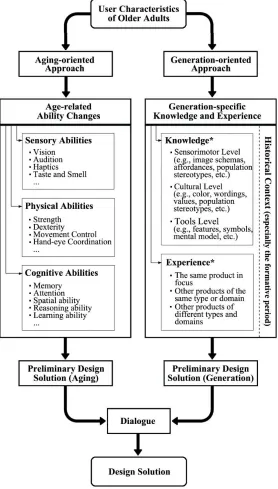
Reviewing existing design recommendations on user interface design for older adults over the past twenty years showed that existing design recommendations focused on older adults’ age-related changes (declines) in physical, sensory, and cognitive abilities, and accordingly provided design recommendations to accommodate these aging characteristics of older adults (e.g., Hawthorn, 2000; Pattison & Stedmon, 2006; Morris, 1994; Zajicek, 2001a). These design recommendations were generated from an aging perspective which we termed it the ‘aging-oriented approach’.
29 providing a perspective to an entire generation of individuals. In this paper, we termed this the ‘generation-oriented approach’. Unfortunately, older adults’ prior knowledge and experience, especially the knowledge and experience gained collectively at a generation level has been underexplored. Studies have shown that prior knowledge and experience affected user’s performance of interacting with products. Products that better match prior knowledge and experience of their users increased the speed and effectiveness of interaction (e.g., Blackler, 2006; Langdon, Lewis, & Clarkson, 2007; Lewis, Langdon, & Clarkson, 2008; O’Brien, 2010).
According to the ISO 20281-1:2006 (E), entitled “Ease of operation of everyday products” (International Standards Organization, 2006), the three main groupings of user characteristics were defined as demographics, physical and sensory characteristics, and psychological and social characteristics (including cognitive abilities, prior knowledge and experience, etc.). The aging-oriented approach and the generation-oriented approach addressed different aspects of older adults’ user characteristics. The aging-oriented approach addressed physical and sensory abilities, and cognitive abilities; the generation-oriented approach addressed prior knowledge and experience.
In this paper, a framework which would systematically combine both the aging-oriented approach and the generation-aging-oriented approach is proposed. The main user characteristics central to this paper are: physical and sensory abilities, cognitive abilities, and prior knowledge and experience. This framework would provide a holistic view of older adults as a cohort and provide guidance during the interface design process when seeking an ultimate design solution. The framework will support usability specialists, product designers, interaction designers, product manufacturers and others involved in the design and development of user interfaces of modern technologies for older adults.
Review
30 interface’, ‘interface design’, ‘older adults’, and ‘elderly’ to search databases (Ergonomics Abstracts, Compendex, and Web of Science), 303 articles were identified for abstract review. Studies were excluded from further review when abstracts indicated that the work only applied previously developed design recommendations rather than generating new recommendations or centered on products that did not have an interactive interface. Based on the exclusion criteria, the set of literature was refined to 201 for review using a phased approach. First, articles documenting existing design recommendations focused on older adults’ age-related ability changes (sensory, physical, and cognitive abilities) were reviewed. Second, existing design recommendations focused on older adults’ prior knowledge and experience were reviewed. Finally, the two approaches (focusing on the age-related ability changes vs. focusing on the generation-specific knowledge and experience) were compared.
The purpose of this literature review was to identify user characteristics addressed by the existing design recommendations, and by which perspective. It also provides the rational and evidence supporting the proposed framework.
Design recommendations focused on older adults’ age-related ability changes.
The majority of the literature reviewed focused on older adults’ age-related ability changes, including sensory, physical, and cognitive abilities.
Comprehensive, cogent reviews of the age-related ability changes are available (Fisk, Rogers, Charness, Czaja, & Sharit, 2009; Hawthorn, 2000; Morris, 1994; Pak & McLaughlin, 2011; Pattison & Stedmon, 2006; International Standards Organization, 2008). Simulation tools which are helpful for understanding the age-related physical and sensory ability changes have been developed (e.g., the simulation toolkit (e.g., Cardoso, Keats, & Clarkson, 2004), the simulation suit (e.g., Tremayne, Burdett, & Utecht, 2011)).
31 management systems (e.g., Ansari, 2011), smart home systems (e.g., Zhang, Rau, & Salvendy, 2009), e-government systems (e.g., Lines, Ikechi, & Hone, 2007), etc.
Existing design recommendations are informed by age-related changes in:
• Sensory abilities: vision (e.g., Zajicek, 2001b), audition (e.g., Jacko, Scott, Sainfort, Moloney, Kongnakorn, Zorich, & Emery, 2003), haptics (e.g., Jones & Sarter, 2008), etc.
• Physical abilities: motor control (e.g., Smith et al., 1999), hand eye coordination (e.g., Rau &
Hsu, 2002), strength (e.g., DiDomenico & Nussbam, 2003), dexterity (e.g., Jin, Plocher, & Kiff, 2007), etc.
• Cognitive abilities: working memory (e.g., Ogata, Kumada, Suto, Watanabe, & Ifukube, 2011), episodic memory (e.g., Mead et al., 1999), attention (e.g., Tsai & Lee, 2011), spatial ability (e.g., Rau & Hsu, 2002), etc.
The design recommendations were generated by various methods, including laboratory experiments (e.g., Rau & Hsu, 2002), questionnaires (e.g., Ansari, 2011), structured or semi-structured interviews (e.g., Lines et al., 2007), focus groups (e.g., Ansari, 2011), participatory approaches (e.g., Batu et al., 2010), etc.
Design recommendations focused on older adults’ prior knowledge and experience. The lack of publications focusing on older adult’s prior knowledge about user interfaces and their prior interaction experiences underscores the limited progress on developing cohesive design recommendations for older adults. In addition to a lack of design guidelines, currently there is no tool available for simulating older adults’ prior knowledge and experience. “Simulation kits” can provide the designers an experience with a range of physical and sensory abilities; however, it would be extremely difficult to accurately simulate one’s prior knowledge and experience (Cardoso et al., 2004).
32 cultural environment. Vines & Thompson (2007) mentioned that designers can design a user interface which affords older adults unconscious retrieval of knowledge gained over a lifetime’s experience in the world, especially that gained during the formative period (10-25 years old). Fisk et al. (2009) also recommended that designers should take advantage of older adults’ well-developed knowledge base and develop products and systems that are consistent with their representations, expectations, and experiences.
Aging-oriented approach vs. generation-oriented approach. The aging-oriented approach and the generation-oriented approach differ in the following aspects.
Explanation of age-group differences. Older adults typically have more difficulties with today’s user interface of modern technologies compared to the younger adults (Czaja et al., 2006a). The aging-oriented approach explained the differences by focusing on biological and genetic attributes and the decrements as a result of the process of aging. The generation-oriented approach focused on learned differences to explain the difficulties of older adults’ with user-interfaces contrasting the generation-specific knowledge and experience to the requirements of the current user interface.
Period of lifespan. The aging-oriented approach focused on the later period of life of older adults when the age-related ability changes (declines) occur. On the other hand, the generation-oriented approach utilized knowledge and experience acquired over a lifetime, focusing on the formative period (10-25 years old).
Declining and maintaining. The aging-oriented approach focused on declines in abilities and provides design recommendations to accommodate the losses. The generation-oriented approach focused on what is remaining and provides design recommendation to leverage those abilities and knowledge.