Drowsiness Detection for Drivers Using Image
Processing
Twinkal Parmar1, Jaymin Bhalani2, Dishant Shah3
M.E Student, Dept. of E.C. (CSE), Babaria Institute of Technology, Varnama, Vadodara, India1 Associate Professor, Dept. of E.C. (CSE), Babaria Institute of Technology, Varnama, Vadodara, India2
Director, Emertech Electronic Systems, Vadodara, India3
ABSTRACT: Conduct the experiment by the simulation and analyse the data, to search for a system for automatic detection of drowsiness based on driver’s performance, human behaviours and emotions. The aim of this project is to develop a prototype of drowsiness detection system. A Drowsy or sleepy driver is unable to determine when he/she will have an uncontrolled sleep. Fall asleep crushes are very serious in terms of injury. Recent statistics estimate that annually 1,200 deaths and 76,000 injuries can be caused to fatigue or drowsiness related crashes[1].More than 25% of highway traffic accidents are caused as result of driver fatigue[2]. We can reduce the risk of an accident by warning the driver of his/her drowsiness. The main concept of this system is to simulate the drowsiness detection system using image processing and to identify level of drowsiness. In addition, we can also notify the authorized person with the location of the vehicle using GPS. This system will be helpful in preventing many accidents, and consequently save human life and reduce personal suffering. This system will monitor the driver’s eyes using camera and by developing an algorithm we can detect symptoms of driver drowsiness early enough to avoid accident. The driver eyes are closed more than 80% within a specified time interval is defined as drowsiness.So this project will be helpful in detecting driver fatigue in advance and will gave alarming signals in the form of sound and LED blinking. The warning will be deactivated manually rather than automatically. So for this purpose a deactivation switch will be used to deactivate warning. The system draws the conclusion that the driver is falling asleep and issues a warning signal.
KEYWORDS: Drowsiness detection, advanced vehicle safety, Eye tracking system, Track the location (GPS), Warning output (alarm and LED blinking), Real time drowsiness detection
I. INTRODUCTION
The real time drowsiness behaviours are dangerous which are related to drowsiness in the form of the eye blinking, head movement and brain activity. The aim of this system is to detect the human behaviours and mood like eye blinking, yawing etc.There are mainly three parts in this system (1) Face detection (2) Facial feature extraction like detect the eye portion (3) Detection of the open or closed eye. Face is detected in the real time in the MATLAB using the face detection algorithm and facial features like detect the eye portion and then detect the open or closed eye by self developing algorithm and reduce the accidents caused by fatigue related and also save the money and the reduced human suffering.
II. DROWSINESSDETECTION
A Drowsy or sleepy driver is unable to determine when he/she will have an uncontrolled sleep. Fall asleep crushes are very serious in terms of injury. Recent statistics estimate that annually 1,200 deaths and 76,000 injuries can be caused by fatigue and drowsiness.[1] More than 25% of highway traffic accidents are caused as result of driver fatigue.[2] With the rapidly increase the number of accidents day to day. Therefore, we need to arise to design a system that keeps the drivers focused on the road and reduce the risk of an accident by warning the driver of his/her drowsiness. Our whole focus and concentration will be placed on designing the system that will accurately monitor the open and closed state of the driver’s eye in the real term.This system will monitor the driver’s eyes using camera and by self developing an algorithm we can detect symptoms of driver drowsiness. Eyes and face symptoms are the best way for drowsiness detection for our needs. The driver eyes are closed more than 80% within a specified time interval is defined as drowsiness. [3] Warning output in form of sound and LED blinking. The warning will be deactivated manually rather than automatically. So for this purpose a deactivation switch will be used to deactivate warning signal.
III. ALGORITHM STUDY
Algorithm description and its work:
There are mainly three parts in this system (1) Face detection using viola-jones algorithm (2) Facial feature extraction like detect the eye portion using viola-jones algorithm (3) Detection of the open or closed eye using new logic and it is pixels map.
(A) Haar algorithm [6]:
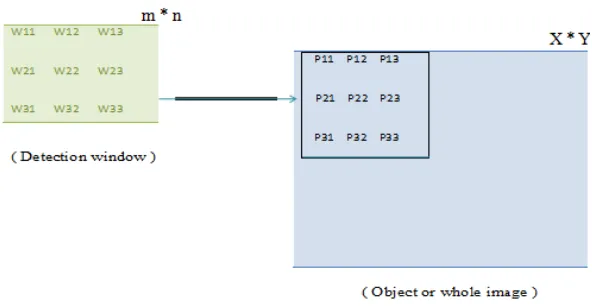
Haar features are digital image features used in the object recognition. Haar is working with only image intensity (like the RGB pixel values at each and every pixel of image) made the task of the feature calculation. Haar features consider the detection window or a region at the specific location. Figure (1) is describe that the detection window passes through the whole image and its detection values and the pixel values are multiply each other and sum all the pixel values in each region and calculate the difference between sums.
Figure 1: Haar features
Calculation: (ii(x, y) =∑ value(x′, y′)
′ , ′ )
Or (ii(x′, y′) =
× ∑ wij. pij >
)
For example: Face database,
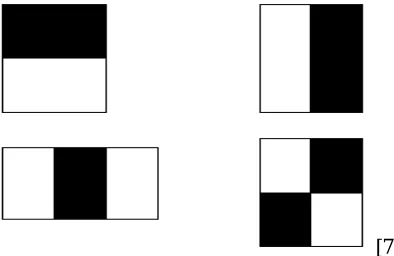
The region of the eyes is darker than the region of the cheek. The Haar feature is set of two rectangles on the eye and cheek region. The rectangle is defined as the detection window. Figure (2) is describe that the Haar cascade features in the form of horizontal view, vertical view, centre, and angle view of the pixel values in the binary values for the image.
[7] Figure 2: For kinds of Haar features in binary Advantage : Calculation speed
Disadvantage: Detection time is high (B) Haar cascade [8]:
Haar-cascade is an object detection algorithm used to locate faces, objects and facial expressions in an image and mainly used for face detection. Figure (3) is described that the structure of cascade features and it’s working in the loop. The cascade classifier consists of multiple stages and each one is weak classifier. Once the sub windows fail on any stage, it will be judged as no face. Only the sub windows pass all the stages is cosidered as a face.
Figure 4: Haar cascade algorithm
Figure (4) is describe that, a cascade classifier is working with the Haar like features is trained with the hundred samples views of the particular object like face, car etc. called positive image and the negative images are arbitrary images of the same size. After, a classifier is trained; it can be applied to the region of interest in an input image. If the classifier output is ‘yes’ or ‘1’then the region is show the object and if the classifier output is ‘no’ or ‘0’ then the region is not show the object. To search for the object in the whole image, the detection window move across the image and check the every location using the classifier. The cascade classifier or the detection window is designed, so that it can be easily resized in order to be finding the object of interest at the different size.
Advantages : Used for particular Detection time is less Disadvantages: Numerical value expect Calculation complex
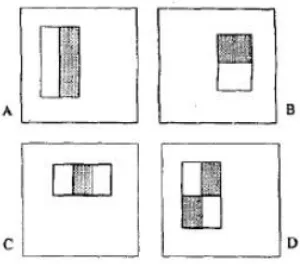
Figure 5: Rectangle features use in Haar-cascade Figure (5) is described that the rectangular features are used in the Haar cascade. (3) Viola-jones algorithm [9]:
(1) Robust (very high detection rate for true-positive output & very low false-positive output). (2) Real time (at least 2 frames per second must be processed). (3) Face detection only (not recognition). The viola-jones algorithm is working with the integral image. Here, integral image means representation of the image. The detection framework involved the sums of image pixels within rectangular areas. The value of any feature is the sum of the pixels within clear rectangles subtracted from the sum of the pixels within shaded rectangles.
Calculation: Value = Σ (pixels in black area) - Σ (pixels in white area)
Advantage : Calculation easy
Disadvantage: Accuracy less rather than Ada-boost (4) Pixel map:
In this system, detect the open or closed eye portion using new algorithm and its pixels map. In pixels map, first we crop the images and count the white and black pixel value in terms of open or closed portion or area of the eye. If the white pixel values are high then the output of the eye is in the form of open and the black pixel values are high then the output of the eye is in the form of closed.
Table 1 : Comparitive study of algorithm:
Here, table 1 is described that the accuracy of the Ada-boost is very high but its detection time is high and the detection time of viola-jones algorithm is less. So, the viola-jones algorithm is preferable to the first step of this system.
IV.METHODOLOGY
We are going to design a system using camera that points directly towards the driver’s face and monitors the driver’s eyes in order to detect fatigue or drowsiness by self developed image processing algorithm which can give information regarding drowsiness of drivers.
A. BLOCK DIAGRAM :
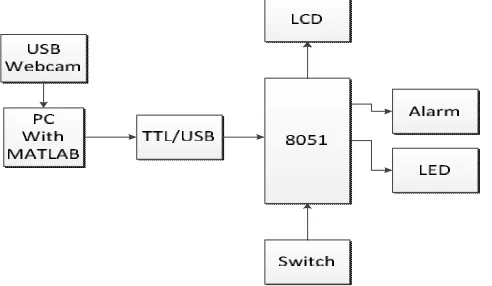
Figure 6: Block diagram
No Parameters Haar features Haar cascade Viola-jones Ada-boost 1. Calculation Easy Complex Easy compared to all Complex rather
than viola-jones 2. Detection time High Less Less High 3. Working area Whole image Particular image Intregal image Classifier 4. Resized area Cannot resized Resized Resized Cannot resized 5. Accuracy Low Better than Haar High compared to
Haar and cascade
Figure (6) is described that the system will monitor the driver’s eyes using camera and by self developing an algorithm we can detect symptoms of driver drowsiness and will gave alarming signals in the form of sound and LED blinking. The warning will be deactivated manually rather than automatically. So for this purpose a deactivation switch will be used to deactivate warning. The system draws the conclusion that the driver is falling asleep and issues a warning signal.
B. WORKING FLOW DIAGRAM OF SYSTEM :
1. For software unit 2. Microcontroller unit
Figure 7: Flow chart
V. TEST AND RESULT
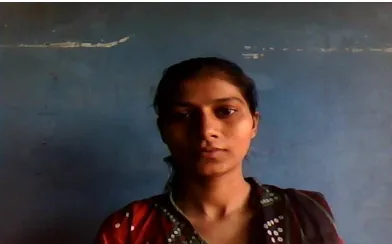
In this system, the main part of the project is capture the image using camera and its result is shown in figure (8).
Figure 8: Capture the image using camera
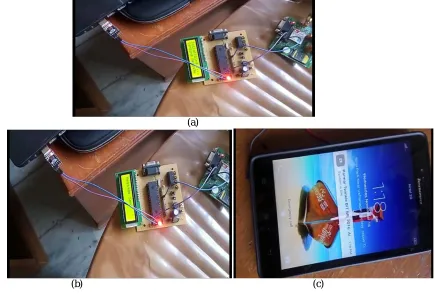
Serial communication of the UART is to transmitting and receiving data for 8051 microcontroller and MATLAB with GSM module. If GSM module is connected to the system, then system will passes the message in the form of “system is ON” shown in figure (9).
(a)
(b) (c)
Figure 9: Serial communication with GSM
The MATLAB is transmitting the wrong data, and then transmitted data shows in the form of “wrong data” will be transmitted on the LCD display shown in figure (10).
MATLAB will transmit the data to the system and drop the message through the GSM in the form of “driver is sleepy” shown in figure (11).
Figure 11: Output in form of Driver is sleepy
Result of Face detection:
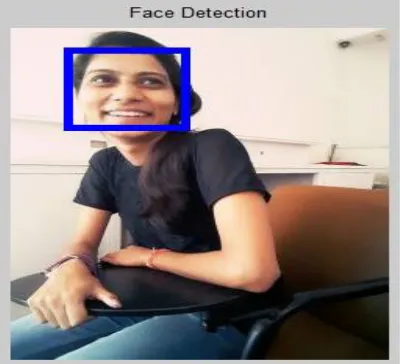
Face detection in the general terms is defined as to isolate human faces from their background and exactly locate their position in an image. Face is the primary focus of our system for conveying identity. Human face detection by computer system has become a major field of our system. Different algorithms based on this system or approaches, like our knowledge based, template matching, neural networks, Face decomposition, pattern recognization etc. are applied in detection of faces. In our system, we are using the viola-jones algorithm for the face detection. The output is shown in figure (12).
VI.ACCURACY
Accuracy related result:
Here, below table shows the accuracy about system. This table contains the data according to face detection of the images.
Description Total Images Detected False detection Accuracy Images with plain
background
10 7 0 70 %
Images with multiple face
16 12 0 75%
Images with varying background
10 8 2 80%
Total 36 27 2 75%
VII.CONCLUSION
The aim of this dissertation is to detect the drowsiness for drivers using image processing.We are going to design a system using camera that points directly towards the driver’s face and monitors the driver’s eyes in order to detect fatigue or drowsiness by self developed image processing algorithm which can give information regarding drowsiness of drivers. So the first step is the face detection. For face detection viola-jones method is used. Viola-jones has been successfully applied on the facial detection system and based on the accuracy of human location detection. The second step is Feature Extraction like detect the eye portion which has been done by viola-jones algorithm. During detection of eyes, system will be able to decide if the eyes are open or closed and whether the driver is looking in front by self developed algorithm and its pixels map. When the eyes will be closed for too long, a warning signal will be given in the form of buzzer or in the form of alarm signal and also send the feedback reply to the driver for the system.
REFERENCES
1. Neeta Parmar , “Drowsy Driver Detection System” , Department of Electrical and Computer Engineering , Ryerson University , 2002 2. Singh Himani Parmar , Mehul Jalal , Yadav Priyanka Brijbhan , “Drowsy Driver Warning System Using Image Processing” , Electronics &
Communication , GEC , Bharuch , Gujarat
3. Chi Zhang , Hong Wang , and Rongrong Fu , “Automated Detection of Driver Fatigue Based on Entropy and Complexity Measures” , IEEE Transactions on Intelligent transportation systems, Vol.15, No.1, February 2014
4. Hardeep Singh, Mr. J.S Bhatia, Mrs. Jasbir Kaur, “Eye Tracking Based Driver Fatigue Monitoring and Warning System”, M.E (E.P.D.T), E&EC Deptt. Director, P.E.C University of Tech, Chd , Director, CDAC Mohali , A-34, Sector-71 Mohali (India) , Asst. Professor , P.E.C University of Tech, Chd , IEEE 2011
5. Peter M. Corcoran , Fellow, IEEE, Florin Nanu , Stefan Petrescu and Petronel Bigioi , Senior Member , IEEE , “Real-Time Eye Gaze Tracking for Gaming Design and Consumer Electronics System ”, : IEEE Transactions, 2012
6. https://en.wikipedia.org/wiki/Haar-like_feature
7. Weiyan Wang , Yunquan Zhang , Shengen Yan , Ying Zhang ,Haipeng Jia , “Parallelization and Performance Optimization on Face Detection Algorithm with OpenCL: A Case Study”, TSINGHUA SCIENCE AND TECHNOLOGY ISSNll 1007-0214ll08/18llpp287-295 Volume 17 , Number 3 , June 2012
8. https://en.wikipedia.org/wiki/Haar-like_feature
9. https://en.wikipedia.org/wiki/Viola–Jones_object_detection_framework
10. https://www.google.com/
11. Matlab website: http://www.mathwork.com 12.
Books: