R E S E A R C H
Open Access
Nonlinear joint transmit-receive processing for
coordinated multi-cell systems: centralized and
decentralized
Zhirui Hu
1,2*, Chunyan Feng
1, Tiankui Zhang
1, Qin Niu
1and Yue Chen
3Abstract
This paper proposes a nonlinear joint transmit-receive (tx-rx) processing scheme for downlink-coordinated multi-cell systems with multi-stream multi-antenna users. The nonlinear joint tx-rx processing is formulated as an optimization problem to maximize the minimum signal-to-interference noise ratio (SINR) of streams to guarantee the fairness among streams of each user. Nonlinear Tomlinson-Harashima precoding (THP) is applied at transmitters, and linear receive processing is applied at receivers, to eliminate the inter-user interference and inter-stream interference. We consider multi-cell systems under two coordinated modes: centralized and decentralized, corresponding to systems with high- and low-capacity backhaul links, respectively. For thecentralized coordinatedmode, transmit and receive processing matrices are jointly determined by the central processing unit based on the global channel state information (CSI) shared by base stations (BSs). For thedecentralized coordinated mode, transmit and receive processing matrices are computed independently based on the local CSI at each BS. In correspondence, we propose both a centralized and a decentralized algorithm to solve the optimization problem under the two modes, respectively. Feasibility and computational complexity of the proposed algorithms are also analyzed. Simulation results prove that the proposed nonlinear joint tx-rx processing scheme can achieve user fairness by equalizing the bit error rate (BER) among streams of each user and the proposed scheme outperforms the existing linear joint tx-rx processing. Moreover, consistent with previous research results, performance of the proposed centralized nonlinear joint tx-rx processing scheme is proved to be better than that of the decentralized nonlinear joint tx-rx processing.
Keywords:Coordinated multi-cell; Centralized coordinated; Decentralized coordinated; Joint transmit-receive processing; Nonlinear precoding; Tomlinson-Harashima precoding (THP)
1 Introduction
Coordinated multi-cell is a promising technology to reduce inter-cell interference and increase user data rate, which has been considered as one of the potential technologies for LTE Advanced [1,2]. To fully utilize the advantage of coordinated multi-cell technology, it is essential to manage the multi-user interference (MUI) within the coordinated area appropriately as it is directly related to the achievable spectrum efficiency [3]. Precod-ing is a well-known technique for MUI mitigation in
multi-user multiple-input multiple-output (MU-MIMO) systems [4,5]. The joint transmit-receive (tx-rx) process-ing can be used to further improve the downlink performance of MU-MIMO systems by optimizing the transmit precoding and receive filter matrices jointly. According to the processing of the transmit precoding, the joint tx-rx processing technology can be divided into two types, linear and nonlinear schemes.
The coordinated multi-cell technology can be imple-mented in a centralized or decentralized mode based on the backhaul capacity of the systems. The centralized co-ordinated mode can achieve higher data rate at the cost of high-capacity backhaul links in order to enable base sta-tions (BSs) to share their channel state information (CSI) (defined as local CSI) and data. Hence, the centralized
* Correspondence:[email protected]
1
Beijing Key Laboratory of Network System Architecture and Convergence, Beijing University of Posts and Telecommunications, Beijing 100876, China 2
School of Communication Engineering, Hangzhou Dianzi University, Hangzhou 310018, China
Full list of author information is available at the end of the article
approach is limited to systems with sufficient backhaul capacity [6,7]. The decentralized coordinated mode does not require BSs to share their local CSI, and the precoding or tx-rx processing is conducted at each BS [8]. This approach has less requirement on backhaul link capacity at some loss on the data rate in comparison to the central-ized coordinated mode.
In recent years, relevant works on joint tx-rx process-ing in coordinated multi-cell systems have been widely studied under either centralized [9-19] or decentralized mode [20-23]. For designing the nonlinear joint tx-rx processing, many different optimal objectives have been considered, such as minimizing the sum mean square error (S-MSE) or maximizing the SINR; yet, the fairness among the streams of each user has not been solved for the coordinated multi-cell systems with multi-stream multi-antenna users.
1.1 Prior art
Linear joint tx-rx processing algorithms have been widely studied for coordinated multi-cell systems under centralized mode [9-14]. In [9], block diagonalization (BD) precoding was designed to maximize the weighted sum rate of all users. The tx-rx processing optimization with the criterion of minimizing the S-MSE was pre-sented in [10-12], and the authors of [13] proposed a weighted S-MSE minimization algorithm by considering the channel gain as the weight factor. In [14], the energy efficiency was considered in the tx-rx processing design. A new criterion of maximizing weighted sum energy efficiency was formulated, and the optimization problem was solved by an iterative algorithm. For the decentra-lized coordinated mode, D. Gesbert and R. Holakouei, et al. studied the decentralized linear precoding tech-niques for the system with single-antenna users recently [20-22]. In [20], a distributed precoding scheme based on zero-forcing (ZF) criterion (defined as DZF) and sev-eral centralized power allocation approaches was pro-posed. In [21,22], a characterization of the optimal linear precoding strategy was derived. Distributed virtual SINR (DV-SINR) precoding approaches, where each BS bal-ances the ratio between signal gain at the intended user and the interference caused by other users, had been pro-posed for the particular case of two users in [21] and gen-eralized for multi-user in [22]. The DV-SINR scheme was illustrated to satisfy the optimal precoding characterization and outperform DZF.
Compared with the linear joint tx-rx processing schemes, the nonlinear joint tx-rx processing schemes are more complex but can obtain more system gain, which have gained much attention recently. Most re-search about the nonlinear precoding focus on Tomlinson-Harashima precoding (THP), as it can achieve approximate performance with the optimal dirty paper coding but
has a much lower complexity [5]. For the centralized coordinated mode, the tx-rx processing scheme was de-signed to minimize the S-MSE in [15] and maximize the SINR in [16], wherein both should be solved by an itera-tive method, resulting in high computational complexity. The schemes with low complexity were proposed and derived a closed-form solution based on minimum aver-age bit error rate (BER) in [17], minimum mean square error (MMSE) in [18], or ZF criterion in [19]. In [18], the receive processing matrix was firstly computed by CSI. Then,the transmit processing matrix and receive weight coefficient were computed based on MMSE. In [19], the algorithm decomposed the MU-MIMO channel into par-allel independent single user MIMO (SU-MIMO) chan-nels, and then, closed-form expressions of transmit and receive processing matrices were derived to optimize the performance of each user. The above research works on nonlinear tx-rx processing were all developed for the centralized coordinated mode. The relevant works for the decentralized coordinated mode are relatively fewer. A decentralized nonlinear precoding, ZF-THP, was proposed in [23] but can only be applied for the system with a single user. To the best of our know-ledge, for the system with multi-stream multi-antenna users, the tx-rx processing solutions under decentra-lized coordination mode have not been addressed in the literature.
Previous work did not consider fairness among streams of each user in the coordinated multi-cell system with multi-stream multi-antenna users. It is essential to study the fairness for nonlinear scheme, as unfairness is an in-herent character of THP and the worst performance de-termines the whole performance of the user [24].
1.2 Contributions
In this paper, a nonlinear joint tx-rx processing scheme is proposed to improve fairness among streams of each user with multi-antenna. The nonlinear joint tx-rx processing is formulated as an optimization problem to maximize the minimum SINR of streams. The perform-ance of the proposed scheme is evaluated under both centralized and decentralized coordinated modes. Two algorithms for solving the optimization problem are derived.
The main work of this paper can be summarized as follows.
Nonlinear joint tx-rx processing scheme is developed for a coordinated multi-cell system with multi-stream multi-antenna users under two coordinated modes, centralized and decentralized mode.
Two algorithms, the centralized and the
optimization problem, and both of them derive the closed-form solutions.
The algorithms guarantee the fairness among the streams of each user, which not only boost the performance of each user, but bring much convenience to the modulation/demodulation and coding/decoding procedures.
The remainder of this paper is organized as follows. Section 2 presents the coordinated multi-cell system model. The proposed nonlinear joint tx-rx processing scheme is described in detail in Section 3. A perform-ance analysis of the proposed algorithms is developed in Section 4. Simulation results and conclusions are presented in Section 5 and Section 6, respectively.
1.3 Notation
We use uppercase boldface letters to denote matrices and lowercase boldface to denote vectors. The operators (⋅)T, (⋅)H, (⋅)†, E(⋅), and Tr(⋅) stand for transpose, Hermit-ian, Moore-Penrose pseudo-inverse, expectation, and the trace of a matrix, respectively. diag(⋅) and blockdiag(⋅) denote diagonal and block diagonal matrix. Iand 0 are the identity and the all-zero matrix, respectively, with appropriate dimensions. ‖⋅‖F represents the Frobenius norm of a matrix. [⋅]i:j,k:l denotes the submatrix com-prised of row i through row j and column k through columnlof a matrix.
2 System model
Consider a downlink coordinated multi-cell system, where N BSs cooperatively serve K users. Each BS and user is equipped with nt and nr antennas, re-spectively. All BSs share user data and cooperatively transmit the data to an intended user. Each BS trans-mits L¼XK
k¼1lk data streams to K users, where lk is the number of transmitted data streams for user k.
We assume that BSs' transmit power for every user is
P. Therefore, the total transmit power of BSs is KP.
De-note xk¼ xk1T;⋯;xk T N
h iT
, where xkn denotes the prepro-cessed signal transmitted by the nth BS for user k,
satisfying TrnxkxkHo
is the global CSI between BSs and the kth user and Hkn∈Cnrnt denotes the local CSI
between thenth BS and the kth user, whose entries are independent and identically distributed (i.i.d.) complex Gaussian variables with zero mean and unit variance. In Equation 1, the second term on the right-hand side is MUI, andnkeCNð0;σ2InrÞis the additive white Gaussian
noise variable.
Each user decodes the desired data by multiplying with the receive processing matrix. The received data of the
kth user is given as:
where Rk∈Clknr denotes the receive processing matrix
of thekth user.ñk=Rknkis the equivalent received noise vector at thekth user.
Let y¼ y1T
;⋯;yKT
T
represent the received signal
of theKusers. Equation 2 can be expressed as:
~
notes the nth local CSI between thenth BS andKusers.
x¼XKk¼1xk denotes the transmit signal at BSs, and
xn¼ XK
k¼1x
k
n is the transmit signal at the nth BS.
~ n¼ n~1T
;⋯;n~KT
T
is the combination of the receive
noise at theKusers.
Define Λðk;tÞ ¼RkXNn¼1Hknxtn¼RkHkxt. The rate of
For the centralized coordinated mode, it is assumed that all BSs exchange their local CSI, and the tx-rx processing matrices are jointly designed at the central processing unit. The system can be seen as a virtual MU-MIMO system withNt=Nnttransmit antennas. On the contrary, for the decentralized coordinated mode, BSs do not share their CSI, and every BS only has knowledge of local CSI between itself and K users. Therefore, the tx-rx processing matrices are independently designed at each BS.
3 Nonlinear joint transmit-receive processing algorithm
In this section, we present nonlinear joint tx-rx process-ing algorithms for a coordinated multi-cell system under two different coordinated modes. The algorithm structure is firstly shown. Then, we formulate the optimization problem, aiming at maximizing the minimum SINR of streams to guarantee the fairness among the streams of each user. Finally, the algorithms for different coordinated modes are proposed.
3.1 Algorithm structure
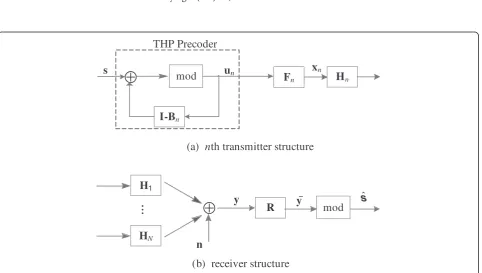
The structure of the proposed algorithm is shown in Figure 1. In the proposed algorithms, nonlinear preprocessing is applied at transmitters; meanwhile, linear processing is applied at each receiver.
At thenth(n= 1,…,N) transmitter,s¼ s1T
;⋯;sKT
T
∈CL1 denotes the modulated data vector satisfying E{ssH} =I,
where sk is comprised of the lk data streams for the kth user. In THP, feedback matrixBnis a unit lower triangular matrix,
Bn¼
B1n;1 0 ⋯ 0
B2n;1 B2n;2 ⋱ ⋮
⋮ ⋱ ⋱ 0
BK;1
n ⋯ BKn;K−1; BKn;K 2
6 6 4
3 7 7
5 ð5Þ
where Bkn;k is a unit lower triangular matrix withlk×lk size. un is the output data of THP. Therefore, the lth data stream of un is interfered by the first (l-1) data streams; in other words, the lth(l= 2,⋯,L) element uln in un is a linear combination of sj(j≤l). Assume M-ary square constellation is employed to s. To ensure that the real and the imaginary parts of uln are constrained into −pffiffiffiffiffiM;pffiffiffiffiffiM, modulo 2pffiffiffiffiffiM operation mod2pffiffiffiffiMð Þ⋅ is introduced. The output data of THP is expressed as:
un¼ mod2pffiffiffiffiM½ðI−BnÞunþs
¼ðI−BnÞunþsþdn ð6Þ
where dn¼2 ffiffiffiffiffi M p
zIþjzQ
,zIandzQare both integers. Definevn=s+dn, and then,unis written as:
un¼B−n1vn ð7Þ
(a)
n
th transmitter structure
(b) receiver structure
y
R
~
y
n
H
1H
Ns
mod
H
nx
nTHP Precoder
u
ns
I-B
nmod
F
nThere is a power enhancement of τ=M/(M−1) due
At the receivers, the received signal in Equation 3 can be rewritten as: user data will finally be obtained by modulo operation and demodulation. Obviously, the received noise power oflkstreams of thekth user is:
From Equation 1, it is noticed that the received signal of every user is influenced by MUI. In order to liberate every user from MUI, the relative matrices in this algorithm are designed to satisfy ZF criterion:
RHFCB−1¼W ð11Þ of thekth user can be obtained as:
ρk
In order to guarantee the fairness among streams of each user, we investigate the tx-rx processing matrices design to maximize the minimum SINR for each stream of each user, which is formulated as follows:
max denotes that Bn is the unit lower triangular matrix, where Si= [Ii,0i× (L−i)] and ei is the ith column of
In Equation 13, the relative matrices are entangled with each other. To solve this problem, we start from the ZF constraint. Every BS is assumed to have the same feed-back matrix, denoted as B, which will be determined at the central processing unit based on the global CSI. (a) in Equation 13 can be rewritten as
RHF0 ¼WB ð14Þ
whereF0 ¼ FT1;⋯;FTN T
. AsBis a unit lower triangular matrix, the left side of Equation14should satisfy:
RtHtFk ¼0 ðt<kÞ ð15Þ
found by doing singular value decomposition (SVD) on⌣Hk:
⌣
is named as the transmit space
matrix and Fk is the transmit diversity matrix with
Nt−
Xk−1 i¼1li
h i
lksize.
The above analysis is suitable for the kth(k> 1) user. Since the first user is not limited by Equation 15, we use
F1¼INt.F k
can be formed as:
Fk¼ INt; k¼1
Vk0; 1<k≤K
ð17Þ
With Fk and THP, the proposed algorithm decom-poses the MU-MIMO channel into parallel independent SU-MIMO channels [19]. We can comprehend this as follows: for the kth user, Fk is designed to avoid the interference from users (k+ 1,⋯,K). Meanwhile, THP is used to eliminate the interference from the first (k−1) users. Therefore, user k will not suffer from MUI. For
designed separately. For thekth user, Equation13can be The optimal solution of Equation 19 can be obtained from the generalized triangular decomposition of HkFk [19,28]: lower triangular matrix, the diagonal elements of which satisfy:
where λki is the ith largest positive singular value of Hk
Based on Equation 10 and Equation 22, the received
noise power of every stream of thekth user isσ2 λk −2. Therefore, the SINR of thekth user is:
ρk
It can be seen that every stream of the kth user can achieve equal SINR.
Note that for the computation of the transmit space matrix of the kth user Fk, we need to know the receive processing matrices of the first (k−1) usersRt(t<k) and that, for the computation of the receive processing matrix of thekth userRk, we need to know the transmit space matrix of the kth user. Therefore, Fk and Rk are
designed step-by-step, which starts by computing the transmit space matrix and the receive processing matrix of the first user, then computes the matrices for the sec-ond user by utilizing the receive processing matrix of the first user and so on.
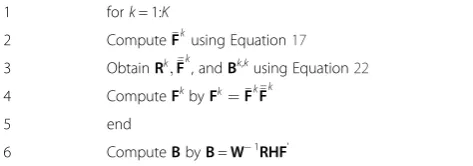
All of the matrices are designed at the central process-ing unit, and the receive processprocess-ing matrices are trans-mitted to each user by downlink channel. The procedure of the proposed centralized algorithm is summarized in Table 1.
3.4 Decentralized algorithm
In this scenario, as BSs do not exchange their local CSI, each BS independently preprocesses the user data with the local CSI of itself. The data processed by each BS cannot be obtained by other BSs. In order to ensure that the user's receive signal is not interfered by MUI, relative matrices at each BS should satisfy the ZF criterion. Therefore, Equation 11 is reduced to:
RHnFnB−n1¼Wn; n¼1;⋯;N ð24Þ user is related to the transmit signals from N BSs. If Rk is computed at BSs, each BS can only decide it dependently as the local CSI of each BS is not exchanged. Generally,Rkderived at different BSs has different values, which is unreasonable. Otherwise, for each user, fre-quently interactive information with all coordinated BSs is required. It will largely increase the system computational complexity. Therefore, we firstly compute Rk(k= 1,⋯,K)
, whereGkis a diagonal matrix for normalizing the received signal and will be determined at the BSs. For fre-quency division duplex system, user kcan only feedback the equivalent local CSIHkn¼Uk1Hknto thenth BS. There-fore, Equation 10 can be rewritten as:
σ2
n;1;⋯;σ2n;lk
¼σ2diagGkGkH
ð25Þ
Table 1 Centralized nonlinear joint tx-rx processing algorithm
1 fork= 1:K
2 ComputeFkusing Equation17
Assume that every BS has equal transmit powerp=P/N. Based on the above analysis, Equation 13 is equivalent to the following optimization problem:
max are used to guarantee the power constraint.
In Equation 26, the relative matrices are entangled with each other. Similarly, to solve this problem, we start from the ZF constraint. Take thenth BS for example. (a) in Equation 26 can be rewritten as:
HnFn¼G−1WnBn ð27Þ
As G and Wn are diagonal matrices and Bn is a unit lower triangular matrix, the left side of Equation 27 is a lower triangular matrix, i.e.,
HtnFkn¼0 ðt<kÞ ð28Þ
which reveals that Fk
nðk>1Þ lies in the null space of
The above analysis is suitable for the kth(k> 1) user. Since the first user is not limited by Equation 28, we use
Fkn¼Int.F k
ncan be achieved by:
Similarly, with Fn1 and THP, the algorithm
decom-poses the MU-MIMO channel into parallel independent
SU-MIMO channels. Define Hkn¼H separately. For thekth user, Equation 26 can be reduced to:
max
The optimal solution of Equation 32 is obtained when all lk streams attain equal SINR [29]. According to Equation 12 and Equation 25, it is equivalent to possess equal value for diagonal elements of Gk, expressed as Gk=αkI. Equation 32 is equivalent to:
tained. The problem of Equation 33 can be rewritten as:
min objective of Equation 34 is equivalent to minimizing
Let Linði¼1;⋯;lkÞ represent the ith column of H
. Then, we can attain:
By differentiating of Equation 35 with respect to bin and setting the result to zero,binis achieved by:
bin¼− Yi
Then, Bkn;k is obtained by combining all columns Bkn;keki (i= 1,⋯,lk). Therefore, we can derive users, and other matrices are designed at the BSs. The design of matrices is independently performed at every
BS. Hk
ð Þ should be transmitted to
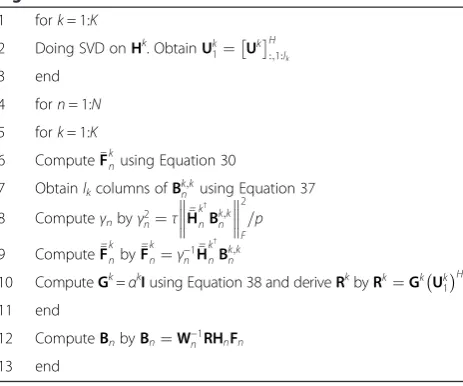
thekth(k= 1,⋯,K) user by downlink channel for achiev-ing Gk at the kth user. The procedure of the proposed decentralized algorithm is described in Table 2.
3.5 Remark 1 (applicability)
It should be noted that the proposed two algorithms are also suitable for the system with a single-data stream transmitted for each user. Moreover, the proposed two algorithms both are applicable to the noncoordinated system. However, the centralized scheme is suggested to apply for the noncoordinated system, as the decentra-lized scheme is a suboptimal solution in this situation.
4 Performance analysis
From Equation 23 and Equation 38, it is noted that both of the proposed two algorithms can achieve equal SINR for every stream of the user. They guarantee the balance
performance among streams of each user, which bring much convenience to the modulation/demodulation and coding/decoding procedures. In this section, we analyze the feasibility and the computational complexity of the proposed two algorithms.
4.1 Feasibility analysis
In the MIMO system, in order to distinguish every transmit stream, the constraint that the number of transmit data streams is no more than the number of transmit and re-ceive antennas should be satisfied. For the centralized coor-dinated mode and the decentralized coorcoor-dinated mode, the constraint on the number of transmit data streams is speci-fied as follows:
Lemma 1: For the centralized coordinated mode, the number of transmit data streams are bounded by L≤Nt,
lk≤nr; for the decentralized coordinated mode, the number
of transmit data streams are bounded by L≤nt,lk≤nr. In the proposed centralized algorithm, the design of
the transmit space matrix Fkðk¼1;⋯;KÞ requiresNt−
Xk−1
i¼1li>0 . Furthermore, to guarantee that the optimization problem Equation 19 has solutions, S≥lk is required. As the entries of HkFk are zero-mean
com-plex Gaussian variables, the rank of HkFk is S¼ min
nr;Nt−
Xk−1 i¼1li
with a probability of 1. Therefore,S≥lk is the necessary condition to carry out the algorithm. Base on Lemma 1, the necessary condition is satisfied to the centralized coordinated system. Therefore, the proposed centralized algorithm is feasible.
In the proposed decentralized algorithm,nt−
Xk−1 i¼1li>0 is required to guarantee the existence of the transmit space
matrixFknðk¼1;⋯;K;n¼1;⋯;NÞ. Moreover, the solu-tion of optimizasolu-tion problem Equasolu-tion 34 requires nt−
Xk−1
i¼1li≥lk, which is satisfied in the decentralized coordi-nated system. Therefore, the proposed decentralized algorithm is feasible.
4.2 Computational complexity
For simplicity, the number of float point operations is used to measure the computational complexity of the proposed algorithms.
In the proposed centralized algorithm, the design of the relative matrices for thekth user includes the follow-ing: a onetime multiplication of alk−1×nrmatrix and a
nr×Ntmatrix, the complexity of which isO(lk−1nrNt); a
onetime computation of the null space of a Xk−1 i¼1li
matrix, the complexity of which is O
nrNt Nt−
Xk−1 i¼1li
h i
; and a onetime computation of the
singular value of a nr Nt−
complexity. Therefore, the
complex-ity of the relative matrices designed for thekth user isO
Xk−1
In the proposed decentralized algorithm, every BS has the same computational complexity. For any BS, the design of the relative matrices for the kth user includes the fol-lowing: a onetime computation of the singular vector of a
nr×ntmatrix with O n2rnt
complexity; a onetime multiplication of alk×ntmatrix and
ant nt−
Xk−1 i¼1li
h i
matrix, the complexity of which isO
lknt nt−
Xk−1 i¼1li
h i
; and lk-times computation of the
Moore-Penrose pseudo-inverse of a nt−
Xk−1 i¼1li
h i
½lk−i
i¼1;⋯;lk
ð Þ matrix, the complexity of which is O
nt−
. The complexity of other
scalar computations can be ignored. Therefore, the complexity of the relative matrices designed for the
kth user is O Xk−1
Assume that the data streams for every user is equal, i.e.,l1=
⋯=lK=l. Thus, the complexity of the proposed centralized al-gorithm is O K L2NtþK nr2NtþK nrN2t
4.3 Remark 2 (backhaul latency effect)
For centralized coordinated mode, tx-rx processing matrices are jointly computed at the central processing unit and then reported to every BS through the backhaul link. The existing backhaul latency can affect the system performance. We ignore the backhaul latency effect in the paper and will study it in the future work.
5 Numerical results and discussions
This section presents some simulation results to evaluate the BER performance of the proposed two algorithms. We compare them with the following algorithms: the interference-free algorithm, the joint transit-receive pro-cessing algorithm proposed in [19], and the centralized BD (CBD) and decentralized BD (DBD). As the trad-itional BD cannot be directly applied in a decentralized manner, here in DBD, receive processing matrix is de-rived firstly based on the same method for receive pro-cessing matrix in the proposed decentralized algorithm, then the precoding matrix is derived based on the ZF criterion. For the system with a single stream transmit-ted for each user, i.e., lk= 1 (k= 1,…,K) system, we also compare the proposed decentralized algorithm with DZF [20] and DV-SINR [22]. Flat Rayleigh fading channels are considered in simulations. The elements of the chan-nels are i.i.d. complex Gaussian variables with zero mean and unit variance. In this simulation, a 64-QAM modu-lation scheme is employed in the simumodu-lation. The signal to noise ratio (SNR) is defined as SNR =P/(SMσ2), where
M= 4 is the signal constellation size andSis the average number of the data streams transmitted for each user.
5.1 Balance BER performance among streams of each user
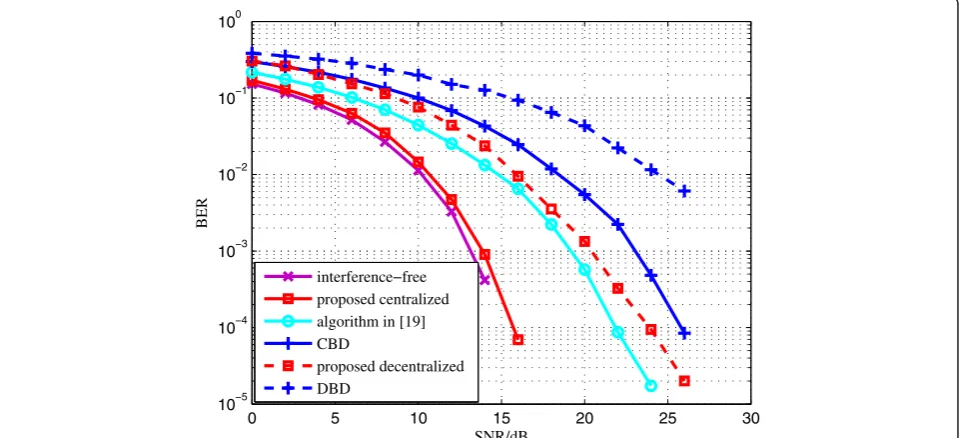
5.2 BER performance comparison of different algorithms Figure 3 presents the BER performance comparison of the six algorithms. A 2-cell coordinated system with
nt= 6 transmit antennas and K= 3 users each equipped with nr= 5 antennas is considered. The number of the data streams transmitted to each user is set to 2, i.e.,lk= 2 (k= 1,…,K). It is noticed that in the interference-free algorithm, only a single user is served by BSs. On the whole, centralized algorithms have better performance than decentralized algorithms, at the cost of information
exchange among BSs. For the proposed algorithms, the centralized algorithm achieves about 7-dB gain related to the decentralized algorithm at BER = 10−3. Compared with the existing algorithms, when BER = 10−3, the proposed centralized algorithm has an approximately 5-dB gain to the algorithm in [19] and a 10-dB gain to CBD. Also, about a 10-dB gain is achieved by the proposed decentra-lized algorithm related to DBD at BER = 10−2.
In Figure 4, we consider the BER performance of a 3-cell coordinated system, with nt= 6 transmit antennas
0 5 10 15 20 25 30
10−5 10−4 10−3 10−2 10−1 100
SNR/dB
BER first user−first stream
first user−last stream last user−first stream last user−last stream first user−first stream first user−last stream last user−first stream last user−last stream
proposed centralized algorithm proposed decentralized algorithm
Figure 2BER performance of each stream in the proposed two algorithms withN= 3,K= 3,nt= 6,nr= 3,lk= 2 (k= 1,…,K).
0 5 10 15 20 25 30
10−5 10−4 10−3 10−2 10−1 100
SNR/dB
BER
interference−free proposed centralized algorithm in [19] CBD
proposed decentralized DBD
andK= 3 users each equipped withnr= 3 antennas. The number of the data streams transmitted to each user is set to 2, i.e.,lk= 2 (k= 1,…,K). As mentioned in Figure 3, in the interference-free algorithm, only a single user is served by BSs. As can be seen from Figure 4, centralized algorithms have better BER performance than decentra-lized algorithms. The proposed centradecentra-lized algorithm has a lower BER than the algorithm in [19] and CBD, and the proposed decentralized algorithm achieves bet-ter performance than DBD. Compared with Figure 3, the
performance gains among algorithms are different, as they are related with system configuration.
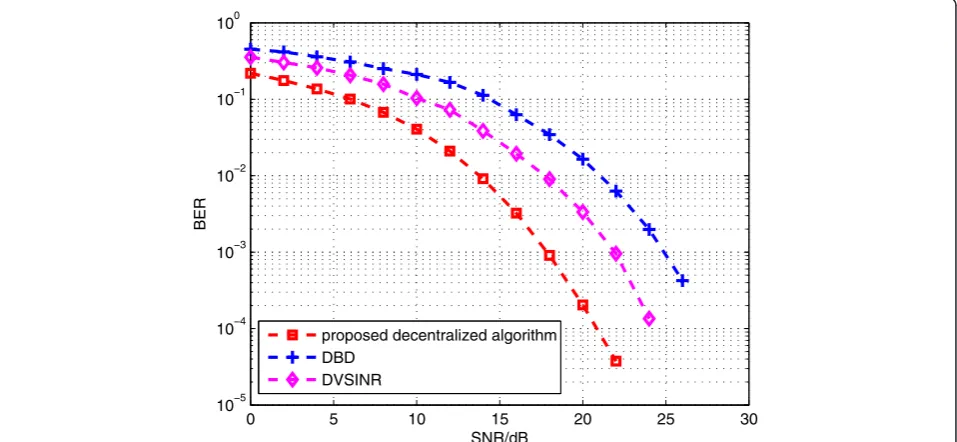
In Figure 5, the performance of the proposed decen-tralized algorithm for the system with a single stream transmitted for each user, i.e., lk= 1 (k= 1,…,K), is veri-fied and compared with the existing decentralized algo-rithms, DZF [20], and DV-SINR [22] in BER. A 3-cell coordinated system withnt= 6 transmit antennas andK= 5 users each equipped withnr= 3 antennas is considered. As can be seen from Figure 5, the proposed decentralized
0 5 10 15 20 25 30
10−5 10−4 10−3 10−2 10−1 100
SNR/dB
BER
interference−free proposed centralized algorithm in [19] CBD
proposed decentralized DBD
Figure 4BER performance of centralized and decentralized algorithms withN= 3,K= 3,nt= 6,nr= 3,lk= 2 (k= 1,…,K).
0 5 10 15 20 25 30
10−5 10−4 10−3 10−2 10−1 100
SNR/dB
BER
proposed decentralized algorithm DBD
DVSINR
algorithm has a lower BER than other algorithms. When BER = 10−3, it can achieve an approximately 7-dB gain compared with DZF, and a 5-dB gain compared with DV-SINR.
5.3 The effect of the receive antennas and user's number to centralized algorithms
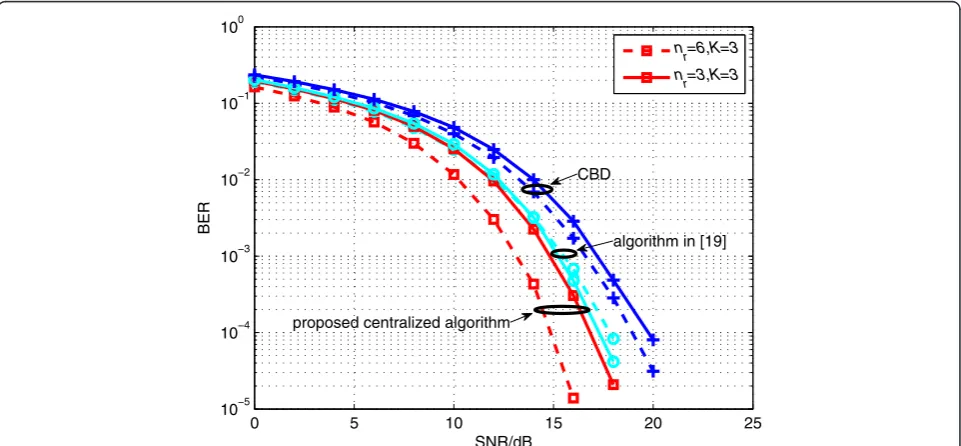
Figure 6 illustrates the effect of the number of receive antennas to the proposed centralized algorithm, the al-gorithm in [19], and the CBD. We consider a 3-cell coor-dinated system with nt= 6 transmit antennas and K= 3 users. The number of the data streams transmitted to each user is set to 2, i.e.,lk= 2 (k= 1,…,K). As can be seen from Figure 6, the performance difference between the pro-posed centralized algorithm and the algorithm in [19] is increased with the number of the receive antennas. In the proposed centralized algorithm, the receive processing matrix is considered into the MU-MIMO channel de-composition. Compared with the algorithm in [19], the decomposed SU-MIMO channels have larger dimensions, which increases the system diversity gain and improves the system performance. With a larger number of the re-ceive antennas, the decomposed SU-MIMO channels have the same dimension in the proposed centralized algorithm but have smaller dimensions in the algorithm in [19]. Therefore, with increased number of the receive antennas, the proposed centralized algorithm can achieve more performance gain than the algorithm in [19].
In Figure 7, the effect of the number of users to the pro-posed centralized algorithm, the algorithm in [19] and CBD is illustrated. We consider a 3-cell coordinated system with
nt= 6 transmit antennas and nr= 3 receive antennas. The number of the data streams transmitted to each user is set to 2, i.e.,lk= 2 (k= 1,…,K). As can be seen from Figure 7, the increased number of users enlarges the performance differences among the algorithms. The tx-rx processing matrices of each user, in CBD, are used to eliminate the interference of all other users. Differently, in the proposed centralized algorithm and the algorithm in [19], they are used to eliminate the interference of part of the other users, bringing in more space dimensions for the diversity gain.
5.4 BER performance of the proposed algorithms in a noncoordinated system
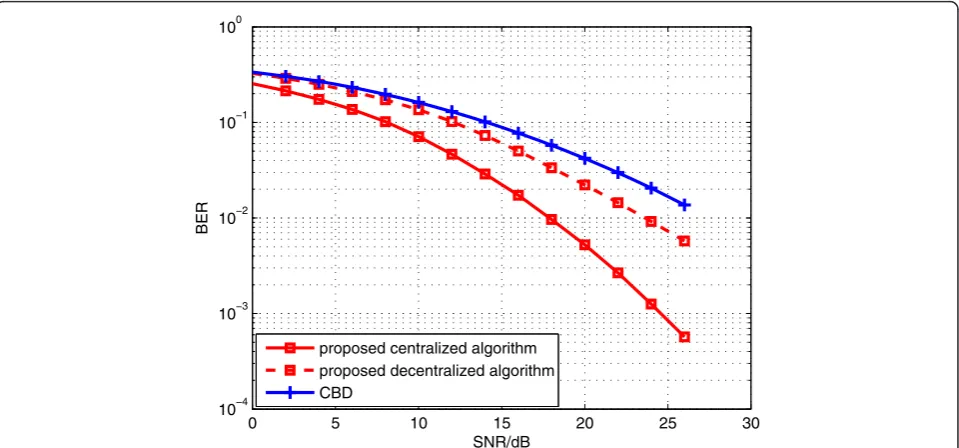
In Figure 8, we illustrate the performance of the proposed algorithms for the noncoordinated system withN= 1 and compare them with CBD. In this situation, CBD is equiva-lent to the traditional BD in a single-cell MIMO system. A MU-MIMO system, in which there are nt= 8 transmit antennas and K= 4 users each equipped with nr= 2 antennas, is considered. The number of the data streams transmitted to each user is set to 2, i.e.,lk= 2 (k= 1,…,K). It is shown that the proposed algorithms can achieve better BER performance than BD, and that the proposed decentralized algorithm is only a suboptimal scheme for the noncoordinated system, as part of the receive pro-cessing matrix is not jointly derived with the transmit processing matrix. In this situation, the proposed centralized algorithm is verified to achieve lower BER than the proposed decentralized algorithm. It exhibits an approximately 6-dB gain over the decentralized scheme at BER = 10−2.
0 5 10 15 20 25
10−5 10−4 10−3 10−2 10−1 100
SNR/dB
BER
nr=6,K=3 nr=3,K=3
proposed centralized algorithm
CBD
algorithm in [19]
6 Conclusions
Nonlinear joint tx-rx processing technology for a coordi-nated multi-cell system with multi-stream multi-antenna users has been studied. The capacity of the backhaul link determines different coordinated modes among BSs, in-cluding centralized and decentralized coordinated. The proposed centralized algorithm is proposed to derive the tx-rx processing matrices jointly at the central processing
unit. The proposed decentralized algorithm allows each BS design to transmit precoding in a decentralized manner, which alleviates the demand on the backhaul capacity. The analysis and simulation results show that the centralized algorithm achieves better performance than the decentra-lized algorithm. And, the proposed algorithms achieve better performance than the existing joint tx-rx processing algorithms and the decentralized linear precodings.
0 5 10 15 20 25 30
10−6 10−5 10−4 10−3 10−2 10−1 100
SNR/dB
BER
proposed centralized algorithm algorithm in [19]
CBD
n
r=3,K=3
n
r=3,K=6
Figure 7The effect of the number of usersKto different centralized algorithms withN= 3,nt= 6,lk= 2 (k= 1,…,K).
0 5 10 15 20 25 30
10−4 10−3 10−2 10−1 100
SNR/dB
BER
proposed centralized algorithm proposed decentralized algorithm CBD
Figure 8BER performance of the proposed algorithms in noncoordinated multi-cell system withN= 1,K= 4,nt= 8,nr= 2,
Competing interests
The authors declare that they have no competing interests.
Acknowledgements
This work is supported by the Special Funding for Beijing Common Construction Project and the Beijing Natural Science Foundation (4144079).
Author details
1
Beijing Key Laboratory of Network System Architecture and Convergence, Beijing University of Posts and Telecommunications, Beijing 100876, China. 2
School of Communication Engineering, Hangzhou Dianzi University, Hangzhou 310018, China.3School of Electronic Engineering and Computer Science, Queen Mary University of London, London E1 4NS, UK.
Received: 3 August 2014 Accepted: 5 January 2015
References
1. M Sawahashi, Y Kishiyama, A Morimoto, D Nishikawa, M Tano, Coordinated multipoint transmission/reception techniques for LTE-advanced [Coordinated and Distributed MIMO]. IEEE Wireless Commun.17(3), 26–34 (2010) 2. D Lee, H Seo, B Clerckx, E Hardouin, D Mazzarese, S Nagata, K Sayana,
Coordinated multipoint transmission and reception in LTE-advanced: deployment scenarios and operational challenges. IEEE Commun. Mag.
50(2), 148–155 (2012)
3. D Gesbert, S Hanly, H Huang, S ShamaiShitz, O Simeone, W Yu, Multi-cell MIMO cooperative networks: a new look at interference. IEEE J. Sel. Areas Commun.28(9), 1380–1408 (2010)
4. K Karakayali, GJ Foschini, RA Valenzuela, R Yates,On the maximum common rate achievable in a coordinated network. Proceedings of the IEEE International Conference Communications(IEEE, Istanbul, 2006), pp. 4333–4338
5. Z Keke, RC de Lamare, M Haardt, Multi-branch Tomlinson-Harashimaprecoding design for MU-MIMO systems: theory and algorithms. IEEE Trans Commun.
62(3), 939–951 (2014)
6. S Jing, D Tse, J Soriaga, J Hou, J Smee, R Padovani, Multicell downlink capacity with coordinated processing. EURASIP J. Wireless Commun.Netw
2008, 586878 (2008)
7. S Liyan, Y Chenyang, H Shengqian, The value of channel prediction in CoMP systems with large backhaul latency. IEEE Trans Commun.
61(11), 4577–4590 (2013)
8. Papadogiannis, E Hardouin, D Gesbert, Decentralisingmulticell cooperative processing: a novel robust framework. EURASIP J. Wireless Commun.Netw
2009, 890685 (2009)
9. R Zhang, Cooperative multi-cell block diagonalization with per-basestation power constraints. IEEE J. Sel. Areas Commun.28, 1435–1445 (2010) 10. S Shi, M Schubert, N Vucic, H Boche,MMSE optimization with
per-base-station power constraints for network MIMO systems. Proceedings of the IEEE International Conference Communications(IEEE, Beijing, 2008), pp. 4106–4110 11. J Zhang, Y Wu, S Zhou, J Wang, Joint linear transmitter and receiver
design for the downlink of multiuser MIMO systems. IEEE Commun Lett
9(11), 991–993 (2005)
12. RC de Lamare, Adaptive and iterative multi-branch MMSE decision feedback detection algorithms for multi-antenna systems. IEEE Trans. Wirel. Commun.
12(10), 5294–5308 (2013)
13. H Park, SH Park, HB Kong, I Lee, Weighted sum MSE minimization under per-BS power constraint for network MIMO systems. IEEE Commun. Lett16(3), 360–363 (2012)
14. S He, Y Huang, L Yang, B Ottersten, Coordinated multicell multiuser precoding for maximizing weighted sum energy efficiency. IEEE Trans. Signal Process.62(3), 741–751 (2014)
15. M Wei, C Xiang, Z Ming, W Jing, Joint stream-wise THP transceiver design for the multiuser MIMO downlink. IEICE Trans. Commun.92(1), 209–218 (2009) 16. W Hardjawana, B Vucetic, Y Li, Multi-user cooperative base station systems
with joint precoding and beamforming. IEEE J Sel Top Signal Process
3(6), 1079–1093 (2009)
17. S Adão, H Reza, G Atílio, Power allocation strategies for distributed precodedmulticell based systems. EURASIP J. Wireless Commun. Netw
2011, 1 (2011)
18. Y Sun, M Wu, M Zhao, C Xu,Transceiver designs using non-linear precoding for multiuser MIMO systems with limited feedback. Proceedings of the IEEE VehicularTechnology Conference(IEEE, Dresden, 2013), pp. 1–5
19. L Sun, M Lei,Adaptive joint nonlinear transmit-receive processing for multi-cell MIMO networks. Proceedings of the IEEE Globe Communications Conference (IEEE, Anaheim, 2012), pp. 3766–3771
20. R Holakouei, A Silva, A Gameiro,Distributed versus centralized zero-forcing precoding for multicell OFDM systems. Proceedings of the IEEE Globe Communications ConferenceWorkshops(IEEE, Houston, 2011), pp. 188–193 21. R Zakhour, D Gesbert, Distributed multicell-MISO precoding using the
layered virtual SINR framework. IEEE Trans. Wireless Commun.9(8), 2444–2448 (2010)
22. E Bjornson, R Zakhour, D Gesbert, B Ottersten, Cooperative multicell precoding: rate region characterization and distributed strategies with instantaneous and statistical CSI. IEEE Trans. Signal Processing58(8), 4298–4310 (2010) 23. X Zhao, H Xu, X Yang,Performance enhancement for CoMP based on power
allocation and a modified ZF-THP. Proceedings of the IEEE Personal Indoor and Mobile Radio Communications(IEEE, Sydney, 2012), pp. 2309–2313 24. I Krikidis, B Ottersten, Diversity fairness in Tomlinson–Harashimaprecoded
multiuser MIMO through retransmission. IEEE Signal Process Lett.20(4), 375–378 (2013)
25. G Boudreau, J Panicker, N Guo, R Chang, N Wang, S Vrzic, Interference coordination and cancellation for 4G networks. IEEE Commun. Mag.
47(4), 74–81 (2009)
26. J Tang, S Lambotharan, Interference alignment techniques for MIMO multi-cell interfering broadcast channels. IEEE Trans. Commun.
61(1), 164–175 (2013)
27. R.F.H.Fisher, Precoding and signal shaping for digital transmission (John Wiley & Sons Ltd, 2002)
28. Y Jiang, W Hager, J Li, The generalized triangular decomposition. Math. Comput.77, 1037–1056 (2007)
29. A Wiesel, E Yonina, CS Shlomo, Linear precoding via conic optimization for fixed MIMO receivers. IEEE Trans. Signal Process.54(1), 161–176 (2006)
Submit your manuscript to a
journal and benefi t from:
7Convenient online submission
7Rigorous peer review
7Immediate publication on acceptance
7Open access: articles freely available online
7High visibility within the fi eld
7Retaining the copyright to your article