A Theoretical Framework for Soft-Information-Based
Synchronization in Iterative (Turbo) Receivers
Nele Noels,1Vincenzo Lottici,2Antoine Dejonghe,3Heidi Steendam,1Marc Moeneclaey,1
Marco Luise,2Luc Vandendorpe3
1Department of Telecommunications and Information Processing, Ghent University, 9000 Gent, Belgium
Emails:[email protected],[email protected],[email protected]
2Department of Information Engineering, University of Pisa, 56122 Pisa, Italy
Emails:[email protected],[email protected]
3Communications and Remote Sensing Laboratory, Universit´e Catholique de Louvain, 1348 Louvain-la-Neuve, Belgium
Email:[email protected],[email protected]
Received 13 May 2004; Revised 29 September 2004
This contribution considers turbo synchronization, that is to say, the use of soft data information to estimate parameters like carrier phase, frequency, or timing offsets of a modulated signal within an iterative data demodulator. In turbo synchronization, the receiver exploits the soft decisions computed at each turbo decoding iteration to provide a reliable estimate of some signal parameters. The aim of our paper is to show that such “turbo-estimation” approach can be regarded as a special case of the expectation-maximization (EM) algorithm. This leads to a general theoretical framework for turbo synchronization that allows to derive parameter estimation procedures for carrier phase and frequency offset, as well as for timing offset and signal amplitude. The proposed mathematical framework is illustrated by simulation results reported for the particular case of carrier phase and frequency offsets estimation of a turbo-coded 16-QAM signal.
Keywords and phrases:turbo synchronization, iterative detection, turbo codes, parameter estimation.
1. INTRODUCTION
The impressive performance of turbo codes [1] has triggered in the last decade a lot of research addressing the applica-tion of this powerful coding technique to digital communi-cations [2]. More recently, the associated idea of iterative de-coding has been extended to other receiver functions. This led to the so-calledturbo principlewhich enables to perform (sub)optimal joint detection and decoding through the iter-ative exchange of soft information between soft-input/soft-output (SISO) stages. See [3,4] for a review of some existing turbo receivers.
In addition to detection/decoding a receiver has also to perform signal synchronization, that is, to estimate a number of parameters like carrier phase offset, frequency offset, tim-ing offset, and so forth. Synchronization for turbo-encoded systems is a challenging task since the receiver usually
This is an open access article distributed under the Creative Commons Attribution License, which permits unrestricted use, distribution, and reproduction in any medium, provided the original work is properly cited.
operates at low SNR values (which can be defined as the ratio between the mean bit energy and the noise spectral density). In the technical literature a great effort is thus being devoted to the development of efficient estimation techniques to per-form the above-mentioned synchronization functions within turbo receivers. We outline here at least two categories of al-gorithms.
receivers are proposed in [9] based on the insertion into each transmitted coded block of a number of pilot symbols with the aim of helping the joint phase estimation and decoding process.
(ii) The second category consists of algorithms that try to use the soft information provided at each iteration by a conventional turbo decoder. This approach will be re-ferred to as turbo synchronization in the sequel. In [10], a carrier phase recovery algorithm operating in conjunction with the SISO decoders and exploiting the extrinsic informa-tion generated at each iterainforma-tion is proposed. Furthermore, in [11, 12], for instance, it is proposed to combine soft-decision-directed carrier phase estimation with turbo decod-ing. Tentative decision-aided synchronization within a turbo decoder is reported in [13,14].
Algorithms in the latter category seem to be promis-ing but they often do not rely on any theoretical basis. The purpose of this paper is therefore to give a mathemat-ical interpretation of such turbo synchronization algorithms and to generalize them. This can be done by means of the expectation-maximization (EM) algorithm. Such an algo-rithm has been applied to various problems, as in [15], for instance, wherein it is used for channel and noise variance estimation in combination with optimal BCJR-based detec-tion. The same is done in [16] in combination with a subop-timal filter-based equalizer and in [17] for a coded CPM sys-tem. In [18], channel gain, and delay estimation is performed in an uncoded CDMA system with a hard-output iterative se-rial interference canceller. These ideas have been extended to turbo receivers in [19] (see also references therein) and [20] for channel and noise variance estimation in turbo-CDMA and turbo-MIMO contexts, respectively.
In the present paper, we will focus on the specific prob-lem of synchronization.Section 2will give a general formu-lation of iterative ML estimation of unknown parameters in the presence of nuisance parameters by means of the EM al-gorithm. The particular issue of synchronization (i.e., car-rier phase, frequency offset, channel gain, and timing esti-mation) for a digital data-modulated passband signal will then be addressed in Section 3. This implementation will then be extended to the turbo context by showing that the EM algorithm iterations (for parameter estimation) can be combined with those of a turbo receiver (for symbol detec-tion/decoding). This will lead to a general theoretical frame-work for turbo synchronization. In particular, it will turn out that algorithms introduced in an ad hoc fashion, such as the blind soft-decision-directed carrier phase turbo synchronizer recently proposed in [11], actually correspond to a particu-lar instance of the general scheme proposed here. In order to illustrate the mathematical considerations, in Section 4 we consider as a case study the practical problem of carrier phase and frequency offsets estimation for a turbo-coded 16-QAM system. The relevant simulation results show that the proposed scheme enables to perform blind reliable synchro-nization and almost ideal coherent detection at very low SNR as required in a turbo receiver.Section 5considers the com-putational complexity of the proposed algorithm, whereas a concluding section eventually ends up the paper.
2. ML ESTIMATION IN THE PRESENCE OF A NUISANCE VECTOR
We denote with ra random vector obtained by expanding the received modulated signalr(t) onto a suitable basis, and we indicate with b a deterministic vector of parameters to be estimated from the observation of the received vectorr. Assume thatralso depends on a random nuisance parame-ter vectoraindependent ofband with a priori probability density function (pdf) p(a). The problem addressed in this section is to find the ML estimatebofb, that is to say, the solution of
b=argmax b
lnpr|b. (1)
The likelihood function to be maximized with respect to the trial valuebofbis obtained after elimination of the nuisance parameter vectoraas follows:
pr|b=
ap(a)p
r|a,bda. (2)
In order to solve (1), we take the derivative of lnp(r|b) with respect toband we equate it to zero, that is,
∂ ∂blnp
r|b
=
ap(a)p
r|a,b∂/∂blnpr|a,bda
ap(a)p
r|a,bda
=
a
p(a)pr|a,b
pr|b
∂ ∂blnp
r|a,bda=0.
(3)
Now, it is easily seen using Bayes’ rule that the first factor in the integrand into (3) is nothing but the a posteriori condi-tional pdfp(a|r,b) of the nuisance vector
p(a)pr|a,b
pr|b =p
a|r,b. (4)
Therefore, the ML estimation problem given by (1), (2), and (3) is turned into
∂ ∂blnp
r|b=
ap
a|r,b ∂
∂blnp
r|a,bda
=Ea ∂
∂blnp
r|a,br,b
=0.
(5)
In other words, the ML estimatebofbis that value that nulls the conditional a posteriori expectation of the derivative with respect tobof the conditional log-likelihood function (LLF) lnp(r|a,b).
solutionb(n)by solving the resulting simplified equation that Observe now that the first factor of the integrand in (6) does not depend onb(n). Therefore, we can bring the deriva-tive back out of the integral and obtain the equivalent equa-tion
that is, the estimateb(n)maximizes the conditional a posteri-ori expectation of the conditional LLF lnp(r|a,b):
Formulation (8a)-(8b) of our iterative solution can also be derived by means of the EM algorithm [21,22,23]. Con-sider ras the “incomplete” observation andz = (rT,aT)T
as the “complete” observation. The EM algorithm states that the sequenceb(n)defined by
(i) expectation step (E-step):
Qb,b(n−1)=Ea
lnpz|b|r,b(n−1), (9a) (ii) maximization step (M-step):
converges to the ML estimate under mild conditions [21,22]. To make (9a)-(9b) equivalent to (8a)-(8b), we observe that, by using the Bayes rule and considering that the distribu-tion ofadoes not depend on the parameter vector to be esti-mated, as the M-step is concerned, it can be dropped. Consequently, the estimation procedure given by (8a)-(8b) and the EM al-gorithm, defined by (9b) and (11), yield the same sequence of estimates. We explicitly observe that the solution of (1) can be found iteratively by only using a posteriori probabilities
p(a|r,b(n−1)) and the LLF lnp(r|a,b).
3. APPLICATION TO SYNCHRONIZATION FOR SOFT-INFORMATION-BASED RECEIVERS
3.1. EM-based synchronization
In this section, we will show how to apply the general frame-work of the previous section to the estimation of the syn-chronization parameters for a digital data-modulated band-pass signal. In this context, the nuisance parameter vector a contains the values of the N unknown (hence random) transmitted symbols, that is, aT = (a0,. . .,a
N−1). Those
symbols take values in anM-point constellationA(such as
M-PSK, M-QAM, etc.) according to some rule. Thus, the vector ahas a probability mass function (pmf)P(a = µ), withµT = (µ0,. . .,µ
N−1) and µ ∈ AN. The vectorb
con-tains the synchronization parameters to be estimated, that is, bT = (A,τ,ν,ϑ) whereA,τ,ν,ϑ are the channel gain,
symbol timing, carrier frequency, and phase offsets, respec-tively. Here, the synchronization parameters are assumed as constant within the received code block. This has the ad-vantage of simplifying notably the processing required by the estimation algorithm while inherently is the main lim-itation of the approach itself. However, a possible yet rea-sonable solution to handle a time-varying phase offset (due, e.g., to phase noise) is shown in [24]. The idea is quite sim-ple and consists in subdividing the entire block in a num-ber of subblocks within which the phase can be considered approximately as constant, and then in applying to each of them the soft-information-based estimation procedure pro-posed above. Further, yet again for the sake of simplicity, we will consider in the sequel an AWGN channel as well. Hence, putting all these facts together, the baseband received signal
r(t) can be written as square-root raised-cosine) pulse, andw(t) is complex-valued AWGN with power spectral density 2N0 (assumed to be known).
where
is obtained by frequency precompensating the received sig-nal by the “trial” value −ν, then applying the result to the matched filterg(−t), and finally sampling the matched filter output at the “trial” instant kT +τ. Substituting (13) into ori mean and a posteriori mean square value of the channel symbolak, respectively, as follows:
ηk
) denotes the marginal a posteriori prob-ability (APP) of thekth channel symbolak conditioned on
the observationrand on the estimateb(n−1)at the previous (n−1)th step, andαmtheMpossible values taken in the
con-stellationA. Equation (15) can then be rearranged as
Λb,b(n−1)= −2ARe
We emphasize the similarity between (13) and (17): the latter is formally obtained from the former by simply replacing the termsak and|ak|2by their respective a posteriori expected
valuesηk(r,b
given by (17), with respect tob. The corresponding result is
The obtained solution can be interpreted as an iter-ative synchronization procedure, which can be referred to as soft-decision-directed (SDD) synchronization. What we call here soft decisions are the a posteriori average values
ηk(r,b
(n−1)
) andρk(r,b
(n−1)
) of each channel symbol. They are a sort of “weighted average” over all the constellation points according to the respective symbol APPs. Note that, thanks to (16a) and (16b), these a posteriori average val-uesηk(r,b
(n−1)
) andρk(r,b
(n−1)
) can be computed from the
marginalsP(ak=αm|r,b
(n−1)
) only. In other words, due to the particular structure of the digital data-modulated signal, the implementation of the iterative ML estimation algorithm only requires the evaluation of the marginal a posteriori sym-bol probabilitiesP(ak=αm|r,b
(n−1) ).
We now concentrate on the evaluation of the marginal a posteriori symbol probabilities. Whereas for uncoded trans-mission the usual assumption is that data symbols are inde-pendent and equally likely (yieldingP(a=µ)=M−Nfor all µ∈AN), for a coded transmission with code rateλ, we only
have a subsetB ⊂ANof all possible sequences
correspond-ing toMλN legitimate encoder output sequences. Therefore,
taking into account that the APP of the symbol sequenceais given by
which relates the APP of the symbol sequence to the condi-tional likelihood function. Note that the result for uncoded transmission is obtained from (21) by takingB = AN.
Fi-nally, the marginal APP related to a symbolakis obtained by
summing the symbol sequence APPs (21) over all symbolsai
Evaluation of the APPs according to (21) yields a com-putational complexity that increases exponentially with the sequence length N, as all possible data sequences must be enumerated. However, in systems where the received sig-nal can be modeled as a Markov process, (i.e., transmis-sion over a frequency selective channel, coded systems, MIMO or CDMA systems, etc.), the marginal symbol APPs
P(ak=αm|r,b
(n−1)
) can be efficiently obtained using the BCJR algorithm [25], with a complexity that grows only lin-early with the sequence length N. Note however that the computations related to the BCJR algorithm must then be carried out once per iteration of the synchronizer.
3.2. Turbo synchronization
The EM-based synchronization procedure proposed in the previous subsection is intrinsically well suited to iterative (turbo) receivers that perform detection/decoding through extrinsic information exchange between SISO stages. Indeed, one usually assumes that such receivers provide, after con-vergence of the iterative process, soft information that equals channel symbol APPs. This makes synchronization via the EM algorithm and turbo receivers complementary since the symbol APPs needed by the first one can be provided by the second one.
As shown in the previous subsection, the estimation of the synchronization parameters needs at each EM iteration the knowledge of the marginal APPs P(ak=αm|r,b
(n−1) ) in order to compute the a posteriori expected values
ηk(r,b
(n−1)
) and ρk(r,b
(n−1)
) required for the evaluation of (18a), (18b), and (18c). In a strict implementation, this means that at each EM iteration the turbo receiver has to reinitialize the extrinsic information, and then has to iterate until the soft information reaches a steady-state value, in order to yield good approximations of the re-quired symbol APPs. It is clear that the main drawback of this approach is the considerable increase in com-plexity and latency in comparison with the correspond-ing ideal synchronized turbo receiver, since the turbo sys-tem is required to converge at each EM iteration. To deal with such a trouble, an approximate implementation can be used: the turbo decoder is no longer reinitialized and at each EM iteration only one detection/decoding it-eration is performed. In other words, the synchroniza-tion iterasynchroniza-tions (EM algorithm) are merged with the detec-tion/decoding ones (turbo decoder). Note that this approx-imate “merged” procedure strictly differs from the EM al-gorithm in that performing only one detection/decoding it-eration at each EM itit-eration (especially in the first ones) leads to poorer estimations of the required symbol APPs. To investigate the potential performance degradation that the proposed simplified algorithm may imply, in [26] the BER performance of both the EM-based synchronizer and its approximate version are evaluated in the context of a BICM (bit-interleaved-coded modulation) 8-PSK trans-mission scheme. The difference between the two diff er-ent synchronization methods is that at each EM iteration
in the former we make additionally 5 detection/decoding iterations whereas in the latter only 1 detection/decoding iteration is performed. In spite of this rough simplifica-tion, the simulation results surprisingly indicate a negli-gible performance degradation at EM iteration 10, even though the EM-based method exhibits a faster convergence due to a more reliable symbol APPs estimates in the first iterations.
When applied to the specific case of carrier phase estima-tion for turbo-coded QAM transmission, the proposed ap-proximate implementation leads to the algorithm introduced earlier in an ad hoc fashion in [11,27], wherein the symbol APPs computed at each turbo decoding iteration are prop-erly combined with the received samples in order to provide a reliable estimate necessary for coherent demodulation. This leads in this case to a sort of “bootstrapping effect,” wherein decoding helps synchronization that in turn aids decoding and so forth. Therefore, more generally it can be concluded that the proposed mathematical framework provides a the-oretical justification to the category of ad hoc algorithms which make use of the available soft decisions in a turbo re-ceiver for the purpose of iteratively estimating the synchro-nization parameters. Furthermore, if one has to deal with a parameter vectorbfor which more than one or two parame-ters have to be estimated at the same time, it may happen that the turbo receiver must be allowed to proceed for more iter-ations between the synchronization steps. In this more de-manding context, the number of needed detection/decoding iterations has to be selected considering the trade-off be-tween the requirement on providing an accurate estimation of the APPs and the corresponding increase in complexity and latency.
As far as the initial parameter estimateb(0)is concerned, we have to point out that convergence of our iterative, EM-like, synchronization algorithm to the true ML estimate is not unconditional. Due to the highly nonlinear properties shown by the turbo decoding process, a good choice of
4. SIMULATION RESULTS
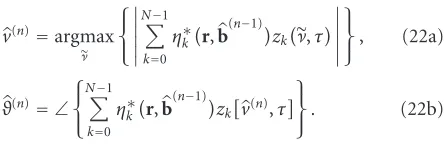
Theoretical analysis of the proposed algorithms proved to be extremely difficult. We resorted therefore to simulation to de-rive performance results of the different iterative SDD turbo synchronization algorithms. As a case study, we consider a turbo-coded QAM-modulated transmission scheme. We fo-cus here on the simple case where the channel gainAand the timing offsetτare known to the receiver, so that only the car-rier frequency offsetνand phase offsetϑ, assumed to be con-stant within the received block, have to be estimated. To be more specific, the corresponding joint SDD phase-frequency recovery procedure is based on (18a)-(18b), that is, assum-ing the estimates ofAandτreplaced by their a priori known values can be written as
v(n)=argmax
ν
N−1
k=0
η∗k
r,b(n−1)zk
ν,τ
, (22a)
ϑ(n)=∠
N−1
k=0
η∗kr,b(n−1)zk
v(n),τ
. (22b)
The required a posteriori average valuesηk(r,b
(n−1) ) given by (16a) are evaluated on the basis of the symbol APPs com-puted at the output of the turbo decoder (see Section 5for more details). In the sequel, according to the discussion in Section 3.2, only one decoding iteration is performed at each synchronization iteration, in order to limit the overall com-plexity and latency. Therefore, at the nth iteration the esti-matev(n)is found according to (22a) and used to reevaluate the sampleszk(ν,τ) byfrequencycompensating the received
signal by−v(n)and sampling the matched filter output at the “exact” instantkT+τ. Then, the phase estimateϑ(n)is com-puted by applying (22b) and eventually employed forphase
compensating the matched filter output samples for the next decoding iteration. As initial estimates for the iterative syn-chronization procedure, we took (v(0),ϑ(0))=(0, 0) in (22a )-(22b).
We consider the simple rate−λ=3/4 turbo encoder that encompasses parallel concatenation of two identical binary 16-state rate−1/2 recursive systematic convolutional (RSC) encoders with generatorsg1 = (31)8 andg2 = (33)8 [28], via a pseudorandom interleaver with block lengthL=1500 information bits, and an appropriate puncturing pattern so that the block at the turbo-encoder output comprises 2000 coded bits. This binary turbo code is combined with con-ventional gray-mapped 16-QAM modulation (giving rise to a transmitted block of 500 symbols) adhering to the so-called suboptimum “pragmatic approach” wherein coding and modulation are performed separately, as illustrated in [29]. Simulation results are provided assuming that the car-rier frequency and phase offsets are time-invariant on the transmitted data block. In addition, the above offsets change from one block to the next only in the case of the single-block joint SDD carrier recovery approach, whereas they are considered invariant if the time-recursive algorithm is applied.
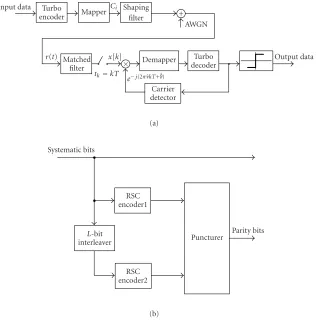
The baseband-equivalent architecture of such a turbo-coded transmission system and the encoder schematic are depicted in Figures1aand1b, respectively. Note that, in con-trast with (14), frequency correction is appliedaftermatched filtering. Indeed, in the case of|νT| 1, this modification causes a negligible performance degradation and, more no-tably, enables a remarkable reduction in the receiver com-plexity. At the receiver, consistently to the encoding process, pragmatic disjoint demodulation and binary turbo decod-ing is performed. As for the latter, to decrease its computa-tional complexity we resort to a suboptimal solution given by the Max-Log-MAP algorithm [30]. Further, the symbol APPs required by the turbo synchronization algorithm can be obtained from the coded bits log-likelihood ratios (LLRs) made available at the output of the binary turbo decoder (see Section 5for more details).
The proposed synchronization algorithm’s performance will be assessed through evaluation of the mean estimated value (MEV) and the root-mean squared estimation error (RMSEE). We will also investigate the overall BER perfor-mance of the coded system with carrier recovery as compared to ideal synchronization, taking as main design parameters the number of decoder iterationsIand the energy per bit-to-noise spectral density ratioEb/N0.
4.1. MEV curves
Figure 2depicts the MEV curves (i.e., the average estimated value E{ϑ}as a function of the true phase offsetϑ) for the SDD phase recovery algorithm based on (22b) for diff er-ent numbers of decoder iterations I = 8, 10, 12, assuming a null frequency offset and with Eb/N0 = 6 dB (roughly corresponding to BER = 10−4with ideal carrier recovery). The difference between the MEV curves is not significant for phase errors |ϑ| ≤ 20◦, whatever the number of iterations, whereas with larger phase errors the bias of the algorithm is negligible only forI = 10, 12. For the particular transmis-sion scheme ofFigure 1a, the rotational invariance is not de-stroyed and the usual π/2 estimation ambiguity due to the four-fold symmetry of the QAM constellation is apparent, as can be found in [11]. Note that, if one can afford an increase in complexity, the above problem can be easily handled by evaluating the average value of the absolute soft output of the decoder for different multiples ofπ/2, and choosing the phase offset that provides the highest reliability according to the approach illustrated in [12].
The MEV curves illustrated inFigure 2suggest using this estimator as a sort of phase error detector in atime-recursive
recovery scheme. This can be done on a block-by-block re-cursive basis as follows. We denote withϑmthe time-recursive
phase estimate related to the mth data block and withϕ(mI)
the phase error estimate after I decoding iterations as de-scribed above. After a prerotation of the received samples in the (m+ 1)th data block by−ϑmand a new phase error
esti-mateϕ(mI)+1, the phase estimate for the (m+ 1)th data block is computed as
Input data Turbo
encoder Mapper
Shaping
filter +
Ci
AWGN
r(t) Matched
filter
tk=kT
x[k]
× Demapper decoderTurbo Carrier
detector
Output data
e−j(2πˆνkT+ ˆϑ)
(a) Systematic bits
RSC encoder1
Puncturer
L-bit interleaver
RSC encoder2
Parity bits
(b)
Figure1: (a) Turbo-coded transmission system and (b) turbo-encoder schematic.
assuming as starting conditionϑ0 =ϕ(0I). We found by sim-ulation that to accomplish an adequate acquisition only 3 blocks are sufficient (i.e., just 3 updates on min (23)). In doing so, the operating point of the phase error estimator is progressively brought back to the vicinity of the origin, that is, in a negligible-bias zone. Indeed, the results in Figure 3 obtained forI=10 iterations show the improvement of the recursive algorithm with respect to the one based on a single block.
We now tackle the additional issue of carrier frequency recovery. We have to jointly solve (22a) (where the timing off -set is considered perfectly known) and (22b).Figure 4shows the MEV curves for the single-block estimation of the phase offset, for the true values (ϑ = 0◦, 10◦, 20◦, 30◦), as a func-tion of the true normalized frequency offsetνT. Results are provided for I = 12 decoder iterations andEb/N0 = 6 dB. The joint estimator works fine up to |ϑ| ≤ 20◦, but the operating interval for frequency recovery is quite narrow, that is,|νT|< 10−4, if compared with a conventional data-aided method [31]. This can be easily explained if we con-sider the following fact. For a given block length, the resid-ual frequency offset causes a phase rotation on the received signal samples leading to a considerable performance degra-dation for the constituent SISO decoders. Clearly, the larger the frequency offset, the larger will also be the phase rotation
on the block samples. Consequently, there exists a threshold value for the frequency offset, such that the overall phase ac-cumulated on a block will be aroundπ, above which the re-liability of the decoded bits, even after a few decoding iter-ations, will stay small. This hinders joint convergence of the (blind) frequency estimator and data decoder.
The time-recursive approach can be used to improve the performance of joint phase-frequency recovery as well. To be more specific, the frequency and phase estimates are used to precorrect the received signal samples in the subsequent block both in frequency and in phase prior to a new iterative estimation. Unfortunately, the improvement for frequency is not as dramatic as for phase estimation, as can be seen from Figure 5. The operating range for the carrier frequency esti-mator is now|νT|< 3·10−4forI =12 decoder iterations andEb/N0=6 dB. The conclusion is that some form of “quency sweeping” is required in order to perform initial fre-quency acquisition when the offset is larger than the value above. Further enlargement of this range can be alternatively obtained by partitioning the code block into shorter estima-tion windows, over which we can apply (time-recursive) joint estimation. With shorter windows, a larger frequency oper-ating range is obtained, but the phase estimation accuracy decreases, so that an optimum length will exist for a given
60 40 20 0
−20
−40
−60
−180 −120 −60 0 60 120 180
Phase offset (deg)
Phase
M
E
V
(deg)
I=12
I=10
I=8
Figure2: MEV curves for single-block phase SDD recovery with different iteration numbers, 16-QAM,λ=3/4,L=1500,Eb/N0= 6 dB.
60 40 20 0
−20
−40
−60
−180 −120 −60 0 60 120 180
Phase offset (deg)
Phase
M
E
V
(deg)
Single block Time-recursive
Figure 3: MEV curves for time-recursive and single-block SDD phase recovery, 16-QAM,λ=3/4,L=1500,Eb/N0=6 dB.
4.2. RMSEE curves
Figure 6shows the curves of RMSEEσθ(i.e., #
E{(ϑ−ϑ)2}) of the phase SDD recovery algorithm as a function of
Eb/N0 for various values of the true offset ϑ. The curves are compared to the modified Cram´er-Rao bound (MCRB) [31], and with ideal DA estimation that lies exactly on the MCRB. Conversely, the RMSEE performance of SDD gets approximately close to the bound for Eb/N0 ≥ 6 dB only, that is, in the interval where soft-data decisions are reli-able enough (as will be illustrated in the sequel). It is also noted that the RMSEE curve for conventional hard-decision-directed (HDD) phase estimation, that is, based on the de-cisions taken at the decoder input, is catastrophic. This is
30 20 10 0
−10
−20
−30
10−5 2 3 4 5 6 710−4 2 3 4 5 6 710−3 2 3 4 5 6 710−2
Frequency offsetνT
Phase
M
E
V
(deg)
θ=0◦
θ=10◦
θ=20◦
θ=30◦
Figure 4: MEV phase curves for single-block joint SDD phase-frequency recovery with different true phase, 16-QAM,λ = 3/4,
L=1500,Eb/N0=6 dB.
6 4 2 0
−2
−4
−6
×10−4
−6 −4 −2 0 2 4 6
×10−4
Frequency offsetνT
Fre
q
u
en
cy
M
EV
Single block Time-recursive
Figure 5: MEV curves for time-recursive and single-block joint SDD phase-frequency recovery, 16-QAM, λ = 3/4, L = 1500,
Eb/N0=6 dB.
10
9 8 7 6 5 4
3
2
1
9 8 7 6 5 4
3
2
0.1
2 3 4 5 6 7 8 9 10
Eb/N0(dB)
Phase
RMSEE
σθ
(deg)
SDDθ=0◦ SDDθ=10◦ HDDθ=10◦
IHDDθ=10◦ DA
MCRB
Figure 6: RMSEE curves for single-block SDD and IHDD, DA, HDD phase recovery, 16-QAM,λ=3/4,L=1500,I=12.
The curves for the frequency RMSEE σνT (i.e., #
E{(ν−ν)2T2}) in Figure 7 follow the same general pattern as those for the phase. As noted for SDD phase recovery, the frequency MCRB bound [31] is attained for
Eb/N0 ≥ 6 dB, and negligible performance degradation is observed both for the frequency offsets νT = 0 and νT=10−4.
4.3. BER performance
To get a picture about the overall performance of the 16-QAM turbo receiver equipped with the proposed SDD car-rier synchronizer, the BER curves can be evaluated as a func-tion of the signal-to-noise ratioEb/N0. For each curve all
sim-ulation runs were stopped upon the detection of 100 frame error events. Specifically,Figure 8shows the BER curves with time-recursive SDD phase recovery and withI = 10 itera-tions. The curves with a phase offsetϑ =20◦, 40◦exhibit a negligible performance degradation with respect to the one with ideal phase recovery. These curves motivate the depar-ture of the RMSEE curves of SDD synchronization from the MCRB. The “knee point” of the RMSEE curves, which roughly corresponds to Eb/N0 = 6 dB, is in fact located in the so-called “waterfall region” (abrupt BER decrease). The associated BER is then sufficiently decreased and the syn-chronization algorithm performance tends to that of a DA synchronizer. Further, for the sake of completeness, is wor-thy to point out that a similar behavior is found even with a lower rate, namely 1/2, encoder combined with a 4-QAM modulation format, as shown in the results presented in [11,27].
10−4 9 8 7 6 5 4
3
2
10−5 9 8 7 6 5 4
3
2
10−6
2 3 4 5 6 7 8 9 10
Eb/N0(dB)
Phase
RMSEE
σνT
SDDνT=0 SDDνT=10−4
MCRB
Figure 7: RMSEE curves for single-block joint SDD phase-frequency recovery, 16-QAM,λ=3/4,L=1500,I=12.
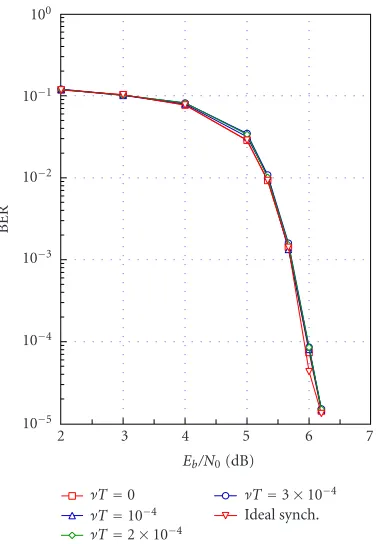
The BER curves for joint SDD phase-frequency recov-ery are illustrated in Figures 9and10in the case of single-block and time-recursive estimation, respectively. The main result which has to be pointed out is that the performance of single-block-based joint SDD phase-frequency recovery al-gorithm gets worse for increasing frequency offsets to be esti-mated, while the time-recursive approach enables to achieve turbo decoding with a negligible degradation with respect to ideal synchronization for a frequency offset up to about νT=3·10−4. The increased robustness of the time-recursive version of the proposed synchronizer is coherent with what was already observed above inSection 4.1. Indeed, with the iteration of (23) the carrier offset estimation error is pro-gressively reduced despite a nonnegligible initial value due to, for instance, the choice of employing a shorter preamble to achieve a better efficiency.
5. COMPUTATIONAL COMPLEXITY
In this section we focus on the computational complexity of the turbo receiver (whose performance has been evaluated in Section 4) performing soft-decision-based iterative car-rier synchronization. In particular, we perform a comparison with the complexity of the turbo receiver with ideal synchro-nization.
100
10−1
10−2
10−3
10−4
10−5
2 3 4 5 6 7
Eb/N0(dB)
BER
θ=0◦
θ=20◦
θ=40◦ Ideal synch.
Figure 8: BER for time-recursive SDD phase recovery, 16-QAM,
λ=3/4,L=1500,I=10.
(as adopted inSection 4) the SDD receiver performs at each EM iteration only 1 detection/decoding iteration, whereas for both receivers the matched filtering is carried out only once before applying the decoding and synchronization pro-cedures. Our complexity evaluation is performed on the ba-sis of the number of required floating point (FP) operations, namely additions and multiplications, thereby leaving out (in a first approximation) operations such as comparisons and table lookups.
We denote withLthe block length of information bits, withSthe number of states of the rate−1/2 RSC component decoder and with N the number of transmitted 16-QAM symbols, respectively. The following basic operations have to be performed.
(OP0) Matched filtering is based on an FIR filter with an op-erating frequency equal to 2/T, whereTis the signal-ing interval. Taksignal-ing as impulse response a root cosine Nyquist function in the range (−5T, 5T), which cor-responds to 20 samples, the relevant computational complexity amounts toC0∼=80N.
(OP1) Each SISO constituent decoder accomplishes MAP de-coding by evaluating the APPs for the systematic bits according to the BCJR algorithm [25]. Specifically, to limit the decoder complexity and avoid multipli-cations, we adopt the Max-Log-MAP approach illus-trated in [30]. This involves the computation of the metrics (related to the states transitions)αl(s),βl(s),
andγl(s,s) through forward and backward recursions,
withsandsenumerating the trellis states and 1≤l≤
L. As for each decoding iteration two SISO decoders
100
10−1
10−2
10−3
10−4
10−5
2 3 4 5 6 7
Eb/N0(dB)
BER
νT=0
νT=10−4
νT=1.5×10⁻⁴
νT=2×10⁻⁴
Ideal synch.
Figure9: BER for single-block joint SDD phase-frequency recov-ery, 16-QAM,λ=3/4,L=1500,I=10.
100
10−1
10−2
10−3
10−4
10−5
2 3 4 5 6 7
Eb/N0(dB)
BER
νT=0
νT=10−4
νT=2×10⁻⁴
νT=3×10⁻⁴
Ideal synch.
Figure10: BER for time-recursive joint SDD phase-frequency re-covery, 16-QAM,λ=3/4,L=1500,I=10.
are employed, assuming a total ofIiterations, the com-plexity of this operation is approximatelyC1 = 24S·
(OP2) In the iterative synchronizer, the APPs for the parity bits are required as well. This means that additional calculations have to be carried out within the two con-stituent SISO decoders, for a total additional load of roughlyC2=12S·L·Ioperations.
(OP3) The matched filter output samples after frequency and phase compensation are exploited to evaluate the ini-tial metrics required by the turbo decoder. Denoting withyk, 1 ≤k ≤N, the sequence at the decoder
in-put, the metrics for the four bits associated to thekth transmitted symbol are computed as follows [28]:
Γ(1)
According to (24), the relevant computational com-plexity can be regarded roughly negligible, that is,C3= 2N·I.
(OP4) The APPs of both the systematic bits and the parity bits provided by the turbo decoder are required in the computation of the a posteriori mean value of the transmitted symbols defined in (16a). After some alge-bra it can be proved that
ηk
2 ] are the four coded bits asso-ciated with thekth transmitted symbol, andLn(a(1k)),
Ln(a(2k)),Ln(b1(k)), andLn(b2(k)) are the corresponding APPs at thenth decoding iteration, with 1 ≤ n ≤ I. Note that in (25) the evaluation of the hyperbolic tangent may be carried out via a proper lookup ta-ble, and consequently the complexity of this operation amounts toC4=4N·I.
(OP5) Using the a posteriori averages ηk(r,b
(n−1)
), the fre-quency and phase estimates are updated according to (22). The maximization can be carried out through an exhaustive grid search on a small numberNg of trial
values (since the operating range of the estimator is narrow), so that the corresponding complexity equals
C5=6N·I·Ng.
The complexity concerning (OP0), (OP3), (OP4), and (OP5) is proportional to the block lengthN, but not to the number of states S. This is the reason why the overall complexity is dominated by (OP1) and (OP2). To sum up, the complexity of the SDD receiver is given by
CSDD=
When synchronization is known a priori, (OP2), (OP4), and (OP5) do not apply since they are needed for SDD syn-chronization. The metrics calculation (OP3) is carried out only once, and the matched filtering (OP0) is clearly the same. Therefore, the overall complexity of the ideal receiver is
and the additional complexity introduced by the SDD itera-tive receiver is
Summing up, the complexity of the receiver with itera-tive synchronization is greater, namely around 50%,than that of the receiver with ideal synchronization, because the addi-tional complexity is due mainly to the evaluation of the APPs of the parity bits (OP2). This price to be paid can be avoided whether one accepts to evaluate them only once at the de-coder input. This approximate solution entails a negligible performance degradation in the case of high code rate, that is, when the parity bits are substantially less in number than the information bits, as is shown by the performance results illustrated inSection 4. However, it has to be remarked that for other channel coding schemes also suited to iterative de-coding, such as SCCC (serially-concatenated convolutional codes) and LDPC (low-density parity check), at each itera-tion APPs are available for both systematic and parity bits in a code block, and consequently the incremental complex-ity due to synchronization is relatively smaller than the com-plexity of the whole iterative decoder.
6. CONCLUSIONS
ACKNOWLEDGMENTS
This work has been supported by the Interuniversity At-traction Poles (IAP) Program P5/11, Belgian Science Pol-icy, Fedral Office for Scientific, Technical, and Cultural Af-fairs, Belgium, EU 6FP IST Network of Excellence in Wire-less COMmunications (NEWCOM), a project funded by Eu-ropean Community, and FIRB project PRIMO funded by MIUR (Italian Ministry of Education and Research). A. De-jonghe thanks the Belgian “FNRS” for its financial sup-port.
REFERENCES
[1] C. Berrou and A. Glavieux, “Near optimum error correcting coding and decoding: turbo codes,” IEEE Trans. Commun., vol. 44, no. 10, pp. 1261–1271, 1996.
[2] J. Hagenauer, “The turbo principle: tutorial introduction and state of the art,” inProc. Int. Symposium on Turbo Codes and Related Topics, pp. 1–11, Brest, France, September 1997. [3] “The turbo principle: from theory to practice. I,” IEEE J.
Se-lect. Areas Commun., vol. 19, no. 5, 2001.
[4] “The turbo principle: from theory to practice. II,” IEEE J. Select. Areas Commun., vol. 19, no. 9, 2001.
[5] A. Anastasopoulos and K. M. Chugg, “Adaptive iterative de-tection for phase tracking in turbo-coded systems,” IEEE Trans. Commun., vol. 49, no. 12, pp. 2135–2144, 2001. [6] G. Colavolpe, G. Ferrari, and R. Raheli, “Noncoherent
itera-tive (turbo) decoding,” IEEE Trans. Commun., vol. 48, no. 9, pp. 1488–1498, 2000.
[7] B. Mielczarek and A. Svensson, “Phase offset estimation using enhanced turbo decoders,” inProc. IEEE International Con-ference on Communications (ICC ’02), vol. 3, pp. 1536–1540, New York, NY, USA, April 2002.
[8] I. Motedayen-Aval and A. Anastasopoulos, “Polynomial-complexity noncoherent symbol-by-symbol detection with application to adaptive iterative decoding of turbo-like codes,” IEEE Trans. Commun., vol. 51, no. 2, pp. 197–207, 2003.
[9] R. Nuriyev and A. Anastasopoulos, “Pilot-symbol-assisted coded transmission over the block-noncoherent AWGN chan-nel,” IEEE Trans. Commun., vol. 51, no. 6, pp. 953–963, 2003.
[10] W. Oh and K. Cheun, “Joint decoding and carrier phase re-covery algorithm for turbo codes,” IEEE Commun. Lett., vol. 5, no. 9, pp. 375–377, 2001.
[11] V. Lottici and M. Luise, “Embedding carrier phase recov-ery into iterative decoding of turbo-coded linear modula-tions,” IEEE Trans. Commun., vol. 52, no. 4, pp. 661–669, 2004.
[12] A. Burr and L. Zhang, “A novel carrier phase recovery method for turbo-coded QPSK system,” inProc. European Wireless (EW ’02), pp. 817–821, Florence, Italy, February 2002. [13] C. Morlet, I. Buret, and M.-L. Boucheret, “A carrier phase
es-timator for multi-media satellite payloads suited to RSC cod-ing schemes,” inProc. IEEE International Conference on Com-munications (ICC ’00), vol. 1, pp. 455–459, New Orleans, La, USA, June 2000.
[14] C. Langlais and M. Helard, “Phase carrier for turbo codes over a satellite link with the help of tentative decisions,” in2nd International Symposium on Turbo Codes and Related Topics, vol. 5, pp. 439–442, Brest, France, September 2000.
[15] G. K. Kaleh and R. Vallet, “Joint parameter estimation and symbol detection for linear or nonlinear unknown channels,” IEEE Trans. Commun., vol. 42, no. 7, pp. 2406–2413, 1994. [16] R. R. Lopes and J. R. Barry, “Blind iterative channel
identifica-tion and equalizaidentifica-tion,” inProc. IEEE International Conference on Communications (ICC ’01), vol. 7, pp. 2256–2260, Helsinki, Finland, June 2001.
[17] C. Brutel, J. Boutros, and P. M`ege, “Iterative joint estimation and detection of coded CPM,” in2000 International Zurich Seminar on Broadband Communications, pp. 287–292, Zurich, Switzerland, February 2000.
[18] M. Guenach and L. Vandendorpe, “Performance analysis of joint EM/SAGE estimation and multistage detection in UTRA-WCDMA uplink,” inProc. IEEE International Confer-ence on Communications (ICC ’00), vol. 1, pp. 638–640, New Orleans, La, USA, June 2000.
[19] M. Kobayashi, J. Boutros, and G. Caire, “Successive interfer-ence cancellation with SISO decoding and EM channel esti-mation,” IEEE J. Select. Areas Commun., vol. 19, no. 8, pp. 1450–1460, 2001.
[20] C. Lamy, F. Boixadera, and J. Boutros, “Iterative APP de-coding and channel estimation for input multiple-output channels,” submitted toIEEE Trans. on Communica-tions.
[21] T. Moon, “The expectation-maximization algorithm,” IEEE Signal Processing Mag., vol. 13, no. 6, pp. 47–60, 1996. [22] A. P. Dempster, N. M. Laird, and D. B. Rubin, “Maximum
likelihood from incomplete data via the EM algorithm,” J. Roy. Statist. Soc. Ser. B, vol. 39, no. 1, pp. 1–38, 1977. [23] C. Georghiades and J. C. Han, “Sequence estimation in the
presence of random parameters via the EM algorithm,”IEEE Trans. Commun., vol. 45, no. 3, pp. 300–308, 1997.
[24] L. Benvenuti, L. Giugno, V. Lottici, and M. Luise, “Code-aware carrier phase noise compensation on turbo-coded spectrally-efficient high-order modulations,” in8th Interna-tional Workshop on Signal Processing for Space Communica-tions (SPSC ’03), vol. 1, pp. 177–184, Catania, Italy, September 2003.
[25] L.R. Bahl, J. Cocke, F. Jelinek, and J. Raviv, “Optimal de-coding of linear codes for minimizing symbol error rate,” IEEE Trans. Inform. Theory, vol. 20, no. 2, pp. 284–287, 1974.
[26] N. Noels, C. Herzet, A. Dejonghe, et al., “Turbo-synchronization: an EM interpretation,” inProc. IEEE Inter-national Conference on Communications (ICC ’03), Anchor-age, Alaska, USA, May 2003.
[27] L. Giugno, V. Lottici, and M. Luise, “Another “turbo-something”: Carrier synchronization,” in14th European Sig-nal Processing Conference (EUSIPCO ’02), vol. 1, pp. 127–131, Toulouse, France, September 2002.
[28] W. E. Ryan, “A turbo code tutorial,” on http://www.ece. arizona.edu/∼ryan, 1998.
[29] S. Le Goff, A. Glavieux, and C. Berrou, “Turbo codes and high spectral efficiency modulation,” inProc. IEEE International Conference on Communications (ICC ’94), pp. 645–649, New Orleans, La, USA, May 1994.
[30] P. Robertson, P. Hoeher, and E. Villebrun, “Optimal and sub-optimal maximum a posteriori algorithms suitable for turbo decoding,” European Trans. on Telecomm., vol. 8, no. March/April, pp. 119–125, 1997.
Nele Noelsreceived the Diploma of Elec-trical Engineering from Ghent University, Gent, Belgium, in 2001. She is currently a Ph.D. student at the Department of Telecommunications and Information Pro-cessing, Ghent University. Her main re-search interests are in carrier and symbol synchronization. She is the author of several papers in international journals and confer-ence proceedings.
Vincenzo Lotticireceived the Dr.-Ing. de-gree (cum laude) in electronic engineering and the Best Thesis SIP Award from the University of Pisa in 1985 and 1986, respec-tively. From 1987 to 1993 he worked in the design and development of sonar digital sig-nal processing systems. Since 1993 he has been with the Department of Information Engineering at the University of Pisa, where he is currently a Research Fellow and
As-sistant Professor in telecommunications. His research interests in-clude the area of wireless multicarrier and UWB systems, with par-ticular emphasis on synchronization and channel estimation tech-niques.
Antoine Dejonghewas born in Ottignies, Belgium, in 1977. He received the Electri-cal Engineering degree in 2000 from the Universit´e Catholique de Louvain (UCL), Louvain-la-Neuve, Belgium. He is currently pursuing the Ph.D. degree in electrical en-gineering at the Communications and Re-mote Sensing Laboratory of UCL. Since 2000, he has been a Research Fellow at the Belgian National Fund for Scientific
Re-search (FNRS). His reRe-search interests are in the field of digital com-munication systems relying on the so-called turbo principle.
Heidi Steendam received the Diploma of Electrical Engineering and the Ph.D. degree in electrical engineering from Ghent Uni-versity, Gent, Belgium, in 1995 and 2000, respectively. She is Professor at the Depart-ment of Telecommunications and Informa-tion Processing, Ghent University. Her main research interests are in statistical commu-nication theory, carrier and symbol syn-chronization, bandwidth-efficient
modula-tion and coding, spread-spectrum (multicarrier spread-spectrum), and satellite and mobile communications. She is the author of more than 50 scientific papers in international journals and conference proceedings.
Marc Moeneclaeyreceived the Diploma of Electrical Engineering and the Ph.D. degree in electrical engineering from Ghent Uni-versity, Ghent, Belgium, in 1978 and 1983, respectively. He is a Professor at the Depart-ment of Telecommunications and Informa-tion Processing (TELIN), Ghent University. His main research interests are in statistical communication theory, carrier and symbol synchronization, bandwidth-efficient
mod-ulation and coding, spread-spectrum, and satellite and mobile
communications. He is the author of more than 250 scientific papers in international journals and conference proceedings. To-gether with Professor H. Meyr (RWTH Aachen) and Dr. S. Fech-tel (Siemens AG), he coauthors the bookDigital Communication Receivers—Synchronization, Channel Estimation, and Signal Pro-cessing(J. Wiley, 1998). He is the corecipient of the Mannesmann Innovations Prize 2000. During the period 1992–1994, he was the Editor for Synchronization, for the IEEE Transactions on Commu-nications. He served as a Coguest Editor for special issues of the Wireless Personal Communications Journal (on equalization and synchronization in wireless communications) and the IEEE Journal on Selected Areas in Communications (on signal synchronization in digital transmission systems) in 1998 and 2001, respectively.
Marco Luiseis a Full Professor of telecom-munications at the University of Pisa, Italy. He received the M.S. (cum Laude) and Ph.D. degrees from the University of Pisa, Italy. In the past, he was a Research Fel-low of the European Space Agency, a search Scientist of the Italian National Re-search Council, and an Associate Professor at the University of Pisa. He chaired the V, VI, VII, and IX editions of the Tyrrhenian
International Workshop on Digital Communications, and in 1998 he was the General Chairman of the URSI Symposium ISSSE’98. He was the Technical Cochairman of the 7th International Work-shop on DSP Techniques for Space Communications, and of the Conference European Wireless 2002. Professor Luise is a Senior Member of the IEEE, was an Editor of the IEEE Transactions on Communications, and has served as the Coeditor of the Special Is-sue on Signal Processing in Telecommunications of the European Transactions on Telecommunications (ETT). He has also been the Coeditor of the IEEE JSAC Special Issue on Signal Synchroniza-tion in Digital Transmission Systems and Editor for Communica-tion Theory of ETT. His main research interests lie in the area of wireless communications, with particular emphasis on mobile and satellite communication and positioning systems.
Luc Vandendorpewas born in Mouscron, Belgium, in 1962. He received the Electri-cal Engineering degree (summa cum laude) and the Ph.D. degree from the Universit´e Catholique de Louvain (UCL), Louvain-la-Neuve, Belgium, in 1985 and 1991, respec-tively. Since 1985, Dr. Vandendorpe is with the Communications and Remote Sensing Laboratory of UCL. In 1992, he was a Re-search Fellow at the Delft Technical