Open Access
Proceedings
Comparison of affected sibling-pair linkage methods to identify
gene × gene interaction in GAW15 simulated data
Emma K Larkin*, Nathan J Morris, Yali Li, Nora L Nock and
Catherine M Stein
Address: Department of Epidemiology and Biostatistics, Case Western Reserve University, Triangle Building, Suite 260, 11400 Euclid Avenue, Cleveland, Ohio 44106 USA
Email: Emma K Larkin* - [email protected]; Nathan J Morris - [email protected]; Yali Li - [email protected]; Nora L Nock - [email protected]; Catherine M Stein - [email protected]
* Corresponding author
Abstract
Non-parametric linkage methods have had limited success in detecting gene by gene interactions. Using affected sibling-pair (ASP) data from all replicates of the simulated data from Problem 3, we assessed the statistical power of three approaches to identify the gene × gene interaction between two loci on different chromosomes. The first method conditioned on linkage at the primary disease susceptibility locus (DR), to find linkage to a simulated effect modifier at Locus A with a mean allele sharing test. The second approach used a regression-based mean test to identify either the presence of interaction between the two loci or linkage to the A locus in the presence of linkage to DR. The third method applied a conditional logistic model designed to test for the presence of interacting loci. The first approach had decreased power over an unconditional linkage analysis, supporting the idea that gene × gene interaction cannot be detected with ASP data. The regression-based mean test and the conditional logistic model had the lowest power to detect gene × gene interaction, possibly because of the complex recoding of the tri-allelic DR locus for use as a covariate. We conclude that the ASP approaches tested have low power to successfully identify the interaction between the DR and A loci despite the large sample size, which may be due to the low prevalence of the high-risk DR genotypes. Additionally, the lack of data on discordant sibships may have decreased the power to identify gene × gene interactions.
from Genetic Analysis Workshop 15
St. Pete Beach, Florida, USA. 11–15 November 2006
Published: 18 December 2007
BMC Proceedings 2007, 1(Suppl 1):S66
<supplement> <title> <p>Genetic Analysis Workshop 15: Gene Expression Analysis and Approaches to Detecting Multiple Functional Loci</p> </title> <editor>Heather J Cordell, Mariza de Andrade, Marie-Claude Babron, Christopher W Bartlett, Joseph Beyene, Heike Bickeböller, Robert Culverhouse, Adrienne Cupples, E Warwick Daw, Josée Dupuis, Catherine T Falk, Saurabh Ghosh, Katrina A Goddard, Ellen L Goode, Elizabeth R Hauser, Lisa J Martin, Maria Martinez, Kari E North, Nancy L Saccone, Silke Schmidt, William Tapper, Duncan Thomas, David Tritchler, Veronica J Vieland, Ellen M Wijsman, Marsha A Wilcox, John S Witte, Qiong Yang, Andreas Ziegler, Laura Almasy and Jean W MacCluer</editor> <note>Proceedings</note> <url>http://www.biomedcentral.com/content/pdf/1753-6561-1-S1-info.pdf</url> </supplement>
This article is available from: http://www.biomedcentral.com/1753-6561/1/S1/S66
© 2007 Larkin et al; licensee BioMed Central Ltd.
Background
Linkage analysis methods to identify gene × gene interac-tions in complex diseases have been developed [1-4], however, in the absence of already characterized candi-date genes, their ability to identify epistasis is unknown. Moreover, analyses from the Genetic Analysis Workshop (GAW) 14 simulated data further support the difficulty in locating gene × gene interaction [5]. The GAW15 simu-lated rheumatoid arthritis (RA) data set affords another opportunity to compare the statistical power of three non-parametric linkage approaches using affected sibling pairs (ASPs) to identify gene × gene interactions between two unlinked loci: 1) locus DR, which was simulated to repre-sent the risk of DRB1 locus of HLA on RA, and 2) locus A, which was simulated as an effect modifier on DR.
First, we examined a mean test variant of the conditional methodology presented by Cox et al. [1]. The motivation behind this methodology is that correlations between identity-by-descent (IBD) allele sharing at unlinked loci can be used to identify the relationship between loci. We adapted this methodology to the mean test for linkage at another locus by excluding ASPs with no evidence for linkage to the first locus.
We also examined the power and type I error of two other covariate based approaches to detect epistasis with vary-ing covariate codvary-ing schemes of the genotyped locus (DR). The first is a regression-based mean test that can be used to test for the presence of gene × environment inter-actions in ASPs [2]. By treating the DR locus as an "envi-ronmental variable," it is possible to use this method to identify gene × gene interaction. Second, we explored the conditional logistic model developed by Olson and col-leagues [4,6], which is an alternative parameterization of the LOD score model presented by Risch [7]. Significant increases in linkage between a baseline model without covariates and a model with the DR locus as a covariate suggest epistasis between the DR locus and the locus where linkage is assessed.
Methods
Sample
The simulated data set from GAW15 Problem 3 consists of a 5-cM microsatellite genome scan for each of 100 repli-cates, in which each replicate represents a random sample of 1500 ASPs with RA and their parents (four-person ped-igrees). Data from all replicates were analyzed with researchers unblinded to the simulation parameters. The DR locus on chromosome 6 was simulated as the primary disease susceptibility locus with additional genetic and environmental factors affecting the risk of disease. Only Locus A on chromosome 16 was simulated as an effect modifier on the risk of RA due to the DR locus. Thus, it was used as the test locus for gene × gene interaction. The
DR locus has three alleles: X, 1, and 4, with prevalences 0.65, 0.1, and 0.25, respectively. The A locus is diallelic and acts in a dominant fashion with a prevalence of 0.3 for risk allele "A". Assuming Hardy-Weinberg proportions at the DR locus and holding other risk factors constant, the marginal risk of RA due to the DR locus in individuals with the A allele at locus A is 5.2, which decreases to 3.5 in individuals who are homozygous for the low-risk "a" allele at Locus A.
Multipoint allele sharing from ASPs was determined using GENIBD (S.A.G.E. v5.2). Parental genotype data were recoded to missing for deceased individuals. Various cod-ing schemes for the covariate DR locus were examined including: 1) the X allele under an additive genetic model; 2) the 4 allele under an additive model; and, 3) a linear combination of the covariates based entirely on the simu-lated risk levels provided in the solutions. The "linear" coding for each individual given their DR locus genotype was constructed as follows: 1) "X/X" genotype was assigned a value of 0; 2) "X/1" or "X/4" genotypes were assigned a value of 1; 3) "4/4" genotype was assigned a value of 2 and, 4) "1/4" or "1/1" genotypes were assigned a value of 3. This coding scheme was designed to capture in a simple fashion the increased risk associated with the DR1 and DR4 alleles, on the basis of the values of the risk multipliers which are 0.8, 1, 2, and 6, respectively.
Statistical analysis
The percent of replicates in which the p-value for linkage on chromosome 16 was less than 0.05 was used to esti-mate power. Type I error was determined by taking the chromosomes with no simulated disease or quantitative trait loci and averaging the number of times a replicate exceeded the threshold value of the test statistic at the α= 0.05 level. Within each replicate, the locus with the high-est proportion of alleles shared IBD within a 20-cM region of the DR locus was selected as representing the point with most significant evidence for linkage to the DR locus because linkage can be detected as far as 20 cM away from the causal locus [8].
1) Conditional Method
Let π be the mean proportion of alleles shared IBD
values were selected: 0.5, 0.7, and 0.9. By testing various subsets, we were effectively applying 0,1 weights proposed by Cox et al. [1] to select ASPs with evidence for allele sharing at the DR locus. ASPs contributing to linkage at the DR locus should also be linked to the A locus if inter-actions exists [1]. Analyses were performed using the mean test in SIBPAL (S.A.G.E. v. 5.2).
2) Mean Interaction Test Method
Alternatively, an intercept only (π0) regression model is equivalent to the mean test, where εi represent the errors for each ASP i that are normally distributed with mean 0 and variance σ2: π
i = π0 + εi [2]. A test for linkage only can
be conducted by a likelihood ratio test or by Wald test ((π0 - 0.5)/(s.e.(π0)))2. The regression-based mean test is extended to allow for the inclusion of a mean centered covariate Xi that captures the joint values of the sibling pairs at the DR locus as described above [2]. In this anal-ysis we used the mean-corrected average of the sibling val-ues:
A likelihood ratio test was conducted with π0 = 0.5 and β = 0 against the alternative that π0 > 0.5 or β ≠ 0 with a resultant test statistic that is distributed as a 50:50 mixture of χ2
1 and χ22 [2]. In addition, we performed a Wald test of β= 0 against the alternative that β≠ 0 using SAS v. 8.1, which can be interpreted as a test for interaction.
3) Conditional Logistic Model Method
LODPAL (S.A.G.E. v 5.2) implements the conditional logistic model [4], which estimates λi, the recurrence risk ratio for an affected sibling pair that shares i alleles IBD (for i = 0, 1, or 2) with the constraint that λ2 = 3.634λ1 -2.634 [6]. The effect of covariates was assessed by estimat-ing λ1 = exp(β+ γx), where βmeasures the genetic effect at the marker and x is the sib-pair covariate. The DR locus was included as a covariate by summing each sibling pair's individual values using the aforementioned genotype codes that were mean-corrected. A likelihood ratio test was conducted by comparing 2ln10 times the difference in LOD scores between models with and without the
cov-ariate to a distribution. For this distribution to be
valid, loci with LOD = 0 were removed from the analysis and the denominators for calculations of type I error and power were adjusted accordingly. This adjustment is due to the fact that LODPAL rounds any negative LOD score up to 0.
Results
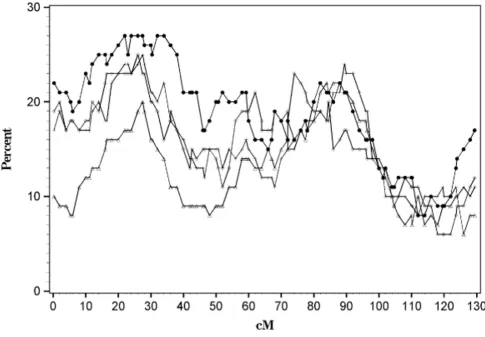
The conditional method using the subsetting approach did not provide additional power to detect linkage above and beyond using the entire data set to detect a main link-age effect of Locus A. Figure 1 shows that selecting a subset of ASPs with evidence for linkage to the DR locus did not vary by the arbitrary cut-points chosen. At 26 cM (the approximate location of the A locus) only 27 of the repli-cates detected linkage at an α= 0.05 level using all ASPs in each replicate. Restricting the sample sizes in each repli-cate by selecting ASPs with the proportion of alleles shared IBD at the DR locus greater than or equal to 0.5 resulted in slightly decreased power to detect linkage at the A locus than the complete data set (24%). DR allele sharing cutoffs of 0.7 or 0.9 did not increase power to detect linkage (24% and 20%, respectively). The type I error of these tests averaged, 10%, 9%, 9%, and 13% for cutpoints of 0.5, 0.7, 0.9, and the complete data set, respectively. To examine heterogeneity, we restricted the sample to those sib pairs with allele sharing less than 0.3 and 0.1, and the power again barely exceeded the type I error rate (data not shown).
Similarly, the mean interaction test had limited power to detect evidence for linkage to the A locus or evidence for a significant interaction using a test of the βcoefficient. Fig-ure 2 shows the percent of replicates that were detected across chromosome 16 for the ASP covariate sum that models the DR4 allele additively. The power of the test for linkage was 18% at the A locus and the power of the inter-action term by itself was low (4%). Type I error was 5% and 9% for the interaction term alone and the joint test of linkage, respectively. The other models which used an alternative coding scheme for the covariate coding the DR locus (as described in the Methods section) produced sim-ilar results.
The conditional logistic methodology did not detect the interaction at the A locus, with the power ranging from 1 to 9% in the 40-cM region around the A locus. This power never exceeded the type I error. Even coding the covariates in a manner that mimicked the actual simulated risk parameters through a linear coding scheme did not improve the power to detect linkage.
Discussion
None of the methods we examined had enough power at a type I error rate of α = 0.05 to detect linkage to the A locus in the presence of linkage to DR. There was no dif-ference between the conditional method, which used a restricted sample, and the mean test and conditional logistic models, demonstrating that this lack of power was not due to insufficient sample size. Our results were quite similar to those of Brock et al. [9], who analyzed the GAW14 data. Of the 36 multipoint models that used the
πi =π0+β(Xi −X)+εi.
conditional logistic model, the highest power achieved was 34%. These results support the theoretical work by Vieland and Huang, which suggests that the establish-ment of epistasis in ASP data is impossible due to insuffi-cient penetrance structure [10]. Using Gauderman and Siegmund's mean test [2], we found that the power of the test of the linkage-only model (π> 0.5) was greatest, fol-lowed by the joint test of πand β, and that the interaction only model had no less than 10% power. The power to detect interaction only is generally much lower than the power to detect linkage when allowing for interaction [3], so our results are not surprising. Furthermore, the work of Elston et al. [11] suggests that discordant pairs are neces-sary to detect gene × gene interaction, which was further demonstrated using simulated data [12]. Ultimately, our analyses are limited by the fact that these statistical defini-tions may not reflect biological reality in real data.
Our analyses of the GAW15 data also illustrate the chal-lenges of testing for gene × gene interaction for complex
diseases. First, we found that our analysis was hampered by the complexity of the simulated model. While the interaction was simulated to be large for certain geno-types, the prevalence of those genotypes was low. For example, the largest simulated multiplicative interaction between DR and the "A" allele of locus A was the DR4/ DR4 genotype; however, the prevalence of DR4/DR4 was approximately 0.1. Gauderman and Siegmund demon-strate that, assuming a prevalence of exposure is at least 0.5, the increased risk must be greater than 3 to have suf-ficient power to detect gene × "environment" interaction [2]. In our analyses, we used the DR locus as the "environ-mental exposure"; thus, the low prevalence of the high risk genotype combinations likely affected our inability to detect the gene × gene interaction. The power of the con-ditional logistic model (in LODPAL) is greatest when using a dichotomous risk categorization as the covariate [3]; thus, we suspect that the reason we did not observe an increase in power when we used the DR locus as the cov-ariate was because of the low frequency of the high risk
Mean test for linkage on chromosome 16 using various subsets of ASPs Figure 1
DR genotypes. Second, a challenge in this data was that the DR locus was tri-allelic. Holmans [3] also discusses sit-uations in which there are varying levels of risk associated with the candidate locus, or when certain genotypes may confer their increased risk in conjunction with different genotypes at the test locus. In these cases, the coding of the covariate is not trivial, and incorrect recoding may greatly reduce power. These complexities are certainly true of the simulated relationship between DR and A, and likely explain our loss of power. Finally, these results also raise another issue regarding the importance of the defini-tion of the main effect and how main effects should be incorporated into such an analysis [13]. The first method-ology that conditions on allele sharing at the first locus detects interaction that is a departure from the multiplica-tive penetrance model. An implicit assumption in detect-ing this kind of interaction is the presence of joint Hardy-Weinberg proportions or gametic phase equilibrium. While the A and the DR loci are on different chromo-somes, it is possible that additional allelic association not
due to linkage disequilibrium exists. Schaid et al. also indicate that for the mean interaction test to be valid the two loci must be uncorrelated in the general population [14], which would be true if joint Hardy-Weinberg equi-librium holds. This limitation holds for the conditional method, as well.
Conclusion
In summary, we observed that the most commonly used current methods for detecting gene × gene interaction in ASP data had low power to detect the interaction between DR and A in the simulated data set. This lack of power is likely due to the lack of information in ASP data com-pared to having discordant pair data and/or the low prev-alence of the high-risk DR genotypes and the complex nature of the simulated risk multipliers. Although compli-cated, this simulated data probably more accurately depicts real complex disease data; thus, we believe further research on linkage methods that can more powerfully detect epistasis while minimizing type I error is warranted.
Mean interaction test on chromosome 16 Figure 2
Publish with BioMed Central and every scientist can read your work free of charge "BioMed Central will be the most significant development for disseminating the results of biomedical researc h in our lifetime."
Sir Paul Nurse, Cancer Research UK
Your research papers will be:
available free of charge to the entire biomedical community
peer reviewed and published immediately upon acceptance
cited in PubMed and archived on PubMed Central
yours — you keep the copyright
Submit your manuscript here:
http://www.biomedcentral.com/info/publishing_adv.asp
BioMedcentral
Competing interests
The author(s) declare that they have no competing inter-ests.
Acknowledgements
The results of this paper were obtained by using S.A.G.E., which is sup-ported by a U.S. Public Health Service Resource Grant (RR03655) from the National Center for Research Resources. Funding is provided by: 8K12-RR023264 (CMS); HL46380 (EKL); 5R25T-CA094186 (NLN); T32-HL7567 (NJM); and GM28356 (YL). The authors also thank Dr. Robert C. Elston for his invaluable insight and support.
This article has been published as part of BMC Proceedings Volume 1 Sup-plement 1, 2007: Genetic Analysis Workshop 15: Gene Expression Analysis and Approaches to Detecting Multiple Functional Loci. The full contents of the supplement are available online at http://www.biomedcentral.com/ 1753-6561/1?issue=S1.
References
1. Cox NJ, Frigge M, Nicolae DL, Concannon P, Hanis CL, Bell GI, Kong A: Loci on chromosomes 2 (NIDDM1) and 15 interact to increase susceptibility to diabetes in Mexican Americans.
Nat Genet 1999, 21:213-215.
2. Gauderman WJ, Siegmund KD: Gene-environment interaction and affected sib pair linkage analysis. Hum Hered 2001,
52:34-46.
3. Holmans P: Detecting gene-gene interactions using affected sib pair analysis with covariates. Hum Hered 2002, 53:92-102. 4. Olson JM: A general conditional-logistic model for
affected-relative-pair linkage studies. Am J Hum Genet 1999,
65:1760-1769.
5. Maher BS, Brock GN: Approaches to detecting gene × gene interaction in Genetic Analysis Workshop 14 pedigrees.
Genet Epidemiol 2005, 29(Suppl 1):S116-S119.
6. Goddard KA, Witte JS, Suarez BK, Catalona WJ, Olson JM: Model-free linkage analysis with covariates confirms linkage of pros-tate cancer to chromosomes 1 and 4. Am J Hum Genet 2001,
68:1197-1206.
7. Risch N: Linkage strategies for genetically complex traits. I. Multilocus models. Am J Hum Genet 1990, 46:222-228.
8. Cordell HJ: Sample size requirements to control for stochas-tic variation in magnitude and location of allele-sharing link-age statistics in affected sibling pairs. Ann Hum Genet 2001,
65:491-502.
9. Brock GN, Maher BS, Goldstein TH, Cooper ME, Marazita ML:
Methods for detecting gene × gene interaction in multiplex extended pedigrees. BMC Genet 2005, 6(Suppl 1):S144. 10. Vieland VJ, Huang J: Two-locus heterogeneity cannot be
distin-guished from two-locus epistasis on the basis of affected-sib-pair data. Am J Hum Genet 2003, 73:223-232.
11. Elston RC, Song D, Iyengar SK: Mathematical assumptions ver-sus biological reality: myths in affected sib pair linkage anal-ysis. Am J Hum Genet 2005, 76:152-156.
12. Huang Y, Bartlett CW, Segre AM, O'Connell JR, Mangin L, Vieland VJ:
Exploiting gene × gene interaction in linkage analysis. BMC Proceedings 2007, 1(Suppl 1):S64.
13. Elston RC, Bush N: The hypotheses that can be tested when there are interactions in an analysis of variance model. Bio-metrics 1964, 20:681-698.