Facilitating Watermark Insertion
by Preprocessing Media
Ingemar J. Cox
Departments of Computer Science and Electronic and Electrical Engineering, University College London, Adastral Park Postgraduate Campus, Ross Building, Martlesham Heath, Ipswish, Suffolk IP5 3RE, UK Email:[email protected]
Matt L. Miller
NEC Research Institute, 4 Independence Way, Princeton, NJ 08540, USA Email:[email protected]
Received 5 May 2003; Revised 17 January 2004
There are several watermarking applications that require the deployment of a very large number of watermark embedders. These applications often have severe budgetary constraints that limit the computation resources that are available. Under these circum-stances, only simple embedding algorithms can be deployed, which have limited performance. In order to improve performance, we propose preprocessing the original media. It is envisaged that this preprocessing occurs during content creation and has no budgetary or computational constraints. Preprocessing combined with simple embedding creates a watermarked Work, the per-formance of which exceeds that of simple embedding alone. However, this perper-formance improvement is obtained without any increase in the computational complexity of the embedder. Rather, the additional computational burden is shifted to the prepro-cessing stage. A simple example of this procedure is described and experimental results confirm our assertions.
Keywords and phrases:digital watermarking, preprocessing, digital rights management, copy control.
1. INTRODUCTION
There are a number of applications of watermarking in which it is necessary to deploy a very large number of water-mark embedders. In such situations, economic constraints are often severe and constrain the computational resources that are available for embedding. Unfortunately, high-perfor-mance—as measured by effectiveness, fidelity, and robust-ness—watermark embedders commonly require very sub-stantial computational resources, especially when perceptual modeling [1,2], informed coding [3,4,5],1and/or informed embedding [6] are utilized.
We address this dilemma by proposing a two-stage pro-cedure in which a substantial fraction of the computational workload is performed as a preprocessing step on the media prior to its release to the general public. This preprocessing step is designed to permit, at a later time, subsequent wa-termark embedding based on computationally simple algo-rithms that are very economic.
Our solution is appropriate in situations where content can be modified before it reaches the watermark embedders.
Section 2discusses two examples where this is common. The
1Note that the term “preprocessing” as used in [4] differs from our usage here.
first example uses watermarks for transaction tracking (also known asfingerprinting) during consumer playback of copy-righted material. Here, each player embeds a unique water-mark into everything it plays. The waterwater-marks may be used to identify the source of any content that is subsequently dis-tributed illegally. The second example uses watermarks to prevent certain forms of illegal copying. Here, acopy markis added to video as it is being recorded in a consumer device, differentiating the original from the copy. Thecopy mark in-dicates that it is illegal to make a second-generation copy of the copy.
InSection 3, we describe the basic principles behind pre-processing and a two-step watermarking process. Some per-formance implications are discussed inSection 4. An illustra-tive implementation of preprocessing is then described and tested inSection 5. Finally, a discussion of results and future work are contained inSection 6.
2. MOTIVATION
severely limit the power of the embedders that may be used. At the same time, both applications allow expensive prepro-cessing of video before it reaches the watermark embedders, making our solution possible. How this preprocessing can be used to improve the performance of inexpensive embedders is described inSection 3.
2.1. DiVX transaction-tracking system
In late 1996, the DiVX Corporation2 released an enhanced DVD player based on a pay-per-play business model. DiVX disks used proprietary encryption, so they could only play in DiVX-enabled DVD players. The players communicated with the DiVX Corporation over the phone lines, allowing DiVX to monitor the number of times a given player played each disk, and bill the player’s owner accordingly.
In order to allay the piracy concerns of Hollywood stu-dios, DiVX implemented a number of security technologies. One of these was a watermark-based system for transaction tracking. Each DiVX player embedded a unique watermark in the analog NTSC video signal during playback of a movie. These transaction watermarks were intended to be used to track the source of any pirated video that originated from the DiVX customer base. As players were connected to the DiVX corporation by phone, this would make it possible to quickly identify the pirate.
The DiVX DVD player was a consumer-level product and, as such, was extremely price sensitive. Accordingly, the computational resources allocated to embedding the trans-actional watermark had to be small. This limitation on com-putational resources was further exacerbated by the require-ment that the watermarks be embedded in real time. There are no published details regarding the design of the water-mark embedder deployed by DiVX, but a personal commu-nication between one of the authors and a Hollywood execu-tive suggests that the fidelity was poor. This is to be expected given the design constraints.
The solution proposed here would preprocess the video prior to the release of the DVD disc in order to improve the performance of the watermark embedder. This preprocessing could have been performed during DiVX’s proprietary media preparation.
2.2. Generational copy control for DVD
In 1997, the Copy Protection Technical Working Group is-sued a request for proposals for a watermarking system to prevent illegal copying of DVD movies. The basic idea is that each DVD recorder will contain a watermark detec-tor, and will refuse to record video that contains certain watermarks. They received eleven proposals. After several rounds of testing and negotiations, these were reduced to the Milleniumsystem, proposed by Philips, DigiMarc, and Macrovision, and the Galaxy system, proposed by NEC, IBM, Sony, Hitachi, and Pioneer. Both these systems in-volved embedding watermarks in video to implement one of
2The DiVX Corporation filed for bankruptcy about one year after their product launch.
the more difficult requirements in the request for proposals, known asgenerational copy controlorcopy generation man-agement.
Copy generation management is intended to allow a sin-gle generation of copies to be made from a master, but no subsequent copies to be made from the first-generation copies. The requirement arises because consumers in the US are permitted by law to record television broadcasts for view-ing later. This right was accorded consumers after the in-troduction of the video cassette recorder when Hollywood studios sued electronics manufacturers alleging that such de-vices enabled widespread piracy of movies.3DVD recorders are covered by this law, but the studios recognize that digital recording is a potentially greater threat than analog record-ing since there is no degradation in video quality with each generational copy.
In order to reduce the threat of piracy, content own-ers envisage labeling broadcasted material ascopy onceand subsequently labeling the material as copy no more after recording. A number of technical solutions to copy gener-ation management were proposed in the context of DVD recorders. These are discussed in [7,8]. The solution pro-posed in the Galaxy system used a fixed watermark to encode thecopy oncestate, and add a second copy mark, to encode the copy no more state. This second watermark would be added during recording, within the consumer DVD recorder. Because the second watermark embedder was to be in-corporated into consumer devices, it was subject to se-vere economic constraints. These economic constraints man-dated that the embedder circuitry not exceed 50 K gates, which precluded the use of a frame buffer. A consumer DVD recorder is expected to have both analog and digital video input. In the analog case, for example, NTSC, watermark embedding was required to proceed in real time. The digital video input is assumed to be a compressed MPEG-2 stream. Copy mark embedding must therefore occur in both the compressed and baseband video domains. Moreover, pressed and baseband watermarks must be completely com-patible, that is, a watermark embedded in the MPEG domain must be detectable in the baseband domain and vice versa.
Embedding into the MPEG-2 stream introduces several additional limitations. First, because there is no possibility of employing a frame buffer, the watermark must be embedded without full decompression. This may be accomplished by directly modifying the compressed video stream in a man-ner that changes the underlying baseband video [9]. Second, MPEG-2 recording may occurfasterthan real time, making it necessary to embed the watermark in up to eight times real time. Third, to maintain the integrity of the transport stream, it is necessary to ensure that the size of individual transport packets remain unchanged by the watermarking process. An embedder that satisfies all these constraints is un-likely to be capable of performing the processing required to embed high-fidelity, robust watermarks.
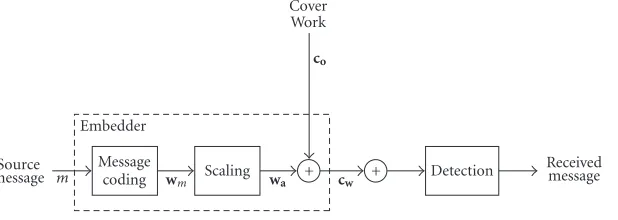
Source message m
Embedder Message
coding wm Scaling
Cover Work co
wa + cw + Detection
Received message
Figure1: Watermarking using blind embedding.
In the Galaxy system, a primary component of our so-lution to thecopy markembedding problem was the use of preprocessing.4At the time that thecopy oncemark was em-bedded, video was also processed to ease the task of subse-quentcopy markembedding. The principles for performing this type of preprocessing are the subject of the remainder of this paper. For the sake of simplicity, we describe these prin-ciples in the context of systems using conventional, baseband embedders. However, they apply equally well to any embed-ding method that embeds weak watermarks into the base-band video, even if that embedding is performed by modify-ing the compressed stream.
3. MEDIA PREPROCESSING
One of the main difficulties with cheap watermark embed-ders is that their performance is highly dependent on the cover Works to which they are applied. An embedder might perform well on one Work, successfully embedding a high-fidelity, robust mark, while completely failing to embed in another Work. The idea of preprocessing is to modify all the Works beforehand, altering them such that an inexpensive embedder will perform well.
We illustrate the idea of preprocessing by applying it to three basic watermarking systems: a simple, zero-bit5 linear-correlation system (Section 3.1), a zero-bit, normalized-correlation system (Section 3.2), and a one-bit, normalized-correlation system (Section 3.3). Admittedly, these basic sys-tems are quite rudimentary, and do not have the theoret-ical justification of more recent systems based on dirty-paper coding (see [10,11] for some recent examples). Nev-ertheless, systems like these have long proven useful in practice, and they serve nicely as testbeds for the concept of media preprocessing. In principle, the ideas presented here should also be applicable to more sophisticated sys-tems.
4Note that, although the basic principles presented in this paper were developed during our work on the Galaxy proposal, the actual algorithms presented are not those used in Galaxy.
5A system that can embed 2ndistinct watermark messages is said to
em-bed ann-bit watermark. Thus, azero-bit system can embed only 20 =1 possible message. The watermark is either present or absent.
3.1. Preprocessing for a linear correlation system In a zero-bit, linear-correlation watermarking system, the de-tector tests for the presence or absence of a watermark by computing the linear correlation between a received Workc and a reference patternwr:
zlc=N1c·wr= N1 N
i
c[i]wr[i]. (1)
If zlc is greater than a detection thresholdτlc, then the de-tector reports that the watermark is present. The interested reader is directed to [12] for background on the justification and interpretation of this type of system.
The simplest method of embedding watermarks for such a system is with a blind embedder in which the embed-ded pattern and embedding strength are independent of the cover Work. The structure of a blind embedder is shown in
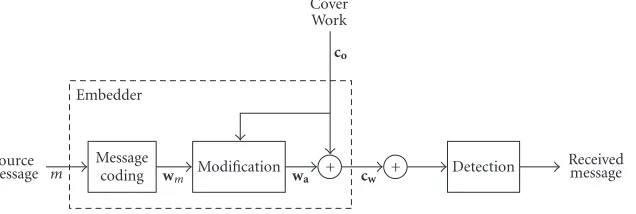
Figure 1. This contrasts withinformedembedding, as shown in Figure 2, where the embedding strength can be adjusted to ensure that a watermark is successfully embedded in every cover Work.
Blind embedding is computationally trivial. For example, a watermark can be added to a video stream (in baseband) without requiring that the frames be buffered. However, a blind embedder will necessarily fail to embed the watermark into some content, making its embedding effectiveness less than 100%. This makes it unacceptable for many applica-tions in which the watermark must be embedded, even at the expense of occasional reductions in fidelity. An informed embedder, on the other hand, can guarantee 100% eff ec-tiveness by automatically adjusting the embedding strength (and hence the fidelity) for each cover Work, but to do so, it must examine the entire cover Work before embedding the mark, so a video system would require the expense of a frame buffer. Thus, informed embedding can be substantially more expensive than blind embedding. Below, we describe the two types of embedding in more detail, and then show how in-formed embedding can be split into a preprocessing step, fol-lowed by an inexpensive, blind embedder.
Source message m
Embedder
Message
coding wm Modification
Cover Work co
wa + cw + Detection
Received message
Figure2: Watermarking using informed embedding.
independent of the cover Work is added to each Work, the intention being to move the cover Work into the detection region. A two-dimensional geometric model is illustrated in
Figure 3a. If a simple correlation detector is used, then this detection region is a half-plane, the boundary of which is de-noted by the vertical line inFigure 3a. Unwatermarked cover Works lie to the left of this boundary and are denoted by the open circles. Notice that some cover Works are closer to the boundary than others.6The horizontal arrows represent the watermarking process which moves the cover Work towards, and hopefully into, the detection region. This is also illus-trated inFigure 3awhere the majority of cover Works have indeed been moved into the detection region, but one cover Work has not. The embedder is said to have failed to water-mark this particular cover Work, that is, its effectiveness is less than 100%.
Clearly, if the magnitude of the arrows is larger, then more cover Works will be successfully watermarked. How-ever, a compromise must be made between the strength of the watermark and the fidelity of the watermarked Work.
In contrast to blind embedding, informed embedding al-lows us to automatically vary the strength of the watermark based on the cover Work.Figure 3billustrates the effect of an informed embedder in which a watermark of different mag-nitude is added to each cover Work such that all watermarked Works are guaranteed to be a fixed distance within the de-tection region. Using such an informed embedder ensures that all watermarked Works will lie in the narrow shaded re-gion ofFigure 3b. We refer to this region as theembedding
region.
It should be noted that the systems illustrated inFigure 3
are not strictly comparable because they solve subtly diff er-ent problems. The blind embedder inFigure 3ais trying to embed the most robust watermark possible within a given prescribed limit on perceptual distortion. By contrast, the in-formed embedder inFigure 3bis trying to embed the least-perceptible watermark possible within a given prescribed limit on robustness. Thus, the blind embedder deals with the problem of unwatermarkable content—content which cannot be watermarked within a prescribed fidelity limit— by failing to embed, while the informed embedder deals
6In fact, it is also possible for an unwatermarked Work to be to the right of the boundary. This would denote a false positive.
with this problem by relaxing the fidelity constraint.7Which approach is better depends on the application. In some ap-plications, maintaining fidelity (as specified with some nu-merical measure) is more important than ensuring that ev-ery Work is marked. In others, the watermark is more impor-tant. We have argued elsewhere [6,18] that the latter type of application is very common, and, for the remainder of this paper, we assume that this is the type of application in which our system will be employed. The difficulty we face is that in-formed embedding, because it requires a frame buffer, is too costly for our assumed application.
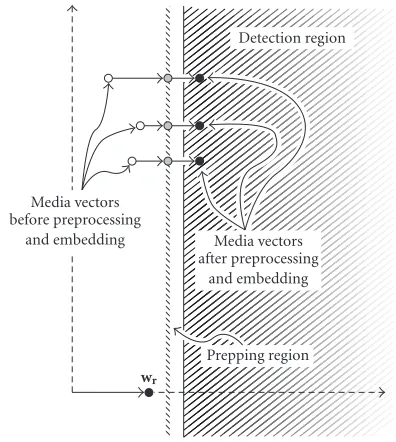
Now we consider a two-step process in which informed preprocessing is used to guarantee that subsequent blind embedding will be successful. Figure 4 shows how such a system might work. Here, the preprocessing stage modifies each original cover Work (open circles) so that the processed Works (grey circles) all lie within a narrow region close to, but outside of, the detection region. We refer to this narrow region as the preppingregion. Since the prepping region is outside the detection region, no watermarks are detected in the preprocessed content. However, when a simple blind em-bedder is subsequently applied to the preprocessed content, it will be 100% effective in embedding the watermark.
3.2. Preprocessing for a normalized-correlation system
The same technique can be applied to more complex water-marking systems, such as those that use normalized correla-tion as a deteccorrela-tion metric (see, e.g., [19]). Here, the detec-tor computes the normalized correlation between a received Workcand a reference patternwras
znc=
c·wr
(c·c)wr·wr
. (2)
This results in a conical detection region.
Media vectors before embedding
wr
Detection region
Media vectors after embedding
(a)
Media vectors before embedding
wr
Detection region
Media vectors after embedding
Embedding region
(b)
Figure3: Geometric interpretation of two ways to embed marks for a linear-correlation detector: (a) blind embedding with fixed visibility; (b) informed embedding with fixed robustness. The empty circles denote unwatermarked Works and are randomly distributed in a high-dimensional vector space. The vertical line denotes the detection boundary when a linear correlator is used. Thex-axis is aligned with the watermark reference vector. In (a), addition of the reference vector to unwatermarked Works moves these Works to locations denoted by the solid circles which are usually, but not necessarily, within the detection region. This gives roughly constant fidelity at the expense of variable robustness (and occasional failure to embed). In (b), the reference vector is scaled to ensure that every watermarked Work lies a fixed distance inside the detection region, giving roughly constant robustness at the expense of variable fidelity.
Here again, blind embedding can often successfully em-bed watermarks, but it fails in many cases. It is argued in [6,18] that a more reliable method of embedding is to seek a fixed estimate of robustness. We can estimate robustness as the amount of white noise that may be added to the water-marked Work before it is likely to fall outside the detection region. This is given by
R2=
c·wr
τncwr 2
−c·c, (3)
whereτnc is the detection threshold that will be applied to the normalized correlation, andR2is the estimate of robust-ness (see [18] for a derivation of this equation). A fixed-robustness embedder that uses this estimate of fixed-robustness will employ a hyperbolic embedding region, as shown in
Figure 5. Although such an embedder is preferable for many applications, it can be quite costly, as it not only requires ex-amining the entire Work before embedding (which requires buffering), but also involves solving a quartic equation to find the closest point in the embedding region [12].
To obtain the reliability of a fixed-robustness embedder, while using a simple blind algorithm to embed, we can define a prepping region by shifting the embedding region outside the detection region. The distance that the embedding region must be shifted depends on the embedding strength that will be used by the blind embedder. This is shown inFigure 6.
Media vectors before preprocessing
and embedding
wr
Detection region
Media vectors after preprocessing
and embedding
Prepping region
Figure4: Geometry of the preprocessing and embedding.
wr
Embedding region
Figure5: Behavior of a fixed-robustness embedder for a normal-ized-correlation-based watermark. The shaded area is a conical de-tection region obtained by applying a threshold to the normalized correlation between a Work and a reference pattern. The embedding region, which comprises all the points that can survive a specified amount of white noise, is a hyperboloid within this cone.
wr
Prepping region
Figure6: Preprocessing to obtain constant robustness when a blind embedder is applied. The open circle shows an unwatermarked Work. The grey circle shows the effect of preprocessing that Work, and the black circle shows the Work obtained by applying a blind embedder to the preprocessed Work.
Note that, if the embedding strength that will be used during blind embedding is too low, the shifted embedding region might overlap with the detection region. This would not be satisfactory as a prepping region since it would lead to false positives. To solve this problem, we can simply re-move a portion of the shifted embedding region from consid-eration during preprocessing. The preprocessor would move each Work to the closest point on the shifted hyperboloid that lies sufficiently far outside the detection region. This is illustrated inFigure 7.
3.3. Preprocessing for multiple bit watermarks
The two systems described above apply preprocessing to sim-ple, zero-bit watermarks. That is, the detectors in these sys-tems report whether the watermark is present or absent, but do not distinguish between different watermark messages, so the watermark carries zero-bits of payload information. If we
wr
Prepping region
Figure7: Preprocessing for constant robustness with a weak blind embedder. Because the embedding strength used during blind em-bedding will be small, the shifted hyperboloid does not lie entirely outside the detection region. This is solved by ignoring a portion of the shifted hyperboloid during preprocessing. The result is a prep-ping region that is only part of the hyperboloid.
have a system that can embed several different watermark patterns, representing different messages, we must modify our preprocessing method accordingly.
In the simplest case, we might have a system with two possible messages, or one bit of payload. For a message of m = 1, we might embed a reference markwr. Form = 0, we might embed the negation of the reference mark −wr. The detector would check for presence of both the positive and negative watermarks, reporting the corresponding mes-sage if one of them is found. Such a system, then, would define two disjoint detection regions, one for each mes-sage.
To ensure that blind embedding will succeed in embed-ding any of the possible messages, the preprocessor must move content to a prepping region that is the intersection
of appropriate prepping regions for all the messages. For example, consider a one-bit system using normalized cor-relation as its detection metric, as illustrated in Figure 8. The two detection regions in this case would be two oppos-ing cones. A fixed-robustness embedder, when embeddoppos-ing m =1, would move each Work to a hyperbolic embedding region within the positive cone. When embeddingm=0, it would move each Work to an embedding region within the negative cone. Shifting each of these embedding regions ac-cording to the effect of a blind embedder gives us two possi-ble prepping regions—one that ensures the blind embedder can embed messagem=1, and one that ensures it can em-bed messagem=0. Only a Work in the intersection of these two regions will allow successful embedding of either mes-sage.
Prepping region form=0
Prepping region form=1
−wr wr
Intersection of two message-prepping
regions
Figure8: Preprocessing for a one-bit, normalized-correlation wa-termarking system. The one-bit detector defines two conical detec-tion regions: one centered aroundwr, form=1, and one around −wr, for m = 0. For each detection region, there is a
message-preppingregion of content in which a blind embedder can embed the corresponding message. The overall prepping region is the in-tersection of these two message-prepping regions, which comprise two points in this two-dimensional figure.
(N−1)-dimensional sphere. Thus, although the figure ap-pears to define a prepping region of only two points, the ac-tual prepping region is a high-dimensional surface, and, with appropriate watermark extraction techniques, it is possible to implement a preprocessor that does not introduce too much distortion (seeSection 5).
A problem that might arise is that the prepping regions for the separate messages do not intersect. This would occur if the embedding strength used by the blind embedder is too weak. In such a case, it would be impossible to perform the type of preprocessing we are proposing here. However, this is a pathological case regardless of whether preprocessing is employed, as it means there is no single Work into which the blind embedder can embed all possible messages. For every Work, there is at least one message that the blind embedder cannot embed. Thus, this would be a case of an unacceptable blind embedder that cannot be made acceptable by prepro-cessing.
It might appear, fromFigure 8, that we will necessarily have the problem of non-overlapping message-prepping re-gions when we introduce even one additional message. After all, there is no way to place an additional cone in the figure so that its message-prepping region intersects with either of the two points of intersection illustrated. But this is an illu-sion caused by our limited, two-dimenillu-sional figure. To un-derstand that many more than two detection cones can have intersecting message-prepping regions, imagine that the cen-ter lines of the cones (reference marks) all lie on a single plane in a three-dimensional space. The message-prepping regions for all these cones can intersect at two points, one above the plane and the other below it. As in the case of the two-point prepping region ofFigure 8, these two points in 3-space correspond to a high-dimensional hypersphere in me-dia space.
4. PERFORMANCE CONSIDERATIONS
The above discussion of preprocessing has focused on the robustness of the watermark embedded by a simple em-bedder. However, by introducing the preprocessing step, we have introduced some new questions regarding the fidelity, robustness, and security in the overall system. Can we ob-tain satisfactory fidelity in both the preprocessed and wa-termarked media? What happens if the preprocessed Work is distorted by normal processing before the watermark is embedded? Does preprocessing introduce any new security risks? Each of these questions is addressed in turn below.
4.1. Fidelity
In watermarking systems that do not involve preprocess-ing, the embedder must create a watermarked Work that lies within some region of acceptable fidelity around the original. When we introduce a preprocessing step, we must now find
twonew Works within the region of acceptable fidelity: the preprocessed Work and the watermarked Work. These must be separated by the effect of the simple embedder.
In our experience, finding these two Works has not been difficult. This is not surprising, as the simple embedder will usually be designed to introduce very little fidelity degrada-tion. Thus, the preprocessed and watermarked Works will be perceptually very similar, and if the fidelity of one is accept-able, the fidelity of the other is unlikely to be much worse.
Furthermore, the application may be designed in such a way that the preprocessed Work is never actually seen. For ex-ample, in the DiVX application, video never leaves the player without having a watermark embedded. In this case, the fi-delity of the preprocessed video would be irrelevant, and we would only be concerned with the fidelity of watermarked video. The problem of maintaining this fidelity is little diff er-ent than that in a system that does not er-entail preprocessing.
4.2. Robustness
In some applications, the preprocessed Work might be ex-pected to undergo some normal processing before the simple watermark embedder is applied. This would not be the case in the DiVX application, as the embedder is applied immedi-ately after the video is read offthe disk, but in the DVD appli-cation, it is expected that preprocessed video will be broad-casted via television before it reaches the watermark embed-der in a DVD recorembed-der. Such broadcasting might entail lossy compression and analog distortions. This raises the question of whether these distortions will ruin the preprocessing so that subsequent embedding fails.
However, many, if not most, distortions that can be ex-pected are not independent of the Work. In these cases, there is a difference between applying the distortion before or af-ter waaf-termark embedding. For some distortions, this diff er-ence is small, and systems designed to be robust against addi-tive noise will usually be reasonably robust against them. But other distortions are highly dependent on the Work to which they are applied, and these can represent a serious problem to a system employing preprocessing.
Perhaps the most severe example of such a class of dis-tortions for video is the class of geometric disdis-tortions— translation, scaling, rotation, and so forth. If any of these distortions is applied to preprocessed video, it can desyn-chronize the preprocessing from the watermark embedding, causing the embedder to be no more effective than it would be on unpreprocessed video.
This is a problem that probably cannot be solved in a gen-eral way. In the DVD application, however, it can be solved by taking advantage of the detector for thecopy oncemark. This detector must be robust against the same geometric distor-tions that might causecopy no moreembedding to fail. Ro-bustness against geometric distortions is usually attained by detecting those distortions and inverting them before water-mark detection. Thus, a description of the distortions can be made available to thecopy no moreembedder. The embed-der can then apply them to the watermark pattern so that the pattern is once again synchronized with the preprocessing.
4.3. Security
The final question to be addressed is whether a system that depends on preprocessing is necessarily less secure than one that does not. This question is of particular interest in the two example applications ofSection 2, as they are both intended to deter unauthorized copying.
The main, novel security risk that preprocessing might introduce is a risk that adversaries might modify prepro-cessed media so that subsequent embedding fails. This as-sumes, of course, that the adversary has access to the prepro-cessed media before the embedder is applied. It is possible to imagine applications of preprocessing in which the adversary has no such access. For example, we might build a streaming media server that puts a unique watermark into each stream. The stored media could be preprocessed to facilitate the use of inexpensive, real-time embedders. As all the embedding occurs before the media reaches the customer, the adversary will not have access to anything unwatermarked.
Unfortunately, in the DVD and DiVX applications, the adversary must be assumed to have access to unwatermarked video. In the case of DiVX, this would require hacking the player to disable or bypass the embedder. In the DVD ap-plication, unwatermarked video is broadcast in the clear. In these cases, the adversary may very well be able to modify the video so that the embedder will fail.
The question, however, is why would the adversary bother? Presumably, his aim is to make a copy of the video that does not contain the watermark. If he has access to the unwatermarked video, he need not modify it—he can just copy it. In the case of the DVD, this would require a
non-compliant or hacked recorder that would not embed a mark. In the case of the DiVX, this could be done with any recorder once the DiVX player has been hacked. Thus, if the unwa-termarked video is available to the adversary, the risk intro-duced by reliance on preprocessing is arguably irrelevant.
A second risk in the types of systems being discussed here arises from the weakness of the embedder itself. Simple em-bedding algorithms are more likely to be easily hacked. This risk is particularly high if the adversary has access to an em-bedder, and can compare unwatermarked with watermarked media, which is the case in the DVD and DiVX applications. But this risk is not a consequence of reliance on preprocess-ing. The simplicity of the embedder and its availability to the adversary are dictated by the application. Preprocessing is merely a trick that makes such an application feasible.
Our conclusion, then, is that preprocessing may intro-duce some novel security risks, but these only arise in ap-plication settings where security is extremely weak anyway. However, it must be noted that weak security can still be valuable. The proposed DVD system would add a level of de-terrence to certain illegal copying which is presently entirely undeterred. If enough people are unwilling to bother break-ing the system, the cost of that system may be justified.
5. AN IMPLEMENTATION
To illustrate the preprocessing technique, we implemented a preprocessor for the E BLK BLIND D BLK CC image watermarking system described in [12]. This is a one-bit, normalized-correlation system which operates in a linear projection of image space.
E BLK BLIND is a simple blind embedder. Although its description and implementation in [12] are a bit more com-plicated (to allow easy modifications into more sophisticated embedders), it essentially just adds or subtracts a scaled, tiled watermark pattern to the image. It takes as input an imagec to be watermarked, a message of either m = 1 orm = 0, an embedding strengthα, and an 8×8 reference markwr. If
m = 1, the embedder addsαwrto each 8×8 block in the image. Ifm=0, it subtractsαwrfrom each block.
The D BLK CC detection algorithm consists of two steps. In the first step, a mark vectorvis extracted from an imagecby averaging together 8×8 blocks to form one array of 64 values, as illustrated inFigure 9. The mark vectorvis given by
In the second step, the correlation coefficient8z
ccis com-puted between the averaged 8×8 blockvand the reference
Original image (vector in media space)
Average all 384 blocks Extracted vector
(vector in marking space)
+
Figure9: Watermark extraction procedure. Dimensionality of the original image=128×192=24576 and dimensionality of extracted vector=8×8=64.
markwr. That is,
zcc= ˜ v·w˜r
(˜v·˜v)w˜r·w˜r
, (5)
where ˜v=(v−¯v), ˜wr=(wr−w¯r), and ¯vand ¯wrare the means ofvandwr. It compareszccagainst a detection thresholdτcc. Ifzcc > τcc, it reports that messagem=1 has been embed-ded. Ifzcc < −τcc, it reports that messagem =0 has been embedded. Otherwise, it reports that there is no watermark present.
We implemented a preprocessor for this system accord-ing to the principles described inSection 3.3and illustrated inFigure 8. The preprocessor performs the following steps.
(1) Extract a mark vector vo from the unwatermarked Work in the same manner as the detector.
(2) Identify a two-dimensional plane that containsvoand the reference markwr. The plane is described by two, orthogonal, unit vectorsXandY, obtained by Gram-Schmidt orthonormalization [20]:
X= wr
√ wr·wr
,
Y0=vo−
vo·X
X,
Y= Y0
Y0·Y0.
(6)
(Note thatY0here is a temporary vector.)
(3) Projectvointo theX,Yplane:
xvo=vo·X,
yvo=vo·Y.
(7)
(4) Find the point in the prepping regionxvp,yvp that
is the closest toxvo,yvo. As shown inFigure 8, the
prepping region in this two-dimensional plane com-prises only two points. Since yvo is guaranteed to be
positive, the upper of these two points will always be the closest toxvo,yvo. Thus,xvp =0, andyvpis a
pos-itive value chosen to ensure that blind embedding will yield the desired level of robustness. To find yvp, first
note that, in theX,Yplane, the watermark vectorwr will be eitherk, 0or−k, 0, depending on whether we wish to embed a 1 or a 0. Here,kis the magnitude of the watermark reference pattern, which was√N in our experiments, whereNis the size of the watermark reference pattern, that is,N =64. After the blind em-bedder is applied with a strength ofα, we will obtain vw=vp+αwr, which gives us, in theX,Yplane, either αk,yvporvw = −αk,yvp. By lettingwr = ±k, 0,
c = ±αk,yvp, andτnc = τccin (3), and solving for
yvp, we obtain
yvp=
α2k21−τ2 cc
τ2 cc
−R2, (8)
whereR2is the desired robustness.
(5) Obtain a preprocessed mark vectorvp by projecting xvp,yvpback into 64-dimensional space:
vp=xvpX+yvpY. (9)
(6) Invert the original extraction operation onvpto obtain the preprocessed cover Workcp. This is done by simply addingvp−voto each block of the image.
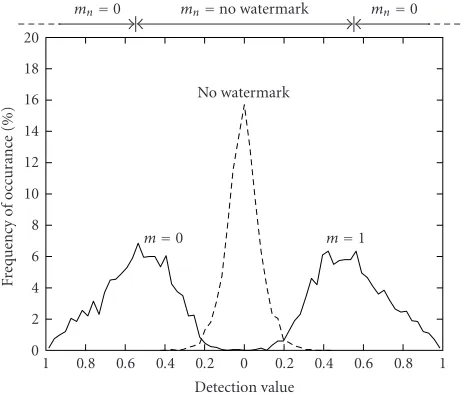
To test these procedures, we first tested the watermarking system on original images that had not been preprocessed, using a weak embedding strength ofα=0.5. Watermarks of m = 1 andm = 0 were embedded in each of 2000 images from the Corel image database.9Each image was 256×384 pixels, and k = 8.Figure 10shows the resulting detection values. The dotted line is a histogram of detection values for unwatermarked images, and each of the solid lines shows tection values for one of the embedded messages. With a de-tection threshold ofτcc=0.55, this succeeded in embedding watermarks in just over 45% of the trials.
Next, we applied the preprocessor to each of the 2000 im-ages, withτcc=0.55,α=0.5, andR=30, and ran the same test again. The results are shown inFigure 11. As expected, application of the blind embedder to preprocessed images succeeded in embedding watermarks in 100% of the trials. In addition, the detection values obtained from preprocessed
m=0 m=1
Figure10: Results of the watermarking system with no preprocess-ing andα=0.5.
Figure11: Results of the watermarking system applied to prepro-cessed images.
images before embedding a watermark are very narrowly dis-tributed around 0. This indicates that they are less likely to yield false positives than are unpreprocessed images. In some applications, if we can guarantee that the detector will never be run on unpreprocessed images, we could take advantage of this to lower the detection threshold, thereby obtaining even better robustness.
The question that arises is whether we could obtain equally good results, with the same fidelity, by just increas-ing the embeddincreas-ing strength used durincreas-ing blind embeddincreas-ing. Blind embedding alone, with no preprocessing, yields an av-erage mean squared error between marked and unmarked images of exactlyα(because of the way we scaledwr).
Prepro-m=0 m=1
Figure12: Results of the watermarking system with no preprocess-ing andα=1.04.
cessing, however, introduces additional fidelity degradation. The average mean squared error between original images and images that have been both preprocessed and watermarked was just under 1.04. If, instead of applying preprocessing, we simply increased α to 1.04, we would obtain the same fi-delity impact as preprocessing plus embedding, but we would have substantially stronger watermarks than with α = 0.5. Would this yield 100% effectiveness without preprocess-ing?
Figure 12 shows the results of applying the blind em-bedder to unpreprocessed images with α = 1.04. Although this performance is vastly better than that ofFigure 10, it is still inferior to the performance obtained with preprocess-ing. With this higher value ofα, blind embedding still failed to embed watermarks in just under 6% of the trials.
Of course, since we can assume that we have substan-tial computing power available during preprocessing, we can improve on the fidelity impact of preprocessing by apply-ing more sophisticated algorithms, such as perceptual mod-eling. Such improvements would increase the disparity be-tween watermarking with and without preprocessing.
6. CONCLUSION
There are several watermarking applications in which a po-tentially very large number of embedders must be deployed under severe computational constraints that limit perfor-mance. In order to attain the performance of sophisticated embedding algorithms, and yet maintain the simple, inex-pensive embedder, we propose preprocessing media before it is released. Most of the computational cost is shifted to the preprocessing stage where it is assumed that significant re-sources are available.
Two examples of such applications are the transaction-tracking system deployed by the DiVX corporation, and the proposed Galaxy watermarking system for copy protection of DVD video.
Before preprocessing, unwatermarked Works can be ge-ometrically thought of as being randomly distributed in a high-dimensional vector space. Within this space lies a de-tection region—Works falling within this region are said to be watermarked. Unwatermarked Works are seldom if ever found in the detection region. Traditional embedding algo-rithms seek to add a watermark pattern to a Work in order to move the Work into the detection subspace, subject to fi-delity and robustness constraints. During the preprocessing stage suggested here, a signal is added to a Work such that the preprocessed Work lies on a predetermined surface near, but outside of the detection region. That is, the unwatermarked, but preprocessed Works are no longerrandomlydistributed in the high-dimensional space but lie in a well-defined re-gion.
This preprocessing step provides two main advantages. First, since preprocessed Works lie on a well-defined surface, near, yet outside of, the detection region, simple embedding techniques are sufficient to watermark the Works with good fidelity and robustness. Second, the computational cost as-sociated with the preprocessing step is not borne by the em-bedders. Instead, content creators bare this cost, the prepro-cessing being performed by dedicated devices located with content creators. Thus, the performance of the overall system need no longer be constrained by the computational budget allocated to the embedder.
A third possible advantage of preprocessing is that it can reduce the probability of false positives. This results from the preprocessor ensuring that all Works are at least a certain distance outside the detection region. However, this advan-tage can only be exploited in applications where the water-mark detector will never be applied to unpreprocessed con-tent.
We have implemented a preprocessor for a simple, one-bit watermarking system with blind embedding. Tests on 2000 images show that preprocessing significantly improves performance of the embedder.
ACKNOWLEDGMENT
This work was performed while the author was at NEC Re-search Institute, Princeton, NJ, USA.
REFERENCES
[1] R. B. Wolfgang, C. I. Podilchuk, and E. J. Delp, “Perceptual watermarks for digital images and video,” Proceedings of the IEEE, vol. 87, no. 7, pp. 1108–1126, 1999.
[2] J. F. Delaigle, C. De Vleeschouwer, and B. Macq, “Watermark-ing algorithm based on a human visual model,”Signal Process-ing, vol. 66, no. 3, pp. 319–335, 1998.
[3] J. J. Eggers, J. K. Su, and B. Girod, “A blind watermarking scheme based on structured codebooks,” inIEE Seminar on Secure Images and Image Authentication, pp. 4/1–4/21, Lon-don, UK, April 2000.
[4] B. Chen and G. W. Wornell, “Preprocessed and postpro-cessed quantization index modulation methods for digital wa-termarking,” inProc. SPIE Security and Watermarking of Mul-timedia Contents II, vol. 3971 ofProceedings of SPIE, pp. 48– 59, San Jose, Calif, USA, January 2000.
[5] J. Chou, S. Sandeep Pradhan, and K. Ramchandran, “On the duality between distributed source coding and data hiding,” inProc. 33rd Asilomar Conference on Signals, Systems & Com-puters, vol. 2, pp. 1503–1507, Pacific Grove, Calif, USA, Octo-ber 1999.
[6] M. L. Miller, I. J. Cox, and J. A. Bloom, “Informed embed-ding: exploiting image and detector information during wa-termark insertion,” inProc. IEEE International Conference on Image Processing (ICIP ’00), vol. 3, pp. 1–4, Vancouver, British Columbia, Canada, September 2000.
[7] J. A. Bloom, I. J. Cox, T. Kalker, J.-P. M. G. Linnartz, M. L. Miller, and C. B. S. Traw, “Copy protection for DVD video,” Proceedings of the IEEE, vol. 87, no. 7, pp. 1267–1276, 1999. [8] T. Kalker, “System issues in digital image and video
water-marking for copy protection,” inProc. IEEE International Conference on Multimedia Computing and Systems, vol. 1, pp. 562–567, Florence, Italy, June 1999.
[9] J. A. Bloom, I. J. Cox, and M. L. Miller, “Method for data preparation and watermark insertions,” US Patent 6,332,194, 2001.
[10] J. Chou and K. Ramchandran, “Robust turbo-based data hid-ing for image and video sources,” inProc. IEEE International Conference on Image Processing (ICIP ’02), vol. 2, pp. 133–136, Rochester, NY, USA, September 2002.
[11] M. L. Miller, G. Do¨err, and I. J. Cox, “Dirty-paper trellis codes for watermarking,” inProc. IEEE International Conference on Image Processing (ICIP ’02), vol. 2, pp. 129–132, Rochester, NY, USA, September 2002.
[12] I. J. Cox, M. L. Miller, and J. A. Bloom, Digital Watermark-ing, Morgan Kaufmann Publishers, San Francisco, Calif, USA, 2001.
[13] M. Costa, “Writing on dirty paper,” IEEE Transactions on Information Theory, vol. 29, no. 3, pp. 439–441, 1983. [14] M. L. Miller, “Watermarking with dirty paper codes,” inProc.
IEEE International Conference on Image Processing (ICIP ’01), vol. 2, pp. 538–541, Thessaloniki, Greece, October 2001. [15] B. Chen and G. W. Wornell, “Quantization index modulation:
a class of provably good methods for digital watermarking and information embedding,” inProc. IEEE International Sympo-sium on Information Theory (ISIT ’00), p. 46, Sorrento, Italy, June 2000.
[16] J. J. Eggers, R. B¨auml, and B. Girod, “Estimation of ampli-tude modifications before SCS watermark detection,” inProc. SPIE Security and Watermarking of Multimedia Contents IV, vol. 4675 ofProceedings of SPIE, pp. 387–398, San Jose, Calif, USA, January 2002.
[17] K. Lee, K. A. Moon, D. S. Kim, and T. Kim, “EM estimation of scale factor for quantization-based audio watermarking,” inProc. 2nd International Workshop on Digital Watermarking, pp. 316–327, Seoul, Korea, October 2003.
[18] I. J. Cox, M. L. Miller, and A. L. McKellips, “Watermarking as communications with side information,”Proceedings of the IEEE, vol. 87, no. 7, pp. 1127–1141, 1999.
[19] I. J. Cox, J. Kilian, F. T. Leighton, and T. Shamoon, “Se-cure spread spectrum watermarking for images, audio and video,” inProc. IEEE International Conference on Image Pro-cessing (ICIP ’96), vol. 3, pp. 243–246, Lausanne, Switzerland, September 1996.
Ingemar J. Cox received his B.S. degree from University College London and Ph.D. degree from Oxford University. He has worked for AT&T Bell Labs and NEC Re-search Institute and is currently Profes-sor and Chair of Telecommunications in the Departments of Electronic Engineering and Computer Science at University College London. He has worked on problems to do with stereo and motion correspondence and
multimedia issues of image database retrieval and watermarking. In 1999, he was awarded the IEEE Signal Processing Society Best Pa-per Award (Image and Multidimensional Signal Processing Area) for a paper he coauthored on watermarking. From 1997 till 1999, he served as Chief Technical Officer of Signafy Inc., a subsidiary of NEC responsible for the commercialization of watermarking. Be-tween 1996 and 1999, he led the design of NEC’s watermarking proposal for DVD video disks. He is the coauthor of the book Dig-ital Watermarking, published by Morgan Kaufmann.