R E S E A R C H
Open Access
Improved Wasserstein conditional
generative adversarial network speech
enhancement
Shan Qin
*and Ting Jiang
Abstract
The speech enhancement based on the generative adversarial network has achieved excellent results with large quantities of data, but performance in the low-data regime and tasks like unseen data learning still lag behind. In this work, we model Wasserstein Conditional Generative Adversarial Network-Gradient Penalty speech enhancement system and introduce the elastic network into the objective function to simplify and improve the performance of the model in low-resource data environment. We argue that the regularization is significant in learning with small amounts of data and the available information of the input data is key in speech enhancement performance and generalization ability of the model, which means that network parameters and network structure can be set up and designed according to the characteristics of actual input data. Experiments on the noisy speech corpus show that the improved algorithm outperforms previous generative adversarial network speech enhancement approach.
Keywords:Wasserstein conditional GAN, Speech enhancement, Generalization
1 Introduction
Speech enhancement is one of the main technologies to improve the performance of speech systems in noisy en-vironment [1–3]. Recently, the generation adversarial net-work has shown great potential in deep learning and has been applied to the field of speech enhancement with large quantities of data, which overcomes the limitations of traditional network for speech enhancement of specific targets and shows good generalization performance for unseen environmental noise [4,5]. But the problems like instability of learning and mode collapse of generative ad-versarial network (GAN) affect its practical applications. Many improved algorithms have been proposed such as conditional GAN and Wasserstein GAN to solve those disadvantages. However, those improved GAN algorithms have not been used in speech enhancement yet and the performance in low-resource environment still lags.
Goodfellow et al. introduced the generative adversarial networks (GAN), which formulate a minimax game of a discriminator D and a generator G [6]. The goal is to learn a generator distribution that matches the real data
distribution. Martin Arjovsky proposes the Wasserstein GAN to improve the learning stability [7] and Ishaan Gulrajani improves the Wasserstein GAN substituting gradient penalty for weight clipping [8]. Daniel Michel-santi applies conditional GAN for speech enhancement (SE) [9] and Santiago Pascual models SE with GAN [10]. They explore the potential of conditional GAN and GAN for SE and investigate the feasibility and perform-ance of GAN for speech processing.
Compared with most of the current deep learning speech enhancement systems based on the spectrum
analysis framework [11–15], GAN and the variant
algorithm of GAN work end-to-end with the raw speech data without hand-crafted features extracted and as-sumptions about the raw data utilized. Because further studies show that outperformance of speech quality is possible, especially when a clean phase spectrum and high frequency information are known [16–18], the raw data retain both phase information and frequency infor-mation. GAN and the variant algorithm of GAN provide a sample process without recursive operation in recurrent neural networks and long short-term memory networks [19–22]. But the current GAN system performance in the low-data regime and tasks like unseen data learning still * Correspondence:[email protected]
Beijing University of Posts and Telecommunications, Haidian District, Beijing 100000, China
lag, because of the instability of training and the problem of gradient disappearing resulting in an inadequate train-ing and the overfitttrain-ing caused by the complex model.
In this paper, we model WCGAN-GP SE system ob-tain enhanced speech and introduce an elastic network into the objective function to simplify and improve the performance of the model in low-data regime. Improved WCGAN-GP preserves a variety of features in voice data which is possible to improve the speech quality. And we focus on measuring the ability of models to generalize unseen data and to learn from even very little of it. We explore the factors that influence the enhancement per-formance of the SE model and the factors related to the generalization of network.
2 Wasserstein generative adversarial network BothGandDare parameterized by convolutional neural networks and the minimax game is given by the follow-ing expression:
min maxL Dð ;GÞ ¼Expdatað Þx½logD xð Þ
þEzpg zð Þ½log 1ð −D G zð ð ÞÞÞ ð1Þ pdata(x)is the real data distribution andpg(z)is the
gen-erated data distribution, G(z) is the generated samples byG,xis the real data, andD(·) is the output of discrim-inator, which is DðxÞ ¼ pdataðxÞ
pdataðxÞþpgðxÞ. Then, the expansion of Formula1is shown:
minmaxL Dð ;GÞ ¼Expdata log
Kullback–Leibler divergence is defined:
KLðP1jj Þ ¼P2 ExP1 logPP1
So, the objective function of GAN is as followed:
minmaxL Dð ;GÞ ¼2JSðPdataj Pg −2 log2 ð5Þ
As Jensen-Shannon divergence chose to be a target function, the gradient may be disappearing when the two
distributions do not overlap, resulting in the generator un-able to learn to improve. This is the main reason for the instability of training.
However, Wasserstein GAN has proved that to minimize reasonable approximation of Earth-Mover dis-tance is the best way to solve the above problems in both theory and practice [23]. The Earth-Mover distance or Wasserstein:
W P r;Pf¼ infγ∈ΠðPr;PfÞEð Þx;y γ½kx−yk ð6Þ
Pr and Pf donate the marginal distributions of joint distributions γ(x,y). The Earth-Mover distance indicates the cost must be transported from x to y in order to transform the distributions Pr into the distribution Pf. The infimum cannot be solved directly, the Lipschitz continuity which is shown in formulate (7) adding a re-striction to the continuous function is introduced to the objective function of neural network.
f xð Þ−f yð Þ≤K xj −yj
j j ð7Þ
The Lipschitz continuity theorem restricts the max-imum local variation of a continuous function. The ob-jection function of Wasserstein GAN is as follows:
minL Dð ;GÞj jDL≤K ¼Ezpg zð Þ½D zð Þ−Expdatað Þx½D xð Þ ð8Þ
But weight clipping in the discriminator in Wasser-stein GAN results in gradient extinction or gradient explosion, gradient penalty in the discriminator is intro-duced to make training stability. The gradient penalty is simply added to the Wasserstein distance in the total loss function. To circumvent tractability issues, we en-force a soft version of the constraint with a penalty on the gradient norm for random samples ^xp^x, The ob-jection function of Wasserstein GAN-GP is:
minL Dð ;GÞ ¼Ezpg zð Þ½D zð Þ−Expdatað Þx½D xð Þ þλE^xp^x k∇zDð Þ^x k2−1
2
h i ð9Þ
minGloss¼−Ezpg zð Þ½D zð Þ ð10Þ where ^x represents a soft version of the constraint with a penalty on the gradient norm for random samples.
p^x is a uniform sampling distribution along straight lines between pairs of points sampled from the data dis-tributionpdata(x)and the generator distributionpg(z).Here,
we setλ= 12, which we found to work well across a var-iety of architectures and datasets.
results in the generalization and recognition accuracy of the model almost to a valley. In addition, the complex models will result in training overfitting in low-data en-vironment. Accordingly, we propose an improved object function on WCGAN to reduce the complexity of the model and improve the generalization performance, and introduce the Wasserstein conditional GAN SE model in the next section.
3 Improved Wasserstein conditional GAN speech enhancement model
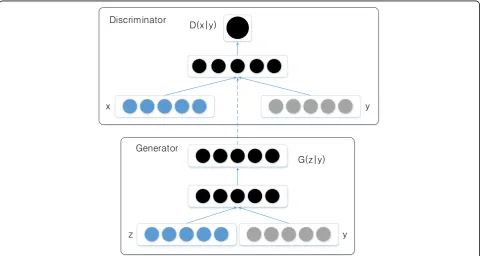
The conditional GAN network obtains the desired data for directivity, which is more suitable for the domain of speech enhancement. Therefore, we exploit Wasserstein conditional GAN with GP to implement speech en-hancement. There are a positive pair (noisy speech and clean speech) and a negative pair (noisy speech and generate speech), then the discriminator is to distinguish between the two pairs. The structure of speech enhance-ment conditional GAN is shown in Fig.1:
Recent several studies have proved that the phase information is significant to improve the effect of the speech intelligibility and quality when spectrograms are used to resynthesized back into time-domain waveforms [24, 25]. As known that the high frequency details of speech also play an important role in speech intelligibility and quality, raw waveform contains the phase features and spectral features of low-frequency and high-frequency of speech. In previous work, Santiago Pascual proposed an
end-to-end speech enhancement system based on a gen-erative adversarial network (SEGAN). To research the potential of the WGAN-GP, we continue to explore and improve the speech enhancement system with raw speech data.
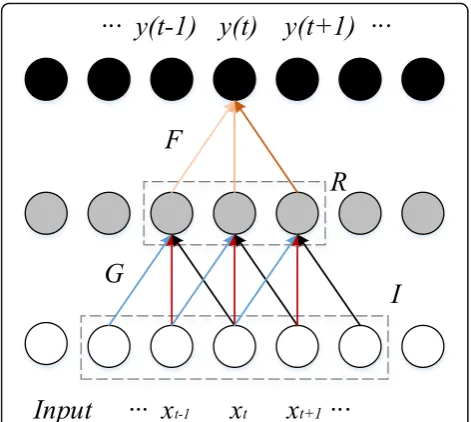
The generator is designed to be fully convolution layers without fully connected layers in an auto encoder struc-ture, which may well preserve local information to gener-ate high-frequency components [26]. In the field of ASR, it has been shown that deep learning-based models with raw waveform inputs can achieve higher accuracy than those with hand-crafted features. Therefore, in this paper, the discriminator and the generator are both all full con-volutional networks. The fully concon-volutional layer network structure of the generator is shown in Fig.2.
Each output sample in FCN relates only locally to the neighboring input regions as shown in Fig. 2. That is distinct from fully connected layers in which the local information and the spatial arrangement of the previous features cannot be well preserved.
The Wasserstein distance insteads of the least mean square error in SEGAN and an elastic network is added to the generator loss to generalize the network perform-ance. The L1 norm performs the automatic selection and sparsity of the features, and the main function of the L2 norm is to avoid overfitting. Elastic network re-duces the weight of parameters and simplifies the com-plexity of models. Ridge regularization keeps more speech feature information to improve intelligibility and
speech quality. The objective function can be repre-sented by the following equations.
minL Dð ;GÞ ¼Excpg xcð Þ½D G xð ð Þc ;xcÞ−Expdatað Þx½D xð ;xcÞ
where xc represents the noisy speech samples. K is the punishment factor. We usually set theKweight of elastic network from 100 to 1000. The constraint condition of L1_ratio isα. In general, it is set according to the experi-ence and experiments.
Lasso and Ridge regularization methods are synthe-sized in elastic network when many of the features of a data set are interrelated. Elastic network will enhance the group effect between the multiple interrelated vari-ables. The advantage of the tradeoff between Lasso and Ridge is that it allows the stability of Ridge to be inher-ited during the loop process.
4 Experiments and results 4.1 Experimental setup
In order to evaluate the performance of WCGAN speech enhancement system, the noisy speech corpus (NOI-ZEUS) which is developed to facilitate comparison of speech enhancement algorithms among research groups
is employed to prepare the training and test sets. The noisy database contains 30 IEEE sentences (produced by three male and three female speakers) corrupted by eight different real-world noises (Babble, Car, Exhibition, Res-taurant, Street, Airport, Station, and Train) at different signal-to-noise ratios (SNRs) (0, 5, 10, and 15 dB). There are five sentences for per speaker.
In this study, 1 s of speech with 500 ms overlap was extracted from the waveforms to form a frame for the proposed SEWCGAN model, whose sampling rate is 16 KHz. The proposed SEWCGAN model is trained for 50 epochs with RMS prop and a learning rate of 0.0003, an effective batch size of 100. Due to the addition of the gradient penalty, there is no batch normalization in net-work structure. In both train and test, a pre-emphasis filter of coefficient 0.95 is applied for all input samples to highlight the high-frequency characteristics to im-prove the intelligibility and the quality of speech.
Regarding theγweight of gradient penalty, after some experimentation, we set it to 10 for the whole training. We set the Kweight of elastic network to 150. Usually, L1_ratio parameters α(0 <α< 1) are employed to regu-late the convex combination of L1 and L2. We set it to
0.15 for the whole training. We observed that the G
weight follows normal distribution during updating, so the elastic network had practical effect on the learning. As the elastic network value got lower, the quality of the output samples increased, which we hypothesize helped Gbeing more effective in terms of realistic generation.
Regarding the architecture, the structure of improved
speech enhancement WCGAN has been shown in Fig.3.
Gis composed of 20 convolutional layers of filter width
31 and strides of N= 2 which is followed by PReLU
activation. The amount of filters per layer increases so that the depth gets larger as the width gets narrower. The resulting dimensions per layer is 16,384 × 1, 8192 × 16, 4096 × 32, 2048 × 32, 1024 × 64, 512 × 64, 256 × 128, 128 × 128, 64 × 256, 32 × 256, 16 × 512, and 8 × 1024. It is known that the decoder stage of G is a mirroring of the encoder with the same filter widths and the same amount of filters per layer. The residual network makes training stable and noisy speech vector makes the number of feature maps in every layer to be doubled.
We directly handle the original speech signal and avoid the extraction of acoustic features. Discriminator sent the update information to generator, which fine-tunes the out-put distribution toward the real distribution to reduce the interference signal.
In this paper, to evaluate the quality of the enhanced speech, we compute the following objective measures. PESQ [−0.5,4.5]: perceptual evaluation of speech quality. SNR [0, ∞): signal-to-noise ratio. segSSNR [0, ∞): seg-mental SNR.
A. Convergent training dataset
To evaluate the convergence of speech enhance-ment systems in low-resource environenhance-ment, 900 utter-ances were randomly selected and corrupted with eight noise types at four SNR levels (0, 5, 10, and 15 dB) as a training set to train the SEGAN model and improved the SEWCGAN model.
B. Generalized training dataset
To explore the influence of the available informa-tion on the system generalizainforma-tion performance, we train the improved SE model with different numbers of noise scenes (two scenes, three scenes, four scenes, six scenes, and eight scenes) and different numbers of speakers (two speakers, three speakers, four speakers, and six speakers) at four conditions of SNR. The test data consist of unseen speakers ap-plied by TIMIT database and unseen noisy scenes applied by NoiseX-92.
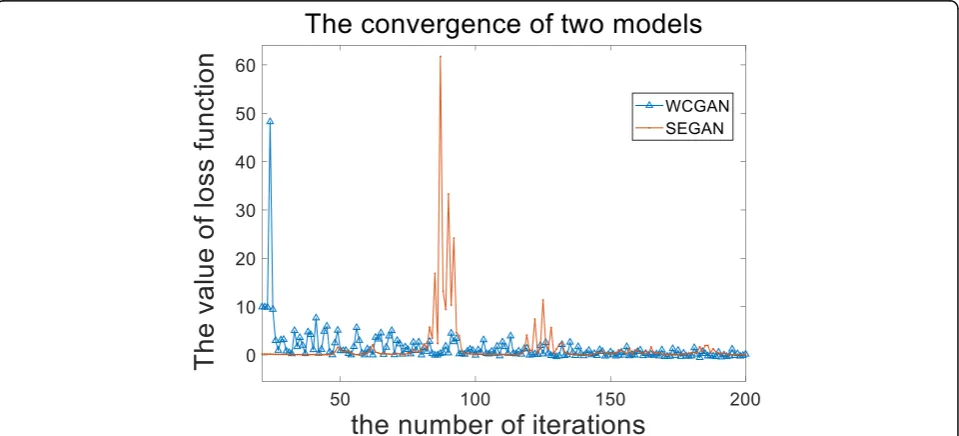
Fig. 4The value of discriminator losses. The point labeled line is the loss function value of SEGAN model and the triangular labeled line is the loss function value of improved WCGAN model
5 Results and discussion
1. Comparison of convergence performance: The
convergence of loss function is selected to estimate the convergence of the SEGAN model and
improved SEWCGAN model. The experiment results are shown in Fig.4as follows.
In Fig. 4, the point labeled line is the loss function value of SEGAN model and the triangular labeled line is the loss function value of improved WCGAN model. As shown in the diagram, the triangular labeled line quickly converges to the stable state near zero, while the conver-gence rate of the point labeled line is slower. One can observe that the discriminator successfully learns to dis-tinguish the generated representations and the ground-truth in low-resource regime.
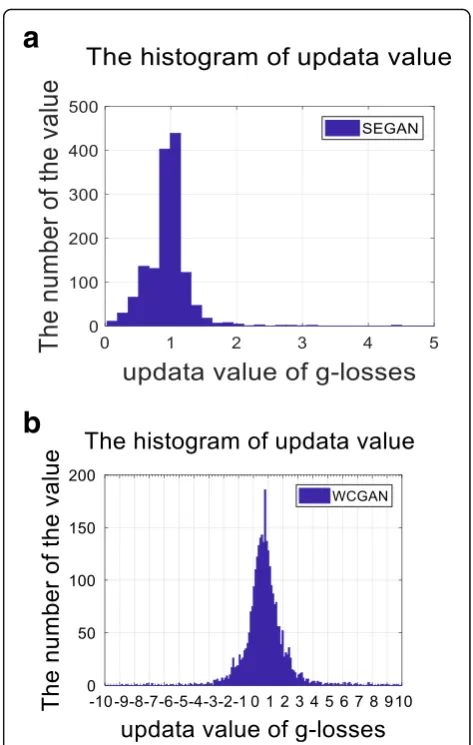
Regarding the learning performance of generator, the histogram of update value of the generator is depicted in Fig.5. Panel (a) is the histogram of the update value of the SEGAN generator, and panel (b) is the histogram of the update value of the improved WCGAN generator. The values in panel (b) mainly range from 0 to 2, and the uneven distribution is easy to cause insufficient learning in network. Relatively, the distribution of the value in panel (a) is uniform which ranges from−4 to 4, which indicates that the network learning is full and the system performance is better. Compared with SEGAN, the learning performance of the new objective function outperforms the previous one and the convergence rate is faster under the same data conditions.
2. Comparison and study of generalization
performance:We explore the influence of the
available information on the system generalization performance. In this paper, the available
information consists of the number of noisy scenes and the number of speakers’clean speech. Firstly, the influence of the number of different training noisy scenes on the system generalization
performance is studied. Training data set consists of six speakers’pure voice with different number of noisy scenes (two scenes, three scenes, four scenes, six scenes, and eight scenes) at four different SNR conditions. Test data is applied with a pure male speech in TIMIT database with factor floor noise in NoiseX-92.
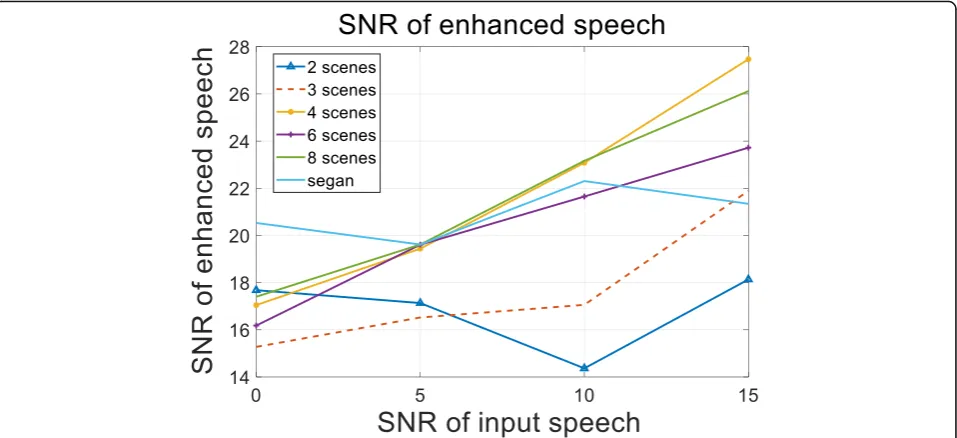
Figure6 depicts the SNR of speech enhancement sig-nal of test data in improved WCGAN models with dif-ferent number of scenes and SEGAN model with the average SNR. In this part, the main purpose is to explore the impacts of generalization performance, so we show the average SNR of SEGAN only. We find surprisingly
that, simply by applying elastic network to the WCGAN models, our improved model achieves mean value 23.65 gain in the SNR on WCGAN and achieves 21.05 gain on SEGAN. The performance of the four-scene model and eight-scene model are almost the same, which are better than other three models. Figure7describes the segmented SNR of enhanced speech in different scenes in two models. By calculating the mean, the improved model achieves mean value 4.28 gain in the segSNR on WCGAN and achieves 1.45 gain on SEGAN. The four-scene model outperforms the other models in segmented SNR.
According to the two-graph information, it intimates that the four-scene SE model outperforms the other scene models. It means that if the number of clean speech is certain, increasing the noisy training data does
a
b
not play a totally positive role in the enhancement performance and generalization performance of the speech system.
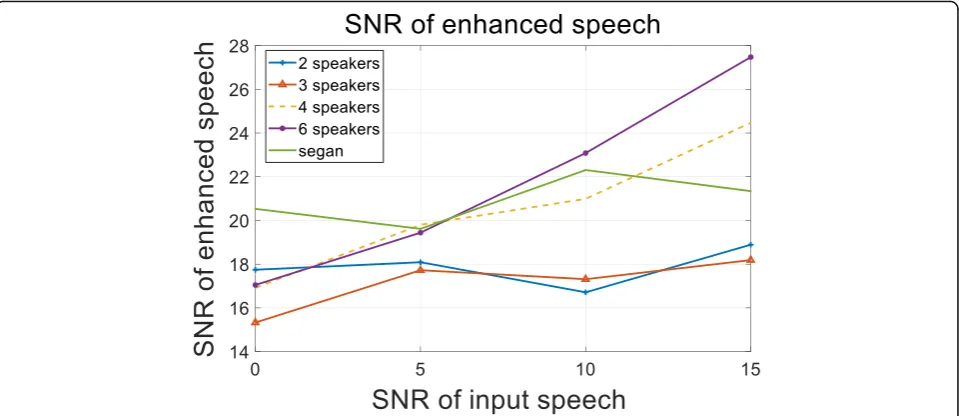
Secondly, the influence of the number of speakers’ clean speech on the system generalization performance is discussed. Training data set consists of four scenes with different numbers of speakers’ clean speech (two speakers, three speakers, four speakers, and six speakers) at four different SNR conditions. Test data is as the same as the above experiment. The experimental results are shown in Figs.8and9as follows.
Figure 8 shows the SNR of enhanced speech of test
data in improved WCGAN models with different numbers of speakers and SEGAN model with the aver-age SNR. The Performance of the four-speaker model and the six-speaker model are almost the same at low SNR condition. The six-speaker model performs prom-inently at high SNR conditions. The SEGAN model works well at 0 dB condition as well. Figure9describes the segmented SNR of enhanced speech in different models. The four-speaker model shows a better per-formance than other models in low SNR of input
Fig. 7The segSNR of enhancement speech. It describes the segmented SNR of enhanced speech in different scenes in two models. By calculating the mean, the improved model achieves mean value 4.28 gain in the segSNR on WCGAN and achieves 1.45 gain on SEGAN
speech but not good enough at 15 dB than the six-speaker model.
According to the two-graph information, it indicates that the four-speaker SE model has a better enhance-ment effect than the other models, which means that more labeled data plays a positive role to increase the enhancement and generalization performance of speech system but is not in the direct ratio when the training data is fixed.
From Table1, we notice that improved model achieves a higher average PESQ score than that by the SEGAN model, which means added elastic work improves the
intelligibility and speech quality. The PESQ improve-ments from 5 to 21% are observed. Although the im-provement of SNR of the two-scene model is not the best, which means that it retains more voice component and obtains a highest speech quality score. The PESQ score of the four-scene model is lower than other situa-tions but performs best in SNR on an improved model.
While the improvement in SNR of the speech is higher, relatively, the more voice component loss that causes a lower speech quality score. So, it is a significant strategy to balance the relationship between the SNR and the quality of enhanced speech. Furthermore, the
enhancement and generalization performance of the speech system works effectively when the training data and the labeled data meet a certain proportion. We should train and design the network based on the avail-able information of the actual data.
6 Conclusions
In this paper, we investigated the use of improved Was-serstein conditional GAN for speech enhancement in low-data environment. We add an elastic network to the generator loss to generalize the network performance and simplified the SE model. Experiments show that the convergence performance of the improved algorithm outperforms SEGAN in low-resource environment. The available information of input data on the system are closely related with the generalization performance of system; furthermore, we can also design the effective network structure like designing the number of layers, choosing the activity functions according to the available information of input data.
Abbreviations
GAN:Generative adversarial network; PESQ: Perceptual evaluation of speech quality; SE: Speech enhancement; SEGAN: Speech enhancement generative adversarial network; segSNR: Segmental signal-to-noise ratio; SNR: Signal-to-noise ratio; WCGAN: Wasserstein conditional generative adversarial network
Acknowledgements
This work was supported by National Natural Science Foundation of China (NSFC) (No.61671075) and Major Program of National Natural Science Foundation of China (No.61631003).
Funding
The funding was supported by National Natural Science Foundation of China (NSFC) (No.61671075) and Major Program of National Natural Science Foundation of China (No.61631003).
Authors’contributions
SQ and TJ conceptualized the idea and designed the experiments. SQ contributed in writing and draft preparation and TJ supervised the research. All authors read and approved the final manuscript.
Competing interests
The authors declare that they have no competing interests.
Publisher’s Note
Springer Nature remains neutral with regard to jurisdictional claims in published maps and institutional affiliations.
Received: 13 April 2018 Accepted: 3 July 2018
References
1. Mai K V, Pastor D, Bey AAE, et al. Combined detection and estimation based on mean-square error log-spectral amplitude for speech enhancement[C]. GRETSI. Sep 2017, Juan-Les-Pins, France
2. Y Bando, K Itoyama, M Konyo, et al., Speech enhancement based on Bayesian low-rank and sparse decomposition of multichannel magnitude spectrograms[J]. IEEE/ACM Trans Audio Speech Lang Process 99, 1 (2017)
3. Deng F, Bao C C, Jia M S, HMM-based cue parameters estimation for speech enhancement[C]. International Symposium on Chinese Spoken Language Processing. IEEE, 2017:1–4.
4. Qiao L, Zhang X, Chen X, et al, Speech enhancement using non-negative matrix factorization solved by improved alternating direction method of multipliers[C]. International Conference on Progress in Informatics and Computing IEEE, pp. 374–378 (2017)
5. Mohammed S, Tashev I. A statistical approach to semi-supervised speech enhancement with low-order non-negative matrix factorization[C]. IEEE International Conference on Acoustics, Speech and Signal Processing, IEEE (2017).
6. Goodfellow IJ, Pouget-Abadie J, Mirza M, Xu B, Warde-Farley D, Ozair S, et al. Generative adversarial nets. International Conference on Neural Information Processing Systems. MIT Press. Vol.3, pp. 2672-2680 (2014) 7. CC Hsu, HT Hwang, YC Wu, et al.,Voice conversion from unaligned corpora
using variational autoencoding Wasserstein generative adversarial networks[J] (2017), pp. 3364–3368
8. Gulrajani I, Ahmed F, Arjovsky M, et al. Improved training of Wasserstein GANs[J]. 2017.
9. Pascual S, Bonafonte A, Serrà J. SEGAN: speech enhancement generative adversarial network[J]. 2017.
10. Michelsanti D, Tan ZH, Conditional generative adversarial networks for speech enhancement and noise-robust speaker verification[C]. INTERSPEECH 2017 August 20–24, Stockholm, Sweden (2017)
11. Wang Z, Li X, Wang X, et al., A DNN-HMM approach to non-negative matrix factorization based speech enhancement[C]. INTERSPEECH 2016 September 8–12, San Francisco, USA (2016)
12. Y Xu, J Du, LR Dai, et al., An experimental study on speech enhancement based on deep neural networks[J]. IEEE Signal Process Lett21(1), 65–68 (2014)
13. C Huemmer, A Schwarz, R Maas, et al., A new uncertainty decoding scheme for DNN-HMM hybrid systems with multichannel speech enhancement[C]. IEEE International Conference on acoustics, Speech and Signal Processing. IEEE, 5760–5764 (2016)
14. Radford A, Metz L, Chintala S, Unsupervised representation learning with deep convolutional generative adversarial networks[J]. arXiv preprint arXiv: 1511.06434, (2015).
15. Kumar A, Florencio D. Speech enhancement in multiple-noise conditions using deep neural networks[J]. 2016.
16. X Lu, Y Tsao, S Matsuda, et al., Speech enhancement based on deep denoising autoencoder[C]. Interspeech., 436–440 (2013)
17. L Sun, J Du, LR Dai, et al., inHands-free speech communications and microphone arrays. IEEE. Multiple-target deep learning for LSTM-RNN based speech enhancement[C] (2017)
18. W Han, X Zhang, G Min, et al., Perceptual weighting deep neural networks for single-channel speech enhancement[C]. 2016 12th World Congress on Intelligent Control and Automation, pp. 446–450 (2016)
19. C Valentini-Botinhao, X Wang, S Takaki, et al., inISCA Speech Synthesis Workshop. Investigating RNN-based speech enhancement methods for noise-robust text-to-speech[C] (2016)
20. F Weninger, H Erdogan, S Watanabe, et al.,Speech Enhancement with LSTM Recurrent Neural Networks and its Application to Noise-Robust ASR[J]., vol 9237 (2015), pp. 91–99
21. Erdogan H, Hershey J R, Watanabe S, et al, Phase-sensitive and recognition-boosted speech separation using deep recurrent neural networks[C]. Acoustics, speech and signal processing (ICASSP), 2015 IEEE International Conference on. IEEE (2015). p. 708712.
22. KFC Yiu, KY Chan, SY Low, et al., A multi-filter system for speech enhancement under low signal-to-noise ratios[J]. J Ind Manag Optim5(3), 671–682 (2017)
Table 1The standard of speech quality evaluation PESQ
Scenes PESQ 2 3 4 6 8 Average
IWCGAN 1.915 1.714 1.497 1.714 1.634 1.695
SEGAN 1.908 1.443 1.423 1.412 1.855 1.608
23. Arjovsky M, Bottou L. Towards principled methods for training generative adversarial networks[J]. arXiv preprint arXiv:1701.04862 (2017).
24. Karras T, Aila T, Laine S, et al, Progressive growing of GANs for improved quality, stability, and variation[J]. arXiv preprint arXiv:1710.10196 (2017). 25. Berthelot D, Schumm T, Metz L. Began, Boundary equilibrium generative
adversarial networks[J]. arXiv preprint arXiv:1703.10717 (2017). 26. Fu S W, Yu T, Lu X, et al, Raw waveform-based speech enhancement by