MAC Protocols for Optimal Information Retrieval
Pattern in Sensor Networks with Mobile Access
Zhiyu Yang
School of Electrical and Computer Engineering, Cornell University, Ithaca, NY 14853, USA Email:[email protected]
Min Dong
Corporate Research & Development, QUALCOMM Incorporated, 5775 Morehouse Drive, San Diego, CA 92121, USA Email:[email protected]
Lang Tong
School of Electrical and Computer Engineering, Cornell University, Ithaca, NY 14853, USA Email:[email protected]
Brian M. Sadler
Army Research Laboratory, Adelphi, MD 20783-1197, USA Email:[email protected]
Received 9 December 2004
In signal field reconstruction applications of sensor network, the locations where the measurements are retrieved from affect the reconstruction performance. In this paper, we consider the design of medium access control (MAC) protocols in sensor net-works with mobile access for the desirable information retrieval pattern to minimize the reconstruction distortion. Taking both performance and implementation complexity into consideration, besides the optimal centralized scheduler, we propose three decentralized MAC protocols, namely, decentralized scheduling through carrier sensing, Aloha scheduling, and adaptive Aloha scheduling. Design parameters for the proposed protocols are optimized. Finally, performance comparison among these protocols is provided via simulations.
Keywords and phrases:medium access control, signal field reconstruction, sensor networks.
1. INTRODUCTION
In many applications, sensor networks operate in three phases: sensing, information retrieval, and information pro-cessing. As a typical example, in physical environmental monitoring, sensors first take measurements of the signal field at a particular time. The data are then collected from individual sensors to a central processing unit, where the sig-nal field is fisig-nally reconstructed.
An appropriate network architecture for such applica-tions is SEnsor Networks with Mobile Access (SENMA) [1,2]. As shown inFigure 1, SENMA consists of two types of nodes: low-power low-complexity sensors randomly de-ployed in a large quantity, and a few powerful mobile access
This is an open access article distributed under the Creative Commons Attribution License, which permits unrestricted use, distribution, and reproduction in any medium, provided the original work is properly cited.
points communicating with the sensors. The use of mobile access points enables data collection from specific areas of the network.
We focus on the latter two operational phases in the SENMA architecture: information retrieval and processing, which are strongly coupled. To achieve the optimal perfor-mance of the sensor network, the two phases should be con-sidered jointly. The key to information retrieval is medium access control (MAC) that regulates data retrieval from sen-sors to the access point. The main focus of this paper is to design MAC protocols for the optimal reconstruction of the signal field.
Access point
Sensor
Figure1: A 1D sensor network with a mobile access point.
sensor application; a high-throughput MAC does not imply low reconstruction distortion. In this paper, we propose a new MAC design criterion for the field reconstruction ap-plication.
The new MAC design criterion is motivated by the need to collect data evenly across the field for a given throughput. If we have an infinitely dense network, the optimal data col-lection strategy is to retrieve samples from evenly spaced lo-cations. For a finite density network considered in this work, however, there may not exist sensors in the desired loca-tions. The optimal centralized scheduler, with the location information of all sensors, calculates the optimal location set and retrieves data from the optimal set to minimize the re-construction distortion. Such optimal centralized scheduler comes with the substantial cost of sensor-location informa-tion gathering. Decentralized MAC protocols, on the other hand, require much less intervention from the mobile access point and bandwidth resources.
We consider a one-dimensional problem for simplicity, which can be extended to a two-dimensional setup. Taking both performance and implementation complexity into con-sideration, besides the optimal centralized scheduler, we pro-pose three decentralized MAC protocols. We first propro-pose a decentralized scheduler via carrier sensing, which, under the no-processing delay assumption, provides little performance loss compared to the performance of the optimal scheduler. Then, to simplify the implementation, we introduce a MAC scheme which uses Aloha-like random access within a resolu-tion interval centered at the desired retrieval locaresolu-tion. Finally, to improve the performance, we propose an adaptive Aloha scheduling scheme which adaptively chooses the desired re-trieval locations based on the history of retrieved samples. Design parameters are optimized for the proposed schemes. The performance comparison under various sensor density conditions and packet collection sizes is also provided.
The problems on sensor network communications have attracted a growing research interest. In terms of medium ac-cess control, many MAC protocols have been proposed aim-ing at the special needs and requirements for both ad-hoc sensor networks [3,4,5,6] and sensor networks with mo-bile access [2]. Most of these proposed schemes only consider the MAC layer performance, that is, throughput. The effect of MAC for information retrieval on information process-ing is analyzed in [7,8] for infinite and finite sensor density
networks, respectively, where the performance of the central-ized scheduler and that of the decentralcentral-ized random access are analyzed and compared.
The idea of using carrier sensing for energy-efficient transmission in sensor networks was first proposed in [9, 10,11], where backoffdelays are chosen as a function of the channel strength. The carrier sensing strategy presented here generalized that in [9,10,11] by using carrier sensing to dis-tinguish nodes in different locations.
2. SYSTEM MODEL AND MAC DESIGN OBJECTIVE
In this section, we introduce the system model and the sig-nal field reconstruction distortion measure, which leads to a simple MAC design objective.
2.1. Signal field model
Consider a one-dimensional field of unit length, denoted by A=[0, 1]. LetS(x) (x ∈A) be the source of interest inA at a particular time. We assume that the spatial dynamic of S(x) is a homogeneous Gaussian random field given by the following linear stochastic differential equation:
dS(x)= −f S(x)dx+σdW(x), (1) where f > 0,σ are known,{W(x) : x ≥ 0}is a standard Brownian motion, andS(x)∼N(0,σ2/|2f|) is the
station-ary solution of (1). The random field modeled in (1) is essen-tially a diffusion process which is often used to model many physical phenomena of interest. Being homogeneous inA, S(x) has the autocorrelation
ESx0
Sx1
= σ2
2fe
−f(x1−x0) (2)
forx0< x1, which is only a function of the distance between
the two pointsx1andx0.
2.2. Sensor network model
We assume that sensors in Aare deployed randomly, and their distribution forms a one-dimensional homogeneous spatial Poisson field with local density ρ sensors/unit area. That is, in a length-linterval, the number of sensorsN(l) is a Poisson random variable with distribution
PrN(l)=k=e−ρl(ρl)k
k! , (3)
and the numbers of sensors in any two disjoint intervals are independent. To avoid the boundary effect, we assume that there is a sensor at each of the two boundary pointsx=0 and x=1. LetNdenote the number of sensors in the field exclud-ing the two boundary points. DenotexN =[x1,x2,. . .,xN]T
the sensor locations, where 0< x1< x2<· · ·< xN <1.
dmax
0 1
x
Retrieved Not retrieved
Figure2: Linear field.
forming a snapshot of the signal field. The measurement of a sensor at locationxis given by
Y(x)=S(x) +Z(x), (4) whereZ(x) is zero mean, spatially white Gaussian measure-ment noise with varianceσ2
Z, and is independent ofS(x). Each sensor stores its local measurement along with its location information in the form of a packet for future data collection.
2.3. The multiple-access channel
When the mobile access point is ready for data collection, sensors transmit their measurement packets to the access point through a common wireless channel. We assume slot-ted transmission in a collision channel, that is, a packet is cor-rectly received if and only if no other users attempt transmis-sion. To retrieve measurement packets from the field through a collision channel, some form of MAC is needed. In this pa-per, we propose and discuss four MAC protocols, with differ-ent performance and complexity trade-off, to optimize the reconstruction performance.
In each time slot, sensors compete for the channel use. The channel output may be a collision, an empty slot, or a data packet that contains the measurement and the loca-tion of the sensor. We assume that the access point uses m time slots to retrieve measurement data and refer tomas the packet collection size. Letqi, 1 ≤i≤m, denote the sample location of theith channel outcome if a packet is successfully received. Otherwise, let qi = ∅. Letq = [q1,q2,. . .,qm]T
denote the output location vector. To avoid the boundary ef-fect for signal reconstruction, we assume that, in addition to the mretrieval attempts, the two boundary measurements are also retrieved by the mobile access point.
2.4. Information processing and performance measure
After the information retrieval, we reconstruct the original signal field based on the received data samples. LetKdenote the number of qi’s not equal to∅ inq, excluding the two boundary points. LetrK =[r1,r2,. . .,rK]T,r1≤r2≤ · · · ≤
rK, be the ordered sample location vector constructed fromq by ordering the non-∅elements. For convenience, letr0=0
andrK+1=1.
We estimateS(x) at locationxusing its two immediate neighbor samples by the MMSE smoothing, that is, forri < x < ri+1, 0≤i≤K,
S(x)=ES(x)|Yri,Yri+1
. (5)
dmax
θ x
Retrieved Not retrieved
Figure3: Circular field.
Givenq, we definethe maximum field reconstruction distor-tionas he maximum mean-square estimation error inA,
E(q)max
x∈AES(x)−S(x)
2
q. (6)
The expected maximum distortionof the signal reconstruction inmcollection time slots is then given by
¯
E(m)EE(q), (7)
where the expectation is taken over the output location vec-torq.
2.5. MAC design objective
Our objective is to design MAC protocols that result in the smallest signal field reconstruction distortion for a fixed number of retrieval slots. From [7,8], we have shown that the maximum distortion is determined only by the maximum distance between two adjacent data samples,
E(q)=2f σZ2/σ2+ 1−e−f dmax(q) 2f σ2
Z/σ2+ 1 +e−f dmax(q) σ2
2f E
dmax(q)
, (8)
where
dmax(q)= max 0≤i≤K
ri+1(q)−ri(q)
. (9)
The maximum distortion in (6) is a monotonically increas-ing function of dmax. Thus, a smaller E{dmax} indicates a
smaller reconstruction distortion. Our objective now is to design MAC for the minimumE{dmax}.
2.6. Linear field and circular field
sensors/unit length; see (3). The location of each sensor on the circular field is described by its angleθ, 0 ≤θ < 2π, as shown inFigure 3. Alternatively, the location can also be de-scribed byx =θ/2π, 0≤x <1. LetxN =[x1,x2,. . .,xN]T,
x1≤x2≤ · · · ≤xN, denote the sensor locations whereNis
the number of sensors in the field.1
Similar to the linear field, letq=[q1,q2,. . .,qm]Tdenote
the output location vector, whereqi, 1≤i≤m, is the sample location of theith channel outcome if a packet is successfully received in the ith slot, orqi = ∅otherwise. Let K be the number of non-∅elements inqand letrK=[r1,r2,. . .,rK]T
be the ordered sample location vector constructed fromqby ordering the non-∅elements, withr1being the smallest. For
convenience, letrK+1=1+r1. The maximum distance for the
circular field is defined as
dmax(q)max 1≤i≤K
ri+1(q)−ri(q)
. (10)
To avoid ambiguity, define dmax to be 1 if only one sample
is retrieved, or 2 if none is retrieved. Since we are not work-ing in the extremely low-density regime, the probability of retrieving only one or no sample is small. Besides the vector form as in (9) and (10), the input parameters ofdmax(q) for
both fields also take other forms in this paper for the ease of presentation. The MAC design objective for the circular field is also to minimizeE{dmax}.
3. MAC FOR OPTIMAL INFORMATION RETRIEVAL PATTERN
3.1. Optimal centralized scheduling
Assume that the location information xN of all sensors is available to the mobile access point. Also assume that the mobile access point is able to activate individual nodes for data transmission. The mobile access point is then able to precompute the optimal set of mlocations and to activate only those sensors. This results in the minimum dmax, and
therefore, the best performance. The performance under this scheduler can be used as a benchmark for performance com-parison.
For a given sensor location realizationxN and a fixedm, the optimaldmaxis
d∗max
xN,m= min
1≤i1≤i2≤···≤im≤Ndmax
xi1,xi2,. . .,xim
. (11)
The optimal set of sensor locations are those that produce d∗max, and the mobile access point activates these sensors one
at a time to avoid collision.
The optimization problem (11) can be solved by a brute force search. To reduce the computational complex-ity, we propose an efficient algorithm for the linear field, Algorithm 1. It first looks for an initial set of locations and
1We are reusing notations for the circular field. If a discussion is
partic-ular to the linear or the circpartic-ular field, the notations should be understood in that context.
The search scheme consists of three steps.
Step 1. Location initialization. A set ofmsensor locations is chosen fromxNas the initial set, (q(0)1 ,. . .,qm(0)). Thedmaxof
the chosen set is assigned tod(0)
max. Leti=0.
Step 2. Within interval (0,d(i)
max), find the sensor location
closest tod(i)
maxand assign it toq(i+1)1 . For 1≤j≤m−1, if q(i+1)j +d(i)max>1, letq(i+1)j+1 =1; ifq(i+1)j +dmax(i) ≤1 and there
exists at least one sensor in the interval (q(i+1)j ,q(i+1)j +d(i)max),
letq(i+1)j+1 be the sensor location closest to the right boundary
of the interval; ifq(i+1)j +d(i)max≤1 and there are no sensors in
the interval (q(i+1)j ,q(i+1)j +d(i)max), the algorithm ends and
d(i)
maxobtained previously is the minimumdmax∗ .
Step 3. After obtainingq(i+1)1 ,. . .,q(i+1)m , calculate d(i+1)
max =dmax(q(i+1)1 ,. . .,qm(i+1)). Ifd(i+1)max < d(i)max, leti=i+ 1
and go to Step 2. Otherwise, the search ends andd(i) maxis the
minimumd∗max.
When the search stops, the corresponding (q(i)1 ,q(i)2 ,. . .,q(i)m)
is the optimal set of locations for the givenxNandm. We
select the initial set as follows. Chooseqi(0)to be the sensor
location that is closest toi/(m+ 1), 1≤i≤m, and let the correspondingdmaxbed(0)max.
Algorithm1
the correspondingdmax. Based on thisdmax, it looks for
an-other set of locations resulting in a smallerdmax. Iteratively,
dmaxconverges to its minimum value in finite steps.
In each iteration,d(maxi) is strictly decreasing.Algorithm 1
stops only whend(maxi) has reached its minimum value. For a
field with finite sensors, the possible values ofdmaxis finite.
Therefore,Algorithm 1finds the optimal locations in finite steps.
Next, we consider the circular field.Algorithm 1can be adapted to solve the optimization of (11) by converting the circular field to the linear field. For the ease of discussion, for a givenxN, letxN+j 1 +xj, 1≤ j ≤N. Suppose thatxiis included in the optimal set, 1 ≤ i≤ N. Then we break the circle at pointxi, and (xi+1,. . .,xN+i−1) are sensor locations
in the linear field withxiandxN+ibeing the two boundary points. The otherm−1 points that minimizedmaxunder the
assumption thatxiis selected can be solved byAlgorithm 1.2
Exhausting allxigives the global optimaldmax∗ . To shorten the
search time, use the smallestdmaxobtained in previous runs
of Algorithm 1 as the initialization valuedmax(0) for the new
search with a newxi. It can be shown that exhaustingx1 ≤
xi< x1+dmaxis enough, wheredmax is any value greater than
or equal to the global minimumd∗max. The initialization value
dmax(0) for the currentxican be used asdmaxfor the exhaustion
stopping criterion.
The centralized scheme gives the best performance under the condition that all sensor location information is avail-able to the mobile access point. However, the bandwidth re-quired for sensors reporting their locations is prohibitively
large, especially for large-scale sensor networks. Decentral-ized schemes that do not require the knowledge of sensor lo-cations at the mobile access point are desirable. Nonetheless, the centralized scheme gives the best possible performance and serves as a benchmark.
3.2. Decentralized scheduling through carrier sensing In practice, the sensor location information may not be avail-able at the mobile access point. Each senor only knows its own location. In this case, in order to retrieve data with the desired pattern and in a decentralized fashion, we propose decentralized scheduling through carrier sensing. We assume that each sensor has a transmission coverage radiusR. Since the propagation delay is relatively small as compared to the slot length, we assume perfect carrier sensing with no prop-agation delay within radius R, that is, a sensor’s transmis-sion is detected immediately by other sensors within distance R.
In the proposed protocol, sensor transmissions are scheduled through carrier sensing, where the distances of sensors from the desired locations are used in the backoff scheme. The backofftime of a sensor is a function of the dis-tance from the sensor to the desired location. A similar idea of using carrier sensing for decentralized transmission was first proposed in [9,10,11], where the channel state infor-mation was used in the backofffunction of the carrier sens-ing scheme for opportunistic transmission.
Protocol.In each time slot, a segment of lengthRis acti-vated. Sensors within the activated region compete for the channel use. Let pj denote the center of the jth segment, 1 ≤ j ≤m. Each sensor within the activated segment com-putes its distance to pj, that is, ifxiis within the activated segment, its distance is di,j = |xi−pj|for the linear field, ordi,j = min(|xi−pj|, 1− |xi−pj|) for the circular field. The activated sensors then choose their respective backoff time based on a backofffunctionτ(d), which maps the dis-tance to a backofftime. A sensor listens to the channel during its backofftime. If it detects a transmission before its back-offtimer expires, the sensor will not transmit in this time slot. Otherwise, the sensor transmits its measurement sam-ple packet immediately when its timer expires. The function τ(d) is designed to be strictly increasing; therefore, if there are sensors in the activated region, only the sensor closest to the center of the activated segment will be received success-fully in this time slot. An example ofτ(d) is given inFigure 4. The activation sequence is deterministic in the sense that it does not change based on the previous data collection re-sults.
Where the activation segments should be centered is a design issue. As the next lemma shows, for the circular field, the segments should be separated evenly.
Lemma 1. Consider the circular field. Suppose that in theith time slot, 1 ≤ i ≤ m, the length-Lsegment centered at pi, 0≤pi<1, is activated to compete for the collision channel use. Suppose that these segments do not overlap. Letqi,0≤qi<1, be the outcome location in theithslot if a packet is success-fully received, orqi= ∅otherwise. Define the relative outcome
τ
τ1
τ2
d d2 d1
Figure4: Backofffunctionτ(d).
locationbi,bi= ∅or−L/2≤bi≤L/2, as follows:
bipi,qi
∅ ifqi= ∅, qi−pi ifqi−pi≤L
2,
qi−pi−1 ifqi−pi>L
2, qi> pi,
qi−pi+ 1 ifqi−pi>L
2, qi< pi, (12)
where the conditions in (12)are to deal with the coordinate transition aroundθ=0orθ=2πon the circular field. Ifbi’s are independent and identically distributed (i.i.d.), then evenly spaced segments produce the minimumE{dmax}for the circular
field.
For the proof, seeAppendix A.
For the linear field, however, evenly spaced activation segment sequence is not optimal because of the asymme-try introduced by the two boundary points. Nonetheless, evenly spaced segment sequence has good performance for largemandρsince the boundary effect is negligible in this scenario. We will use the evenly spaced segment sequence pi =i/(m+ 1), 1 ≤i ≤m, for the linear field in the sim-ulations.
The carrier sensing protocol has high throughput be-cause, if there are nodes within an activation segment, the packet closest to the center will be successfully received with probability one.
3.3. Aloha scheduling
The carrier sensing scheme requires additional hardware for the carrier sensing functionality. In addition, the synchro-nization and timing requirements are strict for the carrier sensing mechanism. Next, we present a cost-efficient proto-col for sensor sample proto-collection.
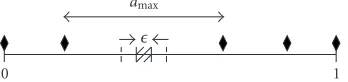
Protocol.Select a sequence ofmnonoverlapping length-
0 p1 p2 p3 1
Figure5: Aloha scheme on the linear field. A sequence of length-segments is activated sequentially. The sensors within the activated range transmit with probabilityP.
sense that it does not depend on the data collection results. Figure 5illustrates the Aloha scheme on the linear field.
In the Aloha protocol, the segment length, the trans-mission probabilityP, and the center locations of the activa-tion segments are optimizaactiva-tion parameters.
Lemma 2. For both the linear and the circular fields, the opti-mal transmission probabilityPis one and the optimal segment lengthis strictly less than1/ρ.
For the proof, seeAppendix B.
It can be shown that the result ofLemma 2also holds in a more general setup where the transmission probability within the activation region is a function of the distance from the sensor to the center of the activation region. An intuitive way to explain Lemma 2is that, for the same throughput, the smaller the activation interval length is, the more pre-cise the outcome location can be. Therefore, the data collec-tion outcomes for a smaller activacollec-tion interval are closer to evenly spaced center locations, producing a smallerE{dmax}.
Letting P = 1 gives the smallest activation interval length for a given throughput. The result aboutcan be explained as follows. Shortening the activation length has two effects on E{dmax}: one is that it gives a lower throughput if the
length is less than or equal to 1/ρ, which is a negative effect; the other is that it produces a more precise outcome loca-tion control, a positive effect. Although (P = 1, = 1/ρ) gives the maximum throughput for Aloha, whenis short-ened a little, the throughput only decreases a little because the derivative of the throughput with respect tois zero at
= 1/ρ. Thus the negative effect is small. The positive ef-fect from the more precise location control favors an activa-tion length strictly shorter than 1/ρ, meaning that the opti-mal throughput is strictly less than 1/e. Nonetheless, the gain by selecting a length shorter than 1/ρis small for dense sensor networks. We will use=1/ρin the simulations.
As shown in Lemma 1, for the circular field, evenly spaced center locations of the activation segments are opti-mal. As mentioned in the carrier sensing protocol, for the lin-ear field, evenly spaced activation segments are not optimal. Nonetheless, evenly spaced segments have good performance for largemandρ, and we will use evenly spaced activation segments in the simulations for the linear field.
3.4. Adaptive Aloha scheduling
The carrier sensing and Aloha scheduling protocols pre-sented previously are deterministic scheduling since the cen-ter location of each activation segment does not change ac-cording to previous data collection outcomes. In determinis-tic scheduling, the activation location information may be preset to sensors before their deployment, eliminating the
dmax
0 1
Figure6: Adaptive Aloha scheduling example on the linear field. The mobile access point activates one interval of length in one time slot. The sensors within the activated range transmit with probabilityP=1. The solid diamonds indicate the received packets. The algorithm tries to break the maximum distance by placing the next polling interval at the center of the two received data sample locations whose distance isdmax.
need to broadcast the location information from the mo-bile access point and saving some hardware cost. Another approach is to let the mobile access point decide the next ac-tivation location on the fly, based on previous data collection results. Allowing the activation sequence to adapt to previous data collection results may give better performance. Next we present an adaptive scheduling for Aloha.
Protocol. The basic activation strategy is similar to the Aloha protocol. The mobile access point activates an inter-val of length=1/ρin each time slot; the sensors within the range transmit with probabilityP=1. The difference is that, in the adaptive version, the locations of the activation inter-vals depend on the previous data collection results, which is described as follows.
After obtaining a new packet, the access point checks all the previous received data and finds the two adjacent sample locations that have the maximum distance. The access point then locates the next polling interval in the middle of these two samples locations (seeFigure 6for the linear field case). If an empty slot occurs, the access point then activates the length- interval adjacent (either left or right) to the pre-vious empty intervals until a success or collision occurs. If a collision occurs, the access point resolves the collision by splitting the collision interval until a packet is successfully received (similar to the splitting algorithms [12]). If a packet is received successfully, the access point recalculates and tries to break the newdmaxof the received samples within the
re-maining time slots. The algorithm keeps running until it uses up themtime slots.
The above protocol works in an environment where the mobile access point can communicate to the whole field from one location, for example, high-altitude airplanes or satel-lites. There are other types of adaptive scheduling schemes. For example, we can also adapt the activation sequence on a carrier sensing scheduling setup. However, as will be shown in the simulations section, the gain of adapting activation se-quence on a carrier sensing setup is small because the per-formance of the carrier sensing scheduling is already close to that of the optimal centralized scheduling.
4. SIMULATIONS
0.1 0.15 0.2 0.25 0.3 0.35 0.4 0.45 0.5
E
{
dmax
}
10 15 20 25 30 35 40 45 50
m
Centralized Carrier sensing
Aloha Adaptive Aloha
Figure7:E{dmax}versus packet collection sizemfor sensor density
ρ=40.
shown. For the circular field, similar results are observed. Sensors are randomly deployed according to the Poisson dis-tribution with density ρ. For convenience, we name these MAC protocols as follows.
(i) π1is the optimal centralized scheduler.
(ii) π2is the decentralized scheduling through carrier
sens-ing withR=1.
(iii) π3is the Aloha scheduling.
(iv) π4is the adaptive Aloha scheduling.
We use thedmaxfound usingπ2as the initial maximum
dis-tance for the iteration algorithm inπ1. The search stops after
1-2 iterations typically. In the comparison, we useE{dmax}as
the performance metric.
Figures 7and8plotE{dmax} versusmfor sensor
den-sityρ=40 and 200, respectively. The expectation ofdmaxin
the figures is averaged over 100 000 realizations of the Pois-son sensor field. As expected, asmincreases, the number of data samples received at the mobile access point increases, and thusE{dmax}decreases. We see that there is little
perfor-mance loss by usingπ2. Notice that, whenmis larger thanρ
(Figure 7), underπ1andπ2, data from all sensors can be
re-trieved with a high probability. Therefore, the performance gap for the two protocols diminishes. The performance un-derπ3 is worse than other schemes even when mis larger
thanρ. This is because, underπ3, some scheduled intervals
do not have data packets received successfully due to either collision or void of sensors. Unlikeπ3, the location of each
ac-tivation interval ofπ4is adapted to the previous data
collec-tion outcomes. Whenmis large, it has enough slots to search for intervals within which sensors exist and to resolve col-lision, therefore avoiding the problem inπ3. FromFigure 7,
we see that, whenmis large, the performance underπ4is as
good as the optimal case.
0 0.05 0.1 0.15 0.2 0.25 0.3 0.35 0.4 0.45
E
{
dmax
}
10 15 20 25 30 35 40 45 50
m
Centralized Carrier sensing
Aloha Adaptive Aloha
Figure8:E{dmax}versus packet collection sizemfor sensor density
ρ=200.
Figures 9and10 plotE{dmax} versusρ for packet
col-lection size m = 10 and 50, respectively. As expected, asρ increases, the density of the sensor field increases, and the received data locations are closer to the desired locations, re-sulting in a sample pattern closer to evenly spaced. There-fore,E{dmax}converges to the minimum value asρincreases.
Again, we see that the performance underπ2closely follows
the optimal one. Asρincreases, we see the performance gap between the two Aloha schemes andπ1 increases. The
per-formance loss underπ3is mainly due to its lower throughput
than that ofπ1andπ2, which limits the number of received
samples. We observe that there is a significant performance improvement ofπ4overπ3by adaptively optimizing the
re-trieval pattern based on the rere-trieval history.
5. CONCLUSION
0.05
Figure9:E{dmax}versus sensor densityρfor packet collection size
m=10.
compared to the performance of the optimal scheduler. For the two Aloha schemes, by exploring the history of retrieved data locations, adaptive Aloha provides a significant perfor-mance gain over the simple Aloha scheme.
APPENDICES
A. PROOF OFLEMMA 1
We first define four operations on integers or real numbers. Letiandjbe two integers. Definei⊕jto be equal toi+j+km, where kis the integer such that 1 ≤ i+ j+km ≤ m. Let i ji⊕(−j). Letx1andx2be two real numbers. Define
x1⊕x2to be equal tox1+x2+k, wherekis the integer such that
0≤x1+x2+k <1. Letx1 x2x1⊕(−x2). For convenience,
extend the operationsand on real numbers to include the symbol∅. Letx1andx2be real numbers or the symbol
∅. Definex1⊕x2andx1 x2to be∅if eitherx1orx2is equal
to∅.
It can be verified that the inverse function of (12) is given by
qipi,bi=pi⊕bi. (A.1) The averagedmaxwhenpis the center location vector is given
by loss of generality, assume that pis an ordered vector with p1 being the smallest. Let ˜pbe an equally spaced location
vector on the circular field. Without loss of generality, let
0.02
Figure10:E{dmax}versus sensor densityρfor packet collection size
m=50.
Therefore, the left-hand side of (A.3) can be expressed as
Eb
Hence, it suffices to show that for anybandp,
1
For a givenbwith one or no non-∅element, by defini-tion,dmaxis equal to 1 or 2, respectively, for bothpand ˜p.
Therefore, (A.6) holds.
LetL(i,j) be the set of indices betweeniand j counter-clockwise, 1 ≤i,j ≤mandi= j, that is,L(i,j)= {l:i < l < j}ifi < j, or{l:i < l≤m, or 1≤l < j}ifi > j. For a givenbwith at least two non-∅entries, searchdmaxamong
dmaxoccurs from theith point to thejth point
counterclock-circumference of the circular field, which is one.
B. PROOF OFLEMMA 2
We proveLemma 2for the linear field. The proof for the cir-cular field is basically the same except that extra care should be taken for coordinate transitions around locationx=0 or x =1. Consider a more general scheme which does not re-quire that each activation segment has the same length and transmission probability. Let pi,Pi, andidenote the center, the transmission probability, and the length of theith activa-tion segment, respectively, 1≤i≤m. Letqibe the outcome location of theith channel competition, orqi= ∅if no sam-ple packet is received successfully in theith time slot, due to either collision or no transmission. The throughput of theith time slot is
siPrqi= ∅=iPiρe−iPiρ. (B.10)
Given a packet is received successfully in theith time slot, the locationqiis uniformly distributed,
pqi|qi= ∅= 1
i1pi−i/2≤qi≤pi+i/2, (B.11)
where 1A is the indicator function. Let q = [q1,. . .,qm]T.
Since the activation segments do not overlap,qi’s are inde-pendent. Letq/idenote the length-(m−1) vector constructed by taking outqifromq. The expecteddmax(q) is given by
Eq rameters remain the same, thenE{dmax(q)}decreases. Since
the throughputsiremains the same, the first term of (B.12) remains the same. If we can show that, for all q/i and for
−i/2≤a≤i/2,
then we have shown that the second term of (B.12) decreases. Therefore, we have proved that, with the same throughput, the shorter the activation length, the better the performance. Hence, the optimalPiis 1 and the optimaliis less than or equal to 1/ρfor allibecause these conditions in Aloha give the shortest activation length for a given throughput.
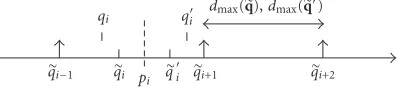
Next we prove (B.13). Let length-mvectorsq, ˜q, and ˜q be functions ofqgivenqi= ∅:qj =q˜j=q˜j=qjforj=i, qi=2pi−qi, ˜qi=pi+ ˜i/i(qi−pi), and ˜qi=pi−˜i/i(qi−pi) (Figure 11). Equivalently, we are proving that
dmax(q) +dmax(q)≥dmax(˜q) +dmax(˜q) (B.14)
for allqwithqi = ∅, or equivalently, for all ˜qwith ˜qi = ∅. We first define three terms for the ease of discussion.dmax(q)
is said to beassociatedwithqi ifqi is one of the endpoints that producesdmax givenqas the outcome location vector.
dmax(q) is said to be associated withqito the insideifdmax(q)
is associated withqiand the centerpiis between the two end-points ofdmax.dmax(q) is said to be associated withqito the
dmax(q),dmax(q)
qi−1 qi pi qi qi+1 qi+2
qi qi
Figure11:Case 1.
not between the two endpoints ofdmax. We prove (B.14) by
verifying all possible cases.
Case 1. Neitherdmax(˜q) is associated with ˜qi nor dmax(˜q)
is associated with ˜qi. Therefore, dmax(˜q) and dmax(˜q) are
associated with two points other than ˜qior ˜qi (Figure 11). Since these two points are also adjacent points inqandq, dmax(q) anddmax(q) are at least as large as the distance of
the two points. Therefore, dmax(q) +dmax(q) ≥ dmax(˜q) +
dmax(˜q).
Case2. Eitherdmax(˜q) is associated with ˜qito the outside or
dmax(˜q) is associated with ˜qi to the outside. Without loss of generality, assume that dmax(˜q) is associated with ˜qito the outside (Figure 12). Suppose that the other endpoint for dmax(˜q) is ˜qk,k = i. By assumption, ˜qk and ˜qi are on the
same side ofpi. Thus, it can be verified that ˜qiand ˜qkare the two endpoints ofdmax(˜q). Therefore,
dmax(˜q) +dmax(˜q)=2pi−qk˜ . (B.15)
Since qi and ˜qk are two adjacent points in q, we have dmax(q)≥ |qi−qk˜ |. Similarly,dmax(q) ≥ |qi−qk˜ |. Since
qiandqiare on the same side of ˜qk, we have
dmax(q) +dmax(q)≥qi−qk˜+qi−qk˜
=2pi−qk˜
=dmax(˜q) +dmax(˜q).
(B.16)
Case 3. Either dmax(˜q) is associated with ˜qi to the inside
or dmax(˜q) is associated with ˜qi to the inside, but neither dmax(˜q) is associated with ˜qito the outside nordmax(˜q) is
associated with ˜qi to the outside. Without loss of general-ity, assume that dmax(˜q) is associated with ˜qi to the inside
(Figure 13). Sinceqiis further away from the centerpithan ˜
qi, we havedmax(q)> dmax(˜q). There are two subcases.
Subcase1. dmax(˜q) is associated with ˜qi to the inside. Since qi is further away from the center pi than ˜qi, we have dmax(q)> dmax(˜q). Therefore,
dmax(q) +dmax(q)> dmax(˜q) +dmax(˜q). (B.17)
Subcase2. dmax(˜q) is not associated with ˜qi. With the same argument as inCase 1, we havedmax(q)≥dmax(˜q).
There-fore, (B.17) still holds.
The above three cases conclude the proof of (B.14). Thus we have shown that the optimal Pi is 1 and the optimali is less than or equal to 1/ρ for alli. Next we prove that the optimaliis strictly less than 1/ρ. SinceE{dmax(q)}is a
con-tinuous function ofi, it suffices to prove that, whenP=1, ∂Edmax(q)
∂i
i=1/ρ
>0. (B.18)
From (B.12),
∂Edmax(q)
∂i
=ρe−iρE
q/i
iρ−1dmax
q/i,qi= ∅
−ρ
2 i/2
−i/2
dmax
q/i, qi=pi+a
+dmax
q/i, qi=pi−a
da
+1 2
dmax
q/i,qi=pi+i 2
+dmax
q/i,qi=pi−i 2
. (B.19)
The first term of (B.19) is equal to zero given thati = 1/ρ. From (B.13),
dmax
q/i, qi=pi+i 2
+dmax
q/i,qi=pi−i 2
≥dmax
q/i,qi=pi+a
+dmax
q/i,qi=pi−a
(B.20)
for−i/2< a <i/2. Since (B.17) inCase 3in the proof of the
first part occurs with nonzero probability, strict inequality in (B.20) occurs with nonzero probability. Therefore, the sum of the second and the third terms of (B.19) is strictly larger than zero given thati=1/ρ, thus proving (B.18).
ACKNOWLEDGMENTS
dmax(q)
dmax(q)
qi−1 qi pi qi qi+1 qi+2
qi qi
Figure12:Case 2.
dmax(q)
dmax(q)
qi−1 qi pi qi qi+1 qi+2
qi qi
Figure13:Case 3.
Multidisciplinary University Research Initiative (MURI) un-der the Office of Naval Research Contract N00014-00-1-0564, and the Army Research Laboratory CTA on Communi-cation and Networks under Grant DAAD19-01-2-0011. Part of this work was presented at MILCOM, Monterey, Calif, USA, October 2004.
REFERENCES
[1] L. Tong, Q. Zhao, and S. Adireddy, “Sensor networks with mo-bile agents,” inProc. IEEE Military Communications Confer-ence (MILCOM ’03), vol. 1, pp. 688–693, Boston, Mass, USA, October 2003.
[2] P. Venkitasubramaniam, S. Adireddy, and L. Tong, “Sensor networks with mobile access: optimal random access and cod-ing,”IEEE J. Select. Areas Commun., vol. 22, no. 6, pp. 1058– 1068, 2004.
[3] A. Woo and D. Culler, “A transmission control scheme for me-dia access in sensor networks,” inProc. 7th Annual ACM/IEEE International Conference on Mobile Computing and Network-ing (MobiCom ’01), pp. 221–235, Rome, Italy, July 2001. [4] W. Ye, J. Heidemann, and D. Estrin, “An energy-efficient MAC
protocol for wireless sensor networks,” inProc. 21st Annual Joint Conference of the IEEE Computer and Communications Societies (INFOCOM ’02), vol. 3, pp. 1567–1576, New York, NY, USA, June 2002.
[5] K. Sohrabi, J. Gao, V. Ailawadhi, and G. J. Pottie, “Protocols for self-organization of a wireless sensor network,”IEEE Pers. Commun., vol. 7, no. 5, pp. 16–27, 2000.
[6] R. Iyer and L. Kleinrock, “QoS control for sensor networks,” in Proc. IEEE International Conference on Communications (ICC ’03), vol. 1, pp. 517–521, Anchorage, Alaska, USA, May 2003. [7] M. Dong, L. Tong, and B. M. Sadler, “Impact of MAC design on signal field reconstruction in dense sensor networks,” sub-mitted toIEEE Trans. Signal Processing.
[8] M. Dong, L. Tong, and B. M. Sadler, “Information retrieval and processing in sensor networks: deterministic scheduling vs. random access,” inProc. IEEE International Symposium on Information Theory (ISIT ’04), pp. 79–79, Chicago, Ill, USA, June–July 2004.
[9] Q. Zhao and L. Tong, “QoS specific medium access control for wireless sensor network with fading,” inProc. 8th Inter-national Workshop on Signal Processing for Space Communica-tions (SPSC ’03), Catania, Italy, September 2003.
[10] Q. Zhao and L. Tong, “Distributed opportunistic transmis-sion for wireless sensor networks,” inProc. IEEE International Conference on Acoustics, Speech, and Signal Processing (ICASSP ’04), vol. 3, pp. 833–836, Montreal, Quebec, Canada, May 2004.
[11] Q. Zhao and L. Tong, “Opportunistic carrier sensing for energy-efficient information retrieval in sensor networks,” EURASIP Journal on Wireless Communications and Network-ing, vol. 2005, no. 2, pp. 231–241, 2005.
[12] D. Bertsekas and R. Gallager,Data Networks, Prentice-Hall, Englewood Cliffs, NJ, USA, 1992.
Zhiyu Yangreceived the B.Eng. degree in electronic engineering from Tsinghua Uni-versity, Beijing, China, in 2000, and the S.M. degree in engineering sciences from Har-vard University, Cambridge, Massachusetts, in 2001. Currently, he is a Ph.D. candidate in the School of Electrical and Computer En-gineering, Cornell University, Ithaca, New York. His areas of interest include wireless communications, communication and
sen-sor networks, information theory, and signal processing.
Min Dongreceived the B.Eng. degree from Tsinghua University, Beijing, China, in 1998, and the Ph.D. degree in electrical and computer engineering from Cornell Uni-versity, Ithaca, New York, in 2004. She is currently with the Cooperate Research and Development, QUALCOMM Incorporated, San Diego, Calif, USA. Dr. Dong received the IEEE Signal Processing Society Best Pa-per Award in 2004. Her research interests
include statistical signal processing, wireless communications, and communication networks.
Brian M. Sadlerreceived the B.S. and M.S. degrees from the University of Maryland, College Park, and the Ph.D. degree from the University of Virginia, Charlottesville, all in electrical engineering. He is a Senior Re-search Scientist at the Army ReRe-search Lab-oratory (ARL) in Adelphi, MD, USA. He was a Lecturer at the University of Mary-land, and has been lecturing at Johns Hop-kins University since 1994 on statistical