Annotating Inter-Sentence Temporal Relations in Clinical Notes
Jennifer D’Souza, Vincent Ng
Human Language Technology Research Institute University of Texas at Dallas
Richardson, TX 75083-0688 {jld082000,vince}@hlt.utdallas.edu
Abstract
Owing in part to the surge of interest in temporal relation extraction, a number of datasets manually annotated with temporal relations between event-event pairs and event-time pairs have been produced recently. However, it is not uncommon to find missing annotations in these manually annotated datasets. Many researchers attributed this problem to ”annotator fatigue”. While some of these missing relations can be recovered automatically, many of them cannot. Our goals in this paper are to (1) manually annotate certain types of missing links that cannot be automatically recovered in the i2b2 Clinical Temporal Relations Challenge Corpus, one of the recently released evaluation corpora for temporal relation extraction; and (2) empirically determine the usefulness of these additional annotations. We will make our annotations publicly available, in hopes of enabling a more accurate evaluation of temporal relation extraction systems.
Keywords: temporal relations, predicate-argument relations, discourse relations
1.
Introduction
Recent years have seen a surge of interest in temporal in-formation extraction (IE) in the natural language process-ing community. In order to facilitate corpus-based ap-proaches to temporal relation extraction, several datasets manually annotated with temporal relations were pro-duced in the past decade, including the TimeBank cor-pus (Pustejovsky et al., 2003), as well as those produced as part of 1 (Verhagen et al., 2007), TempEval-2 (Verhagen et al., TempEval-2010), and the TempEval-201TempEval-2 iTempEval-2bTempEval-2 shared task on temporal relation extraction (Sun et al., 2013).
Manually annotating documents with temporal relations is a fairly sophisticated task, however. Many researchers, in-cluding the organizers of the aforementioned shared tasks, have noticed that it is not uncommon to find missing tem-poral relations in these manually annotated documents. In other words, many temporal relations that must exist be-tween events are in fact not annotated in these documents. Verhagen (2005), Verhagen et al. (2006), and UzZaman et al. (2012), among others, attribute the reason behind this ”missing annotation” problem to annotator fatigue: since the number of temporal relations present in a document, especially one that is long, can potentially be large, it is possible for an annotator to miss some of them during the annotation process. The presence of missing links presents problems to both the training and evaluation of temporal re-lation extraction systems: not only do they cause a temporal relation extraction system to be unfairly evaluated, but they also cause systems to be trained on instances with incorrect temporal relation labels.
Fortunately, some of these missing temporal links can be recovered automatically. For example, if a human annota-tor determines that A occurs before B and B occurs before C, then even if she forgets to annotate A as occurring be-fore C, we can automatically recover such missing link by transitivity. On the other hand, there are many cases where missing links cannot be automatically recovered (see Sec-tion 3 for details).
Our goal in this paper is to manually annotate certain types of missing links that cannot be automatically recovered in the i2b2 Clinical Temporal Relations Challenge Corpus (henceforth i2b2 corpus), one of the recently released eval-uation corpora for temporal relation extraction. To deter-mine the usefulness of our annotations, we train and eval-uate two temporal relation extraction systems, one on only the existing annotated temporal relations, and the other on those augmented with our new annotations. In addition, to enable accurate evaluation of temporal relation extraction systems on this corpus, we will make our annotations pub-licly available.1
2.
Corpus
For annotation, we use the i2b2 corpus, which consists of 310 de-identified discharge summaries pre-partitioned into a training set (190 summaries) and a test set (120 sum-maries). The original corpus is marked up with annotations for event expressions, time expressions, and temporal rela-tions between some of the event pairs and event-time pairs. Being outside the scope of this work, details on time ex-pressions and temporal relations between event-time pairs is excluded from further discussion. In the i2b2 corpus, an event refers to clinically relevant patient-related actions, and contains various attributes, including the type of event
2 , polarity, and modality. For the event pairs that are
an-notated with temporal relations, the temporal order of the events in the pair is reflected by the type of the temporal relation they are assigned. The i2b2 corpus has 12 rela-tion types defined in all. They are Simultaneous, Overlap,
1
Downloadable from http://www.hlt.utdallas. edu/˜jld082000/temporal-relations/
2
Before, After, Before Overlap, Overlap After, During, During Inv, Begins, Begun By, Ends, and Ended By.
% Temporal Relation Annotations Corpus Intrasentence Intersentence
Training data 64.4% 35.6%
[image:2.612.351.492.289.426.2]Test data 61.2% 38.8%
Table 1: i2b2 corpus annotation percentages of intrasen-tence and intersenintrasen-tence temporal relations
These event pairs chosen for annotating with temporal rela-tions can either be intrasentential or intersentential. Table 1 provides a breakdown of the percentage of annotated tem-poral relations in the i2b2 corpus for intrasentential event pairs versus for intersentential event pairs. From these per-centages, we see that the number of annotations for inter-sentence event pairs is much lower than the number of an-notations made for intrasentence event pairs. This sparsity in intersentence links is a problem because it creates gaps in a patient’s clinical timeline. As an example, consider:
[sample1.txt]
[eventCardiac catheterization] done on 01-07 showed
[eventan aortic valve area] of .38 cm.sq. , with [eventa
mean gradient] of 62 . [eventPA pressure] 48/24 , [event1+
mitral regurgitation] , and [eventan ejection fraction] of
[image:2.612.56.284.369.467.2]43% .
Figure 1: Timeline of events constructed from sample.txt
From Figure 1 we observe that the timeline created from existing temporal relation annotations has many missing links, particularly intersentential ones. Since the events of type TEST discussed in the sample1.txt are all conducted together, roughly overlapping in time, it is important for a medical timeline constructed from these events to not leave out this vital piece of information. Such instances of missing temporal relations can cause gaps in construct-ing a timeline of clinical events. Therefore, the main aim of this work is to fill in the gaps that arise due to missing inter-sentence temporal relation annotations by providing human annotations for missing unrecoverable links between event pairs from adjacent sentences.
3.
Transitive Closure
A discharge summary has temporal relations expressed in the following two ways: 1) explicit relations that are annotated in the document; and 2) implicit relations that
are not annotated in the document, but can be gener-ated by computing a transitive closure over the explicit temporal relations. Computing transitive closure over a collection of related event pairs entails applying a set of transitivity rules that have originated from Allen’s (1983) interval algebra. In the closure process, the satisfaction of any rule results in a new relation implied by the rule. As an illustrative example, consider the events from sample2.txt represented in Figure 2. In this example, we are given that event e1 his overall status is Before evente2 transferred and that e2transferred Begins event e3 the floor. So even though we are not given any ex-plicit relation annotation between e1 his overall status and e3 the floor, their temporal relation can be inferred as Before by applying the following transitivity rule: ((e1Beforee2)∧(e2Beginse3)) =⇒ (e1Beforee3).
[sample2.txt]
His oxygen requirement decreased, and [event1his overall
status] improved quickly . He is being [event2transferred]
to [event3the floor] for ongoing care .
Figure 2: Example showing automatic temporal relation in-ference.
Figure 3: Example where automatic temporal relation in-ference is not possible.
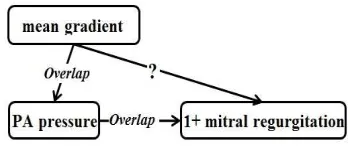
However, automatic inference of temporal relations that must exist between events but which are missing from an-notations is not always possible. Let us reconsider some of the event pairs from Figure 1, as re-depicted in Figure 3. In the figure, we see that event mean gradient of type TEST
Overlaps with another TEST event PA pressure, event PA
[image:2.612.334.508.490.567.2]there are no applicable rules of transitivity to enable infer-ring the relation between event pair (e1,e3). Such situations call for human intervention in making the correct choice of applicable relation from those present in the relations’ set. Therefore, in this work we rely on human judgement to annotate the dataset with inter-sentence missing links that must be present but aren’t, and which are also not automat-ically recoverable from existing explicit annotations.
4.
Annotation of Temporal Relations
4.1. Annotation Guidelines
To annotate these missing links, we must provide guide-lines for identifying eligible links. The original i2b2 cor-pus annotation guidelines describes eligibility as when the paired events have an explicit temporal influence on each other in a patient’s medical timeline. In this setting, an-notators are called to exercise two levels of judgement: 1) decide if the paired events influence each other medically; and if they do, then 2) choose from the given set of temporal relations the one applicable to the pair. We recognize that this annotation setting is susceptible to annotation inconsis-tencies, especially in a multiple annotator setting, on both levels of judgement: 1) in deciding eligibility; and 2) in se-lecting temporal relation type. Our guidelines differ from the original i2b2 corpus guidelines in that instead of using the more generic description of eligibility, we provide an-notators with 10 cases within which the original eligibility statement is true qualifying an event pair that is classified into 1 of the 10 cases as eligible to have a relation. This aids in alleviating annotation inconsistencies arising from the first level of judgements required to be made when us-ing the generic description of eligibility. Once identified as eligible, temporal relation type choice is based on annotator judgement.
Next, we describe the 10 criteria for eligibility. For each event pair (e1,e2) wheree1 ande2 are from adjacent sen-tences in the text, the event pair has an explicit temporal relation if it satisfies any one of the following cases:
Case 1
Prior to and surrounding admission events:
is true when,
• one of the events is an admission OCCUR-RENCE, and the other event is a TREAT-MENT/TEST event that happened before the pa-tient’s admission; or
• one of the events is an admission OCCUR-RENCE for the purpose of the other event which is a TREATMENT; or
• one of the events is an admission OCCUR-RENCE because of a PROBLEM which is the other event; or
• one of the events is a PROBLEM from the pa-tient’s past and the other event is a PROBLEM because of which the patient is admitted.
consider passages,
. . . with [eventmetastatic cervical cancer]
[eventadmitted] with a question of [eventmalignant
pericardial effusion] .
Patient underwent [eventa total abdominal
hysterec-tomy] in the past for a 4x3.6x2 cm [eventcervical
mass] . . .
eligible pair: (admitted, a total abdominal hysterec-tomy)
The patient was [eventadmitted] to [eventthe Tau
Memorial Hospital] .
She was seen by Dr. Freiermthalskush of [eventthe renal service] for [eventmanagement] of her
[eventchronic renal insufficiency] .
eligible pairs: (admitted, management), (admitted, chronic renal insufficiency)
. . . woman who is [eventHIV positive] for two years .
She [eventpresented] with [eventleft upper quadrant
pain] as well as [eventnausea] and [eventvomiting] . . .
eligible pairs: (HIV positive, left upper quadrant pain), (HIV positive, nausea), (HIV positive, vom-iting)
Case 2
Coreferent events:
is true when,
• both events are actually the same event just re-ferred to by distinct phrases, or by the same phrase in two different places.
consider passage,
. . . his usual monthly change of [eventhis suprapubic
catheter] and felt [eventdiscomfort] . . .
. . . he was [eventevaluated] by Urology and had
[eventhis catheter] changed .
eligible pair: (his suprapubic catheter, his catheter)
Case 3
Recurrent events:
is true when,
• one of the events is a recurrence of the other event.
consider passage,
She has complaints of . . . [eventleft upper quadrant
pain] on and off getting progressively worse . . . She has had [eventsimilar pain] intermittently for last
year .
Relation Number of Intra-Sentence Instances
Training Data Test Data
Original After Additional % Original After Additional %
Annotation Links Additional Annotation Links Additional
links links
1 Simultaneous 435 634 199 45.7% 353 560 207 58.6%
2 Overlap 335 2715 2380 710.4% 188 1573 1385 736.7%
3 Before 65 2189 2124 3267.7% 44 1548 1504 3418.2%
4 After 10 89 79 790% 6 52 46 766.7%
5 Before Overlap 74 1727 1653 2233.8% 70 1385 1315 1878.6%
6 Overlap After 0 83 83 - 0 90 90
-7 During 15 166 151 1006.7% 11 150 139 1263.6%
8 During Inv 0 96 96 - 0 65 65
-9 Begins 0 31 31 - 0 19 19
-10 Begun By 9 12 3 33.3% 7 13 6 85.7%
11 Ends 9 12 3 33.3% 7 13 6 85.7%
[image:4.612.64.539.25.208.2]12 Ended By 49 97 48 98.0% 48 97 49 102.1%
Table 2: Number and Percentages of additional links added to the training and test set of the i2b2 corpus.
Case 4
Sequence of events:
is true when,
• both events are either TREATMENT or TEST which are administered in an asynchronous se-quence.
• both events are CLINICAL DEPARTMENTs which the patient visited at different times.
• both events refer to specific admission, discharge, or transference OCCURRENCE with at least one of them being a verb.
consider passages,
She underwent [eventpre-operative testing] along
with [eventcarotid ultrasound] .
CNIS revealed carotid stenosis and she ulti-mately underwent [eventleft carotid stenting] by
[eventvascular surgery] on 10-30 .
eligible pairs: (carotid ultrasound, left carotid stent-ing), (carotid ultrasound,vascular surgery)
While in [eventOaksgekesser/ Memorial Hospital] the
patient was never able to get out of bed . . .
. . . when he is [eventtransferred] to [eventa rehab
facil-ity] that he will continue with [eventphysical therapy]
. . .
eligible pair: (Oaksgekesser/ Memorial Hospital, a rehab facility)
He was most recently [eventdischarged] from
[eventOaksgekesser/ Memorial Hospital] on 03/06/99
and was then [eventtransferred] to [eventLinghs County
Medical Center] . . .
. . . doing relatively [eventwell] at home until one
day prior to [eventadmission] he complained
[eventdiscomfort] . . .
eligible pairs: (discharged, admission), (trans-ferred, admission)
Case 5
PROBLEM causing events:
is true when,
• one of the events is an OCCURRENCE because of the other event of type PROBLEM.
• one of the events is a TEST conducted because of the other event of type PROBLEM.
• one of the events is a TREATMENT administered because of the other event of type PROBLEM.
consider passages,
She was [eventnoted] , on 06/16 , to have
[eventnumerous erythematous maculopapules]
. . . [eventDermatology] was [eventconsulted] and they
felt that this was most likely [eventsteroid acne] .
eligible pair: (numerous erythematous macu-lopapules, consulted)
[eventThe patient’s shortness of breath] and
[eventwheezing] continued but without change
. [eventHer cardiac examination] remained the
same and there continued to be no evidence of [eventtamponade] .
eligible pairs: (The patient’s shortness of breath, Her cardiac examination), (wheezing, Her cardiac examination)
She described [eventthe pain] as a burning pain which
is positional . . .
She has no relief from antacids or H2 blockers .
Case 6
TEST reveals PROBLEM:
is true when,
• one of the events is a TEST which reveals the other event a PROBLEM that the patient faces.
consider passage,
[eventA follow-up CT scan] was done which did
not [eventshow] any evidence for [eventsplenomegaly]
. . . [eventThe 1 cm cyst] which was seen in 10/92 was
still present .
eligible pair: (A follow-up CT scan, The 1 cm cyst)
Case 7
IS-A relation between events:
is true when,
• both events are PROBLEMs or TREATMENTs or TESTs in a hierarchical IS-A relation.
consider passages,
Pathology revealed [eventpoorly differentiated
squamous cell carcinoma of the cervix] and [eventmetastatic squamous cell carcinoma in the
cardinal ligaments] with [eventextensive lymphatic
invasion] .
Patient was felt to have [eventstage 2B disease] and
post-operatively , she was treated . . .
eligible pairs: (poorly differentiated squamous cell carcinoma of the cervix, stage 2B disease), (metastatic squamous cell carcinoma in the cardinal ligaments, stage 2B disease), (extensive lymphatic invasion, stage 2B disease)
. . . where he continued the rest of [eventhis treatment]
.
This consisted of continued [eventnebulizer
treat-ments] as well as [eventintravenous antibiotics] and
[eventintravenous Solu-Medrol] .
eligible pairs: (his treatment, nebulizer treatments), (his treatment, intravenous antibiotics), (his treat-ment, intravenous Solu-Medrol)
Case 8
TREATMENT/TEST/OCCURRENCE events in a CLINICAL DEPARTMENT:
is true when,
• one of the events is a
TREAT-MENT/TEST/OCCURRENCE that happens
in a CLINICAL DEPARTMENT which is the other event.
consider passage,
He stayed in [eventthe unit] for about one day .
During that period of time he received [eventnebulizer
treatments] with [eventAlbuterol] .
eligible pairs: (the unit, nebulizer treatments), (the unit, Albuterol)
Case 9
Event persists during another event:
is true when,
• one of the events persists for the duration of the other event.
consider passage,
. . . towards the last 2-3 days of [eventhis
hospitaliza-tion] the amount of improvement was minimal . It was felt that [eventhis respiratory status] has been
[eventmaximally treated] by then .
eligible pair: (his hospitalization, maximally treated)
Case 10
EVIDENTIAL nature of paired events:
is true when,
• one of the events is a TEST whose EVIDEN-TIAL function is the other event; or
• both are EVIDENTIAL events from separate sen-tences where the events in one sentence causally influence the other sentence events.
consider passage,
She underwent usual [eventpre-operative testing]
along with [eventcarotid ultrasound] . [eventCNIS]
[eventrevealed] [eventcarotid stenosis] . . .
eligible pair: (carotid ultrasound, revealed)
4.2. Annotation Tool
In order to annotate the dataset, annotators were provided with a Java-based annotation tool. 3 The interface of the
tool presented them with the text of the discharge report, marked up event expressions that were highlighted in a different color for ease of identification, and existing an-notations for temporal relations in the report. From the tool the annotators had two views of the data which were split horizontally, with the discharge report text along with marked up event expressions on the top half of the screen, and TLINK information between events on the bottom half
3
of the screen. In order to annotate a temporal relation, two events needed to be clicked on, after which a dialog prompt appears to select a relation to assign. This newly created re-lation then gets added to the set of existing TLINKs on the bottom half of the screen. Thus annotators could annotate the temporal relation between two events with just 3 mouse clicks.
[image:6.612.352.499.18.177.2]4.3. Agreement on Annotation Scheme
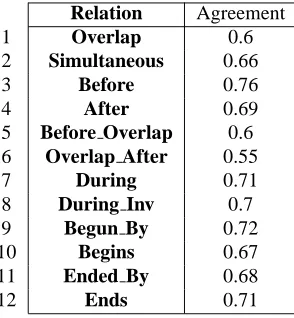
Table 2 shows the number of additional links that were added to the training and the test dataset in the i2b2 cor-pus. While the entire dataset is annotated by one annota-tor, to evaluate the annotation scheme, 50 randomly cho-sen training set files were annotated by a second annota-tor. We then compute two types of agreement based on Co-hen’s Kappa (Carletta, 1996): agreement on which events to pair across adjacent sentences, and agreement on both pairing events and assigning a temporal relation label to the event pair. We obtain a fairly high inter-annotator ment on linking events of 0.82, and a slightly lower agree-ment of 0.65 on linking and assigning relation labels. How-ever, considering that ours is a 12-class relation annota-tion scheme, a score of 0.65 suggests that the annotators judgement is fairly agreeable despite the fine-grained na-ture of this annotation task. Our hypothesis is that pro-viding annotators with specific guidelines (elicited in Sec-tion 4) for linking events has a significant contribuSec-tion in the next stage of annotation which involves choosing a re-lation. In order to gain insights into the difficult annotation classes as faced by the annotators, we obtain class-based inter-annotator agreement scores (shown in Table 3). From the numbers in Table 3, we see that the classes where anno-tators differed most in agreement were classes which were temporally overlapping in nature such as Overlap,
Be-fore Overlap, and Overlap After. This can be in part
at-tributable to differences in perception of overlapping events between annotators. For example, if a treatment adminis-tered to a patient is started right before the patient is admit-ted to a clinical department, then discrepancies in judge-ment can occur in deciding whether to use the Overlap or
Before Overlap relations. However, given the overall
an-notation agreement score, these discrepancies in annotator judgement seem to have a very minor impact on the overall agreement quality of the expanded corpus.
5.
Evaluation
5.1. Experimental Setup
In this section, we will conduct experiments using an exist-ing temporal relations identification and classification sys-tem (D’Souza and Ng, 2013). The goal of these experi-ments is to practically examine changes that are caused in classifier performance after augmenting the i2b2 corpus with the new temporal relation annotations discussed in the preceding sections.
Dataset. We use the 190 training documents from the i2b2
corpus for classifier training and and reserve the 120 test documents for evaluating system performance. The ad-ditional inter-sentence temporal relation annotations cause us to have two versions of the i2b2 corpus: 1) original corpus (Originalcorpus); and 2) original corpus augmented
Relation Agreement
1 Overlap 0.6
2 Simultaneous 0.66
3 Before 0.76
4 After 0.69
5 Before Overlap 0.6
6 Overlap After 0.55
7 During 0.71
8 During Inv 0.7
9 Begun By 0.72
10 Begins 0.67
11 Ended By 0.68
12 Ends 0.71
Table 3:Per-class annotator agreement (Cohen’s Kappa) for tem-poral relation annotation based on which temtem-poral relation from the 12 relations defined in the i2b2 corpus to assign to each pair
with additional inter-sentence temporal relation annotations (Expandedcorpus). Therefore, since we will run our clas-sification system on both versions of the corpus, for each experiment there will be two sets of results shown.
Evaluation metrics. We employ the standard metrics viz.
Recall (R), Precision (P), and micro F-score (Fmi) to eval-uate our 12-class temporal relations classifier.
5.2. Results and Discussion
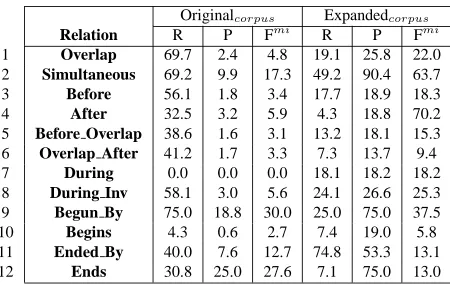
Tables 4 and 5 shows the results for our 12-class tempo-ral relation identification and classification task over all in-stances from that dataset and over only the inter-sentence annotated instances, respectively. Since this work deals with augmenting the corpus with additional links, the over-all classifier performance (in Table 4) is affected by the inter-sentence classification performance (in Table 5). As mentioned earlier, we show experiment results on both ver-sions of the i2b2 corpus i.e. before and after augmenting the corpus with additional inter-sentence temporal relation annotations. The results in row (1) show classifier per-formance on the original i2b2 corpus. And the results in row (2) are from applying the classifier on the expanded version of the i2b2 corpus. In order to explain the results that rows (i) and (ii) represent, we first need to clarify the concept of data skew which we do next.
prob-lem has indeed been dealt with. We do this by training and testing the classifier with and without pruning heuristics on both versions of the corpus. If the classifier performance re-duces significantly without pruning heuristics, then this is an indication of skew in data. But if classifier performs re-mains the same or shows only a slight variation, then this is an indication of no skew in the corpus being used. Rows (i) and (ii) represents classifier performance with and without pruning heuristics, respectively, when trained and tested on the two different corpus versions.
Corpus R P Fmi
[image:7.612.69.275.152.215.2]1 Originalcorpus (i) 52.9 21.0 30.0 (ii) 54.1 12.5 20.3 2 Expandedcorpus (i) 36.0 32.5 34.1 (ii) 37.6 30.9 33.9
Table 4: Classification of automatically identified temporal rela-tions on the original and expanded versions of the i2b2 corpus
Corpus R P Fmi
1 Originalcorpus (i) 52.7 6.7 11.9 (ii) 60.9 3.0 5.6 2 Expandedcorpus (i) 13.0 35.9 19.0
[image:7.612.67.274.274.338.2](ii) 16.7 27.0 20.6
Table 5: Classification of automatically identified temporal re-lations inter-sentence temporal rere-lations on the original and ex-panded versions of the i2b2 corpus
In examining the results in rows (1) and (2) of Tables 4 and 5, we see that classifier performance has a higher reliabil-ity factor on the Expanded version of the corpus than on the Original i2b2 corpus. This is reflected by the improve-ments in precision in the identification and classification system’s output in row (2)’s results when compared with row 1’s results. Next we also see that the data skew problem which existed in the Original corpus as evidenced by the drop in Originalcorpusf-score in row (ii) when compared with row (i)’s f-score, no longer exists in the Expanded ver-sion of the corpus, as the f-scores in rows (i) and (ii) remain relatively unchanged. This shows that the additional anno-tations alleviate skew in original data.
Originalcorpus Expandedcorpus
Relation R P Fmi R P Fmi
1 Overlap 69.7 2.4 4.8 19.1 25.8 22.0
2 Simultaneous 69.2 9.9 17.3 49.2 90.4 63.7
3 Before 56.1 1.8 3.4 17.7 18.9 18.3
4 After 32.5 3.2 5.9 4.3 18.8 70.2
5 Before Overlap 38.6 1.6 3.1 13.2 18.1 15.3
6 Overlap After 41.2 1.7 3.3 7.3 13.7 9.4
7 During 0.0 0.0 0.0 18.1 18.2 18.2
8 During Inv 58.1 3.0 5.6 24.1 26.6 25.3
9 Begun By 75.0 18.8 30.0 25.0 75.0 37.5
10 Begins 4.3 0.6 2.7 7.4 19.0 5.8
11 Ended By 40.0 7.6 12.7 74.8 53.3 13.1
12 Ends 30.8 25.0 27.6 7.1 75.0 13.0
Table 6: Per-class inter-sentence temporal relation classification without pruning heuristics on both versions of the i2b2 corpus
Finally, for more detailed insights into the task of automati-cally linking and classifying temporal relations, we present in Table 6 per-class classification results of the 12-class system without pruning heuristics on both version of the corpus. From these results we see that the difficult classes for the classifier to classify are Overlap, Before Overlap, and Overlap After which happens to be exactly the same set of classes which the human annotators had least agree-ment scores on. We can now safely conclude that the auto-matic identification and classification of temporal relations closely models after human annotation of temporal rela-tions.
6.
Conclusion
In conclusion, we have augmented the i2b2 corpus with a significant proportion of additional temporal relation links that are not automatically recoverable. We have shown that the data produced as result of this work is consistent in choice of temporal relations to add to the corpus ow-ing to fair inter-annotator agreement scores. In addition, for any annotation work dealing with temporal relations in medical data we provide an extended version of the original i2b2 guidelines by eliciting specific criteria for eligibility of temporal relations between events. Experiments on the ex-panded version of the corpus shows that the additional an-notations added to the i2b2 corpus has a positive effect on classifier performance and also eliminates data skew thus facilitating a more natural experimental setting.
Acknowledgements
We would like to thank the anonymous reviewers for their constructive comments. We would also like to thank Isaac Persing whose invaluable annotation work made it possible for us to obtain the inter-annotator agreement scores.
7.
References
Allen, James F. (1983). Maintaining knowledge about temporal intervals. Communications of the ACM, 26(11):832–843.
Carletta, Jean. (1996). Assessing agreement on classifica-tion tasks: The Kappa statistic. Computaclassifica-tional Linguis-tics, 22(2):249–254.
D’Souza, Jennifer and Ng, Vincent. (2013). Temporal re-lation identification and classification in clinical notes. In Proceedings of the International Conference on Bioin-formatics, Computational Biology and Biomedical Infor-matics, page 392. ACM.
Pustejovsky, James, Hanks, Patrick, Sauri, Roser, See, An-drew, Day, David, Ferro, Lisa, Gaizauskas, Robert, Lazo, Marcia, Setzer, Andrea, and Sundheim, Beth. (2003). The TimeBank corpus. In Corpus Linguistics, pages 647–656.
Sun, Weiyi, Rumshisky, Anna, and Uzuner, Ozlem. (2013). Evaluating temporal relations in clinical text: 2012 i2b2 challenge. Journal of the American Medical Informatics Association, 20(5):806–813.
[image:7.612.61.286.563.705.2]expressions, and temporal relations. arXiv preprint arXiv:1206.5333.
Verhagen, Marc, Knippen, Robert, Mani, Inderjeet, and Pustejovsky, James. (2006). Annotation of temporal re-lations with Tango. In Proceedings of LREC.
Verhagen, Marc, Gaizauskas, Robert, Schilder, Frank, Hepple, Mark, Katz, Graham, and Pustejovsky, James. (2007). SemEval-2007 Task 15: TempEval temporal re-lation identification. In Proceedings of the Fourth Inter-national Workshop on Semantic Evaluations (SemEval-2007), pages 75–80.
Verhagen, Marc, Sauri, Roser, Caselli, Tommaso, and Pustejovsky, James. (2010). SemEval-2010 Task 13: TempEval-2. In Proceedings of the 5th International Workshop on Semantic Evaluation, pages 57–62. Verhagen, Marc. (2005). Temporal closure in an