Building a Corpus of Manually Revised Texts from Discourse Perspective
Ryu Iida, Takenobu Tokunaga
Graduate School of Information Science and Engineering, Tokyo Institute of Technology 2-12-1 ˆOokayama, Meguro-ku, Tokyo 152-8552, Japan
{ryu-i,take}@cl.cs.titech.ac.jp
Abstract
This paper presents building a corpus of manually revised texts which includes both before and after-revision information. In order to create such a corpus, we propose a procedure for revising a text from a discourse perspective, consisting of dividing a text to discourse units, organising and reordering groups of discourse units and finally modifying referring and connective expressions, each of which imposes limits on freedom of revision. Following the procedure, six revisers who have enough experience in either teaching Japanese or scoring Japanese essays revised 120 Japanese essays written by Japanese native speakers. Comparing the original and revised texts, we found some specific manual revisions frequently occurred between the original and revised texts, e.g. ‘thesis’ statements were frequently placed at the beginning of a text. We also evaluate text coherence using the original and revised texts on the task of pairwise information ordering, identifying a more coherent text. The experimental results using two text coherence models demonstrated that the two models did not outperform the random baseline.
Keywords:essay revision, text coherence, discourse
1.
Introduction
The research of NLP applications for improving student’s writing skills has grown rapidly in recent years (Dale and Kilgarriff, 2010), as one of education-oriented applica-tions of NLP. The existing studies on these applicaapplica-tions have mainly focused on detecting and correcting grammat-ical and spelling errors (Brockett et al., 2006; Hermet and D´esilets, 2009; Leacock et al., 2010; Park and Levy, 2011). On the other hand, there has been growing need for applica-tions taking into account discourse coherence of a text, e.g. automatic essay scoring (Shermis and Burstein, 2003) and essay revision. They are important because of the difficulty of consistent essay scoring by human evaluators. Further-more, such applications are sometimes required to provide comprehensible reasons of evaluation scores and revision of the text for language learners. For example, learners of Japanese language sometimes use less cohesive referring expressions, e.g. excessive use of ellipses. The comprehen-sible explanation for appropriate usage of (zero) anaphors is required for the learners. However, generating such expla-nation has been less studied because the existing systems of writing support and text revision have less focused on the treatment of discourse processing.
Against this background, we aim at developing a technique of automatically revising a text from discourse perspective, taking Japanese as a target language. To this end, the fol-lowing two approaches, which are complementary to each other, can be considered.
1. A rational approachdevelops a theory of realising co-herent texts from theoretical perspectives of discourse.
2. An empirical approachcreates manually revised texts for quantitative analysis and then develops a text revi-sion model based on clues acquired from the analysis.
The former approach focuses on integration of various clues proposed in the past discourse studies (e.g. Center-ing Theory (Grosz et al., 1995) and Rhetorical Structure
Theory (RST) (Mann and Thompson, 1988)) into the tar-get problem (e.g. essay scoring or essay revision), rely-ing on the notions of discourse theories (e.gcenters intro-duced in Centering Theory and discourse relations defined in RST). However, the effectiveness of those theoretically motivated clues on revising texts has not been studied com-prehensively.
In this work, we take the latter empirical approach to tackle the task of text revision for achieving better discourse co-herence in the revised texts. In order to empirically inves-tigate the discourse characteristics during text revision, we first build a corpus including both before- and after-revision texts. Without explicit revision guidelines, human revisers tend to correct only superficial grammatical and spelling er-rors to make texts at least legitimate. More drastic modifi-cation involving rearrangement of sentence order and using alternate referring expressions for improving coherence re-mains to be performed. This would be because the revisers have too diverse possible modification operations to choose one, and they try to avoid accidental change of text contents against the author’s original intention. For this reason, we design an explicit procedure for prompting a human reviser to take into account discourse coherence during her revi-sion
2.
A procedure of revising texts
in-label name description
pro prompt restates the prompt given to the au-thor and contains no new material or opinions
tran transition shifts the focus to new topics but con-tains no meaningful information the thesis states the author’s position on the
topic for which she is arguing main main idea asserts reasons and foundation
argu-ments that support the thesis elab elaboration further explains reasons and ideas but
contains no evidence or examples supp support provides evidence and examples to
support the claims made in other statements
conc conclusion summarises and concludes the entire argument or one of the main ideas reb rebuttal considers counter-arguments that
contrast with the thesis or main ideas solu solution puts to rest the questions and problems brought up by counter-arguments
sugg suggestion proposes solutions to the problems brought up by the argument
back background states the background of main ideas
Table 1: Statement unit labels
volves difficult content selection issues, which depend on the background knowledge of a reviser, we exclude this op-tion in this work. We eventually adopt the following three steps for revising texts, aiming at replicating these steps based on NLP techniques, especially automatic discourse analysis.
1) Dividing a text to discourse units: First, as a pre-processing of manual revision, a text is automatically de-composed into a series of discourse units (e.g. clauses), which roughly represents a logical proposition. In addition, discourse entities topicalised with case makerwa(topic) are off-topicalised by replacing with eitherga(subj),o(obj) or
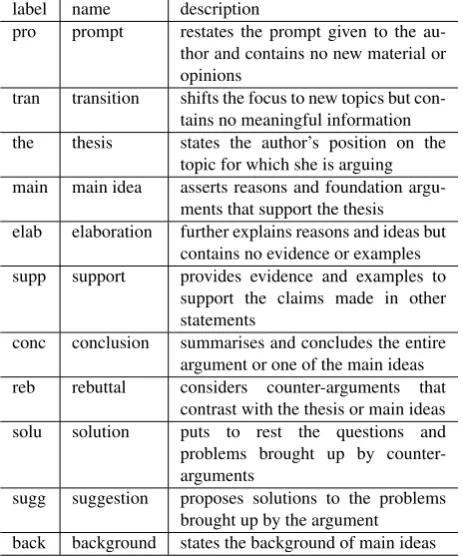
ni(iobj) to neutralise its information status (e.g. old/new information). The conjugate form of the end phrase in each discourse unit is normalised. Due to the lack of re-viser’s knowledge relating to natural language processing, we expected that automatically dividing a text to discourse units is rather consistent compared to manual discourse unit segmentation by revisers. For this reason, we employed a model of discourse unit segmentation based on the anno-tated data instead of manually segmenting discourse units. 2) Organising and reordering statement units: A reviser makes a cluster of adjacent discourse units representing a discourse function in the text (e.g. “thesis” and “elabora-tion”). We call this cluster the statement unit. The state-ment units are sequentially numbered from the beginning of the original text, e.g. SU0, SU1 . . .. The reviser then moves each statement unit to a more appropriate position to make the revised text more coherent. Furthermore, an-notating a function label to each statement unit makes the reviser consider the discourse function of each statement unit within the text. The definition of the function labels for statement units in shown in Table 1, which is an extension
of the work by Persing et al. (2010). In addition, tightly related statement units are assigned coindexed function la-bels, as the statement units 1 and 3 in Table 2. They share index 1 in their function label main1and elab1.
3) Modifying referring and connective expressions: Re-ordering statement units might cause an incoherent text due to inappropriate referring and connective expressions. Therefore, the reviser modifies referring and connective expressions if needed for making the text more coher-ence after reordering statement units. To keep track of these modifications, we employed the notation of ‘horiginal expression|revised expressioni.’ For example, a reviser needs to explicitly edit a part of a sentence as hA|Bifor replacing wordAwith wordBin a sentence.
At each step, the reviser can refer to the original text if needed so as not to change the author’s original intention.
3.
Manually revising Japanese essays
The selection of texts for manual revision is important on the task of automatic text revision because this work fo-cuses on the quality of text organisation and factors rel-evant to the quality. We used 120 Japanese essays writ-ten by Japanese native speakers collected by Usami (2009). The essays were written by high school students on prompt “state your opinion in 800 characters about introducing En-glish education into Japanese elementary schools.” Since the essays need to be informative and persuasive for readers on the controversial topic, the organisation of text is partic-ularly important. Thus, we consider them a good material for our research purpose.
For preprocessing (step 1) in the procedure described in Section 2, we create a maximum entropy classifier1which judges whether a bunsetsu2-unit in a sentence is the end of a discourse unit. This problem setting is reasonable in Japanese because the right most bunsetsu-unit in a dis-course unit, typically consisting of a predicate and its modality particles, gives a strong clue for the discourse unit boundary. We annotated a sub-corpus of a Japanese bal-anced corpus, BCCWJ (Maekawa et al., 2010), including 156 texts (5,815 sentences), with the discourse unit bound-aries. We used the corpus for training a classifier to dis-course unit boundary detection. As a feature set, we used lemmas and PoS of the head and functional morphemes ap-pearing in the target and adjacent bunsetsu units. We also used lemmas of nouns and their PoS appearing in the de-pendency path from the bunsetsu unit in question to the end of the sentence. The dependency trees in the corpus were automatically analysed using a Japanese dependency parser,CaboCha3. The results of a preliminary evaluation with 10-fold cross validation demonstrated that the classi-fier achieved reasonable performance (0.766 in F-score). We employed six revisers who have enough experience in either teaching Japanese or scoring Japanese essays. They were equally divided into two groups. The 120 essays were also equally divided into two data sets, and each reviser
1
http://www.cs.utah.edu/˜hal/megam/
2Bunsetsu is a basic unit of Japanese, consisting of at least one
content word and more than zero functional words.
3
suID label duID revised results
SU4 the DU7 h |i h | i h |i ←Author’s thesis should be placed at the beginning of a text
Early education of English in elementary schools is necessary.
SU3 main1 DU5 h |i
h | i h| i ←Main idea is placed after author’s thesis DU6
h| i
Because I think it is rather necessary to teach English at elementary school so that children have fun in learning English before they feel difficulty in learning English in junior and senior high schools.
SU0 back1 DU0 h | i
When I was in the middle and upper grades of elementary school, I had a chance to learn to English.
SU1 elab1 DU1 h | i h | i
DU2 h |i
DU3
It was not a typical ‘English class’ in junior and senior high schools, rather it was an enjoyable play.
SU2 supp1 DU4
h| i
For example, we sang English songs, exchanged morning greetings in English in the classroom, which made English closer to us.
SU5 main2 DU8 h | i h | i
DU9 h | i
DU10 h| i
However, if the experience is not enjoyable for children, early education does not make sense, rather it works negatively.
SU6 supp2 DU11 h | i h| i
DU12 h | i ALT
DU13 h| i
h| i
Luckily, I enjoyed my English class in junior high school as well as in elementary school.
SU8 reb DU18 h | i h | i h | i←Rebuttal and its
corresponding author’s opinion are placed at the latter part of this text
Some would say that it’s not needed to learn English at an early age. However,
SU9 solu DU19
if children could enjoy English in the early stage, it would expand children’s potential.
SU7 conc DU14 h | i
DU15 h | i h | i
DU16 DU17
It’s not just limited to teaching English. The most important thing is being motivated when they learn something.
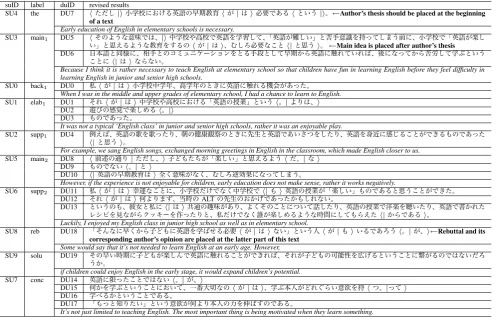
The bold sentences stand for the comments by a human reviser with regards to the move of statement units. The numbering of duIDs denotes the order of the original text. The literal meaning in each discourse unit is sometimes difficult to translate into English preserving their nuance because they are not always a complete sentence. Thus, we instead translated the revised sentences in each statement unit into English.
Table 2: Example of a human revision
group revised a different data set following the procedure introduced in Section 2.
An example of a revised text is shown in Table 2, where 20 discourse units constitute 10 statement units. In this ex-ample, three types of revisions were performed. First, the ‘thesis’ (i.e. statement unit SU4) was placed at the begin-ning of the text. Second, the first ‘main idea’ (i.e. statement unit SU3) was swapped with its ‘elaboration’ (i.e. state-ment unit SU1). Finally, the ‘conclusion’ (i.e. statestate-ment unit SU7) was placed at the end of the text. These revisions contribute to improving the coherence of this text.
Given the original and revised texts, we can analyse general strategies of text revision by human revisers. To investigate what kinds of manual changes frequently occurred between the original and revised texts, we examined frequencies of the label bi-gram of two adjacent statement units4as shown in Table 3. Note that the statement unit labels were anno-tated to the revised version of essays. In this examination, we assume that the segmentation of statement units and their labels are identical in before- and after-revision texts. Thus, we sorted statement units in ascending order and then examined frequencies of the label bi-grams. Table 3 reveals notable tendencies of the revision. For example, the fre-quency of the bi-gram ‘BOT (beginning of text)→the(sis)’ drastically increased by the revision, conforming with our intuition that authors should first state their position on a
4
The indexes of the labels were excluded for this investigation.
given topic.
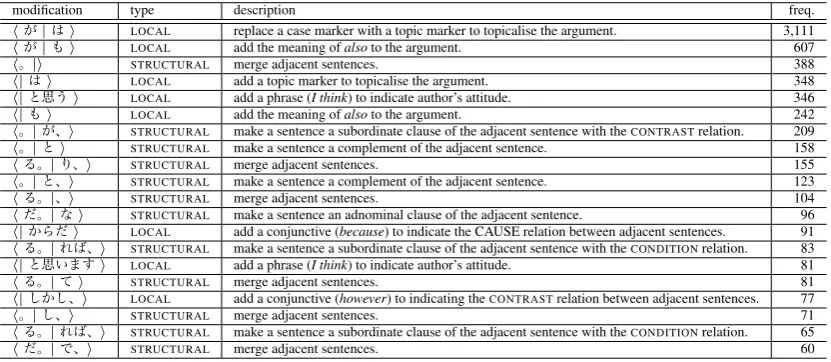
Following the procedure introduced in Section 2, what ex-pressions were modified are recorded by using the notation of ‘horiginal expression|revised expressioni.’ Thus, we can also analyse what expressions were modified through the revision. As a preliminary analysis, we investigated what modifications were frequently occurred in the revision. As a result, our manual analysis revealed that revisers typi-cally employed the two types of modifications; the local and structural modifications. In the former modification, off-topic case makers ga (subj) and o (obj) are replaced with topic case marker wa, or appropriate connective ex-pressions are inserted to an appropriate position in a sen-tence. On the other hand, as the structural modification, a sentence constituting a single discourse unit is merged with an adjacent logically related sentence to make a single sen-tence.
Table 4 shows the 20 most frequent modifications occurred in our current data set. It demonstrates that the most fre-quent modification is the topicalisation, i.e. h (subj)| (topic)idue to the automatic pre-processing including off-topicalisation in discourse units.
re-sui\sui+1 EOT main elab supp the back conc reb solu sugg tran pro total The number in parentheses is the change from the frequency in the original text. BOT and EOT stand for the beginning and end of a text respectively.
Table 3: Bi-gram frequency of statement units before and after revision
model accuracy (%) (cf. newspaper)
baseline 50.0 50.0
entity grid model 25.7 70.7
coref coherence model 38.6 76.1
Table 5: Results of evaluating text coherence
viser needed to consider a logical relation for merging the adjacent sentences. We compared the merged sentences in the revised texts with the corresponding sentences in the original essays to find that the revisers tend to restore the original compound sentences. This counterintuitive result suggests that manual revision following the procedure in Section 2 does not effectively work for sentence reconstruc-tion. Thus, there is a room of reconsideration on the before-revision representation for revisers.
4.
Automatically evaluating text coherence
We evaluated text coherence using the original and revised texts on the task of pairwise information ordering, identi-fying a more coherent text. We employed the existing two models for evaluating text coherence proposed by Barzilay and Lapata (2008) and Iida and Tokunaga (2012). The for-mer model (the entity-grid model) exploits the local coher-ence based on the local transition of discourse entities in a coreference chain with their grammatical roles, and the lat-ter model (the coref coherence model) uses the coherence score based on automatically detected coreference relations in a text. For creating an entity-grid model, we adopted the four grammatical role labels (wa(topic),ga(subj),o/ni
(obj/iobj) and others). For learning these models, we used the NAIST Text Corpus (Iida et al., 2007), where corefer-ence relations were manually annotated.
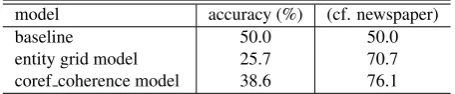
In our evaluation, we used a sample of 70 texts out of the 120 essays in which the sequential order of the discourse units in original and revised texts is not identical. We eval-uated how correctly a model selects the revised text out of the original and revised texts. As a baseline model, we used a model that randomly selects from two given texts. Table 5 shows the results of evaluating text coherence with our data set. For comparing them with the previous work (Iida and Tokunaga, 2012), the table also demon-strates the results using newspaper articles in the NAIST Text Corpus (Iida et al., 2007). Surprisingly, the two coher-ence models did not outperform the baseline when evaluat-ing our data set, whereas the results of the previous work
presented that these two models achieved significantly bet-ter performance than the baseline. The difference was caused by the different experimental setting between the two data sets. In the previous work using newspaper arti-cles, the competing incoherent texts were generated by ran-domly reordering sentences in line with the experimental setting in Barzilay and Lapata (2008). In contrast, because our original essays were written by high school students, their coherence is obviously higher than the texts generated by random reordering. Eventually, given a pair of the orig-inal and revised essays, identifying a more coherent text becomes more difficult in comparison with the problem set-ting in the previous work.
In addition, newspaper articles, which were used as target texts in previous work, are written by professional writers to preserve high coherence by cohesively introducing dis-course entities in a text. Therefore, the two coherence mod-els relying on the local transition of discourse entities with grammatical roles relatively easily estimated the text coher-ence.
On the other hand, the discourse entities in the essays rarely cooccurred across these statement units, For example, word ‘English’ and phrase ‘elementary school’ are relatively fre-quently occurred over the text because they are related to the essay topic, early education of English in Japanese ele-mentary schools. However, they rarely become centers but rather are used for modifying other words, e.g. English songsandin elementary school. Instead, the coherence of the essays is established by means of implicit logical re-lations between statement units, e.g. causal and elabora-tion relaelabora-tions. Therefore, estimating text coherence by the above models becomes more difficult compared to the case of newspaper articles.
5.
Conclusion
modification type description freq. h | i LOCAL replace a case marker with a topic marker to topicalise the argument. 3,111 h | i LOCAL add the meaning ofalsoto the argument. 607
h |i STRUCTURAL merge adjacent sentences. 388
h| i LOCAL add a topic marker to topicalise the argument. 348 h| i LOCAL add a phrase (I think) to indicate author’s attitude. 346 h| i LOCAL add the meaning ofalsoto the argument. 242 h | i STRUCTURAL make a sentence a subordinate clause of the adjacent sentence with theCONTRASTrelation. 209 h | i STRUCTURAL make a sentence a complement of the adjacent sentence. 158
h | i STRUCTURAL merge adjacent sentences. 155
h | i STRUCTURAL make a sentence a complement of the adjacent sentence. 123
h | i STRUCTURAL merge adjacent sentences. 104
h | i STRUCTURAL make a sentence an adnominal clause of the adjacent sentence. 96 h| i LOCAL add a conjunctive (because) to indicate the CAUSE relation between adjacent sentences. 91 h | i STRUCTURAL make a sentence a subordinate clause of the adjacent sentence with theCONDITIONrelation. 83 h| i LOCAL add a phrase (I think) to indicate author’s attitude. 81
h | i STRUCTURAL merge adjacent sentences. 81
h| i LOCAL add a conjunctive (however) to indicating theCONTRASTrelation between adjacent sentences. 77
h | i STRUCTURAL merge adjacent sentences. 71
h | i STRUCTURAL make a sentence a subordinate clause of the adjacent sentence with theCONDITIONrelation. 65
h | i STRUCTURAL merge adjacent sentences. 60
Table 4: Top 20 frequent surface modifications
occurred between the original and revised texts, e.g. ‘the-sis’ statements were frequently placed at the beginning of a text. We also evaluated text coherence using the origi-nal and revised texts on the task of pairwise information ordering, identifying a more coherent text. The experimen-tal results using two text coherence models demonstrated that the two models did not outperform the random base-line because the existing two models evaluated text coher-ence heavily relying on the cohesion of discourse entities, while the coherence of revised essays is mainly established by means of certain types of logical relations between state-ment units.
As future direction, we are planning to create an automatic text revision model based on this corpus, which would be useful for applications supporting human to write more in-formative and persuasive texts. In this paper, we decom-posed a procedure of revising texts into the three steps, as shown in Section 2. In particular, the second step, organis-ing and reorderorganis-ing statement units plays a key role among these three steps. To realise this step, it is important to em-ploy techniques introduced in automated essay scoring, e.g. Persing et al. (2010), which automatically annotates sen-tence and paragraph labels with regard to the organisation of a text. We are planning to adopt such techniques to iden-tify statement unit labels in essays and then tackle reorder-ing problems based on a sequence of statement units with their labels.
6.
References
R. Barzilay and M. Lapata. 2008. Modeling local coher-ence: An entity-based approach. Computational Lin-guistics, 34(1):1–34.
C. Brockett, W. B. Dolan, and M. Gamon. 2006. Correct-ing ESL errors usCorrect-ing phrasal SMT techniques. In Pro-ceedings of the 21st International Conference on Com-putational Linguistics and 44th Annual Meeting of the Association for Computational Linguistics, pages 249– 256.
R. Dale and A. Kilgarriff. 2010. Helping our own: Text massaging for computational linguistics as a new shared task. In Proceedings of the 6th International Natural Language Generation Conference, pages 261–265.
B. J. Grosz, A. K. Joshi, and S. Weinstein. 1995. Center-ing: A framework for modeling the local coherence of discourse. Computational Linguistics, 21(2):203–226. M. Hermet and A. D´esilets. 2009. Using first and second
language models to correct preposition errors in second language authoring. InProceedings of the 4th Workshop on Innovative Use of NLP for Building Educational Ap-plications, pages 64–72.
R. Iida and T. Tokunaga. 2012. A metric for evaluating discourse coherence based on coreference resolution. In
Proceedings of COLING 2012, pages 483–494.
R. Iida, M. Komachi, K. Inui, and Y. Matsumoto. 2007. Annotating a Japanese text corpus with predicate-argument and coreference relations. InProceeding of the ACL Workshop ‘Linguistic Annotation Workshop’, pages 132–139.
C. Leacock, M. Chodorow, M. Gamon, and J. Tetreault. 2010.Automated Grammatical Error Detection for Lan-guage Learners. Synthesis Lectures on Human Lan-guage Technologies. Morgan Claypool.
K. Maekawa, M. Yamazaki, T. Maruyama, M. Yamaguchi, H. Ogura, W. Kashino, T. Ogiso, H. Koiso, and Y. Den. 2010. Design, compilation, and preliminary analyses of balanced corpus of contemporary written Japanese. In
Proceedings of the 8th International Conference on Lan-guage Resou rces and Evaluation (LREC 2010), pages 1483–1486.
W. C. Mann and S. A. Thompson. 1988. Rhetorical struc-ture theory: Toward a functional theory of text organiza-tion. Text, 8(3):243–281.
Y. A. Park and R. Levy. 2011. Automated whole sentence grammar correction using a noisy channel model. In
Proceedings of the 49th Annual Meeting of the Associ-ation for ComputAssoci-ational Linguistics: Human Language Technologies, pages 934–944.
I. Persing, A. Davis, and V. Ng. 2010. Modeling orga-nization in student essays. InProceedings of the 2010 Conference on Empirical Methods in Natural Language Processing, pages 229–239.
Lawrence Erlbaum Associates.