S H O R T R E P O R T
Open Access
Characterization of a circulating PRRSV strain by
means of random PCR cloning and full genome
sequencing
Jan Van Doorsselaere
1*, Marc Geldhof
2, Hans J Nauwynck
2and Peter L Delputte
2,3Abstract
PRRS is a pig disease of major economic importance that causes respiratory and reproductive problems in pigs. Over the last years it has become clear that PRRSV heterogeneity is increasing. Consequently, this has a potential impact on diagnosis and strategies to counter this disease. The use of sequence-independent PCR techniques for the detection and characterization of PRRSV could be useful to bypass problems associated with the heterogeneity of this virus.
A random PCR cloning approach was tested for the characterization of PRRSV strain 07V063 of unknown genetic background that circulated on a Belgian farm. By using this approach, 7305 bp of sequence data were obtained, distributed randomly across the genome. Using RT-PCR with strain-specific primers, the full length sequence (15014 nt) was obtained. Phylogenetic relationships using ORF5 and ORF1a (NSP2) sequences showed that 07V063 was classified in type 1 subtype 1 and that 07V063 was genetically different from prototype Lelystad Virus (LV). 07V063 showed 87-93% aa identity with LV ORFs coding for structural proteins. Most variation (compared to LV) was noticed in Nsp2 (81% identity) with a deletion of 28 aa. This deletion was different from other known deletions in this ORF. In conclusion, it is shown that this random PCR cloning approach can be used for the characterization of new PRRSV strains of unknown genetic background.
Findings
Porcine reproductive and respiratory syndrome (PRRS) is an economically important viral pig disease in swine producing countries worldwide. The virus can cause reproductive disorders and can give rise to respiratory problems in pigs of all ages [1]. Prevention of the dis-ease is based on a combination of management and vac-cination. Evidence is accumulating that PRRSV heterogeneity is affecting the vaccination efficiency. It is suggested that vaccines are only efficacious when the vaccine virus and the challenge virus share a sufficiently high homology [2-6]. PRRSV heterogeneity was origin-ally considered mainly to occur between European (gen-otype 1) and American type (gen(gen-otype 2) PRRSV, but current understanding shows a more complex situation with considerable genetic variability within genotypes [7-9]. Since such variability may affect the efficacy of
vaccination programs and pose an obstacle for PRRSV prevention and control, knowledge on the PRRSV strains circulating on a farm may be essential for choos-ing an appropriate vaccine [10].
PRRSV diagnosis is mainly based on detection of PRRSV antibodies, Reverse Transcriptase (RT) PCR or virus isolation. Detection of antibodies by ELISA or IPMA is not sufficient to establish the level of PRRSV heterogeneity [11]. RT-PCR allows rapid detection and genotyping of PRRSV, but the high degree of sequence variation observed for PRRSV can influence results obtained by (real-time) RT-PCR and primers and/or probes should be carefully designed based on conserved regions [8,12]. The development of sequence-indepen-dent PCR techniques could be useful for the diagnosis and genotyping of unknown PRRSV isolates and for assessment of the PRRSV heterogeneity of field isolates. Several methods have been developed for the identifica-tion of viruses without prior sequence knowledge [13]. For instance, whole genome amplification and random PCR are relatively simple. In both these methods, viral
* Correspondence: [email protected]
1
Department of Health Care and Biotechnology, KATHO Catholic University College of South-West Flanders, Wilgenstraat 32, 8800 Roeselare, Belgium Full list of author information is available at the end of the article
particles (from biological samples or cell culture) are treated with DNAse and RNAse to remove contaminat-ing nucleic acids. RNA and/or DNA from the viral par-ticles is extracted and RNA is reverse transcribed to
cDNA using a primer with a random 3’end.
Subse-quently, cDNA or viral DNA is amplified using a shorter primer (without the 3’ random end). This results in DNA fragments of varying size (e.g. 0.5 - 2 Kb) and these fragments can be cloned and sequenced. For
instance Allander et al. [14] used random PCR on
human respiratory tract samples which allowed identifi-cation of several unknown viruses.
The aim of this study was to test a random PCR clon-ing technique [14] for the detection and genotypclon-ing of a PRRSV strain of unknown genetic background.
Random PCR cloning for the identification of PRRSV 07V063
PRRSV 07V063 was isolated from an aborted foetus from a Belgian farm, by inoculation of porcine alveolar macro-phages. On this farm, vaccination with Porcilis™was in place. PRRS diagnosis was confirmed upon detection of cytopathic effect (CPE), and detection of PRRSV antigens by IPMA staining with the nucleocapsid specific mAb P3/27 [15]. The use of a random PCR approach abrogates the need fora priorisequence information and in combi-nation with small scale shotgun sequencing, this can result in viral sequences. Virus 07V063 was grown on MARC-145 cells and concentrated as described [16] and the viral pellet was treated with DNAseI and RNAse. RNA was extracted using commercial kits and used in reverse transcription and random amplification using the
tagged random hexanucleotide 5’
-GCCGGAGCTCTG-CAGATATCNNNNNN-3’for both first- and second
strand cDNA synthesis and subsequent amplification of
the cDNA with primer 5’
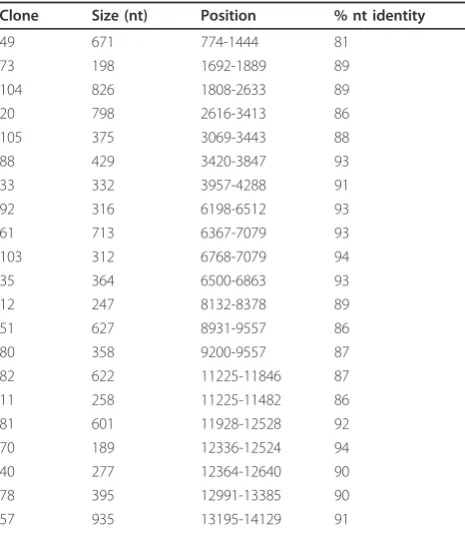
-GCCGGAGCTCTGCAGA-TATC-3’[14]. Random PCR fragments ranging between 500 and 1200 bp were cloned in pCR-Blunt II-TOPO (Invitrogen). Twenty nine clones were sequenced as described [17]. Twenty three clones (80% of the clones) contained PRRS sequences (Table 1). The six other clones showed no match when performing BlastN http:// www.ncbi.nlm.nih.gov. The 07V063 sequences were ran-domly distributed across the PRRSV genome. Several clones were overlapping and six contigs (with sizes between 622 and 2072 bp) were obtained (Figure 1). Thus, without prior knowledge of the sequence it was possible to obtain 7305 bp sequence data using a random PCR cloning approach, hereby confirming PRRS identity.
Full length sequence of 07V063 and comparison with prototype LV
To allow a more detailed evaluation of the PRRSV iso-late 07V063, the full length genome sequence was
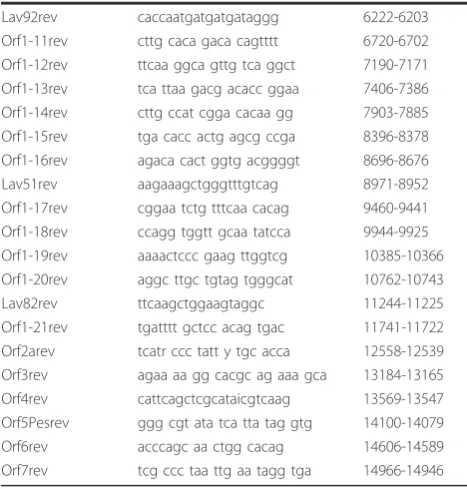
obtained using primers that were based on the 07V063 sequences from the random PCR cloning approach (Table 2). Overlapping amplicons (spanning the com-plete genome) were obtained using RT-PCR. Both strands of these fragments were directly sequenced. For the amplification of the 3’end, oligodT was used in com-bination with ORF7fw. A 5’end primer (5’endfw) was designed based on the alignment of genotype 1 strains LV (M96262), EuroPRRS (AY366525), SD01-08 (DQ489311), KNU-07 (FJ349261) and HKEU16 (EU076704). This primer was used in combination with primer Lavgsprev to amplify the 5’end. A full length sequence of 15014 nt was obtained. This sequence was deposited in Genbank (Accession GU737264).
The 5’end and 3’end of 07V063 was 221 nt and 114 nt, respectively. The size of the 5’end of 07V063 is iden-tical with the 5’end of LV with 92.3% identity and 17 nt Table 1 Overview of the sequences from 07V063
obtained by random PCR cloning
Clone Size (nt) Position % nt identity
49 671 774-1444 81
The position of the sequences is indicated relative to LV. % nt identity is with LV.
differences. Several motifs such as the transcription reg-ulatory sequence (UUAACC) and CACCC stretches (involved in binding of host cell transcription factors) are conserved in 07V063 [18]. Table 3 gives an overview of all ORFs in the 07V063 genome and comparison with ORFs from prototype LV. Most variation with LV was Table 2 Oligonucleotide primers used in RT-PCR
amplification and nucleotide sequencing of 07V063
Primer Sequence Position
5’endFW atgatgtgtagggtattccccc 1-22 Orf1univFW ccctttaaccatgtctggc 111-130 Orf1-1fw catcc gggtg ctgctgg ctt 336-355 Orf1-2fw ggag ccaccc acgtgtt gac 681-701 Lav49fw aatcaatggtattcgtgctg 1072-1091 Orf1-3-fw tcaat gcctacaa ctgcccg 1631-1650 Orf1-4-fw cttgta taaa ttgct attgg 1988-2007 Orf1-5-fw acaa cagg cctc gtaa ggg 2472-2490 Lav73fw aaaacttggcgctgcacgtc 3102-3121 Orf1-6fw ggtcc atta gcca gcgcct 3451-3469 Orf1-7fw cttgag cagcg ccaa cattg 3686-3705 Lav33fw ggtgttggcacggcgagag 4129-4147 Orf1-8fw catgg ctgtt gccca agtgt 4538-4557 Orf1-9fw ttgt gctt acgcc tggccca 4859-4878 Orf1-10fw ggcgac tcct ataat cgtat 5364-5383 Orf1-11fw ccaa gcac ttcg cagg tccg 5701-5720 Orf1-12fw ggctt ggctg ccgaaa tcgg 6096-6115 Orf1-13fw aatgaa gggag tctt gtcta 6566-6586 Lav92fw gtgtatccctcggctaccac 6891-6911 Orf1-14fw catta gtcaa cttcaa ggtt 7280-7299 Orf1-15fw gga ccc tga gcgg catgaa 7765-7783 Lav12fw ccaagaactccatggcaggt 8172-8191 Orf1-16fw ggaaaaacaaattcaaggag 8442-8461 Orf1-17fw tccag cccatg ctggt ata 8817-8835 Lav51fw gtgtttgtttcactcacact 9316-9335 Amp6fwint catcagaccatgtttgacat 9764-9783 Orf1-18fw aaggc caggaa cacca gggt 10136-10155 Orf1-19fw cccagta tttgca ccttt gc 10633-10652 Orf1-20fw cggccgta cttgc aaccag 11132-11150 Orf2afw gts aca cck tat gatta cg 11387-11406 LavORF2aseqfw gtgttcgacaacgcccacacgc 11577-11598 Orf3fw agcc taca gta caa ca ccac 12234-12253 LavORF3seq1fw agcgttgagctcatcttccc 12261-12280 Orf4fw cgg ccc ait tcc atccigag 12672-12691 Orf5Pesfw tga tca cat tcg gtt gct 13320-13337 Orf6fw tacc aa ctt tc ttc tggac 13838-13856 Orf7fw tgg cccc tgccc aic acg 14328-14345 Orf1-1-rev gtcaa cacgt gggtgg ctcc 701-681 Lavgsprev cgacttgacattctagtcca 900-881 Orf1-2-rev agat gcca aacgg acgaa cc 1304-1285 Orf1-3-rev gcag cctt cgga gcag acgc 1796-1777 ORF1-4-rev cggtg aaca cgag acacc tg 2252-2233 Orf1-5-rev gctg atgt tgtc ggatt ctg 2615-2596 Orf1-6-rev ctggg aaca ggagg cgg tgt 3202-3182 Orf1-7-rev gggttgg atg gagtc gagaa 3730-3711 Lav33rev ccccaacacttgtgacaacg 3982-3963 Orf1-8rev gt ccgag tccac tacaatc 4403-4385 Orf1-9rev agag ttgt gccac tgct gaaa 4755-4735 Amp3intrev2 cagagaaggccggttattcct 5023-5003 Amp3intrev gattccaatgagatcacca 5609-5591 Orf1-10rev gctc ggac taaaa cagc tgg 5959-5940
Table 3 Comparison of proteins from 07V63 and prototype LV
ORF Protein Size 07V63 Size LV % identity % similarity
1a Nsp1 385 385 85 91
Nsp10 442 442 94 97
Nsp11 224 224 95 97
Nsp12 152 152 93 96
2a GP2 249 249 93 94
Table 2 Oligonucleotide primers used in RT-PCR amplifi-cation and nucleotide sequencing of 07V063(Continued)
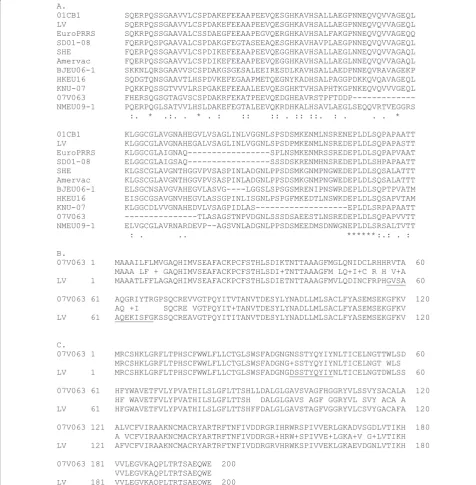
noticed in Nsp1 (85% identity/91% similarity) and Nsp2 (81% identity/85% similarity). A major difference is a deletion of 28 aa in a variable region of Nsp2 (at posi-tions 683-710). Similar deleposi-tions in this region are known e.g. EuroPRRS has a 17 aa deletion (Figure 2A; [18]). The deletion in NSP2 in 07V63 could be a unique marker for this strain.
Strain 07V063 showed 87 - 95% aa identity with LV for the structural ORFs 2 - 7. We compared GP4 and GP5 proteins from 07V063 and LV since it has been shown that these proteins are the main target for neu-tralizing antibodies. Figure 2B shows an alignment of ORF4 proteins. Notably is the high variation in the region 50-70. It has been shown that a neutralizing
A.
01CB1 SQERPQSSGAAVVLCSPDAKEFEEAAPEEVQESGHKAVHSALLAEGPNNEQVQVVAGEQL LV SQERPQSSGAAVVLCSPDAKEFEEAAPEEVQESGHKAVHSALLAEGPNNEQVQVVAGEQL EuroPRRS SQKRPQSSGAAVALCSSDAEGFEEAAPEGVQERGHKAVHSALFAKGPNNEQVQVVAGEQQ SD01-08 FQERPQSPGAAVALCSPDAKGFEGTASEEAQESGHKAVHAVPLAEGPNNEQVQVVAGEQL SHE FQERPQSSGAAVVLCSPDIKEFEEAAPEEVQEGGHKAVHSALLAEGLNNEQVQVVAGAQL Amervac FQERPQSSGAAVVLCSPDIKEFEEAAPEEVQEGGHKAVHSALLAEGLNNEQVQVVAGAQL BJEU06-1 SKKNLQRSGAAVVSCSPDAKGSGESALEEIRESDLKAVHSALLAEDPNNEQVRAVAGEKP HKEU16 SQDGTQNSGAAVTLHSPDVKEFEGAAPMETQEGNYKADHSALPAGGPDKKQVQAVAGEQL KNU-07 PQKKPQSSGTVVVLRSPGAKEFEEAALEEVQESGHKTVHSAPHTKGPNKEQVQVVVGEQL 07V063 FHERSQGSGTAGVSCSPDAKRFEKATPEEVQEDGHEAVRSTPFTDDP--- NMEU09-1 PQERPQGLSATVVLHSLDAKEFEGTALEEVQKRDHKALHSAVLAEGLSEQQVRTVEGGRS :. * .:. . * . : :: :: . :: ::. : . . . *
01CB1 KLGGCGLAVGNAHEGVLVSAGLINLVGGNLSPSDSMKENMLNSRENEPLDLSQPAPAATT LV KLGGCGLAVGNAHEGALVSAGLINLVGGNLSPSDPMKENMLNSREDEPLDLSQPAPASTT EuroPRRS KLGGCGLAIGNAQ---SPLNSMKENMRSSREDEPLDLSQPAPVAAT SD01-08 ELGGCGLAIGSAQ---SSSDSKRENMHNSREDEPLDLSHPAPAATT SHE KLGSCGLAVGNTHGGVPVSASPINLADGNLPPSDSMKGNMPNGWEDEPLDLSQSALATTT Amervac KLGSCGLAVGNTHGGVPVSASPINLADGNLPPSDSMKGNMPNGWEDEPLDLSQSALATTT BJEU06-1 ELSGCNSAVGVAHEGVLASVG----LGGSLSPSGSMRENIPNSWRDEPLDLSQPTPVATM HKEU16 EISGCGSAVGNVHEGVLASSGPINLISGNLPSPGFMKEDTLNSWKDEPLDLSQSAPVTAM KNU-07 KLGGCDLVVGNAHEDVLVSAGPIDLAS---EPLDLSRPAPAATT 07V063 ---TLASAGSTNPVDGNLSSSDSAEESTLNSREDEPLDLSQPAPVVTT NMEU09-1 ELVGCGLAVRNARDEVP--AGSVNLADGNLPPSDSMEEDMSDNWGNEPLDLSRSALTVTT : . .. ******:.: . :
B.
07V063 1 MAAAILFLMVGAQHIMVSEAFACKPCFSTHLSDIKTNTTAAAGFMGLQNIDCLRHHRVTA 60 MAAA LF + GAQHIMVSEAFACKPCFSTHLSDI+TNTTAAAGFM LQ+I+C R H V+A LV 1 MAAATLFFLAGAQHIMVSEAFACKPCFSTHLSDIETNTTAAAGFMVLQDINCFRPHGVSA 60
07V063 61 AQGRIYTRGPSQCREVVGTPQYITVTANVTDESYLYNADLLMLSACLFYASEMSEKGFKV 120 AQ +I SQCRE VGTPQYIT+TANVTDESYLYNADLLMLSACLFYASEMSEKGFKV LV 61 AQEKISFGKSSQCREAVGTPQYITITANVTDESYLYNADLLMLSACLFYASEMSEKGFKV 120
C.
07V063 1 MRCSHKLGRFLTPHSCFWWLFLLCTGLSWSFADGNGNSSTYQYIYNLTICELNGTTWLSD 60 MRCSHKLGRFLTPHSCFWWLFLLCTGLSWSFADGNG+SSTYQYIYNLTICELNGT WLS LV 1 MRCSHKLGRFLTPHSCFWWLFLLCTGLSWSFADGNGDSSTYQYIYNLTICELNGTDWLSS 60
07V063 61 HFYWAVETFVLYPVATHILSLGFLTTSHLLDALGLGAVSVAGFHGGRYVLSSVYSACALA 120 HF WAVETFVLYPVATHILSLGFLTTSH DALGLGAVS AGF GGRYVL SVY ACA A LV 61 HFGWAVETFVLYPVATHILSLGFLTTSHFFDALGLGAVSTAGFVGGRYVLCSVYGACAFA 120
07V063 121 ALVCFVIRAAKNCMACRYARTRFTNFIVDDRGRIHRWRSPIVVERLGKADVSGDLVTIKH 180 A VCFVIRAAKNCMACRYARTRFTNFIVDDRGR+HRW+SPIVVE+LGKA+V G+LVTIKH LV 121 AFVCFVIRAAKNCMACRYARTRFTNFIVDDRGRVHRWKSPIVVEKLGKAEVDGNLVTIKH 180
07V063 181 VVLEGVKAQPLTRTSAEQWE 200 VVLEGVKAQPLTRTSAEQWE LV 181 VVLEGVKAQPLTRTSAEQWE 200
epitope is present in LV at positions 57-68 [19] and that this region is under antibody-mediated pressurein vitro andin vivo [20,21]. Pigs infected with 07V063 produce neutralizing antibodies against the57RVTAAQGRIYTR68 epitope. However, these antibodies do not cross-protect against LV [22]. Similarly, antibodies against the same region in LV, do not cross-protect against 07V063. Interestingly, this lack of cross-neutralization is in agree-ment with the finding that strain 07V063 was able to replicate and cause disease on a farm where animals were vaccinated with the LV-like Porcilis™vaccine.
GP5 has been described as the main target for virus-neutralizing antibodies in North American PRRSV strains. A neutralizing epitope has been identified at positions 37-45 [23]. Figure 2C shows that 07V063 and LV have an identical sequence from 37-45 with the exception of an extra glycosylation site at position 37 in 07V063. It has been shown that several strains are cosylated at this position but the significance of this gly-cosylation is not known. Other amino acid changes occur throughout the sequence and several of these positions have been described as variable [24]. No other differences in glycosylation pattern of the structural pro-teins between 07V063 and LV was observed.
Phylogenetic relationship of 07V063
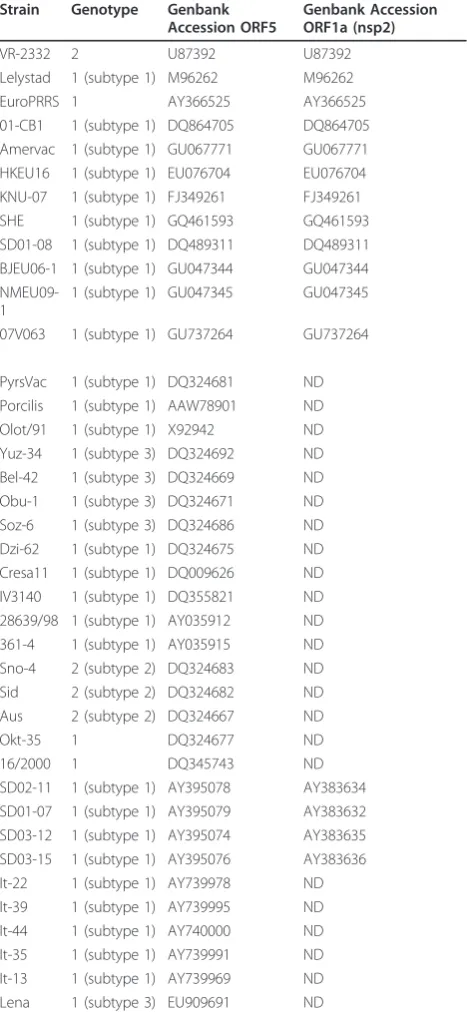
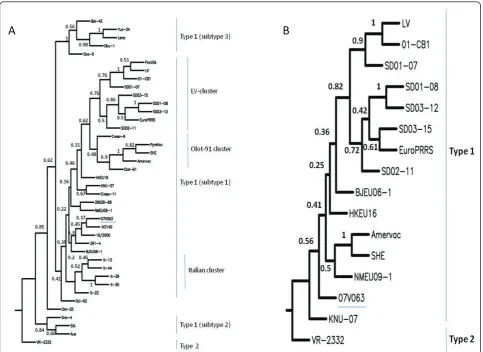
Since ORF5 is frequently used as a marker for the study of genetic relationships [8], we constructed phylogenetic trees using ORF5 sequences from a selection of geno-type 1 strains (Table 4). In addition genogeno-type 1 strains for which the full length sequence was available in Gen-bank were included. VR-2332 (genotype 2) was used as out-group.
Figure 3A shows a phylogenetic tree of ORF5 DNA sequences based on the Neighbour Joining (NJ) method. Several clusters are evident and supported by high boot-strap values. It can be concluded that 07V063 clusters within the pan-European subtype 1 [8]. Within subtype 1, a cluster with LV- and Olot/91-like strains can be dis-tinguished. Although both LV and Olot/91 belong to the earliest PRRSV isolates, still LV and Olot/91-like strains such as SD01-08 are circulating. Strain 07V063 is genetically different from LV- and Olot/91- like strains. Apparently 07V063 clusters together with isolates from different geographical locations e.g. isolates from Spain (16/2000), Denmark (361-4), China (BJEU06-1) and South-Korea (IV3140) although this clustering is not supported by high bootstrap values. A similar tree topol-ogy was obtained using ORF5 protein sequences (data not shown). The sub-clustering of type 1 is complex and cannot always be explained by geographic isolation of the strains [8]. The sequence of 07V63 adds to the increase of genetic diversity of type 1 strains and is an example of continuous genetic drift within PRRSV [24].
A recent PRRSV study in Spain [25] demonstrated that Spanish isolates from different years show continuous evolution and increase in heterogeneity and that differ-ent genotypes and variants within the genotypes co-circulate.
Table 4 Overview of strains used for phylogenetic analysis
Lelystad 1 (subtype 1) M96262 M96262 EuroPRRS 1 AY366525 AY366525 01-CB1 1 (subtype 1) DQ864705 DQ864705 Amervac 1 (subtype 1) GU067771 GU067771 HKEU16 1 (subtype 1) EU076704 EU076704 KNU-07 1 (subtype 1) FJ349261 FJ349261 SHE 1 (subtype 1) GQ461593 GQ461593 SD01-08 1 (subtype 1) DQ489311 DQ489311 BJEU06-1 1 (subtype 1) GU047344 GU047344
NMEU09-1
1 (subtype 1) GU047345 GU047345
07V063 1 (subtype 1) GU737264 GU737264
PyrsVac 1 (subtype 1) DQ324681 ND Porcilis 1 (subtype 1) AAW78901 ND Olot/91 1 (subtype 1) X92942 ND Yuz-34 1 (subtype 3) DQ324692 ND Bel-42 1 (subtype 3) DQ324669 ND Obu-1 1 (subtype 3) DQ324671 ND Soz-6 1 (subtype 3) DQ324686 ND Dzi-62 1 (subtype 1) DQ324675 ND Cresa11 1 (subtype 1) DQ009626 ND IV3140 1 (subtype 1) DQ355821 ND 28639/98 1 (subtype 1) AY035912 ND 361-4 1 (subtype 1) AY035915 ND Sno-4 2 (subtype 2) DQ324683 ND Sid 2 (subtype 2) DQ324682 ND Aus 2 (subtype 2) DQ324667 ND
Okt-35 1 DQ324677 ND
16/2000 1 DQ345743 ND
SD02-11 1 (subtype 1) AY395078 AY383634 SD01-07 1 (subtype 1) AY395079 AY383632 SD03-12 1 (subtype 1) AY395074 AY383635 SD03-15 1 (subtype 1) AY395076 AY383636 It-22 1 (subtype 1) AY739978 ND It-39 1 (subtype 1) AY739995 ND It-44 1 (subtype 1) AY740000 ND It-35 1 (subtype 1) AY739991 ND It-13 1 (subtype 1) AY739969 ND Lena 1 (subtype 3) EU909691 ND
Also, phylogenetic trees using Nsp2 were constructed (Figure 3B). Sequences from all known full length geno-type 1 strains (Table 4) were included. Essentially, the same topology can be observed as for ORF5. A cluster of LV-like strains is evident and supported by high bootstrap values. As was already observed from the ORF5 phylogenetic tree, Amervac and SHE are very clo-sely related as is the case for strains 01-CB1 and LV. 07V063 clusters apart from LV and is genetically dis-tinct from the LV prototype.
Conclusions
By using a simple random PCR cloning approach we obtained PRRSV sequence data from a recent European PRRSV isolate of unknown genetic background. This approach can be used to obtain partial genome sequences from for instance East-European type strains
(for which until present, no full length genomes are available) and to get a better knowledge of the increas-ing PRRSV variability. We also showed that the isolate sequenced in this study is genetically different from pro-totype LV.
List of abbreviations
PRRSV: porcine reproductive and respiratory syndrome virus; RT-PCR: reverse transcriptase polymerase chain reaction.
Acknowledgements
This work was supported by the Industrial Research Fund (IOF) of Ghent University. The authors would like to thank Ine Vanherpe for technical assistance and Merijn Vanhee for critical reading of the manuscript.
Author details
1Department of Health Care and Biotechnology, KATHO Catholic University
College of South-West Flanders, Wilgenstraat 32, 8800 Roeselare, Belgium.
2Department Virology, Parasitology and Immunology, Faculty of Veterinary
Medicine, Ghent University, Salisburylaan 133, 9820 Merelbeke, Belgium.
3ProVaxs, Faculty of Medicine and Health, Ghent University, De Pintelaan 185
- 3K3, 9000 Gent, Belgium.
Authors’contributions
JVD carried out the molecular characterization and drafting of the manuscript. MG isolated the virus and performed IPMA analysis. HJN participated in coordination and supervision of this work. PLD participated in the design and coordination of the study and drafting of the manuscript. All authors read and approved the manuscript.
Competing interests
The authors declare that they have no competing interests.
Received: 26 January 2011 Accepted: 10 April 2011 Published: 10 April 2011
References
1. Wensvoort G, de Kluyver EP, Pol JM, Wagenaar F, Moormann RJ, Hulst MM, Bloemraad R, den Besten A, Zetstra T, Terpstra C:Lelystad virus, the cause of porcine epidemic abortion and respiratory syndrome: a review of mystery swine disease research at Lelystad.Vet Microbiol1992,33: 185-193.
2. Cano JP, Dee SA, Murtaugh MP, Trincado CA, Pijoan CB:Effect of vaccination with a modified-live porcine reproductive and respiratory syndrome virus vaccine on dynamics of homologous viral infection in pigs.Am J Vet Res2007,68: 565-571.
3. Cano JP, Dee SA, Murtaugh MP, Pijoan C:Impact of a modified-live porcine reproductive and respiratory syndrome virus vaccine intervention on a population of pigs infected with a heterologous isolate.Vaccine2007,25: 4382-4391.
4. Labarque G, Van Reeth K, Nauwynck H, Drexler C, Van Gucht S, Pensaert M: Impact of genetic diversity of European-type porcine reproductive and respiratory syndrome virus strains on vaccine efficacy.Vaccine2004,22: 4183-4190.
5. Scortti M, Prieto C, Alvarez E, Simarro I, Castro JM:Failure of an inactivated vaccine against porcine reproductive and respiratory syndrome to protect gilts against a heterologous challenge with PRRSV.Vet Rec2007, 161: 809-813.
6. Prieto C, Alvarez E, Martinez-Lobo FJ, Simarro I, Castro JM:Similarity of European porcine reproductive and respiratory virus strains to vaccine strain is not necessarily predictive of the degree of protective immunity conferred.Vet J2008,175: 356-363.
7. Stadejek T, Oleksiewicz MB, Potapchuk D, Podgorska K:Porcine reproductive and respiratory syndrome virus strains of exceptional diversity in eastern Europe support the definition of new genetic subtypes.J Gen Virol2006,87: 1835-1841.
8. Stadejek T, Oleksiewicz MB, Scherbakov AV, Timina AM, Krabbe JS, Chabros K, Potapchuk D:Definition of subtypes in the European genotype of porcine reproductive and respiratory syndrome virus: nucleocapsid characteristics and geographical distribution in Europe.
Arch Virol2008,153: 1479-1488.
9. Balka G, Hornyak A, Balint A, Kiss I, Kecskemeti S, Bakonyi T, Rusvai M: Genetic diversity of porcine reproductive and respiratory syndrome virus strains circulating in Hungarian swine herds.Vet Microbiol2008,127: 128-135.
10. Meng XJ:Heterogeneity of porcine reproductive and respiratory syndrome virus: implications for current vaccine efficacy and future vaccine development.Vet Microbiol2000,74: 309-329.
11. Yoon KJ, Zimmerman JJ, McGinley MJ, Landgraf J, Frey ML, Hill HT, Platt KB: Failure to consider the antigenic diversity of porcine respiratory and reproductive syndrome (PRRS) virus isolates may lead to misdiagnosis.J Vet Diagn Invest1995,7: 386-387.
12. Indik S, Schmoll F, Sipos W, Klein D:Genetic variability of PRRS virus in Austria: consequences for molecular diagnostics and quantification.Vet Microbiol2005,107: 171-178.
13. Ambrose HE, Clewley JP:Virus discovery by sequence-independent genome amplification.Rev Med Virol2006,16: 365-383.
14. Allander T, Tammi MT, Eriksson M, Bjerkner A, Tiveljung-Lindell A, Andersson B:Cloning of a human parvovirus by molecular screening of respiratory tract samples.Proc Natl Acad Sci USA2005,102: 12891-12896.
15. Wieczorek-Krohmer M, Weiland F, Conzelmann K, Kohl D, Visser N, van Woensel P, Thiel HJ, Weiland E:Porcine reproductive and respiratory syndrome virus (PRRSV): monoclonal antibodies detect common epitopes on two viral proteins of European and U.S. isolates.Vet Microbiol1996,51: 257-266.
16. Delputte PL, Nauwynck HJ:Porcine arterivirus infection of alveolar macrophages is mediated by sialic acid on the virus.J Virol2004,78: 8094-8101.
17. Karniychuk UU, Geldhof M, Vanhee M, Van Doorsselaere J, Saveleva TA, Nauwynck HJ:Pathogenesis and antigenic characterization of a new East European subtype 3 porcine reproductive and respiratory syndrome virus isolate.BMC Vet Research2010,6: 30.
18. Ropp SL, Mahlum Wees CE, Fang Y, Nelson EA, Rossow KD, Bien M, Arndt B, Preszler S, Steen P, Christopher-Hennings J, Collins JE, Benfield DA, Faaberg KS:Characterization of emerging European-like porcine reproductive and respiratory syndrome virus isolates in the United States.J Virol2004,78: 3684-3703.
19. Meulenberg JJ, van Nieuwstadt AP, van Essen-Zandbergen A, Langeveld JP: Posttranslational processing and identification of a neutralization domain of the GP4 protein encoded by ORF4 of the Lelystad Virus.J Virol1997,71: 6061-6070.
20. Costers S, Lefebvre DJ, Vanhee M, Geldhof M, Van Doorsselaere J, Delputte PL, Nauwynck HJ:GP4 of porcine reproductive and respiratory syndrome virus contains a neutralizing epitope that is susceptible to immuno-selection in vitro.Arch Virol2010,155: 371-378.
21. Costers S, Vanhee M, Van Breedam W, Van Doorsselaere J, Geldhof M, Nauwynck H:GP4-specific neutralizing antibodies might be a driving force in PRRSV evolution.Virus Res2010,154: 104-113.
22. Vanhee M, Costers S, Van Breedam W, Geldhof MF, Van Doorsselaere J, Nauwynck HJ:A variable region in GP4 of European-type porcine reproductive and respiratory syndrome virus induces neutralizing antibodies against homologous but not heterologous virus strains.Viral Immunol2010,23: 1-11.
23. Ostrowski M, Galeote JA, Jar AM, Platt KB, Osorio FA, Lopez OJ: Identification of neutralizing and nonneutralizing epitopes in the porcine reproductive and respiratory syndrome virus GP5 ectodomain.J Virol2002,76: 4241-4250.
24. Pesh S, Meyer C, Ohlinger VF:New insights into the genetic diversity of European porcine reproductive and respiratory syndrome virus (PRRSV).
Vet Microbiol2005,107: 31-48.
25. Prieto C, Vazquez A, Nunez JI, Alvarez E, Simarro I, Castro JM:Influence of time on the genetic heterogeneity of Spanish porcine reproductive and respiratory syndrome virus isolates.Virol J2009,180: 363-370.
doi:10.1186/1743-422X-8-160
Cite this article as:Van Doorsselaereet al.:Characterization of a circulating PRRSV strain by means of random PCR cloning and full genome sequencing.Virology Journal20118:160.
Submit your next manuscript to BioMed Central and take full advantage of:
• Convenient online submission
• Thorough peer review
• No space constraints or color figure charges
• Immediate publication on acceptance
• Inclusion in PubMed, CAS, Scopus and Google Scholar
• Research which is freely available for redistribution