Interpreting BEC in e
+e
−annihilation
W.J.Metzger1,∗,T.Csörg˝o2,3,T.Novák3, andS.Lökös3,4
1IMAPP, Radboud University, NL-6525 AJ Nijmegen, The Netherlands 2Wigner RCP, Konkoly-Thege 29-33, H-1121 Budapest XII, Hungary 3Eszterházy University, Mátrai út 36, H-3200 Gyöngyös, Hungary
4Eötvös University, Pázmány Péter Sétány 1/A, H-1111 Budapest, Hungary
Abstract.The usual interpretation of Bose-Einstein correlations (BEC) of
iden-tical boson pairs relates the width of the peak in the correlation function at small relative four-momentum to the spatial extent of the source of the bosons. How-ever, in theτ-model, which successfully describes BEC in hadronic Z decay, the width of the peak is related to the temporal extent of boson emission. Some new checks on the validity of both theτ-model and the usual descriptions are presented.
1 Introduction
First a brief review of ‘classic’ parametrizations of Bose-Einstein Correlations (BEC) is given and contrasted with the parametrization of theτ-model [1, 2]. which has been found [3] to describe well Bose-Einstein correlations in hadronic Z decay.
The data used in this paper are taken from Ref. [3]. They comprise both two-jet and three-jet events, as determined using the Durham three-jet algorithm [4–6] with resolution parameter
ycut=0.006, from e+e−annihilation at the Z-pole.
1.1 ‘Classic’ Parametrizations
The Bose-Einstein correlation function, R2, is measured by R2(Q) = ρ(Q)/ρ0(Q), where
ρ(Q) is the density of identical boson pairs with invariant four-momentum difference Q =
p
−(p1−p2)2 andρ0(Q) is the similar density in an artificially constructed reference sam-ple, which should differ from the data only in that it does not contain the effects of Bose symmetrization of identical bosons. It is often parametrized as
R2=γ[1+λG] (1+Q), (1)
with
G=exp−(rQ)2 . (2)
The corresponding distribution of boson emission points in space-time is a spherically sym-metric Gaussian with standard deviationr.
The factor (1+Q) is included to account for non-BEC which are not removed byρ0,i.e., to make up for slight inadequacies inρ0, andγis a normalization parameter. The parameter
∗e-mail: [email protected]
λis introduced to account for effects reducing the amount of BEC,e.g., some of the bosons coming from resonance decays, or the identical bosons being partially coherent.
However, this description was found [3] not to describe the Z-decay data, a better descrip-tion being provided by the Edgeworth expansion about the Gaussian [7]:
G=exp−(rQ)2·
1+ κ 3!H3(rQ)
, (3)
whereH3is the third-order Hermite polynomial.
A different way to depart from the Gaussian is the generalization to a symmetric Lévy stable distribution. Then
G=exp (−(rQ)α) , (4)
where 0< α≤2 is the so-called index of stability, which was introduced to BEC in Ref. [8]. A fit of the Edgeworth parametrization to the two-jet data of Ref. [3] findsκ=0.71±0.06, while a fit of the symmetric Lévy parametrization yieldsα= 1.34±0.04. Both values are far from the corresponding Gaussian values ofκ =0 andα=2, respectively. Although the
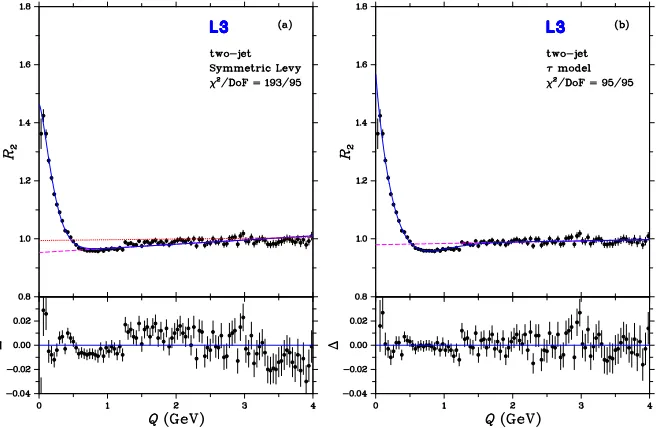
χ2of these fits are a great improvement over that of the Gaussian fit, they are still very large. The corresponding confidence levels are 10−15 for the Gaussian and 10−5 and 10−8 for the Edgeworth and Lévy fits, respectively. The symmetric Lévy fit is shown in Fig. 1a.
Figure 1.(a) Symmetric Lévy fit for two-jet events; (b) Simplifiedτ-model fit for two-jet events.
The reason for the failure of the ‘classic’ parametrizations is readily apparent from Fig. 1a. There is a region of anti-correlation (R2<1) extending from aboutQ=0.5 to 1.5 GeV. The ‘classic’ parametrizations, which are of the form 1+P, wherePis a positive-definite quantity, are unable to accomadate the anti-correlation. This was not realized for a long time because experiments only plotted the correlation function up to Q = 2 GeV or less. In Ref. [3] Q was plotted to 4 GeV, and the anti-correlation became apparent. This anti-correlation, which one might term Bose-Einstein Anti-Correlations (BEAC), as well as the Bose-Einstein correlations (BEC) are both well described by theτ-model.
1.2 Theτ-model
Theτ-model [1, 2] rests on several assumptions:
• The average production point is proportional to the momentum of the emitted boson. Di-mensionally the momentum must be multiplied by a time divided by a mass to yield a spatial dimension. The description of a two-jet event is invariant to Lorentz boosts along the direction of the colour field. The relevant boost-invariant quantities are the
“longitu-dinal” proper time, τ =
q
t2−r2z and the “transverse” mass,mt = q
E2−p2
z, resulting
in
xµ(pµ)=aτpµ, a=1/mt. (5)
• The spatial distribution of production points about their mean is very narrow, although the distribution of proper time may be broad.
• The distribution ofτis a one-sided Lévy distribution, one-sided because no particles are emitted before the e+e−collision.
ThenR2 turns out to depend on three variables, Qand the transverse mass of each of the particles making up the pair:
R2(Q,a1,a2) = γ (
1+λcos
"τ
0Q2(a1+a2)
2 +tan
απ
2
∆τQ2
2
!αaα 1 +a
α 2 2 # ·exp " − ∆τQ
2
2
!αaα 1 +a
α
2 2
#)
·(1+Q) . (6)
Fits in three dimensions are problematic with the available statistics. Hence we simplify this expression by introducing an effective radius,R, defined by
R= ∆τ 2
!αaα 1+a
α
2
2 . (7)
Further, we assume that particle production begins immediately,i.e.,τ0=0. Then
R2(Q)=γ h
1+λcos(RaQ)2α
exp−(RQ)2αi(1+Q), (8a)
R2aα=tan
απ
2
R2α. (8b)
The fit of the simplifiedτ-model to the two-jet data is shown in Fig. 1b. Unlike the fits of the classic parametrizations, theχ2is acceptable, and the residuals lack structure.
Note that the difference between the parametrizations of Eqs. (4) and (8) is the presence of the cosine term, which provides the description of the BEAC dip. The parameterRdescribes the BEC peak, andRadescribes the anti-correlation region. While one might have had the insight to add, ad hoc, a cos term to Eq. (4), it is theτ-model which provides a physical reason for it and which predicts a relationship, Eq. (8b), betweenRandRa,i.e., between the correlation and the anti-correlation.
2 Expansions
Recall that the Edgeworth expansion of the Gaussian parametrization provided evidence (in addition to the poorχ2) that the Gaussian was inadequate. In this section we look at expan-sions of the Symmetric Lévy and theτ-model parametrizations.
2.1 Symmetric Lévy
The symmetric Lévy distribution can be expanded in terms of Lévy polynomials [9, 10],li,
which are orthonormal. The resulting expression forR2is
R2(Q)=γ h
1+λexp (− |rQ|α) (1+Xcili)
i
·(1+Q) . (9)
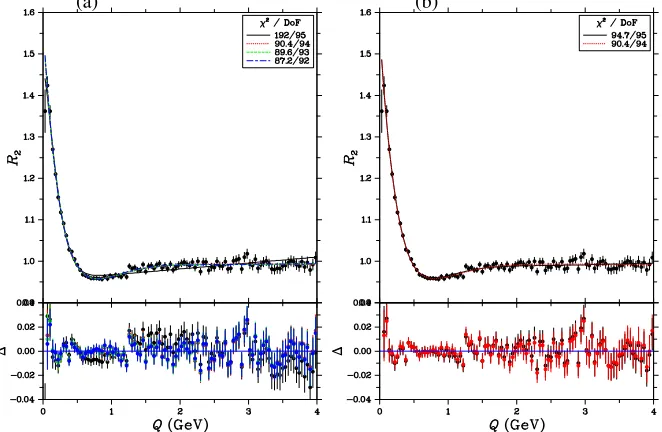
Fits to the two-jet data are shown in Fig. 2a for orders 0 through 3 of the Lévy polynomials. The order-0 fit (also shown in Fig. 1a) has a very poorχ2, but the order-1 fit has a goodχ2. Higher orders show only marginal further improvement.
(a) (b)
Figure 2. (a) Symmetric Lévy fit for two-jet events up to orders 0 through 3 Lévy polynomials; (b) First-order Lévy polynomial fit (black) for two-jet events compared to theτ-model fit (red).
The first-order symmetric Lévy polynomial fit is shown together with the simplified τ -model fit in Fig. 2b. Theχ2of the Lévy polynomial fit is slightly better than theτ-model fit, but the fit curves are nearly identical, what difference there is being mainly forQ>1.5 GeV. Comparing Eqs. (8) and (9), we see that in the symmetric Lévy parametrization the cosine of theτ-model parametrization is replaced by the Lévy polynomial expansion. Also, in the exponential 2αbecomes simplyα. Fig. 3 compares the cosine and the Lévy polynomials. We see a rather similar behaviour: Both decrease more or less linearly with Q, which explains why both fit the data approximately equally well.
2.2 τ-model (asymmetric Lévy)
Lacking an orthogonal polynomial expansion for the asymmetric Lévy distributionH(τ) of theτ-model, we use, motivated by the results of Ref. [9], a derivative expansion:
R2(Q) = γ h
1+λncos(RaQ)2α
exp−(RQ)2α
+X
cn
dn
dQncos
(RaQ)2α
exp−(RQ)2α
)#
·(1+Q) . (10)
1 2 3 4Q(GeV)
-0.6 -0.4 -0.2 0.2 0.4 0.6
λτcos(RaQ)2ατ
λSL1(1+c1 n1l1(Q RSL1,αSL1))
λSL2(1+c2 n1l1(Q RSL2,αSL2) +c2 n2l2(Q RSL2,αSL2))
λSL3(1+c3 n1l1(Q RSL3,αSL3) +c3 n2l2(Q RSL3,αSL3) +c3 n3l3(Q RSL3,αSL3))
Figure 3. Comparison of the cosine term of theτ-model parametrization with the Lévy polynomial term of the symmetric Lévy parametrization.
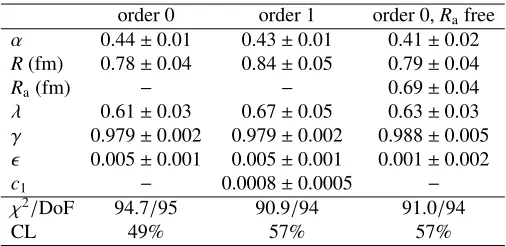
We also consider lettingRabe a free parameter rather than as defined in Eq. (8b). The results of these fits are shown in Table 1 and Fig. 4a. Theχ2of the order-1 fit is, of course, smaller than that of the order-0 fit, as is theRa-free fit, and the confidence levels are somewhat better. To test the significance of the improvement inχ2, we make use of theχ2-difference. For the order-0 and order-1 fits this isχ2
diff =94.7−90.9=3.8, and the difference in the number of degrees of freedom is 1. The confidence level for aχ2of 3.8 with 1 degree of freedom is 5.1%. A small value of this confidence level, say less than 5%, would be grounds for rejecting the order-0 parametrization. (This corresponds to the 95% commonly used in making decisions.) Thus we conclude that for two-jet events the order-0 fit is adequate.
The order-0,Ra-free fit also provides an adequate description, having aχ2nearly identical to that of the order-1,Ra-constrained fit. Note that the physical parameters (α,R,λ) differ at most by about 1 standard deviation in going from order-0 to order-1 or toRafree. Thus conclusions based on these values, such as the reconstructions of the space-time picture in Ref. [3], remain valid.
3 Conclusions for two-jet events
We have used expansions about the hypothesized form to test whether it provides an adequate description of the data or is only a (poor) approximation. In the latter case the shape of the expansion terms provide an indication of how to modify the original parametrization. For the symmetric Lévy parametrization this showed that an approximately linearly decreasing function ofQis necessary, which in fact is what is provided by theτ-model.
An expansion in the case of theτ-model is found not to be significant,i.e., the one-sided Lévy distribution of theτ-model is adequate.
Table 1.Fit results ofτ-model parametrizations for two-jet events.
order 0 order 1 order 0,Rafree
α 0.44±0.01 0.43±0.01 0.41±0.02 R(fm) 0.78±0.04 0.84±0.05 0.79±0.04
Ra(fm) − − 0.69±0.04
λ 0.61±0.03 0.67±0.05 0.63±0.03
γ 0.979±0.002 0.979±0.002 0.988±0.005
0.005±0.001 0.005±0.001 0.001±0.002
c1 − 0.0008±0.0005 −
χ2/DoF 94.7/95 90.9/94 91.0/94
CL 49% 57% 57%
(a) (b)
Figure 4.(a) Fits of theτ-model (black), the order-1 expansion of theτ-model (red), and theτ-model withRa free (green), for two-jet events; (b) Fits of theτ-model (black), the order-1 expansion of the τ-model (red), theτ-model withRafree (green), and the order-1 expansion of theτ-model withRafree (blue), for three-jet events.
4 Three-jet events
For two-jet events hadronization occurs basically in 1+1 dimensions, which lead to the de-pendence ofR2 onτ, the longitudinal proper time andmt, the transverse mass. For three-jet events, the q¯qg system no longer forms a linear system (in the overall centre of mass), but a planar one. There is no event axis by which the transverse mass and longitudinal proper time are defined. Therefore we might expect theτ-model, as formulated for a two-jet system, to work less well.
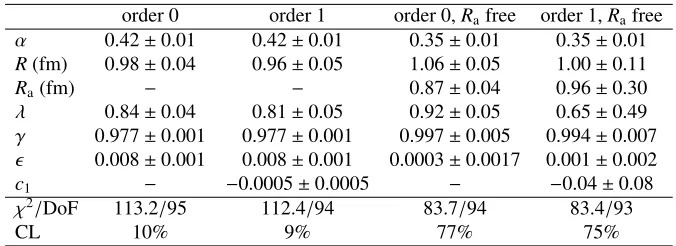
The results of fits of theτ-model and its first-order expansion, without and withRaa free parameter, are shown in Fig. 4b and Table 2. Applying theχ2-difference test to the order-0 and order-1 fits yields a confidence level of 37% for the case thatRais constrained and 58% whenRais free.
However, theχ2-difference between the order-0 R
aconstrained and free cases yields a confidence level of 6·10−8. Thus regardingR
a as a free parameter does give significant improvement.
But it must be pointed out that the parametersRaandτ0are expected to be highly corre-lated. While for two-jet events it was found in Ref. [3] thatτ0is consistent with zero, such studies have not yet been performed for three-jet events. Further investigation is ongoing. Also, note that the value of α is significantly less for the fits withRa free than for those withRa constrained. This was not the case for two-jet events. This too requires additional investigation.
Table 2.Fit results ofτ-model parametrizations for three-jet events.
order 0 order 1 order 0,Rafree order 1,Rafree
α 0.42±0.01 0.42±0.01 0.35±0.01 0.35±0.01 R(fm) 0.98±0.04 0.96±0.05 1.06±0.05 1.00±0.11 Ra(fm) − − 0.87±0.04 0.96±0.30
λ 0.84±0.04 0.81±0.05 0.92±0.05 0.65±0.49
γ 0.977±0.001 0.977±0.001 0.997±0.005 0.994±0.007
0.008±0.001 0.008±0.001 0.0003±0.0017 0.001±0.002 c1 − −0.0005±0.0005 − −0.04±0.08
χ2/DoF 113.2/95 112.4/94 83.7/94 83.4/93
CL 10% 9% 77% 75%
5 Conclusions for three-jet events
As for the two-jet case, expansion of the τ-model expression does not lead to significant improvement in the fits. This validates the use of an asymmetric Lévy distribution for the longitudinal proper time.
However, significant improvement of the fit is obtained by lettingRabe a free parameter. i.e., by lessening the connection of the simplifiedτ-model between the BEC peak and the antisymmetric dip. Whether lettingτ0 also be a free parameter would also give significant improvement is the subject of ongoing investigation, as is the question whetherαdecreases as the number of jets increases.
S. Lökös greatfully acknowledges the support from the ERASMUS project of the EU and thanks W. Metzger for his kind hospitality at the Radboud University Nijmegen, The Netherlands. This research was partially supported by the NKTIH FK 123842 and FK 123 959 grants (Hungary), by the Circles of Knowledge Club (Hungary) and by the EFOP 3.6.1-16-2016-00001 project (Hungary).
References
[1] T. Csörg˝o, J. Zimányi, Nucl. Phys.A517, 588 (1990)
[2] T. Csörg˝o, W. Kittel, W. Metzger, T. Novák, Phys. Lett.B663, 214 (2008) [3] L3 Collab., P. Achard,et al., Eur. Phys. J.C71, 1648 (2011)
[4] Y. Dokshitzer, Contribution cited in Report of the Hard QCD Working Group, Proc. Workshop on Jet Studies at LEP and HERA, Durham, Dec. 1990, J. Phys. g17 (1991) 1537
[5] S. Catani,et al., Phys. Lett.B269, 432 (1991) [6] S. Bethke,et al., Nucl. Phys.B370, 310 (1992)
[7] L3 Collab., M. Acciarri,et al., Phys. Lett.B458, 517 (1999) [8] T. Csörg˝o, S. Hegyi, W. Zajc, Eur. Phys. J.C36, 67 (2004)
[9] M. De Kock, H. Eggers, T. Csörg˝o, inProc. Workshop on Particle Correlations and Femtoscopy 2011(PoS, 2011), p. 033