Live Data Center Migration across WANs:
A Robust Cooperative Context Aware Approach
K.K. Ramakrishnan, Prashant Shenoy , Jacobus Van der Merwe
AT&T Labs-Research / University of Massachusetts
Abstract
A significant concern for Internet-based service providers is the continued operation and availability of ser-vices in the face of outages, whether planned or unplanned. In this paper we advocate a cooperative, context-aware approach to data center migration across WANs to deal with outages in a non-disruptive manner. We specifically seek to achieve high availability of data center services in the face of both planned and incidental outages of data center facilities. We make use of server virtualization technologies to enable the replication and migration of server functions. We propose new network functions to enable server migration and replication across wide area networks (i.e., the Internet), and finally show the utility of intelligent and dynamic storage replication technology to ensure applications have access to data in the face of outages with very tight recovery point objectives.
1 Introduction
A significant concern for Internet-based service providers is the continued operation and availability of ser-vices in the face of outages, whether planned or unplanned. These concerns are exacerbated by the increased use of the Internet for mission critical business and real-time entertainment applications. A relatively minor outage can disrupt and inconvenience a large number of users. Today these services are almost exclusively hosted in data centers. Recent advances in server virtualization technologies [8, 15, 23] allowed for thelivemigration of services within a local area network (LAN) environment. In the LAN envi-ronment, these technologies have proven to be a very ef-fective tool to enable data center management in a non-disruptive fashion. Not only can it support planned main-tenance events [8], but it can also be used in more dynamic fashion to automatically balance load between the physical servers in a data center [23]. When using these technolo-gies in a LAN environment, services execute in a virtual server, and the migration services provided by the underly-ing virtualization framework allows for a virtual server to be migrated from one physical server to another, without any significant downtime for the service or application. In particular, since the virtual server retains the same network
address as before, any ongoing network level interactions are not disrupted. Similarly, in a LAN environment, storage requirements are normally met via either network attached storage (NAS) or via a storage area network (SAN) which is still reachable from the new physical server location to allow for continued storage access.
Unfortunately in a wide area environment (WAN), live server migration is not that easily achievable for two rea-sons: First, live migration requires the virtual server to maintain the same network address so that from a network connectivity point of view the migrated server is indistin-guishable from the original. While this is fairly easily achieved in a shared LAN environment, no current mech-anisms are available to efficiently achieve the same feat in a WAN environment. Second, while fairly sophisticated re-mote replication mechanisms have been developed in the context of disaster recovery [21, 7, 11], these mechanisms are ill suited to live server migration, because in general the available technologies are unaware of application/service level semantics.
In this paper we outline a design for live server migra-tion across WANs. Our design makes use of existing server virtualization technologies and propose network and stor-age mechanisms to facilitate migration across a WAN. The essence of our approach is cooperative, context aware mi-gration, where a migration management system orchestrate the migration across all three subsystems involved, namely the server platforms, the wide area network and the disk storage system. While conceptually similar in nature to the LAN based work described above, using migration tech-nologies across a wide area network presents unique chal-lenges and has to our knowledge not been achieved. Our main contribution is the design of a framework that will al-low the migration across a WAN ofallsubsystems involved with enabling network based services. We describe new mechanisms as well as extensions to existing technologies to enable this and outline the cooperative, context aware func-tionality needed across the different subsystems to enable this.
2 Live Data Center Migration across WANs
Three essential subsystems are involved with hosting ser-vices in a data center: First, theservershosting the
applica-tion or service logic. Second, services are normally hosted in a data center to provide shared access through anetwork, either the Internet or virtual private networks (VPNs). Fi-nally, most applications require some diskstoragewhere the amount of disk space and the frequency of access varies greatly between different services/applications.
Disruptions, failures, or in general outages of any kind of any of these components will cause service disruption. For this reason much work have addressed the robustness of these components. For example, data centers typically have multiple network connections and redundant LAN de-vices to ensure redundancy at the networking level. Sim-ilarly, physical servers are being designed with redundant hot-swappable components (disks, processor blades, power supplies etc). Finally, redundancy at the storage level can be provided through sophisticated data mirroring technologies. The focus of our work, however, is on the case where such local redundancy mechanisms are not sufficient. Specifically we are interested to provide service availabil-ity when the data center as a whole becomes unavailable, for example because of data center wide maintenance oper-ations, or because of catastrophic events. As such, our basic approach is to migrate services between data centers across the wide are network (WAN).
By necessity, moving or migrating services from one data center to another needs to consider all three of these com-ponents. Historically, such migration has been disruptive in nature, requiring downtime of the actual services involved, or requiring heavy weight replication techniques. In the lat-ter case concurrently running replicas of a service can be made available thus allowing a subset of the service to be migrated or maintained without impacting the service as a whole. We argue that these existing mechanisms are inad-equate to meet the needs of modern real-time services for continuous availability and operation. In stead, we advo-cate an approach where server, network and storage subsys-tems cooperate and coordinate actions, in a manner that is cognizant of the service context in order to realize seamless migration across wide area networks.
In this section we briefly describe the technical building blocks that would enable our approach. As outlined below, some of these building blocks exist, or exist in part, while in other cases we use the desire for high availability of services as the driver for the changes we are proposing.
2.1 Live Virtual Server Migration
The main enabler for our approach is the live server mi-gration capabilities that have been developed in the context of server virtualization in recent years [6, 8]. In this ap-proach an entire running operating system (including any active applications) executing as a virtual server is being transfered from one physical machine to another. Since the virtual server is migrated in its entirety, both application and kernel level state gets migrated, including any state asso-ciated with ongoing network connections. Assuming that
network level reachability to the virtual server network ad-dresses are maintained after the migration, the implication is that applications executing in the virtual server experi-ence very little downtime (in the order of tens to hundreds of milliseconds) and ongoing network connections remain intact.
In order to maintain network level reachability, the IP ad-dress(es) associated with the virtual server has to be reach-able at the physical server where the virtual server is mi-grated to. In a LAN environment this is achieved either by issuing an unsolicited ARP reply to establish the binding between the new MAC address and the IP address, or by re-lying on layer-two technologies to allow the virtual server to reuse its (old) MAC address [8].
Because of the difficulty of moving network level (i.e., IP addresses) in a routed non-LAN environment, using live server migration as a management tool have been limited to the LAN environments [23]. However, we argue that vir-tual server migration across the wide area will also be an attractive tool, specifically to deal with outages, and there-fore propose below networking mechanisms to enable this.
If disk storage needs are being met with network attached storage (NAS), the storage becomes just another network based application and can therefore be addressed in the same way during LAN based migration [8]. Modern virtualiza-tion environments also include support for other forms of (local) storage including storage area networks (SANs) [1]. However, since we propose to use WAN server migration as a means to deal with complete data center outages, these mechanisms are inadequate for our purposes and below we propose extension to remote replication technologies which can work in concert with server migration to minimize ser-vice downtime.
2.2 Networking Requirements
From the discussion above a key requirement for live server migration across a WAN is the ability to have the IP address(es) of the virtual server be reachable at the new data center location immediately after the migration has com-pleted. This presents a significant challenge for a number of reasons. First, despite decades of work in this area, IP address mobility remains an unresolved problem that is typ-ically only addressed at manual configuration time scales. The second challenge comes from the fact that current rout-ing protocols are well known to have convergence issues which is ill suited to the time constraints imposed by the live migration process. Third, in today’s networking environ-ment connectivity changes are typically initiated and con-trolled by network operators or network management sys-tems. Again this is poorly suited to WAN server migration where it is essential that the migration software, which is closely monitoring the status of the server migration pro-cess, initiate this change at the appropriate time.
Our approach to addressing the networking requirements for live WAN migration builds on the observations that not
all networking changes in this approach are time critical and further that instantaneous changes are best achieved in a lo-calized manner. Specifically, in our solution, described in detail in Section 3, we allow the migration software to ini-tiate the necessary networking changes as soon as the need for migration has been identified. We make use of tunneling technologies during this initial phase to preemptively estab-lish connectivity between the data centers involved. Once server migration is complete, the migration software initiate a local change to direct traffic towards the new data center via the tunnel. Slower time scale network changes are then enacted to phase out this local network connectivity change for a more optimal network wide connectivity changes.
2.3 Storage Replication Requirements
Data availability is typically addressed by replicating business data on a local/primary storage system, to some remote location from where it can be accessed. From a business/usability point of view, such remote replication is driven by two metrics [9]. First is the recovery-point-objectivewhich is the consistent data point to which data can be restored after a disaster. Second is the recovery-time-objectivewhich is the time it takes to recover to that consis-tent data point after a disaster.
Remote replication can be broadly classified into the fol-lowing two categories:
Synchronous replication: every data block written to a local storage system is replicated to the remote location before the local write operation returns.
Asynchronous replication: in this case the local and remote storage systems are allowed to diverge. The amount of divergence between the local and remote systems is typically bounded by either a certain amount of data, or by a certain amount of time.
Synchronous replication is normally recommended for applications, such as financial databases, where consistency between local and remote storage systems is a high priority. However, these desirable properties come at a price. First, because every data block needs to be replicated remotely, synchronous replication systems can not benefit from any local write coalescing of data if the same data blocks are written repeatedly [17]. Second, because data have to be copied to the remote location before the write operation re-turns, synchronous replication has a direct performance im-pact on the local system, since both lower throughput and increased latency of the path between the primary and the remote systems are reflected in the time it takes for the local disk write to complete.
An alternative is to use asynchronous replication. How-ever, because the local and remote systems are allowed to di-verge, asynchronous replication always involves some data loss in the event of a failure of the primary system. But, be-cause write operations can be batched and pipelined,
asyn-chronous replication systems move data in a much more ef-ficient manner than synchronous replication systems.
For WAN live server migration we argue for the need for more flexible replication where the replication mode can be dictated by the migration semantics. Specifically, to sup-port live server migration we propose a remote replication system where the initial transfer of data between the data centers is performed via asynchronous replication to bene-fit from the efficiency of that mode of operation. When the bulk of data have been transfered in this manner, replica-tion switch to synchronous replicareplica-tion in anticipareplica-tion of the completion of the server migration step. The final server mi-gration step triggers a simultaneous switch over to the stor-age system at the new data center. In this manner, when the virtual server starts executing in the new data center, storage requirements can be locally met.
3 WAN Migration Scenarios
In this section we illustrate how our cooperative, context aware approach can combine the technical building blocks described in the previous section to realize live server mi-gration across a wide area network. We demonstrate how the coordination of server virtualization and migration tech-nologies, the storage replication subsystem and the network can achieve live migration of the entire data center across the WAN. We utilize different scenarios to demonstrate our approach. In Section 3.1 we outline how our approach can be used to achieve a safe live migration of a data center when planned maintenance events are handled. In Section 3.2 we show the use of live server migration to mitigate the effects of unplanned outages or failures.
3.1 Maintenance Outages
We deal with maintenance outages in two parts. First, we consider the case where the service has no (or very lim-ited) storage requirements. This might for example be the case with a network element such as a voice-over-IP (VoIP) gateway. Second, we deal with the more general case where the service also requires the migration of data storage to the new data center.
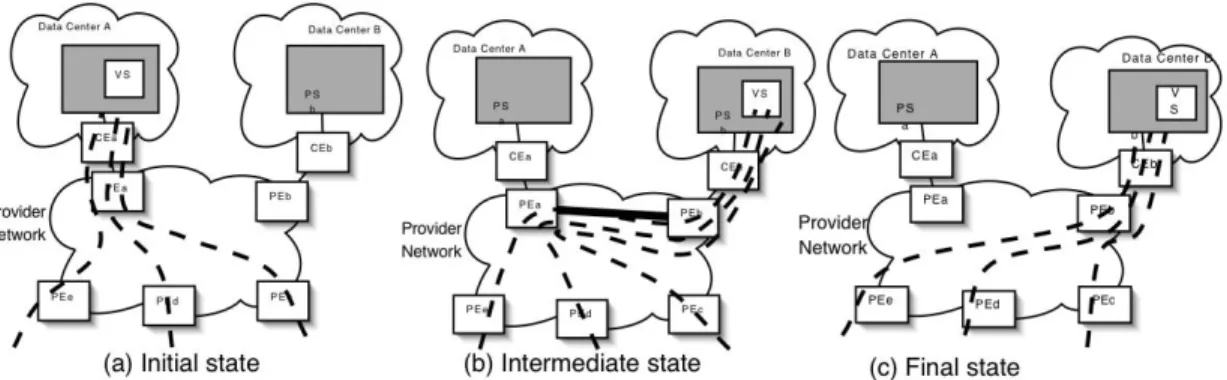
Without Requiring Storage to be Migrated:Without stor-age to be replicated, the primary components that we need to coordinate are the server migration and network “mobil-ity”. Figure 1 shows the environment where the application running in a virtual server “VS” has to be moved from a physical server in data center A to a physical server in data center B.
Prior to the maintenance event, the coordinating “mi-gration management system” (MMS) would signal to both the server management system as well as the network that a migration is imminent. The server management system would initiate the migration of the virtual server from phys-ical server “a” ( ) to physical server “b” ( ). After an
Figure 1: Live server migration across a WAN initial bulk state transfer, the server management system will
mirror any state changes between the two virtual servers. Similarly, for the network part, based on the signal re-ceived from the MMS, the service provider edge ( ) router will initiate a number of steps to prepare for the mi-gration. Specifically, as shown in Figure 1(b), the network service provider will create a tunnel between and which will be used subsequently to transfer data destined to VS to data center B.
When the MMS determines a convenient point to quiesce the VS, another signal is sent to both the server management system and the network. For the server management system, this signal will indicate the final migration of the VS from data center A to data center B, i.e., after this the VS will become active in data center B. For the network, this second signal enables the local data path switchover to the remote data center. Specifically, from this point in time, any traffic destined for the virtual server address that arrives at will be switched onto the tunnel to for delivery to data center B.
Note that at this point, from a server perspective the mi-gration is complete as the VS is now active in data center B. However, traffic is sub-optimally flowing first to and then across the tunnel to . To rectify this situation an-other networking step is involved. Specifically, starts to advertise a more preferred route to reach VS, than the route currently being advertised by . In this manner, as ingress PEs to the network ( to in Figure 1) receive the more preferred route, traffic will start to flow to directly and the tunnel between and can be torn down leading to the final state shown in Figure 1. Requiring Storage Migration: When storage has to also be replicated, it is critical that we achieve the right balance between performance (impact on the application) and the re-covery point or data loss when the switchover occurs to the remote data center. To achieve this, we allow the storage to be replicated asynchronously, prior to any initiation of the maintenance event, or, assuming the amount of data to be transfered is relatively small, asynchronous replication can be started in anticipation of a migration that is expected to
happen shortly. Asynchronous replication during this initial phase allows for the application to see no performance im-pact. However, when the maintenance event is imminent, the MMS would signal to the replication system to switch from asynchronous replication to synchronous replication to ensure that there is no loss of data during migration. When data is being replicated synchronously, there will be a per-formance impact on the application. This requires us to keep the exposure to the amount of time we replicate on a syn-chronous basis to a minimum.
When the MMS signals to the storage system the require-ment to switch to synchronous replication, the storage sys-tem completes all the pending asynchronous operations and then proceed to perform all the subsequent writes by syn-chronously replicating it to the remote data center. Thus, between the server migration and synchronous replication, both the application state and all the storage operations are mirrored at the two environments in the two data centers. When all the pending write operations are copied over, then as in the previous case, we quiesce the application and the network is signaled to switch traffic over to the remote data center. From this point on, both storage and server migra-tion operamigra-tions are complete and activated in data center B. As above, the network state still needs to be cleaned up to ensure optimal data flow directly to data center B.
Note that while we have described the live server migra-tion process as involving the service provider for the net-working part, it is possible for a data center provider to per-form a similar set of functions without involving the service provider. Specifically, by creating a tunnel between the cus-tomer edge (CE) routers in the data center, and performing local switching on the appropriate CE, rather than on the PE, the data center provider can realize the same functionality.
3.2 Unplanned Outages
We propose to also use cooperative, context aware migra-tion to deal with unplanned data center outages. There are multiple considerations that go into managing data center operations to plan and overcome failures through migration. Some of these are:
Amount of overhead under normal operation to over-come anticipated failures
Amount of data loss affordable (recovery point objec-tive - RPO)
Amount of state that has to be migrated
Time available from anticipated failure to occurrence of event
At the one extreme, one might incur the overhead of com-pletely mirroring the application at the remote site. This has the consequence of both incurring processing and net-work overhead under normal operation as well as impacting application performance (latency and throughput) through-out. Approaches to mitigate this are to checkpoint appli-cation state (store appliappli-cation state either periodically or in an application-aware manner as databases do and then copy it to the remote site). Of course, this has the conse-quence that the application can be restarted remotely at the checkpoint boundary only. Similarly, for storage one may use asynchronous replication and a periodic snapshot that is copied over to the remote site. Some data loss may occur upon an unanticipated, catastrophic failure, but the recovery point may be fairly small, depending on the frequency of checkpointing application and storage state. Coordination between the checkpointing of the application state and the snapshot of storage is key to successful migration with right RPOs. Incremental checkpointing of application and stor-age is key to efficiency, and we see existing techniques to achieve this [5, 4], [11]. For instance, rather than full appli-cation mirroring, a virtualized replicate can be maintained as a “warm standby”—in dormant or hibernating state— enabling for a quick switch-over to the previously check-pointed state. To make the switch-over seamless, in addi-tion to replicate data and recovering state, network support is needed. Specifically, on detecting the unavailability of the primary site, the secondary site is made active, and the same mechanism described in Section 3.1 is used to switch traf-fic over to reach the secondary site via the pre-established tunnel. Note that for simplicity of exposition we assume here that the PE that performs the local switch over is not affected by the failure. The approach can however, easily be extended to make use of a switch over router “deeper” in the network.
The amount of state and storage that has to be migrated may vary widely from application to application. There may be many situations where, in principle, the server can be stateless. For example, a SIP proxy server may not have any persistent state and the communication between the clients and the proxy server may be using UDP. In such a case, the primary activity to be performed is in the network to move the communication over to the new data center site. Little or no overhead is incurred under normal operation to enable the migration to a new data center. Failure recovery involves
no data loss and we can deal with near instantaneous, catas-trophic failures.
As more and more state is involved with the server, more overhead is incurred to checkpoint application state and po-tentially to take storage snapshots, either periodically or upon application prompting. It also means that the RPO is a function of the interval between checkpoints, when we have instantaneous failures. The more advanced information we have of an impending failure, the more effective we can be in having the state migrated over to the new data center, so that we have a tighter RPO when operations are resumed at the new site.
4 Related work
Prior work on this topic falls into several categories: virtual machine migration, storage replication and network support.
At the core of our technique is the ability of encapsulate applications within virtual machines that can be migrated without application down-times [16]. Most virtual machine software, such as Xen [8] and VMWare [15] support “live” migration of VMs that involve extremely short down-times ranging from tens of milliseconds to a second; details of Xen’s live migration techniques are discussed in [8]. As indicated earlier, these techniques assume that migration is being done on a LAN. VM migration has also been studied in the Shirako system [10] and for grid environments [18, 20].
Current virtual machine software support suspend and re-sume feature that can be used to support WAN migration with down-times [19, 12]. Recently live WAN migration us-ing IP tunnels was demonstrated in [22], where an IP tunnel is set up from the source to destination server to transpar-ently forward packets to and from the application; we advo-cate an alternate approach that assumes edge router support. In the context of storage, replication can be synchronous or asynchronous. There exist numerous other commercial products that perform replication, such as IBM Extended Remote Copy, HP Continuous Access XP, and EMC RepliS-tor. An excellent description of these and others, as well as a detailed taxonomy of the different approaches for repli-cation can be found in [11]. The Ursa Minor system ar-gues that no single fault model is optimal for all applica-tions and proposed supporting data-type specific selecapplica-tions of fault models and encoding schemes for replication [2]. Recently, we proposed the notion of semantic-aware repli-cation [13] where the system supports both synchronous and asynchronous replication concurrently and use “sig-nals” from the file system to determine whether to replicate a particular write synchronously and asynchronously.
In the context of network, our work is related to the RouterFarm approach [3], which makes use of orchestrated network changes to realize near hitless maintenance on provider edge routers. Other than being in a different
appli-cation area, our approach differs from the RouterFarm work in two regards. First, we propose to have the required net-work changes be triggered by functionality outside of the network, (as opposed to network management functions in-side the network). Second, due to the stringent timing re-quirements of live migration, we expect that our approach would require new router functionality (as opposed to be re-alizable via the existing configuration interfaces).
Finally, the recovery oriented computing (ROC) project emphasizes recovery from failures rather than failure avoid-ance. In a similar spirit to ROC, we advocate using mecha-nisms from live VM migration to storage replication to sup-port planned and unplanned outages in data centers (rather than full replication to mask such failures).
5 Conclusion
A significant concern for Internet-based service providers is the continued operation and availability of ser-vices in the face of outages, whether planned or unplanned. In this paper we advocated a cooperative, context-aware approach to data center migration across WANs to deal with outages in a non-disruptive manner. We sought to achieve high availability of data center services in the face of both planned and incidental outages of data center facilities. We advocated using server virtualization technologies to enable the replication and migration of server functions. We proposed new network functions to enable server migration and replication across wide area networks (i.e., the Internet), and finally showed the utility of intelligent and dynamic storage replication technology to ensure applications have access to data in the face of outages with very tight recovery point objectives.
References
[1] A xen way to iscsi virtualization? http://www.internetnews.com/dev-news/article.php/3669246, April 2007.
[2] M. Abd-El-Malek, W. V. Courtright II, C. Cranor, G. R. Ganger, J. Hendricks, A. J. Klosterman, M. Mesnier, M. Prasad, B. Salmon, R. R. Sambasivan, S. Sinnamohideen, J. D. Strunk, E. Thereska, M. Wachs, and J. J. Wylie. Ursa minor: versatile cluster-based stor-age. USENIX Conference on File and Storage Technologies, Decem-ber 2005.
[3] Mukesh Agrawal, Susan Bailey, Albert Greenberg, Jorge Pastor, Panagiotis Sebos, Srinivasan Seshan, Kobus van der Merwe, and Jennifer Yates. Routerfarm: Towards a dynamic, manageable net-work edge. SIGCOMM Workshop on Internet Netnet-work Management (INM), September 2006.
[4] L. Alvisi.Understanding the Message Logging Paradigm for Mask-ing Process Crashes. PhD thesis, Cornell, January 1996.
[5] L. Alvisi and K. Marzullo. Message logging: Pessimistic, optimistic, and causal. InProceedings of the 15th International Conference on Distributed Computing Systems, pages 229–236. IEEE Computer So-ciety, June 1995.
[6] Paul Barham, Boris Dragovic, Keir Fraser, Steven Hand, Tim Harris, Alex Ho, Rolf Neugebar, Ian Pratt, and Andrew Warfield. Xen and
the art of virtualization. In the Proceedings of the ACM Symposium on Operating Systems Principles (SOSP), October 2003.
[7] K. Brown, J. Katcher, R. Walters, and A. Watson. Snapmirror and snaprestore: Advances in snapshot technology. Network Ap-pliance Technical Report TR3043. www.netapp.com/tech_ library/3043.html.
[8] C. Clark, K. Fraser, S. Hand, J. Hanse, E. Jul, C. Limpach, I. Pratt, and A. Warfiel. Live migration of virtual machines. InProceedings of NSDI, May 2005.
[9] Disaster Recovery Journal. Business continuity glossary. http: //www.drj.com/glossary/drjglossary.html. [10] Laura Grit, David Irwin, , Aydan Yumerefendi, and Jeff Chase.
Vir-tual machine hosting for networked clusters: Building the founda-tions for autonomic orchestration. InIn the First International Work-shop on Virtualization Technology in Distributed Computing (VTDC), November 2006.
[11] M. Ji, A. Veitch, and J. Wilkes. Seneca: Remote mirroring done write. USENIX 2003 Annual Technical Conference, June 2003. [12] M. Kozuch and M. Satyanarayanan. Internet suspend and resume.
InProceedings of the Fourth IEEE Workshop on Mobile Computing Systems and Applications, Calicoon, NY, June 2002.
[13] Xiaotao Liu, Gal Niv, K. K. Ramakrishnan, Prashant Shenoy, and Jacobus Van der Merwe. The case for semantic aware remote repli-cation. InProc. 2nd International Workshop on Storage Security and Survivability (StorageSS 2006), Alexandria, VA, October 2006. [14] Aravind Menon, Alan L. Cox, and Willy Zwaenepoel. Optimizing
Network Virtualization in Xen. InUSENIX Annual Technical Con-ference, 2006.
[15] Michael Nelson, Beng-Hong Lim, and Greg Hutchins. Fast Trans-parent Migration for Virtual Machines. InUSENIX Annual Technical Conference, 2005.
[16] Mendel Rosenblum and Tal Garfinkel. Virtual machine monitors: Current technology and future trends.Computer, 38(5):39–47, 2005. [17] C. Ruemmler and J. Wilkes. Unix disk access patterns. Proceedings
of Winter 1993 USENIX, Jan 1993.
[18] Paul Ruth, Junghwan Rhee, Dongyan Xu, Rick Kennell, and Se-bastien Goasguen. Autonomic Live Adaptation of Virtual Compu-tational Environments in a Multi-Domain Infrastructure. InIEEE In-ternational Conference on Autonomic Computing (ICAC), June 2006. [19] Constantine P. Sapuntzakis, Ramesh Chandra, Ben Pfaff, Jim Chow, Monica S. Lam, and Mendel Rosenblum. Optimizing the migration of virtual computers. InProceedings of the 5th Symposium on Operating Systems Design and Implementation, December 2002.
[20] A. SUNDARARAJ, A. GUPTA, and P. DINDA. Increasing Appli-cation Performance in Virtual Environments through Run-time In-ference and Adaptation. InFourteenth International Symposium on High Performance Distributed Computing (HPDC), July 2005. [21] Symantec Corporation. Veritas Volume Replicator
Administra-tor’s Guide. http://ftp.support.veritas.com/pub/ support/products/Volume_Replicator/2%83842. pdf, 5.0 edition, 2006.
[22] F. Travostino, P. Daspit, L. Gommans, C. Jog, C. de Laat, J. Mam-bretti, I. Monga, B. van Oudenaarde, S. Raghunath, and P. Wang. Seamless live migration of virtual machines over the man/wan. Else-vier Future Generations Computer Systems, 2006.
[23] T. Wood, P. Shenoy, A. Venkataramani, and M. Yousif. Black-box and gray-box strategies for virtual machine migration. In Proceed-ings of the Usenix Symposium on Networked System Design and Im-plementation (NSDI), Cambridge, MA, April 2007.