This is a pre-copyedited, author-produced PDF of an article accepted for publication in the Journal of Public Administration Research and Theory following peer review. The version of record, Ingold, Karin and Philip Leifeld (2016): Structural and Institutional Determinants of Influence Reputation: A Comparison of Collaborative and Adversarial Policy Networks in Decision Making and Implementation. Journal of Public Administration Research and Theory 26(1): 1–18, is available online at: http://dx. doi.org/10.1093/jopart/muu043.
Structural and Institutional Determinants of Influence
Reputation: A Comparison of Collaborative and
Adversarial Policy Networks in Decision Making and
Implementation
Karin Ingold
Philip Leifeld
Abstract
The central assumption in the literature on collaborative networks and policy net-works is that political outcomes are affected by a variety of state and nonstate actors. Some of these actors are more powerful than others and can therefore have a considerable effect on decision making. In this article, we seek to provide a struc-tural and institutional explanation for these power differentials in policy networks and support the explanation with empirical evidence. We use a dyadic measure of influence reputation as a proxy for power, and posit that influence reputation over the political outcome is related to vertical integration into the political sys-tem by means of formal decision-making authority, and to horizontal integration by means of being well embedded into the policy network. Hence, we argue that actors are perceived as influential because of two complementary factors: (a) their institutional roles and (b) their structural positions in the policy network.
Based on temporal and cross-sectional exponential random graph models, we compare five cases about climate, telecommunications, flood prevention, and toxic chemicals politics in Switzerland and Germany. The five networks cover national and local networks at different stages of the policy cycle. The results confirm that institutional and structural drivers seem to have a crucial impact on how an actor is perceived in decision making and implementation and, therefore, their ability to significantly shape outputs and service delivery.
Keywords: Policy networks, Influence, Power, Reputation, Implementation, Col-laborative Governance, Decision making, Institutions, Policy
This article was written within the framework of three projects running at the Swiss Federal Institute of Technology (ETH Zurich) and the University of Bern: “Sustainable Land-Use Practices in Mountain Regions: Integrative Analysis of Ecosystem Dynamics under Global Change, Socio-economic Impacts and Policy Implications” (MOUNTLAND), supported by the Competence Center Environment and Sustainability; “NCCR-Climate,” supported by the Swiss National Science Foundation; and “Multi-level regulation of the utilities sector in Belgium, the Netherlands, Ireland, and Switzerland: energy and telecommunications” (REGUNET), led by KU Leuven and UC Louvain, Belgium.
Supplementary materials: http://dx.doi.org/10.1093/jopart/muu043. Replication dataset andRscript: http://dx.doi.org/10.7910/DVN/27456.
Introduction
Policy analysis and public administration both have a strong interest in how effective and efficient policy outputs and outcomes are produced (Knill and Tosun 2012; Howlett and Ramesh 1995). Yet they focus on different stages of the policy cycle (Rethemeyer and Hatmaker 2008; Jann and Wegrich 2007): a management perspective focuses its attention on the role, performance and effectiveness of public and private organizations with regard to implementation and the quality of service delivery (Huang and Provan 2013; Klijn 2005). Research about policy making rather concentrates on negotiations and structures during the decision-making process. It aims at explaining how policy solutions are designed to tackle problems that have passed the crucial agenda-setting stage (Sabatier and Jenkins-Smith 1993; Baumgartner and Jones 1993). In what follows, we adopt an encompassing perspective, including both, political decision-making and implementation at the national and local level, and highlight that both branches of the literature are interested in how effective and efficient outputs come about and that they attribute a strong role to “powerful” political actors (Ferris et al. 2007; Watkins and Rosegrant 1996).
The definition of the power of those actors depends on whether we conceptualize pol-icy making as a process shaped by elected officials and senior public managers or rather by a variety of interdependent private and public actors (Svara 1998; Montjoy and Wat-son 1995). While the first can be understood as institutional power defined by formal rules, the second can be characterized as informal structural power or access to political influence (Stokman and Zeggelink 1996). Historically, the view on power in management and decision making developed hand-in-hand with the emergence of what is often called inter-organizational collaboration or network governance (Provan and Kenis 2008; Raab, Mannak and Cambr´e 2015; Raab and Kenis 2009; Rethemeyer and Hatmaker 2008). Pro-cesses are shaped by both horizontal and vertical integration of actors into the governance system (Bolleyer and B¨orzel 2010). If we acknowledge this complex and interdependent nature of today’s decision making and service delivery, a viable research strategy is to adopt a network approach in order to analyze power differentials. Policy networks are composed of actors (nodes) and the relations among them (ties or edges). Actors’ at-tributes (such as their resources) and network configurations (that is, specific realizations of a network) are jointly responsible for policy dynamics and outcomes (Henning 2009; Pappi and Henning 1998, 1999; Lin 2001; Klijn 1996; Laumann and Knoke 1987).
In empirical policy networks, the two modes of power—formal power derived from institutional roles and structural power derived from network configurations—cannot be easily disentangled. Recent studies emphasize the potentially complementary impact of the two modes of power (see also Feiock, Moon-Gi and Kim 2003): Choi and Robertson (2014) distinguish between formal, “processual” and “structural” modes of power that might be able to mitigate power imbalances among actors, and thus impact upon decision outcomes in a group of stakeholders. Park and Rethemeyer (2014) analyze the explana-tory value of actors’ resource dependence for the structure of policy networks. They, too, distinguish between “material-institutional” and “social-structural” resources (Park and Rethemeyer 2014: 4). Both studies aim at disentangling formal decision-making rules and institutionally derived resources from, on the one hand, deliberative processes and, on the other, resources derived from persistent patterns of interaction between actors in a network (see also Kenis and Schneider 1991). They further highlight that integrating
both institutional and structural resources into one statistical network model would help to understand the complexity of resource dependence and power (im)balance.
In line with these studies, we aim to provide a structural and institutional explanation for power differentials in policy networks and further ask what impact structural versus formal power has on the formation of policy outputs and outcomes. However, we acknowl-edge that it is difficult to evaluate the policy success of an actor or the effectiveness of achieving policy outputs empirically (McConnell 2010). We therefore seek to investigate an antecedent condition for factual political influence and success: the reputation of an actor to be influential. From the social psychology literature, we borrow the argument that how an actor is perceived in the policy process matters for the actor’s policy effec-tiveness. Put differently: perception influences action. Carpenter (2010) and Carpenter and Krause (2012) convincingly demonstrate how reputation shapes the factual influence and behavior of government agencies and how organizational reputation is relevant for understanding their role in democratic systems. In line with Kilduff and Krackhardt (1994), we define reputation as the perceived importance of actors when evaluated by their peers or other stakeholders involved in the policy process. The underlying assump-tion is that actors who have a reputaassump-tion for being influential can considerably influence collective decision-making.
This research therefore asks: what factors determine the influence reputation of po-litical actors?
We posit that influence reputation with regard to the political outcome is related to two complementary factors: vertical integration into the political system by means of formal decision-making authority, and horizontal integration by means of advantageous structural positions in the policy network. Hence, we argue that actors are perceived as influential because of both their institutional power and their structural power derived from their positions in the policy network.
Moreover, the analysis presented in this article tests whether these propositions are empirically valid across different types of networks or whether they are confined to local-or national-level netwlocal-orks, collablocal-orative local-or adversarial netwlocal-orks, local-or decision-making local-or implementation networks. Theoretical arguments from the different branches of the lit-erature suggest that a unified explanation of power differentials might be valid across contexts.
Our argument is structured as follows. The first section discusses perceived influence reputation (our dependent variable in the statistical model presented below) as an in-tervening variable in the explanation of political outcomes. The second section reviews existing research on reputation in policy networks and develops several hypotheses along the lines of institutional and structural features of actors in policy networks (our inde-pendent variables). The third section provides details about the datasets and methods employed in our empirical analysis. Section four presents temporal and cross-sectional exponential random graph models (TERGM and ERGM) and discusses the results in light of existing findings on policy networks. Park and Rethemeyer (2014) observe that “surprisingly little is known about the effects of [various] social factors on the structure of policy networks due, in part, to the statistical challenges in modeling them precisely.” With our use of temporal ERGMs, we are able to explore the causal relationships be-tween the variables of interest and thus overcome some of those limitations. Finally, the last section concludes and discusses implications for public policy and management, and avenues for future research.
Influence reputation as an intervening variable
be-tween network structure and political outcomes
How actors are perceived matters. Zhang and Feiock (2010) show under what conditions administrative managers share power with elected bodies. They point out that managers’ experience and professionalism seem to impact upon their “perceived policy leadership.” “Authority [of managers] is often more a function of their personalities and personal charisma than it is of their official positions” (Fairholm 2001: iv). This is not to say that managers do not require formal authority, but rather that the combination of authority and referent power—defined as respect, loyalty and admiration—can create considerable influence (Locke 2003). Hence, there are some broader views on important positions and political influence, rather than just a focus on formal authority and decision-making (for the latter, see Lukes 1974; Schumpeter 1943). Carpenter (2010), and later Carpenter and Krause (2012), point to factors that affect perception in organizational settings. They prominently emphasize the link between reputation and outcomes by analyzing how an actor’s reputation and exposure to multiple audiences (such as clients, media and congres-sional committees) conditions his or her administrative choices and strategic behavior. The way in which organizational reputations are formed and subsequently cultivated is fundamental to understanding the role of public administration in a democracy (Car-penter and Krause 2012: 26). Building on this important insight, we are interested in explaining how the influence reputation of private and public agencies involved in the policy process comes about in the first place.
The issue of reputation is also prominently studied in sociology and organizational studies in which authors analyze the factors that determine perceived reputation (Lee and Whitford 2012; Maor, Gilad and Bloom 2013; Kilduff and Krackhardt 1994). Burt (2008) shows the relevance of two main approaches: the human capital approach, which focuses on accumulated experience and knowledge that may enhance positive reputation and make it persist over time; in contrast, the social capital approach focuses on the quality and/or quantity of an actor’s ties to explain his or her reputation. From this perspective, reputation can be defined as the extent to which a person, group or organization is known to be trustworthy, performing well or important (Burt 2005, 2008; Lamothe and Lamothe 2012; Weigelt and Camerer 1988). It should be noted that reputation is related to a cognitive approach: it is not about who an actor is or what he or she does, but about how an actor is perceived in terms who he or she is or what he or she does.
In early political sociology and policy elite research, the reputational approach re-ceived considerable attention and was compared to positional and decisional approaches in order to study the influence of organizational actors (for a comparison, see French 1969). The “reputational method” was first employed by Hunter (1953) and conceptual-izes power in terms of actors mutually recognizing one another as influential. An actor is influential if he or she is rated as being influential by other relevant actors. The “posi-tional method” was first employed by Mills (1956) and relies on archival data to describe capital flows and the other relations and properties of organizations. An actor is influen-tial if he or she accumulates more resources than others and thereby gains a position of authority. The “decisional approach” was first used by Hunter (1953: 214) and concep-tualizes influence as a result of an organization’s realized interest positions. An actor is influential if he or she participates in important decisions. The relative merit of each ap-proach was subject to debate in the 1960s. French (1969) found that reputational power enriched with positional indicators provides the most accurate picture of influence. This
view is supported by Freeman et al. (1963: 797), who find that the reputation method identifies those actors that are actually influential and the “institutional leaders” behind the scenes, whilst the decisional approach only gets at the active “workers” who rely on the institutional leaders (cf. French 1969).
In other words, it is well established in various branches of the literature that actors with considerable reputational power are particularly able to shape decision making. To date, however, very little research exists in political science and public administration as to why some actors are perceived as more important than others and can therefore exert stronger factual influence. Nevertheless, it is recognized that some specific actors involved in policy processes particularly care about their reputation and how they are perceived by others: politicians are subject to a (re-)electoral logic and are therefore especially keen on having a good reputation and being regarded as influential (Landry and Varone 2005; Besley and Case 1995; Barro 1973).
If influence reputation is an intervening variable that affects political outcomes, the important question then becomes: what factors determine whether an actor is regarded as influential by other political actors in the first place? How can we deconstruct and understand influence reputation in policy and implementation processes? In line with Kilduff and Krackhardt (1994), we focus on actors’ reputations and assume that actors who have a higher reputation can greatly influence decision making. Influence reputation thus follows a cognitive approach, where peers evaluate how important they perceive an actor involved in the respective policy or implementation process to be (Hunter 1953).
Structures and institutions as sources of influence
rep-utation
The institutionalist view on power and influence presupposes that important actors can be identified by looking at formal decision-making rules and institutionalized power (Dahl 1994; Tsebelis 2002). From a social-structural perspective, however, perceived influence depends on direct and, possibly, indirect connections with others (Smith et al. 2014), and on the location in the overall network rather than rules and institutions (Ibarra 1993; Well-man and Berkowitz 1988). An important insight from policy process theory (Howlett and Ramesh 1995; Laumann and Knoke 1987) and neo-institutionalism (Mayntz and Scharpf 1995) is that the two perspectives are not necessarily mutually exclusive: institutions (formal, informal and operational rules; see Kiser and Ostrom 1982) and structures can influence one another (see also Choi and Robertson 2014; Park and Rethemeyer 2014).
We therefore take both structural and institutional elements into account and investi-gate how they affect the perceived influence of an actor in a given political decision-making or implementation process.
Structural determinants of influence reputation
A central issue in understanding any type of network requires the identification of which actor in the network has power (Smith et al. 2014). Organizations or actors participate in policy networks because they depend on the public sector for key resources (Park and Rethemeyer 2014). To assess structural determinants of resources and power, some scholars point to two different branches of research that have followed “relatively separate
tracks” (Rethemeyer and Hatmaker 2008; see also Schalk, Torenvlied and Allen 2010): policy networks versus collaborative networks research.
Policy networks can be defined as a set of relatively stable relationships which are of a non-hierarchical and interdependent nature and link a variety of public and private actors who share common interests (not preferences) with regard to a specific policy (Peterson and Bomberg 1999: 8; B¨orzel 1997). Actors exchange resources and information in order to increase the impact of their lobbying on policy decisions (Leech et al. 2009; Baumgartner and Leech 2001). This relational exchange is organized in policy networks (Laumann and Knoke 1987). While it is widely acknowledged that final decision control is the most important resource in policy making, authors largely agree that this control can be exchanged for influence resources such as information, public support or technical expertise (Leifeld and Schneider 2012; Henning 2009; Pappi and Henning 1998, 1999; Knoke et al. 1996; Coleman 1988; Choi and Robertson 2014). The possession of these influence resources considerably facilitates direct access to decision making and policy design and increases actors’ reputational power (Beyers and Braun 2014; Heaney 2014; Raub and Weesie 1990).
Some recent policy network studies analyze reputation as dyadic influence attribution, rather than as an attribute. They focus on common venue participation, joint issue or policy preferences, and existing channels of cooperation between any two actors as com-plementary determinants of influence attribution, and thus the formation of reputation (Heaney 2014; Fischer and Sciarini 2015).
While research on policy networks stresses the competitive and adversarial logic of decision-making (through lobbying, resource exchange, gatekeeping and brokerage), re-search on collaborative networks conceptualizes decision making and implementation as a cooperative game for the common cause of policy coordination—a game during which cooperation often breaks down due to collective action problems. Research on collab-orative networks identifies factors that inhibit these collective action problems, such as bonding and bridging, social capital, and the integration of local actors (Schneider et al. 2003; Berardo and Scholz 2010; Shrestha 2013; Andrews et al. 2005; Provan and Kenis 2008; O’Toole 1997).
While policy networks are mostly concerned with decision making, collaborative net-works are established for implementing and providing public goods (Schalk, Torenvlied and Allen 2010: 630; Rethemeyer and Hatmaker 2008: 620; Lubell and Fulton 2008; Huang and Provan 2007). In some applications—mainly concerning natural resource management—the boundaries between the two are blurred by analyzing decision making in local policy networks as a common good (Henry, Lubell and McCoy 2011; Ingold 2011; Bodin and Crona 2009; Scholz and Wang 2006; Lubell and Scholz 2001). The empirical analysis presented below takes into account this diversity of settings and logics and in-cludes networks operating at different scales (national, regional and local), at different stages of the policy cycle (decision-making versus implementation) and with different rationales of actors (collaboration versus adversarial lobbying).
Both concepts, policy networks and collaborative governance networks, assume that actors get involved because they expect a payoff from participation (Burt 1992; Granovet-ter 1973), and collaboration, cooperation or information exchange relations are typically analyzed (for an exception, see Smith et al. 2014). The selective formation of these
net-work relations seems to enhance an actor’s ability to gain structural or strategic advantage from participation in the network (Leifeld and Schneider 2012).1
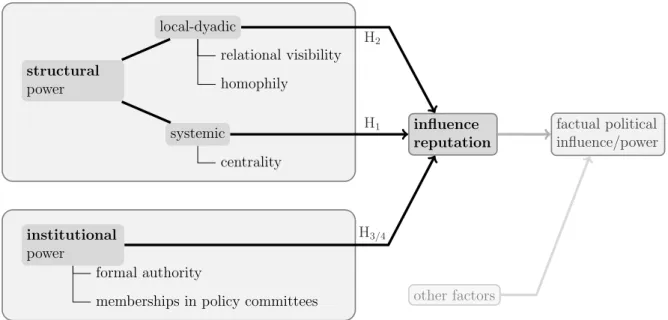
We follow the argument that ties, once established, become resources (Rethemeyer and Hatmaker 2008) and that the only feasible strategy to attract greater attention and thus a better reputation is to allocate the scarce resources (that is, the limited number of cooperation ties) in a more efficient way. Thus, actors strategically select collaboration partners so that many other actors can observe the strategic role the actor is playing in the policy network. In the present article, we thus posit that reputation also has a systemic component, and we develop a notion of systemic power rather than localized (“dyadic”) structural power (see Figure 1): political actors strive to occupy network positions from where they can control resource or information flows through the network, and this is rewarded by gaining a greater reputational power.
Burt’s concept of “structural holes” (Burt 1992) is one prominent approach used to investigate how actors strategically select their collaboration partners. The ability of an actor to control the flows reaching other actors is one of the underlying mechanisms cited for the power of a broker’s position in a structural hole (Smith et al. 2014: 162). A bro-ker is therefore defined as an intermediary actor between several otherwise disconnected actors; he or she holds a powerful position by controlling the flows between them (Ingold and Varone 2011; see again Smith et al. 2014). Obtaining resources indirectly is especially attractive as there are little or no added costs to actors in sustaining these indirect ties (Shrestha 2013: 308; Burt 1992; Granovetter 1973). Actors thus try to achieve brokerage positions (measurable by indices like betweenness centrality) to become more powerful. Based on an analysis of the communication network in the U.S. health policy domain, Fernandez and Gould (1994: 1481) conclude that the occupancy of brokerage positions is a crucial determinant of influence. From a game-theoretical perspective, we can therefore expect actors to engage in what Bei et al. (2011) call a betweenness centrality game. Conversely, if actors strive for a higher reputation by occupying positions with a high betweenness, we can expect other actors to rate them as being particularly influential if they occupy such positions.
Betweenness centrality (Freeman 1979; for applications, see Galaskiewicz 1979; Ingold 2011; Laumann and Pappi 1976; Laumann and Knoke 1987) is defined as the number of shortest paths between any two actors in a network on which an actor is situated. The greater the number of exclusive shortest paths an actor occupies, the easier it is for this actor to cut off indirect connections between other actors, or manipulate information or other resources that travel through the network (Mu˜noz-Erickson et al. 2010; Scott 2000). We argue that this constitutes a structural ability to exert power in a policy network. It is a systemic rather than a local or dyadic component of power and reputation because it involves both adjacent and remote actors in the network.
Hypothesis 1 The higher the betweenness centrality of alter in a collaboration or contact network, the more likely ego is to report alter as being particularly influential.
The pertinent literature contends that local or dyadic relational patterns, such as relational visibility of alter or homophily, add to our understanding of reputation (Heaney 2014; Fischer and Sciarini 2015). Relational visibility can be defined as the presence
1Policy networks may consist of different types of relations (Pappi and Henning 1998), that is, em-pirical networks are often multiplex. We focus on collaborative relations among actors because we are interested in how strategic collaboration with other actors can increase one’s reputation.
of direct contacts to others in the network (Heaney 2006: 910). If an actor (“ego”) maintains collaborative ties with another actor (“alter”), ego may be inclined to rate alter as particularly powerful (Fischer and Sciarini 2015). Burt (2008), for example, deduces reputation from such direct links between actors. If two individuals are directly linked, this affects their positive evaluation of each other (Burt 2005).
Hypothesis 2 Collaboration between ego and alter leads ego to report alter as being particularly influential.
Hypothesis 1 thus captures a systemic-structural aspect of power, while hypothesis 2 captures a dyadic-relational aspect of power (Figure 1).
Institutional power
The structural aspects of power, as hypothesized above, address the horizontal integration of political actors in the policy network. “Horizontal” integration refers to informal, non-hierarchical network structures, rather than formal responsibilities and institutionally derived arrangements. Our argument is that power is comprised of both this horizontal component and the vertical integration of actors into the political system (a similar argu-ment was developed by Kilduff and Krackhardt 1994 in an intra-organizational context). Horizontal and vertical integration supposedly have additive effects, which means that one of the factors can contribute to the influence reputation of an actor independently of the other factor.2
The degree of vertical integration into the political system is the distinction between actors who have institutionally granted power (= high vertical integration) and actors whose power is limited to lobbying activities (= low vertical integration). Stokman and van den Bos (1992), for example, distinguish between an influence stage and a voting stage in the policy process. In the influence stage, all sorts of actors may engage in lobbying activities, while the voting stage is restricted to decision-makers and elected politicians.
Fischer and Sciarini (2015) confirm that institutionalized decision-making power af-fects how influential an actor is perceived in a policy network. They include this formal authority of political actors as an explanatory variable for dyadic reputation. Actors have formal authority if they are administrative agencies, executive bodies of the central state, political parties or peak associations. We adopt a slightly narrower definition of for-mal power by including only the subset of actors with forfor-mal voting or otherwise legally binding power. This includes political parties because their parliamentary groups can vote in the parliament, and federal ministries, which can give ministerial orders. More-over, independent regulatory agencies and infrastructural project managers (in local-level implementation networks) can issue legally binding orders.
Hypothesis 3 Actors with institutional decision-making power tend to be perceived as particularly influential by other actors, irrespective of their structural position in the policy network.
Finally, formal power is also expressed through institutionalized rules of access granted to key policy venues. These venues or policy committees are arenas where policy-making
2We ruled out potential interaction effects in additional model specifications which are not reported here.
structural power local-dyadic relational visibility homophily systemic centrality institutional power formal authority
memberships in policy committees
influence reputation factual political influence/power H2 H1 H3/4 other factors
Figure 1: Conception of Influence Reputation
takes place behind closed doors (Pralle 2003, 2006; Baumgartner and Jones 1991). In sum, institutional voting power can be assessed through the identification of actors with formal decision-making competences or with institutionalized access to authoritative decision arenas. It is presumably complementary to the structural aspects of power.
Hypothesis 4 Actors with multiple memberships in policy committees and institution-alized policy venues are perceived as being more influential.
Figure 1 summarizes the four hypotheses and our conception of influence reputation.
Datasets and methodology
Four different case studies are used to test our hypotheses. Table 1 gives an overview of their characteristics. The datasets cover local and national settings, as well as decision-making policy networks and collaborative implementation networks. Three out of the four case studies were conducted in Switzerland, which is characterized by direct-democratic instruments and consensual policy-making. The fourth case study was conducted in Germany, which is also known as a consensual democracy. The four case studies were therefore selected to provide variation across several potentially important macro vari-ables and to increase confidence in the results. If the statistical effects are consistent across those cases, we can be confident that we have properly caught the data-generating process and are not merely over-fitting the data. Furthermore, if the results are consis-tent despite the case studies being conducted in two different countries and the networks operating at different scales (national versus local networks) and different stages of the policy cycle (decision-making versus implementation), and with different underlying ra-tionales of the actors (collaborative governance versus adversarial lobbying), then we can expect the results to be applicable to other cases as well.
The first case study is about Swiss climate policy making during two different time steps, the second addresses the Swiss telecommunications implementation network, the
Case/Net w ork Coun try Lev el P olicy cycl e stage Av ailabilit y Y ear of data collection Swiss Climate P olicy Switzer land National Decision mak ing Longitudinal 2004–2005 1995–2000 and 2002–2005 (t w o w a v es) Swiss T elecomm unications Switzerland National Implemen tation Stati c 2010 Implemen tation Regional Flo o d Prev en tion Switzerland Lo cal Im plemen tation Static 2009 (PM Visp) German to xic chemicals German y National Decision-making Static 1984–1985 p olicy net w ork T able 1: Case Study Characteristics.
third a regional flood prevention project, and the fourth concerns toxic chemicals regu-lation at the national level in Germany in the 1980s.
The two waves of the climate policy network case study focus on two different leg-islative processes: the launch of the Swiss CO2 Act (SR 641.71), which was aimed at mitigating greenhouse gas emissions and reducing them by 10 percent by 2012; and a major amendment of this act by extending existing voluntary measures and introducing an incentive tax to mitigate climate change. All data were gathered in the winter of 2004–2005 by conducting 50 semi-structured and survey-based interviews with represen-tatives of 33 organizations (more details about the dataset are provided by Ingold 2008). This network includes four governmental actors (all public agencies), five political parties (four governmental parties among them), 11 organized interest groups (private sector and business associations), six scientific/research organizations, and seven ecological NGOs. The response rate was 100 percent.
The telecommunications dataset focuses on implementation rather than decision-making. It captures the implementation of regulatory decisions arising from the Swiss Telecommunications Act (Telecom – SR 784.10) introduced in 1997. The act consists of the full liberalization of the Swiss telecommunications market and was amended by a minor reform in 2006. Data was gathered in 2010 through a paper-and-pencil postal survey, with a focus on the special role of newly introduced actors, such as independent sector- and non-sector-specific regulatory agencies. The survey was sent out to 38 ac-tors and the response rate reached 82 percent. This network consists of 14 governmental actors (mainly federal ministries, but also including four independent regulatory agen-cies), six political parties, 13 private sector representatives (organized interest groups and telecommunications providers), and five trade unions.
The regional flood prevention project is about Priority Measures in the city of Visp (PM Visp) in the Swiss canton of Valais. The policy process was about the implemen-tation of infrastructural measures and spatial planning to prevent the region from a hundred-year-flood event. Constructions of PM Visp began in 2008, and are expected to be completed in 2016. 62 percent of the 38 actors answered the paper-and-pencil postal survey. This case includes 20 governmental actors (municipalities and cantonal public agencies), 12 representatives of local industry and business, and six organized interest groups (environment and consumers associations).
Finally, the toxic chemicals regulation policy network is a national-level case study from Germany based on publicly available3 network data collected by Schneider (1988). Details on the case study are described by Schneider (1988, 1992) and more recently by Leifeld and Schneider (2012). Network and attribute data were collected on 47 po-litical actors just after the decision-making phase of a new chemicals law (ChemG) in 1984/1985. The law was about how new and existing toxic chemical substances should be regulated. The dataset contains the “influence core” of those 30 actors in the policy network who at least one other actor rated as being influential during the decision-making process. This network is composed of 11 governmental actors (among them six federal ministries), three political parties, seven organized interest groups (health, environment, occupational safety and industry), six scientific/research organizations and three inter-national organizations. The response rate was 100 percent. This policy network can be characterized as an adversarial network where competing interests try to exert influence on the political process (Schneider 1988).
In all four cases, boundary specification and actor selection followed the procedures outlined by Laumann, Marsden and Prensky (1983). Actors were first identified through the analysis of primary and secondary sources, as well as expert interviews. For the first list of actors, we relied on the positional approach (Laumann, Marsden and Prensky 1983) to investigate whose interests were affected by the respective decision-making and imple-mentation process.4 We then divided each process into decisional phases and assessed who participated in more than one such phase; those actors who did were added to our list in the second step. Finally, and using a reputational approach (Laumann, Marsden and Prensky 1983), this list was then presented to 2 to 4 experts per case who could add further actors that he or she deemed to be important in the respective process. This combined approach left us with 33 actors for the climate cases, 38 for telecommunica-tions, 37 for PM Visp and 30 for the toxic chemicals policy network. Only organizational actors, rather than individuals, are included in the analysis because they are the relevant actors who shape policy making and implement political decisions (for a justification, see Knoke et al. 1996; Kriesi 1980).
The dependent variable is an influence reputation relation. Each interview partner was asked which actors in the respective process his or her organization perceived as very important and influential. The responses were transformed into a sociomatrix with the evaluating organizations (the senders) as row labels and the organizations being evaluated (the receivers) as column labels. This constitutes a directed and binary network matrix. Whether reputation is a network relation and thus subject to dependence between dyadic observations or whether a dyadic independence model, such as logistic regression, is sufficient is an unanswered question. On the one hand, actors cannot usually observe other actors’ cognitive judgments about third parties, which would mean that—at least at the level of purposive action—one dyadic judgment does not affect another dyadic rep-utation judgment. On the other hand, influence reprep-utation is presumably a hierarchical phenomenon that is, by its very definition and under the assumption of internal validity of the data, characterized by acyclic and transitive relations. If actor A judges actor B to be important, and B rates C as important, C is unlikely to rate A as important because this would violate transitivity. This may be a network dependency at the systemic level rather than strategic action by actors. We thus model reputation using an exponential random graph model (ERGM) with dyadic dependence (Robins, Pattison, Kalish and Lusher 2007; Robins, Snijders, Wang, Handcock and Pattison 2007) and include a model term for cyclical ties and a model term for transitive ties in order to control for the po-tentially hierarchical nature of the network. These model terms capture the propensity of edges to be involved in cyclical triads (that is, A → B → C → A) and transitive triads (A → B → C and A → C), respectively. As cyclical ties should not be present in a hierarchical phenomenon such as influence reputation, we expect there to be negative coefficients. Conversely, we should see positive coefficients for transitivity if the network shows these kinds of dependencies.
We also control for the potential tendency of ties to be reciprocated in order to make sure that there are no omitted dependencies when we estimate our effects of interest. Moreover, the number of edges in a network serves as a baseline for all other effects, similar to a constant in linear models. Finally, in any dyad, the actor who makes the judgment
4Note that data gathering for three out of the four cases, and for four out of the five networks, was done by one of the co-authors, while for the German toxic chemicals case we relied on publicly available data provided by Schneider (1988) and accessible athttp://hdl.handle.net/1902.1/17004(accessed January 1, 2014).
(= ego) may have an individual baseline propensity towards making positive judgments. One actor may be inclined to call many other actors influential while another actor may be more cautious and may identify fewer organizations as influential irrespective of the characteristics of all alters. We control for the number of judgments that ego makes in the whole network, which is effectively the outdegree centrality (Freeman 1979) of ego in the influence reputation network.
As an operationalization of the structural independent variables, each interview part-ner was asked to indicate with which actors in the process his or her organization was strongly collaborating. This information was then also transformed into a directed and binary network matrix where entries of 1 correspond to an active collaboration tie and entries of 0 indicate the absence of collaboration. In the telecommunications and PM Visp case studies, 9 percent and 58 percent of the values in the collaboration network matrix, respectively, were missing due to unit non-response. The results of the two structural effects in these two cases are therefore not as certain as in the other three cross-sectional models. In these missing cases, the dyad A → B was imputed by the dyad B → A if possible, and the dyad B →A was imputed by the dyad A → B. If both directions were missing, the modal value (= 0) was imputed. This procedure is justifiable on the grounds that collaboration as a social fact is, per se, undirected, and unconfirmed ties can be regarded as a nuisance rather than real directional information. In the climate policy and toxic chemicals case studies, we decided to retain the directed relations in order not to lose any information.
Finally, we constructed two variables which capture institutional aspects of power: the first is a binary attribute variable for each actor, where 1 indicates that the actor has formal decision-making power and 0 indicates that the actor does not have any formal decision-making power. The second is a count variable which represents the number of policy committee or institutional venue memberships of an actor. Supplementary Tables A1–A6 show summary statistics of our variables and relations for all four cases; Supplementary Tables A9–A11 provide actors’ lists including the type of organization, and various attributes and network measures for each actor.
All estimations were conducted in the statistical computing environment R (R Devel-opment Core Team 2009) and using theergm package (Handcock et al. 2008), thetergm
package (Krivitsky and Handcock 2014) and the xergm package (Leifeld, Cranmer and Desmarais 2016).
ERGMs are increasingly employed in political science and public administration to model (1) network dependencies (that is, endogenous structural properties like cycles or popularity), as well as (2) exogenous node-level covariates (like properties of actors involved in a dyad), and (3) dyad-level covariates (e. g., other network relations affecting whether ego and alter establish an edge) in order to explain tie formation in networks. These models are estimated using the Markov Chain Monte Carlo Maximum Likelihood Estimation (MCMC MLE). For seminal political science applications, see Cranmer and Desmarais (2011), Henry, Lubell and McCoy (2011), Leifeld and Schneider (2012), and Park and Rethemeyer (2014).
In order to tap the full potential of the longitudinal character of the first case study, we also employ two forms of temporal ERGMs: an autoregressive temporal ERGM with lagged dependent and independent variables (TERGM), and a separable temporal expo-nential random graph model (STERGM)—both are recent developments in social network analysis (Hanneke, Fu and Xing 2010; Desmarais and Cranmer 2012; Krivitsky and Hand-cock 2014)—to model the transition between the climate policy network at time step 1
and the network at time step 2. MCMC MLE is used to fit the two longitudinal models. The use of TERGMs allows us to make claims about the direction of causality, which would not otherwise be warranted. For example, while from a cross-sectional ERGM it is not clear whether collaboration causes influence attribution or vice-versa, the tem-poral models allow us to test whether the change in collaboration between t = 1 and
t = 2 increases or decreases the likelihood of influence attribution at t = 2 controlling for collaboration at t = 1 and influence attribution at t = 1. This enables us to infer the direction of causality because, arguably, influence attribution at t = 2 cannot affect collaboration at t= 1. Compared to static ERGMs and TERGMs, STERGMs allow for edge formation and edge dissolution to be modeled as two separate processes. Hence, there are separate coefficients indicating whether a factor contributes to the persistence of ties over time and whether a factor triggers the formation of new ties. The downside of this approach is that the network att= 1 cannot be used as a lagged dyadic covariate for the network at t= 2. For this reason, we report both types of temporal models: the TERGM and the STERGM.
Analysis and discussion
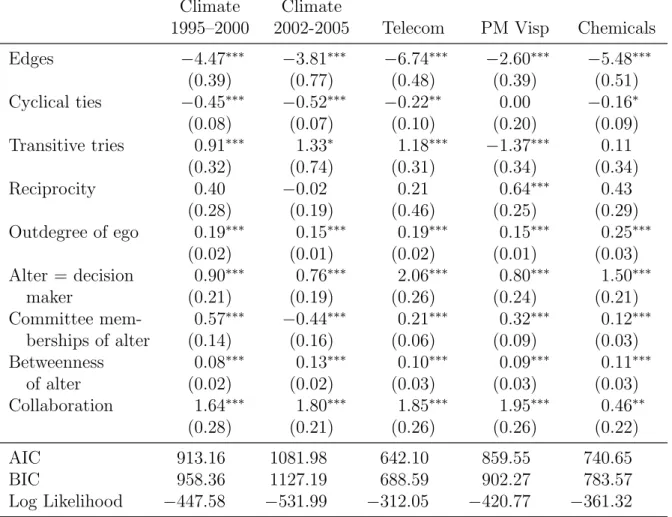
The main analysis is composed of five different static ERGMs, two for each of the two respective waves of the climate policy panel dataset and one for each remaining case study (see Table 2 for the coefficients and standard errors). A second analysis presents the results of the (S)TERGMs, which are based on the longitudinal climate policy case study.
Analysis of static network snapshots
The coefficients in Table 2 can be interpreted as log-odds ratios conditional on the rest of the network (Handcock et al. 2008). ERGMs follow a generative paradigm, which means that the interplay of the model terms is simulated and then compared to the empirically observed network in order to fit the model iteratively.
The edges term is similar to a constant in linear regression models and indicates the baseline likelihood of any dyad in the network to form a tie. Four of the five models show a negative coefficient for cyclical ties, while this term is not significant in the PM Visp case. The negative coefficients indicate the absence of cyclical ties, which is in line with the prediction that influence reputation is a hierarchical, acyclic social phenomenon—if A rates B as influential and B rates C as influential, then C is unlikely to rate A as influential, just like in formal hierarchies that are organized like “trees.” Four of the five models also show a positive coefficient (in one case significant) for transitivity, which is a complementary effect that captures the hierarchical structure. The reciprocity control is significant in one case, and the outdegree of ego control variable is significant in all cases. The more outgoing ties an actor has, the more likely the actor is to call any alter influential. Controlling for these structural and nodal terms allows for the substantive interpretation of the remaining coefficients.
Most importantly, in all five models we find a significantly positive effect of the be-tweenness centrality of alter in the collaboration network. In other words, the more alter tends to occupy a strategic position (from an information and resource control per-spective) in the policy network, the more likely it is that ego finds alter powerful. The betweenness scores were rescaled so that all scores in a network add up to 100 percent.
Climate Climate
1995–2000 2002-2005 Telecom PM Visp Chemicals Edges −4.47∗∗∗ −3.81∗∗∗ −6.74∗∗∗ −2.60∗∗∗ −5.48∗∗∗ (0.39) (0.77) (0.48) (0.39) (0.51) Cyclical ties −0.45∗∗∗ −0.52∗∗∗ −0.22∗∗ 0.00 −0.16∗ (0.08) (0.07) (0.10) (0.20) (0.09) Transitive tries 0.91∗∗∗ 1.33∗ 1.18∗∗∗ −1.37∗∗∗ 0.11 (0.32) (0.74) (0.31) (0.34) (0.34) Reciprocity 0.40 −0.02 0.21 0.64∗∗∗ 0.43 (0.28) (0.19) (0.46) (0.25) (0.29) Outdegree of ego 0.19∗∗∗ 0.15∗∗∗ 0.19∗∗∗ 0.15∗∗∗ 0.25∗∗∗ (0.02) (0.01) (0.02) (0.01) (0.03) Alter = decision 0.90∗∗∗ 0.76∗∗∗ 2.06∗∗∗ 0.80∗∗∗ 1.50∗∗∗ maker (0.21) (0.19) (0.26) (0.24) (0.21) Committee mem- 0.57∗∗∗ −0.44∗∗∗ 0.21∗∗∗ 0.32∗∗∗ 0.12∗∗∗ berships of alter (0.14) (0.16) (0.06) (0.09) (0.03) Betweenness 0.08∗∗∗ 0.13∗∗∗ 0.10∗∗∗ 0.09∗∗∗ 0.11∗∗∗ of alter (0.02) (0.02) (0.03) (0.03) (0.03) Collaboration 1.64∗∗∗ 1.80∗∗∗ 1.85∗∗∗ 1.95∗∗∗ 0.46∗∗ (0.28) (0.21) (0.26) (0.26) (0.22) AIC 913.16 1081.98 642.10 859.55 740.65 BIC 958.36 1127.19 688.59 902.27 783.57 Log Likelihood −447.58 −531.99 −312.05 −420.77 −361.32
Note: AIC, Akaike information criterion; BIC, Bayesian information criterion. ∗∗∗p <0.01,∗∗p <0.05,∗p <0.1.
Table 2: Cross-sectional ERGMs.
This allows them to be comparable and interpretable. Exponentiating the coefficients yields fairly similar results between the networks: if the betweenness centrality of alter is increased by one percent, the odds of establishing an influence reputation tie between ego and alter increase by roughly 8 percent in the first climate network, 14 percent in the second climate network, 11 percent in the telecommunications network, 9 percent in the PM Visp network, and 12 percent in the toxic chemicals policy network. Considering that the standard deviations of the betweenness scores range between 4.74 and 5.93 for the different networks, even moderate changes in the structural composition of the network could lead to large increases in the odds of establishing a tie. For example, if an alter in the second climate policy network were able to increase his or her strategic position by improving his or her betweenness score by one standard deviation (= 5.93 percent), the odds of ego calling alter influential would go up by roughly 116 percent. This anal-ysis reveals that the structural position an actor is able to acquire in the network is an important aspect of influence reputation.5
5As alternative model specifications, we tested the effects of indegree centrality and eigenvector cen-trality in the collaboration network (results reported in the Supplementary material; see Tables A7 and A8). Since the centrality measures are somewhat correlated, their effects work as substitutes rather than complementary mechanisms: including one centrality measure makes the other measure insignificant. Conclusions from these results show that organizations are deemed to be influential if they either have
The next relational model term is the presence of existing collaboration. Again, the effects are similar in magnitude across the five models (except for a lower value in the chemicals regulation model). An existing collaboration tie between ego and alter roughly quintuples (or doubles, in the last model) the odds of ego reporting alter as being particularly influential, compared to dyads where a collaboration tie does not exist. Two explanations come to mind: either this is a perceptual bias of ego, as actors may tend to perceive those whom they collaborate with as important because this increases their own importance. Or this may be a structural component of power because incoming collaboration ties are exponentially distributed (that is, collaboration edges tend to cluster together around the same targets), and if ego has such a tie to alter, it is likely that many others also collaborate with alter, which makes alter important. On the other hand, as mentioned above, controlling for the indegree of alter in the collaboration network only makes betweenness centrality insignificant, and not the collaboration effect, which would support the first interpretation of a perceptual bias. In any case, whether theoretically understood or not, this effect supports the earlier findings of Heaney (2014) and Fischer and Sciarini (2015), and its inclusion does not mitigate the theoretical mechanism we are mainly interested in: the betweenness centrality of alter as a structural component of power.
In addition to structural components, we are interested in the institutional aspects of influence reputation. If alter is a decision maker, the odds of alter being identified as particularly influential are more than doubled in all models (compared to cases where alter is not a decision-maker, irrespective of whether ego is a decision maker), and in the telecommunications and toxic chemicals models even more so. This suggests that institutional positions in these two regulatory policy domains are more important for the influence reputation of an actor than in the other policy domains. Taking a closer look at the mixing matrices of the decision-making dummy variable demonstrates that density is usually highest where both ego and alter are decision makers and is second-highest where only alter is a decision maker but not ego. Apparently, decision makers find one another particularly important (a homophily effect) but, independent of this observation, decision makers are also judged to be more influential than makers by non-decision-makers. The bottom line is that the ability to vote or give binding orders is an important component of reputation (in adversarial policy networks and collaborative settings), and this aspect of power is complementary to the structural aspects of power outlined above. It is therefore not premature to speak of a composite effect of structural and institutional power, or horizontal and vertical integration, into policy making.
Finally, institutional integration of an actor via membership in policy committees significantly increases the likelihood of it being rated as influential. Except for the outlier in the second climate politics branch (where potential membership in only one committee was recorded), an additional policy committee increases the odds of being tied by between 13 percent in the toxic chemicals policy domain (where the average number of committee memberships per actor is 6.00) and 77 percent in the first climate politics branch (where the average number of committee memberships per actor is only 0.56).
To sum up the empirical evidence so far, both structural and institutional compo-nents of influence reputation can be pinpointed. There is relatively little variation in the
many incoming collaboration ties (and are thus visible, as measured by indegree centrality); if they have incoming collaboration ties from other influential actors (as measured by eigenvector centrality); or if they occupy strategic gatekeeping positions in the collaboration network that would allow them to secure control over information or resource flows (as measured by betweenness centrality).
empirical findings across cases, which means that the substantive results hold for collab-orative and adversarial settings, and national as well as local-level case studies. However, a potential objection might be that causality may run in the opposite direction for at least some of the hypothesized relationships if the estimation of tie formation is based on a single snapshot of each observed network. In the following analysis, we therefore exploit the fact that two waves of the climate policy network were recorded and estimate a TERGM and a STERGM.
Longitudinal analysis of consecutive network snapshots
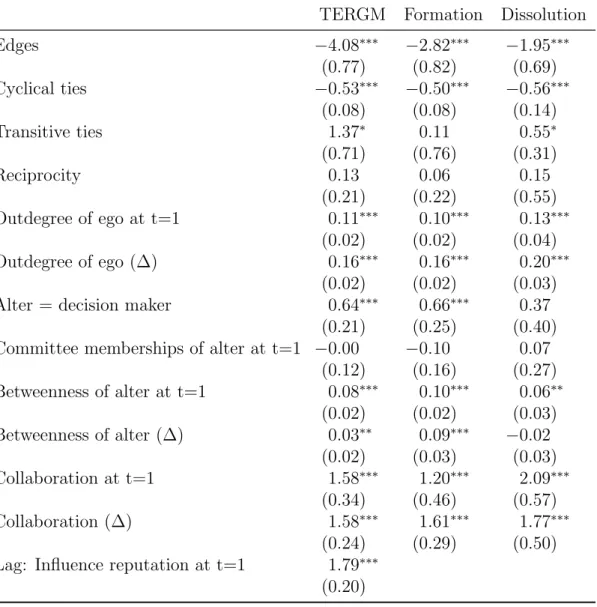
The first column of Table 3 shows a TERGM, which essentially reduces to an ERGM of the second time step with the first time step being used as a lagged covariate. All other interesting hypotheses are introduced into the model as lagged covariates and, additionally, in terms of their absolute changes between the first and the second time step (∆). This allows us to assess the direction of causality because causality can only go from the change of the covariate between t = 1 and t= 2 to dyadic influence reputation attribution att = 2, but not vice-versa. To achieve this, we control for the absolute level of the covariate at t = 1 and the reference likelihood of tie formation in the reputation network at t = 1. Due to the inclusion of the lagged network, this procedure entails that we now conceptualize policy making as a process that spans multiple years. This assumption is backed by the policy networks literature, which argues that policy networks are relatively stable, or “sticky,” informal arrangements (Leifeld and Schneider 2012).
The two remaining columns of Table 3 present the results of a STERGM, which estimates tie formation and tie dissolution between t = 1 and t = 2 in a single model. Coefficients are interpreted in a similar way as before, with two main differences: (1) a positive coefficient in the formation column means that the model term increases the odds that a new tie is established between the two time periods where a tie previously did not exist, while a negative coefficient means that the model term decreases the odds of establishing a new tie between the two time periods where a tie did previously not exist; and, (2) a positive coefficient in the dissolution column means that the model term increases the odds that an existing tie is kept, while a negative coefficient means that a model term decreases the odds of carrying an existing tie from time point 1 over to time point 2. Simply put, the formation column is about new influence reputation ties, while the dissolution column is about existing influence reputation ties. As the STERGM estimates tie formation and dissolution as a process, the lagged covariate from the TERGM cannot be incorporated.
Figure 2 shows the goodness of fit of the TERGM. The boxplots are the results of 100 simulations of the model, and the black lines represent the empirical climate policy network at t = 2. While the fit is moderate for the indegree distribution because the empirical network does not show any clear trends, the model is able to reasonably well reproduce the distribution of edge-wise shared partners, dyad-wise shared partners, and the shortest paths in the empirical network. Overall, the goodness of fit of the TERGM is relatively high.
The network at time point 1 has an effect on the network at time point 2, as indicated by the positively significant effect of the lagged reputation network in the TERGM in the first column. Influence ratings appear to be stable over time, which is an indicator that the data-generating process did not change between the two waves of data collection, unlike in other studies reported in the literature (e. g., Park and Rethemeyer 2014).
TERGM Formation Dissolution Edges −4.08∗∗∗ −2.82∗∗∗ −1.95∗∗∗ (0.77) (0.82) (0.69) Cyclical ties −0.53∗∗∗ −0.50∗∗∗ −0.56∗∗∗ (0.08) (0.08) (0.14) Transitive ties 1.37∗ 0.11 0.55∗ (0.71) (0.76) (0.31) Reciprocity 0.13 0.06 0.15 (0.21) (0.22) (0.55) Outdegree of ego at t=1 0.11∗∗∗ 0.10∗∗∗ 0.13∗∗∗ (0.02) (0.02) (0.04) Outdegree of ego (∆) 0.16∗∗∗ 0.16∗∗∗ 0.20∗∗∗ (0.02) (0.02) (0.03) Alter = decision maker 0.64∗∗∗ 0.66∗∗∗ 0.37
(0.21) (0.25) (0.40) Committee memberships of alter at t=1 −0.00 −0.10 0.07
(0.12) (0.16) (0.27) Betweenness of alter at t=1 0.08∗∗∗ 0.10∗∗∗ 0.06∗∗ (0.02) (0.02) (0.03) Betweenness of alter (∆) 0.03∗∗ 0.09∗∗∗ −0.02 (0.02) (0.03) (0.03) Collaboration at t=1 1.58∗∗∗ 1.20∗∗∗ 2.09∗∗∗ (0.34) (0.46) (0.57) Collaboration (∆) 1.58∗∗∗ 1.61∗∗∗ 1.77∗∗∗ (0.24) (0.29) (0.50) Lag: Influence reputation at t=1 1.79∗∗∗
(0.20)
∗∗∗p <0.01,∗∗p <0.05,∗p <0.1
Table 3: TERGM and STERGM Results for Swiss Climate Policy-Making Including Two Waves (1995–2000; 2002–2005).
Both the TERGM and the STERGM show that influence ratings are acyclic. The TERGM has a strongly negative coefficient for cyclical ties, which means that the config-uration A→B→C→A occurs significantly less than in a random graph. The STERGM provides more nuanced context for this finding: if a dyad is involved in a cyclical triad at
t= 1, between the time periods new ties are very unlikely to be established and, if a tie already exists in the context of a cyclical triad, it is likely to be discontinued at t = 2, further supporting the observation that influence as a social phenomenon is hierarchically structured. The other indicator of hierarchy, the transitive ties count, is not significant. It is, however, positive as expected. As in the cross-sectional case, there is no particular tendency for reciprocity, and the outdegree of ego has a positive and significant effect.
As for the structural components of reputation, the higher the betweenness centrality of alter in the collaboration network at t = 1, the more likely ego is to judge alter to be influential (TERGM)—even more so if ego has not done so before (STERGM, tie formation column). A one percent increase in the relative betweenness score of alter in the
0 3 6 9 12 15 18 21 24 27 0 50 100 150 200
Dyad−wise shared partners
Number of dyad−wise shared partners
Frequency 0 3 6 9 12 15 18 21 24 27 0 10 20 30 40 50 60 70
Edge−wise shared partners
Number of edge−wise shared partners
Frequency 1 2 3 4 5 6 Inf 0 100 200 300 400 500 600 Geodesic distance Geodesic distance Frequency 0 3 6 9 12 16 20 24 28 32 0 2 4 6 8 In−degree distribution In−degree Frequency
Figure 2: Goodness of Fit of TERGM.
previous time step (compared to other dyads) increases by 11 percent the odds that ego changes his or her mind between t= 1 and t = 2 and calls alter particularly influential. The persistence of positive reputation judgments is also slightly more likely than mere chance. This finding is in line with the study of Rethemeyer and Hatmaker (2008) on the effect of the internet on policy processes, where actors who were already entrenched in positions of structural power within the network possessed very high reputational ratings. Most interestingly, we can estimate a separate effect of the change of betweenness centrality between t = 1 and t = 2, which can be interpreted on top of the absolute betweenness effect of t = 1: actors are very sensitive to structural changes in their sur-rounding policy network. Having controlled for betweenness and reputation ties att = 1, absolute changes in betweenness between t = 1 and t= 2 significantly increase the like-lihood of a reputation tie (in the TERGM). This longitudinal perspective demonstrates that influence not only places actors in more central positions, but occupying strategically more advantageous positions (assessed through betweenness centrality) makes actors to be perceived as more influential over time.
Moreover, if ego did not deem alter to be particularly influential at t = 1, but alter’s betweenness centrality increased from t = 1 to t = 2, then ego is likely to judge alter as particularly influential at t = 2 (formation column). For each additional betweenness centrality percentage point gained between t = 1 and t = 2, ego’s odds of calling alter
influential go up by roughly 9 percent. This reactivity of actors to changes in the be-tweenness of their peers is independent of the absolute level of the structural ability of these peers in terms of betweenness centrality.
There are similar findings for dyadic collaboration. Collaboration between ego and alter at t = 1 forms a reputation tie at t = 2 (TERGM column), as well as making the formation of a tie between t = 1 and t = 2 (formation column) more likely and tie dissolution less likely (or tie persistence more likely, see the dissolution column). On top of this cross-temporal baseline effect, the absolute change in collaboration from t = 1 to
t= 2 (−1 = stopped to collaborate, 0 = no change, +1 = started to collaborate) can also explain tie presence at t = 2, as well as tie formation and tie persistence. All of these effects are highly significant. If a collaboration tie emerges between ego and alter from
t= 1 to t= 2, this boosts tie formation of influence attribution (in case there was no tie at t= 1) or causes ego to carry over his or her positive reputation evaluation of alter to
t= 2 (in case there was a tie at t= 1).
As for the institutional components of power, irrespective of ego’s type, decision mak-ers are prominently associated with influence. The STERGM further reveals that altmak-ers who are decision makers are likely to be judged as influential at t = 2 if they were not judged to be influential att = 1. Existing influence attributions towards decision-makers at t = 1, by contrast, are neither significantly retained nor significantly removed. This is in line with the findings of the cross-sectional models. Committee memberships are also consistent with the cross-sectional climate case studies—there was contradictory evi-dence for the two waves, and there is therefore no significant tendency in the longitudinal model.
Summarizing these findings, there is substantial longitudinal (and hence causal6)
ev-idence that influence reputation is composed of structural and institutional elements. In particular, the structural components of influence reputation, such as betweenness cen-trality and dyadic collaboration, can be consistently interpreted: when the structural conditions are present or pronounced, reputation ties are likely, and when they emerge or disappear, reputation ties emerge or disappear as well. Actors appear to be very sensitive to other actors who achieve better network positions over time. Put differently, ego is particularly likely to regard alter as influential if alter has recently managed to occupy a network position where he or she can control more information or other resources than previously (as identified in the models through higher betweenness centrality scores). This adds to our knowledge about structural aspects of power, because being perceived as influential is not only about being central in absolute terms, but also about becoming more central rather than more peripheral in relative terms. Collaboration between ego and alter behaves in a similar way and is a complementary predictor of reputation (for-mation). More (less) collaboration over time leads to a greater (lower) likelihood of ego rating alter as particularly influential. On the other hand, the evidence for the institu-tional components—operainstitu-tionalized by formal decision-making power and participation in political committees—is mixed: while formal authority is a clear predictor across all case studies, institutional committee memberships seem to play a role in all but one case study (which may be due to the fact that only one committee was available at the time).
6True causal analysis is only possible by conducting experiments. The longitudinal design employed here, however, comes as close to causal inference as possible with survey data.
Conclusion
What have we learned from studying the determinants of influence reputation in detail? First and foremost, we have been able to deconstruct power into two separate but com-plementary components: an institutional element and a structural element, which are not substitutable. These two drivers of influence reputation correspond to political actors’ vertical integration into the political system by means of formal authority and horizontal integration into policy-making or implementation through informal collaborations.
Our finding adds to the existing literature on influence reputation by demonstrating how power is shaped by systemic structural features, in addition to the local dyadic patterns (like collaboration or actor homophily) or nodal attributes (like formal authority) identified by previous research (in particular Heaney 2014 and Fischer and Sciarini 2015). By only focusing on institutionalized decision-making power or local network effects (such as joint participation in venues, stages or phases)—without incorporating the second, structural-systemic dimension of political power—our understanding of why some actors are more successful than others at influencing policy-making and implementation would be incomplete. The broader significance of our findings is that we have explained how an important intervening variable in the explanation of political outcomes comes about.
These results are valid across several types of networks at different levels. On the one hand, political actors in adversarial policy networks can gain influence reputation by occupying structural holes (horizontal integration). Actors with formal authority or with access granted to formal decision-making venues are (perceived as) more influential (verti-cal integration). On the other hand, this research has similar managerial implications for collaborative and implementation networks: public managers and officials with binding decision-making rights are (perceived as) more influential in the negotiation or imple-mentation process (vertical integration), and these actors can gain additional influence reputation by occupying structural holes in the network (horizontal integration).
The institutional and structural composition of political influence is also relevant to other subfields of public administration and political science. First, in addition to knowl-edge, professionalism and expertise, the structural position in collaborative networks might also matter for the development of leadership abilities (see also Zhang and Feiock 2010). Future research may shed light on the link between structural and institutional variables and the leadership skills of public managers. Second, this paper also contributes to the literature on collective action problems and confirms that actors can expect a pay-off from participation in networks: results show that actors who want to be perceived as influential might want to occupy structural holes and establish ties with disconnected others (Burt 1992). Third, there are implications for macro-comparative political re-search. Comparative politics has long been content with analyzing institutional variation between political systems as determinants of cross-national policy variation, largely ne-glecting structural variation. The results reported here suggest that institutional macro variables like corporatism vs. pluralism (Streeck and Schmitter 1985), the number of veto players (Tsebelis 2002) or consensual versus majoritarian politics (Lijphart 1999) may not sufficiently capture the integration of informal gatekeepers into policy making or implementation. The distribution of structurally relevant positions among state and non-state actors beyond crude measures like a corporatism dummy variable is likely to add explanatory power to the analysis of political outcomes in national or cross-sectoral perspectives. Future research should try to find clever ways to accommodate this variable at a lower cost than previous and current policy network studies, and test
whether the horizontal integration of non-state actors is sufficiently captured by existing macro variables like corporatism.
Future research should also try to disentangle whether the structurally advantageous positions of political actors—gatekeepers or brokers—are the result of strategic, rational behavior (Ingold and Varone 2011), or whether these positions are a byproduct of other processes that may be going on between actors.
Moreover, there is one further limitation that future research may try to overcome. While the results seem to be valid across decision-making and implementation contexts, and in local as well as national settings, all of the case studies conducted here are based on data from consensual political systems: Switzerland and Germany. There is evidence that policy networks also operate in majoritarian settings like Great Britain (Marsh and Rhodes 1992) and the United States (Laumann, Knoke and Kim 1985), but whether influence reputation can be similarly deconstructed into an institutional and a structural component in these polities remains an unanswered question.
Finally, the research presented here touches upon deep normative questions related to democratic legitimacy. Should a democratic society prefer a system where power is concentrated in state actors that can be held accountable and were legitimized through elections? Or should a democratic society prefer a system where power is distributed across the civil society and in polycentric governance arrangements (Ostrom 2010), which may lead to checks and balances and opportunities for control and participation, but at the expense of formal accountability and procedural legitimacy? Mayntz (1993) argues that policy networks as a new horizontal mode of governance are a response to an “esca-lating functional differentiation of social subsystems” due to social modernization. Our results indicate that policy networks do actually fulfill this horizontally differentiated role and integrate non-state actors into the inner power structure of the polity. They are not merely a “metaphor” (Dowding 1995; Pappi and Henning 1998); policy networks as a “new mode of governance” (B¨orzel 1998) and their relevance for political outcomes can indeed be pinpointed by the “methodological toolbox” (Kenis and Schneider 1991) of social network analysis—policy networks do seem to matter, even in the originally metaphorical sense. What remains unanswered is the question whether this is beneficial or detrimental to the welfare of a society, and whether we can steer these developments in the sense of a second-order governance of governance arrangements (Kooiman 1999).
References
Andrews, Rhys, George A. Boyne, Kenneth J. Meier, Laurence J. O’Toole and Richard M. Walker. 2005. “Representative Bureaucracy, Organizational Strategy, and Public Ser-vice Performance: An Empirical Analysis of English Local Government.” Journal of
Public Administration Research and Theory 15(4):489–504.
Barro, Robert J. 1973. “The Control of Politicians: An Economic Model.” Public Choice
14(1):19–42.
Baumgartner, Frank R. and Beth L. Leech. 2001. “Interest Niches and Policy Bandwag-ons: Patterns of Interest Group Involvement in National Politics.”Journal of Politics
63(4):1191–1213.
Baumgartner, Frank R. and Bryan D. Jones. 1991. “Agenda Dynamics and Policy Sub-systems.”The Journal of Politics 53(4):1044–1074.