www.elsevier.com/locate/jcss
First-order query rewriting for inconsistent databases
Ariel Fuxman
∗, Renée J. Miller
Department of Computer Science, University of Toronto, Canada
Received 23 January 2006; received in revised form 11 July 2006 Available online 11 December 2006
Abstract
We consider the problem of retrieving consistent answers over databases that might be inconsistent with respect to a set of integrity constraints. In particular, we concentrate on sets of constraints that consist of key dependencies, and we give an algorithm that computes the consistent answers for a large and practical class of conjunctive queries. Given a queryq, the algorithm returns a first-order queryQ(called aquery rewriting) such that for every (potentially inconsistent) databaseI, the consistent answers forq can be obtained by evaluatingQdirectly onI.
©2006 Published by Elsevier Inc.
Keywords:Consistent query answering; Inconsistent data; Uncertain data
1. Introduction
Consistent query answering is the problem of retrieving “consistent” answers over databases that might be incon-sistent with respect to a set of integrity constraints. Applications that have motivated the study of this problem include data integration and data exchange. Data integration is the problem of providing a unified view of data residing at different sources [11]. Data exchange is the problem of restructuring data residing under a source schema and creating an instance of a target schema that best represents the source data [7]. In both contexts, it is often the case that the source data does not satisfy the integrity constraints of the global or target schema. The traditional approach to deal with this situation involves “cleaning” the source instance in order to remove data that violates the target constraints. However, data cleaning is supported by semi-automatic tools at best, and it is necessarily a human-labor intensive process. An alternative approach would be to exchange an inconsistent instance, and employ the techniques of consis-tent query answering to resolve inconsistencies at query time. Of course, this approach becomes viable only if efficient tools for consistent query answering are available. In this paper, we present a number of results that are a step in this direction.
In addition to these long-standing problems, the trend toward autonomous computing is making the need to manage inconsistent data more acute. In autonomous environments, we can no longer assume that data are defined by a single set of constraints that represent their semantics. As constraints are used in an increasing number of roles (from modelling the query capabilities of a system, to defining mappings between independent sources), there is an
* Corresponding author.
E-mail addresses:[email protected] (A. Fuxman), [email protected] (R.J. Miller). 0022-0000/$ – see front matter ©2006 Published by Elsevier Inc.
increasing number of applications in which data must be used with a set of independently designed constraints. In such applications, a static approach where consistency (with respect to a fixed set of constraints) is enforced by cleaning the database may not be appropriate. Rather, a dynamic approach in which data is not changed, but consistency is taken into account at query time, permits the constraints to evolve independently from the data.
The input to the consistent query answering problem is: a schemaR, a setΣof integrity constraints, and a database instanceIoverR. The databaseImight beinconsistent, in the sense that it might violate some of the constraints ofΣ. In this work, we draw upon the concept ofrepairs, defined by Arenas et al. [1], to give semantics to the problem. A repairIofI is an instance ofRsuch thatIsatisfies the integrity constraints ofΣ, andIdiffers minimally fromI
(where minimality is defined with respect to the symmetric difference betweenIandI). Under this definition, repairs need not be unique. Intuitively, each repair corresponds to one possible way of “cleaning” the inconsistent database.
The notion of repairs is used to give semantics to consistent query answering in the following way. Given an instanceI, a tuplet is said to be aconsistent answerforq onI ifI|=q[t],for everyrepairI ofI. This concept is similar to that ofcertain answersused in the context of data integration [2], but for consistent answers the set of possible worlds are the repairs of the inconsistent database, rather than the legal instances of a global database.
In this work, we focus on sets of integrity constraints that consist of key dependencies. The most commonly used constraints in database systems are keys and foreign keys. Of these, keys pose a particular challenge since instances that are inconsistent with respect to a set of key dependencies admit an exponential number of repairs in the worst case. This potentially large number of repairs leads to the question of whether it is possible to compute consistent answers efficiently. The answer to this question is known to be negative in general [4,6]. However, this does not necessarily preclude the existence of classes of queries for which the problem is easier to compute. Hence, we consider the following question: for what queries is the problem of computing consistent answers in polynomial time (in data complexity)?
In general, given a queryq, it does not suffice to evaluateqdirectly on a (possibly inconsistent) instanceI in order to get the consistent answers. Therefore, a related question is: does there exist some other queryQsuch that for every instanceI, the consistent answers forq can be obtained by just evaluatingQonI? IfQis a first-order query, we say thatq isfirst-order rewritable. Since first-order queries can be written in SQL, if the query is first-order rewritable, then its consistent answers can be retrieved (at query time) using existing commercial database technology. Given the desirability of such an approach, we consider the question of identifying classes of queries that are first-order rewritable.
1.1. Summary of results
The main contribution of this paper is an algorithm that produces a first-order query rewriting for the problem of computing consistent answers. The algorithm, which is presented in Section 3, runs in linear time in the size of the query. We prove the correctness of the algorithm for a large class of conjunctive queries. The class is defined in terms of thejoin graphof the query. The join graph is a directed graph such that: its vertices are the literals of the query; and it has an arc for each join in the query that involves some variable that is at the position of a nonkey attribute. Our algorithm works for conjunctive queries without repeated relation symbols (but with any number of literals and variables) whose join graph is acyclic. The queries may have projections (that is, existentially-quantified variables), which pose a particular challenge in the context of consistent query answering. In Section 3, we argue that the class that we handle is broad enough to include many queries that arise in practice.
In Section 4, we show that the class of queries considered in Section 3 is in fact a maximal class of queries, in the sense that minimal relaxations of its conditions lead to intractability. We then embark on a more ambitious goal: we present a class of queries for which the conditions of applicability of the algorithm (which can be verified in polynomial time in the size of the query) are necessary and sufficient. That is, we show a class such that the problem of computing the consistent answers is coNP-complete for everyquery of the class whose join graph has a cycle. Notice that this type of result is much stronger than the usual approach taken in the consistent query answering literature, which consists of showing intractability of a class by exhibitingat least onequery for which the problem is intractable. As a corollary of our result, we get a dichotomy for this class of queries: given a queryq in our class, either the problem of computing the consistent answers forq is first-order rewritable (and thus it is in PTIME), or it is a coNP-complete problem.
2. Formal framework
AschemaRis a finite collection of relation symbols, each of which has an associated arity. A set ofintegrity con-straintsΣ consists of sentences in some logical formalism overR. AninstanceI overRis a function that associates to each relation symbolR ofRa relationI (R). Given a tuplet occurring in relationI (R), we denote byR(t )the association betweentandR. An instanceI isconsistentwith respect to a set of integrity constraintsΣifI satisfies
Σin the standard model-theoretic sense, that isI|=Σ.
We adopt a semantics for consistent query answering that was originally introduced by Arenas et al. [1], and relies upon the concept ofrepairs. A repair is an instance that satisfies the integrity constraints, and which has a minimal distance to the inconsistent database. Thedistancebetween two database instancesI andI is defined as their symmetric difference, i.e.,(I, I)=(I−I)∪(I−I ). The formal definition of repair is the following.
Definition 1(Repair [1]).LetIbe an instance. We say that an instanceIis arepairofI with respect toΣif1:
• I|=Σ, and
• there is no instanceIsuch thatI|=Σ and(I, I)⊂(I,I)(i.e.,(I,I)is minimal under set inclusion in the class of instances that satisfyΣ).
Example 1.LetRbe a schema with one relation symbolR. Assume thatRhas two attributes:E(Employee) andS
(Salary), and that the only constraint inΣis that attributeEis the key ofR. LetI= {R(John,1000), R(John,2000), R(Mary,3000)}. We can see thatI is inconsistent with respect toΣ. In particular, there is uncertainty about what John’s salary is. There are two repairs:I1= {(John,1000), (Mary,3000)}andI2= {(John,2000), (Mary,3000)}.
We use the term “repair,” as opposed to “minimal repair,” because it is standard in the literature [1]. However, no-tice that, by definition, all repairs have a minimal distance to the inconsistent database. For example, the instances {(John,2000)}and{(Mary,3000)}are not repairs because their distance with respect toI is not minimal under set inclusion. The minimality condition for the repairs is crucial in the definition. Otherwise, the empty set would trivially be a repair of every instance.
The semantics for query answering is given in terms ofconsistent answers[1], which we define next.
Definition 2(Consistent answer [1]).LetRbe a schema. LetΣbe a set of integrity constraints. LetI be an instance over R(possibly inconsistent with respect to Σ). Let q(z) be a query overR. We say that a tuple t is a consis-tent answer for q with respect to Σ ifI |=q[z/t], for every repairI of I with respect to Σ. We denote this as
t∈consistentΣ(q, I ).
Example 1(continued).Letq1(e)= ∃s.R(e, s). The consistent answers forq1onI are the tuples(John)and(Mary).
Letq2(e, s)=R(e, s). The only consistent answer forq2 onI is(Mary,3000). Notice that the tuples(John,1000)
and(John,2000)are not consistent answers. The reason is that neither of them are present inbothrepairs. Intuitively, this reflects the fact that John’s salaries are inconsistent data.
For convenience, we will use the following notation for the consistent answers of Boolean queries.
Definition 3.LetRbe a schema. Let Σ be a set of integrity constraints. LetI be an instance overR. Letq be a Boolean query overR. We say thatconsistentΣ(q, I )=trueif for every repairIof I with respect toΣ,I|=q. We say thatconsistentΣ(q, I )=falseif there existsat least onerepairIofI with respect toΣsuch thatI |=q.
Notice the asymmetry between the case forconsistentΣ(q, I )=trueandconsistentΣ(q, I )=false. While, for the former, every repair must satisfy the query, for the latter it suffices to have just one non-satisfying repair. This is not intrinsic to Boolean queries: by Definition 2, it is also the case thatt /∈consistentΣ(q, I )if there exists at least one repairIsuch thatI |=q[t].
We will denote the problem of computing consistent answers asCONSISTENT(q, Σ ), and define it as follows.
Definition 4.LetRbe a schema. Letqbe a query overR. LetΣbe a set of integrity constraints. Theconsistent query answering problemCONSISTENT(q, Σ )is the following: given an instanceI overR, and tuplet, is it the case that
t∈consistentΣ(q, I )?
We will design an algorithm that computes consistent answersdirectly from the inconsistent database, without explicitly building the repairs. In fact, given a queryq, the algorithm will return a first-order queryQsuch that, for every instanceI, the consistent answers forqcan be obtained by just evaluatingQonI. We callQafirst-order query rewriting, and define it next.
Definition 5 (First-order query rewriting).LetRbe a schema. LetΣ be a set of integrity constraints. Letq(z) be a query overR. We say that the problemCONSISTENT(q, Σ )isfirst-order rewritableif there is a first-order query
Qsuch thatI|=Q[z/t]ifft∈consistentΣ(q, I ), for every instance I overR. We also say thatQis afirst-order rewritingofCONSISTENT(q, Σ ).2
Notice that ifCONSISTENT(q, Σ )is first-order rewritable, then it is tractable. This is because the data complexity of first-order logic is in PTIME (in fact, inAC0, which is a subset of PTIME). Thus, it can be tested in polynomial time whetherI|=Q[z/t]. Besides this, an approach based on query rewriting is attractive because first-order queries can be written in SQL. Therefore, if the query is first-order rewritable, the consistent answers can be retrieved using existing database technology.
Throughout the paper, we will assume that the setΣ of integrity constraints consists of one key dependency per relation of the schema, where a key may consist of many attributes (in particular, it may contain all attributes). To facilitate specifying the set of constraints each time that we give a query, we will underline the positions in each literal that correspond to key attributes. Furthermore, by convention, the key attributes will be given first. For example, the queryq= ∃x, y, z.R1(x, y)∧R2(y, z)indicates that literalsR1andR2represent binary relations whose first attribute
is the key. We will use vector notation (e.g.,x,y) to denote vectors of variables or constants from a query or tuple. In addition, when we give a tuple, we will underline the values that appear at the position of key attributes. For instance, for a tupleR(c, d), we will say thatcis akey value, anddis anonkey value. Using this notation, the key constraints ofΣthat are relevant to the query are denoted directly in the query expression.
The results in this paper concern (classes of) conjunctive queries. We will adopt the convention of usingxto denote variables and constants that appear at the position of key attributes, andyfor variables and constants that appear at the position of nonkey attributes. Thus, conjunctive queries will be of the form:
q(z1, . . . , zl)= ∃w1, . . . , wm.R1(x1,y1)∧ · · · ∧Rn(xn,yn)
wherew1, . . . , wm, z1, . . . , zl are all the variables that appear in the literals ofq. We will say thatz1, . . . , zmare the free variables ofq. Notice that even though there are no equality symbols inq, their effect is achieved by having variables that appear inq more than once. The queries may also contain constants, which we will denote with bold letters from the beginning of the alphabet (e.g.,aandb). We will say that there is ajoinon a variablewifwappears in two literalsRi(xi,yi)andRj(xj,yj)such thati =j. Ifwoccurs inyiandyj, we say that there is anonkey-to-nonkey joinonw; ifwoccurs inyi andxj, we say that there is anonkey-to-key join; and ifwoccurs inxi andxj, we say that there is akey-to-key join.
Throughout the paper, we will focus on the class of conjunctive querieswithout repeated relation symbols. A con-junctive query without repeated relation symbols is a concon-junctive query such that every relation symbol of the schema appears in q at most once. Notice that, in spite of this restriction, the query can still have any arbitrary number of literals and relation symbols, and there are no constraints on the occurrence of variables in the query.
3. A query rewriting algorithm 3.1. A class of tractable queries
The problem of computing consistent answers for conjunctive queries over databases that might violate a set of key constraints is known to be coNP-complete in general [4,6]. This is the case even for queries with no repeated relation symbols, which is the focus of this section. However, this does not necessarily preclude the existence of classes of queries for which the problem is easier to compute. In fact, in this section we characterize a large and practical class of conjunctive queries for which the problem of computing consistent answers is indeed tractable. Even more so, we show that all queries in this class are first-order rewritable, and we give a linear-time algorithm that computes the first-order rewriting.
Before presenting the tractable class, let us consider the following queries for which the problem of computing consistent answers is coNP-complete, as will be shown in Section 4:
• q1= ∃x, x, y.R1(x, y)∧R2(x, y),
• q2= ∃x, y.R1(x, y)∧R2(y, x),
• q3= ∃x, x, w, w, z, z, m.R1(x, w)∧R2(m, w, z)∧R3(x, w)∧R4(m, w, z).
The queries presented above are rare in practice. The first consists of a join betweennonkeyattributes; the second involves a cycle; and the third, a join with part, but not the entire key of a relation. We use these queries to provide insight into when a query is intractable. In particular, we will show in Section 4 a class of queries for which the presence of cycles and nonkey-to-nonkey joins are in fact necessary and sufficient conditions for intractability. Notice that such conditions are concerned with the joins in the query where at least one nonkey variable is involved. In order to define such conditions precisely, we will state them in terms of what we call thejoin graphof the query.
Definition 6(Join graph).Letqbe a conjunctive query. Thejoin graphGofq is a directed graph such that: • the vertices ofGare the literals ofq;
• there is an arc fromRi toRj ifi =j, and there is some variablewsuch thatwis existentially-quantified inq,
woccurs at the position of a nonkey attribute inRi, andwoccurs inRj.
Notice that the free variables of a query do not introduce arcs to the join graph. As a special case, if all the variables of a query are free, then its join graph has no arcs. Queries without existentially-quantified variables correspond to the class ofquantifier-freequeries, and have already been shown to be first-order rewritable [1]. Handling queries with existentially quantified variables (that is, projections), is one of the main challenges addressed in our work.
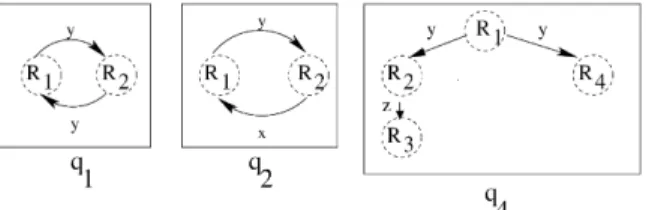
As we can see in Fig. 1, the join graphs ofq1andq2have a cycle. Since computing consistent answers for these
two queries is coNP-hard, we will focus on queries whose join graph is acyclic. For example, the join graph of the following query is acyclic. The graph is shown in Fig. 1,
q4(w)= ∃x, y, z.R1(x, y)∧R2(y, z)∧R3(z, w)∧R4(y,a).
Additionally, when we consider how two relations,R1 andR2, are joined, we will require that if any of the key
attributes ofR1are joined with a nonkey attribute ofR2, then all of the key attributes ofR1join with nonkey attributes
ofR2. We will then say that the query hasfull nonkey-to-key joins. For example, all the nonkey-to-key joins of query
q4are full. On the other hand, in the query
q3= ∃x, x, w, w, z, z, m.R1(x, w)∧R2(m, w, z)∧R3(x, w)∧R4(m, w, z)
the joins betweenR1andR2, and betweenR3andR4, are not full since they do not involve the entire key ofR2and
R4, respectively.
Definition 7.Letq be a conjunctive query. LetRi(xi,yi)andRj(xj,yj)be a pair of literals ofq. We say that there is afull nonkey-to-key joinfromRi toRjif every variable ofxj appears inyi.
We observe that ifGis an acyclic join graph for a query all of whose nonkey-to-key joins are full, thenGmust be a forest. We show this with the following proposition.
Proposition 1.Letqbe a query all of whose nonkey-to-key joins are full. LetGbe the join graph ofq. IfGis acyclic, thenGis a forest.
Proof. Assume towards a contradiction thatGis a directed acyclic graph that is not a tree. Then, there is a nodevin
Gthat receives arcs from two different nodesvi andvj ofG. LetR(x , y),Ri(xi,yi), andRj(xj,yj)be the literals at the nodes ofv,vi, andvj, respectively. Since there are arcs fromviandvjtov, there are variableswiandwj inyi andyj, respectively, that appear inR. SinceGis acyclic,wi andwj must appear inx. Also,wj cannot appear in a nonkey position ofRi(or, otherwise, there would be a cycle between the nodesviandvj). Since there is a nonkey-to-key join fromRi toR on variablewi, and variablewj does not occur at a nonkey position ofRi, the join is not full; contradiction. 2
We will give an algorithm for queries with an acyclic join graph and all of whose nonkey-to-key joins are full. It follows from the previous proposition that the join graph of such queries will always be a forest. We call the class of such queriesCforest, and define it next.
Definition 8.Letq be conjunctive query without repeated relation symbols and all of whose nonkey-to-key joins are full. LetGbe the join graph ofq. We say thatq∈CforestifGis a forest (i.e., every connected component ofGis a tree).
A fundamental observation aboutCforestis that it is a very common, practical class of queries. Arguably, the most used forms of joins are from a set of nonkey attributes of one relation (which may be a foreign key)3to the key of another relation (which may be a primary key). Furthermore, such joins typically involve theentireprimary key of the relation (and, hence, they are full joins in our terms). Finally, cycles are rarely present in the queries used in practice. Admittedly, the restriction not to have repeated relation symbols does rule out some common queries (those in which the same relation appears twice in theFROMclause of an SQL query). Still, many queries used in practice do not have repeated relation symbols.
3.2. Algorithm
The following examples highlight some of the intuition underlying our query rewriting algorithm.
Example 2.Letq= ∃x.R1(x,a). First of all, notice thatq itself is not a query rewriting ofCONSISTENT(q, Σ ).
Consider instanceI1= {R1(c1, a), R1(c1, b)}. It is easy to see that I1|=q. However,consistentΣ(q, I1)=false
because the repairI= {R1(c1, b)}is such thatI |=q. Now, considerI2= {R1(c1, a), R1(c1, b), R1(c2, a)}. It is easy
to see thatconsistentΣ(q, I2)=true. This is because there is a key value inR1(c2in this case) that appears with
a as its nonkey value, and does not appear with any other constanta such thata =a. This can be checked with
a formulaQconsist(x)= ∀y.R1(x, y)→y=a. In fact, we will show that a query rewritingQforqcan be obtained
as the conjunction ofqandQconsist:
Q= ∃x.R1(x,a)∧ ∀y.R1(x, y)→y=a.
Example 3. Let q = ∃x, y, z.R1(x, y)∧R2(y, z). As in the previous example, q itself is not a query rewriting
ofCONSISTENT(q, Σ ). Consider the instanceI1= {R1(c1, d1), R1(c1, d2), R2(d1, e1)}. It is easy to see thatI1|=q.
However,consistentΣ(q, I1)=falsebecause the repairI= {R1(c1, d2), R2(d1, e1)}is such thatI |=q. Now,
con-siderI2= {R1(c1, d1), R1(c1, d2), R2(d1, e1), R2(d2, e2)}. It is easy to see thatconsistentΣ(q, I2)=true. This is
becauseeverynonkey value that appears together withc1in some tuple (in this case, d1 andd2) joins with a tuple
ofR2. This can be checked with a formulaQconsist(x)= ∀y.R1(x, y)→ ∃z.R2(y, z). We will soon show that a query
rewritingQforqcan be obtained as the conjunction ofqandQconsist, as follows:
Q= ∃x, y, z.R1(x, y)∧R2(y, z)∧ ∀y.
R1(x, y)→ ∃z.R2(y, z)
.
We now proceed to presentRewriteConsistent, our query rewriting algorithm (shown in Figs. 2–4). Given a query q such that q ∈Cforest and a set of key constraints Σ (containing one key per relation), the algorithm
RewriteConsistent(q, Σ )returns a first-order rewritingQfor the problem of obtaining the consistent answers
forq with respect toΣ. The main body of the algorithmRewriteConsistentis shown in Fig. 2. The first-order rewritingQthat it returns is obtained as the conjunction of the input queryq, and a new query calledQconsist. The queryQconsistis used to ensure thatq is satisfied ineveryrepair (and, hence,consistentΣ(q, I )=true). It is im-portant to notice thatQconsist will be applied directly to the inconsistent database (i.e., we will never generate the repairs). The queryQconsistis obtained by recursion on the tree structure of each of the components of the join graph ofq (recall that sinceq∈Cforest, the join graph is a forest). The recursive algorithm is calledRewriteTree, and is shown in Fig. 3.
The first part ofRewriteTreeproduces a rewritingQlocalfor the literalR(x , y) at the root of the tree. This rewriting is done independently of the rest of the query, and it is produced by the algorithmRewriteLocal. We show this algorithm in Fig. 4. The queryQlocal deals with the constants that appear iny in the same way as we illustrated in Example 2. It also deals with the free variables of the query, as we show in the next example.
Example 4.Consider the queryq(y)= ∃x.R1(x, y). Notice that the only difference with the query of Example 2
is that the constantais replaced by the free variabley. The algorithmRewriteLocalcreates a new, universally-quantified variableyfory, and equatesytoy. The resulting query rewriting forq is the following:
Q(y)= ∃x.R1(x, y)∧ ∀y.R1(x, y)→y=y.
AlgorithmRewriteConsistent(q, Σ )
Input:q(z), a query of the form∃ w.φ(w, z)
Σ, a set of key constraints, one per relation used inq
LetGbe the join graph ofq
LetT1, . . . , Tmbe the connected components ofG fori:=1 tomdo
LetRi(xi,yi)be the literal at the root ofTi Letφi be the conjunction of literals ofTi
Letwi = {w: wis a variable that occurs inφi andw, andw /∈ xi} Letzi= {z: zis a variable that occurs inφiandz, andz /∈ xi} Letqi(xi,zi)= ∃ wi.φi(xi,wi,zi) LetQi(xi,zi)=RewriteTree(qi, Σ ) end for LetQconsist(w, z)= i=1,...,mQi(xi,zi) LetQ(z)= ∃ w.(φ(w, z) ∧Qconsist(w, z)) returnQ
AlgorithmRewriteTree(q, Σ )
Input:q(x, z), a query inCforest of the form∃ w.φ(x, w, z),
whose join graphT is a tree with root literalR(x , y) Σ, a set of key constraints, one per relation
LetT be the join graph ofq
LetR(x , y) be the literal at the root node ofT
Letqlocal(x, z)= ∃ w.R(x , y)
LetQlocal(x, z)=RewriteLocal(qlocal, Σ )
ifφhas exactly one literalthen
Q=Qlocal
else
LetR1(x1,y1), . . . , Rm(xm,ym)be the children ofRinT fori:=1 tomdo
LetTibe the subtree ofT rooted atRi Letφi be the conjunction of literals ofTi
Letwi= {w: wis a variable that occurs inφi andw, andw /∈ xi} Letzi= {z: zis a variable that occurs inφiandz, andz /∈ xi} Letqi(xi,zi)= ∃ wi.φi(xi,wi,zi)
LetQi(xi,zi)=RewriteTree(qi, Σ ) end for
Lety0= {y: yis a variable that occurs inyandw, andy /∈ x}
LetQ(x, z)=Qlocal(x, z)∧ ∀y0.R(x, y) →
i=1,...,mQi(xi,zi) end if
returnQ
Fig. 3. Recursive algorithm on the tree structure of the join graph.
The second part of RewriteTree recursively creates a query Qi for each subtree Ti of T rooted atR. Let
y0 be the variables at nonkey positions ofR (excluding those that also appear in x). Then, one of the conjuncts
of the rewritten query returned byRewriteTreeis of the form∀y0.R(x, y) →i=1,...,mQi(xi,zi). Notice that thevariables ofy0(i.e., the variables at nonkey positions of the root literalR) are universally quantified. The intuition
behind this is that, as we illustrated in Example 3, the query must be satisfied by all the nonkey values of a given key. The next example illustrates an application of the algorithm.
Example 5.Letq be the queryq4introduced in Section 3.1,
q(w)= ∃x, y, z.R1(x, y)∧R2(y, z)∧R3(z, w)∧R4(y,a).
The join graph T of q is shown in Fig. 1. In this case,T consists of one connected component, which is a tree. Let q1 be the query q1(x, w)= ∃y, z.R1(x, y)∧R2(y, z)∧R3(z, w)∧R4(y,a); letq2 be the query q2(y, w)=
∃z.R2(y, z)∧R3(z, w); let q3 be the queryq3(z, w)=R3(z, w); and let q4(y)=R4(y,a). The first-order query
rewritingQofqis obtained by applying the algorithmRewriteConsistent(q, Σ )as follows:
Q(w)=RewriteConsistent(q, Σ )
= ∃x, y, z.R1(x, y)∧R2(y, z)∧R3(z, w)∧R4(y,a)∧Qconsist(x, w),
Qconsist(x, w)=RewriteTree(q1, Σ )= ∃y.R1(x, y)∧ ∀y.R1(x, y)→
Q2(y, w)∧Q4(y)
, Q2(y, w)=RewriteTree(q2, Σ )= ∃z.R2(y, z)∧ ∀z.R2
y, z→Q3(z, w), Q3(z, w)=RewriteTree(q3, Σ )=R3(z, w)∧ ∀w. R3(z, w)→w=w , Q4(y)=RewriteTree(q4, Σ )=R4(y,a)∧ ∀u.
R4(y, u)→u=a
.
Notice that we reuse variables in the rewritten queries. In particular, each existentially-quantified variable ofq that appears at a nonkey position inq is first existentially quantified, and then universally quantified in the rewritingQ.
AlgorithmRewriteLocal(q, Σ )
Input:q(x, z), a query of the form∃ w.R(x, y), where none of the variables ofwappear inx Σ, a set of key constraints
Letσbe an injective function that maps natural numbers to variables not present inR
InitializeEqas an empty set
foreach positionpofydo
Letwbe the variable that appears at positionpofy
Letz=σ (p)
ifthere is a constantdat positionpofythen
Add the equalityz=dtoEq end if
ifwappears inxorwappears inzthen
Add the equalityz=wtoEq end if
forevery positionpofysuch thatp =pandwoccurs inyat positionpdo
Letz=σ (p)
Add the equalityz=ztoEq end for
end for ifEq = ∅then
Lety∗be a vector of variables of the same arity asy, and such that ifzis at positionpofy∗, thenσ (p)=z
LetQeqbe the conjunction of the equalities ofEq LetQlocal(x, z)= ∃ w.R(x, y) ∧ ∀y∗.R(x, y∗)→Qeq
else
LetQlocal(x, z)= ∃ w.R(x, w)
end if returnQlocal
Fig. 4. Query rewriting for a given literal.
Recall that we do not allow queries with repeated relation symbols in the classCforest. We now give an example of a query with repeated relation symbols for which our algorithm fails to give the consistent answer. Although not addressed in this paper, it would be interesting to characterize the class of queries with repeated relation symbols for which our algorithm is indeed correct.
Example 6.LetRbe a schema with one relationr(A, B, C), where the attributeAis the key of the relation. Letqbe the queryq= ∃x, y, z.r(x, y,a)∧r(y, z,b). If we apply our query rewriting algorithm, we obtain the following:
Q= ∃x, y, z.r(x, y,a)∧r(y, z,b)∧ ∀y, z.r(x, y, z)→z=a
∧ ∀y.r(x, y,a)→ ∃z.r(y, z,b)∧ ∀z, w.r(y, z, w)→z=b.
LetI = {r(c, d, a), r(d, e, b), r(d, f, a), r(f , g, b)}. In this case, there are two repairs I1= {r(c, d, a), r(d, e, b),
r(f , g, b)}andI2= {r(c, d, a), r(d, f, a), r(f , g, b)}. Clearly,I1|=qandI2|=q. However,I |=Q.
We finish this section by pointing out that the complexity of the query rewriting algorithm is linear in the number of literals of the input query. To see this, notice that the algorithm visits each node of the join graph exactly once.
3.3. Correctness proof
In this section, we show that the algorithm presented in the previous section is correct for all queries in the class Cforest. In particular, we prove the following theorem.
Theorem 1.LetRbe a schema. LetΣbe a set of integrity constraints, consisting of one key dependency per relation of R. Let q(z) be a conjunctive query overR such thatq ∈Cforest. LetQ(z) be the first-order query returned by
RewriteConsistent(q, Σ ). LetI be an instance overR.
Then,I|=Q(z)[z/t]ifft∈consistentΣ(q, I ).
Our proofs rely on a few simple properties of repairs of inconsistent databases where the set of integrity constraints contain a single key dependency per relation. We establish these properties in Section 3.3.1. We use these properties to prove the correctness ofRewriteLocal(Section 3.3.2).RewriteLocalconsiders queries without joins (i.e., with a single literal), but with arbitrary selections, and with projections on any subset of the nonkey attributes (more precisely, any of the nonkey attributes may be projected out of the query result). We consider here only equality selections, but it is quite easy to see how to extend this algorithm to more general selection conditions.
In Section 3.3.3, we show two structural properties that are fundamental in order to guarantee the correctness of the algorithm. First, we show that for queries inCforest, the literals from distinct trees of the join graph may only share variables that appear as key attributes at the root of their trees. Second, we consider a subclass ofCforest, where the join graph of the queries is a single tree, and in which the free variables are exactly the variables at the key of the root of this tree. For this class of queries, we show that for any inconsistent instanceI, there is a repairMsuch that ifM|=q(x)[x/c], thenconsistentΣ(q(x)[x/c], I )=true. This enables the algorithm toindependentlyconsider each instantiation of the variables for the key of the root literal. Finally, in Section 3.3.4, we prove the correctness of
theRewriteTreeandRewriteConsistentalgorithms.
3.3.1. Properties of repairs
We first show a few important properties of repairs when the set of integrity constraints consist of one key depen-dency per relation.
Proposition 2.LetIbe an instance. LetIbe a repair ofI wrtΣ. ThenI⊆I.
Proof. LetIbe an instance such that I|=Σ. Assume that there is a tuplet such thatt∈I andt /∈I. LetI= I− {t}. It is easy to see that by removing tuples from an instance, we do not introduce violations with respect to a set
of key dependencies. Hence,I|=Σ. Clearly,(I, I)⊂(I, I). Therefore,Iis not a repair ofI wrtΣ. 2
Proposition 3.LetI be an instance. LetIbe a repair ofIwrtΣ. LetR(c, d) be a tuple ofI. Then, there exists some
dsuch thatR(c, d)is a tuple ofI.
Proof. Let I be an instance such that I|=Σ and R(c,d) /∈I, for every d. Let I =I∪ {R(c,d)}. Since R(c, d) /∈I for everyd,I|=Σ. Clearly,(I, I)=(I, I)− {R(c, d)}. Since(I, I)⊂(I, I),I is not a repair ofIwrtΣ. 2
Proposition 4. LetI be an instance. LetR(c, d) be a tuple ofI. Then, there exists some repair I ofI such that
R(c, d) ∈I.
Proof. Let I∗ be a repair of I wrt Σ. By Proposition 3, there exists d such that R(c, d)∈I∗. Let I =
I∗− {R(c, d)} ∪ {R(c, d)}. Since I∗ is a repair, I∗|=Σ. Since I does not introduce any violation to the key dependencies of Σ, I|=Σ. Assume that I is not a repair of I. Then, there exists a repair I∗∗ of I such that
(I,I∗∗)⊂(I, I). By Proposition 2,I∗⊆I, and thus I⊂I. Furthermore, by Proposition 2, I∗∗⊆I. Thus,
I −I∗∗⊂I−I. Therefore, I⊂I∗∗. Let I=I∗∗− {R(c, d)} ∪ {R(c,d)}. Clearly,I∗⊂I. Thus, I∗is not a repair; contradiction. 2
3.3.2. Correctness ofRewriteLocal
We now give a correctness proof ofRewriteLocal, the algorithm that produces a rewriting for a query with a single literal where all key attributes (x) are free in the query.
Lemma 1.Let q(x, z)be a query of the form ∃ w.R(x , y) . LetI be an instance. LetQlocal(x, z) be the first-order
query returned byRewriteLocal(q, Σ ).
Proof. (⇒) Assume that I |= Qlocal(x, z)[x/c][z/t]. Then, there is a tuple R(c, d) such that {R(c, d)} |= ∃ w.R(x , y)[x/c][z/t]. Assume towards a contradiction that consistentΣ(∃ w.R(x , y)[x/c][z/t], I )=
false. Then, there is some repairIsuch thatI |= ∃ w.R(x , y)[x/c][z/t]. By Proposition 3, there is a tupleR(c, d)
inI.
Following the construction ofQlocalinRewriteLocal, letσbe an injective function that maps natural numbers to variables not present inR. Lety∗be a vector of variables of the same arity asyand such that ifzis at positionp
ofy∗, thenσ (p)=z. Letνandνbe valuations for the variables ofxandy∗such thatν(x) = c,ν(y∗)= d,ν(x) = c, andν(y∗)= d.
Since{R(c, d)} |= ∃ w.R(x , y) [x/c][z/t]and{R(c, d)} |= ∃ w.R(x , y)[x/c][z/t], there is some variablezat some positionpofy∗such that
(1) ν(z) =ν(z), and there is a constant at positionpiny; or
(2) ν(z) =ν(z), and there is some variablewsuch thatwoccurs at positionpofy, andwoccurs in eitherxorz; or (3) there are variableswandz, and a positionpsuch thatwoccurs at positionpofy,woccurs at positionpofy,
p =p,z=σ (p), andν(z) =ν(z).
Assume (1) that there is a constantd at positionpiny. Since{R(c, d)} |= ∃ w.R(x , y)[x/c][z/t],ν(z)=d. Since
ν(z) =ν(z), there is a constant d such that d =d and ν(z)=d. Notice in the algorithm RewriteLocal
that sinceI |=Qlocal(x, z)[x/c][z/t], we have thatI |= ∀y∗.R(x, y∗)→z=d. Since I⊆I,R(c, d)∈I. Thus, {R(c, d)} |= ∀y∗.R(x, y∗)→z=d. Therefore,ν(z)=d; contradiction.
Assume (2) that there is some variablewsuch thatwoccurs at positionpofy, andwoccurs in eitherxor inz. Let
c=ν(w). Since{R(c, d)} |= ∃ w.R(x, y∗)[x/c][z/t],ν(z)=c. Sinceν(z) =ν(z),ν(z) =c. Notice in the algorithm
RewriteLocalthat sinceI|=Qlocal(x, z)[x/c][z/t], we have thatI|= ∀y∗.R(x, y∗)→z=w[w/c]. SinceI⊆I,
R(c, d)∈I. Thus,{R(c, d)} |= ∀y∗.R(x, y∗)→z=w[w/c]. Therefore,ν(z)=c; contradiction.
Assume (3) that there are variableswandz, and a position p such thatw occurs at positionpof y,woccurs at position p of y, p =p, z =σ (p), and ν(z) =ν(z). Notice in the algorithm RewriteLocalthat since
I |= Qlocal(x, z)[x/c][z/t], we have that I |= ∀y∗.R(x, y∗) → z = z. Since I ⊆ I, R(c, d) ∈ I. Thus, {R(c, d)} |= ∀y∗.R(x, y∗)→z=z. Therefore,ν(z)=ν(z); contradiction.
(⇐) Assume that consistentΣ(q(x, z)[x/c][z/t], I ) = true. Assume towards a contradiction that
I |=Qlocal(x, z)[x/c][z/t]. Then, at least one of the following conditions holds: (1) I |= ∃ w.R(x, y)[x/c][z/t]; or
(2) there is a constantdat positionpinyand a variablezsuch thatz=σ (p)and
I |= ∀y∗.R(x, y∗)→z=d[x/c][z/t]; or
(3) there is some variablewsuch thatwoccurs at positionpofy,woccurs in eitherxorz, andI |= ∀y∗.R(x, y∗)→ z=w[x/c][z/t]; or
(4) there is some variablew that occurs at positionp ofy, and at a positionp of ysuch thatp =p,σ (p)=z,
σ (p)=zandI |= ∀y∗.R(x, y∗)→z=z[x/c][z/t].
Assume thatI |= ∃ w.R(x, y)[x/c][z/t]. LetIbe an arbitrary repair ofI. SinceI⊆I,I |= ∃ w.R(x, y)[x/c][z/t]; contradiction.
Suppose thatI |= ∃ w.R(x, y) [x/c][z/t]. Furthermore, assume that there is a constantd at positionpinyand a variablezsuch thatz=σ (p)andI |= ∀y∗.R(x, y∗)→z=d[x/c][z/t]. Then, there is a tupleR(c, d) inIsuch that {R(c, d)} |= ∀y∗.R(x, y∗)→z=d[x/c][z/t]. This means that there is some constanteat positionpofdsuch that
d =e. Thus,{R(c, d)} |= ∃ w.R(x, y) [x/c][z/t]. By Proposition 4, there is a repairIofI such thatR(c, d) ∈I. As-sume thatI|= ∃ w.R(x, y) [x/c][z/t]. LetR(c, d)be a tuple ofIsuch that{R(c, d)} |= ∃ w.R(x, y)[x/c][z/t]. Since
I is a repair ofI,I satisfies the key constraints ofΣ. Thus,d= d. Therefore,{R(c, d)} |= ∃ w.R(x, y)[x/c][z/t];
contradiction.
Suppose thatI|= ∃ w.R(x, y) [x/c][z/t]. Furthermore, assume that there is some variablew such thatwoccurs at position p of y, w occurs in either x or z, and I |= ∀y∗.R(x, y∗)→z=w[x/c][z/t]. Then, there is a tuple R(c, d) inI such that{R(c, d)} |= ∀y∗.R(x, y∗)→z=w[x/c][z/t]. Letνbe a valuation for the variables ofxand
zsuch thatν(x) = candν(z)= t. Letc=ν(w). Then, there is some constanteat positionpofdsuch thatc =e. Thus,{R(c, d)} |= ∃ w.R(x, y)[x/c][z/t]. By Proposition 4, there is a repairI ofI such thatR(c,d) ∈I. Assume that I|= ∃ w.R(x, y)[x/c][z/t]. Let R(c, d) be a tuple ofI such that{R(c, d)} |= ∃ w.R(x, y)[x/c][z/t]. Since
I is a repair ofI,I satisfies the key constraints ofΣ. Thus,d= d. Therefore,{R(c, d)} |= ∃ w.R(x, y) [x/c][z/t]; contradiction.
Suppose thatI|= ∃ w.R(x, y)[x/c][z/t]. Furthermore, assume that there is some variablewthat occurs at position
pofy, and at a positionpofysuch thatp =p,σ (p)=z,σ (p)=z andI |= ∀y∗.R(x, y∗)→z=z[x/c][z/t]. Then, there is a tupleR(c, d) inIsuch that{R(c, d)} |= ∀y∗.R(x, y∗)→z=z[x/c][z/t]. Letνbe a valuation for the variables ofy∗such thatν(y∗)= d. Then, there are constantsdandeat the respective positionspandpofdsuch that
d =e. Thus,{R(c, d)} |= ∃ w.R(x, y)[x/c][z/t]. By Proposition 4, there is a repairI ofI such thatR(c, d) ∈I. As-sume thatI|= ∃ w.R(x, y)[x/c][z/t]. LetR(c, d)be a tuple ofIsuch that{R(c, d)} |= ∃ w.R(x, y) [x/c][z/t]. Since
I is a repair ofI,I satisfies the key constraints ofΣ. Thus,d= d. Therefore,{R(c, d)} |= ∃ w.R(x, y) [x/c][z/t]; contradiction. 2
3.3.3. Structural properties ofCforest
In the next lemma, we show a structural property of the queries inCforestthat is fundamental in order to guarantee the correctness of the algorithm. In particular, we show that distinct trees of the join graph may only share free variables (which do not contribute arcs to the join graph) or variables that appear as key attributes at the root of their trees.
Lemma 2.Letq(z)be a query such thatq∈Cforest. LetGbe the join graph ofq. LetTiandTj be distinct connected components of G. LetRi(xi,yi)andRj(xj,yj)be the literals at the roots ofTi andTj, respectively. Letw be a variable that occurs in a literal of bothTi andTj. Then, eitherwis free(w∈ z)orwis in the key of the roots of both trees(w∈ xi∩ xj).
Proof. Letwi= {w: wis a variable that occurs in some literal ofTi,w /∈ xi andw /∈ z}. Letwj= {w: wis a variable that occurs in some literal ofTj,w /∈ xj andw /∈ z}. Assume that there is some variablewsuch thatwappears inwi andwj. LetS1(u1,v1)andS2(u2,v2)be literals ofTiandTj, respectively, such thatwappears inS1andS2. We must
now consider the next two cases. First, suppose thatwoccurs inv1. Then, by definition of join graph, there is an arc
fromS1toS2inG. ButS1andS2are in distinct connected components ofG; contradiction. Second, suppose thatw
occurs inu1. By definition ofwi,S1is not at the root ofTi (i.e.,S1 =Ri). Hence, there must be a nonkey-to-key join from another literal,S3(u3,v3), inTi toS1. Sinceq is inCforest, all the nonkey-to-key joins ofq are full. Thus, the variablewalso appears in a nonkey position inv3. Hence, there must be an arc in the join graph fromS3toS2. But
S2andS3are in distinct connected components ofG; contradiction. 2
In Lemma 3 below, we show the following result. Letq(x) be a query inCforest, whose join graphT is a tree, and where the free variablesxare exactly the variables of the key ofT’s root. LetIbe an instance. We show that there is a repairMofI such that for allc, ifM|=q(x)[x/c], thenconsistentΣ(q(x)[x/c], I )=true. This is a fundamental property for the following reason. Consider a Boolean query q= ∃x,w.φ( x, w) and a queryq(x) = ∃ w.φ(x, w) . That is,qandqhave the same literals, but some of the (existentially-quantified) variables ofqare free inq. Suppose that we would like to check whether consistentΣ(q, I )=true. This holds if, for every repairI ofI,I|=q. In particular, sinceMis a repair ofI,M|=q. Thus, there is somecsuch thatM|=q(x) [x/c]. By Lemma 3 below, it follows thatconsistentΣ(q(x) [x/c], I )=true. This property will be exploited in the design of our algorithms in order to check the consistency of each tuple ofxindependently. Notice that the property does not hold in general for conjunctive queries, as we show in the next example. However, it does hold for the queries that satisfy the conditions of Lemma 3.
Example 7.Letqnk be the Boolean query∃x, x, y.R1(x, y)∧R2(x, y). Notice thatqnk is not inCforest because it contains a nonkey-to-nonkey join. LetI be an instance such thatI= {R1(a1, b1), R1(a1, b2), R1(a2, b3), R1(a2, b4),
R1(a3, b5), R1(a3, b3), R2(c1, b1), R2(c1, b3), R2(c2, b4), R2(c2, b5), R2(c3, b2), R2(c3, b3)}.It can be checked that
Now, consider the query qnk (x)= ∃x, y.R1(x, y)∧R2(x, y). That is, qnk and qnk only differ in the fact that x is existentially-quantified in the former, and free in the latter. Let I1 be repair of I such that I1=
{R1(a1, b1), R1(a2, b3), R1(a3, b5), R2(c1, b3), R2(c2, b4), R2(c3, b3)}. Let I2 be a repair of I such that I2=
{R1(a1, b1),R1(a2, b3), R1(a3, b5), R2(c1, b1), R2(c2, b4), R2(c3, b2)}. Notice that (a1) /∈qnk (I1), (a2) /∈qnk (I2),
and(a3) /∈qnk (I1). Thus, even thoughconsistentΣ(qnk, I )=true, we have thatconsistentΣ(qnk (x)[x/a], I )=
false, for everya. Therefore, it is not possible to check whetherconsistentΣ(qnk, I )=trueby independently checking all instantiations of the free variables ofqnk .
Lemma 3. Let q(x) be a query in Cforest, whose join graph T is a tree and where R(x , y) is the literal at
the root of T. Let I be an instance. Then, there is a repair M such that for all c if M|=q(x)[x/c], then consistentΣ(q(x)[x/c], I )=true.
AlgorithmBuildRepair
Input: q(x), a query inCforest of the form∃ w.φ(w, x) ,
whose join graphT is a tree with root literalR(x , y) Σ, a set of key constraints, one per relation
I, an instance
InitializeMas an empty instance
ifφhas exactly one literalthen
foreachcsuch that there is someR(c, d) inI do ifthere is somedsuch thatR(c, d) ∈I,
and{R(c, d)} |= ∃ w.R(x , y)[x/c]then
Lett=R(c, d)
else
Lettbe any tuple ofI such thatt=R(c, d), for somed
end if
AddttoM
end for else
/*φhas more than one literal*/
LetS1, . . . , Smbe the children ofRinT forj :=1 tomdo
LetTjbe the subtree ofT whose root isSj Letφj be the conjunction of literals ofTj
Letwj= {w: wis a variable that occurs inφj andw, andw /∈ xj} Letqj(xj)= ∃ wj.φj(xj,wj)
LetMj=BuildRepair(qj, I )
AddMj toM
end for
foreachcsuch that there is someR(c, d) inI do
ifthere is somed, somej, some valuationνfor the variables ofy, and somecj such thatR(c, d) ∈I,ν(y) = d,ν(xj)= cj, and Mj |=qj(xj)[xj/cj]then
Lett=R(c, d)
else
Lettbe any tuple ofI such thatt=R(c, d), for somed
end if
AddttoM
end for end if
Proof. LetMbe the instance built by invoking the procedureBuildRepair(q, I )given in Fig. 5. Assume thatq
is of the formq(x) = ∃ w.φ(w, x). We will prove the claim by induction on the number of literals ofφ.
Base case. Assume thatφ consists of exactly one literalR(x , y). Lettbe the tuple selected by the algorithm in the iteration for literalR and the vector of valuesc. Assume towards a contradiction thatconsistentΣ(∃ w.R(x, w) [x/c], I )=false. Then, there is some repairI ofI such thatI |= ∃ w.R(x , y) [x/c]. Sincet∈I andI is a repair ofI, by Proposition 3, there is some tupletinI and somedsuch thatt=R(c, d). SinceI |= ∃ w.R(x , y) [x/c],
we have that{t} |= ∃ w.R(x , y)[x/c].
Notice that t and t can be added to M only during the iteration for the vector of values c. Since {t} |= ∃ w.R(x , y) [x/c]and{t} |= ∃ w.R(x , y)[x/c], the algorithm never selects tuplet. Butt∈M; contradiction.
Inductive step. Assume thatφhas more than one literal. LetT1, . . . , Tmbe the subtrees ofT such that the root of
Tj is a child of the root ofT, for 1j m. For each 1j m, letSj(xj,yj)be the literal at the root ofTj. Let
φj be the conjunction of the literals ofTj. Letwj= {w: wis a variable ofφj, andw /∈ xj}. Letqj=φj(xj,wj). Let
Mj=BuildRepair(φj, I ).
Assume thatM|=q(x)[x/c]. Lett be the tuple ofI selected by the algorithm in the iteration for literalR and the vector of valuesc. Then,t∈M, and there is somedsuch thatt=R(c, d). SinceM|=q(x) [x/c], we have that for everyj such that 1j m, there is some valuationνfor the variables ofy, and somecj such thatν(y) = d,
ν(xj)= cj, andMj|=qj(xj)[xj/cj].
Assume towards a contradiction thatconsistentΣ(q(x) [x/c], I )=false. Then, there is some repairIofI such thatI |=q(x) [x/c]. Sincet∈I andIis a repair ofI, by Proposition 3, there is some tupletinIand somedsuch thatt=R(c, d). By Lemma 2, none of the variables ofwiappear inwj, for everyiandjsuch thati =j, 1im, 1j m. Thus, there is some j, some valuationν for the variables ofy, and some tuple of valuescj such that 1jm,I |=qj(xj)[xj/cj],ν(y) = d, andν(xj)= cj. Thus,consistentΣ(qj(xj)[xj/cj], I )=false. By in-ductive hypothesisMj |=qj(xj)[xj/cj]. SinceMj|=qj(xj)[xj/cj], the algorithm never selectstin the construction ofM. Butt∈M; contradiction. 2
3.3.4. Correctness ofRewriteTreeandRewriteConsistent
Consider a Boolean query q = ∃x,w.φ( x, w) and a query q(x) = ∃ w.φ(x, w) . That is, q and q have the same literals, but some of the (existentially-quantified) variables of q are free in q. In Lemma 3 above, we showed that if q is in a certain class of conjunctive queries, then there is a repair M such that for all c, if M|=q(x)[x/c], thenconsistentΣ(q(x)[x/c], I )=true. We also argued that this fact implies that, in order to check whether consistentΣ(q, I )=true, it suffices to find some instantiationcfor the free variables ofq such thatconsistentΣ(q(x) [x/c], I )=true. The latter condition is fundamental in the design of our algorithm since it can be checked with a first-order query directly on the inconsistent instanceI. In the next lemma, we show that the algorithm RewriteTree, the main building block ofRewriteConsistent, produces a first-order query that checks precisely this condition.
Lemma 4.Letq(x, z) be a query inCforestwhose join graphT is a tree with root literalR(x , y). LetI be an instance.
LetQ(x, z)be the first-order query returned byRewriteTree(q, Σ ). Then,I|=Q(x, z)[x/c][z/t]iffconsistentΣ(q(x, z)[x/c][z/t], I )=true. Proof. The proof is by induction on the number of literals ofq.
Base case. Assume thatq has exactly one literal. Then,q(x, z)= ∃ w.R(x , y), andQ=RewriteLocal(q, Σ ). By Lemma 1, we have thatI|=Q(x, z)[x/c][z/t]iffconsistentΣ(q(x, z)[x/c][z/t], I )=true.
Inductive step. LetR1(x1,y1), . . . , Rm(xm,ym)be the children ofRinT. Assume thatqis of the form∃ w.φ(w, z), whereφis a conjunction of literals. For each 1im, letTi be the tree whose root isRi. Letφibe the conjunction of the literals ofTi. Letwi = {w: wis a variable that occurs inφi andw, andw /∈ xi}. Letzi= {z: zis a variable that occurs inφi andz, andz /∈ xi}. Letqi(xi,zi)= ∃ wi.φi(xi,wi,zi). LetQi(xi,zi)=RewriteTree(qi, Σ ). Let
(⇒) Assume thatI |=Q(x, z)[x/c][z/t]. Then, there is a valuationνfor the variables ofφsuch that: (1) ν(x) = c, and
(2) ν(z)= t, and
(3) I|=Qlocal(x, z)[ν], and
(4) for everyisuch that 1im, there areciandtisuch thatν(xi)= ci,ν(zi)= ti, andI|=Qi(xi,zi)[xi/ci][zi/ti]. Let I be a repair of I. Assume towards a contradiction that I |= ∃ w.R(x , y)[x/c][z/t]. Then,
consistentΣ(∃ w.R(x , y)[x/c][z/t], I )=false. By Lemma 1, we have thatI |=Qlocal(x, z)[ν]; contradiction. Assume thatI|= ∃ w.R(x , y) [x/c][z/t]. By Lemma 2, none of the variables ofwi appear inwj, for everyiandj such thati =j, 1im, 1j m. Then,I |=qi(xi,zi)[xi/ci][zi/ti]for some i such that 1im. Thus, consistentΣ(qi(xi,zi)[xi/ci][zi/ti], I )=false. By inductive hypothesis, I |=Qi(xi,zi)[xi/ci][zi/ti]; contradic-tion.
(⇐) Assume thatconsistentΣ(q(x, z)[x/c][z/t], I )=true. Assume towards a contradiction thatI |=Q(x, z) [x/c][z/t]. Letνbe a valuation for the variables ofφsuch thatν(x) = candν(z) = t. By Lemma 2, none of the vari-ables ofwiappear inwj, for everyiandjsuch thati =j, 1im, 1jm. Then, either (1)I |=Qlocal(x, z)[ν]; or (2) there is someisuch thatI |=Qi(xi,zi)[ν].
Assume that I |= Qlocal(z)[ν]. By Lemma 1, consistentΣ(∃ w.R(x , y)[x/c][z/t], I )=false. Thus, it is the case that consistentΣ(q(x, z)[x/c][z/t], I )=false; contradiction. Assume that there is some i such that
I |=Qi(xi,zi)[ν]. By inductive hypothesis, consistentΣ(qi(xi,zi)[xi/ci][zi/ti], I )=false. Thus, it is the case thatconsistentΣ(q(x, z)[x/c][z/t], I )=false; contradiction. 2
We are now ready to give the correctness proof of our rewriting algorithm, for all queries in classCforest. The in-tuition of the proof is the following. Assume that we are given a queryq such thatq is inCforest. Then, each of the connected components of the join graph ofqis a tree. Recall thatRewriteTree, the algorithm for which we proved correctness in the above lemma, requires that the input query satisfies the following conditions. First, the join graph of the query must be a tree. Second, the free variables of the query must include all the variables at key positions of the literal at the root of this tree. In order to be able to useRewriteTree,RewriteConsistentproduces a subquery for each tree of the join graph such that the variables at the key of the corresponding tree root are free. In this way, a first-order rewriting can be produced for each subquery by invoking the algorithmRewriteTree. For each i, let Qi(xi,zi) be the rewriting obtained by invoking RewriteTree(qi, Σ ). The query returned by
RewriteConsistenthas the formQ(z)= ∃ w.(φ(w, z)∧i=1,...,mQi(xi,zi)), whereφ(w, z)is the conjunction of literals of the original queryq, and the variables of eachxi are inw. The correctness of this formula relies on the structural properties proved in Section 3.3.3. First, by Lemma 3, it suffices to find one instantiation for the variables of eachxi. Thus, the variables ofxi can be free inQi. Second, the subqueries do not share existentially-quantified variables. This is ensured by the structural property proved in Lemma 2.
Theorem 1.LetRbe a schema. LetΣbe a set of integrity constraints, consisting of one key dependency per relation ofR. Let q(z) be a conjunctive query overRsuch that q∈Cforest. Let Q(z) be the first-order query returned by
RewriteConsistent(q, Σ ). LetI be an instance overR.
Then,I|=Q(z)[z/t]ifft∈consistentΣ(q, I ).
Proof. LetGbe the join graph ofq. Sinceq∈Cforest,Gis a forest. LetT1, . . . , Tmbe the connected components (trees) ofG. Assume thatq is of the form ∃ w.φ(w, z), whereφ is a conjunction of literals. For each 1im, letRi(xi,yi)be the literal at the root of Ti. Let φi be the conjunction of the literals of Ti. Let wi = {w: w is a variable that occurs inφi andw, andw /∈ xi}. Let zi = {z: zis a variable that occurs inφi andz, andz /∈ xi}. Let
qi(xi,zi)= ∃ wi.φi(xi,wi,zi). LetQi(xi,zi)=RewriteTree(qi, Σ ).
(⇒) Assume thatI |=Q(z)[z/t]. Then, there is a valuationνfor the variables ofφsuch that: (1) ν(z)= t, and
(2) I|=φ(w, z)[ν], and